





RyoCity
The city of sea and freedom
Cadiz, Spain
RyoCity
The city of sea and freedom
Cadiz, Spain
5.4 km
Distance
2h30
Durée
25
Audios
Boucle
Parcours
Shutterstock
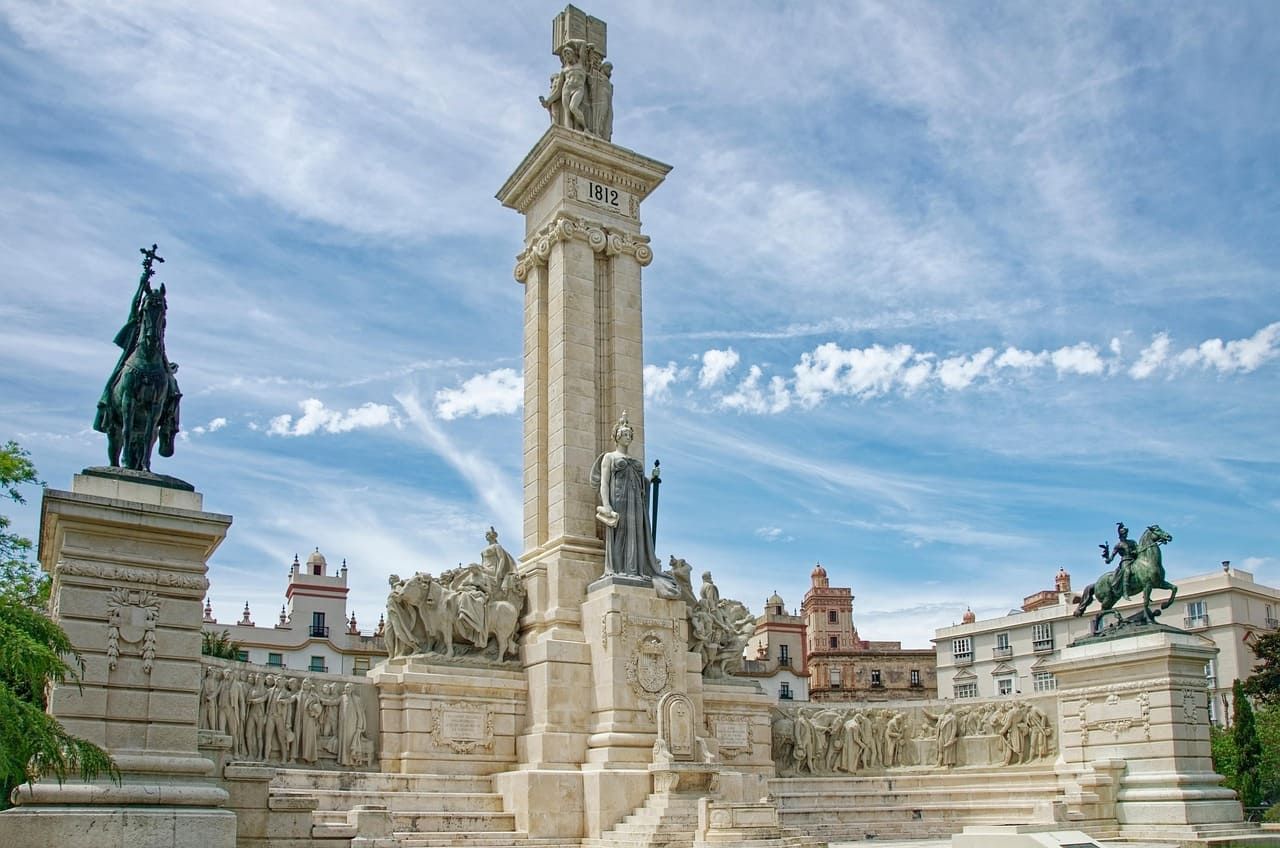
Monumental, open to the port and shaped by the history of Spanish liberalism, Plaza de España is one of Cádiz’s great urban stages. From where you’re standing, at the far end of the square, you’re right in front of the Casa de las Cinco Torres, an elegant eighteenth-century complex recognisable by the five viewpoints punctuating its façade, and just beside it the Casa de las Cuatro Torres mirrors it with its four almost identical lookout towers. In the past, these belvederes allowed merchants to watch for the arrival of trading ships in the bay. If you walk straight across the wide esplanade, you’ll eventually reach the Monument to the Constitution of 1812, the focal point of the square. This vast hemicycle commemorates “La Pepa,” the first Spanish constitution: two bronze horsemen symbolise War and Peace, a tall column bears the allegory of Spain holding the constitutional text, and several sculpted groups depict Cádiz’s resistance to Napoleon and the birth of liberal ideas. If you turn toward the opposite side of the square, the large pink building you see is the former Palacio de la Aduana, now the seat of the Provincial Council, a reminder of the time when this area marked the boundary between the fortified city and the port. Even from this end, the square gives you a clear sense of its scale and its history. As you continue your walk, you’ll discover its central monument and then the opening onto the modern port, where Cádiz naturally links its past to its present.
