© Shutterstock
 Votre guide Ryo
Visiting Christ the Redeemer in Rio: Everything You Need to Know Before Climbing Corcovado (2026)
One glance at the summit of Corcovado is enough to understand why Rio de Janeiro fascinates so many: up there, at 710 meters above sea level, a figure with outstretched arms seems to embrace the entire city. Visiting Christ the Redeemer Rio means discovering a presence that changes the way you perceive urban space, whether you are Catholic, agnostic, or simply curious: it is far more than a statue to tick off a list. Inaugurated in 1931 after nearly ten years of construction, the monument is now one of the Seven Wonders of the World and receives more than 2 million visitors per year. Before you queue for the Corcovado train, here is everything worth knowing: how it was built, what its posture truly means, the best options for getting there, and the time slots to choose to avoid the peak hours. To continue exploring the city after your visit, the audio-guided tour La Cité des Merveilles will guide you through Rio's iconic neighborhoods at your own pace.
Christ the Redeemer by the Numbers: a Statue That Defies Imagination
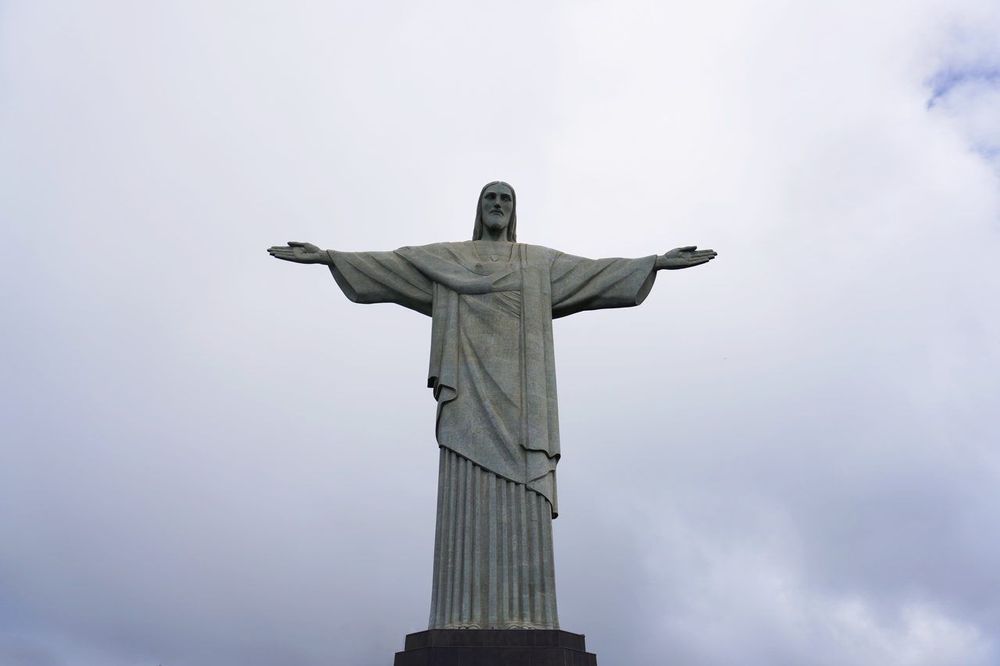
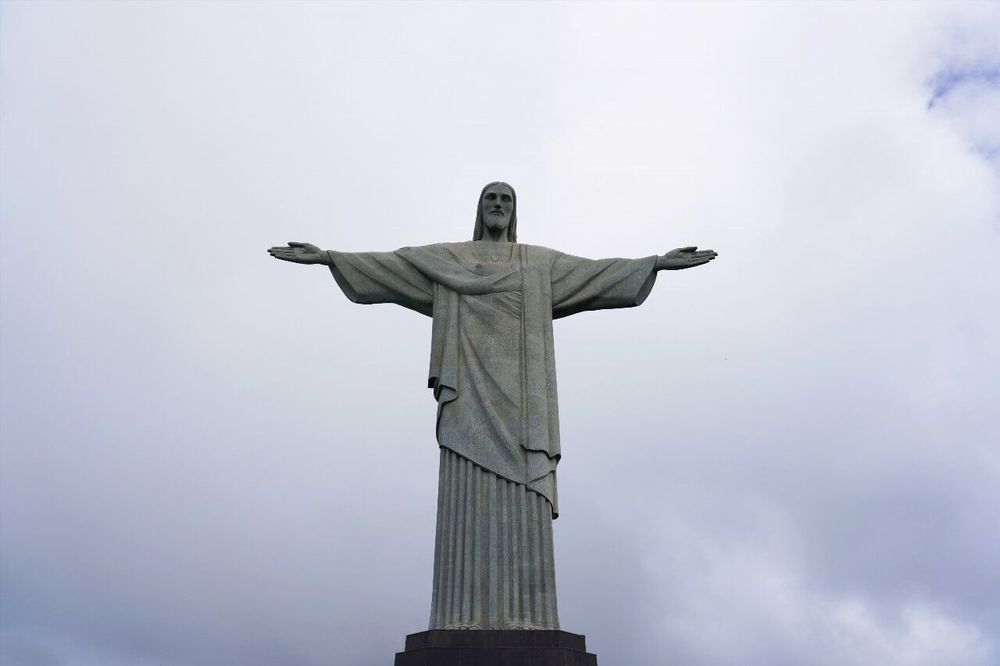
Christ the Redeemer is often described as a symbol, and rightly so, but the raw figures help capture what photographs fail to convey. The statue stands 30 meters tall, not counting the pedestal which adds another 8 meters, for a combined height of 38 meters. The arm span reaches 28 meters: laid flat on the ground, the arms would stretch across nearly the full length of a handball court. The entire structure weighs 635 tons, a significant portion of which comes from the blocks of soapstone, a soft and workable stone, that cover the entire sculpture.
Corcovado itself rises to 710 meters above sea level, within Tijuca National Park, which covers more than 3,200 hectares of Atlantic Forest in the heart of the city. It is one of the largest tropical urban forests in the world: a little-known fact is that the forest surrounding the statue has not only been home to capuchin monkeys and toucans, but has been protected since 1861.
The monument was listed as a Brazilian historical heritage site in 1973, then included on the list of the New Seven Wonders of the World in 2007 following an international vote that gathered more than 100 million ballots. That vote, organized by the New Open World Corporation, was criticized for its unscientific nature, but it had the practical effect of significantly boosting tourist numbers at the site.
Every night, floodlights illuminate the statue from the base of the pedestal, making it visible for dozens of kilometers around. On clear nights, it becomes a nocturnal landmark that Cariocas naturally use to orient themselves, much like the Eiffel Tower in Paris, but with a religious dimension that the metal tower does not share.
History and Construction: How the Statue Came to Be
The idea of erecting a Christian monument on the summit of Corcovado is older than most people realize. As early as 1859, Catholic priest Pedro Maria Boss had proposed placing a statue dedicated to Princess Isabel of Orléans-Bragança on this rocky peak. The project never materialized, and the Proclamation of the Republic in 1889, which brought about the separation of Church and State, made such an initiative even more politically complicated.
It was in 1921 that the movement truly gained momentum. The Archdiocese of Rio de Janeiro launched a public fundraising campaign, called the "Week of Religious Art," to finance the construction of a great Catholic monument to mark the centenary of Brazil's independence (1922). The response was overwhelming: donations poured in from across Brazilian society, from rural parishes to wealthy Rio families.
The design competition, held the same year, ultimately selected the project by Brazilian engineer Heitor da Silva Costa. His initial drawing depicted Christ holding a large globe in one hand and a cross in the other, a more traditional iconography. It was during Costa's trip to Europe to refine the project that the design evolved toward the open-armed posture we know today. This human cross shape, arms spread at shoulder height, was deemed more universal and more recognizable from the city below.
Construction began in 1926. The project lasted five years under technically challenging conditions: access to the summit of Corcovado required transporting all materials via the small cog railway built in 1884, which was requisitioned for the occasion. The internal structure is made of reinforced concrete, a relatively new technology at the time, and the outer cladding consists of soapstone mosaic, assembled by hand by Brazilian craftsmen.
The statue was inaugurated on October 12, 1931 in the presence of President Getúlio Vargas and Cardinal Sebastião Leme da Silveira Cintra. The inauguration was meant to feature a spectacular illumination triggered remotely from Europe via a radio signal, a symbolic gesture of modern technology for a religious statue. The weather had other plans: low clouds obscured the effect, and the floodlights were ultimately switched on by hand. No matter: the assembled crowds were transfixed by the illuminated silhouette emerging from the fog.
Since its inauguration, the statue has weathered the decades without losing its symbolic importance. It has been struck by lightning twice, in 2008 and 2014, without major structural damage, although the 2014 lightning strike, which occurred during the FIFA World Cup, damaged the right thumb and required prompt repair. In 2010, during a major renovation of the site, the pedestal was enlarged to accommodate a chapel and new visitor facilities.
Paul Landowski and Gheorghe Leonida: the Two Sculptors Behind the Work
The creation of Christ the Redeemer is generally attributed solely to Paul Landowski, a French sculptor of Polish origin. His role is indeed real and central, but the history of the sculpture is more complex and less often told.
Paul Landowski (1875–1961) was one of the most celebrated sculptors in France at the beginning of the 20th century. Winner of the Grand Prix de Rome in 1900, he had already created several major public monuments. Heitor da Silva Costa entrusted him with the sculptural design of the work after the two met in Paris. Landowski first worked on plaster and clay maquettes at his studio in Boulogne-Billancourt, on the outskirts of Paris, where he modeled in particular the head and hands, the elements to which he devoted the greatest expressive care. The internal structure was calculated by French engineer Albert Caquot, one of the great names in reinforced concrete of his era.
However, Landowski did not sculpt the statue's final face. That task fell to a lesser-known Romanian sculptor, Gheorghe Leonida (1892–1942), who was studying in Rome at the time. Leonida modeled Christ's face drawing on several sources of inspiration, including, according to some accounts, the face of his own wife, though this anecdote is not confirmed by the archives. The result is a face of particular serenity, slightly tilted forward, designed to be legible from the foot of the hill despite the distance.
The fabrication of the soapstone elements, approximately 6 million small triangular blocks used to clad the statue, was carried out in Brazil itself. This stone, quarried from the local region, is notable for being lightweight, easy to carve, and resistant to tropical climate variations. Each fragment was assembled by hand onto the concrete structure, like a three-dimensional mosaic.
Today, Landowski's Parisian studio in Boulogne-Billancourt has become a municipal museum dedicated to his work. Visitors can see the original maquettes used to design the statue, a striking way to appreciate the gap between the small clay figurine and the 30-meter monument that towers over Rio.
Engineer Heitor da Silva Costa remains the central Brazilian figure of the project: it was he who coordinated the entire construction, adapted the plans to local constraints, and supervised the on-site assembly. Without him, the work conceived in Paris would never have taken the form the world now knows.
The Meaning of Christ the Redeemer: Religious, National, and Cultural Symbol
The posture of Christ, arms open, palms facing downward, head slightly tilted, is anything but accidental. It is simultaneously a gesture of blessing, welcome, and protection. In Catholic iconography, this posture evokes the "Christ the King" who protects and embraces the world. Heitor da Silva Costa had explicitly intended the statue to be visible from the sea, from Guanabara Bay, so that travelers arriving in Brazil would be greeted by this gesture.
For Catholic Brazilians, who still represent a large share of the population according to recent data, the monument remains a place of pilgrimage and ceremony. Masses are celebrated regularly in the chapel located inside the pedestal, dedicated to Nossa Senhora Aparecida, the patron saint of Brazil. Wedding, baptism, and confirmation ceremonies take place there every week.
But the work extends beyond the strictly religious sphere. For Cariocas, the residents of Rio, the statue is above all an urban identity landmark, proof that their city is unique. It embodies that brasilidade that is hard to translate: the pride of a mixed, joyful, and resilient country. When major sporting events occur and the national team wins, Cariocas instinctively gather at the foot of Corcovado.
The political dimension of the monument is less often discussed. It was inaugurated under Getúlio Vargas, an authoritarian president who knew how to use the symbol to legitimize his rule as the symbolic patron of his nationalist regime. This instrumentalization has not erased the popular significance of the statue, but it invites us to read its history with a critical eye.
Beyond Brazil, the statue has become one of the most recognized visual symbols in the world, on a par with the Eiffel Tower or the Statue of Liberty. It appears in thousands of films, advertisements, and works of art, often as a visual shorthand for "Latin America" or "the tropical world."
How to Get to Corcovado: Train, Van, or on Foot
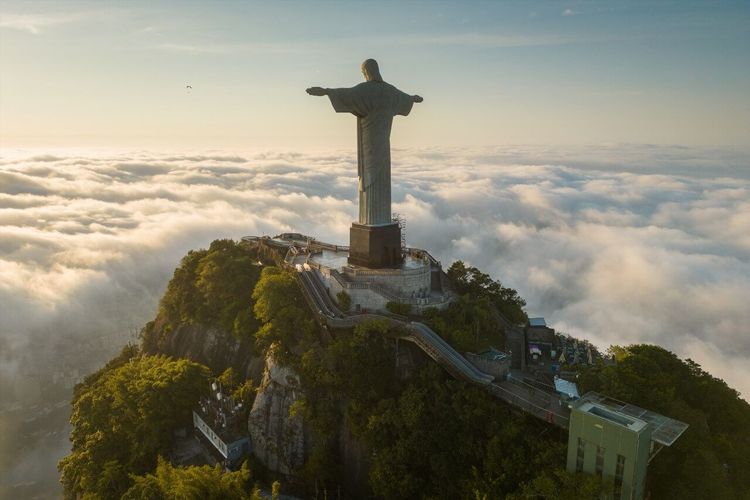
The summit of Corcovado can be reached in three main ways, with notable differences in terms of duration, price, and experience.
The cog railway is the most iconic and most recommended option. Inaugurated in 1884, a full 47 years before the statue itself, this electric train climbs the 3.8 kilometers separating the Cosme Velho neighborhood from the summit in approximately 20 minutes. The ascent through the Atlantic Forest is already spectacular in its own right: the train winds between centuries-old trees, passes wild orchids, and offers glimpses of the city below even before reaching the top. Tickets include site access and cost around R$ 134 for an adult in 2026 (approximately €22), with the round-trip journey included. The departure station, Cosme Velho, is about 30–40 minutes from the city center by taxi or Uber.
The official Paineiras-Corcovado vans departing from several points around the city (notably Largo do Machado and Praça Mauá) are a practical alternative for visitors staying far from Cosme Velho. These vans travel along a forest road accessible to vehicles and drop passengers at the Paineiras complex, from where a shuttle leads to the foot of the statue. The fare is close to that of the train and includes the round trip from your departure point in the neighborhood.
Walking up is possible but rarely recommended for ordinary visitors. The best-known trail starts from Parque Lage and passes through a steep forested area where security incidents have been reported. This option is mainly used by experienced hikers accompanied by local guides, early in the morning, in groups. If you want to walk, opt instead for the partial ascent from the Paineiras complex (accessible by van), which reserves the final stretch for those with willing legs.
Whatever transport option you choose, booking in advance is strongly advised for morning time slots, which are in high demand. The official online ticketing system allows you to reserve a departure time, avoiding queues that can exceed two hours in peak season. To plan your day in Rio more broadly, the Ryo article things to do in Rio de Janeiro and surroundings lists other visit ideas to combine with Corcovado.
Once at the summit, escalators and a ramp make the ascent from the train station to the base of the statue easier, including for visitors with reduced mobility. Access is therefore generally straightforward, although some panoramic terraces require climbing a few steps.
On-Site: What You Will See at the Summit of Corcovado
Arriving at the summit of Corcovado after about twenty minutes on the train through the forest produces a threshold effect that is hard to anticipate. You step off the carriage into a different light, the air noticeably cooler at a hundred meters higher, and the silhouette of the statue appears immediately overhead, larger than you imagined from the city below.
The plaza around the statue is organized across several levels. The lower level houses the ticket office, souvenir shops, and restaurants. An escalator or ramp leads up to the main platform, positioned at the foot of the statue, about 6 meters above the plaza. This is where the classic photos are taken: the statue seen head-on, arms open with the city panorama behind you. This terrace is often packed between 10 a.m. and 2 p.m.
The Nossa Senhora Aparecida chapel, built inside the pedestal during the 2006 renovation, can be visited free of charge. Small and understated, it hosts several religious ceremonies each week, a dimension often overlooked by hurried visitors who stop only at the outer platform. Access is via a side door in the pedestal; check with staff for free-visit opening hours.
From the upper platform, the eye takes in a 360° view over Rio and its surroundings. Sugarloaf Mountain is visible to the east, Lagoa Rodrigo de Freitas to the south, Santos Dumont Airport and Guanabara Bay to the north. On very clear days, the beaches of Copacabana and Ipanema are visible along the Atlantic coastline. The rising sun, in the early morning hours, tints the panorama in orange and pink, which is why arriving at opening time, at 8 a.m., is so worthwhile.
The immediate surroundings of the site also deserve a detour. Tijuca National Park, which spreads out below Corcovado, offers several marked trails accessible without a guide. The Floresta da Tijuca is home to waterfalls, natural pools, and forest wildlife, including howler monkeys, toucans, and hummingbirds, that contrast strikingly with the urban density of Rio visible just a few hundred meters below. If you arrive by van, ask the driver to drop you slightly earlier so you can walk the last portion of the forest path.
To continue exploring the city after your visit, the Ryo audio guide La Cité des Merveilles extends the experience through the streets of Rio, Santa Teresa, Lapa, the historic center, with contextual stories about the city that complement the sweeping view taken in from the summit.
The Panoramic View over Rio: What the Vista Reveals
The view from Corcovado is one of the most complex and instructive on offer, not because it is the highest point in Rio (Sugarloaf Mountain is closer to the sea and offers a different perspective), but because it provides a continental panorama: forest, city, bay, ocean, and mountain all within a single visual plane.
From the platform, Rio's singular geography becomes immediately clear. The city developed in the gaps between mountain and sea, squeezed between the forested massif of Corcovado and the Serra da Carioca on one side, and Guanabara Bay and the Atlantic Ocean on the other. This geographical constraint explains the intense urban density of neighborhoods such as Botafogo, Flamengo, and Laranjeiras, visible directly below.
To the left (toward the northeast), Guanabara Bay opens onto the horizon, dotted with islands and bridges. The Rio–Niterói Bridge, stretching 13 kilometers, is visible on clear days as a straight line drawn across the water. Further still, the mountains of the Serra dos Órgãos form a bluish backdrop that is a reminder that Brazil is above all a country of vast nature.
To the right (toward the south) lies Lagoa Rodrigo de Freitas, surrounded by the upscale residential neighborhoods of Leblon and Ipanema. The beaches are visible from the terrace, but without a telescope they appear more as pale strips between the buildings and the water. It is from Sugarloaf Mountain that the view of Copacabana is sharper.
The nocturnal panorama, for those who can stay until closing time or join an organized night visit, is of a particular beauty: the illuminated city sprawls in every direction, the reflection of lights on Guanabara Bay creates a mirror effect, and the silhouette of Sugarloaf Mountain stands out in black against the city sky. These night visits are offered by certain tour operators; they are not organized directly by the Corcovado site. The next day, our Rio audio-guided tour picks the city up at street level, from Praça XV to the Municipal Theatre.
Tickets, Prices, and Booking: Everything You Need to Know in 2026
The official ticketing is managed by Trem do Corcovado (R. Cosme Velho, 513 - Cosme Velho, Rio de Janeiro - RJ, 22241-090, rated 4.1/5 on Google based on 1,205 reviews), the site's concession operator. All tickets, whether for the cog railway or the vans, must be purchased through the official website tremdocorcovado.rio, or in person at the Cosme Velho station.
2026 prices (indicative, subject to seasonal variation):
- Adult: R$ 134 (approximately €22) for the round-trip train journey and site access
- Child (ages 7 to 11): reduced rate at R$ 107 (approximately €18)
- Child up to age 6: free entry, upon presentation of supporting documentation and when seated on an adult's lap
- Reduced rates: R$ 70 for Brazilian seniors aged 60 and over; half-price also available for students and ID Jovem cardholders with supporting documentation
Tickets are sold with a scheduled departure time slot for the train. Once at the summit, you may stay as long as you wish: there is no time limit on-site. The return journey is made on the first available train after your visit.
Note: during peak tourist season (July–August, Carnival, Christmas, New Year), morning time slots can be sold out several days in advance. Booking two to four days ahead is recommended for these periods. For the rest of the year, booking 24 to 48 hours in advance is generally sufficient.
If you wish to access the site outside standard time slots, "sunrise" tickets are available, with very early departures, sold as part of organized tours. These tickets are more expensive but allow you to enjoy the site while it is still quiet and benefit from exceptional photographic light.
The Corcovado train runs Monday to Friday from 8 a.m. to 5 p.m., and Saturdays and Sundays until 6 p.m. Brazilian public holidays and major religious dates may cause schedule changes: check the official website before you go.
There is no official combined ticket with other Rio attractions (Sugarloaf Mountain, Museu do Amanhã, etc.). Each attraction is purchased separately. If you are visiting several sites in one day, Uber or ride-hailing apps are often the most efficient way to travel between them.
When to Go: Weather, Crowds, and Time Slots
Rio de Janeiro has a humid tropical climate characterized by two distinct seasons: a dry season from May to September and a wet season from October to March. This distinction has direct consequences for the quality of a visit to Corcovado.
The dry season (May to September) is generally recommended for visibility reasons. Mornings are often clear, temperatures remain between 20 and 28°C, and the likelihood of arriving at the summit to find the statue shrouded in clouds is at its lowest for the year. July and August also coincide with peak tourist season, so the site is very busy, but the weather delivers.
The wet season (October to March) is more unpredictable. Afternoons are often disrupted by short but intense storms, and low clouds or fog can completely obscure the statue from below, as well as the panoramic view from the top. Carnival (in February or March depending on the year) draws millions of visitors to Rio, and footfall at the site surges. If you are visiting during this period, arrive at opening time or book a very early morning visit.
The ideal time slot, whatever the season, is between 8 a.m. and 10 a.m. The morning light is superb for photography, crowds are far thinner than at midday, and the chance of finding a clear sky is at its highest. From 11 a.m. onward, the site fills up quickly, and the queues for escalators and well-positioned selfies can turn the visit into a frustrating experience.
A lesser-known tip: weekdays are consistently less crowded than weekends, even in high season. A Tuesday or Wednesday morning in July offers a very different experience from a Saturday during the same period. If your schedule allows, plan your visit mid-week.
For real-time weather, the Clima Tempo app is reliable for Rio and provides hour-by-hour forecasts that are useful for anticipating late-afternoon storms. If the summit is in the clouds when you arrive, the fog often lifts within an hour: the Atlantic Forest plays with the clouds in unpredictable ways.
Christ the Redeemer in Global Popular Culture
Few monuments have colonized the global collective imagination so thoroughly in so short a time. Since the 1980s, the image of Christ the Redeemer has appeared in films, TV series, video games, and advertisements at a rate of several dozen times per year.
In cinema, the statue is perhaps the most widely used geographic marker: one shot of the monument and the viewer immediately knows they are in Rio. It appears in productions as varied as Fast & Furious 5 (2011), the animated film Rio (2011), and countless documentaries about Latin America. It also appears in more political contexts, used in satirical photomontages, artistic manifestos, and international communication campaigns.
In the world of video games, Corcovado and its statue have been recreated in Grand Theft Auto V (the fictional city of Los Santos borrows several real-world landmarks of this type), in Tropico, and in several editions of FIFA, which regularly use the Corcovado view to introduce matches played in Rio.
The statue has also inspired a long series of replicas and architectural tributes around the world, a testament to its unique status in the planet's visual imagination.
On social media, Christ the Redeemer is one of the most photographed and tagged monuments in the world, with millions of geolocated Instagram posts every year. Curiously, the most viral photos are not all taken from the summit: some of the most memorable images are portraits shot from Ipanema beach or from Guanabara Bay, where the statue appears miniaturized by distance but instantly recognizable among all the world's monuments.
Replicas of Christ the Redeemer Around the World
The worldwide success of the original statue has generated a long list of replicas, more or less faithful, erected in all corners of the globe. Some are simple tourist tributes; others have a pronounced religious dimension.
The tallest stands in Świebodzin, Poland: consecrated in late 2010, the Christ the King statue reaches 36 meters including the crown (33 meters for the figure and 3 meters for the gilded crown), making it the tallest statue of Christ in the world, roughly 3 meters taller than the Brazilian original. It was built at the initiative of a local priest and funded by parishioners' donations, just like the original, nearly 80 years earlier. Another notable replica stands in Cochabamba, Bolivia (the Cristo de la Concordia, 34 meters, inaugurated in 1994).
In Europe, replicas can be found in Lisbon (Santuário de Cristo Rei (Av. Cristo Rei, 2840-014 Almada, Portugal, rated 4.6/5 on Google based on 46,024 reviews), inaugurated in 1959 and directly inspired by Christ the Redeemer following the visit of the Patriarch of Lisbon to Rio), as well as at Tibidabo, near Barcelona, where an open-armed Sacred Heart statue overlooks the amusement park and the city. Beyond Europe, examples can be found in Italy, Indonesia, and Vietnam.
Beyond strict replicas, the open-armed posture has become an independent sculptural archetype, reproduced in dozens of cultural and religious contexts. The visual influence of Christ the Redeemer extends far beyond the boundaries of Catholicism: the posture is now used as an icon of peace, openness, or welcome in entirely secular contexts.
FAQ
Who built Christ the Redeemer in Rio?
The construction of Christ the Redeemer was a collective endeavor. The architectural and structural project was conceived by Brazilian engineer Heitor da Silva Costa, who supervised the entire construction from 1926 to 1931, with the internal structure calculated by French engineer Albert Caquot. The sculptural design of the statue, particularly the body and hands, was entrusted to French sculptor of Polish origin Paul Landowski, who worked from his studio in Boulogne-Billancourt in Paris. The face of the statue was modeled separately by Romanian sculptor Gheorghe Leonida. The project was funded by the Brazilian Catholic Church through a public fundraising campaign launched in 1921 by the Archdiocese of Rio de Janeiro.
How Tall Is Christ the Redeemer?
The statue itself stands 30 meters tall. It rests on an 8-meter pedestal, bringing the total to 38 meters above the summit of Corcovado. The arm span is 28 meters and the statue weighs 635 tons. Mount Corcovado, on which it stands, rises to 710 meters above sea level.
What Is the Real Name of Christ the Redeemer?
The official name in Portuguese is "Cristo Redentor", which translates exactly as "Christ the Redeemer." It is also sometimes called "O Cristo" (The Christ) or "O Corcovado" in popular Carioca speech, by metonymy with the name of the mount on which it stands. There is no other official or historical name for the statue: "Cristo Rei" (Christ the King) is a distinct designation that applies to other statues in the Catholic world.
When Was Christ the Redeemer Inaugurated?
Christ the Redeemer was inaugurated on October 12, 1931, in the presence of President Getúlio Vargas and Cardinal Sebastião Leme da Silveira Cintra. Construction had begun in 1926, following a fundraising campaign launched in 1921 by the Archdiocese of Rio to celebrate the centenary of Brazil's independence. The original project dates back even further: the first proposals to erect a religious monument on Corcovado date from 1859.
How Do You Get to Christ the Redeemer from Downtown Rio?
The most recommended option is the cog railway from the Cosme Velho station. To reach Cosme Velho from downtown, allow 30–40 minutes by taxi or Uber. The train ride takes about twenty minutes and the ticket includes site access (R$ 134 for an adult in 2026). Official vans departing from several points around the city (Largo do Machado, Praça Mauá) are a practical alternative, especially for visitors not staying near Cosme Velho. Walking up is not recommended without a local guide.
Should You Book in Advance to Visit Christ the Redeemer?
Yes, advance booking is strongly recommended. During peak season (July–August, Carnival, Brazilian school holidays), morning time slots can sell out several days ahead. Booking is done through the official website tremdocorcovado.rio. Outside peak periods, booking 24 to 48 hours in advance is generally sufficient. Tickets include a scheduled departure time for the train.
What Time Is Best to Visit to Avoid the Crowds?
The ideal time slot is right at opening at 8 a.m., until around 10 a.m. Crowds grow quickly from 11 a.m. onward and the site can become very busy between 11 a.m. and 3 p.m. Weekdays are consistently less crowded than weekends. For photography, the morning light, especially during the dry season, is also the most beautiful: it illuminates the face of the statue rather than backlighting it as in the afternoon.
Conclusion
Christ the Redeemer stands as a singular architectural object, born of an international collaboration in the 1920s, steeped in complex political and religious history, and transformed over the decades into one of the most powerful visual symbols in the world. Climbing Corcovado means understanding Rio differently: its relationship to the mountain, the forest, the sea, and that tenacious joie de vivre the city displays even in its most difficult moments.
To continue exploring Rio with the same level of detail, our audio walking tour La Cité des Merveilles guides you through the city's neighborhoods with in-depth stories about its history, architecture, and people: the best way to build on what the view from Corcovado began to tell you.