© Shutterstock
 Votre guide Ryo
Basilica Notre-Dame de Fourvière in Lyon: Complete Guide to Visiting in 2026
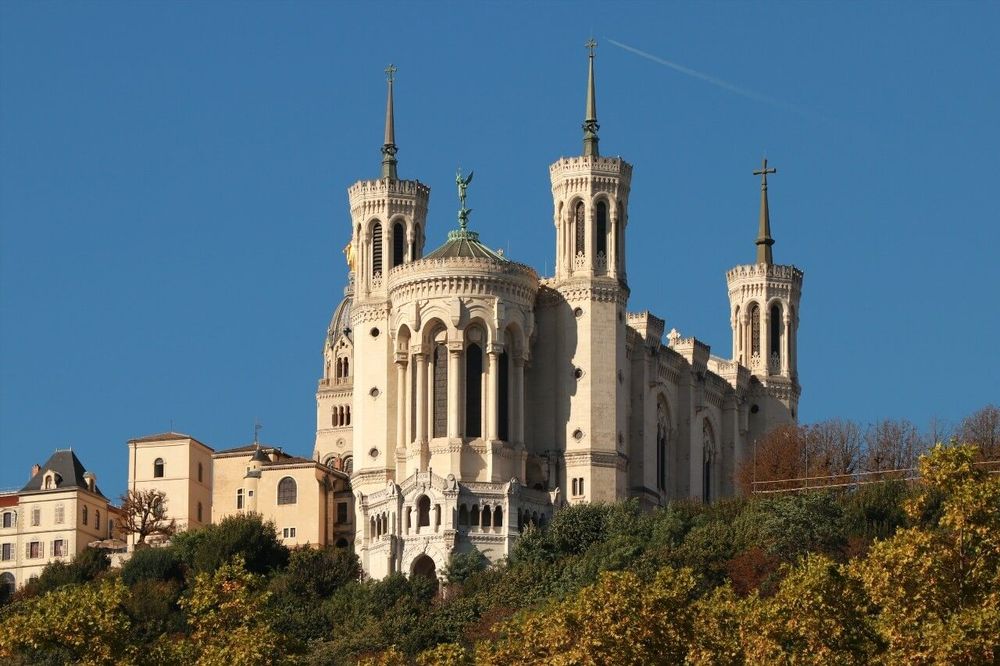
Many search for it under the name Fourvière Cathedral, but this monument that the people of Lyon eventually came to call "the folly of Fourvière" is in reality a neo-Byzantine basilica, rising from the flank of a Roman hill, visible from almost any point in the city, its four towers dominating a metropolis of nearly two million inhabitants. It is therefore not a cathedral in the canonical sense, even though everyone calls it that: it is a votive building constructed by a city that had vowed, in 1870, to give thanks to the Virgin if Lyon were spared from the Prussian invasion. The promise was kept, and the result far exceeds anything imagined when it was made.
This guide gives you everything you need to know before pushing open the doors of Fourvière: the surprising history of the vow and architect Bossan, the details not to be missed in the mosaics (there are Indian elephants in a Catholic nave), the exact opening hours, the price of the tower tour with its panorama of the Alps, the options for climbing up from Vieux-Lyon, and the time slots when the basilica regains its silence. Whether you type "Fourvière Cathedral" or "Fourvière Basilica" into your search engine, it is indeed the same place, and everything that follows concerns you. For visitors who want to explore Lyon beyond Fourvière, the Ryo app offers a complete audio-guided tour of Vieux-Lyon and the hill.
History of the Basilica Notre-Dame de Fourvière: Birth of a Vow
The history of the Fourvière Basilica cannot be explained without the war. In July 1870, France declared war on Prussia. Within weeks, the French armies collapsed, Napoleon III was captured at Sedan, and Paris was besieged. Lyon was in a state of complete uncertainty. On December 8, 1870, Cardinal Ginoulhiac and a group of the faithful climbed to the original chapel on the hill and made a solemn vow: if Lyon were spared and France recovered, they would build a basilica dedicated to the Virgin on this hill.
Lyon was indeed spared by the Prussians. The vow committed the city for the fifty years that followed.
The Fourvière commission, tasked with carrying the project forward, chose in 1872 the architect Pierre Bossan, a native of Lyon whose mystical temperament and deep religious convictions matched exactly the ambition of the project. Bossan was not a practitioner of the comfortable eclecticism that then dominated French architecture. He had been thinking for years about what a truly Christian architecture should look like — neither medieval Gothic nor Roman Baroque, but a new synthesis drawing from Byzantium, Romanesque art, and Eastern cathedrals. Fourvière would be his masterpiece.
Construction began in 1872 and would not be completed until 1884 for the main structure, before the interior decoration kept craftsmen busy for another two decades. His health declining, Bossan supervised part of the construction from a distance and delegated execution to his collaborator. He died in 1888 without seeing his work fully completed. It was Louis Sainte-Marie Perrin who took over the project and brought most of the decoration to completion.
The foundation stone was laid at the bottom of the foundations on November 8, 1872. The consecration of the Fourvière Basilica took place on June 16, 1896, twenty-six years after the original vow.
The building was elevated to the rank of minor basilica by Pope Leo XIII on March 16, 1897, less than a year after the consecration — a recognition of the spiritual importance and already considerable attendance at the site. It is this title, and not that of cathedral, that officially defines Fourvière.
During the First World War, the vow of 1870 resonated once again. Mass pilgrimages took place at Fourvière throughout the duration of the conflict. After the armistice, a new wave of gratitude flowed toward the hill, reinforcing the bond between the basilica and Lyonnais identity.
It is important to understand that Fourvière has never been a cathedral in the canonical sense of the term. The cathedral of Lyon, the episcopal seat, is the Saint-Jean-Baptiste Cathedral (the Primatial Saint-Jean), in Vieux-Lyon at the foot of the hill. Fourvière is a devotional basilica, a place of pilgrimage. The confusion between cathedral and Fourvière Basilica stems from its size, its dominant position, and its symbolic role in the city. The people of Lyon themselves sometimes call it "the cathedral of the hill", which says something about how they experience it.
Today, Fourvière welcomes more than 2.5 million visitors and pilgrims per year, making it one of the most visited religious sites in France. On December 8, for the Fête des Lumières, hundreds of thousands of people climb the hill with their small candles — a tradition of which Fourvière is the beating heart.
Exterior Architecture: The Four Towers and Façades
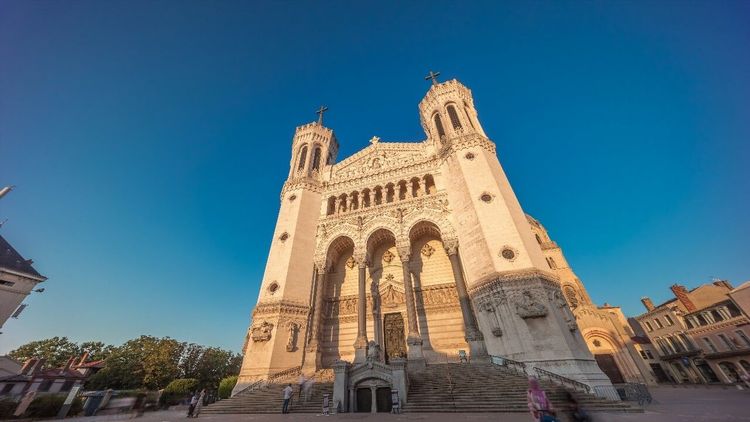
Seen from the banks of the Saône or from the Presqu'île, the silhouette of Fourvière is immediately recognizable: four square towers topped with bulbous roofs, a façade adorned with two statues of the archangel Gabriel and the Virgin, and a terrace open to the city. The first impression is that of a fortress — Bossan himself described his building as a "fortress of God".
The four corner towers are the most striking element of the silhouette. They are not purely decorative: two of them (the north towers) provide access to a panoramic terrace. Their architecture blends references deliberately — the bases are Romanesque, while the bulbous tops draw inspiration from Byzantine architecture and even certain Near Eastern buildings that Bossan had studied during his travels in Italy and Sicily.
The main façade, facing east, is built from white Savonnières limestone (from the Meuse region), chosen for its luminous contrast with the sky and its resistance to the elements. This whiteness contributes to the "folly" effect the basilica produces on the city, especially at night when it is illuminated.
At the top of the façade, two large exterior mosaics depict biblical scenes. They foreshadow what awaits inside, but their scale remains accessible from the terrace. Look at the details: the golden glass tesserae, laid at slightly different angles to catch the light from various directions.
The statue of the Virgin crowning the main bell tower stands 5.60 meters tall and weighs more than three tons. It was crafted in repoussé copper and gilded with gold leaf. It is she that the people of Lyon see shining from their windows at dusk, and it is toward her that all eyes converge on December 8, when the entire city is lit up.
The terrace accessible from the esplanade is a viewpoint in its own right. The view extends across Lyon to the hills of the Ain and, on clear days, all the way to the Alps. On fine winter or spring days, it is not uncommon to glimpse Mont Blanc — an experience that local guides mention with quiet pride. It is from this terrace that photographers capture the most spectacular Lyon skylines.
On the north side of the esplanade, a metal scale model represents the floor plan of the basilica with its exact proportions, designed for visually impaired visitors but useful for everyone: it allows you to understand the layout of the volumes before going inside.
Take the time to walk all the way around the building before entering. The south side façade features sculptures less known to tourists but carefully crafted. The apse on the west side reveals the buttresses that stabilize the interior vaults — a structure that shows the structural complexity hidden behind the apparent massiveness of the building.
The Nave and Mosaics: A Décor That Overwhelms
Push open the main door and pause for a moment to let your eyes adjust. What awaits you inside Fourvière is one of the most intense visual experiences that French religious architecture can offer — and that is a statement that holds even when compared to the Sainte-Chapelle or the Sacré-Cœur.
The total surface area of the mosaics covers nearly 5,500 m², spread across the nave walls, the dome pendentives, and the side apses. They were produced mainly by the Guilbert-Martin workshop of Lyon, from designs created by several artists. The work spanned more than forty years of tessera-laying.
The main nave is devoted to the story of the Virgin Mary. The cycle begins in the choir with the Annunciation and unfolds toward the façade, following Mary's life from her birth to her Assumption. Each panel is an autonomous composition, but together they form a coherent narrative readable from ground level.
What surprises you first is the color palette. Unlike classic Byzantine mosaics that favor gold and deep blues, Fourvière uses an extended range: greens, ochres, reds, as well as almost raw whites and strong blacks. The natural light, filtered through bullseye glass rather than traditional painted stained glass, causes these colors to shift throughout the day.
The side aisles are dedicated to different themes: the north aisle traces the Virgin's interventions in the history of France (Joan of Arc features prominently), while the south aisle illustrates episodes from the Old Testament. It is in these side aisles that the most unexpected details are hidden.
Among them, the elephants. In the mosaic depicting the entry of Jesus into Jerusalem (north aisle), two Indian elephants appear in the crowd — an iconographic liberty intended to emphasize the universal dimension of the Christian message. This detail is almost always mentioned by local guides, and for good reason: it forces the visitor to truly look, rather than sweeping the whole with a single glance.
The domes are the most impressive spaces in the basilica. The crossing of the transept is topped by an octagonal dome whose pendentives represent the four evangelists. From ground level, the sense of height is amplified by the play of golden tesserae capturing and redistributing light according to the orientation of each tile — a technique inherited from the Byzantine masters of Ravenna and Constantinople.
In the choir, behind the main altar, the Assumption mosaic is the largest single piece in the entire ensemble. It depicts Mary ascending to heaven surrounded by angels with intensely blue wings. It is the most frequently photographed composition in the basilica, which explains the crowd that gathers in front of the choir gates during peak hours.
If you visit with raking light (early morning or late afternoon), you will notice something particular: certain areas of mosaic seem to "vibrate" slightly due to the micro-inclinations of the tesserae. This is not an illusion — it is the result of very precise calculation by the craftsmen, who adjusted the angle of each piece to maximize this kinetic effect.
The Crypt: The Overlooked Heart of Fourvière
The majority of visitors do not go down into the crypt. This is a mistake. Whereas the upper basilica is a triumph of decorative excess, the crypt offers exactly the opposite: a sober, vaulted space for contemplation where the stone remains visible and ornamentation is reduced to the essential.
The Saint-Joseph Crypt occupies the entire lower level of the basilica, an area comparable in size to a medium-sized church. It served as the main place of worship throughout the construction of the upper level, even before the consecration of the upper basilica.
The architecture of the crypt deliberately contrasts with that of the upper level. The vaults are Romanesque, low and massive, supported by stocky cut-stone pillars. No flamboyant mosaics here: the surfaces are clad in polychrome marbles of restrained palette (beige, Languedoc red, Pyrenean green) and a few modestly sized murals.
The high altar of the crypt is dedicated to Saint Joseph. The central statue, in white marble, is the work of the Lyonnais sculptor Joseph Fabisch — the same artist who created the statue of the Virgin at the grotto of Lourdes. This detail creates a powerful symbolic link between the two great Marian pilgrimage sites of France.
In the side chapels of the crypt, several stained-glass windows are worth attention. Unlike those of the upper basilica (non-figurative bullseye glass), these windows are narrative and colorful — a choice that reinforces the sense of intimacy in the space. The Soldiers' Chapel on the left retains ex-votos connected to the two World Wars: engraved marble plaques, military medals, framed photographs.
The crypt is also the quietest spot in the entire site, even during peak visiting hours. Its thick stones absorb sound. In summer, the temperature there is naturally cool — several degrees below that of the upper basilica.
Access to the crypt is via an interior staircase from the narthex of the basilica. Entry is free of charge, as is entry to the basilica itself.
The Original Chapel and the Maison de Marie
Before the basilica, there was the chapel. And before the chapel, there was a statue.
The original chapel Notre-Dame (8 Place de Fourvière, 69005 Lyon, rated 4.8/5 on Google with 39,789 reviews) is the original building that stood on the hill before Bossan's construction. This is where the people of Lyon came on pilgrimage since the Middle Ages, and where the vow of 1870 was pronounced. The original chapel is attached to the left flank of the basilica and remains an active place of worship, distinct and independent from the great basilica.
The current structure dates mainly from the 17th century, but rests on much older foundations. An early oratory existed on this site as far back as the Middle Ages, linked to a Marian cult already well established in the Lyon region. The chapel was enlarged and modified several times over the centuries, under the impetus of the canons of Lyon.
Inside, the atmosphere is radically different from that of the neighboring basilica. The walls are covered with ex-votos — thousands of plaques, paintings, medals, and various objects left by pilgrims in thanksgiving for graces received. This accumulation of testimonies spanning several centuries creates an emotional density that is difficult to convey. Some ex-votos date from the 17th century and depict scenes of shipwrecks, healed illnesses, or survived battles.
The statue of the Virgin venerated in the chapel — the central object of devotion — is an ancient sculpture, dressed in an embroidered cloth mantle regularly renewed by associations of pilgrims. The tradition of pilgrimage to this Virgin predates the construction of the great basilica by several centuries.
The Maison de Marie, adjacent to the chapel, houses the pilgrims' welcome services, a religious bookshop, and meeting rooms. This is where spiritual retreats and training sessions for pilgrimage groups are organized. It is not open to standard tourist visits, but individual visitors may enter freely during opening hours.
The North Tower and the Panorama over Lyon
While visiting the Fourvière Basilica is free, the north tower is its only paid activity — and if you can only choose one, this is the one. The panorama from this vantage point is truly exceptional, and it offers a perspective on the basilica itself, seen from inside its own roof space, that no other visit provides.
The north tower visit is organized as a guided tour only, with regular departures depending on the season. The guide takes you through the attic spaces of the basilica — a world of timber framing, dressed stone, and riveted metal that the general public never sees — before emerging onto the summit terrace, perched well above the level of the Saône.
From this terrace, the view reaches in every direction. To the east, the Presqu'île of Lyon and its riverbanks stretch to the Rhône-Saône confluence. To the north, the hills of the Ain and, on clear days, the first foothills of the Jura. To the south, the Rhône corridor and the Beaujolais hills. To the west, the hills of the Lyonnais, and on certain winter mornings, the Alps with Mont Blanc in the background.
The visit also includes a climb into the bell tower, where the basilica's bells are visible. Guides explain the clockwork mechanism and the use of the bells in Fourvière's liturgy.
A detail few visitors know before going up: from the attic, it is possible to get a close look at the metal armatures that support the large nave mosaics. Bossan, as much engineer as architect, had designed wrought-iron structures to hold the mosaic panels without requiring major restoration in the short term.
The price of the guided north tower tour is in the range of €6 to €8 per adult (reduced rate for under-18s and students), for a duration of approximately 50 minutes. It is strongly advised to book online on the official website fourviere.org during high season (May–September), as groups are limited to around ten people per departure.
Physically, the visit involves fairly steep spiral staircases. It is not accessible to people with reduced mobility. Wear closed-toe shoes, as the attic spaces are unheated in winter.
The Museums and Treasures of Fourvière
The Fourvière site includes several museum spaces that complement a visit to the basilica. They are less frequented than the basilica itself, making them havens of calm to explore after the crowds of the nave.
The Musée d'Art Sacré de Fourvière (8 Place de Fourvière, 69005 Lyon, rated 4.2/5 on Google with 105 reviews), housed in the site's buildings, holds a collection of liturgical objects spanning several centuries. Religious goldsmithery, altar textiles, wooden and ivory sculptures, illuminated manuscripts — the collection reflects the wealth of donations made to Fourvière since the 17th century. Some pieces of 18th-century goldwork are of the highest order and would deserve a place in a national decorative arts museum.
The Museum Space presents the history of the basilica's construction through scale models, original architectural drawings, and construction tools. Bossan's drawings on display here are particularly valuable: they show how the architect conceived the interior space as a succession of "tableaux" that the faithful would pass through as they walked from the entrance to the choir. The narrative logic of the mosaic ensemble is clearly explained here.
The Fourvière Treasury brings together the most precious pieces donated to the basilica since its founding: gold and silver monstrances, processional crosses, reliquaries, embroidered liturgical vestments. Among the remarkable pieces, a votive crown offered by the city of Lyon at the end of the 19th century, and several 19th-century reliquaries of exceptional craftsmanship.
The museums are accessible from the esplanade. Prices vary: some spaces are included in the tower visit ticket, while others are free to enter. Check on-site for the specific opening hours of each space, as they may differ from those of the main basilica.
For art history enthusiasts, the Maison de Marie bookshop sells specialist publications on Fourvière's architecture and mosaics, some published by the site's own services and unavailable in general bookshops.
The Parc des Hauteurs and the Surroundings of Fourvière
Fourvière is more than a basilica. The hill that hosts it forms, together with the Croix-Rousse hill, one of Lyon's two historic hills, and the area around the basilica offers enough richness to justify an entire half-day.
The Parc des Hauteurs is a network of pedestrian pathways linking the two hills along a route that passes through gardens, footbridges, planted promenades, and successive viewpoints. This linear park was developed by the City of Lyon and is now one of the most appreciated green spaces among the people of Lyon — and one of the least frequented by tourists. Access is entirely free.
From the Fourvière esplanade, the park heads north toward the metal tower, an iron structure from the 19th century. The tower is not open to visitors but remains a strong visual landmark from the lower city. It is often confused with the Eiffel Tower by visitors unfamiliar with Lyon, which greatly amuses the locals.
Still on the hill, the Gallo-Roman theater (Odeon and Grand Theater) is located a few hundred meters to the southwest of the basilica. These two theaters are among the best preserved in the western Roman Empire. The Grand Theater accommodates several thousand spectators and is still used for concerts and performances in summer as part of the Nuits de Fourvière festival. The Musée Gallo-Romain de Fourvière, adjacent to the theaters, is one of the finest Roman archaeology museums in France.
Heading back down toward Vieux-Lyon through the traboules (covered passageways characteristic of Lyon's architecture), you pass through medieval courtyards and corridors, some of which open directly onto the banks of the Saône. The traboule of the Chemin du Rosaire, which descends from the basilica toward the rue Cléberg, is one of the most picturesque and least crowded.
The Saint-Georges neighborhood at the foot of the hill on the Saône side deserves a stop: its winding streets, traditional bouchon restaurants, and craftsmen's workshops are a natural extension of a Fourvière visit. Our audio-guided tour of Lyon follows the same descent, from the basilica down towards the Saône.
How to Get up to Fourvière: Funicular, on Foot, by Car
Fourvière has to be earned. The hill rises to over 300 meters above sea level and there is no effortless way to reach it — unless you take the funicular, which we strongly recommend for the journey up if you are carrying a bag or traveling with family.
The Funicular
This is the simplest, fastest, and most iconic option. Lyon's two funicular lines departing from the Vieux-Lyon station (metro line D) serve Fourvière (basilica) and Saint-Just respectively. Take the "Fourvière" line; you arrive directly on the esplanade in 2 to 3 minutes.
The funicular is integrated into the Lyon public transport network TCL. A standard ticket is valid, as is the Liberté pass or a book of tickets. The single fare is approximately €1.90 in 2026 (check on tcl.fr). Holders of a multi-day TCL pass can use it at no extra cost — the most economical option for visitors spending several days in Lyon.
The funicular generally operates from 5:30 AM to 10:30 PM (hours subject to change; check on tcl.fr). It can be crowded in late morning and early afternoon on busy tourist days (July–August, December 8).
Walking up
Walking up is recommended for the return journey or for those who want to immerse themselves in the atmosphere of Vieux-Lyon. Several paths are available.
The most popular is the Chemin du Rosaire from the rue Saint-Georges, a stone stairway lined with vegetation and calvaries that takes 15 to 20 minutes for a normal walker. It is a place of quiet reflection as much as a practical access route.
The montée des Chazeaux from the quai Fulchiron is more direct but steeper. It reaches the esplanade in approximately 20 minutes.
A third option, less well known, passes through the terraced Rosaire gardens, a public park planted with roses and trimmed shrubs offering successive viewpoints over Vieux-Lyon and the Saône. Access is from the montée Nicolas de Lange.
By Car
Driving to the Fourvière esplanade is possible via the rue du Cardinal Gerlier from the north, or via the rue Roger Radisson on the A6/A7 side. A paid car park is located a few dozen meters from the esplanade. Expect around €1.50 to €2 per hour. Parking is difficult on public holidays and during events (Nuits de Fourvière concerts, December 8).
It is possible to drop passengers directly on the Place de Fourvière. Taxis and rideshare vehicles have unrestricted access.
By Bike / Scooter
The hill is technically accessible by bike via the paved roads, but the gradient is severe. Most shared bikes (Vélo'v) are not suitable for this climb. However, electric bikes (e-bikes) available for hire in Lyon handle it with ease.
Opening Hours, Prices, and Practical Information
Opening Hours
The opening hours of Fourvière Cathedral (a reminder: it is a basilica) are among the most generous of Lyon's major monuments. The basilica (main nave and crypt) is open every day, including Sundays and public holidays:
- April to October: 7:00 AM – 7:00 PM
- November to March: 7:00 AM – 6:00 PM
During religious services, tourist visits are suspended or limited to non-liturgical areas. Sunday morning services (particularly the 11:00 AM High Mass) may make access to the choir difficult for 1 to 1.5 hours.
The original chapel has slightly different hours, generally opening from 8:00 AM and closing earlier in the evening. Check the official website fourviere.org.
Prices
Visiting the Fourvière Basilica is free: entry to the basilica and crypt is entirely free of charge. No ticket is required to visit the nave, the side chapels, or the Saint-Joseph Crypt.
The guided north tower tour (with access to the attic and panoramic terrace) is paid:
- Adult: ≈ €7 (indicative 2026 price)
- Child (6–17) / student: ≈ €4.50
- Child under 6: free
- Groups: specific rate on booking
The site's museums have their own admission fees, which may change during the year. Some spaces are included in a combined ticket with the tower visit.
Guided Tours
Several types of guided tours are available:
- Guided tours of the basilica: led by site guides, departing from the esplanade, lasting approximately 1 hour. No additional charge for the basilica itself; included in some Lyon tourist passes.
- North tower tour: guided groups only, with regular departures depending on the season. Online booking recommended from May to September.
- Evening tours: organized on an occasional basis, particularly around December 8. Check fourviere.org for the 2026 program.
- School and group visits: available on booking with specialist cultural mediators.
For independent visitors who prefer to explore at their own pace, the Ryo app offers an audio-guided tour of Vieux-Lyon and the Fourvière hill — a great way to prepare your visit or to supplement what the official site guides don't have time to cover.
Religious services are open to all visitors (believers or not). The early morning daily Mass, before the tourist crowds arrive, is a special moment to experience the basilica in its liturgical use.
Accessibility
The main basilica is partially accessible to people with reduced mobility (access via the terrace, possible ascent from the funicular which has a dedicated space). The crypt is accessible via an interior lift. The north tower tour is not accessible to people with reduced mobility (unequipped spiral staircases).
Practical Tips: Timing, Crowds, and Local Advice
Fourvière welcomes several million visitors per year. Managing the flow of visitors is the main challenge to a successful visit.
The best time slot remains the first hour after opening (7:00–8:30 AM). The basilica is almost deserted, the morning light enters through the glazed windows and brings the mosaics to life in a way impossible to reproduce at midday. It is also the time of the morning Mass: if you are comfortable with the liturgical atmosphere, it is a unique visiting experience.
Days to avoid if you are seeking serenity: Sundays during the school term (mix of worshippers and tourists), Catholic public holidays (Assumption on August 15, All Saints' Day, Immaculate Conception on December 8 — the Fête des Lumières with hundreds of thousands of people on the hill). That said, the evening of December 8 remains an event to experience at least once in your life, even with the crowds.
Weather and visibility: for the panorama from the tower or terrace, the best conditions are in winter or spring on clear days after a cold front has passed. In summer, heat haze often obscures the Alps. On days with a bise (northeast wind), conditions are perfect: visibility can reach over 100 km.
Recommended visit duration:
- Quick visit (basilica only): 45 minutes to 1 hour
- Full visit (basilica + crypt + chapel): 1.5 to 2 hours
- Extended visit (+ north tower + museums + Parc des Hauteurs): half a day (3–4 hours)
What to wear: the attic spaces and tower terrace are exposed to the wind in all seasons. Even in summer, bring an extra layer. In winter, temperatures on the terrace can be 5 to 8 degrees lower than in the lower city.
Photography: tripods are permitted in the basilica outside of services. Flash is discouraged on the mosaics (the tesserae can deteriorate over time from the heat generated). Natural light is more than sufficient; a 24 mm lens (or equivalent prime focal length) allows you to frame the large mosaic compositions from ground level.
If you have young children: the crypt is the most pushchair-friendly part of the basilica (flat floor, few steps if you use the interior lift). The main nave, with its columns and overwhelming proportions, can be quite overwhelming for children under 5.
Fourvière in Lyonnais Culture
Fourvière is more than a monument: it is an identity marker for the people of Lyon, who maintain a relationship with their basilica that blends pride with a touch of fond irony.
Lyon is often described as the city of two hills facing each other — praying Fourvière and working Croix-Rousse — a phrase that crystallizes the symbolic opposition between the hill of the canuts (the silk weavers) and that of the clergy. This dialectic is still very much alive in the way the people of Lyon talk about their city.
The Nuits de Fourvière is the annual cultural festival held since 1946 in the neighboring Gallo-Roman theaters. Each summer it presents an eclectic program (theater, dance, classical music and jazz concerts, street performances) that makes the hill, for three months, the cultural heart of Lyon. Some concerts are held outdoors with Fourvière as a backdrop — a natural stage set unmatched anywhere in France.
The Fête des Lumières on December 8 is inseparable from the basilica. The tradition dates back to 1852: on that day, the inauguration of the statue of the Virgin on the hill, initially postponed due to a storm, was finally celebrated that evening — and the people of Lyon spontaneously lit up their windows in a sign of joy. Since then, the tradition has been passed down and grown. Every December 8, hundreds of thousands of people converge on the hill, small candles in hand, in a collective ritual that remains one of the strangest and most moving in France.
The expression "être plus Fourvière que Croix-Rousse" (to be more Fourvière than Croix-Rousse) is still used in Lyon to describe someone as conservative or traditionalist — which says something about the way the basilica embodies, in the eyes of the people of Lyon themselves, a certain idea of their city.
FAQ
Is the Basilica Notre-Dame de Fourvière a Cathedral?
No. Despite being frequently searched under the name "Fourvière Cathedral", it is a minor basilica, a title granted by Pope Leo XIII on March 16, 1897. The cathedral of Lyon, the episcopal seat where the archbishop officiates, is the Saint-Jean-Baptiste Cathedral, in Vieux-Lyon at the foot of the hill. The two buildings are approximately 500 meters apart as the crow flies. The confusion is very widespread, even among French visitors, because the size and dominant position of Fourvière spontaneously give it the role of a "symbolic cathedral" in the Lyon skyline.
Is Visiting Fourvière Free?
Yes, for the most part. Entry to the basilica, the crypt, and the original chapel is completely free. The only paid service is the guided north tower tour (access to the attic and panoramic terrace), priced at around €7 for adults and €4.50 at reduced rate. Some museums on the site also have their own admission fees, but the majority of the site can be visited without a ticket.
Who Owns the Fourvière Basilica?
Contrary to popular belief, Fourvière does not belong to the state or the municipality. It is the private property of the Fondation Fourvière (heir to the Fourvière commission), a foundation of Catholic laypeople who oversaw its construction and manage it to this day. Built at the end of the 19th century, the basilica was never subject to the 1905 law on buildings predating that date: it has remained private property since its founding. The Fondation Fourvière works in conjunction with the Archdiocese of Lyon for worship, but it is indeed the foundation that owns the building.
What Are Fourvière's Opening Hours in 2026?
The basilica is open every day:
- April to October: 7:00 AM – 7:00 PM
- November to March: 7:00 AM – 6:00 PM. The original chapel has slightly different hours (opening around 8:00 AM, closing earlier). The north tower tour operates in season with regular guided departures. Outside of religious services (especially Sunday mornings), access is free and queue-free on weekdays outside peak season. Check fourviere.org for updated hours and any exceptional closures.
How Do You Get to Fourvière from Central Lyon?
The simplest option is the funicular from the Vieux-Lyon station (metro line D, right bank of the Saône). Take the "Fourvière" line, a 2–3 minute journey, with a standard TCL ticket (≈ €1.90 in 2026). Walking up is possible via the Chemin du Rosaire (15–20 min from the rue Saint-Georges) or via the montée des Chazeaux from the riverbanks. Access by car is possible but parking is limited. From Lyon-Part-Dieu station, allow 20 minutes by public transport (metro D + funicular).
Can You Photograph the Interior of the Basilica?
Yes, photography is permitted inside the basilica outside of services. Tripods are tolerated. Flash is discouraged (long-term risk to the mosaics). Phones and digital cameras can capture the mosaics without difficulty; natural light is generally sufficient. The crypt is slightly darker; a stabilizer or high ISO sensitivity may be useful. There are no restrictions on publishing photos on social media.
Is a Floor Plan of the Basilica Available on Site?
Yes. A free floor plan of the basilica is available at the welcome desk (esplanade, documentation table at the main entrance). It details the layout of the mosaics by theme and indicates the main points of interest (crypt, chapel, tower access). A more detailed plan including descriptions of the iconographic cycles is available in guides sold at the Maison de Marie bookshop (around €8–12). Mobile visit apps (including the Ryo route covering the site and its surroundings) offer audio commentary for each area.
Conclusion
Fourvière deserves more than a quick stop between two Saône riverbanks. It is a basilica to be savored slowly, whose mosaics tell stories you never finish exploring, and whose terrace opens onto one of the most spectacular views in France. Whether you come for the architecture, the history, the spirituality, or simply the panorama, allow yourself at least two hours — and come back the next morning if you haven't seen it all.
To continue exploring beyond the basilica, the Ryo audio-guided tour of Vieux-Lyon and the hill covers the traboules, the Gallo-Roman theaters, and the successive viewpoints from Fourvière down to the Presqu'île. Our Ryo app is available without a subscription to discover Lyon at your own pace, whether you go up by funicular or by the Chemin du Rosaire.