© Shutterstock
 Votre guide Ryo
Visiting Lyon in 3 Days: The Complete 2026 Itinerary
At the Vieux Lyon metro station, just look up toward the Fourvière hill to understand why the Romans chose this very spot to found Lugdunum. Visiting Lyon in 3 days means crossing two thousand years of history without ever really leaving the centre: the ancient theatres almost touch the rooftops of the old town, which itself looks out over the Presqu'île where a museum of glass and steel has taken root. To get a sense of the terrain before you set off, the Ryo audio-guided tour of Lyon already covers many of the stops that follow.
Over three days, you will climb up to the Fourvière basilica for a panorama that reveals the Alps on a clear day, get lost in covered passages that sometimes cut through four buildings without ever stepping back outside, eat in a bouchon whose menu has barely changed since the 1950s, and come across an 800 m² mural depicting thirty famous Lyonnais figures. Between stages, this guide also breaks down the real cost of an extended weekend, which neighbourhoods to stay in depending on your travel style, up-to-date Lyon City Card prices, and how to link everything together without ever needing a car.
A word on the approach: the itinerary follows the city's topography rather than monument rankings. Each day stays focused on one area, with lunch planned for where you will actually be at midday, and room left for the unexpected, a rain shower or a children's nap.
Understanding the Itinerary: Lyon in 3 Days, Day by Day
Lyon reads like a map in three zones, and it is this geographical logic that shapes the best itinerary for a first visit. Day one stays on the right bank of the Saône, between the Fourvière hill and the Renaissance district: this is historic Lyon, where Roman antiquity and the 15th century sit side by side. Day two shifts to the Presqu'île, that tongue of land wedged between the Rhône and the Saône, before heading down to the Confluence district, a symbol of the city's architectural reinvention. Day three climbs the other hill, the Croix-Rousse, before descending toward the parc de la Tête d'Or and the residential Brotteaux neighbourhood.
Seen from above, the breakdown looks like this:
- Day 1, Fourvière hill and the old town: funicular, basilica, ancient theatres, traboules, Saint-Jean cathedral, Saône riverbanks. Around 6 km of walking, mostly downhill.
- Day 2, Presqu'île and Confluence: place Bellecour, shopping streets, Musée des Confluences, Halles Paul Bocuse, place des Terreaux. Around 7 km, with a tram ride to reach the southern tip.
- Day 3, Croix-Rousse, Tête d'Or and Brotteaux: slopes and street art, Maison des Canuts, park, Fresque des Lyonnais. Around 6 km including the uphill stretch.
This structure is not arbitrary: it follows the city's relief and avoids unnecessary back-and-forth. You can easily swap days two and three depending on the weather, since it is worth saving the park for a sunny day. Keep the hill for the opening day, though: the view from Fourvière gives you an overall reading of the city that illuminates everything else in the itinerary, including the neighbourhoods you will not have time to explore.
One last landmark before you set off: each hill carries a well-established local reputation — the hill that prays for Fourvière and its religious buildings, the hill that works for the Croix-Rousse and its silk workshops. It is a guidebook phrase, but it fairly accurately captures the contrast you will feel between day one and day three.
Day 1: Fourvière and Vieux Lyon
Fourvière Basilica, Roman Theatres and Panoramic Views
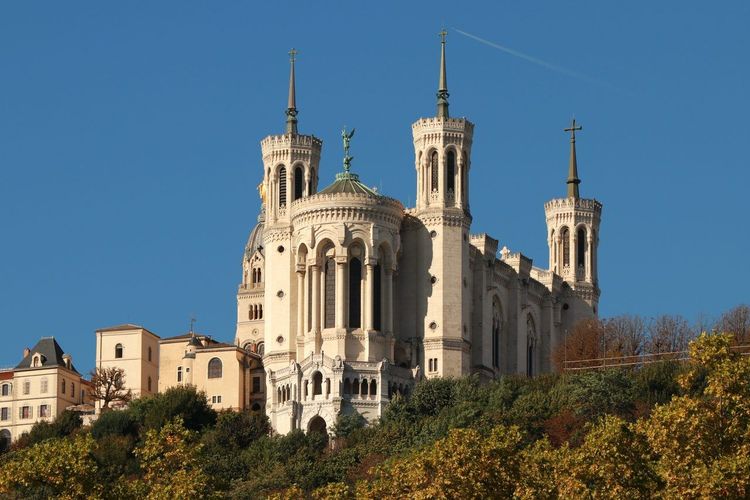
Start early, before the tour groups arrive. The funicular from the Vieux Lyon station takes barely two minutes to reach the top, but nothing stops you from walking up through the Jardin du Rosaire, a switchback path of around twenty minutes that offers successive viewpoints over the rooftops. The Basilique Notre-Dame de Fourvière was born from a vow made on 8 October 1870 during the Franco-Prussian War: the city promised a sanctuary if it escaped invasion. The construction project, entrusted to architect Pierre Bossan, ran from 1872 to 1884, and the building was only consecrated on 16 June 1896. Its four corner towers rise to 48 metres, four metres higher than those of the cathedral below, a detail that speaks volumes about the rivalries of the era.
The interior often surprises visitors: Byzantine mosaics covering the vaults, coloured marbles, gilded sculptures, a world away from the sobriety of Lyon's other churches. Head down into the crypt as well, which is far more austere and where the crowds thin out immediately. Just behind the basilica, the esplanade offers the most complete view over the city: the two rivers, the rooftops of the old town, the Incity tower and, on a clear day, the Alpine chain with Mont Blanc on the horizon. Those with a head for heights can try the rooftop tour, which takes you through the roof timbers and onto terraces normally closed to the public; book a few days ahead in high season.
Further down the hill, the Roman theatres of Fourvière are a reminder that the colony founded in 43 BC by Munatius Plancus became, under Augustus, the capital of the Three Gauls. The great theatre, enlarged in the 2nd century, could hold around 10,000 spectators and still serves as a stage for the Nuits de Fourvière every summer. The neighbouring odeon, smaller and originally roofed, hosted readings and concerts. The adjoining Lugdunum museum, half-buried in the hillside and reached by a long helical ramp, is well worth an hour for its mosaics, inscriptions and the Claudian tablet, a bronze plaque engraved with a speech by Emperor Claude, who was born in Lyon.
Vieux Lyon, Its Traboules and Saint-Jean Cathedral
Walk back down through the traboules, those covered passages that connect one street to another by cutting through interior courtyards and stairwells. The city is said to have nearly 500, of which 215 are in the Renaissance district alone, 163 on the slopes of the Croix-Rousse and 130 on the Presqu'île. Only around forty are freely open to the public, thanks to agreements signed between the city and property owners: push the door gently, as these are occupied residential buildings. The Longue Traboule, which connects rue Saint-Jean to rue du Bœuf, remains the most spectacular with its four successive courtyards and spiral staircases.
These passages were historically used to move around under cover, and above all to transport silk without exposing it to the rain, between the workshops on the hill and the merchants in the centre. They later played a quiet role in Resistance networks, which explains their particular place in Lyonnais memory.
The Cathédrale Saint-Jean-Baptiste has anchored the neighbourhood for eight centuries: construction began around 1175 in Romanesque style and was completed around 1480 in Gothic, which explains the mix of styles visible on the façade. Its astronomical clock, mentioned as far back as the late 14th century and restored in 2021, shows the date, the position of the sun and religious feast days; the automata come to life at set times, generally in the early afternoon.
Around it, rue Saint-Jean and rue du Bœuf line up one of the largest Renaissance ensembles preserved in Europe, often ranked just after Venice. It is this district, together with the Fourvière hill, the Presqu'île and the slopes, that earned the city its UNESCO World Heritage listing in 1998. Take the time to look up at the galleried towers, such as the one on the Maison du Crible, known as the pink tower, tucked at the end of a courtyard open during the day.
Lunch at a Lyonnais Bouchon and a Stroll along the Saône Riverbanks
As midday approaches, head for a bouchon. The Café des Fédérations (8 Rue du Major Martin, 69001 Lyon, rated 4.5/5 on Google from 2,864 reviews), an institution on rue du Major Martin with its narrow dining room, red checked tablecloths and hanging sausages, serves a menu that makes no apologies: quenelle sauce Nantua, andouillette, tablier de sapeur, cervelle de canut as a savoury finale. Budget around thirty euros for a full menu, and book ahead — even at lunchtime on weekdays the room fills up quickly.
A word on the ritual, because it can catch first-timers off guard: in a traditional bouchon, starters often arrive in serving bowls placed in the centre of the table and you help yourself, and wine is drunk from the pot lyonnais, a thick 46-centilitre bottle with a reinforced base. Do not expect an elaborate vegetarian menu — it is simply not what these places do.
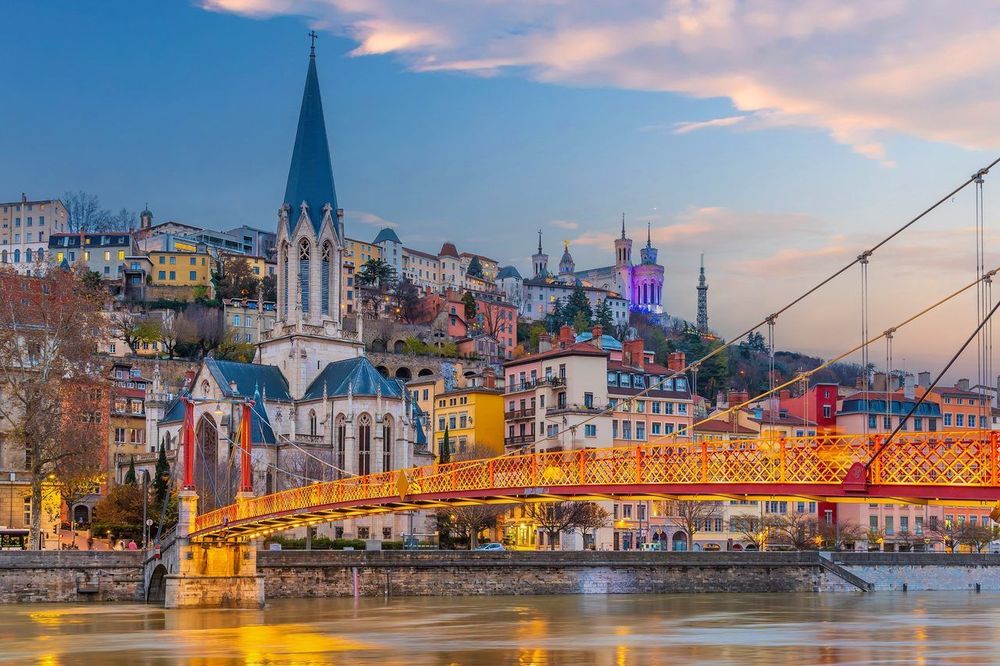
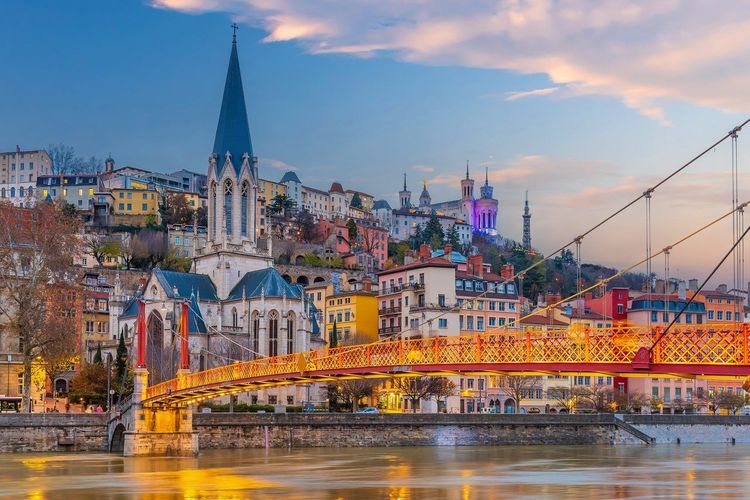
In the afternoon, drift down to the Saône riverbanks, redesigned over the course of the 2010s. The walkway runs alongside the pastel façades of the old town on one side and moored barges on the other, passing under a series of footbridges that make excellent vantage points for photos in the late afternoon light. Cross at the pont Bonaparte to reach the Presqu'île as the terraces start to fill: it is also the most natural way to segue into the next day's programme, which begins right on this side of the city. The Longue Traboule and these same riverbanks are both stops on our short audio walking tour of the two hills.
Day 2: Presqu'île, Confluence and Modern Lyon
Place Bellecour and Shopping in the City Centre
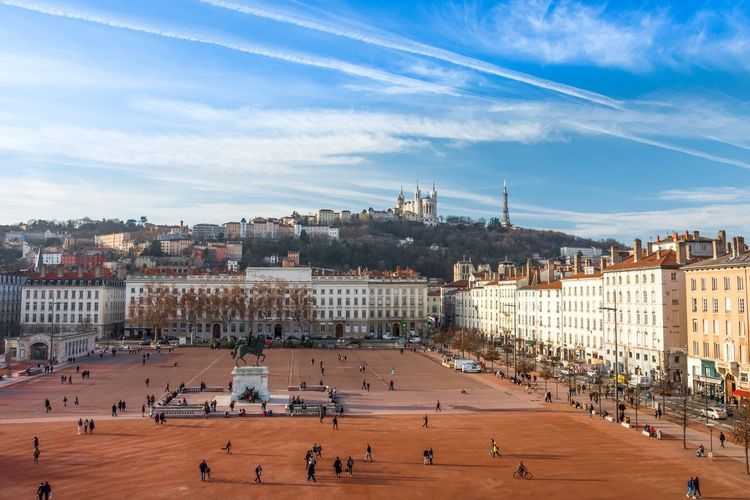
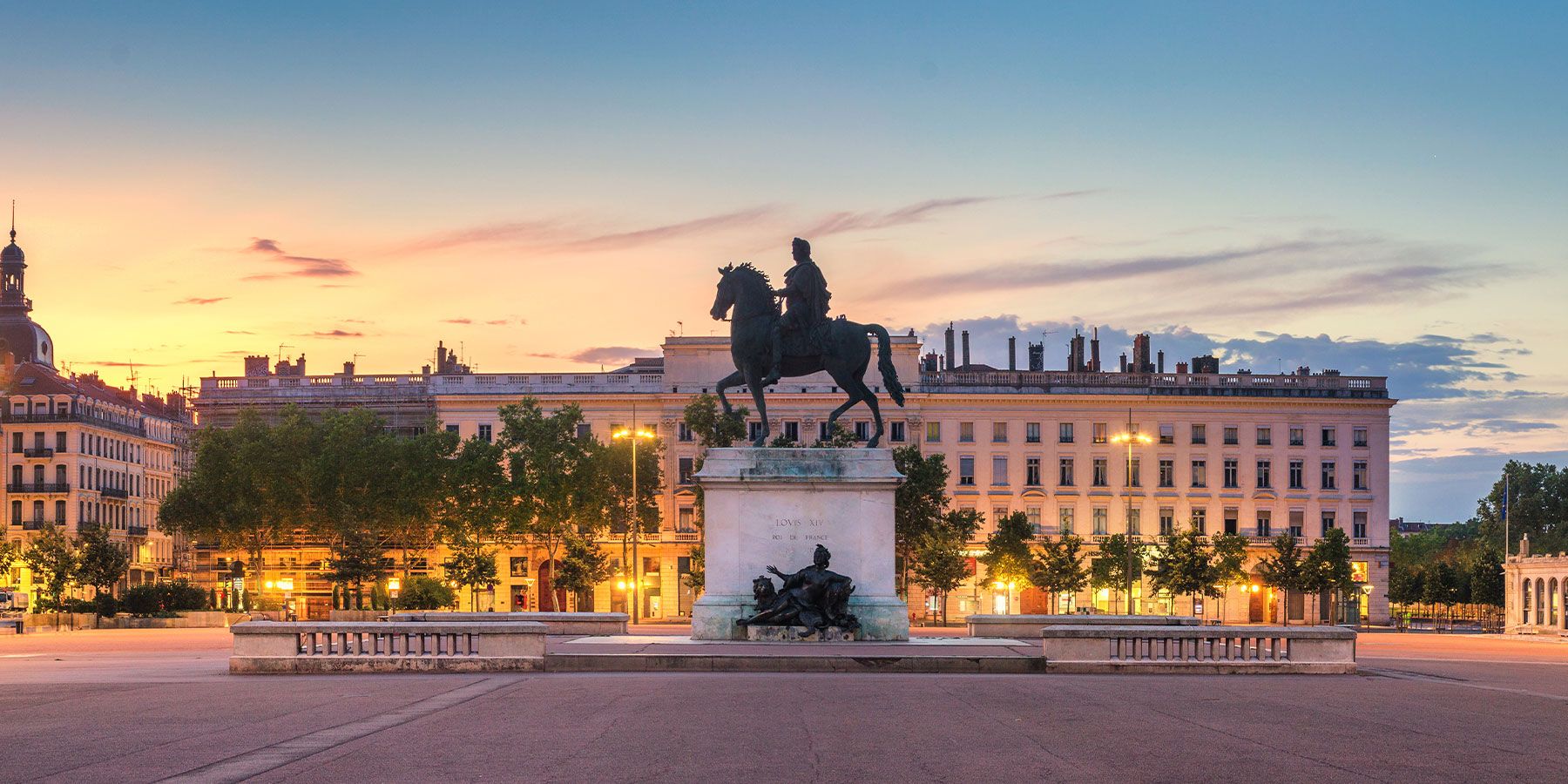
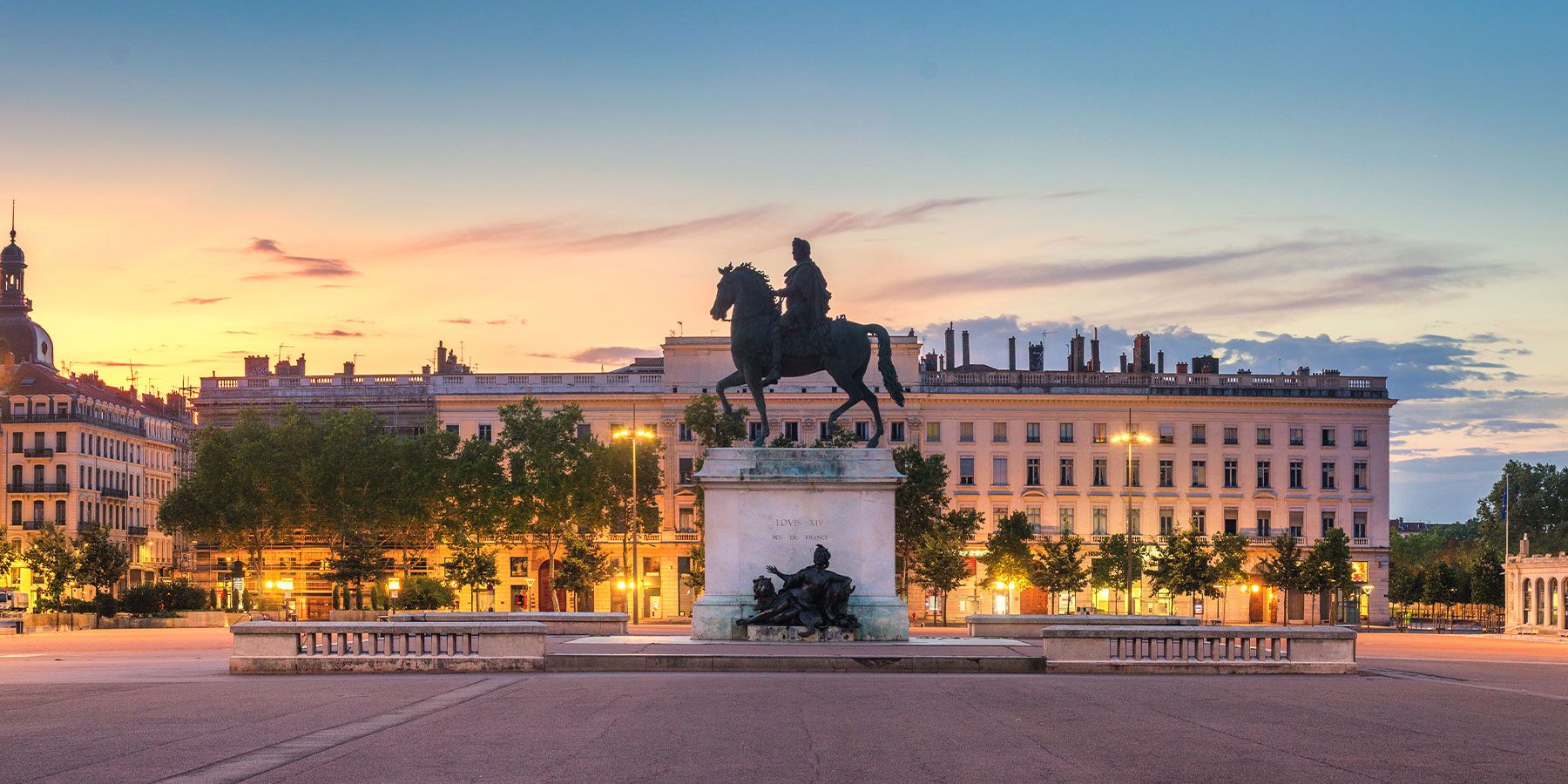
The place Bellecour opens day two: at 62,000 m², it is one of the largest pedestrian squares in Europe, dominated by the equestrian statue of Louis XIV and by a big wheel in winter. The beige gravel surface, deliberately left unpaved, sets it apart from most large European squares that are entirely cobblestoned. It is also the city's zero-kilometre marker and the default meeting point for Lyonnais, which explains the permanent crowds at the foot of the statue.
From there, rue de la République and rue Victor Hugo concentrate most of the city-centre shopping, from national chains to independent boutiques, along nearly two entirely pedestrianised kilometres. If you are looking for local crafts or an old-fashioned stationer, venture as far as rue Mercière, rue des Marronniers or the Ainay neighbourhood, which are quieter and far less uniform. The covered Cordeliers galleries come in handy during a shower, which is not uncommon in spring.
Musée des Confluences and Contemporary Architecture
Take tram T1 or walk a short half-hour to the southern tip of the Presqu'île, where the Rhône and the Saône finally meet. The Musée des Confluences, opened on 20 December 2014 in a building designed by Austrian firm Coop Himmelb(l)au, looks like a vessel run aground between two rivers: 190 metres long, 41 metres high, a concrete base topped by a glass crystal and a cloud of stainless steel.
Inside, around 3,000 m² of permanent exhibition draws on a collection of 2.2 million objects inherited from the former natural history museum: a mammoth skeleton, meteorites, Oceanian masks, anthropology and natural science collections displayed side by side rather than by discipline. This approach puzzles some visitors and captivates many others, making it the most visited museum in the Auvergne-Rhône-Alpes region with nearly 700,000 visitors in 2025. Allow two full hours, more if you add a temporary exhibition.
Around the museum, the entire Confluence district illustrates the urban transformation under way for twenty years: former railway and port wasteland turned into office buildings, residential blocks and a shopping centre open onto a basin. The Cube Orange, with its perforated façade designed by Jakob and MacFarlane, and the colourful buildings along quai Rambaud sum up Lyon's taste for bold architectural gestures. This juxtaposition of ancient stone and contemporary steel is what most sets the city apart from other French metropolises.
Halles Paul Bocuse: a Gourmet Break and Lyonnais Specialities
In the mid-afternoon, head to the Halles Paul Bocuse, renamed in 2006 in honour of the late chef. Around sixty vendors share the space — cheesemongers, charcutiers, fishmongers, wine merchants and pastry makers, several of them holders of the Meilleur Ouvrier de France title. It is the ideal place to snack standing at a counter, between a warm quenelle, a few oysters and a glass of Côtes du Rhône poured by the glass.
Leave with something for the road: pink pralines to take away, saucisson brioché, rosette, or a perfectly ripened saint-marcellin, a speciality of both Maison Mons and Fromagerie Mère Richard, two historic names at the market. If you want to avoid the Saturday morning crush, aim for a weekday visit around 5 p.m. The halles close early, around 7 p.m., making this a gourmet snack stop rather than a proper dinner — worth knowing before you count on it for the evening.
A Cultural Evening on the Presqu'île
For the evening, head back toward the heart of the Presqu'île. The Opéra de Lyon, topped by a semicircular glass barrel vault added by Jean Nouvel in 1993 onto a 19th-century neoclassical shell, offers a packed programme of opera and dance from October to July. Even without a ticket, the façade lit up in red after dark is worth a detour, and the forecourt draws amateur dancers who rehearse in front of the glass walls late into the evening.
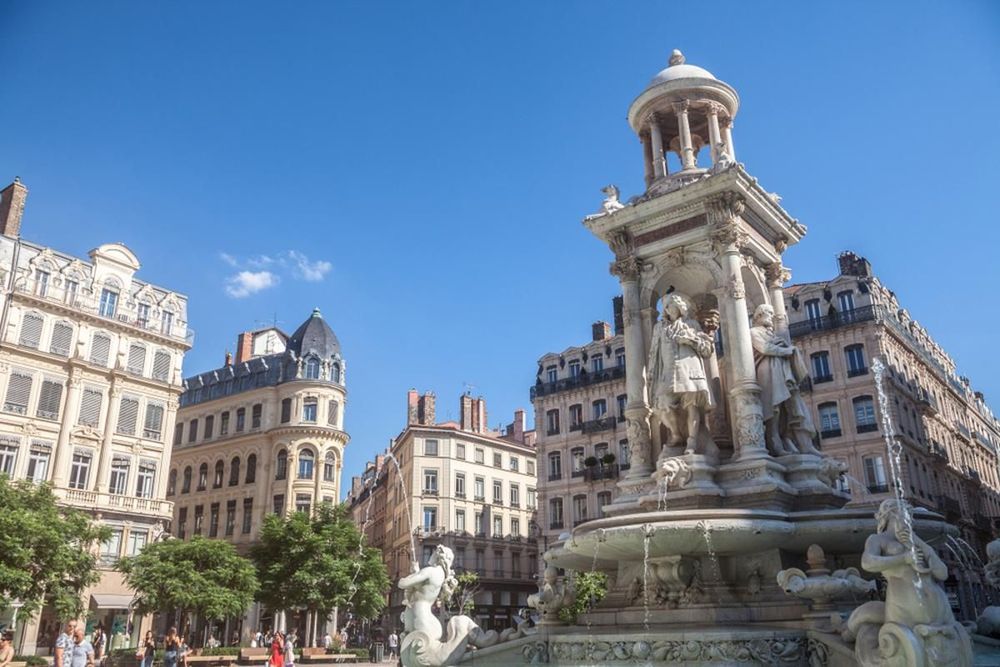
Just steps away, the place des Terreaux and its monumental fountain sculpted by Bartholdi — the same artist behind the Statue of Liberty — form a lively gathering point, framed by the town hall and the Musée des Beaux-Arts. The latter, housed in a former abbey and often described as the second most important fine arts museum in France by the richness of its collections, is worth an entire morning if your stay extends.
To end the day, two options depending on how much energy you have left: the bars on rue Sainte-Catherine, loud and young, or a more relaxed dinner on rue Mercière, whose terraces stay lively well into summer evenings. Either way, you walk home past place Bellecour and the Saône, two of the eighteen stops on our short audio-guided tour of the two hills.
Day 3: Croix-Rousse, Tête d'Or and Authentic Neighbourhoods
Croix-Rousse Slopes, Street Art and the Canuts District
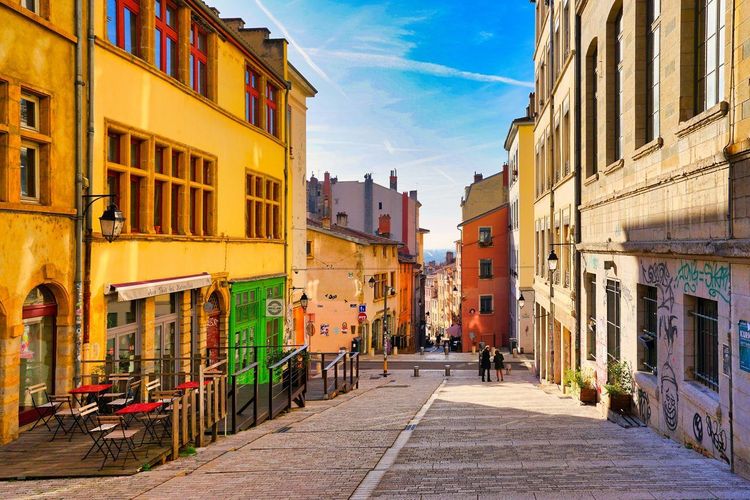
Walk up the slopes, or take metro line C, the network's only rack railway, if your legs are protesting after two days of walking. The Croix-Rousse was the neighbourhood of the canuts, the silk weavers who kept tens of thousands of looms running in the 19th century. Their uprisings of 1831 and 1834, crushed with bloodshed, rank among the first great workers' movements in French industrial history, and the neighbourhood has kept a defiant identity still perceptible at the boulevard market today.
The Mur des Canuts, a 1,200 m² trompe-l'œil mural depicting a typical Lyonnais street with its life-sized painted inhabitants, is the most photographed in the city. Repainted several times since 1987, it ages alongside its characters: the children from the first version have grown into adults in later editions, a detail almost always missed by visitors who have not read about it beforehand.
To understand the trade itself, the Maison des Canuts runs a period Jacquard loom in front of visitors, with a demonstration included in the ticket price. It finally becomes clear why the ceilings in buildings on the slopes rise to over four metres: these machines, several metres tall, had to fit inside the combined home-workshops where people also lived.
Do not leave without passing through the Cour des Voraces, a monumental traboule whose six-storey concrete staircase has served as a film set and as a refuge during both the canuts' insurrection and the Occupation. To explore this neighbourhood further, our audio-guided à la rencontre des Canuts tour links seventeen stops between historic workshops and hidden passages over around two hours of walking.
The Parc de la Tête d'Or
Head down to the sixth arrondissement to reach the parc de la Tête d'Or, 117 hectares laid out in 1857 by the Bühler brothers, Swiss landscape architects who also worked in Bordeaux and Nantes. The 16-hectare artificial lake, fed by pumping from the Rhône water table, lends itself to rowing boat trips in season, and a full circuit of the lake takes a good forty minutes at a leisurely pace.
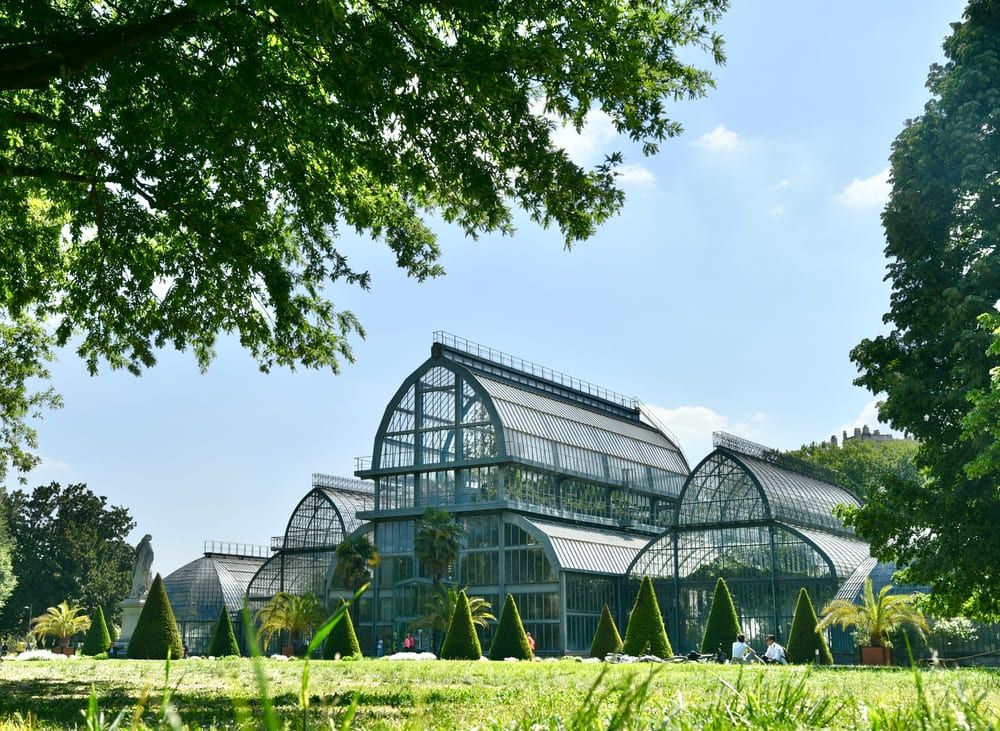
Three rose gardens share the park; the most spectacular, the international rose garden inaugurated in 1964, lines up 60,000 rose bushes and more than 350 varieties, with a peak flowering period in May and June. The botanical garden, relocated here in 1857, catalogues more than 15,000 plants and houses large 19th-century greenhouses that offer a perfect refuge on a rainy day.
The park also contains a free-admission zoological garden open all year round. The African plains area, developed in 2006 over 2.5 hectares, brings together giraffes, zebras and antelopes in a shared space, while the Asian forest biotope, opened in 2021, presents around twenty endangered Southeast Asian species including lemurs and rare primates. Allow two hours of strolling between the lake, the greenhouses and the shaded lawns: it is the ideal counterpoint after two fairly packed days of urban walking, and the one moment in the trip when children can run around without close supervision.
Brunch or Coffee in the Brotteaux District and the Fresque des Lyonnais
Leaving the park on the eastern side, the Brotteaux neighbourhood unfolds its Haussmann-style buildings and Art Nouveau façades, a legacy of early 20th-century bourgeois prosperity. The former Brotteaux station, with its glass canopy and repurposed concourse, sets the tone: this is a quieter Lyon, where terraces fill with families on Sundays. A good moment for a late brunch or a simple coffee, far from the crowds of the old town.
To close the stay, cross back over the Saône to quai Saint-Vincent where the Fresque des Lyonnais unfolds — 800 m² of trompe-l'œil painted in the mid-1990s depicting thirty figures who shaped the city: Emperor Claude, Abbé Pierre, Antoine de Saint-Exupéry, the Lumière brothers, Paul Bocuse, Bernard Pivot. Historical figures occupy the upper floors while contemporary ones appear at street level, where they seem to be stepping out of a shop. Step back a few metres on the quay to take in the perspective effect: it is a fitting final point for a stay that will have moved through every layer of local history, from antiquity to contemporary gastronomy.
Extending Your Stay: Lyon in 4 or 5 Days
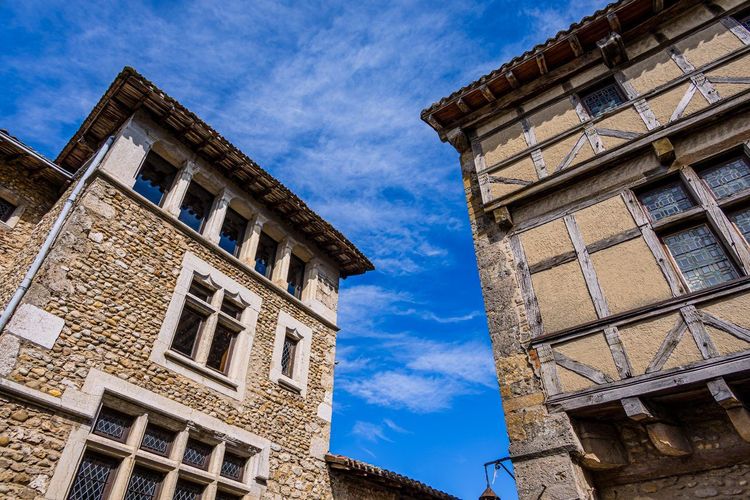
If three days leave you wanting more, the city lends itself very well to a longer format. A fourth day opens the door to full-day excursions: Pérouges and its fortified medieval city, less than an hour away, the golden-stone villages of the Beaujolais for a tasting in the vines, or the old village of Trévoux along the Saône. Our article on day trips around Lyon lists the options accessible without a car, by regional train or organised rideshare.
With a fifth day, the question is less about distance than curiosity. The most beautiful villages around Lyon cover a radius of roughly an hour, between the ochre façades of the Beaujolais and the hilltop villages of the Monts du Lyonnais. It is also an opportunity to slow down after a packed urban stay: a morning with no agenda, wandering through a neighbourhood already visited, often rounds off a long weekend better than another list of monuments.
Staying in the city for two extra days is equally worthwhile. The Musée des Beaux-Arts, the Musée Lumière housed in the family home where the first film in history was shot, the Musée de l'Imprimerie and the Centre d'Histoire de la Résistance et de la Déportation, set up in the former military health school occupied by the Gestapo, each deserve half a day. Add, if the weather allows, an afternoon cycling along the Rhône riverbanks: the city changes scale entirely when seen from the greenways, between the two rivers and away from the crowds at listed sites.
Where to Eat and Drink in Lyon: Bouchons, Halles and Good Addresses
The Essential Lyonnais Bouchons
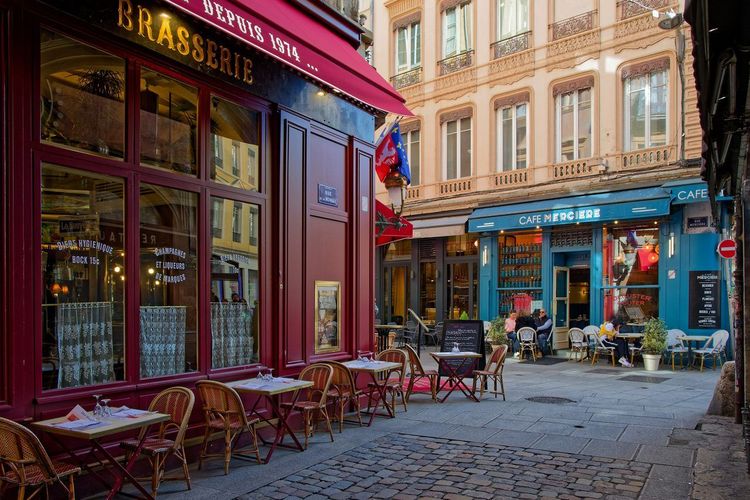
Beyond the Café des Fédérations encountered on day one, the city has 22 establishments bearing the official Les Bouchons Lyonnais label, created by the chamber of commerce and industry together with ONLYLYON Tourisme and the bouchons association. The distinction matters: many tourist addresses call themselves bouchons without honouring the codes, whereas a labelled establishment commits to traditional home-cooked cuisine, served in a setting and at a price-to-quality ratio inherited from the mères lyonnaises.
Among the labelled addresses, Daniel et Denise leads the pack with its Croix-Rousse (8 rue de Cuire) and Vieux Lyon (36 rue Tramassac) locations, renowned for their pâté en croûte and pike quenelle. On the Presqu'île, La Meunière (11 rue Neuve), Le Poêlon d'Or (29 rue des Remparts d'Ainay) and Café Comptoir Abel (25 rue Guynemer), one of the oldest in the city, play the same tune in well-worn dining rooms. On the hill side, L'Auberge des Canuts (8 place Saint-Jean) and Les Fines Gueules (16 rue Lainerie) are a welcome stop after a morning of traboule-hunting. Budget €20 to €40 for a full meal depending on dishes and wine. For a more detailed overview, our selection of bouchons lyonnais worth the visit goes through the addresses neighbourhood by neighbourhood.
Local gastronomy is obviously not limited to bouchons. Between pink pralines, saucisson brioché, tarte à la praline and cervelle de canut — a fresh herb cheese with an off-putting name — the vocabulary deserves a full decoding: our article on the culinary specialities of Lyon takes care of that. A practical tip: many bouchons close on Sundays and Mondays, and some shut for three weeks in August. Check before making the trip.
Coffee, Tea or a Drink
For a coffee or a pastry, the Croix-Rousse slopes and the Saint-Jean area are home to independent roasters and tea rooms installed in former canut workshops, often with soaring ceilings. Locals tend to favour these neighbourhood spots over the chains in the centre, and you will rarely pay more than €3 for a seated coffee.
Come evening, the Presqu'île concentrates most of the nightlife: natural wine bars around rue Sainte-Catherine, more polished cocktails near the Terreaux, rooftops overlooking the skyline near the Hôtel-Dieu, or a simple terrace on place Sathonay. Along the Rhône embankments, around ten barges converted into floating bars animate summer nights until 2 a.m., often with free entry on weekdays. It is the most pleasant way to end a full day without needing to take public transport — and place Sathonay and the Croix-Rousse slopes above it are stops on our audio-guided tour of the silk weavers' world, should the morning after feel ambitious.
Where to Stay in Lyon: Neighbourhoods and Prices
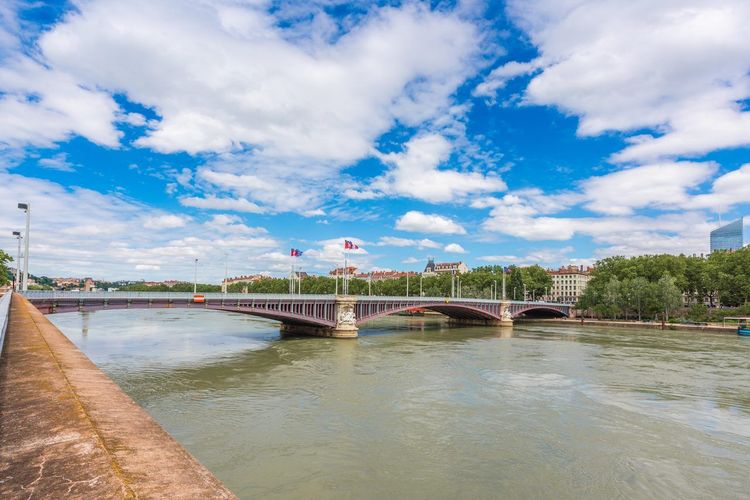
The Presqu'île remains the most practical choice for a first stay: almost all of the historic centre and a good share of the restaurants are within walking distance, with a hotel budget of around €100 to €180 per night in mid-season for a well-located three-star. You lose a little in terms of quiet, especially on the rue de la République and rue Mercière side, but you gain enormously in logistics on a short trip: no morning journey to plan, home on foot in the evening.
Vieux Lyon appeals for its character, with a handful of charming hotels installed in listed Renaissance buildings with unexpected interior courtyards. The budget rises slightly, between €120 and €220 per night, for a far more photogenic setting and direct access to the funicular. It is the neighbourhood to choose as a couple, provided you are happy with cobblestoned streets and summer evening noise drifting up until late.
For a tighter budget, the Part-Dieu area, around the station, offers rooms from €70 to €90 per night at economy chains, with direct access to metro line B and the TGV. The atmosphere is decidedly less picturesque, but the connection to the rest of the city is excellent and rates stay stable even during trade fairs. Two alternatives are worth considering: the Brotteaux neighbourhood, residential and quiet, ten minutes from the park and the centre, and Confluence, newer and popular with families for its spacious aparthotels.
A scheduling note before you book: prices shoot up in early December during the Fête des Lumières and during major trade shows at Eurexpo. On those dates, book several months in advance or shift your stay. Once you are settled, the Ryo audio-guided tour of Lyon lets you head back out to explore the neighbourhoods you have already covered without depending on a guide or fixed schedules.
Getting to and around Lyon: Train, Plane, Metro and Transport Passes
Getting to Lyon by Train or Plane
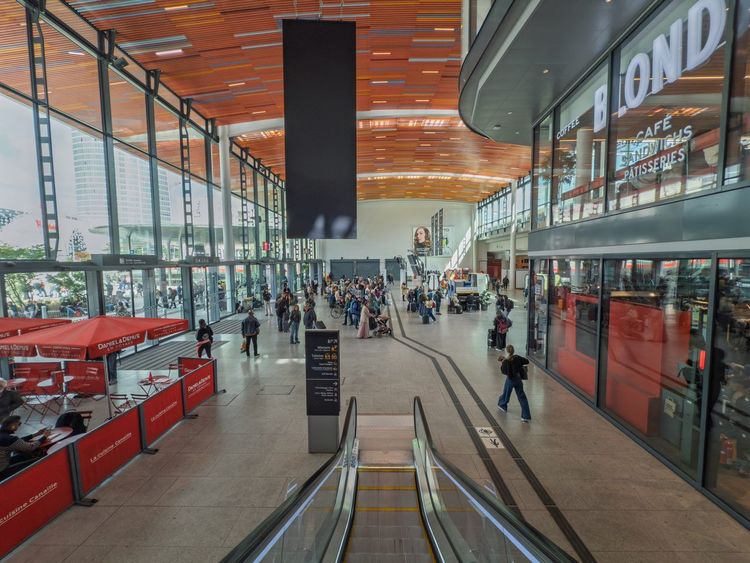
By train, allow around 1 hour 55 minutes from Paris on a direct TGV, with dozens of daily services to the Part-Dieu station right in the city centre. Marseille is 1 hour 40 minutes away, Geneva under 2 hours, Bordeaux just over 4 hours. Pay attention to the arrival station: some TGV services stop at Perrache, at the other end of the Presqu'île, which changes the logistics depending on your hotel.
Lyon-Saint-Exupéry airport is connected to the city centre by the Rhônexpress tram: less than 30 minutes travel time, a departure every 15 minutes, a service running from 4:25 a.m. to midnight and free travel for under-12s. Budget around €15 for a single ticket, considerably more expensive than a standard urban ticket. For a three-day stay, the train often works out cheaper once you factor in the journey times to and from airports.
The Metro, Funiculars and Getting around without a Car
The city is compact and largely walkable, complemented by a dense network: four metro lines, seven tram lines, an extensive bus network and two funiculars that climb from the Vieux Lyon station to Fourvière and Saint-Just. These funiculars, nicknamed les ficelles, run on a standard transport ticket, something many visitors only discover after buying a separate ticket.
Going without a car is no challenge here: it is in fact the simplest way to enjoy the stay, with no parking or traffic worries in the narrow streets of the old town and the slopes. The low-emission zone also restricts access to the city centre for certain vehicles, adding another reason to leave the car at a park-and-ride on the outskirts, which is often included with a daily transport ticket.
For journeys between neighbourhoods, self-service Vélo'v stations usefully complement the network, with the Rhône riverbanks fully equipped for cyclists; our guide to cycling routes and bike itineraries in Lyon details the most enjoyable routes. One caveat though: cycling up to the Croix-Rousse or Fourvière is a real effort — an electric-assist model is strongly recommended.
The Lyon City Card and the Culture and Leisure Pass
The Lyon City Card combines unlimited access to public transport, including the funiculars, on zones 1 and 2, with entry to 26 museums and their temporary exhibitions. In 2026, prices are €29.90 for the 24-hour option, €41.90 for 48 hours and €52.90 for 72 hours at the online rate, a few euros less than the full counter price. The card also includes an ONLYLYON Tourisme guided tour, a Saône river cruise, a Guignol puppet show and access to the planetarium.
Is it worth it? The calculation is straightforward: the 72-hour option pays off from three or four paid attractions including transport. If your itinerary focuses on outdoor spaces — parks, historic districts, street art and traboules, all of which are free — a simple daily transport ticket will do at a far lower cost. Note that the Fourvière basilica, the parc de la Tête d'Or and its zoo are all free of charge, which noticeably lightens the bill of a well-organised stay.
Some travellers prefer a guided tour for a first encounter with the city, particularly in the old town where access to covered passages is restricted at certain times. The tourist office runs tours daily in French and English. The more flexible alternative is to follow a Ryo audio guide directly on your phone, at your own pace and without any group schedule to follow.
Budget for a 3-Day Stay in Lyon
On a budget, allow around €250 to €320 per person over three days: accommodation in a hostel or economy hotel around €70 per night, meals at simple bouchons or snack spots for €25 per day, transport at roughly €10 a day and two or three paid attractions spread across the stay. By sticking to free sites and a picnic bought at the halles, you can bring the cost down further.
For a comfortable stay, the total rises to between €450 and €600 per person: a well-located three-star hotel at around €130 per night, two meals at a labelled bouchon, one more gastronomic dinner, the 72-hour Lyon City Card and an extra such as the Fourvière rooftop visit or a Saône river cruise.
Beyond that, a high-end stay quickly exceeds €800 per person with a four-star on the Presqu'île and privatised experiences. In all cases, bear in mind that Lyon remains one of the French metropolises where you can eat very well for €15 to €20 at lunchtime, which noticeably reduces food costs compared to Paris. Two factors really move the needle on the total: the time of year, with hotel rates that sometimes double in December, and the number of paid museums on your programme.
Practical Tips for Making the Most of Your Stay in Lyon
The question of how many days you need comes up constantly, and the answer depends above all on the pace you want. Three days are more than enough to cover the essentials described here without rushing. A single day is possible if you focus on the Fourvière hill and the old town, at the cost of skipping the Croix-Rousse and the park, while a fourth day opens up the surrounding excursions.
The best period runs from April to June and from September to October, when temperatures are pleasant for walking all day without the sometimes oppressive heat of July and August. Two exceptions are worth the trip outside these windows: the Nuits de Fourvière, a summer festival that fills the ancient theatre from June to late July, and the Fête des Lumières in early December, when the city lights up for four evenings and draws nearly two million visitors. Our page on major events in Lyon lists the dates to watch depending on the season of your visit.
With children, the itinerary works particularly well: the free zoo in the park, the highly interactive Musée des Confluences, the Guignol puppet theatre born here in the early 19th century and the covered passages that naturally turn a walk into a treasure hunt. Simply build in more frequent breaks, and do not hesitate to lighten the day-three programme if the youngest members of the group are flagging.
Three practical details to finish. The cobbled streets and uphill stretches call for proper walking shoes, not smooth soles. Many municipal museums close on Tuesdays — worth checking before you plan your cultural day. Finally, the slopes and the traboules are inhabited spaces: keep your voice down, close doors behind you, and the neighbourhood will continue to remain open to visitors.
FAQ
What Are the 10 Must-Do Things in Lyon?
The Fourvière basilica and its panoramic view, the Roman theatres, the traboules of the Renaissance district, the Saint-Jean cathedral, lunch at a bouchon, the Musée des Confluences, the Halles Paul Bocuse, the place des Terreaux and its Musée des Beaux-Arts, the Mur des Canuts and the parc de la Tête d'Or form the foundation of a successful first stay.
How Many Days Do You Need to Visit Lyon?
Three days cover all the major highlights without rushing. Two days are manageable if you focus on Fourvière, the Renaissance district and the Presqu'île, while four to five days allow you to add secondary museums and a day trip to the Beaujolais region or Pérouges.
Can You Follow This 3-Day Itinerary without a Car?
Yes, entirely. The city centre can be explored on foot, by metro, tram or funicular, and the airport is connected by the Rhônexpress. A car offers no real advantage on a short stay: it complicates parking in narrow streets and runs into the low-emission zone restrictions.
What Budget Should You Plan for a 3-Day Weekend in Lyon?
Between €250 and €320 per person for a budget version, €450 to €600 for a comfortable stay, including accommodation, meals, transport and entrance fees. Meal prices are generally lower than in Paris for equivalent quality, but accommodation prices spike sharply during the Fête des Lumières.
Should You Buy a Transport Pass or the Lyon City Card for 3 Days?
The 72-hour Lyon City Card, at €52.90 online, becomes worthwhile from three or four paid attractions since it also includes transport and 26 museums. Without a heavy cultural programme, a simple daily transport ticket is enough, as most major outdoor sites are free.
Is This 3-Day Itinerary Suitable for Families with Children?
Yes, very much so: the free zoo in the parc de la Tête d'Or, the traboules as a treasure-hunt adventure, a Guignol puppet show and the highly interactive Musée des Confluences all appeal to younger visitors. Simply plan a more relaxed pace and a mid-stay break in the park.
What Is the Best Time of Year to Discover the City?
April to June and September to October offer the most pleasant conditions for walking all day. July and August are very busy and can be hot, though they bring the Nuits de Fourvière festival in the ancient theatre, and in early December the Fête des Lumières transforms the city into an open-air stage.
By the end of these three days, the city will have revealed several faces: that of a Roman capital turned Renaissance city, that of a textile industrial hub reinvented as an arts district, and that of a metropolis unafraid to add glass and steel alongside its golden stone. To extend your discovery beyond this itinerary — picture the Roman Theatre again, or wander back through Place des Terreaux — or simply follow each stage in audio form while you walk, our Lyon audio walking tour remains the most comprehensive resource for exploring the city at your own pace.
À lire également