© Shutterstock
 Votre guide Ryo
The 5 Most Beautiful Villages around Lyon to Visit in Autumn 2026
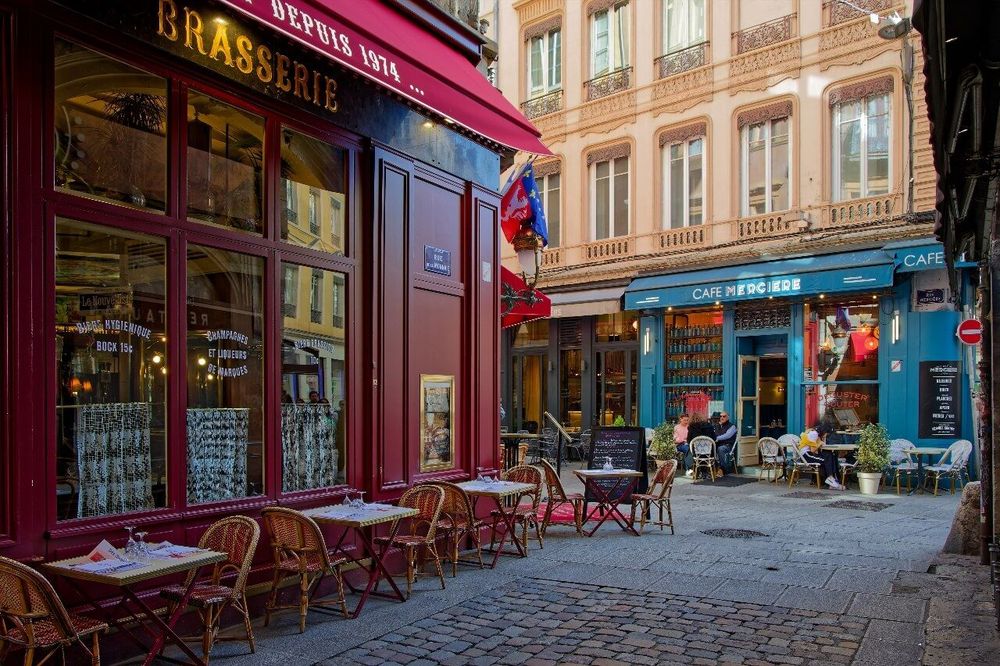
Thirty kilometers from Part-Dieu, the colors change dramatically. The Beaujolais vineyards turn copper red, the cobbled streets of medieval towns empty out after the summer crowds, and the raking October light sets the golden stones ablaze in a way that July never manages. Lyon is a dense, vibrant, intense city — but the beautiful villages around Lyon offer a completely different way to experience the region.
These destinations deserve a day trip or an extended weekend. Among them: a medieval city entirely enclosed by ramparts where no cars are allowed, a former monastery whose monks' cells have been turned into family homes, a hilltop village whose walls glow honey-yellow in the autumn sun, a town with covered market halls from the Middle Ages that are among the best preserved in France, and a flower-filled town in the Ain whose medieval pharmacy has remained intact since the 14th century. This guide takes you to the five we consider unmissable, with practical information on getting there from Lyon. If you are also planning your stay in the city, the Ryo audio guide to Lyon covers both hills, the Presqu'île, and the traboules in 26 stops and 3h30 of guided walking.
Pérouges, the Medieval City Frozen in Time
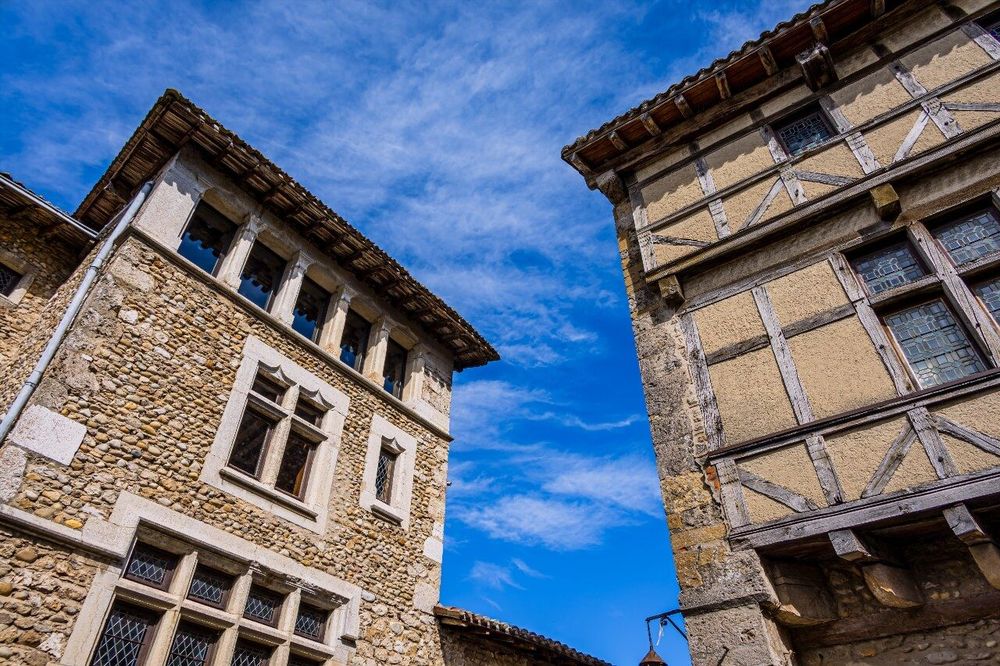
Some places make the centuries seem like a lie. Pérouges is one of them. Located 37 km northeast of Lyon, this fortified city perched on a hill in the Ain has preserved its medieval layout intact: a double ring of walls, cobblestone lanes that rise and fall without warning, and half-timbered houses whose mortar joints have been restored to their original appearance since the 14th century.
The Place de la Halle is the heart of the city. This is where medieval commerce once thrived, beneath stone arcades that still stand today. You will now find the famous galette de Pérouges there — a flat cream and sugar tart baked in a wood-fired oven, its recipe unchanged for centuries. In autumn, when the terraces are no longer overflowing, you can sit quietly and watch cats cross the cobblestones undisturbed.
The walk around the ramparts takes about forty minutes on foot. From the Tour Ronde, at the highest point, the view stretches across the plain of the Ain all the way to the Alps on a clear day. In October, the morning mist lingers in the valley and Pérouges emerges above it like a suspended island. It is a sight that summer photos never capture, and one that few visitors are lucky enough to see.
Pérouges is listed among the «Plus Beaux Villages de France», a distinction awarded to fewer than 180 communes across the entire country. This label explains the summer influx, and makes a good case for choosing autumn instead. Allow at least two hours on site, more if you visit the Hôtel-Musée de Pérouges (Place du Tilleul, 01800 Pérouges, rated 4.3/5 on Google from 639 reviews), which occupies a 15th-century Gothic house and traces the city's craft history through period furniture, tools, and documents.
As for access, Lyon Saint-Exupéry TGV station is only 14 km from Pérouges, but the city itself is not directly served by public transport. By car from Lyon, allow 40 minutes via the A46. A practical tip: leave early to park in the external car park before the city wakes up. On Sunday mornings between 8am and 10am, the magic of the place works at full force.
Oingt, the Golden Gem of the Pierres Dorées
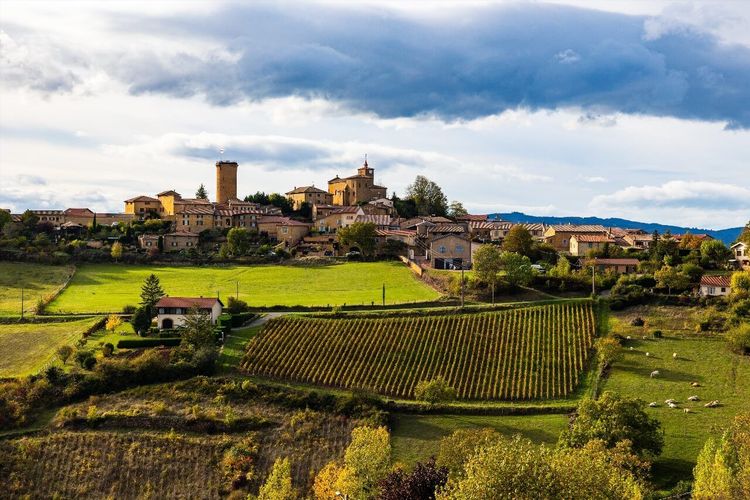
On the opposite side of Lyon, to the northwest, lies the territory of the Pierres Dorées — a stretch of Beaujolais hills where the houses are built from a yellow limestone that turns orange under the late afternoon light. Oingt is the jewel of this area. Also listed as a «Plus Beau Village de France» since 1982 — the only one in the Rhône département to hold this label — the village sits at 520 metres and overlooks the Azergues valley.
The climb through the lanes, all lined with this characteristic honey-coloured stone, leads to the Tour, the former keep of the medieval castle, now converted into a museum. It is reached via a spiral staircase. At the top, the panorama takes in the Beaujolais vineyards, the Mâconnais hills, and on clear days, the first Alpine peaks. In autumn, the colours of the vineyards encircling the village are particularly spectacular — this is objectively the best season for this outing.
The village has fewer than 700 inhabitants and its church of Saint-Mathieu, a former castle chapel, is worth a visit. It preserves 14th-century frescoes discovered beneath whitewash in the 19th century. The autumn light, which enters obliquely through the Romanesque windows in the mid-afternoon, brings out these details in a way that summer lighting cannot.
Oingt fits easily into a Pierres Dorées loop. From Lyon, several nearby villages are worth a stop, particularly Jarnioux (its seven-towered castle) and Châtillon-d'Azergues (its castle and priory). The Route des Pierres Dorées connects all these villages over about 30 km — ideal by bike for the more active, by car for everyone else. At 28 km from Lyon city centre, Oingt can be reached in 35 minutes via the D307 through Lozanne. Enter the village from below: the gradual climb through the lanes is far more beautiful than arriving from the upper car park.
Sainte-Croix-en-Jarez, the Village Born inside a Monastery
This is probably the most singular village in the region. Sainte-Croix-en-Jarez, in the Loire département, 35 km southwest of Lyon, is not simply a village near a monastery: it is a village inside a monastery.
The charterhouse was founded in the 13th century by Béatrix de la Tour du Pin, widow of the lord Guillaume de Roussillon. For five centuries, Carthusian monks lived there in absolute silence, each in his individual cell with a private garden. Then the Revolution drove them out. The buildings were sold to peasant families, who converted the cells into dwellings, the cloisters into lanes, and the monastic gardens into vegetable plots.
Today, you literally walk through the monks' living spaces. The inner courtyards are freely accessible, the chapels are open to visitors, and several residents have converted their former cells into holiday cottages. The atmosphere is strange, caught between the solemnity of the place and the ordinariness of everyday life — laundry at the windows, bicycles leaning against 700-year-old stone walls.
Autumn suits this village particularly well. The Parc Naturel Régional du Pilat begins just a few kilometres away: its beech forests blaze with colour from October to early November, and the hiking trails around Sainte-Croix-en-Jarez offer views of the Alps and the Vercors when the air clears after the first autumn rains. The charterhouse can be visited independently or with a guide (check with the Pilat tourist office for seasonal opening times). Allow an hour and a half for the village alone, considerably more if you set off on a hike.
Crémieu, the Medieval Pearl of the Isère
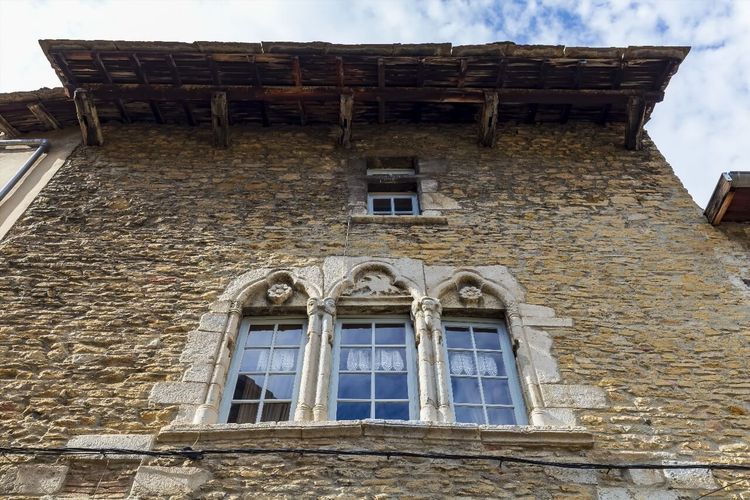
To the east of Lyon, the Isère département hides a town that regional guides often overlook. Crémieu, 40 km from Lyon, is a former Dauphinois city whose medieval centre has come through the centuries almost unscathed.
The main attraction: the covered market halls. Built in the 15th century, they are among the best-preserved medieval halls in France. The oak timber frame, of exceptional span, has stood for nearly 600 years without major intervention.
On either side of the halls, the town unfolds behind its old ramparts. The Couvent des Augustins (14th century) now houses the town hall and a cultural gallery. The Porte Quirieu and its two cylindrical towers are the only surviving remnants of the four original medieval gateways. Climbing up towards the heights, you reach the ruins of the Château Delphinal, whose walls offer a sweeping view over Crémieu's rooftops and, further away, over the ponds of the Plaine de l'Ain.
What sets Crémieu apart from the other villages on this list: it is a genuine market town, with permanent shops and restaurants in the historic buildings. In autumn, local Isère producers set up special markets — wild mushrooms, Dauphiné chestnuts, squash of every variety — that give the visit a gastronomic dimension that summer does not offer. From Lyon, 40 minutes via the A43 then the D517. A regional bus service also connects Crémieu from Bourgoin-Jallieu station, useful if you want to go without a car.
Châtillon-sur-Chalaronne, the Flower-Covered Rooftops of the Ain
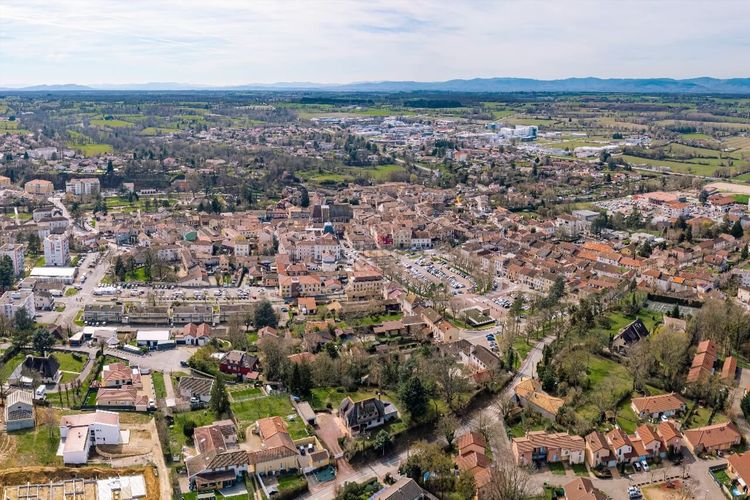
To the north of Lyon, in the Ain département, Châtillon-sur-Chalaronne (Place de la République, 01400 Châtillon-sur-Chalaronne) holds a special place: for several decades, the town has been one of the most flower-adorned in France, awarded «Quatre Fleurs» status and winner of the national Grand Prix du fleurissement. But reducing Châtillon to its window boxes would be doing it a disservice.
The medieval town has its own 15th-century covered market halls, a partially preserved ring of ramparts, and a remarkable church. Along the Chalaronne river, old houses with wooden balconies on stilts create a landscape you would not expect to find in the Ain — an atmosphere reminiscent of certain Alsatian or Savoyard towns. In autumn, the chestnut trees in the centre provide a particularly photogenic canopy of colour.
The local curiosity not to be missed: the Musée de l'Apothicairerie (Rue de l'Hôtel-Dieu, 01400 Châtillon-sur-Chalaronne, rated 4.3/5 on Google from 70 reviews). Housed in the former hospital, it preserves intact the pharmacy run until 1939 by the Sisters of Sainte-Marthe, complete with its Meillonnas faience pots, numbered drawers, and period medical instruments. A fascinating and little-known place, even among locals.
Châtillon-sur-Chalaronne is 58 km north of Lyon via the A6, around 50 minutes by car. The village is listed among the «Plus Beaux Détours de France» and has a good range of accommodation, making it a viable base for exploring the Ain over two days. The Saturday morning market runs year-round and brings together local producers.
Three More Villages to Add to Your Itinerary
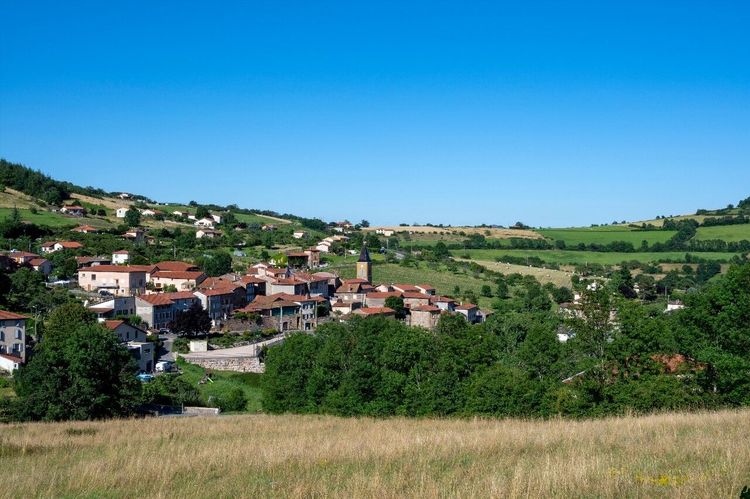
Five villages is already a fine programme for a weekend. But around Lyon, the list of remarkable towns is long. Here are three additional addresses to combine depending on your direction.
Jarnioux (69), in the Beaujolais Pierres Dorées, is known for its medieval castle with seven towers. The building is not open to visitors, but the exterior is impressive and the village itself is worth a stop. Best combined with Oingt, which is about ten kilometres away — the two link naturally in a loop from Lyon.
Chanaz (73), 70 km northeast of Lyon towards Chambéry, is a small river port on the Canal de Savières, between the Rhône and Lac du Bourget. The village clusters around twenty Savoyard houses beside a walnut oil mill that is still in operation. In autumn, the walnut pressing season is in full swing — you can visit the mill and buy freshly pressed oil on the spot. The canal-side atmosphere, with moored boats and colourful plane trees, is particularly gentle in October.
Riverie (69), 30 km south of Lyon, is a hilltop village labelled «Petite Cité de Caractère» and the smallest commune in the Rhône with barely 42 hectares. On clear days, the view from the heights — at over 700 metres altitude — takes in Lyon and its two hills, the Vercors, and the Massif Central. A historical detail that few Lyonnais know: Riverie was in the Middle Ages the fief of Guillaume de Roussillon, whose widow Béatrix de la Tour du Pin founded the very charterhouse of Sainte-Croix-en-Jarez mentioned above. The visit takes less than an hour, but the stop is well worth it if you are in the area. Back in the city, those two hills are covered on foot in 18 audio-guided stops, from Bellecour to Fourvière.
Autumn, the Best Season for These Getaways
These villages can be visited year-round, but autumn gives them a particular light and atmosphere.
First, visitor numbers drop noticeably from mid-September onwards. Pérouges in particular, overwhelmed in summer, rediscovers its calm as a lived-in village in October. The streets free up, residents reappear, and souvenir shops give way to ordinary life.
Second, the light. The raking luminosity of October and November is what makes the golden stones of Oingt and Jarnioux glow most intensely — far more so than the high August sun. Photographers know this, and many make the trip specifically for this season.
Third, the gastronomic seasons. The region's autumn markets — mushrooms, chestnuts, walnuts, mountain cheeses — animate the towns in a way that summer does not. In Crémieu and Châtillon-sur-Chalaronne, the weekly markets from September to November are among the richest of the year. And the galette de Pérouges, enjoyed with a glass of sparkling rosé Cerdon, is a pleasure particularly well suited to the cool temperatures of autumn.
From Lyon: How to Reach These Villages
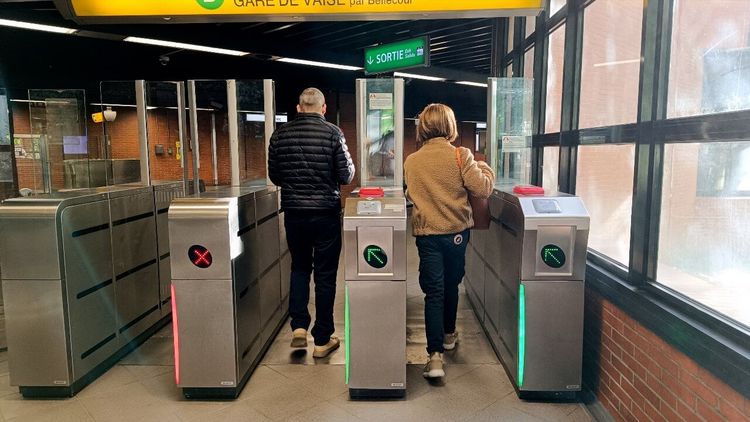
Most of these villages are not served by Lyon's urban transport network, but the situation is not dire if you plan your outing carefully.
By car, this is obviously the simplest option. All the villages in this guide are within 30 to 70 km of Lyon. The A6 heading north (Oingt, Châtillon-sur-Chalaronne), the A43 heading east (Crémieu, Chanaz), and the A46 heading northeast (Pérouges) are the main motorways to use.
By public transport, two destinations stand out. Crémieu is accessible from Bourgoin-Jallieu station (TER from Lyon Part-Dieu in 40 minutes, then a regional bus). Pérouges can be reached by taking the TER to Meximieux-Pérouges station (about 25 minutes from Part-Dieu), then a taxi to the city 3 km away. For Oingt and Sainte-Croix-en-Jarez, a car remains practically essential.
For groups or visitors without a car, several Lyon-based agencies offer day excursions to Pérouges or the Pierres Dorées. A good alternative for enjoying the journey without worrying about parking. Find more outing ideas in our guide to day trips around Lyon.
If you are planning to explore Lyon on foot first, the Ryo audio-guided tour of Lyon makes an excellent introduction to the city before heading out to the villages. For fans of the Croix-Rousse and the history of the silk weavers, the Ryo tour À la rencontre des Canuts pairs well with a day in Lyon before a midweek escape to the neighbouring villages.
FAQ
Which is the most beautiful village around Lyon?
The answer depends on what you are looking for. Pérouges is the most impressive architecturally — a complete medieval city with ramparts, cobbled lanes, and covered market halls. Oingt is the most photogenic, with its golden stones and panoramic view over the Beaujolais. If you prefer an unusual and little-visited spot, Sainte-Croix-en-Jarez has no equivalent in France: nowhere else will you stroll through the courtyards of a Carthusian monastery where families have been living since the Revolution.
Which village around Lyon can be visited without a car?
Pérouges is the most accessible by train: take the TER to Meximieux-Pérouges station (about 25 minutes from Lyon Part-Dieu), then a taxi to the medieval city 3 km away. Crémieu can be reached from Bourgoin-Jallieu (40 min by TER) with a connecting bus. For the other villages in this guide, a car is recommended, or an organized excursion from Lyon.
Is there an entrance fee for Pérouges?
No, entry to the medieval city of Pérouges is entirely free. You can wander freely through the lanes, access the Place de la Halle, and walk the ramparts without spending a cent. Only the Pérouges museum (Hôtel-Musée) charges admission. The outdoor car parks are also free, making Pérouges a very affordable day out.
Can you visit several of these villages in a single day?
Yes, as long as you choose villages that are geographically close. Oingt and Jarnioux can easily be visited in a half-day from Lyon — the Pierres Dorées loop is less than 30 km and the two villages are 10 km apart. Pérouges deserves a half-day on its own, but can be combined with a stop at Châtillon-sur-Chalaronne (40 km further north). For Sainte-Croix-en-Jarez and the Pilat, allow a full day if you want to hike.
When are the Beaujolais vineyards at their most beautiful around Oingt?
The vineyard colors peak between mid-October and mid-November depending on the year and weather conditions. The weeks following the harvest — generally late September to early October in the Beaujolais — are particularly spectacular: the leaves start to turn, the grapes have been picked, and the vines take on hues ranging from yellow to crimson red. The raking late-afternoon light during this period is ideal for photographers.
Are there hikes accessible from these villages?
Absolutely. Sainte-Croix-en-Jarez is ideally located for exploring the Parc Naturel Régional du Pilat on foot — several marked trails start from the village itself. Oingt and the Pierres Dorées have a network of paths running through the villages and vineyards, waymarked and well maintained. Pérouges is surrounded by pleasant farm tracks across the plain of the Ain. For detailed loop ideas departing from Lyon, check our guide to hikes around Lyon.
Conclusion
Less than an hour from Lyon, these villages map out a different face of the region — medieval, rural, coloured by the seasons. Pérouges for its intact ramparts, Oingt for its golden stones, Sainte-Croix-en-Jarez for its monastic mystery, Crémieu for its 15th-century market halls, Châtillon-sur-Chalaronne for its art de vivre between flowers and the Middle Ages. Each has its own character and its own autumn light. Before or after your escape, make the most of your time in the city and explore Lyon at your own pace with the Ryo audio guide to the City of Two Hills — 26 audio stops, 7.9 km of walking, and the best addresses commented step by step, from Vieux-Lyon to Fourvière and through the Presqu'île.