© Shutterstock
 Votre guide Ryo
Pont du Diable in Hérault: Complete Guide to Visit in 2026
The Hérault river emerges from the gorges in an unreal green, translucent to the limestone bottom, and above this unlikely liquid mirror stand two thousand-year-old Romanesque arches. The Pont du Diable in Hérault is one of the department's must-see visits: this Pont du Diable Hérault is simultaneously a classified historic monument, a stage on the Saint-Jacques pilgrimage route, and one of the most frequented natural beaches in Languedoc, a permanent tension between medieval heritage and summer crowds that makes the visit unique like few other sites in France. If you're planning a stay in the region, Ryo offers audio-guided tours in major Mediterranean cities to complete your program, but here, it's nature and raw stone that guide.
This guide covers the essentials before your visit: the bridge's history built between 1025 and 1031 by an unknown architect, its medieval legend and European cousins, swimming rules to know absolutely (accidents unfortunately occur frequently every summer), hikes through the gorges to Saint-Guilhem-le-Désert, canoe descent, and all practical access information. Half a day suffices for the site alone; a full day is necessary when you combine the bridge and the medieval village nearby.
The Bridge's History: A Thousand Years of Romanesque Limestone
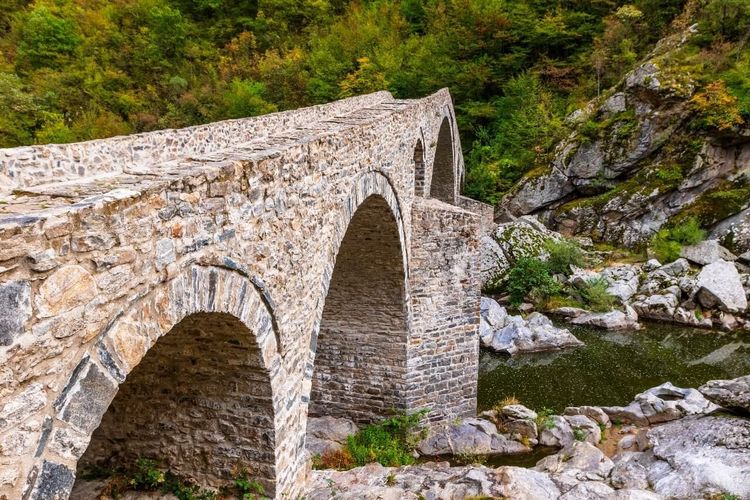
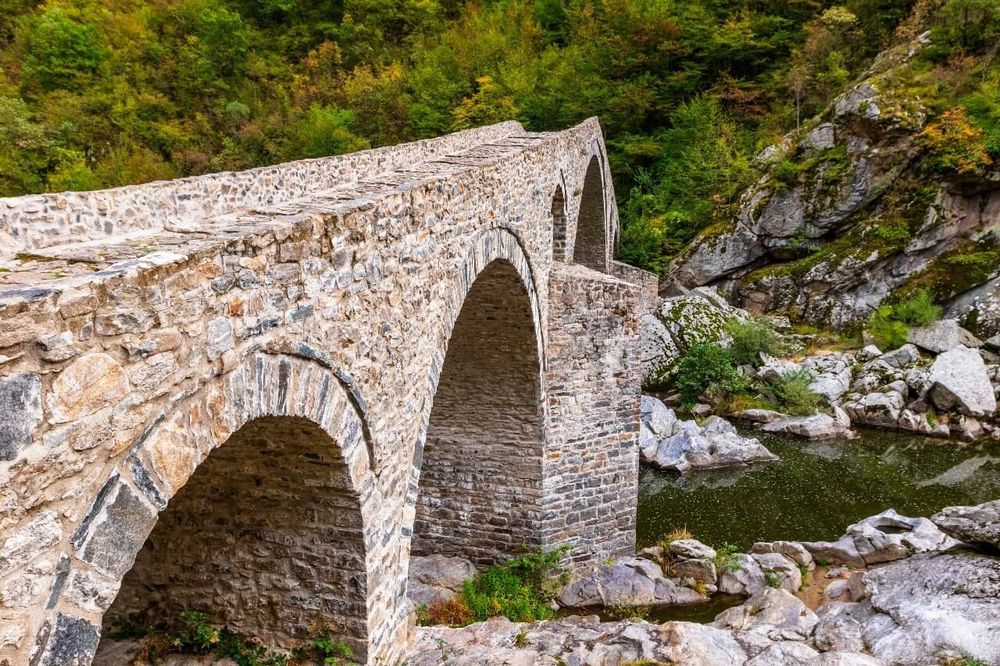
The Pont du Diable (D27, 34150 Saint-Jean-de-Fos, rated 4.6/5 on Google with 6,702 reviews) is not a local curiosity among the Hérault hinterland gorges. It's one of the oldest medieval bridges in France, classified as a historic monument. Its dating remains debated: long attributed to the period 1025-1031 on the joint initiative of Aniane and Gellone abbeys, its construction could, according to the latest research supported by Gellone's cartulary, date back to the 9th century. The reason is simple and imperative: in the 11th century, crossing the Hérault was a permanent challenge. Floods regularly carried away wooden structures, and thousands of pilgrims joining Saint-Guilhem on the Saint-Jacques-de-Compostelle route crossed on foot at the risk of their lives, especially in autumn and spring when the river's flow could increase tenfold in a few hours.
The monks therefore commissioned a stone structure, sober and robust, carved from local limestone. The structure measures 65 meters long and rests on two large Romanesque arches, a technical feat for the era: most French Romanesque bridges did not exceed fifteen to eighteen meters in span. Construction took several years and skills from across Languedoc. No architect's name has survived the centuries, this gap in archives is precisely what will feed the legend.
In the 18th century, a second bridge of the same profile was attached to the original structure to widen the roadway and accommodate increasing traffic. Since then, the two structures read almost as one, unless you look closely at the stones with slightly different joints. The structure was inscribed on historic monuments on April 5, 1935, then classified as UNESCO World Heritage in 1998 as part of the Paths of Saint-Jacques-de-Compostelle in France. It survived the devastating floods of the 13th century, the Revolution, two world wars, and more recently, summer influxes that sometimes bring several thousand people in a single day. The original structure is remarkably intact: the stones visible today are largely those placed by the 11th-century builders.
For Romanesque architecture enthusiasts, comparison is necessary with other medieval Languedocian bridges built over impetuous watercourses. What distinguishes the Pont du Diable is its exceptional preservation and integration into a first-class natural site: the gorges constitute a setting that Roman aqueducts or urban bridges don't have.
The Devil's Legend: Pact, Cunning and Stolen Soul
Such an ambitious construction in the 11th century could only nourish local imaginations. Legend says that the monks, desperate at the apparent impossibility of the project, made a pact with the devil: he would build the bridge in one night in exchange for the soul of the first living being to cross it.
Once the agreement was made, the devil carried it out. At dawn, the structure stood above the Hérault. But the monks, cunning as imagined in medieval tales, first sent a cat to cross the structure. The devil, furious at being outsmarted, could only seize the animal's soul. Frustrated, he would have struck the stone with all his might, leaving the imprint of his hand in the limestone. Some locals still claim to see it, on the left bank side.
The legend of the "bridge built by the devil" is a medieval topos widespread throughout Christian Europe. It's found, with variants, at Pont Valentré in Cahors, in several Alpine and Pyrenean valleys, and even in Germanic countries. This is no coincidence: in the Middle Ages, the technical feat of a stone arch seemed literally supernatural to rural populations who saw no other explanation than intervention by a superior power, divine or demonic. What distinguishes the Hérault version is its geographical precision. The site is real, identifiable, and the river below retains impressive power during autumn floods. Seeing the Hérault in flood under the arches, in November or December, is enough to understand why 11th-century pilgrims saw something inhuman there.
The Grand Site de France of the Hérault Gorges
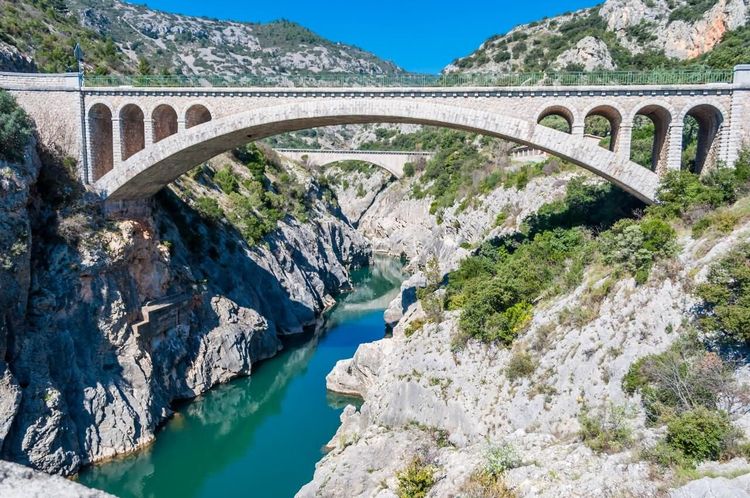
Since 2010, the bridge is no longer an isolated site on a tourist map. It's the entry point and emblem of the Grand Site de France of the Hérault Gorges, a national label awarded to exceptional natural or cultural sites whose visitation is managed sustainably. The label was renewed in 2018, then in 2025 for eight additional years.
The perimeter covers about 50 km² between Montpeyroux in the north and Gignac in the south, encompassing the gorges, the villages of Saint-Guilhem-le-Désert and Aniane, and several remarkable natural sites including Clamouse cave. Annual attendance is estimated at more than one million visitors, with very heavy concentration in July and August.
The label implies concrete commitments: parking management to limit influx on riverbanks, trail maintenance, signage on authorized and prohibited swimming areas, and water quality preservation. The Maison du Grand Site in Gignac offers permanent exhibitions on gorge geology and village history, it's a good starting point if you're arriving in the area for the first time.
In season, free shuttles connect the main Saint-Jean-de-Fos parking lot to Saint-Guilhem-le-Désert village and Clamouse cave entrance, allowing you to visit the entire area without driving once parked. It's a well-thought organization for a site that welcomes so many people, and significantly reduces pressure on the small gorge roads.
Swimming: Authorized Areas, Prohibitions and Safety
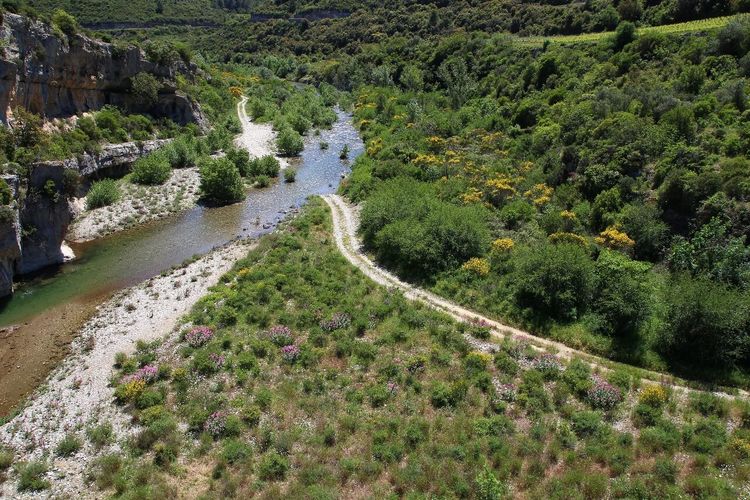
Let's be direct: this is one of Hérault's most frequented summer swimming sites, and one of the department's most accident-prone. Understanding the site's geography before arriving can save you many problems, which is why the Ryo audio guide on regional cities always emphasizes practical conditions before points of interest.
The Hérault river forms here a series of natural pools with translucent waters of a green-blue characteristic of Languedoc limestone rivers. Water temperature rarely exceeds 22°C even in mid-August, it's the reward for families who arrive early. Depth varies greatly by sector: some pools reach six to eight meters, others barely a meter conceal rocks jutting just centimeters from the surface, invisible from the bank.
This is precisely where accidents concentrate. Every summer, several dozen people are injured jumping from the bridge or overhanging rocks, without having assessed the actual depth at impact point. Jumps from the bridge, which peaks at about five meters above water at normal flow, are strictly forbidden by municipal order. The downstream rocks, very popular with thrill-seekers, can reach twelve to eighteen meters depending on chosen areas, heights where imprecise landing can be fatal. Signage on site is abundant and clear. Ignoring it means risking a pelvic fracture or worse in waters where rescue takes time to arrive.
Some practical rules to know before diving:
- Authorized swimming area: pools upstream of the bridge, Saint-Jean-de-Fos side. This is where family swimmers gather and supervision is provided.
- Prohibited area: jumps from the bridge and from rocks downstream of the bridge. The prohibition is permanent, not seasonal.
- Supervision: in July-August, lifeguards are present on developed beaches. Off season, no supervision.
- Water shoes: strongly recommended. Pebbles and limestone rock are slippery, even in weak current.
- Flood alerts: after Cévennes storms, Hérault flow can triple in a few hours. Check Vigicrues before coming off season, the site is regularly closed urgently during flash flood episodes.
Apart from safety issues, swimming in the gorges is an experience in itself. Limestone walls plunge directly into water, vegetation is dense, and in good weather the cliff reflections create unreal light. Come before 10 AM in high summer: after this time, the site is invaded and parking lots saturated. It's one of the rare sites where arriving early truly changes the experience quality.
Hérault Gorges on Foot: Hikes from the Bridge
The site is an ideal departure base for exploring the gorges on foot. Several marked trails start directly from parking lots, with very variable difficulty levels, from riverside walks for families with children to complete gorge crossings for experienced hikers. The Ryo app covers several Languedoc hinterland towns if you extend your stay toward Montpellier or Nîmes.
The most accessible trail is the Gorges path (yellow marking), a 6 km round trip between the bridge and Saint-Guilhem-le-Désert. Elevation gain is limited, the path follows the river on almost the entire route. Mediterranean vegetation, pines, kermes oaks, fragrant garrigue, gives a very different atmosphere depending on season. In May-June, wild orchids line the path by dozens. In September, when summer groups have left, it's one of the department's most beautiful trails: late afternoon slanted light gilds the limestone cliffs with an extraordinary honey tint.
For more experienced hikers, the gorge crossing goes up the river for 14 km to Montpeyroux, with several cliff-edge passages. Allow a full day, bring at least two liters of water per person, springs are rare. Check river level the day before if you plan passages through interior gorges.
The limestone cliffs framing the Hérault shelter several remarkable protected species. Griffon vultures, reintroduced in the 1990s to neighboring causses, have become regular above the gorges, just an updraft is enough to see ten circling effortlessly. Eagle owls and peregrine falcons nest in south-facing walls. Best observation windows are sunny walls in early morning, between February and April.
Canoe-Kayak Descent on the Hérault
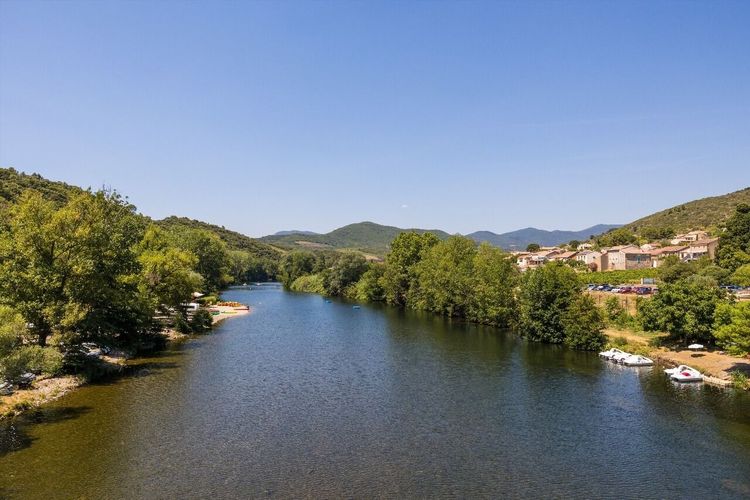
By canoe-kayak, the gorge descent from Montpeyroux to the bridge area is a regional classic that many families do each summer. Several rental companies offer shuttles from Gignac or Aniane, you leave your car at arrival and they take you to departure point.
Allow three to four hours descent depending on river flow and your swimming stops in pools. Morning slots are most in demand; in July-August, book at least two days in advance to avoid being without a boat. Required technical level is low: some narrow passages, no dangerous rapids in normal flow. It's an activity accessible from eight to ten years depending on rental companies.
Kayak descent allows seeing the gorges from a radically different angle than pedestrian hiking: walls seem higher from water, vegetation overhanging the river is denser, and some pools accessible only by water remain preserved from summer crowds. Back on dry land, Ryo's audio walking tour of Montpellier links 21 stops over 3.5 km, from the Peyrou to the botanical garden.
Saint-Guilhem-le-Désert, 3 km Away: Don't Pass Without Stopping
Visiting the area without going up to Saint-Guilhem-le-Désert would be a missed opportunity. The village is 3 km via D4, and it's among the Most Beautiful Villages in France, a deserved label, for once. The combination with Pont du Diable is the region's most obvious: a morning in the pools, lunch, an afternoon in the village.
Saint-Guilhem is founded around Gellone Abbey (Place de la Liberté, 34150 Saint-Guilhem-le-Désert, rated 4.6/5 on Google with 1,971 reviews), built in the 9th century by Guillaume de Gellone, Charlemagne's cousin, who retired there after a life as warrior and conqueror. The abbey has preserved since the 9th century a relic of the True Cross offered by Charlemagne himself, which quickly made it a major stage on the Saint-Jacques route, distinct but complementary to the bridge below. At its medieval peak, the village had over 2,000 inhabitants and several convents; today it barely counts 250 in winter, but welcomes more than 600,000 visitors per year.
The village architecture is homogeneous and remarkably preserved: 12th-15th century limestone houses, paved streets barely wider than two shoulders, flying buttresses and still-functioning washhouses. Place de la Liberté, at the abbey's foot, is shaded by a plane tree that some claim dates to the Napoleonic era, one of the department's most imposing. In July, it's mayhem from 11 AM. In September or May, the village regains tranquility that makes the visit infinitely more pleasant and allows sitting in the abbey courtyard without being jostled.
The abbey is worth forty-five minutes visit: the Romanesque cloister, partially reconstructed as several columns were sold to New York's Metropolitan Museum of Art in early 20th century, the broken barrel nave, and the crypt where Guillaume de Gellone rests. Entry is free for the main nave and excavation space. The in-depth guided tour requires a ticket sold on site.
For a complementary late afternoon experience, the Terrasse de Larzac vineyards begin a few kilometers north of Saint-Guilhem. The wine estate circuit in the garrigue above the gorges is a good option when the village empties of visitors and slanted light transforms the landscape. It's actually the appellation area rising fastest in recognition among Parisian sommeliers over the past decade.
Where to Eat and Sleep Near Pont du Diable
Restaurant offerings around the bridge are decent in summer and almost nonexistent off-season. Parking lot snacks and fry stands should be avoided if you're looking for something memorable.
For proper meals, two options. In Saint-Guilhem-le-Désert, several inns serve honest regional cuisine based on local products: Causses lamb, Terrasse de Larzac wines, goat cheeses aged in gorge caves. Reservation absolutely necessary in summer, tables are few and highly demanded, some restaurants close their waiting lists from 12:30 PM. In Gignac (34150 Gignac, rated 4.1/5 on Google with 520 reviews), ten kilometers away, choice is broader and prices more reasonable: brasseries, pizzerias and some good Languedoc cuisine tables.
For accommodation, Gignac is the most practical base: classic hotels, guest houses and a well-equipped municipal campground at the village exit. In Saint-Guilhem itself, offerings are very limited, a handful of guest houses and two gîtes, booked months in advance in high season. The gorges campgrounds in Saint-Jean-de-Fos and Causse-de-la-Selle are popular for families wanting to stay several days in the area. Montpellier is 35 km away, a comfortable base if you're visiting the region for several days with a thirty to forty minute car return in the morning.
Practical Info: Access, Parking, Rates and Hours
Car Access
From Montpellier, take A750 toward Millau, Gignac exit, then D32 toward Saint-Jean-de-Fos. Allow 40 minutes from Montpellier center. There's no direct public transport access to the bridge, a car is essential for this site.
Parking
Three parking lots are arranged near the bridge. In July-August, they fill up before 9:30 AM. The main parking lot on the Saint-Jean-de-Fos side is paid in season (about €8 per day). Arriving before 9 AM remains the only reliable strategy to park without turning around. Outside high season, parking is free. Free shuttles (July-August) connect parking to Saint-Guilhem-le-Désert and Clamouse cave.
Hours and Rates
The bridge and riverbanks are accessible year-round, without fixed hours. Access to the natural site is free. The Maison du Grand Site in Gignac is open Tuesday to Sunday 10 AM to 6 PM (closed in January).
Best Period
May-June and September-October offer the best conditions: water still cool and swimmable, reduced crowds, vegetation at its best. July-August: magnificent site but very crowded. Gorge hikes remain pleasant even in winter if weather is dry, it's the season for griffon vultures above the cliffs.
FAQ
Can you swim at Pont du Diable in Hérault?
Yes, swimming is allowed in the natural pools upstream of the bridge, on the Saint-Jean-de-Fos side. This is where families gather and where lifeguards provide supervision in July and August. Jumping from the bridge and rocks downstream is strictly forbidden by municipal order: depths are unpredictable and accidents, sometimes very serious, occur every summer.
Is access to the site free?
Access to the bridge and riverbanks is completely free, year-round. Only parking is paid during high season, around €8 per day for the main parking lot on the Saint-Jean-de-Fos side. Gellone Abbey in Saint-Guilhem-le-Désert is also free for the main nave.
How long should you plan for the visit?
For the site alone, swimming and walking along the riverbanks, allow two to three hours. Combined with Saint-Guilhem-le-Désert 3 km away, a full day passes quickly. If you hike through the gorges to Saint-Guilhem via the Gorges trail (6 km one way), add two hours of walking round trip.
Can you canoe on the Hérault?
Yes. Several rental companies based in Gignac and Aniane offer canoe-kayak descents from Montpeyroux to the bridge area, with return shuttle. Allow three to four hours of descent depending on flow. In July-August, book in advance, morning slots go first.
When is the best time to visit the site?
May-June and September-October are ideal periods: swimmable water, significantly less crowded site, remarkable vegetation. In high summer, arrive before 9:30 AM to find a parking space and enjoy the pools without crowds. Avoid July-August weekends if you have a choice.
Is Pont du Diable far from Montpellier?
The bridge is about 35 km from Montpellier, or 35-40 minutes by car via the A750. It's a very accessible day trip from the city, or a logical stop on the route to the Hérault hinterland.
The Bridge That Lasts Longer Than Legends
This bridge isn't really visited, it's experienced. A morning in the pools, a walk up to Saint-Guilhem, an hour in the abbey, and you understand why this limestone enclave has fascinated for a thousand years both medieval pilgrims and contemporary vacationers. The Hérault river, with its almost artificial green waters, does the rest of the work.
If you're exploring the region for several days and wish to extend toward Montpellier or Nîmes, the Ryo app offers audio guides to discover these cities at your own pace. The tension between heritage and mass visitation is real at this site, but the Hérault gorges resist: a thousand years of limestone stones have seen much worse than tourists in swimwear pass by.
À lire également