
Créé par Romane, le 20 juin 2026
Votre guide Ryo
The 13 Most Beautiful Villages of Le Perche to Visit in 2026
© Shutterstock
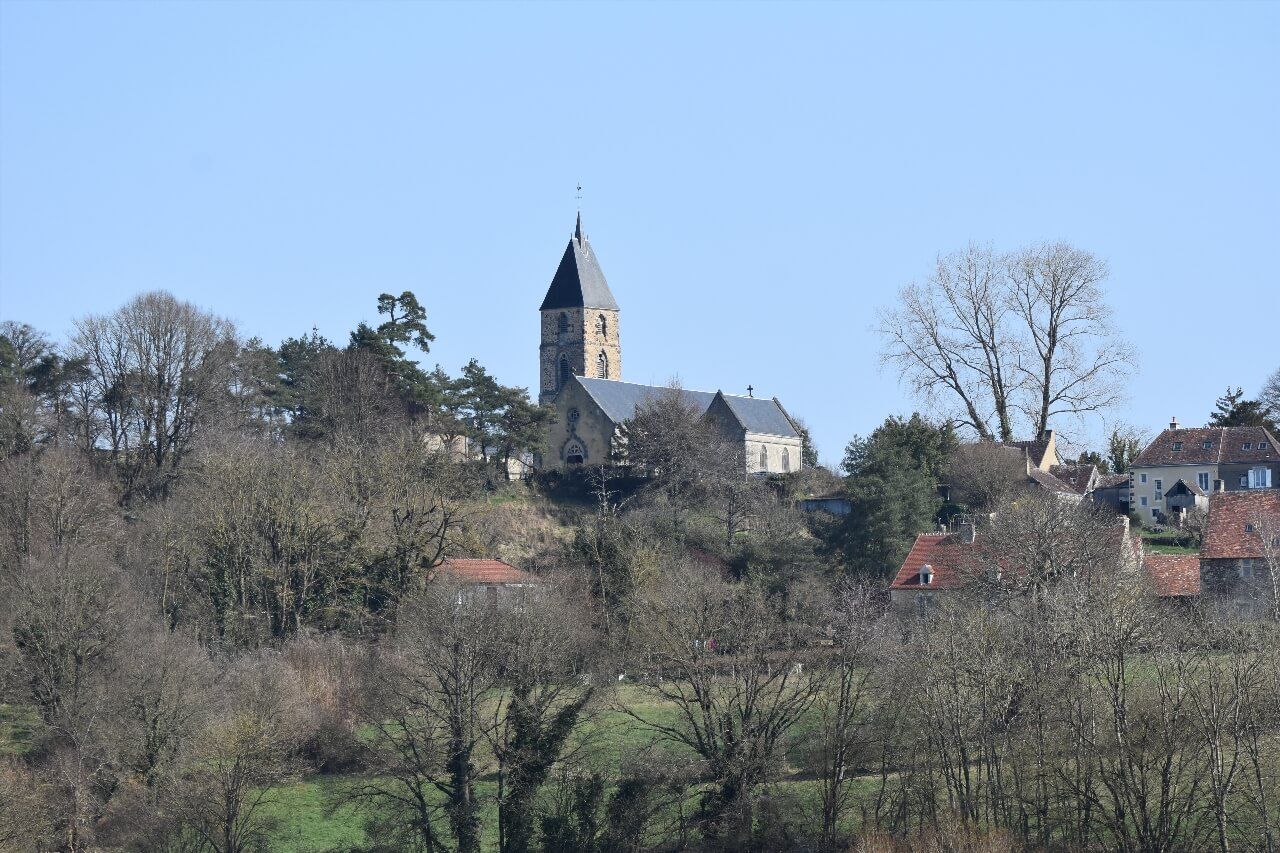
Le Perche is not an administrative region. It is a state of mind: gentle hills rolling toward the horizon, oak and chestnut forests where light filters differently depending on the hour, granite and limestone villages that seem to have been set down effortlessly. Wedged between Normandy, Maine and Île-de-France, this territory straddling the Orne, Eure-et-Loir and Sarthe departments has in recent years attracted visitors in search of a France less frequented than the great heritage destinations. And rightly so: among the most beautiful villages of Le Perche, you will find medieval châteaux, neo-Gothic basilicas, state forests and markets where sausage has been sold alongside Perche cheese for centuries.
This selection of 13 villages covers the entire Perche territory, from the Perche ornais to the Perche vendômois by way of the Perche-Gouët. You will find the must-sees — Bellême, Mortagne-au-Perche, Saint-Céneri-le-Gérei — but also lesser-known villages that are well worth the detour: Frazé and its Renaissance château, Thiron-Gardais and its abbey, La Ferté-Vidame and its landscape park. To complete your exploration of rural France, take a look at our guide to the most beautiful villages in France produced by Ryo.
Bellême, the Capital of the Perche ornais
Bellême (Place de la République, 61130 Bellême, rated 4.5/5 on Google with 420 reviews) naturally presents itself as the starting point for any exploration of Le Perche. Perched on a hilltop at 241 metres above sea level, this village of fewer than 1,500 inhabitants overlooks the state forest that bears its name — 2,400 hectares of oak and beech high forest ranked among the most beautiful in France. The view from the ramparts alone is enough to understand why the Counts of Perche made it their capital as early as the 11th century.
Bellême's historic centre is organised around the Porte Begeanne, the sole survivor of the medieval gates that once controlled access to the walled town. Through this granite arch, the Rue Ville-Close unfolds its 17th- and 18th-century façades, with golden limestone manor houses alternating with more modest dressed-stone dwellings. The Collégiale Saint-Sauveur deserves an extended stop: begun in the 15th century and completed in the 18th, it preserves stained glass of rare quality for a village of this size.
Twice a year, Bellême emerges from its usual quietude. In September, the Fête du Champignon transforms the streets into a giant mushroom market — the surrounding forests yield porcini, chanterelles and horn-of-plenty in abundance, and local foragers come to sell their harvest to enthusiasts from across the Paris basin. In July, the medieval festival brings knights and archers back to life in the cobbled lanes. Between these two highlights, Bellême is best explored on foot at a leisurely pace, allowing two hours for the essentials and three if you venture onto the forest trails.
Mortagne-au-Perche, the City of White Pudding
Mortagne-au-Perche (Place du Général-de-Gaulle, 61400 Mortagne-au-Perche, rated 4.4/5 on Google with 380 reviews) is the most populous commune in the Perche ornais, with just over 4,000 inhabitants — modest, yet enough to give it a commercial reach that surrounding villages cannot match. The town occupies a promontory position above the Corbionne valley, and its medieval lanes wind down toward more recent outskirts in a tangle that is best appreciated without a map.
The Église Notre-Dame is the town's most imposing building: constructed between the 15th and 17th centuries in a late Flamboyant Gothic style, it houses several remarkable statues and an 18th-century organ case. Right beside it, the Porte Saint-Denis, a remnant of the medieval fortifications, is the only surviving gateway of the walls that once encircled the town. From there, the ramparts walk offers an open panorama over the hills of Le Perche.
Mortagne owes part of its fame to its boudin blanc (white pudding), whose invention it proudly claims. Every March, the Mondial du Boudin Blanc draws several thousand visitors and butchers from across Europe for a competition as serious as it is delicious. The Saturday morning market around the covered hall is another good reason to plan a weekend visit: local cheeses, artisan ciders, Perche pâtés and vegetables from surrounding gardens mingle in an atmosphere that has nothing folksy about it — this is genuinely where locals do their shopping. It also makes an excellent starting point for an audio-guided Ryo tour through the town.
La Perrière, the Village That Overlooks the Valley
La Perrière (Le Bourg, 61360 La Perrière, rated 4.6/5 on Google with 210 reviews) is one of those villages you stumble upon by chance and never quite forget. Perched at 262 metres above the Même valley, this small village of around a hundred inhabitants, awarded the Petite Cité de Caractère label, offers one of the most spectacular panoramas in the region: on a clear day, the eye reaches as far as Le Mans to the south-east and the Norman hills to the north-west. In summer, sunsets over the Perche countryside seen from the church square are worth the journey in themselves.
The Église Saint-Nicolas, dating from the 15th century, stands at the highest point of the village with a granite simplicity that contrasts with the richness of the landscape below. The village itself — a few lanes, stone houses, a wash-house — can be walked in twenty minutes. But it is precisely this conciseness that gives it its charm: you do not come to La Perrière to see a great many things; you come to gaze into the distance and feel how fully this region keeps its promise of tranquillity.
Every summer the village hosts a classical music festival that has drawn musicians and a loyal audience for more than two decades. A stop at the local inn after the walk rounds off the visit nicely.
Saint-Céneri-le-Gérei, the Painters' Village
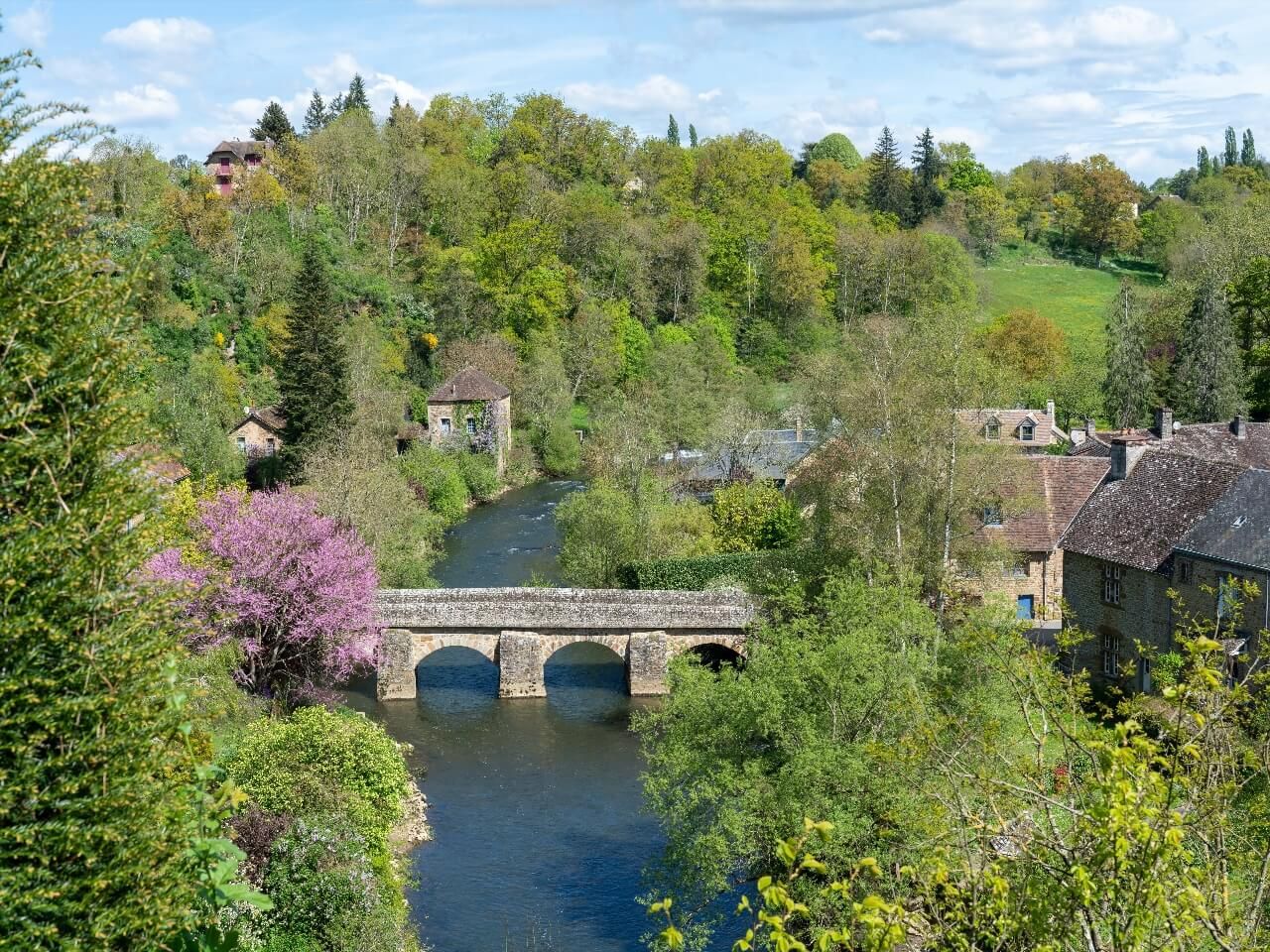
Some places seem made to be painted. Saint-Céneri-le-Gérei (Le Bourg, 61250 Saint-Céneri-le-Gérei, rated 4.7/5 on Google with 540 reviews) is one of them, and the artists of the second half of the 19th century knew it well: Corot, Courbet and a whole generation of landscape painters stayed here to capture the particular light of the Sarthe river loop that encircles the village on three sides. On the border between Le Perche and the Alpes mancelles, it is the only village in this selection officially listed among the « Plus Beaux Villages de France » — a distinction it fully deserves.
The Romanesque Chapelle Saint-Céneri, dating from the 11th century, is the oldest and most moving monument on the site. Its partially preserved medieval frescoes and its apsidal vault make it one of the finest rural churches in Normandy. Heading down toward the river, you cross the old stone bridge spanning the Sarthe in a setting that time seems to have kept intact — the scene is exactly what the 19th-century painters would have known, which is rarer than one might think.
The village draws large crowds in summer, especially at weekends. If you can visit on a weekday or out of season, you will enjoy the atmosphere without the throngs. The hiking paths that follow the river allow you to extend your visit into the surrounding woodland — the GR36 passes nearby.
La Chapelle-Montligeon, the Basilica at the Heart of the Forests
La Chapelle-Montligeon is one of the most unusual villages in the region. Its identity is defined by a single building: the Basilique Notre-Dame de Montligeon (La Chapelle-Montligeon, 61400 La Chapelle-Montligeon, rated 4.7/5 on Google with 682 reviews), an imposing neo-Gothic structure erected from 1894 at the initiative of Abbé Buguet. Dedicated to the souls in purgatory, this basilica is today an active pilgrimage site welcoming tens of thousands of visitors each year — a surprising figure for a commune of fewer than 300 inhabitants tucked away in the forests of Le Perche.
The basilica itself is worth visiting, believer or not: its polychrome stained glass, carved woodwork and 74-metre-long nave make for an interior of uncommon richness for a rural French church. It is, in fact, the largest monument in Le Perche. The exterior dimensions are equally striking — two 60-metre spires dominate the forest for kilometres around. An adjoining museum traces the history of the sanctuary and the devotion to the departed.
The village has hotel accommodation and guest facilities linked to the pilgrimage, making it a practical base for exploring the northern part of the Perche ornais.
Moutiers-au-Perche, the Quiet Side of Le Perche
Moutiers-au-Perche (Le Bourg, 61360 Moutiers-au-Perche, rated 4.3/5 on Google with 85 reviews) is the kind of village that travel guides rarely mention but which regulars of the region know well. This small settlement of around a hundred inhabitants, nestled in a wooded valley not far from the Huisne, has a Romanesque church from the 12th century of elegant proportions, a partly restored medieval manor house, and above all an end-of-the-world atmosphere that recent construction has not yet altered.
The visit takes an hour on foot, with no set itinerary: the church, the path that climbs behind the cemetery with its view over the hills, the wash-house at the edge of the stream. It is precisely in this lightness that Moutiers-au-Perche holds its appeal — a place to breathe, not to tick boxes.
Nogent-le-Rotrou, the City of the Rotrous
Nogent-le-Rotrou is the largest town in the Perche-Gouët, with around 10,000 inhabitants. It is not a village, but its historic centre warrants a substantial stop in any Perche itinerary. The town is dominated by the Château Saint-Jean, a medieval fortress whose rectangular keep, built as early as the 1040s, is among the oldest of its type still standing in France. Preserved to a height of 35 metres, it offers a panoramic view over the town and the surrounding hills.
At the foot of the castle mound, the Église Notre-Dame houses the tomb of Sully, minister to Henri IV, who was lord of Nogent-le-Rotrou and was buried there upon his death in 1641. The half-timbered houses of old Nogent, clustered around the Place du Marché-au-Blé and the Rue Saint-Hilaire, form a coherent urban backdrop that contrasts sharply with the commercial outskirts. The Saturday morning market brings the surrounding streets to life.
Nogent is also a convenient base for exploring the Perche-Gouët, the southern fringe of the Perche territory stretching into Eure-et-Loir. From here, Frazé, Montmirail and Thiron-Gardais are all reachable in under thirty minutes.
Frazé, a Renaissance Château in the Woods
Frazé is one of the finest surprises of the Perche-Gouët. This village of a few hundred inhabitants preserves a château from the 15th and 16th centuries whose round towers with machicolations and water-filled moats form a Renaissance ensemble of rare architectural coherence. The gardens framing the château were restored at the end of the 20th century and host concerts and exhibitions every summer.
The village itself, with its church and quiet lanes, can be walked in an hour. It is the château and its gardens that justify the journey, particularly during the Journées du Patrimoine, when the interiors are opened to the public.
Montmirail, between Le Perche and the Vendômois
Montmirail occupies a frontier position between the Perche-Gouët and the Vendômois, on a hilltop dominating the surrounding agricultural plains. Its château, whose origins go back to the 10th century but whose main fabric dates from the 15th to 17th centuries, is one of the best-preserved fortified châteaux in the area: the corner towers, the seigneurial residence and the castle chapel form a compact and impressive ensemble.
The Collégiale Saint-Laurent, adjoining the château, houses a 14th-century recumbent effigy and several funerary monuments to the lords of Montmirail. The village spreading out below has retained a few old limestone houses, but it is the silhouette of the château on its promontory that remains the defining image of Montmirail.
Senonches, the Forest in the Foreground
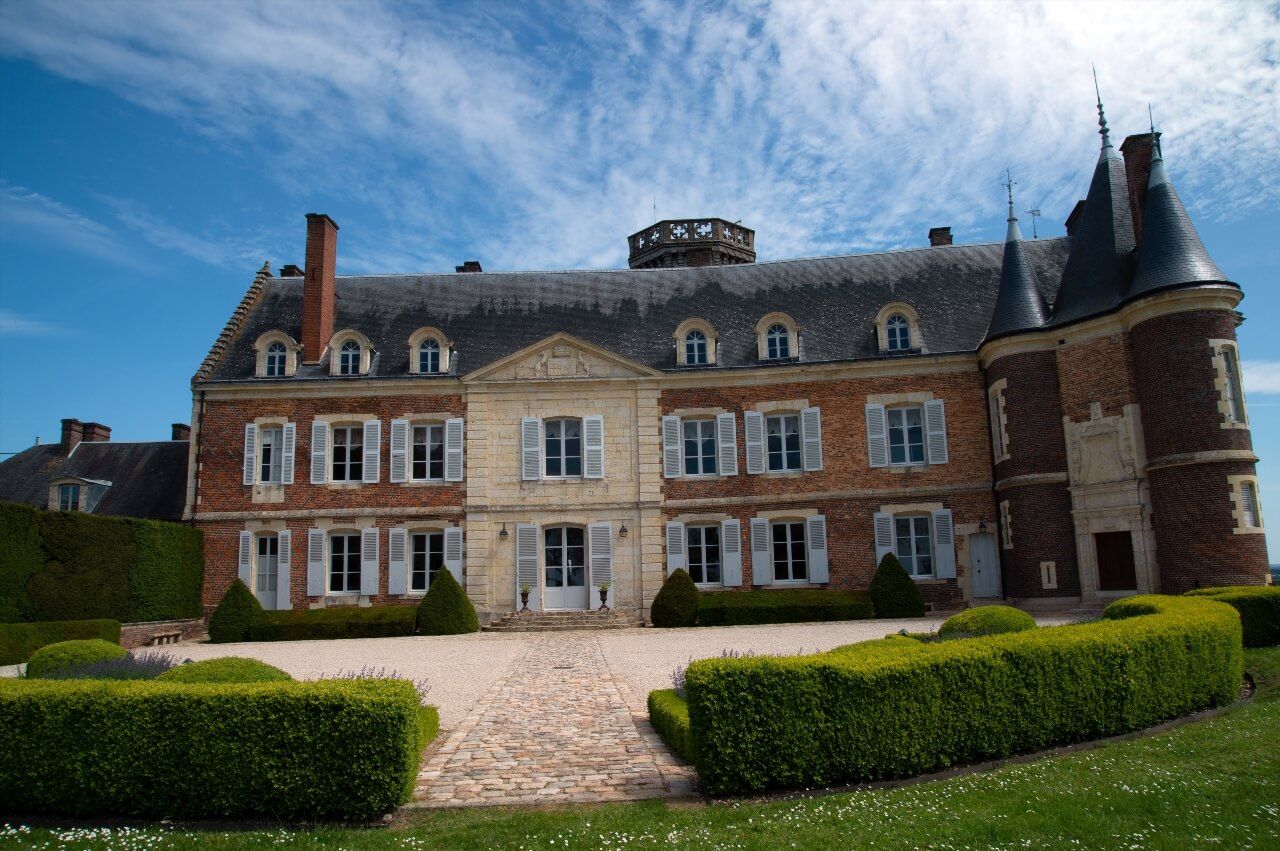
Senonches (Place de l'Hôtel de Ville, 28250 Senonches, rated 4.2/5 on Google with 160 reviews) is defined above all by its forest: with nearly 4,300 hectares, the Senonches state forest is the largest in Eure-et-Loir, a mass of oak and Scots pine that serves as the main playground for the region's hikers, cyclists and horse riders. The village itself, a good hundred inhabitants at the heart of a wider commune, revolves around its 12th-century château, built by Hugues II de Châteauneuf and converted into a forest interpretation centre, and a 15th-century church.
Senonches is less visually striking than some other villages on this list, but it is one of the best bases for outdoor activities in the Perche-Gouët: the Maison de la Forêt offers permanent exhibitions and guided outings, and the network of marked trails around the village runs to dozens of kilometres.
Thiron-Gardais, the Forgotten Abbey
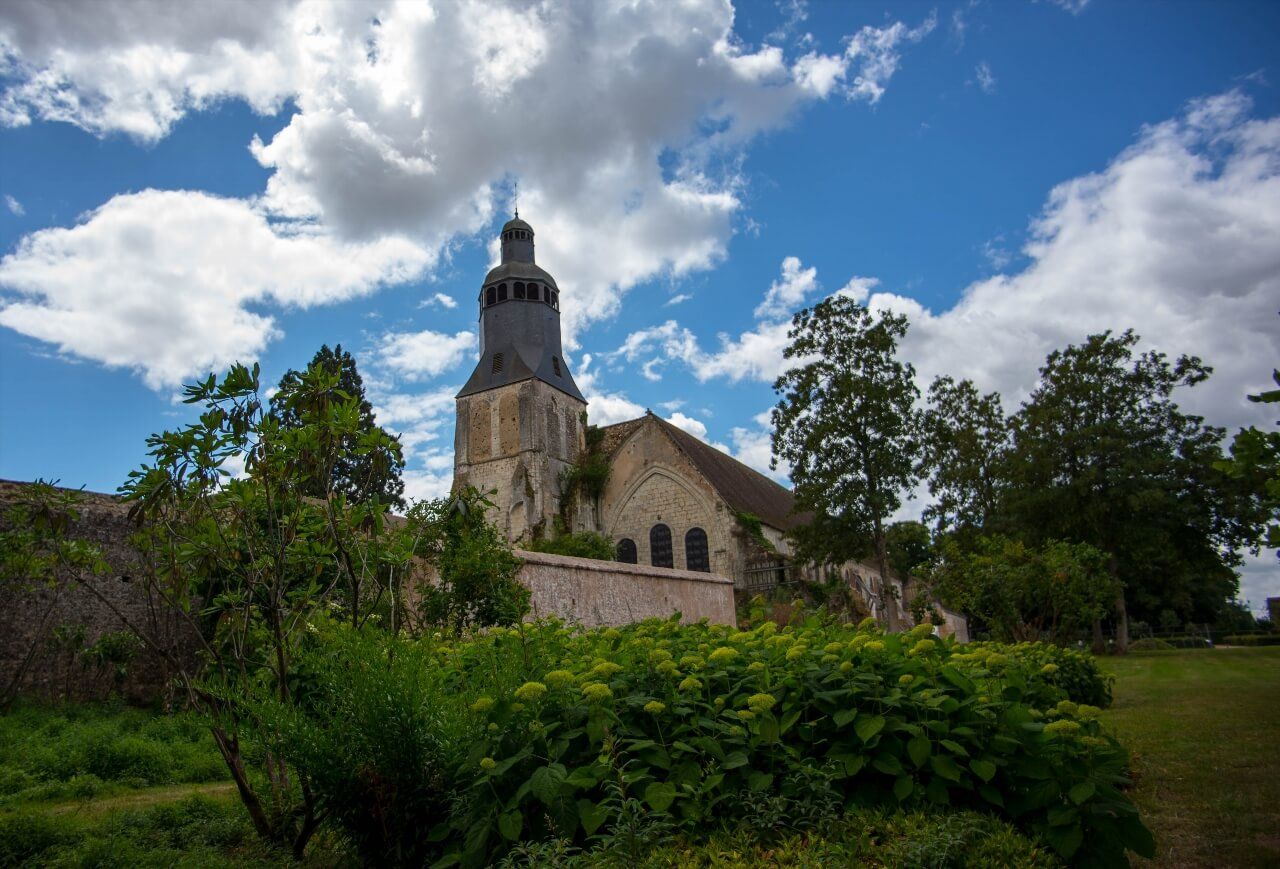
Thiron-Gardais is one of those discoveries you make by chance and are slow to forget. The village owes its existence to a Benedictine abbey founded in 1114 by Saint Bernard of Thiron, a reformer who had a reputation for attracting the most skilled craftsmen of his era. The Order of Tiron spread within a few decades to more than a hundred dependent priories, reaching as far as England, Scotland and Ireland.
What survives today is the partly restored 12th-century abbey church and a few conventual buildings integrated into a former college — giving the site a distinctive atmosphere, halfway between school life and medieval architecture. Visits to the church can be arranged through the local tourist office.
La Ferté-Vidame, the Landscape Park
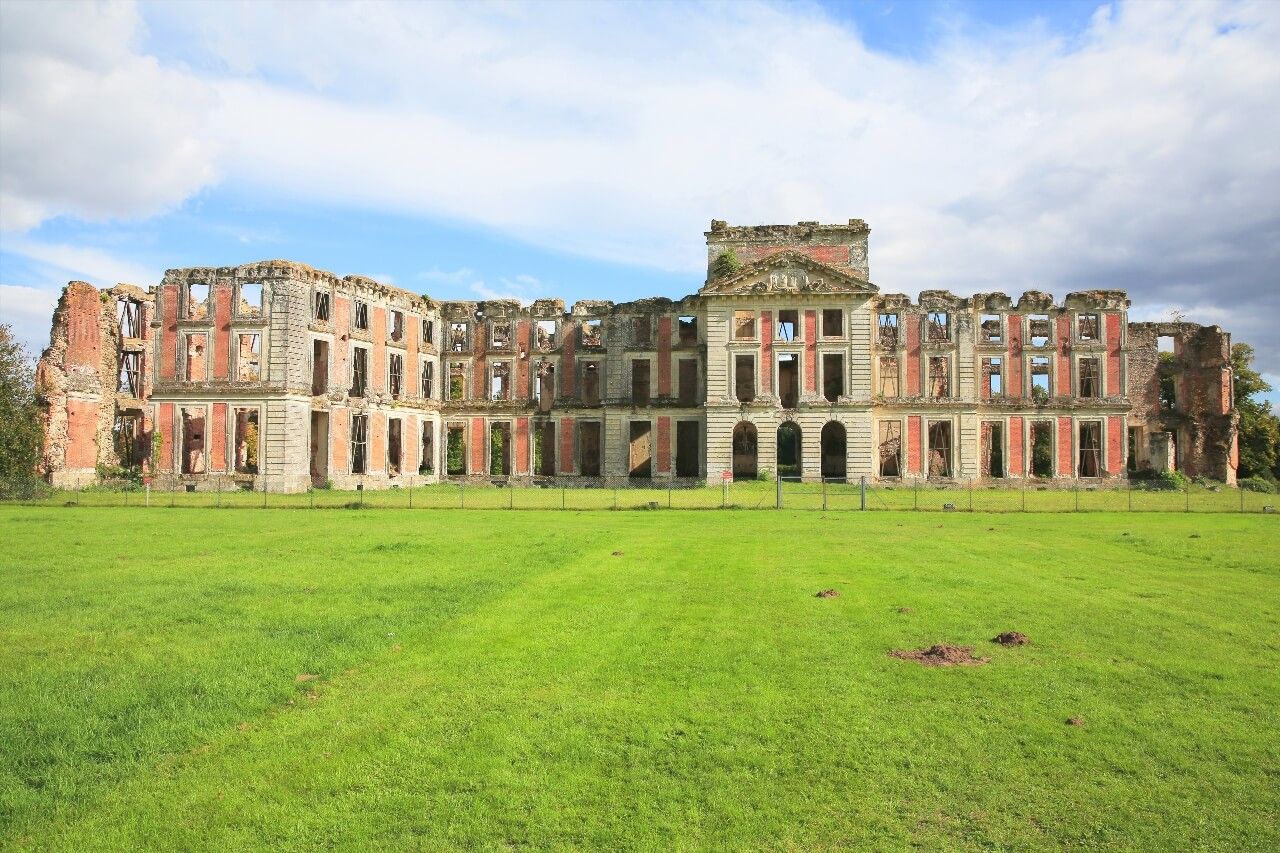
La Ferté-Vidame is known for two things: the ruins of its 18th-century château, associated with the Duc de Saint-Simon (the author of the celebrated Mémoires, who wrote much of his work here), and its landscape park, one of the largest in Le Perche, which once extended over nearly 900 hectares. The château itself has lain in ruins since the Revolution, but the surviving façades and outbuildings are enough to convey the ambition of the original project.
The park, with its ponds, oak avenues and garden follies, is freely accessible. You can spend several hours wandering between the lakes and copses. The village of La Ferté-Vidame, also awarded the Petite Cité de Caractère label, is modest, but its church and a few half-timbered houses are worth a look after a stroll through the park.
Bonneval, the Abbey Churches of Eure-et-Loir
Bonneval (Place du Général-de-Gaulle, 28800 Bonneval, rated 4.6/5 on Google with 56 reviews) lies slightly off the heart of Le Perche, on the border between the Perche-Gouët and the Beauce, but its monuments justify the excursion. The village, through which the Loir flows, possesses a Benedictine abbey founded in the 9th century, whose Romanesque-Gothic abbey church is one of the best-preserved religious buildings in Eure-et-Loir. The medieval ramparts that still partly encircle the village give Bonneval a recognisable silhouette visible from the approach roads.
The walk along the ramparts and the banks of the Loir is the best visiting itinerary: you pass the Porte Bungener, the enclosure towers and the moat before reaching the village centre. Bonneval hosts a weekly market and several cultural events linked to the abbey. It is the kind of village that Ryo favours for its audio-guided tours: rich in history, compact in size, readable in two hours.
Practical Information for Visiting Le Perche
Le Perche is best visited by car, as public transport between villages is virtually non-existent. From Paris, allow approximately 1h30 to reach Mortagne-au-Perche via the A11 and N12. The region is ideally explored over two or three days: one day for the Perche ornais (Bellême, Mortagne, La Perrière, La Chapelle-Montligeon), another for the Perche-Gouët (Nogent-le-Rotrou, Frazé, Thiron-Gardais, Senonches). Accommodation is concentrated in Mortagne and Bellême for the first area, and in Nogent-le-Rotrou for the second.
The best time to visit is spring (May–June) for the forests in full leaf, or autumn (September–October) for the light and the mushrooms. Avoid August at Saint-Céneri-le-Gérei, which then attracts crowds disproportionate to the village's size. To plan your itinerary and add depth to each stop, Ryo's audio guides let you move between these villages at your own pace, headphones on.
FAQ about the Villages of Le Perche
Where exactly is Le Perche located?
Le Perche is a natural and historical territory located approximately 150 kilometres south-west of Paris. It extends mainly across three departments: the Orne (Perche ornais), Eure-et-Loir (Perche-Gouët) and partly the Sarthe. It is not an administrative region but a coherent geographical and cultural entity, recognised since the Middle Ages and today partly covered by the Parc naturel régional du Perche.
What are the must-see highlights of Le Perche?
The must-sees, in order of renown, are: Bellême and its state forest, Mortagne-au-Perche and its white pudding, Saint-Céneri-le-Gérei (the only village in the area listed among the « Plus Beaux Villages de France ») and La Chapelle-Montligeon with its basilica. For those wishing to go further, Frazé and its Renaissance château are the most surprising discovery on the Eure-et-Loir side.
How can you visit Le Perche without a car?
It is challenging, but not impossible. Trains connect Paris-Montparnasse to Nogent-le-Rotrou and to Mortagne-au-Perche. However, to reach isolated villages such as La Perrière, Saint-Céneri or Frazé, you will need a bicycle (some tourist offices offer rentals) or a local taxi. An increasingly popular option: cycling holidays on the roads of Le Perche, linking several villages over two or three days with luggage transferred between each stage.
Is Le Perche ideal for a weekend trip from Paris?
It is one of its main strengths. At 1h30 by car from Paris, Le Perche offers deep countryside without the fatigue of a long journey. A two-day weekend allows you to cover the Perche ornais or the Perche-Gouët properly, but not both. For a more complete exploration including both areas and a few château visits, plan a minimum of three days.
Are there hiking trails in Le Perche?
Yes, and it is one of the region's flagship activities. The GR36 crosses the territory from north to south, passing through Saint-Céneri-le-Gérei and the Orne forests. The Bellême forest has a marked network of over 100 kilometres. Around Senonches, the trails through the state forest are particularly popular with hikers and mountain bikers. The tourist offices in Mortagne and Nogent-le-Rotrou distribute detailed walking guides.
Conclusion
Le Perche keeps a rare promise: that of a living rural France, where villages are not frozen stage sets but inhabited places, with their markets, their craftspeople and their landscapes that change with every season. Whether you start from Bellême in the north or Bonneval in the south, every stop in this selection has something irreplaceable to offer. To continue your discoveries in other regions of France, the Ryo app offers audio guides to the most beautiful villages in France — ideal for exploring at your own pace, with no group constraints or fixed schedules. Enjoy your journey through Le Perche.