
Créé par Emilie, le 20 juin 2026
Votre guide Ryo
Père-Lachaise Cemetery: The Complete Guide to Visiting the World's Most Beautiful Cemetery (2026)
© Shutterstock
Père-Lachaise Cemetery in Paris is a place where you wander cobblestone paths beneath century-old chestnut trees, where every stone tells a life that shaped history. It is not a simple burial ground: it is the largest open-air museum in Paris, a historic park of 44 hectares that welcomes more than 3.5 million visitors per year, more than some national museums. Founded in 1804 on the heights of the 20th arrondissement, Père-Lachaise today holds approximately 70,000 burial plots and the graves of more than 300 notable figures from around the world. To explore this extraordinary heritage with historical and artistic context, the Ryo audio-guided tour of Père-Lachaise offers 18 audio tracks along a 8.9 km route, a way to transform a stroll into a genuine journey through time.
This guide takes you to meet the notable figures buried here, the masterpieces of funerary sculpture, and the hidden pathways where vegetation reclaims its hold on stone. You will discover that Jim Morrison rests just a few hundred metres from Frédéric Chopin, that Oscar Wilde's tomb is covered in messages from around the world, and that Édith Piaf continues to draw admirers every week. Two detailed itineraries will help you plan your visit, whether you have two hours or half a day. Opening hours, access, practical tips, funerary art, biodiversity: everything you need to know to make the most of Père-Lachaise in 2026.
The History of Père-Lachaise: Two and a Half Centuries of Heritage
Behind the name "Père-Lachaise" lies that of Father François de la Chaise, a Jesuit confessor to Louis XIV who resided on this hill in the 17th century. The property belonged to the Jesuits before being sold to the City of Paris during the Revolution. It was Nicolas Frochot, prefect of the Seine under Napoleon Bonaparte, who had the idea of creating here the first major municipal cemetery in Paris, designed by architect Alexandre-Théodore Brongniart, the same man who designed the Palais de la Bourse.
The opening, on 21 May 1804, was met with relative indifference: Parisians were reluctant to bury their loved ones so far from the city centre. Frochot then employed a remarkable communications strategy for the era: in 1817 he arranged for the remains of Molière, Jean de La Fontaine, and those of Pierre Abélard and Héloïse (Division 7, Cimetière du Père-Lachaise, 75020 Paris, rated 4.7/5 on Google based on 73 reviews), the mythical lovers of the Middle Ages, to be transferred here. The publicity was immediate. Within a few years, Père-Lachaise became the most sought-after burial site in the capital.
Throughout the 19th century, the cemetery gradually expanded, growing from 17 hectares at its founding to 44 hectares today, organised into 97 numbered divisions. The great Haussmann urban works influenced its layout: tree-lined pathways, viewpoints, and star-shaped intersections. The Mur des Fédérés, in the eastern section, recalls a defining episode of the Paris Commune in 1871 and is today a major site of collective memory. Several monuments on the site are listed or registered as historic monuments.
Today, Père-Lachaise remains an active cemetery managed by the City of Paris. It is also one of the most visited sites in France, frequented by the curious, history enthusiasts, and tourists from around the world who come to pay their respects, or simply to stroll through one of Paris's most remarkable parks.
Opening Hours, Access, and Map: Everything You Need to Know Before You Visit
Entry to Père-Lachaise Cemetery is free and accessible year-round. Opening hours vary slightly by season:
- From 16 March to 5 November: Monday–Friday 8am–6pm, Saturday 8:30am–6pm, Sunday and public holidays 9am–6pm
- From 6 November to 15 March: closing at 5:30pm
There are several main entrances:
- Boulevard de Ménilmontant (main entrance, division 1), the busiest, and the ideal starting point for a visit
- Rue du Repos (south entrance), convenient for quick access to the famous graves in the central section
- Rue de la Réunion (east entrance), for exploring the quieter divisions
To find your way around, the official map is available at the main entrance and on the City of Paris website. Each famous grave is identified by its division number, essential for avoiding hours of wandering through the maze of pathways. The cemetery is partially accessible to visitors with reduced mobility: the main pathways are manageable, but the cobblestone climbs towards the upper divisions can be challenging.
The Main Entrance and the First Pathways
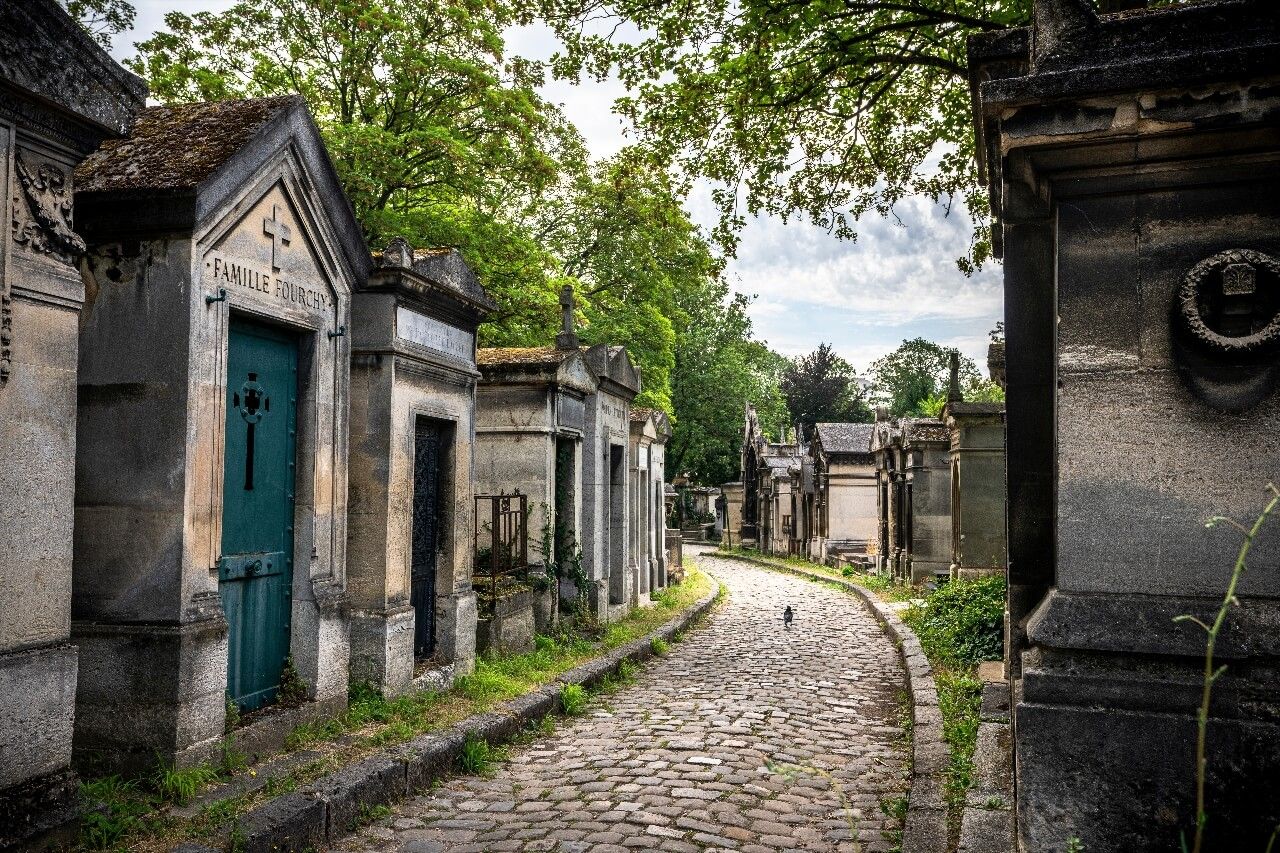
Passing through the gates on the Boulevard de Ménilmontant is to enter a world apart. The first divisions immediately strike with their density: monuments from every era follow one another without any apparent order, reflecting two centuries of history. Neo-Gothic chapels stand alongside Art Deco steles, classical columns next to contemporary sculptures.
The Boulevard de Ménilmontant runs along the western side of the cemetery. From the main entrance, the Avenue Principale gently climbs towards the heart of the site. To the left, the first ornate tombs quickly come into view — small ashlar chapels, some adorned with stained glass faded by the seasons. To the right, more modest rows serve as a reminder that Père-Lachaise welcomes everyone, from national luminaries to anonymous families.
Visitors who take the time to look up will discover that the cemetery is also a remarkable garden: lime trees, sycamore maples, black locusts, and horse chestnuts form a dense canopy above the pathways. On sunny days, light filters through the foliage and creates an almost forest-like atmosphere, far removed from the noise of Paris.
The granite-paved pathways bear evocative names: Avenue de la Chapelle, Chemin du Dragon, Allée des Acacias. Some are so narrow that you must walk in single file, brushing against stone monuments. Others open onto small squares where several pathways cross, offering unexpected vistas over rows of monuments stepping down the hillside.
The Most Visited Graves: Jim Morrison, Édith Piaf, Oscar Wilde
Three graves alone account for a large share of Père-Lachaise's tourist footfall. These are sites of cultural pilgrimage, where admirers from around the world come every day to lay flowers, leave messages, and place tokens of devotion.
Jim Morrison, Division 6
Jim Morrison, lead singer of The Doors, rests in division 6. His grave, a simple granite slab topped with a stone engraved in ancient Greek, draws visitors from every country. The inscription, "True to his own spirit," was chosen by his family. For decades, the slab was covered in messages and objects left as tributes. The City of Paris has repeatedly renovated and secured the site. Today, a barrier surrounds the grave, but the devotion of fans remains undiminished: bouquets, photographs, and guitar picks continuously accumulate on the nearby wall.
Édith Piaf, Division 97
Édith Piaf, "la Môme" who grew up in the neighbouring Belleville district, rests in division 97. The tomb, in grey granite, is understated and peaceful. It always bears fresh flowers, often red roses. Piaf is one of the most visited figures in the cemetery, and the emotion of visitors paying their respects here is often palpable. Admirers love to recall that the singer was born just a few hundred metres away, in that same working-class 20th arrondissement she never disowned.
Oscar Wilde, Division 89
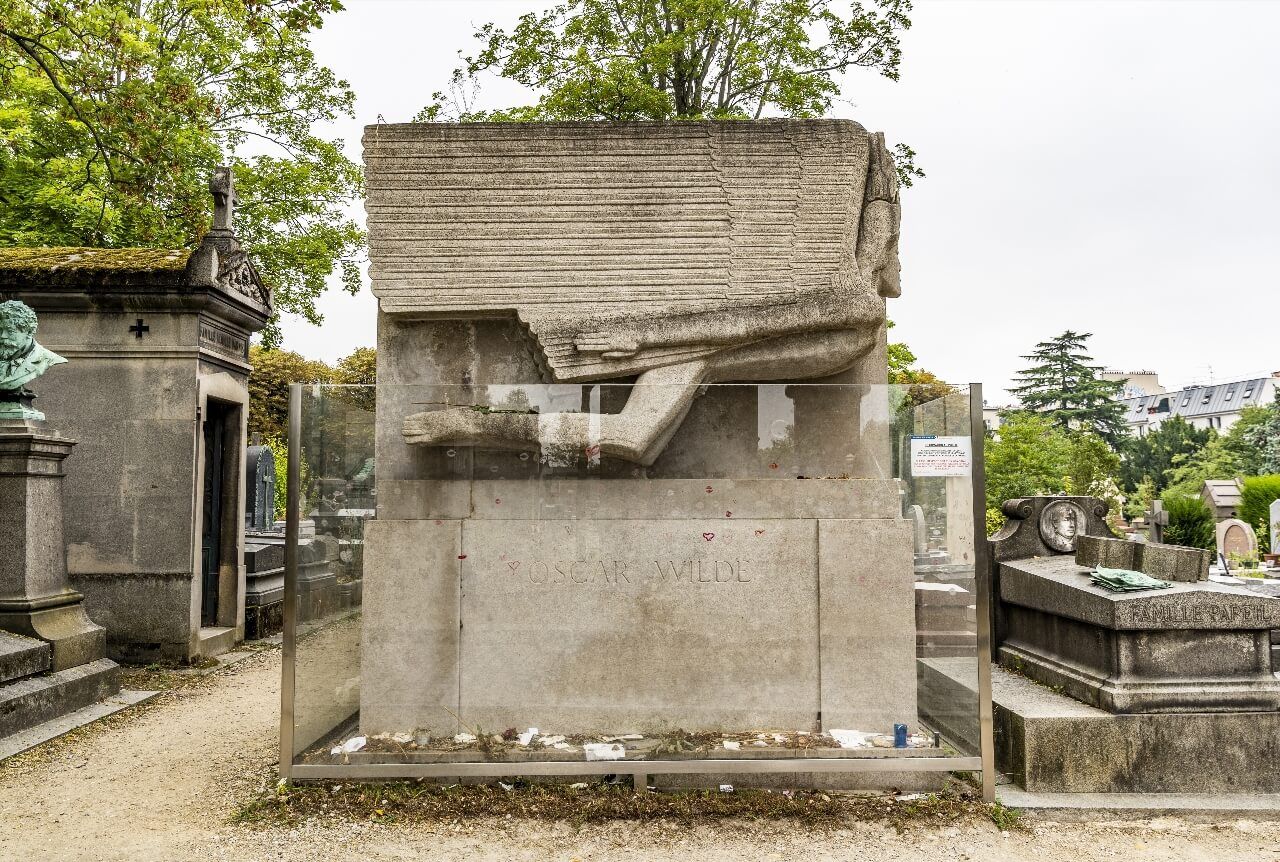
The tomb of Oscar Wilde is arguably the most singular in all of Père-Lachaise. The Irish writer, who spent his final years in Paris, is buried beneath a winged sphinx sculpted by Jacob Epstein in 1912, a monumental work of art that stands apart from the rest of the cemetery's landscape. For years, it was customary for visitors to press lipstick kisses onto the monument, gradually coating it in a colourful layer. Regular cleaning of the monument and the installation of a protective glass screen put an end to this practice, but the grave remains one of the most photographed in the world. Hundreds of small notes of love and admiration are still slipped into the gap between the glass and the stone.
Other Iconic Graves Not to Be Missed
Frédéric Chopin (Division 11, Cimetière du Père-Lachaise, 75020 Paris, rated 4.8/5 on Google based on 346 reviews) (division 11), the Polish pianist and composer, rests beneath a monument adorned with a weeping muse sculpted by Jean-Baptiste Clésinger. Marcel Proust (division 85) has a tomb in black marble, understated and elegant. Simone Signoret and Yves Montand, the mythical couple of French cinema, lie side by side in division 44. Molière (division 25) and Jean de La Fontaine (division 25), transferred here in 1817 to popularise the fledgling cemetery, each have their own monument.
Notable Figures from the Arts and Literature
Père-Lachaise is above all a literary and artistic pantheon. The list of writers buried here could fill several libraries: Honoré de Balzac (division 48), the author of the Comédie humaine, has rested here since 1850. His tomb, topped with a bronze bust in his likeness, is one of the most visited by French readers. Guillaume Apollinaire (division 86), poet of the avant-garde, has a stele adorned with his portrait in medallion. Colette (division 4), the first woman elected to the Académie Goncourt, has a modest burial plot, often adorned with flowers.
From the world of theatre and the stage, Sarah Bernhardt (division 44), "the Divine," rests beneath a granite slab. The tragedienne who invented a revolutionary style of acting at the end of the 19th century remains a reference for actors the world over. Molière, already mentioned, shares his division with La Fontaine, a symbolic pairing of the two giants of the Grand Siècle.
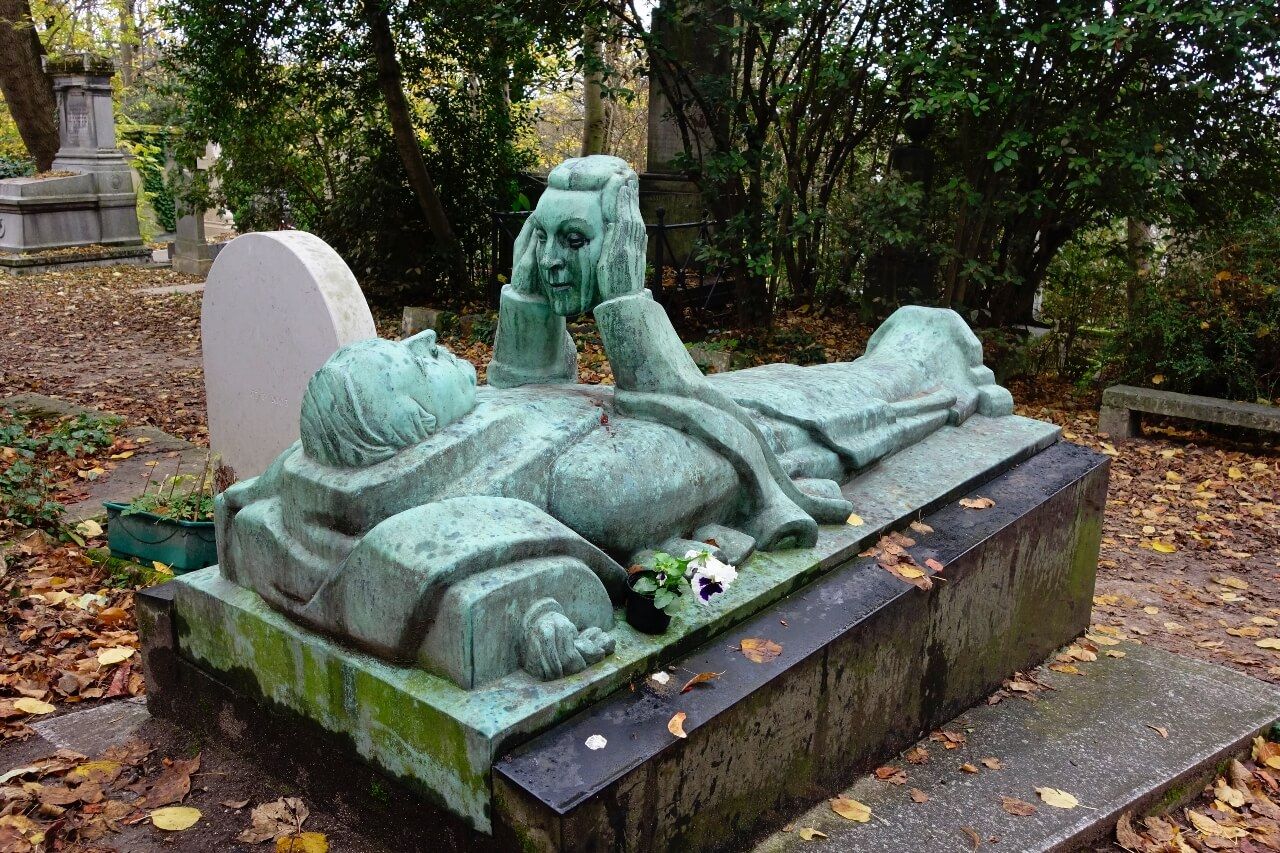
Philosophy enthusiasts will find Auguste Comte (division 17), founder of positivism, whose tomb has been maintained by an association of disciples since the 19th century. Victor Noir (Division 92, Cimetière du Père-Lachaise, 75020 Paris, rated 4.8/5 on Google based on 41 reviews) (division 92) is in a category of his own: this young journalist of the Second Empire is depicted by a life-size bronze statue lying down, polished and shining in certain places by contact with millions of hands, according to a folk tradition linked to fertility.
Eugène Delacroix (division 49), master of Romantic painting, is also interred here. For fans of popular literature, Paul Féval père (division 50), creator of the character Lagardère, rests here too. Père-Lachaise is thus a library in stone where each visit yields new discoveries, depending on one's own cultural interests.
Musicians and Composers at Père-Lachaise
If you close your eyes in certain pathways of Père-Lachaise, you might almost hear music, so well represented are the great figures of musical history. Frédéric Chopin (division 11) naturally heads this list, and his grave remains a site of pilgrimage for pianists and music lovers from around the world. Each year, during commemorations linked to the composer, bouquets are laid at his feet, often brought from Poland.
Gioacchino Rossini (division 4), composer of The Barber of Seville, was interred at Père-Lachaise in 1868 before his remains were transferred to Florence in 1887. His original burial plot is still present and visited. Luigi Cherubini (division 11), another opera composer of the 19th century, is buried not far from Chopin. Georges Bizet (division 68), composer of Carmen, has a simple tomb regularly adorned with flowers by opera enthusiasts.
From the world of French song, the presence of Édith Piaf (division 97) has already been noted, and the couple Yves Montand and Simone Signoret (division 44) rest in a plot of touching simplicity: Montand, the performer of unforgettable songs before becoming one of the great actors of French cinema, is buried alongside his partner.
Rock and contemporary music fans will not want to miss the grave of Jim Morrison (division 6), which has become one of the unmissable stops in the cemetery. The Ryo audio-guided tour of Père-Lachaise connects these musical graves with anecdotes and historical context that the signs alone cannot convey.
Painters, Sculptors, and Visual Artists
Père-Lachaise is also a museum of painting and sculpture in a double sense: artists rest here, and their works sometimes find a final home in the form of funerary monuments commissioned from their peers.
Théodore Géricault (division 12), painter of The Raft of the Medusa, has a tomb topped with a bronze depicting him lying down and painting, a funerary work that is itself a sculptural masterpiece. Camille Pissarro (division 7), a key figure of Impressionism, rests here. Amedeo Modigliani (division 96), the Italian painter and sculptor whose elongated portraits left their mark on 20th-century art, is buried together with his companion Jeanne Hébuterne in the same grave, a symbol of their shared destiny.
From the world of sculpture, Jean-Baptiste Pigalle (division 9), whose name gave its nickname to an entire Parisian neighbourhood, is buried here quietly. Antoine-Louis Barye (division 51), a celebrated animal sculptor, has a modest tomb that hardly reflects the power of his bronzes. For those with an interest in photography, Nadar (Gaspard-Félix Tournachon, division 33), painter and pioneering photographer who produced the first portraits of Parisian personalities, has his tomb among the cemetery's pathways.
Art is not limited to the notable figures buried here: the funerary monuments themselves constitute an exceptional open-air sculpture collection. Sculptors such as Barrias, Préault, and David d'Angers have left works here that deserve a place in the greatest museums. As you walk slowly, you will discover marble cherubs, stone drapery of exceptional delicacy, and faces sculpted with striking expressiveness.
Scientists, Politicians, and Historical Figures
Père-Lachaise is not solely the cemetery of artists. Scientists, statesmen, and defining figures of French history rest within its pathways.
Auguste Comte (division 17), founder of positivism and modern sociology, is buried in a chapel maintained since the 19th century by an association of disciples. His burial plot is one of the few in the cemetery to have been the subject of an organised tribute by his followers.
Gay-Lussac (division 26), physicist and chemist credited with the laws of gases, rests here. Pierre Larousse (division 91), the encyclopaedist who founded the famous dictionary bearing his name, has a tomb regularly pointed out to general knowledge enthusiasts. Georges Méliès (Division 64, Cimetière du Père-Lachaise, 75020 Paris, rated 4.9/5 on Google based on 11 reviews) (division 64), the magician turned filmmaker who invented the first special effects in cinema, is interred here, a pioneer whose grave draws film enthusiasts from around the world.
Among political figures, Marshal Masséna (division 28), one of Napoleon's great military commanders, has an imposing monument. Adolphe Thiers (division 55), first president of the Third Republic, rests in a classical monument. History enthusiasts with an interest in the Paris Commune will inevitably stop at the Mur des Fédérés (division 76), which has become a site of remembrance and gathering every spring.
This diversity makes Père-Lachaise a mirror of French history over two centuries: the cultural, scientific, and political revolutions are all written in stone and bronze.
Commemorative and Memorial Monuments
Beyond individual graves, Père-Lachaise holds a remarkable collection of collective monuments that make it a place of memory as much as a cemetery. These monumental sculptures, signed by major artists, constitute on their own a journey through art history.
The Mur des Fédérés (Division 76, Cimetière du Père-Lachaise, 75020 Paris, rated 4.8/5 on Google based on 98 reviews) (division 76) is the best known. This long red-brick wall is associated with the final days of the Paris Commune in 1871. Having become a symbol of the labour movement, it hosts every year, on the last Sunday of May, the traditional "Montée au Mur" gathering.
The cemetery also includes several monuments dedicated to 20th-century memory, created by major post-war sculptors. Grouped mainly around the upper divisions, they form an ensemble of great visual power, paying tribute to essential chapters of contemporary history. These works, austere and powerful, are particularly well attended during May commemorations.
These memorials integrate naturally into the walk: they require no major detour but form part of the visitor's route through the upper divisions of the cemetery, complementing the artistic dimension of the site.
Funerary Art: Masterpieces of Sculpture and Architecture
Had you come only for a stroll, the funerary art of Père-Lachaise would keep you for hours. This cemetery is an open-air lesson in art history, where every aesthetic tendency of the last two centuries is represented in succession.
The Neo-Gothic chapels of the 19th century initially dominate the landscape. Inspired by medieval cathedrals, they display pinnacles, miniature gargoyles, pointed arches, and stained glass. Some bourgeois families had true small buildings constructed here, with interior altars, ornate wrought-iron gates, and stained-glass windows depicting biblical scenes. Many retain a distinct Romantic charm today.
The Art Deco style of the 1920s and 1930s left monuments of understated elegance: clean lines, noble materials such as black granite or white marble, and inscriptions in modernist typefaces. These tombs deliberately contrast with the Victorian exuberance that precedes them.
Among the most artistically remarkable works, the tomb of Oscar Wilde (Epstein's sphinx, division 89) is unquestionably the star. But one should also pause before the monument of Géricault (division 12) with its recumbent bronze, and before the monument of Abélard and Héloïse (division 7), a Neo-Gothic baldachin erected in 1817 using fragments from the Paraclete Abbey. This monument, one of the oldest in the cemetery, is also one of the most Romantic.
Sculpture enthusiasts will not want to miss the marble angels watching over several graves in division 11, works by 19th-century academic artists of impeccable technique. Division 44, where many stage artists rest, concentrates particularly elaborate monuments. And throughout your walk, details will surprise you: a bronze book lying open on a poet's tomb, a sculpted lyre on that of a musician, a marble paintbrush resting on a painter's slab.
Wildlife and Flora: A Green Lung in the Heart of Paris
Père-Lachaise is also — and this often surprises first-time visitors — a remarkable natural space protected by the City of Paris. Its 44 hectares make it one of the largest tree-covered spaces in central Paris, with a biodiversity that has grown considerably since the site began to be managed according to eco-landscaping principles.
Around 4,000 trees belonging to more than 80 different species have been recorded: horse chestnuts, black locusts, silver limes, plane trees, maples, ash trees, and centuries-old yews. Some specimens are classified as remarkable trees by the City of Paris. In spring, the flowering trees create pink snowfall effects along the pathways; in autumn, the foliage colours the cemetery in red and gold.
On the wildlife side, Père-Lachaise is one of the sites in Paris where foxes can most easily be spotted, having made their home in its quieter divisions. Semi-wild cats, hedgehogs, bats, and numerous nesting bird species complete the picture. Amateur ornithologists sometimes visit specifically to observe great spotted woodpeckers, robins, or blue tits just a few metres away.
Suggested Itinerary: 2 Hours for the Essentials
Only have two hours? Here is a route that will let you see the most iconic graves without getting lost.
Enter via the Boulevard de Ménilmontant. Walk up the Avenue Principale to division 11 to begin with Chopin and the beautiful Neo-Gothic chapels nearby. Continue to division 7 for the monument of Abélard and Héloïse. Then head diagonally down to division 6 for Jim Morrison: allow a few extra minutes, as the queue can be long in high season.
From there, head back up to division 44 for Simone Signoret and Yves Montand, then continue to division 48 for Balzac. Next, head to division 89 for Oscar Wilde — it is a little out of the way but unmissable. Make your way back down to division 85 for Marcel Proust, then finish in division 97 with Édith Piaf, before exiting through the Rue du Repos entrance or returning along the Avenue Principale.
This route of approximately 4 km covers the major names without claiming to be exhaustive. To move more efficiently between graves, the Ryo audio guide for Père-Lachaise includes clear navigation cues between each stop and contextualises each figure with historical anecdotes.
In-Depth Itinerary: Half a Day to Truly Explore
If you have 3 to 4 hours, Père-Lachaise reveals hidden treasures that most guides overlook. This in-depth route begins in the lower divisions and gradually climbs toward the heights of the cemetery.
Divisions 1–12 (starting point): from the main entrance, take the path towards the first divisions. Look for the monuments of 19th-century bourgeois families: some chapels are true gems of Neo-Gothic architecture. In division 9, seek out the tomb of Pigalle. In division 11, Chopin and his elegant marble muse.
Divisions 12–30 (climbing toward the centre): the tomb of Géricault in division 12 deserves a photographic pause. Division 17, Auguste Comte and his burial plot maintained by a group of devoted followers. Division 25, Molière and La Fontaine side by side. Division 28, the imposing monument of Marshal Masséna.
Divisions 40–55 (the heart of the cemetery): division 44, the artists' plot with Signoret and Montand. Division 48, the bust of Balzac. Division 49, Delacroix. Division 51, the animal sculptor Barye. Division 55, Adolphe Thiers.
Divisions 64–97 (the upper section): division 64, Georges Méliès. Division 68, Georges Bizet. Division 76, the Mur des Fédérés and its memorials. Division 85, Proust and his black marble. Division 86, Apollinaire. Division 89, Oscar Wilde. Division 92, Victor Noir. Division 96, Modigliani. Division 97, Édith Piaf.
For this complete route, the Ryo Père-Lachaise Ryocity is particularly valuable: 18 audio tracks over 8.9 km guide your walk with biographical narratives and historical context. The estimated duration is 3 hours 40 minutes, which corresponds exactly to this type of in-depth visit.
The Crematorium and Columbarium
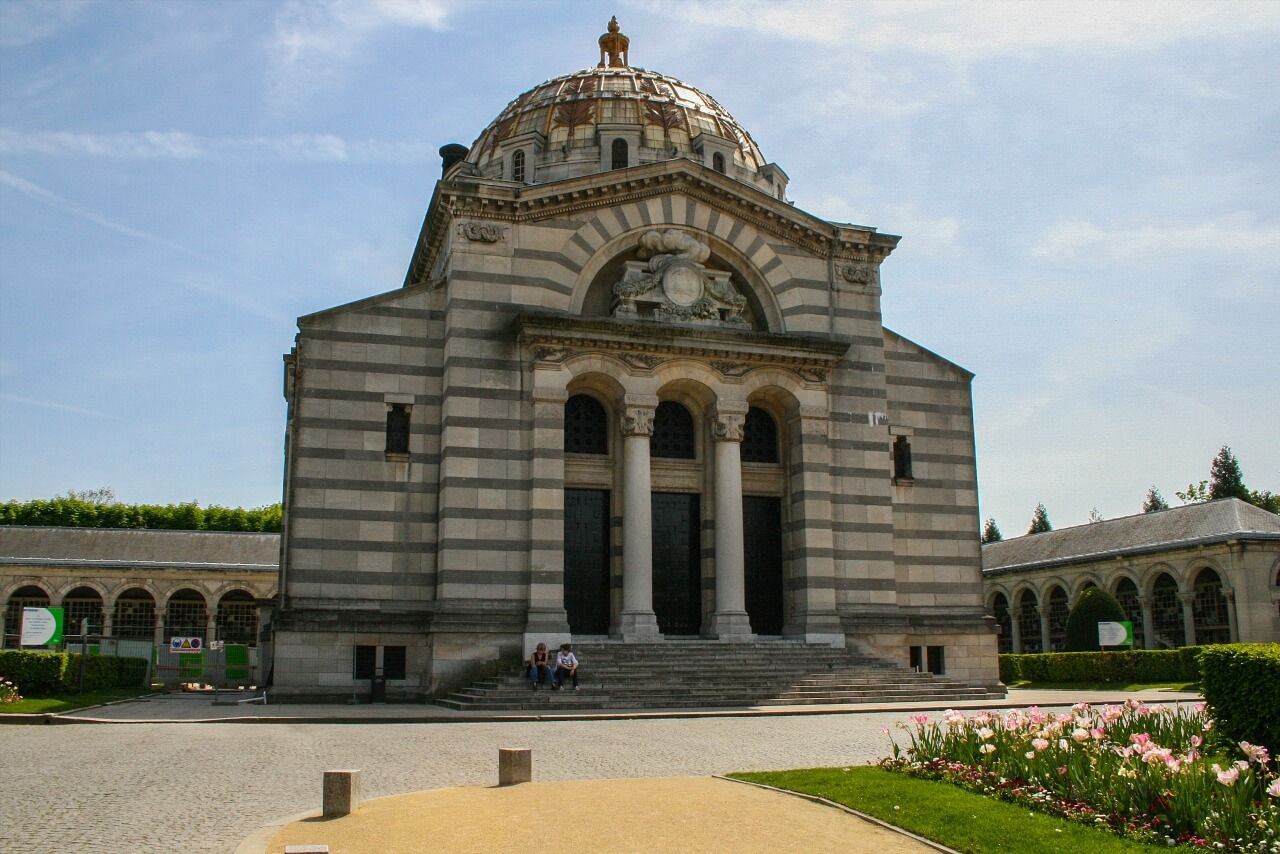
The Père-Lachaise crematorium (8 Boulevard de Ménilmontant, 75020 Paris, rated 4.6/5 on Google based on 4,507 reviews) was the first in France. Designed from 1886 onwards by architect Jean-Camille Formigé, it held its first cremation in 1889. The neo-Byzantine brick building, located in the north-eastern part of the cemetery (division 87), is accessible to visitors outside of ceremonies.
Adjacent to the crematorium, the columbarium is a remarkable architectural structure: galleries of niches stacked across several levels house funeral urns. Among the notable figures whose ashes rest here are Isadora Duncan, the American dancer and pioneer of modern dance, and Max Ernst, a key figure of Surrealism. Visiting the columbarium gives a sense of the true scale of Père-Lachaise and the diversity of burial practices it accommodates.
The crematorium is still in operation. Out of respect for families, certain areas are temporarily off-limits during ceremonies. Check at the entrance if you specifically wish to visit this section.
Guided Tours and Digital Resources
Père-Lachaise can seem daunting at first glance: 97 divisions, thousands of graves, labyrinthine pathways. Several resources can help you find your way and enrich the experience.
The Ryo app and the Ryo audio-guided tour of Père-Lachaise are particularly well suited to this type of site: the 18 audio tracks allow you to explore the cemetery at your own pace, free from group constraints, with biographical narratives that place each figure in their historical and artistic context. Available on smartphone, the Ryo tour covers 8.9 km in approximately 3 hours 40 minutes.
Official guided tours are offered by the association "Les amis du Père-Lachaise" as well as by several accredited guide-lecturers. These themed tours (musicians, writers, funerary art) generally last 1 hour 30 minutes to 2 hours and depart from the main entrances. The City of Paris also occasionally offers tours during the European Heritage Days in September.
The free paper map available at the entrance remains a valuable tool. The divisions are numbered and the famous graves are indicated. For themed visits, the Père-Lachaise conservation website offers downloadable lists by category.
Practical Tips: Photography, Accessibility, Services
Photography is permitted throughout the cemetery. Père-Lachaise is one of the great destinations for street photography in Paris: the interplay of light between monuments and vegetation offers exceptional compositions at any hour. Simply be respectful of families during ceremonies.
Accessibility is partial. The main central pathways (Avenue Principale, Avenue de la Chapelle, Avenue Transversale) are manageable in a wheelchair or with a pushchair. The secondary cobblestone pathways and climbs towards the upper divisions are more difficult. No specific accessibility map for visitors with reduced mobility is available at the entrance, but staff can direct visitors.
Available services: public toilets are located near the main entrance on the Boulevard de Ménilmontant and near the crematorium. There is no cafeteria or shop inside the cemetery. Bring water, especially in summer, and comfortable shoes for the cobblestone pathways. The exits on the Rue du Repos side allow you to quickly reach the cafés and bakeries of the Réunion neighbourhood.
How to Get to Père-Lachaise
Père-Lachaise is very well served by Parisian public transport.
Metro: the Père Lachaise station (lines 2 and 3) gives access to the main entrance on the Boulevard de Ménilmontant. The Philippe Auguste station (line 2) provides access to the Avenue de la Réunion entrance. The Gambetta station (line 3) is convenient for the upper divisions (90–97).
Bus: lines 61, 69 and 76 stop near the various entrances. Bus 69 runs directly from central Paris (Rue de Rivoli) to Père-Lachaise, making it a convenient option for reaching the cemetery without a connection.
By bike: the cemetery is located on the slopes of the Ménilmontant hill. Arriving by bike (Vélib' stations available nearby) is pleasant from below, but the climb is demanding. Plan to lock your bike at the racks outside: bicycles are not permitted inside.
Address: 8 Boulevard de Ménilmontant, 75020 Paris.
FAQ
Is Entry to Père-Lachaise Cemetery Free?
Yes, entry is entirely free and open to everyone, with no reservation required. Père-Lachaise Cemetery is a public service managed by the City of Paris. There is no ticket office and no ticket to purchase in order to enter. Guided tours offered by associations or independent guides do have variable pricing depending on the provider (generally between €10 and €20 per person).
How Much Time Should I Plan for a Visit to Père-Lachaise?
Allow a minimum of 1 hour 30 minutes for a visit to the most famous graves without lingering. For a satisfying visit covering the major figures and some funerary art monuments, plan for 2 hours 30 minutes to 3 hours. For an in-depth exploration of the entire site, half a day (4 hours) is recommended. The Ryo audio-guided tour of Père-Lachaise is calibrated at 3 hours 40 minutes for its 18 stops over 8.9 km.
Is It Easy to Navigate with a Map?
The free map available at the main entrance is essential for a first visit. It shows the 97 numbered divisions and indicates the most visited graves. The divisions are delineated by numbered pathways, but the logic is not always immediately intuitive: getting a little lost is perfectly normal. Each section is marked by a division sign, but these signs do not provide directions within the division itself.
Is the Cemetery Open on Public Holidays?
Yes, Père-Lachaise is open every day of the year, including public holidays such as January 1st, November 1st, and December 25th. Sunday opening hours apply on these days (opening at 9am). On November 1st, attendance is particularly high: plan to arrive early to enjoy the most famous graves in relative peace.
Can Visitors Tour the Crematorium and Columbarium?
Both are accessible to visitors outside of ceremonies. The crematorium (division 87) is open during the cemetery's opening hours, except when active ceremonies are taking place. The adjoining columbarium can be explored freely. Some galleries may be temporarily closed for maintenance. It is advisable to check at the entrance if these areas are among your priorities.
Can You Take Photographs in Père-Lachaise Cemetery?
Yes, photography is freely permitted throughout the cemetery. Père-Lachaise is one of the most photographed sites in Paris. The only rule of courtesy is to be respectful of families during ceremonies. For artistic photography, the best light can be found in the late afternoon, when the low sun creates long shadows between the monuments.
Visiting Père-Lachaise with Ryo
Père-Lachaise Cemetery is not a sad place — it is a living testimony to two centuries of French and world culture, a garden inhabited by thousands of stories waiting to be told. Its pathways of stone and greenery offer a unique walk in Paris, between collective memory and aesthetic beauty.
To transform this visit into a genuine cultural experience, the Ryo Père-Lachaise Ryocity accompanies you with 18 carefully crafted audio stories: biographies, unusual anecdotes, and historical context that bring to life the names carved in stone. At your own pace, headphones on, the cemetery becomes a theatre where every monument finds its voice again. Start your audio-guided tour of Père-Lachaise with Ryo and discover why this singular place continues, century after century, to fascinate the world.