
Créé par Emilie, le 15 mai 2026
Votre guide Ryo
© Shutterstock
Frankfurt has a reputation problem. Most visitors spend a jet-lagged afternoon here before catching a train to somewhere supposedly more exciting, and they miss almost everything. The city is home to 35 museums along a single riverside stretch, a medieval square that survived World War II intact and was then painstakingly reconstructed stone by stone, and a zoo that houses white rhinos and runs 365 days a year. If you're hunting for genuinely fun things to do in Frankfurt, explore it all on foot with the Ryo audio guide for Frankfurt, which turns the city's layered history into something you can actually feel while walking.
Below you'll find 25 genuinely worthwhile things to do in Frankfurt, from a 200-metre observation deck above the European Central Bank to a cider tavern where locals have been arguing about football since the 1860s. One museum offers free admission every Wednesday evening. Another holds the world's second-largest collection of old master paintings outside Italy. None of these require a tour bus or a printed itinerary.
1. Wander Römerberg, Frankfurt's Medieval Heart
Römerberg (Römerberg, 60311 Frankfurt am Main) is the kind of square that makes you stop mid-sentence. A tight cluster of half-timbered facades in ochre, sage green and terracotta faces the old town hall, the Römer, across a cobbled plaza where the Holy Roman Emperors once celebrated their coronations. The buildings look almost too perfect, and for good reason: the originals burned in 1944 and were rebuilt in the 1980s using historical blueprints and photographs. The reconstruction is so faithful that the debate about whether this counts as authenticity or theatre is still ongoing.
The Gerechtigkeitsbrunnen (Fountain of Justice) stands at the centre of the square. According to a story locals have repeated for centuries, wine once flowed from its pipes at the coronation of Matthias in 1612. Whether or not that actually happened, the image is irresistible. The square is also where Frankfurters traditionally gather to celebrate when Eintracht Frankfurt wins a major football trophy, a habit that turns the cobbles into an impromptu open-air party every few seasons.
Come on a weekday morning before 9:30 to see the square without tour groups obscuring the facades. The narrow lanes behind Römerberg, particularly Bendergasse and Hühnermarkt, reward slow walking. You'll find independent bookshops, a handful of small galleries and the kind of bakery that smells like it's been there since 1923. For context on what you're actually looking at, the Ryocity Frankfurt audio guide opens with Römerberg and walks you through which buildings are originals, which are 1980s reconstructions, and which fragments survived the bombing intact, which is exactly the kind of detail that turns a photo stop into something memorable.
2. Spend a Morning at the Städel Museum
The Städel Museum (Schaumainkai 63, 60596 Frankfurt am Main, rated 4.6/5 on Google (12 332 avis)) is one of the great art collections of Europe, and it remains stubbornly underrated compared to its counterparts in London, Paris or Amsterdam. Founded in 1815 by the Frankfurt banker Johann Friedrich Städel, it holds over 4,200 paintings spanning seven centuries, including Vermeer's The Geographer, Botticelli's The Ideal Portrait of a Woman, and a large collection of German Expressionist work that rivals anything in Munich or Berlin.
The lower level, opened in 2012, is architecturally worth seeing on its own terms: a subterranean gallery lit by 195 circular skylights that flood the space with natural light. Plan at least two hours, but the kind of visitor who ends up spending four is common.
On Thursday evenings, the museum stays open until 21:00 and the late slot is the quietest moment of the week. On the first Saturday of each month, guided tours run in English at 15:00. The permanent collection is the priority, but check the temporary exhibition schedule before you visit, since the Städel consistently books major international shows.
3. Go Up Maintower for the City Skyline
Frankfurt is the only city in continental Europe where you can stand on a public observation deck inside a working skyscraper and look across a skyline dense enough to feel genuinely urban. Maintower at 200 metres is the tallest publicly accessible building in the city, and the rooftop platform gives an unobstructed 360-degree view that places the financial district's glass towers against the green hills of the Taunus on one side and the flat Rhine-Main plain on the other.
Entry costs €9 for adults, and queues are shortest between 10:00 and 12:00 on weekdays. On clear evenings in summer, the terrace stays open until midnight, sunset over the river with a glass of something cold in hand is a reliable highlight of any Frankfurt trip.
4. Graze Through Kleinmarkthalle
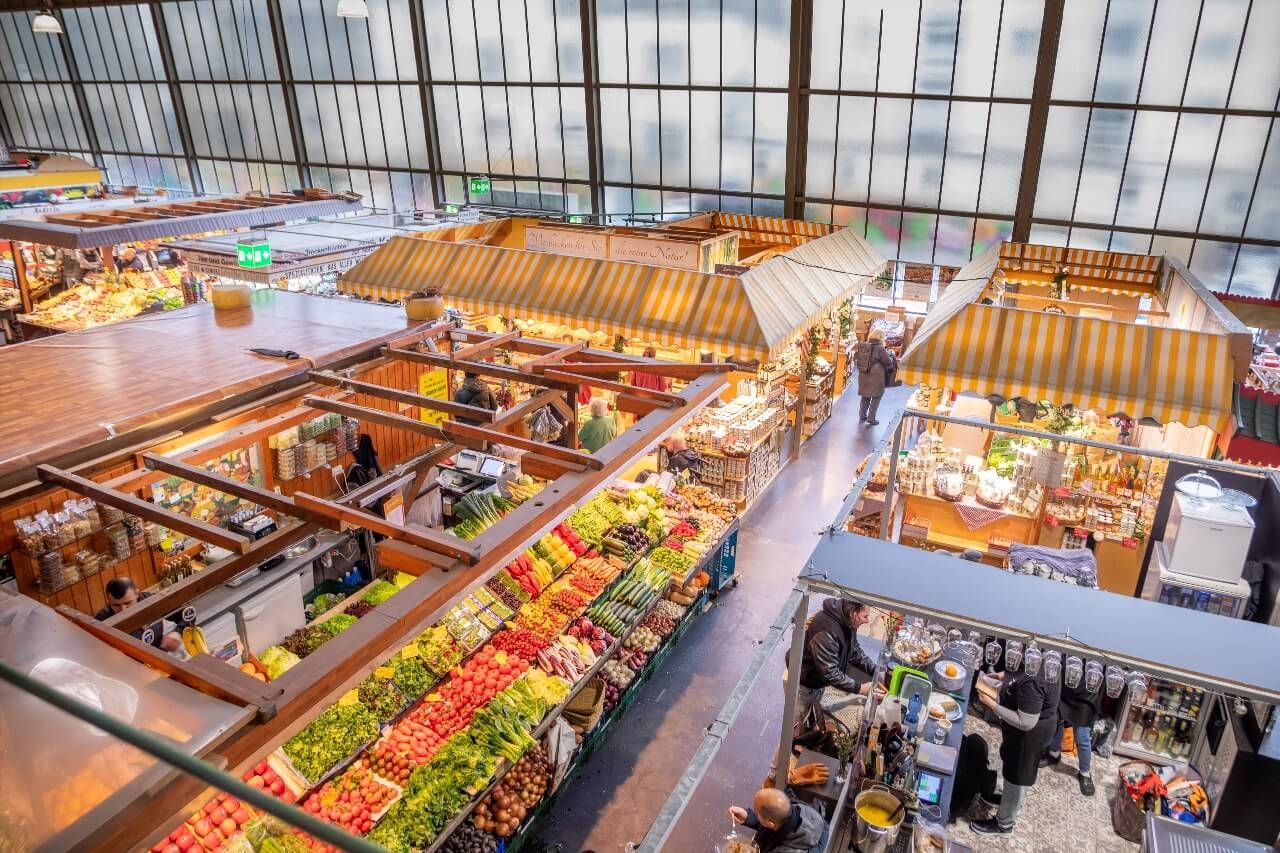
Kleinmarkthalle (Hasengasse 5-7, 60311 Frankfurt am Main, rated 4.6/5 on Google (16 015 avis)) is Frankfurt's covered market and, frankly, one of the best food halls in Germany. Opened in 1954 inside a purpose-built building in the city centre, it runs across three levels and houses around 150 vendors selling everything from Hessian cheeses and wild mushrooms to Japanese knives and Portuguese pastries.
The ground floor is where the serious produce is: butchers who have been at the same stall for three generations, fishmongers with daily deliveries from the North Sea, and a cheese counter with varieties you will not find in a supermarket. The upper gallery holds wine merchants and a bar where you can eat a plate of charcuterie standing up at 11:00 in the morning, a Frankfurt tradition that needs no justification.
Go on a Saturday morning to see it at full capacity. Arrive before 11:00 or navigate through crowds that fill the narrow aisles by midday. The market closes at 18:00 Monday to Friday, 16:00 on Saturdays, and is closed on Sundays.
5. Drink Apple Wine in Sachsenhausen
Sachsenhausen (Schweizer Straße, 60594 Frankfurt am Main) is Frankfurt's south bank neighbourhood, connected to the old town by the Alte Brücke and the pedestrian Eiserner Steg. It's a district of narrow lanes, renovated 19th-century apartment blocks and a concentration of traditional apple wine taverns, Äpfelwoi-Wirtschaften in the local dialect, that have been serving the same tart, slightly fizzy fermented apple cider since the 18th century.
Apple wine (Ebbelwei in the Frankfurt dialect) is the city's defining drink, a fact that surprises many first-time visitors who associate Germany exclusively with beer. It's served in a ceramic jug called a Bembel and poured into ribbed glass tumblers called Geripptes, whose pattern is designed to refract light through the cloudy liquid and grip easily even when the table runs sticky. The taste is dry and acidic, somewhere between a sharp cider and a light white wine. If you find it difficult on first sip, order the Süßer (sweet apple wine) or a Sauergespritzter (apple wine mixed with sparkling water).
The three taverns most consistently recommended by Frankfurt residents are Wagner, Dauth-Schneider (Neuer Wall 5) and Zum Gemalten Haus (Schweizer Straße 67). These are not tourist traps: they serve the same regulars they have served for decades. Arrive without a reservation on a weekday evening and sit wherever you can find space at a communal table. The conversation will come to you. Order Handkäs mit Musik (a regional sour-milk cheese marinated in onions and cumin) and Grüne Soße (the Frankfurt herb sauce served over potatoes and boiled eggs) to taste the menu locals actually order rather than the tourist abridgement.
Sachsenhausen is also worth walking during the day. The streets between Schweizer Straße and the riverbank hold independent wine shops, a Saturday flea market on Schaumainkai, and direct access to the Museum Embankment.
6. Visit Kaiserdom St. Bartholomäus
Kaiserdom St. Bartholomäus (Domplatz 1, 60311 Frankfurt am Main, rated 4.6/5 on Google (7 964 avis)), Frankfurt's Imperial Cathedral, has been standing on the same ground since the 9th century. The current red sandstone building dates mostly from the 14th and 15th centuries, though the tower wasn't completed until 1877. Between 1562 and 1792, ten Holy Roman Emperors were crowned inside these walls. That specific fact tends to reset visitors' sense of how deep the city's roots run.
The cathedral is free to enter. The attached museum (small admission fee) holds the original coronation vestments and liturgical objects from the imperial period. Climb the cathedral tower, 95 steps, for a close-up view of the Dom's Gothic spire and a clear sightline across the old town toward the modern skyline. Go early; the tower gets busy after 11:00.
7. Walk the Museum Embankment (Museumsufer)
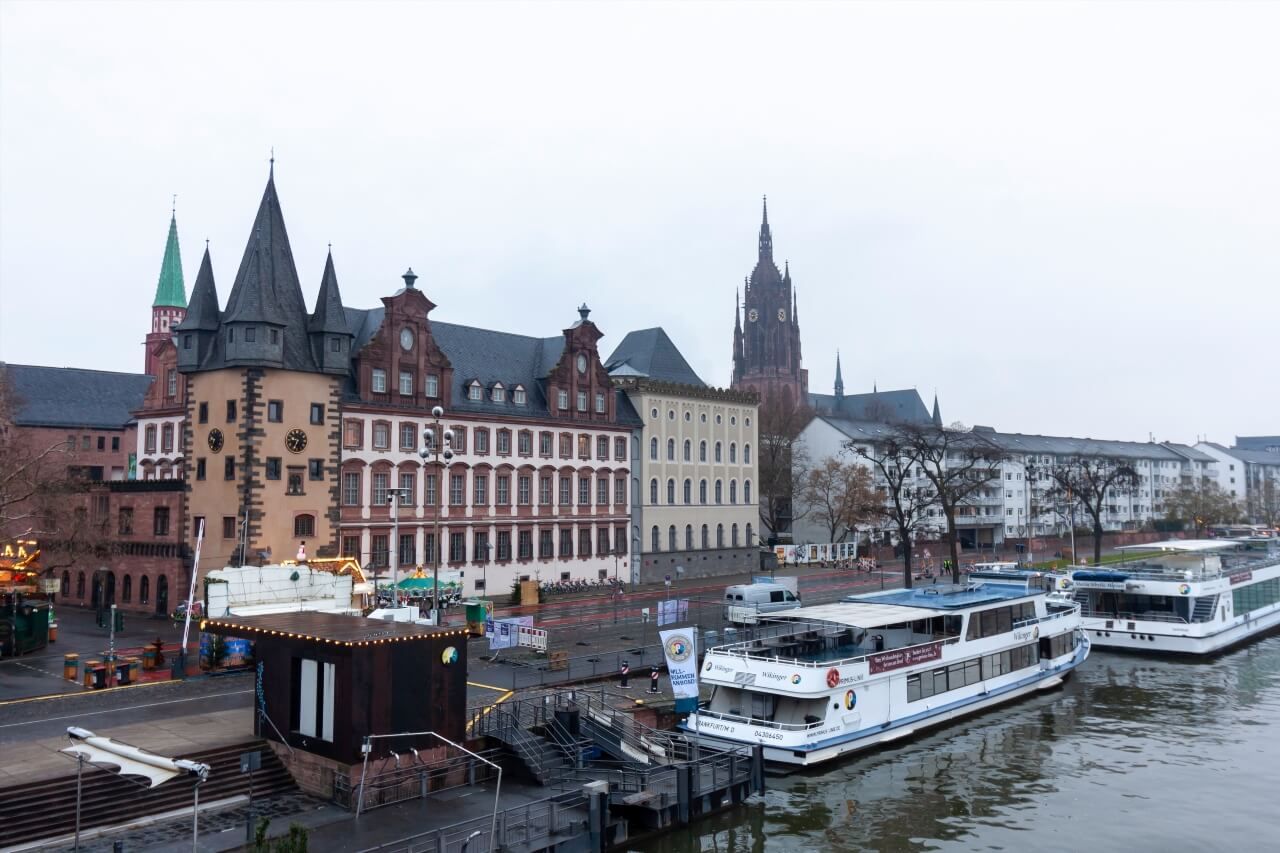
The Museumsufer (Schaumainkai, 60596 Frankfurt am Main, rated 4.6/5 on Google (281 avis)) is a three-kilometre stretch of the south bank of the Main River, the longest concentration of museums in the world by some counts, where 15 institutions line the riverside promenade between Eiserner Steg and Friedensbrücke. You won't visit all of them in one trip. You don't need to. The point is to pick two or three and give them the time they deserve.
The German Film Museum (Deutsches Filmmuseum) at Schaumainkai 41 holds an exceptional collection on the history of cinema, including reconstructed editing suites, original cameras from the silent film era and a programme of classic film screenings that runs year-round. The Museum of World Cultures (Weltkulturen Museum) next door is one of Europe's oldest ethnological collections, with particularly strong holdings from sub-Saharan Africa and the Pacific Islands.
For architecture alone, don't miss the Museum of Applied Arts (Museum Angewandte Kunst), whose main building by Richard Meier, white, geometric, set back from the river in a park, is an exercise in clean modernism that feels oddly meditative. The Saturday flea market along Schaumainkai (9:00 to 14:00 in summer months) turns this stretch into a leisurely social event as much as a shopping occasion. Combine the market with a museum visit and you have most of a Saturday accounted for. Explore this whole stretch with the Ryo audio guide, which covers Frankfurt's riverfront and cultural landmarks in depth.
8. Explore Palmengarten, Frankfurt's Botanical Garden
Palmengarten (Siesmayerstraße 61, 60323 Frankfurt am Main, rated 4.5/5 on Google (671 avis)) is Frankfurt's great botanical garden, a 22-hectare park in the Westend district that has been open to the public since 1871. Its collection spans tropical greenhouses, including a climate-controlled rainforest pavilion, a rose garden with over 600 varieties and a series of themed outdoor gardens that change dramatically between seasons.
The tropical greenhouse complex is the reason to visit in winter: while the city outside sits at 4°C, the Palmenhaus maintains a constant 28°C with humidity that coats your glasses the moment you step inside. The orchid section alone draws collectors from across Germany. In summer, the outdoor stages host open-air concerts and the Sunday bandstand programme has been running in various forms since the garden opened. Admission is €7 for adults, reduced in winter months. Children under 6 enter free.
9. Catch a Performance at Alte Oper
Alte Oper (Opernplatz 1, 60313 Frankfurt am Main, rated 4.6/5 on Google (16 311 avis)), the Old Opera House, is the most photographed building in Frankfurt after Römerberg. Its neoclassical facade, completed in 1880 and destroyed in 1944, was rebuilt between 1976 and 1981 after a long civic campaign that locals still talk about with evident pride. The inscription above the main entrance reads Dem Wahren Schönen Guten (To Truth, Beauty and Goodness), words that the original architect, Richard Lucae, chose specifically to push back against purely commercial interpretations of the city.
Today it functions as a concert hall rather than an opera house, hosting orchestral performances, jazz evenings, and the occasional stand-up comedy night. Even if you don't catch a show, the surrounding square, the Opernplatz, is one of Frankfurt's most sociable outdoor spaces in good weather, with terrace restaurants and a fountain that children use as a paddling pool in summer. Check the official Alte Oper programme before you visit; tickets for popular concerts sell out weeks in advance.
10. Tour Goethe House and Goethe Museum
Johann Wolfgang von Goethe was born at Großer Hirschgraben 23 in Frankfurt in 1749, and the house where he spent his childhood and adolescence survived the war, just barely, intact enough to be restored to its 18th-century appearance. It's now one of Germany's most visited literary museums, and rightfully so: the rooms are furnished with the actual objects the Goethe family owned, including the desk where the young Goethe wrote his first plays and the puppet theatre that inspired his lifelong interest in performance.
The attached Goethe Museum holds the largest collection of 18th and early 19th-century paintings associated with Goethe's circle, including portraits by Johann Heinrich Tischbein. Admission is €10 for adults. Allow 90 minutes. The audio guide (available in English) is genuinely good and contextualises the house without reducing it to a checklist of furniture.
11. Walk Along the Main Riverfront
The riverfront promenade runs along both banks of the Main for several kilometres, lined with benches, beer gardens and stretches of urban parkland. On warm evenings from April to October, it becomes the social centre of the city: cyclists, runners, families and groups of friends occupying every bench and patch of grass within an hour of sunset. The north bank between Untermainbrücke and the Alte Brücke is the most active stretch, with several outdoor bars setting up temporary structures in summer.
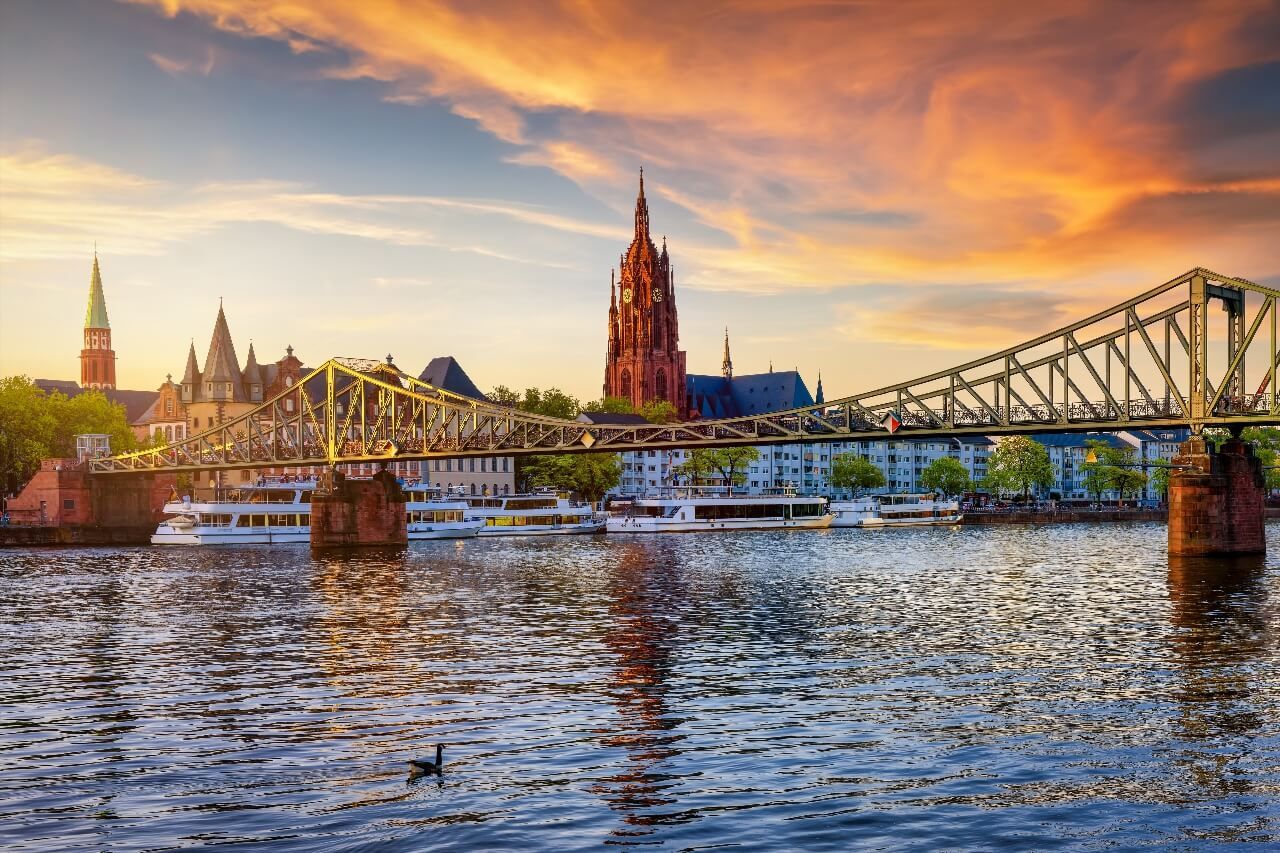
The walk from Eiserner Steg to Flößerbrücke, roughly 4 kilometres round trip, gives you the full panorama of the skyline from both directions. The reflection of the glass towers in the river at dusk, with the Dom's spire visible to the east, is the image most closely associated with Frankfurt in the minds of people who actually live here. It costs nothing. It requires no planning. Go at 19:00 on a weekday in June and you'll understand immediately why Frankfurters don't feel the need to leave their own city at weekends.
12. Spend an Afternoon at Frankfurt Zoo
Frankfurt Zoo (Bernhard-Grzimek-Allee 1, 60316 Frankfurt am Main, rated 4.2/5 on Google (26 339 avis)) is one of the oldest zoos in Europe, founded in 1858, and remains one of the best. Its 14 hectares house over 4,500 animals across 450 species, including a group of white rhinoceroses, a large chimpanzee facility that has contributed to significant research on primate social behaviour, and the Grzimek House, a nocturnal animal pavilion built in 1961 that lets you observe bats, lorises and aye-ayes going about their lives in near-darkness.
The zoo runs a serious conservation programme; the breeding programme for lowland gorillas has produced over 40 births since 1965. The Exotarium reptile and amphibian section has its own following among return visitors, with a saltwater aquarium that doubles as the only public coral reef tank in the city. Adults pay €12 (€13 including the optional Nature Conservation euro), children aged 6-17 pay €6, and the zoo is open every day of the year. Go on a Tuesday or Wednesday morning to avoid the weekend crowds. The playground in the central section keeps younger children occupied independently, which gives adults enough time to actually linger at the exhibits. If you're combining the zoo with the old town in the same day, the Ryo audio guide for Frankfurt covers the walk between the two so you're not navigating with a phone map in one hand and a child in the other.
13. Watch the Skyline from Eiserner Steg
Eiserner Steg (Eiserner Steg, 60594 Frankfurt am Main), the Iron Bridge, is a pedestrian suspension bridge from 1869 connecting the old town to Sachsenhausen at the river's narrowest central point. The view from the middle takes in the entire Frankfurt skyline: glass and steel towers rising directly from the narrow streets of the old city, with no buffer zone between medieval and modern. Couples have covered the railings in thousands of padlocks, Paris-style. Come at sunset.
14. Visit the Jewish Museum Frankfurt
The Jewish Museum Frankfurt (Bertha-Pappenheim-Platz 1, 60311 Frankfurt am Main, rated 4.7/5 on Google (1 318 avis)) holds the history of one of the most important Jewish communities in the world, Frankfurt's Jewish population shaped European banking, philosophy and culture over five centuries, and by 1933 numbered over 30,000 people, roughly 6% of the city's total population. The museum, reopened in a dramatically expanded form in 2020 after a major reconstruction, traces this history from the medieval period through the Holocaust to the present-day community.
The building itself is a statement: the new wing, designed by Staab Architekten, sits adjacent to the two Rothschild Palaces that housed the original museum, connecting old and new with a glass and steel atrium that lets natural light penetrate the archive spaces. Admission is €12 for adults. The permanent exhibition is one of the most thoughtfully curated history museums in Germany; set aside at least two hours.
15. Browse Berger Strasse on a Sunday Morning
Berger Strasse (Berger Straße, 60316 Frankfurt am Main) in the Bornheim district is Frankfurt's most interesting neighbourhood high street. Running roughly two kilometres east from Merianplatz, it's lined with independent cafes, second-hand bookshops, wine bars and specialty food shops that have resisted the chain-store colonisation taking over comparable streets elsewhere in Germany. The Sunday Bornheimer Wochenmarkt sets up along the lower section from 8:00 to 14:00. A good coffee and a Bretzel from a market stall is a considerably better start to a Sunday than most alternatives.
16. See Contemporary Art at Schirn Kunsthalle
Schirn Kunsthalle Frankfurt (Römerberg 6, 60311 Frankfurt am Main, rated 4.4/5 on Google (4 299 avis)) is the city's main contemporary art venue, a purpose-built exhibition hall constructed in 1986 in the centre of the old town between the Dom and Römerberg. It doesn't hold a permanent collection; instead it runs six to eight major temporary exhibitions per year, typically covering 20th-century avant-garde movements, contemporary international artists and thematic shows that cut across periods and geographies.
Past exhibitions have covered Francis Bacon, the Bauhaus centenary, Jean-Michel Basquiat and the photography of Diane Arbus. The quality of curation is consistently high. Admission varies by exhibition (typically €10-14), and Thursday evenings offer extended opening hours until 22:00. Check the schedule before planning a visit, timing your Frankfurt trip around a Schirn opening is worth considering.
17. Walk the Zeil and Watch the City Move
Zeil (Zeil, 60313 Frankfurt am Main, rated 4.4/5 on Google (976 avis)) is Frankfurt's main shopping street and one of the highest-grossing retail streets in Germany by revenue per square metre. This fact is less interesting than what surrounds it: the MyZeil shopping centre at the eastern end, designed by Massimiliano Fuksas and opened in 2009, has a spiralling glass facade that critics have described as a tornado frozen in glass and steel. The interior atrium is worth walking through even if you have no intention of buying anything.
More interesting than the shopping itself is the street life. Zeil runs from Konstablerwache to the Hauptwache, and the entire stretch is pedestrianised. Buskers, street artists, delivery cyclists and school groups create a constant background motion that reflects the city's actual social composition rather than its touristic surface.
18. Discover Money History at the Bundesbank Museum
The Deutsche Bundesbank Money Museum (Wilhelm-Epstein-Straße 14, 60431 Frankfurt am Main, rated 4.7/5 on Google (1 402 avis)) in the Westend traces the history of money from Mesopotamian clay tablets to cryptocurrency, with particular depth on the German hyperinflation of 1923 (a period that still shapes German monetary policy thinking) and the post-war reconstruction of the Deutsche Mark. The interactive exhibits are well-designed: you can lift a gold bar under supervision and walk through a reconstruction of a 1920s bank branch. Admission is free, allow 90 minutes, closed Mondays.
19. Run or Cycle the Nidda River Park
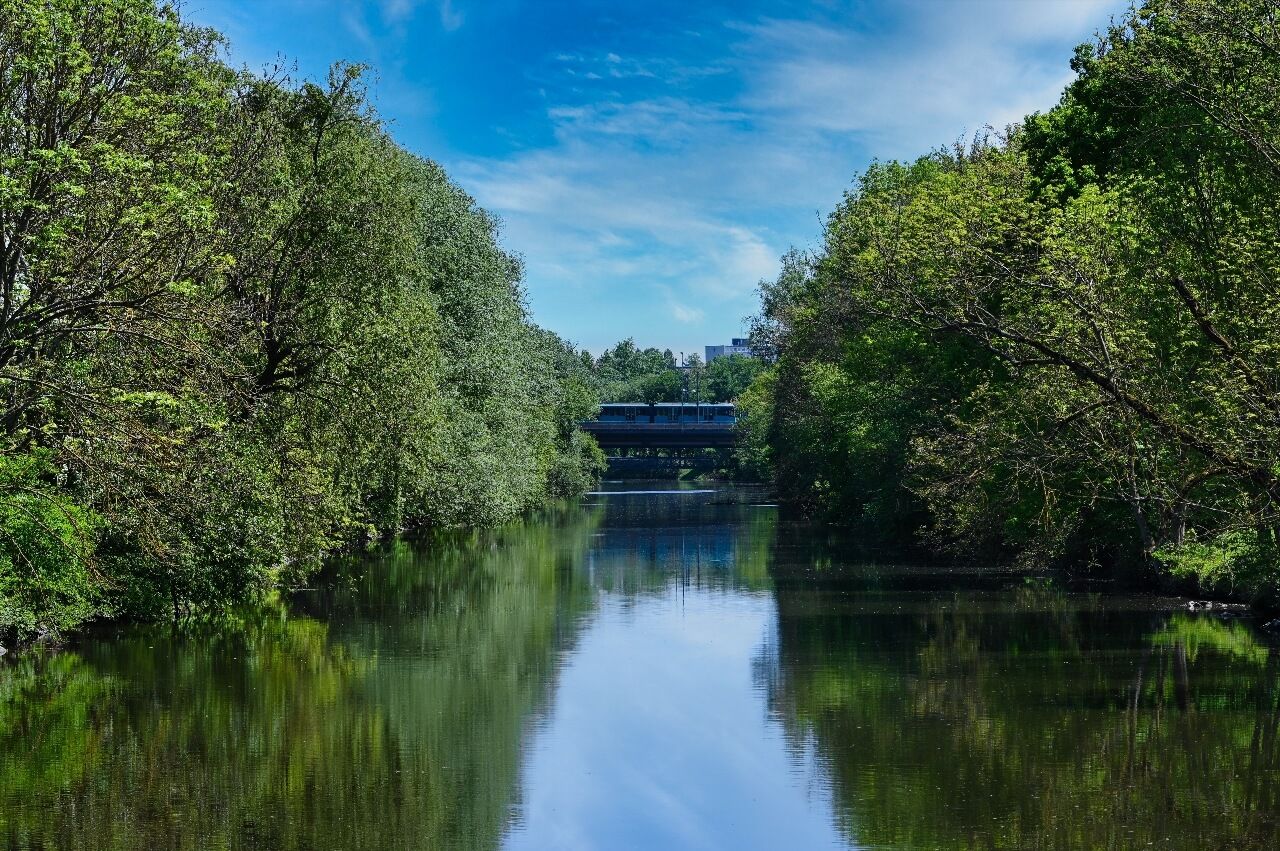
Niddapark (Niddapark, 60488 Frankfurt am Main, rated 4.7/5 on Google (680 avis)) stretches over 12 kilometres along the Nidda through Frankfurt's northwest, from Hausen to the confluence with the Main near Höchst. It's flat, well-surfaced and largely unknown to visitors. Rent a bike near Römer, reach the park in under 20 minutes, and take the round trip to Praunheim and back, about 10 kilometres at an easy pace. Herons and kingfishers patrol the managed wetlands along the way.
20. Access the Commerzbank Tower Sky Lobby
The Commerzbank Tower (Kaiserplatz 2, 60311 Frankfurt am Main, rated 3.7/5 on Google (203 avis)), completed in 1997 and designed by Norman Foster, was Europe's tallest building for a decade at 259 metres. It's still Germany's tallest occupied skyscraper. The building isn't generally open to the public, but the ground-floor lobby is accessible during business hours and gives you a full view of the building's famous interior sky gardens, triangular green spaces planted at every ninth floor, visible through the glass atrium.
For a better view from height without paying for Maintower, the DZ Bank Tower (also known as the Trianon) has a publicly accessible area at its base with an interesting perspective across the banking district. Pair this with a walk through the Bankenviertel, the financial quarter, at rush hour to watch Frankfurt operate as what it actually is: Germany's financial engine, a city where the European Central Bank and seven of the world's largest financial institutions maintain their headquarters within a few hundred metres of a 14th-century cathedral.
21. Experience the Frankfurt Christmas Market
The Frankfurt Christmas Market (Römerberg, 60311 Frankfurt am Main, rated 4.6/5 on Google (21 avis)) (Frankfurter Weihnachtsmarkt) is one of the oldest in Germany, with records of a market on Römerberg dating to 1393. It runs for roughly four weeks from late November to Christmas Eve and spreads across the Römerberg, the Paulsplatz and several connecting streets, with around 200 market stalls selling handmade decorations, traditional food and mulled wine.
Bethmännchen, small almond marzipan cakes decorated with three almond halves, are the Frankfurt-specific market food that you won't find at other German Christmas markets. Try them fresh from the stalls near the Dom. The market is best visited on a weekday evening when the crowds thin enough to actually see the illuminated half-timbered facades behind the stalls. Weekend afternoons between 14:00 and 17:00 are the busiest period; the market at 19:00 on a Tuesday in early December is one of the genuinely atmospheric experiences Frankfurt offers.
22. Spend Time at Senckenberg Natural History Museum
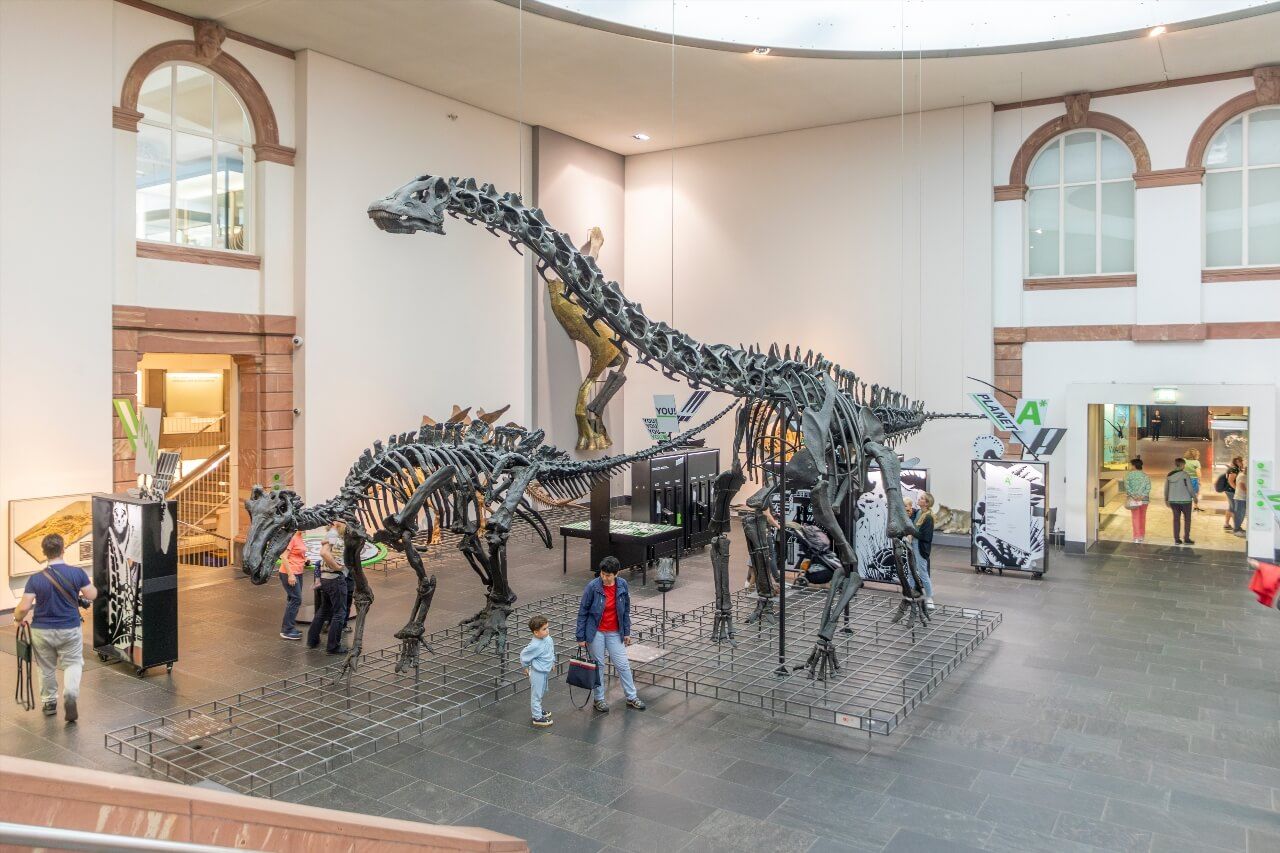
Senckenberg Natural History Museum (Senckenberganlage 25, 60325 Frankfurt am Main, rated 4.6/5 on Google (4 321 avis)) (Senckenberg Naturmuseum) is one of Germany's largest natural history museums and one of the most important palaeontological institutions in the world. Its fossil collection includes the most complete skeleton of a Diplodocus in Europe, a 26-metre sauropod that fills the central hall, along with exceptional holdings of Messel Pit fossils, including preserved Eocene horses and ancestral bats from 47 million years ago.
The Messel section alone justifies the visit: the Messel Pit near Darmstadt is a UNESCO World Heritage site and the world's most productive source of Eocene mammal fossils. The Frankfurt museum holds the best public display of these specimens. Admission is €12 for adults, and the museum is open Tuesday to Sunday. Set aside a minimum of two hours; the palaeontology galleries alone take 90 minutes if you read the explanations.
23. Explore Frankfurt's Nightlife in the Bahnhofsviertel
The Bahnhofsviertel (Kaiserstraße, 60329 Frankfurt am Main), the station quarter, immediately southwest of the main train station, has one of the most concentrated and genuinely interesting nightlife scenes in Germany. It is also one of the most discussed neighbourhoods in Frankfurt for its contradictions: a district where Turkish grocers, Vietnamese restaurants, late-night bars, independent galleries and the city's red-light establishments have coexisted on the same block for decades.
The nightlife here has shifted significantly since 2015. What was once primarily associated with its less salubrious aspects is now home to cocktail bars, electronic music clubs and a growing restaurant scene that has attracted national attention. King Kamehameha Club on Hanauer Landstrasse books international DJs and has a rooftop terrace. The bars around Elbestrasse and Moselstrasse stay open until 4:00 or 5:00 on weekends, and the streets themselves are active from 21:00 onward.
For food before or after a night out, the Vietnamese restaurants concentrated around Münchener Strasse are exceptional and open late. The Bahnhofsviertel is also where Frankfurt's best independent record shops are concentrated, Phono on Moselstrasse, open since 1992, is worth an afternoon visit regardless of what you're doing in the evening.
24. Take a Day Trip to Rüdesheim am Rhein
Rüdesheim am Rhein (Rheinstraße, 65385 Rüdesheim am Rhein) is a small wine town on the Rhine, 75 kilometres west of Frankfurt and reachable by train in under an hour from Frankfurt Hauptbahnhof. It sits at the northern end of the Rhine Gorge, a UNESCO World Heritage stretch of river flanked by vineyard-covered hillsides, medieval castles and the kind of landscape that defines the German Romantic imagination.
The Drosselgasse, a narrow, cobbled pedestrian lane 144 metres long, is the most visited street in Germany after the Berlin Wall section. It's busy, occasionally overwhelming and lined wall-to-wall with wine taverns. Visit it and move on. The real reward is the cable car up to the Niederwald Monument, a 37-metre statue of Germania erected in 1883, which gives a panoramic view across the Rhine valley. Then rent a bike and cycle the Rhine Cycle Route north toward Lorch, the route is flat, the views are continuous and the villages are genuinely quiet compared to Rüdesheim itself.
25. Walk Through Höchst Old Town
Höchst (Höchster Marktplatz, 65929 Frankfurt am Main, rated 4.6/5 on Google (359 avis)) is a district of Frankfurt that most visitors never visit, located on the western edge of the city on the south bank of the Main. Its old town has a well-preserved medieval centre around Höchst Castle, a pink sandstone palatine tower from the 13th century, and the Stiftskirche, a Carolingian church with sections dating to the 9th century, making it older than almost anything in the Frankfurt city centre.
The weekly market on the Höchster Marktplatz runs every Saturday morning and has a local character entirely different from the tourist-facing markets in the city centre. Höchst is accessible by S-Bahn (S1 line) in 20 minutes from Frankfurt Hauptbahnhof. Combine it with a walk along the Nidda confluence, the point where the Nidda River meets the Main, which has an unexpected quality of rural calm for somewhere technically within city limits.
FAQ
What is Frankfurt best known for?
Frankfurt is Germany's financial capital and home to the European Central Bank, as well as one of Europe's busiest international airports. Culturally, it's known as the birthplace of Goethe, for its Museumsufer (the highest concentration of museums per kilometre in the world), and for its apple wine tradition. The city skyline, the only one in continental Europe with genuine skyscraper density, is also distinctive.
Is Frankfurt worth visiting as a tourist?
Yes, considerably more than its reputation suggests. Most visitors underestimate Frankfurt because they arrive expecting the city to function as a transit hub and don't adjust that expectation once they're here. The Städel alone is worth a full day. Add Sachsenhausen, the Museumsufer, Römerberg and the riverfront and you have a genuinely strong two to three days of sightseeing.
How many days do you need in Frankfurt?
Two full days covers the essential sights at a reasonable pace. Three days allows you to go deeper into the museum district, spend a proper evening in Sachsenhausen and take the Maintower or the Commerzbank Tower at different times of day. A fourth day is best used for the day trip to Rüdesheim or the Höchst old town.
What is the best area to stay in Frankfurt?
Sachsenhausen is the most pleasant neighbourhood for visitors, it's quieter than the city centre, within walking distance of Römerberg, and close to the Museum Embankment. The Westend is Frankfurt's most upscale residential area and has excellent restaurant options. The Nordend, north of the main train line, is the preferred neighbourhood for younger visitors and has the best independent coffee shops and bars.
Is Frankfurt expensive to visit?
Moderately. The Deutsche Bundesbank Money Museum is free. The Städel costs €16 at full price. Frankfurt Zoo charges €12 for adults. Accommodation tends to be expensive during trade fairs, the Messe Frankfurt calendar can double hotel prices on certain weeks, so check the fair schedule before booking and adjust dates if possible.
What is apple wine and where can I try it in Frankfurt?
Apple wine (Äpfelwoi in the local dialect) is a fermented apple cider specific to the Frankfurt and Hessen region, drier and more acidic than English or French cider. The best places to try it are the traditional taverns in Sachsenhausen: Wagner on Schweizer Straße, Dauth-Schneider near Neuer Wall, and Zum Gemalten Haus. Order a Bembel (ceramic jug) for two and let the regulars at the communal table recommend what to eat with it.
Conclusion
Frankfurt rewards visitors who slow down long enough to let the city show itself. The fun things to do in Frankfurt collected above range from a 9th-century cathedral to a 200-metre observation deck, from medieval Christmas markets to late-night Bahnhofsviertel bars, and the connecting thread is that almost everything sits within a 30-minute walk of the river. Two or three days, comfortable shoes and a willingness to drink something fizzy that isn't beer is genuinely all you need.
Frankfurt is best explored on foot and at a pace that allows the city to reveal itself gradually. The Ryocity Frankfurt audio guide covers the key areas in depth, from Römerberg's reconstruction history to the stories behind the Museumsufer institutions, the Goethe House and the Bahnhofsviertel's reinvention. Activate it before you start walking and you'll leave knowing the place rather than just having passed through it.