© Shutterstock
 Votre guide Ryo
22 Things to Do in Puglia in 2026 (Complete Guide)
Wondering what to do in Puglia beyond the postcard clichés? This region at the heel of Italy's boot captivates through contrast: an Adriatic coast carved from white rock, hilltop villages swept by whistling winds, and a gastronomy built on three ingredients and two millennia of know-how. Visiting Puglia in 2026 means accepting the possibility of being surprised by a region that many still picture as a mere hinterland of Bari. With the Ryo audio guide, every stop gains depth: the stories hidden behind white limestone façades, the anecdotes behind the UNESCO-listed trulli, the maritime legends of Otranto — everything that signage never tells you. So you don't miss any of Puglia's must-sees, here are 22 experiences to add to your itinerary.
Expect to discover an Alberobello less naïve than it appears (its trulli sheltered a form of tax resistance in the 15th century), a Lecce whose baroque surpasses Rome's in extravagance, a Polignano a Mare suspended above a breathtaking turquoise sea, and a Salento whose white limestone coves rank among Italy's most beautiful. Not to mention fresh morning burrata, hand-rolled orecchiette on the pavements of Bari Vecchia, or a sunset viewed from the terrace of a masseria surrounded by centuries-old olive trees.
1. Alberobello and Its Trulli: the UNESCO Village That Hides a Tax Dodge
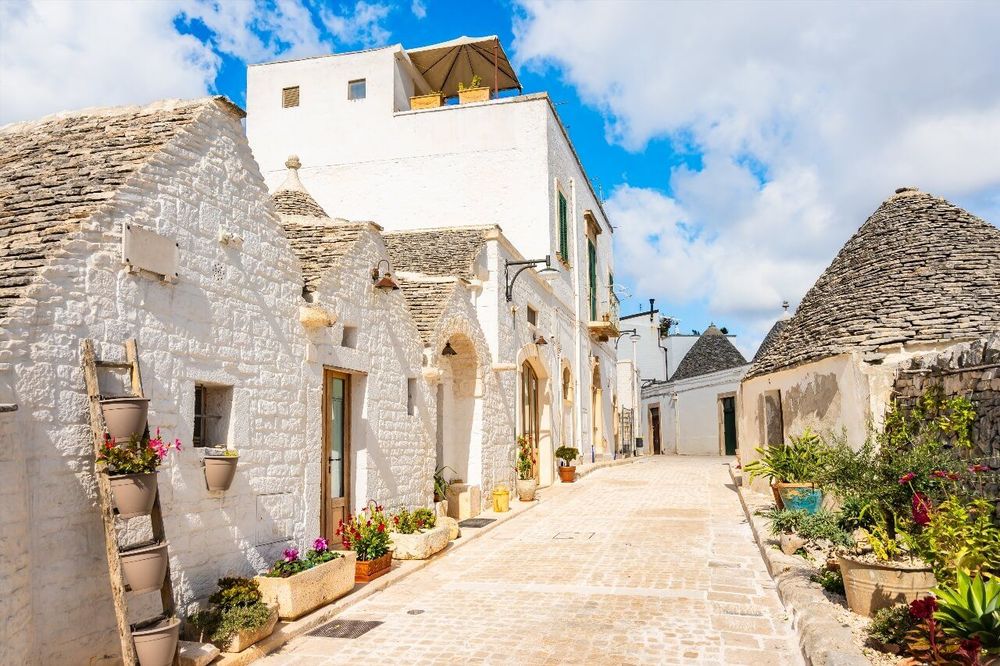
Alberobello (Via Monte San Michele, 70011 Alberobello, rated 4.7/5 on Google with 12K reviews) is Puglia's most photographed destination, and for good reason: its roughly 1,500 trulli (round dry-stone houses topped with a conical roof) form a panorama that looks like it came straight from a fairy tale. But what makes this village truly fascinating is the history that gave rise to such a distinctive architectural style.
In the 15th century, the inhabitants of Alberobello built their homes without mortar, using only lime and dry stone. The reason is pragmatic to the point of genius: according to a well-established tradition (possibly apocryphal), the peasants could dismantle their dwellings within a few hours to avoid the royal tax levied on permanent constructions. When the King of Naples's inspectors arrived, there was nothing left to tax. The historical truth is more complex, but the result speaks for itself: more than 1,500 trulli listed as a UNESCO World Heritage Site since 1996, concentrated in the Monti and Aja Piccola districts.
The Monti district is the most touristy, with its ceramics shops and local produce stores. Aja Piccola, on the other side of the ravine, remains more residential and offers a more authentic atmosphere. To avoid queues inside the Sovereign Trullo (the only one with two cones, built in 1797), arrive before 9:30 am or in the late afternoon. The entry ticket is €1.50, one of the few museums in Puglia that is still free or nearly free. In the evening, when the tourist coaches leave, the alleyways take on an orange, silent light that belongs to the locals.
Allow half a day to walk through both districts, plus an hour if you want to climb up to the terrace of the Sant'Antonio church for a bird's-eye view over the grey stone rooftops. The immediate surroundings also include masserias offering overnight stays in contemporary renovated trulli — an original way to sleep within this living heritage.
2. Lecce, the Baroque Capital of the South
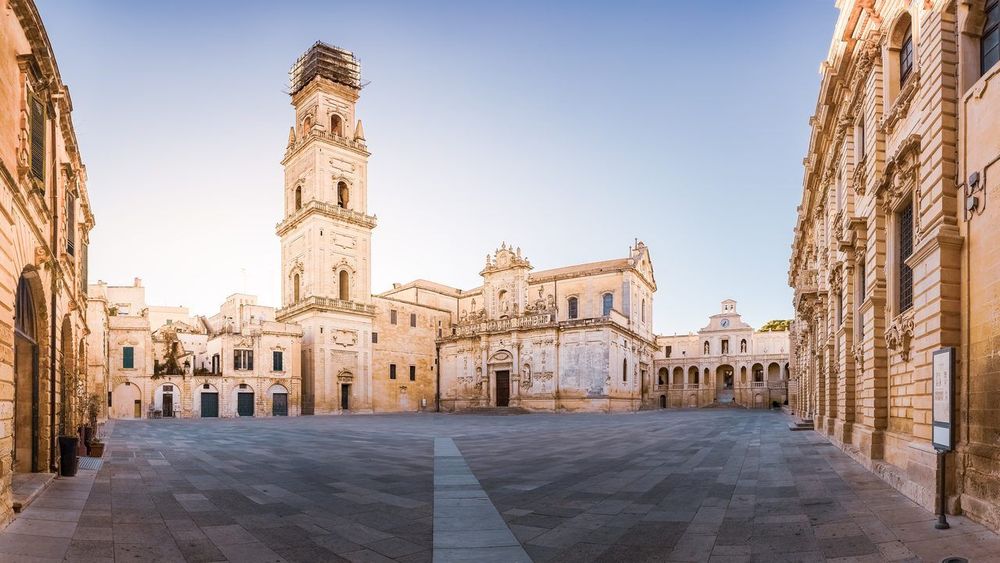
Lecce is not just another city in Puglia. It deserves to be treated as a city of art in its own right, on a par with Florence or Bologna. Its historic centre is a dizzying catalogue of ornaments in leccese, a honey-coloured local limestone that sculpts like butter and turns gold at sunset. The 17th-century architects made abundant use of it, and it shows.
The Basilica di Santa Croce is the obligatory starting point. Its façade is a joyful chaos of caryatids, floral garlands, monsters and biblical scenes piled across five levels. Art historians speak of "Puglian baroque" to distinguish it from the more restrained Roman baroque: here, the horror vacui is a doctrine. Inside, the atmosphere is calmer — a single nave, golden light, and the feeling of being sheltered from the world.
The Piazza del Duomo is the other masterpiece: a square enclosed on three sides, almost entirely baroque, with the cathedral (two façades, one restrained and one extravagant), the 72-metre bell tower and the bishop's palace forming a coherent ensemble that is exceptionally rare in Italy. The square is pedestrianised and the adjacent streets are lined with aristocratic palaces whose doorways compete in sculptural richness.
Beyond its architectural heritage, Lecce is worth visiting for its atmosphere: it is a lively university city, with bookshops and a cultural scene that spills out onto the piazzas in the evening. Don't leave the city without trying a pasticciotto (a flaky pastry filled with custard cream) from one of the pastry shops founded before 1900, and without visiting the provincial archaeological museum, which houses a little-known but remarkable Messapian collection.
Allow at least a full day in Lecce, ideally two. The city is best experienced at the slow pace of Puglia: an espresso at the counter in the morning, a wander through the alleyways at midday, and an aperitivo on Piazza Sant'Oronzo in the evening.
3. Polignano a Mare: Suspended above the Adriatic
Some cities can be explained, and then there is Polignano a Mare (Via Martiri di Via Fani, 70044 Polignano a Mare, rated 1.6/5 on Google with 7 reviews). Perched on a cliff 20 to 30 metres high, plunging sheer into an impossibly blue-green sea, Polignano defies any reasonable description. It is best to arrive without precise expectations and let the view do the rest.
The historic centre is a maze of tightly packed white alleyways, built overhanging the sea caves visible from the terraces. Lama Monachile, a small cove nestled between two cliffs at the entrance to the old town, is Puglia's most photographed beach and probably one of Italy's most beautiful. Arrive before 8 am in summer to find space; after 10 am, it becomes a dense mass of umbrellas and swimmers.
The town is also the birthplace of Domenico Modugno, the author of "Nel Blu Dipinto di Blu" (Volare), whose statue stands on the cliff edge with arms wide open. An anecdote that says a great deal about the spirit of the place. Every summer, professional divers leap from the cliffs during the Red Bull Cliff Diving World Series — a free spectacle that draws thousands of spectators.
You can rent a kayak or join a boat trip to explore the sea caves carved into the cliff, accessible only by sea. The Grotta Palazzese is the most famous: it houses a fine-dining restaurant set inside the cavern itself, with tables overlooking the water. A dinner that takes some planning (reservations required several weeks in advance) but remains a singular memory from any trip to Puglia.
4. Ostuni, the White City Visible from 15 km Away
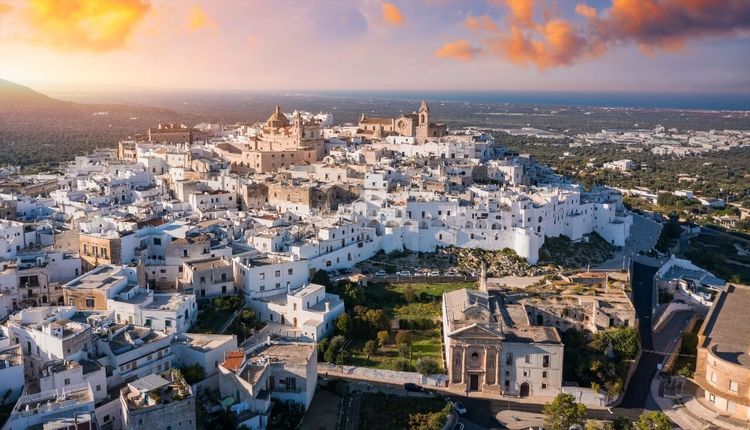
Ostuni more than earns its nickname of "città bianca": the façades of its houses are coated in a dazzling white lime wash, a practice dating back to the 15th century that residents have kept alive through tradition as much as aesthetics. From the olive-tree-covered plain that precedes it, the town stands out on the hillside like a patch of snow — visible from afar on the road between Bari and Brindisi.
The historic centre is a network of narrow alleyways that spiral upward to the late Gothic cathedral, built between 1435 and 1495. Its façade is adorned with a 24-ray rose window, one of the finest in the region. From the cathedral terrace on a clear day, you can simultaneously see the Adriatic Sea to the east and, in exceptional conditions, the hills of Basilicata to the west.
Ostuni is also a very practical logistical base for travellers: well served by train (Bari–Brindisi–Lecce line), it offers a wide range of reasonably priced accommodation out of season, and is 25 minutes by car from the northern Salento beaches. Ostuni's marina (Torre San Leonardo) offers stretches of fine sand that are less crowded than Polignano's beaches.
A practical note: many visitors spend two hours in Ostuni and leave disappointed. The town reveals its character above all when you wander without a fixed plan — a coffee on the main square, a detour through the ceramics shops on Via Cavallerizza, an aperitivo on a terrace overlooking the plain. This is a city for strolling, not for ticking off monuments.
5. The Itria Valley: between Locorotondo, Cisternino and Martina Franca
The Itria Valley is the tranquil heart of Puglia. This limestone plateau between Bari and Brindisi brings together three distinctive villages just a few kilometres apart: Locorotondo (Piazza Vittorio Emanuele II, 70010 Locorotondo, rated 4.8/5 on Google with 72 reviews), Cisternino and Martina Franca. The countryside linking them is covered in olive trees, vines and scattered trulli — a landscape little changed in a century.
Locorotondo (its name means "round place") is built in a circle around a hill, with alleyways that follow the contour lines. It is one of Puglia's most photogenic villages, with its houses featuring "cummerse" roofs (a distinctive double-pitched inverted roof found only in this village). In the evening, the restaurants in the centre serve Locorotondo DOC, a dry, crisp white wine produced locally since the 18th century.
Cisternino is less visited and therefore often more enjoyable. It is famous for its "fornelli pronti": butcher-restaurants where you choose your meat from the counter (bombette, spiedini, gnummareddi) and the butcher grills it immediately over hot embers. A local institution worth visiting as much for the taste as for the social experience.
Martina Franca completes the triptych with its baroque centre and its international Valle d'Itria Festival, one of Italy's most important opera festivals, held each summer in July and August in the courtyards of historic palaces.
6. Bari Vecchia: Orecchiette and a Hidden Mosque
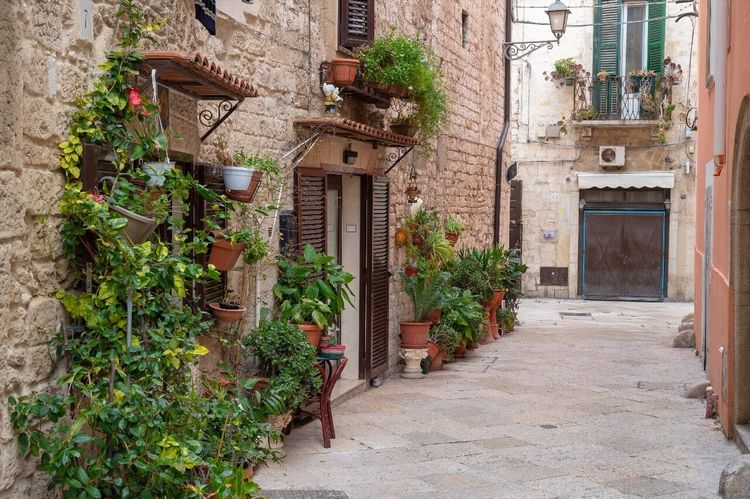
The reputation of Bari is often unfair. The standard travel guide treats it as an airport hub, a transit city before heading elsewhere. This is a mistake. Bari's old town, Bari Vecchia, is one of the most vibrant and least touristified historic centres in Puglia, and deserves a full day.
The architecture of Bari Vecchia is a palimpsest: medieval houses built on Byzantine foundations, Norman mosques converted into churches, alleyways so narrow that two people cannot pass each other. The Basilica di San Nicola, built from 1087 to house the relics of Saint Nicholas (the future Father Christmas, whose bones were "brought back" from Myra in Turkey by Baresi sailors), is one of the finest examples of Romanesque architecture in southern Italy. The crypt still holds the relics and remains an active place of pilgrimage.
But the real life of Bari Vecchia happens in the alleyways. Arancina Road (actually Via dell'Arco Basso and its surroundings) is the heart of the orecchiette tradition: neighbourhood women, seated on stools outside their homes, roll pasta by hand from early morning. The custom is photographed by thousands of tourists every day, yet remains authentic — these women sell the fresh pasta directly to passers-by. 500 grams of fresh orecchiette costs around €4 to €5.
The fish market (Mercato del Pesce) on the old port opens early in the morning, before 8 am. Octopus, sea urchins, red prawns and fish caught the previous night are all on sale. The stalls offer raw seafood, including ricci di mare (sea urchins) served on pieces of grilled bread — one of the most memorable culinary experiences in the entire region.
Outside Bari Vecchia, the national archaeological museum (MARTA, Museo Nazionale Archeologico di Taranto) also deserves a mention, as does the Pinacoteca Provinciale, which holds paintings by Giovanni Bellini and Bartolomeo Vivarini that are generally undervisited.
7. The Castellana Caves: 3 km Underground
Located 40 km south-east of Bari, the Castellana Caves form Italy's longest network of karst caves, with 3.3 km of galleries open to the public. Scientifically discovered in 1938 by geologist Franco Anelli, they have been open to visitors ever since.
The most spectacular formation is the Grotta Bianca, a terminal chamber 60 metres long and 30 metres high, whose walls are entirely lined with perfectly white alabaster stalagmites and stalactites. The artificial lighting creates shadow effects that transform the cave into a living sculpture. The interior temperature is a constant 16–17 °C year-round — worth bearing in mind for summer visits.
Two routes are available: the short one (50 minutes, 1 km, does not include the Grotta Bianca) and the long one (2 hours, 3 km, includes all chambers). The full ticket costs €22 per adult in high season. Online booking is recommended for French-language guided tours available in the morning. The cave closes during heavy rain for safety reasons — check the weather before making the journey.
A curiosity: early explorations of the cave in the 1930s revealed human bones and Bronze Age pottery, proof that these galleries served as a refuge or sanctuary several millennia before our era.
8. Otranto: Cathedral, Castle and the Edge of the World
Otranto occupies the easternmost tip of Italy, and therefore of the entire western European continent. On a clear day, the Albanian coastline is visible from the waterfront, just 80 km away as the crow flies. This extreme geographical position made Otranto a crossroads of civilisations: Greek, Byzantine, Norman, Ottoman.
The Cathedral of Otranto (Piazza Basilica, 73028 Otranto, rated 4.7/5 on Google with 2,366 reviews) (11th century) houses one of Italy's least-known treasures: a floor mosaic covering 1,200 m², created between 1163 and 1165 by a monk named Pantaleone. This mosaic illustrates a medieval vision of the world, from Creation to the Apocalypse, with scenes drawn from the Bible, Greco-Roman mythology, the legends of Roland and King Arthur, and imaginary animals. It covers the entire floor of the nave. It is one of the most astonishing medieval works in Italy, and most visitors discover it by chance.
The Aragonese castle (15th century) overlooks the port and the sea. In the Chapel of the Martyrs of Otranto, in the cathedral crypt, the skulls and bones of 813 Christians executed by the Ottomans in 1480 after the fall of the city are preserved — a story rarely told outside Italy, which gives Otranto a far darker historical dimension than its image as a seaside resort might suggest.
The historic centre is small but dense. Allow two hours for the cathedral and castle, plus an hour for the waterfront and Baia dei Turchi beach 4 km to the north.
9. Gallipoli: the City on the Island
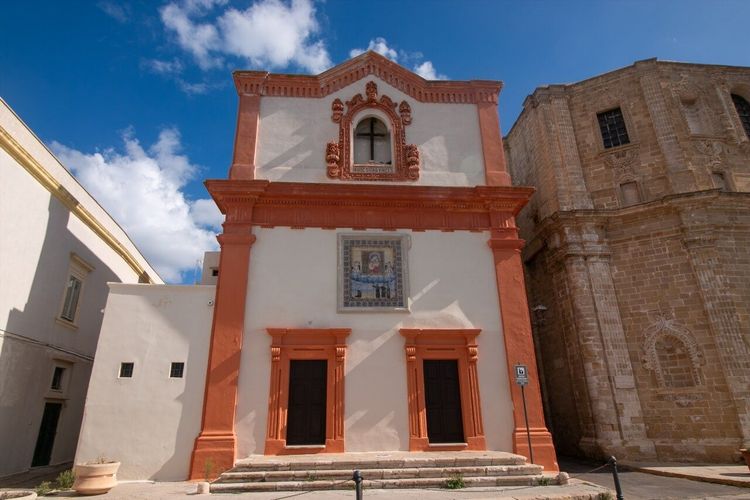
Gallipoli (which means "beautiful city" in Greek) is built on a rocky islet connected to the mainland by a 17th-century bridge. This is not the Gallipoli of the Dardanelles — this one is in the Salento, and deserves an attention that most guides rarely grant it.
The old town on the island is a condensed example of late Neapolitan baroque: the Cathedral of Sant'Agata (1629–1696), with its façade of rosy local stone, and around twenty baroque churches concentrated within a few hectares. The Museo Civico Emanuele Barba holds Renaissance faience and Greek amphorae recovered from the sea offshore.
But Gallipoli is best known as a seaside resort. The Spiaggia della Purità, enclosed by the city walls, offers a beach right in the heart of the historic centre — rare in Italy. Further north, the coastline towards Santa Maria di Leuca alternates limestone coves with white sandy beaches. The coastal road along this stretch, between Gallipoli and Leuca (50 km), is one of the most scenic drives on the Italian peninsula.
In the evening, Gallipoli transforms: the city is one of Italy's summer electronic music capitals, with seafront clubs drawing a young crowd from across the peninsula. A striking contrast with the baroque atmosphere of the daytime.
10. Locorotondo: the Round Village
Locorotondo (Piazza Vittorio Emanuele, 70010 Locorotondo, rated 4.8/5 on Google with 72 reviews) deserves its own section, as a complement to the Itria Valley. This village perched on a hill at 375 metres above sea level is one of the rare places in Puglia where silence is an attraction in its own right. The white limestone paved alleyways rise in concentric circles towards the mother church, flanked by two mismatched bell towers. The cummerse-roofed houses, found nowhere else, give the village a silhouette instantly recognisable from a drone.
In the evening, restaurant terraces serve Locorotondo DOC, a crisp, slightly fruity white wine produced exclusively in this geographical area since the 18th century. Paired with local antipasti (capocollo, caciocavallo, fennel taralli), it makes for an aperitivo that sums up, all by itself, the pleasure of travelling in Puglia.
11. Monopoli: Fishing Port and Unexpected Baroque
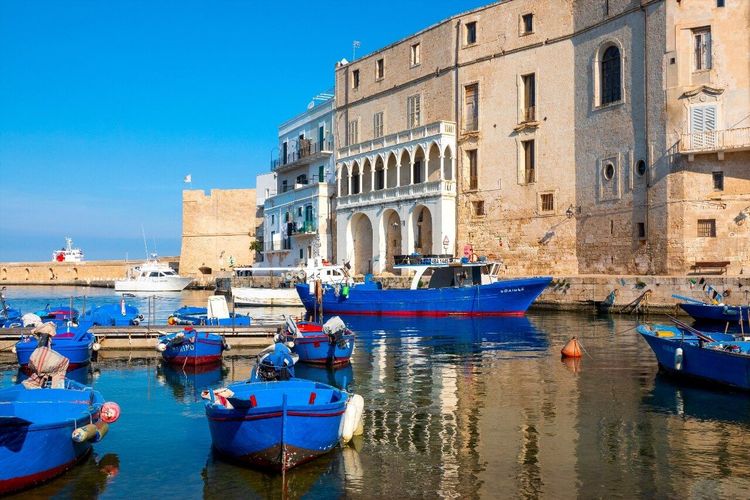
Monopoli is often cited as the "less touristy" alternative to Polignano a Mare — the two towns are 20 km apart and share the same geography of cliffs and turquoise sea. But Monopoli has its own personality that the comparison caricatures.
Monopoli's historic centre is organised around Castello Carlo V, a coastal fortress built by the Spanish in the 16th century, now open to visitors. The neighbouring fishing port remains active: early in the morning, you can watch the fresh fish auction (the "contrattazione"). The baroque cathedral (Basilica della Madonna della Madia, 1742) is one of the most ornate in the region, with a three-level façade and an interior covered in gilded stucco.
Monopoli is also a good base for exploring the surrounding coastline: Cala Porta Vecchia, just below the ramparts, is a small developed cove accessible on foot from the centre. Fine sandy beaches begin a few kilometres to the south, notably at Porto Ghiacciolo and Santo Stefano.
12. Staying in a Masseria: the Authentic Puglia Experience
If you had to pick one thing that sets Puglia apart from other Italian regions, it would be the masseria. These large fortified farmhouses, built between the 16th and 19th centuries to protect workers and harvests from Barbary raids, have gradually been converted into charming accommodation. Some are fully working agricultural estates — vineyards, centuries-old olive trees, kitchen gardens — where you can still watch the olive pressing in autumn.
A night in a masseria is not an ordinary hotel stay. The rooms often occupy former stables or grain lofts, converted using original materials. The swimming pools are set within old irrigation basins. Dinners are table d'hôte affairs where you eat what the farm produced that day.
The most acclaimed masserias are concentrated in the Ostuni–Fasano–Martina Franca triangle. Among the highest-rated: Masseria Torre Coccaro (Contrada Coccaro, 72015 Fasano, rated 4.8/5 on Google with 956 reviews) (Fasano), Masseria Il Frantoio (Ostuni) with its 17th-century olive press, and Masseria Montenapoleone (Cisternino), more affordable, with its trulli guest rooms. Prices range from €80 per night (simple family-run masserias) to over €500 at luxury addresses.
For an even deeper immersion, several masserias offer cooking workshops: making orecchiette, crafting burrata, picking olives in season. A way to go home with more than just a photograph.
13. The Salento and Its White Limestone Coves
The Salento is the name given to the southernmost part of Puglia, the "heel" of the Italian boot, between Brindisi in the north and the cape of Santa Maria di Leuca at the tip. It is a peninsula within a peninsula, with the Adriatic Sea to the east and the Ionian Sea to the west — two bodies of water of different colours, one greener and choppier, the other bluer and calmer.
The Salento's Adriatic coast is shaped by low white limestone cliffs, carved into natural coves (the local term is cala or grotta). Torre dell'Orso (Via Torre dell'Orso, 73026 Melendugno, rated 4.5/5 on Google with 3,533 reviews), Baia dei Turchi (near Otranto) and Porto Miggiano are among the most accessible and most beautiful. The sea is shallow and clear for several dozen metres — ideal for snorkelling.
The Ionian coast offers longer sandy beaches and calmer waters, particularly between Gallipoli and Leuca. The coastal road along this side, between Gallipoli and Porto Cesareo to the north, runs alongside dune-covered stretches of tamarisk trees and near-wild landscapes.
The Salento also has a strong musical identity: it is the birthplace of the pizzica, a traditional dance associated with tarantism (the belief that a tarantula's bite induced states of trance that only music could cure). Pizzica festivals take place every summer throughout the region, notably the "Notte della Taranta" in Melpignano, which draws 150,000 spectators every August — one of Europe's largest folk music festivals.
To explore the Salento in a structured way, without missing the least accessible coves or the inland hilltop villages (Specchia, Ugento, Presicce), the Ryo audio guide is a valuable resource: each stop is put in context with local history, geology and its own particular traditions. And for the regional gateway, our Bari audio walking tour runs 20 stops from the Basilica of Saint Nicholas to the Adriatic viewpoint.
14. The Tremiti Islands: the Adriatic's Overlooked Archipelago
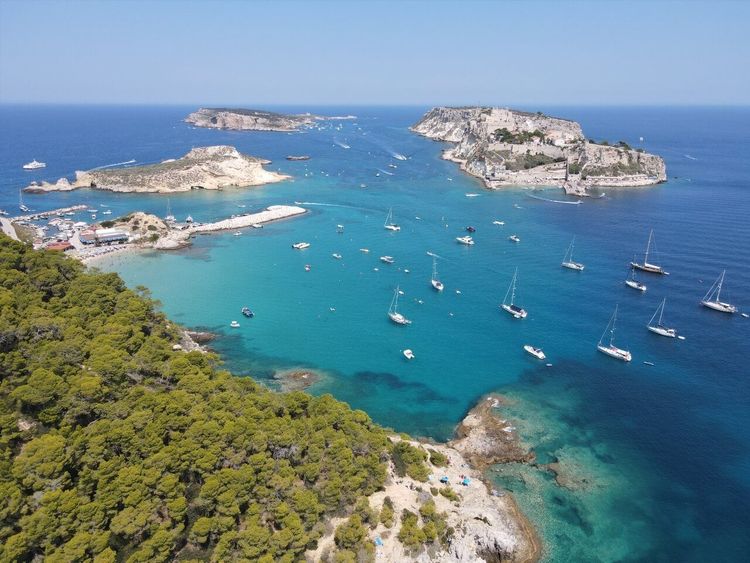
The Tremiti Islands are the great forgotten destination in guides to Puglia. Located 22 km north of the Gargano promontory, this archipelago of five small limestone islands (three of them inhabited) is the only archipelago in the Italian Adriatic. They are accessible by ferry from Vieste, Manfredonia or Termoli (Molise), with the crossing taking between 1h30 and 2h30 depending on the departure point.
San Domino is the largest and most verdant, with its Aleppo pine forests running down to the sea. Its limestone coves — Cala delle Arene, Cala delle Roselle — have water of exceptional clarity and biological richness that place the archipelago among the best diving sites in the Adriatic. The Tremiti Islands Marine Park protects the seabed and regulates diving and fishing.
San Nicola is home to the Benedictine abbey of Santa Maria a Mare, founded in the 11th century and still inhabited by a community of monks. The interior frescoes and Byzantine mosaic floor are extraordinarily rare for a building of this size. Capraia (or Cretaccio) is an uninhabited rock, reserved for seabirds.
The Tremiti Islands are closed to motor traffic: you get around on foot, by rowing boat or by water taxi between the islands. At the height of summer (July–August) they attract many Italian holidaymakers — prefer June or September for peace and quiet.
15. Puglian Gastronomy: Burrata, Orecchiette and Primitivo
Travelling in Puglia without talking about the food would be like visiting Florence without the museums. Puglian gastronomy is one of Italy's richest and most coherent, built on ingredients of exceptional quality (olive oil, seasonal vegetables, fresh cheeses) and a tradition of cucina povera that has elevated the humble to the noble.
Burrata was born in Andria in the 1950s (some say 1956, others 1920 — local cheesemakers don't agree). It is a buffalo or cow's milk mozzarella filled with cream and shredded mozzarella strands. It must be eaten within 48 hours of being made, which explains why exported burrata never comes close to the freshness of one eaten on the spot, at room temperature, with a ripe tomato and green Apulian olive oil. Expect to pay €2 to €4 for a 125 g burrata bought directly from a cheesemaker.
Orecchiette ("little ears") are the region's emblematic pasta. Rolled by hand with a thumb on a wooden board, they are most often served "alle cime di rapa" (with broccoli rabe shoots, a bitter and flavourful vegetable grown mainly in Puglia) or with a tomato and sausage sauce. In honest restaurants in Bari or Lecce, expect to pay €8 to €12 for a pasta dish.
Local cheeses also deserve systematic exploration: caciocavallo podolico (stretched-curd cheese from Podolian cattle, raised free-range in the Gargano), ricotta forte (fermented ricotta, strong and creamy, to be spread on grilled bread), and scamorza affumicata (smoked mozzarella). In any artisan cheese shop in the region, you can put together a board for €15 to €20 that would put a Parisian affinage menu to shame.
For wines, two appellations dominate: Primitivo di Manduria (a powerful, full-bodied red, 14 to 17% ABV, made from the Primitivo grape, a genetic cousin of Californian Zinfandel) and Negroamaro (a more refined red, with notes of black cherry and cocoa, produced in the Salento). Both are available in every wine bar in the region, by the glass or bottle, at very accessible prices compared to equivalent appellations in Tuscany or Piedmont.
16. Matera: the Essential Day Trip outside Puglia
Matera is not in Puglia — it is in Basilicata, the neighbouring region. But from Bari it is 65 km away (about 1 hour by road), and not going there from Puglia would amount to a form of geographical stubbornness with little justification. The city is so extraordinary that it warrants a full day, even from Puglia.
"Mediterranean" is the word that crops up in every article about Matera, but "Sassi" is the one that matters. The Sassi di Matera (Via Sette Dolori, 75100 Matera, rated 4.5/5 on Google with 2 reviews) are two districts (Sasso Caveoso and Sasso Barisano) built into limestone ravines, in cave-dwellings inhabited from prehistory until the 1950s, when the Italian government evicted the last residents (around 15,000 people) for sanitary reasons. Since then, some caves have been converted into museums, luxury hotels and restaurants, and the whole area was listed as a UNESCO World Heritage Site in 1993.
The view over the Sassi from the Civita belvedere (the elevated old town) is one of the most striking in Italy. The lunar landscape of the ravines, the bell towers emerging from the caves, the goats grazing on the roof-terraces — it is a spectacle without equal. Several films have used the Sassi as a backdrop: Mel Gibson shot "The Passion of the Christ" there in 2004; James Bond passed through in "No Time to Die" (2021).
Plan an overnight stay if you can — the illuminated Sassi at night have an atmosphere that a daytime visit cannot fully capture.
17. Trani and Its Cathedral with Its Feet in the Water
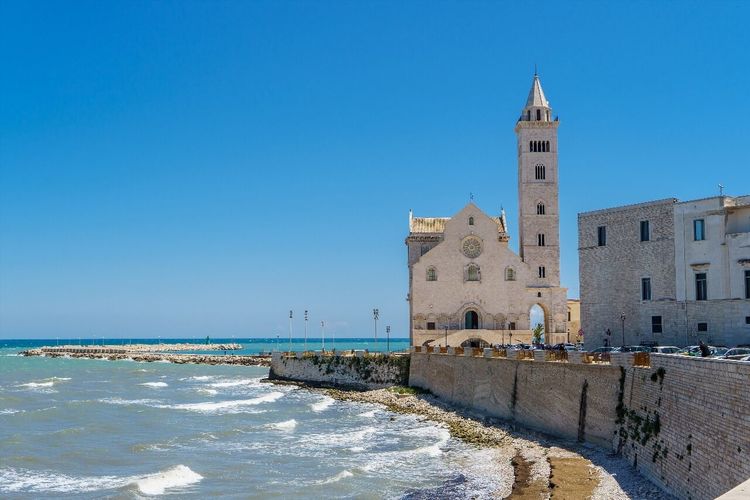
Trani is one of northern Puglia's best-kept secrets. A coastal city 45 km north-west of Bari, it is built on a rocky promontory jutting into the Adriatic Sea. Its main monument makes no concessions: the Cathedral of San Nicola Pellegrino (1143–1200), a masterpiece of Puglian Romanesque whose northern apse literally touches the seawater.
The cathedral's façade has a formal purity that contrasts sharply with the flamboyant baroque of Lecce or Otranto: white limestone, sculpted portal, three soberly articulated apses, a square bell tower rising to 59 metres. At high tide, the base of the building is lapped by water — a photographic composition rare in Italy.
Trani's port is one of the most lively on the northern Adriatic coast of Puglia. The morning market on the quay offers octopus, wedge clams and shellfish that the port's restaurants prepare at lunchtime. The city also has a remarkably well-preserved medieval Jewish quarter (one of Italy's oldest Jewish communities), with two synagogues, one of which — the Scolanova — was converted into a church in 1380 but retains its original architecture.
18. Cisternino and Its Fornelli Pronti
Cisternino (Piazza Vittorio Emanuele, 72014 Cisternino, rated 4.6/5 on Google with 3K reviews) is one of the least touristy villages in the Itria Valley, which makes it one of the most enjoyable to wander through. The historic centre is a tangle of small squares, white limestone stairways and vaulted passages where children still play football in the evening. Few souvenir shops, few estate agencies — just a village that remains unaware of itself as a tourist destination.
The local culinary speciality, the fornelli pronti, is worth the trip on its own. In several butcher's shops in the centre, you choose your meat from the counter — bombette (pork rolls stuffed with cheese, the local speciality), gnummareddi (grilled lamb offal, an experience for enthusiasts), spiedini — and the butcher grills it directly over hot embers behind the counter. You eat it standing up or on one of the benches in the nearby square, with bread and a jug of wine.
Budget €10 to €15 for a full meal at a fornello, wine included. An honest price that perfectly illustrates the value for money of Puglian gastronomy when you step away from the tourist restaurants.
19. The Grotta della Poesia: Italy's Oldest Rock Art Gallery
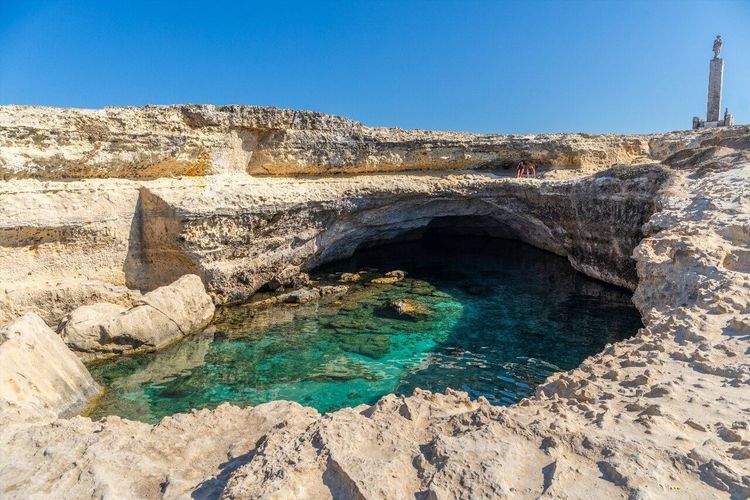
Near Roca Vecchia, on the Salento's Adriatic coast, the Grotta della Poesia (Via Litoranea, 73026 Roca Vecchia, rated 4.4/5 on Google with 17,558 reviews) is a sea cave whose walls are covered with 3,000 inscriptions and engravings dating from the 9th to the 3rd century BC, making it the largest rock sanctuary in the Mediterranean for this period. Names, human figures, animals, geometric symbols — in Greek, Latin, Messapian (the pre-Roman local language) and other languages not yet deciphered.
The cave was a place of pilgrimage for sailors crossing the Otranto Channel: before braving the crossing towards Greece or the Orient, they would stop here to leave their name on the stone. This practice is found at other Mediterranean sanctuaries, but never at this scale and density.
The site is listed; guided visits are compulsory (admission €5). The cave is open mainly during the summer season. The sea in front of the site is beautiful and uncrowded — combine the visit with a swim in the adjacent cove.
20. The Gargano Promontory: Forest, Sea and Pilgrimage
The Gargano Promontory is a limestone spur jutting into the Adriatic Sea in northern Puglia. Geologically distinct from the rest of the region (it was once an island connected to the mainland around 60 million years ago), the Gargano is covered by the Umbra Forest, the largest beech forest in southern Italy (10,700 hectares, part of the Gargano National Park). A rarity in a generally open and dry region.
The Gargano coast alternates white sandy beaches with spectacular limestone cliffs. Vieste is the main seaside resort, with its Pizzomunno rock (a 25-metre monolith standing in the sea facing the beach) and its fine sandy beaches. Peschici is smaller, more rugged, with a white old centre perched on a cliff.
The Gargano is also an important place of pilgrimage. Monte Sant'Angelo is home to the Sanctuary of the Archangel Michael, inscribed on the UNESCO World Heritage List in 2011 (as part of the "Longobards in Italy" serial site). The cave where Saint Michael is said to have appeared in AD 490 is still an active place of devotion, drawing thousands of pilgrims every year. The architecture of the sanctuary, carved into the rock, is a remarkable testament to the medieval devotion of southern Italy.
21. Castel del Monte: Frederick II's Mysterious Geometry
Castel del Monte (Strada Provinciale 234, 76012 Andria, rated 4.5/5 on Google with 22,469 reviews) is one of Italy's most enigmatic monuments. Built by Emperor Frederick II of Hohenstaufen between 1240 and 1250 on an isolated hilltop in the heart of the Murgia, this castle is a purely geometric construction: octagonal floor plan, 8 octagonal towers at the corners, 8 rooms per floor, 8 external doorways. Nobody knows with certainty what it was used for — a hunting lodge, a meditative retreat, an architectural manifesto on the properties of the number 8? The interior has no kitchens, stables or defensive installations worthy of a serious fortress.
UNESCO listed it in 1996. Since 1998, the castle has featured on the Italian 1-cent euro coin.
The monument is 65 km west of Bari. Access is via a road that climbs through a near-deserted agricultural plateau. The view from the castle over the Murgia is vast: olive groves, wheat fields and silence. Admission: €8. Allow an hour and a half for a full visit. The car park is 1.5 km from the castle; a shuttle is available in high season.
22. Drinking a Primitivo in the Vineyards at Sunset
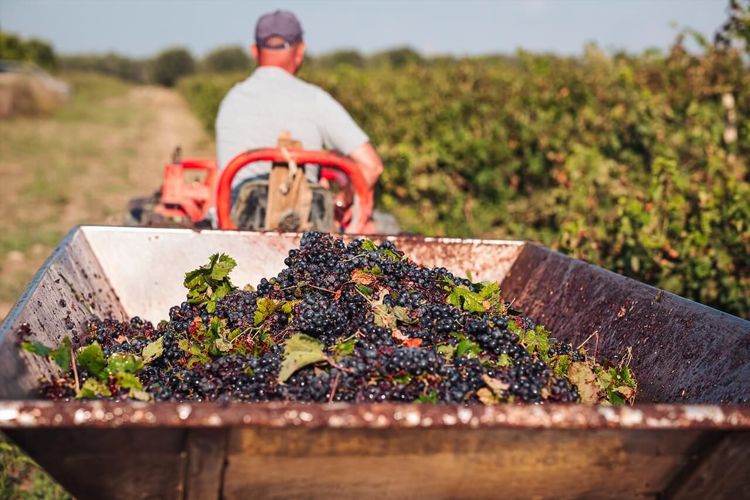
Some experiences appear in no guidebook, and yet. In the area around Manduria, between Taranto and the Gulf of Taranto, Primitivo vines cover hundreds of hectares of reddish limestone terrain. Several estates offer visits and tastings directly in the vineyards, with sea views in some cases.
The Primitivo di Manduria DOCG is a wine of unusual concentration for southern Italy: deep red, almost violet, full-bodied, with velvety tannins and a long finish of dark fruit and chocolate. It ages remarkably well — older vintages (10 to 15 years) develop notes of candied cherry and old leather. The Pervini estate (Primitivo di Manduria) and the Produttori di Manduria cooperative (Via Fabio Massimo, 74024 Manduria, rated 4.7/5 on Google with 1,068 reviews) are two accessible references that require no advance reservation.
A glass of Primitivo at sunset in the vineyards, with a board of local cheeses, is perhaps the best way to close a day in Puglia. No monuments to tick off, no queues — just the raking light on the vines, the silence of the countryside and the very soft sound of the wind in the leaves. The Ryo app can point you towards wineries open to the public in the region, with up-to-date opening hours and contact details.
FAQ
What to do in Puglia in 3 days?
Three days allow you to cover the Bari–Alberobello–Lecce triangle without rushing. Day 1: Bari Vecchia (morning) + drive to Alberobello (afternoon). Day 2: Ostuni + Cisternino + Locorotondo. Day 3: Lecce for a full day. A rental car is essential — distances between villages are short but public transport is irregular.
What to do in Puglia in 5 days?
Five days allow you to add Polignano a Mare, the Salento coast (Otranto, Gallipoli) and a night in a masseria. The optimal itinerary: Bari + Alberobello (day 1), Itria Valley (day 2), Polignano + Monopoli (day 3), Lecce + Otranto (day 4), Gallipoli + Salento (day 5). Pick up your rental car at Bari or Brindisi airport.
What to do in Puglia in 7 days?
Seven days offer the luxury of venturing up to the Gargano in the north, including a day trip to Matera, and dedicating a full day to the Salento beaches. The Ryo app offers audio guides to greatly enrich the main stops along the route, with no extra logistical effort.
What is the best season to visit Puglia?
May–June and September–October are the best periods: the sea is already (or still) warm enough to swim in, temperatures stay below 30 °C, and tourist sites are noticeably less crowded. July–August is pleasant but hot (35–40 °C) and very busy, especially in Polignano and Alberobello. December–March allows you to visit the architectural heritage (Lecce, Otranto, Trani) in peace, but beaches are closed and some masserias too.
How do you get around Puglia?
A car is almost essential for exploring the region independently. Trains connect Bari, Brindisi, Lecce, Taranto and some coastal towns, but inland villages (Alberobello, Ostuni, Locorotondo) are less well served. Puglia's secondary roads are pleasant to drive, rarely congested out of season and well signposted. Bring a GPS or an offline app, as network coverage can be patchy in the Murgia.
Which areas of Puglia should you avoid?
No area is dangerous for tourists, apart from the industrial outskirts of Taranto (pollution linked to steelworks). Brindisi is often unfairly maligned — its historic centre is pleasant but admittedly limited (2 hours is enough). The paid beach clubs (lidos) that cover almost the entire coastline in summer can come as a surprise: fully free-access beaches are rare, especially between Gallipoli and Otranto.
Conclusion
Puglia resists any quick definition: neither the Tuscany of the south nor the Sicily of the Adriatic, but a region with its own logic — slow, white, salty. From the obsessive geometry of Castel del Monte to the sea caves of Polignano, from the millennia-old inscriptions of the Grotta della Poesia to the alleyways of Alberobello, each stop adds another layer to an image that no single photograph can capture.
To make the most of your stay, explore Puglia with the Ryo audio guide: it transforms every walk into a story, giving context to every façade and every square. Download your stages before you leave — some areas in the south have limited connectivity — and let yourself be guided at the pace of Puglia.