© Shutterstock
 Votre guide Ryo
Sardinia: 20 Places You Absolutely Must Visit in 2026
What to visit in Sardinia when you look beyond the image of a beach island reserved for yachts and postcard-perfect shores? The reality is far richer: 8,000 nuraghi scattered across the inland hills, gorges carved 500 metres deep, villages whose mural frescoes recount sixty years of peasant resistance. Before planning your trip, start by exploring the Ryo audio-guided tour of Cagliari — 17 audio stops, 1h50 of walking — to get to the heart of the capital before you even set foot on the island.
This article reviews the 20 must-see places to visit in Sardinia: from Cagliari and its medieval neighbourhoods to the secret coves of the Gulf of Orosei, from the Phoenician ruins of Tharros to the orange-coloured houses of Bosa. You will also find practical information to help you plan your stay — best time to visit, transport, gastronomy — so that a week or ten days in Sardinia becomes a complete experience, far from the beaten track.
Cagliari, the Capital with Four Historic Quarters
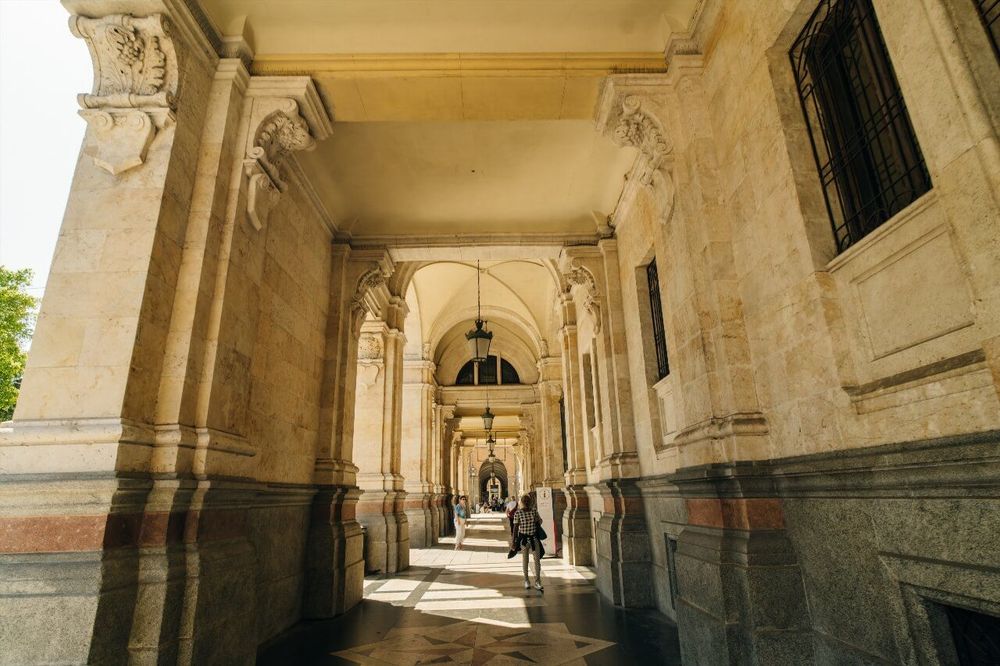
Cagliari stands out as the natural entry point for anyone visiting Sardinia for the first time. Within less than two square kilometres, the city concentrates four districts of radically distinct character: Castello, the medieval citadel perched on its rocky spur; Marina, a maze of commercial alleyways at the foot of the ramparts; Stampace, a baroque quarter with numerous churches; and Villanova, with its still-preserved village atmosphere.
The Castello quarter is the city's historic heart. Its 13th-century Pisan towers — the Torre dell'Elefante and the Torre di San Pancrazio — dominate a walled city where cobbled alleyways open onto breathtaking panoramas over the gulf and the lagoons. The National Archaeological Museum houses the world's largest collection of Nuragic bronzetti: these small bronze statuettes depicting warriors and deities are the key to understanding a civilisation that built more than 7,000 stone towers between 1800 and 500 BC.
Heading down towards the seafront, the Passeggiata Umberto I runs alongside the lagoons where thousands of flamingos spend the winter. This presence — often surprising to visitors who are unaware that Cagliari is one of the rare places in Europe where these birds nest in the immediate vicinity of a capital city — perfectly captures the Sardinian paradox: an island dense with intertwined history and wild nature.
Allow at least one full day, two if you want to explore the Poetto district and its seven kilometres of urban beach. The Ryo audio guide of Cagliari — Le Trésor Sarde covers the essential highlights of all four quarters over 4.5 km on foot, with stops at the Bastione di Saint-Remy (Piazza Costituzione, 09124 Cagliari, rated 4.6/5 on Google with 28,001 reviews), the Torre dell'Elefante, the San Benedetto markets, and hidden little squares that printed guides never mention.
Costa Smeralda: Between Discreet Luxury and Wild Coves
The Costa Smeralda owes its worldwide reputation to an Aga Khan consortium that, in the 1960s, transformed an almost deserted granite coastline into one of the most coveted beach destinations in the Mediterranean. Porto Cervo (07020 Arzachena, rated 4.5/5 on Google with 4.3K reviews), its artificial yet seductive "village", is packed with luxury boutiques and multi-million-euro yachts. But this heavily publicised façade reveals little about the real coastline.
The true wealth of the Costa Smeralda lies in its coves accessible only on foot or by boat. The beach of Capriccioli, two kilometres from the main road, offers turquoise waters set among pink rocks that the crowds rarely reach before 10 in the morning. Further north, Liscia Ruja beach stretches for nearly a kilometre with no visible tourist facilities — a miracle at this latitude during high season.
If you are staying in this area, the city of Olbia (30 km away) serves as an efficient logistical base: ferries, airport, supermarkets. The Caprera peninsula, accessible from La Maddalena, also offers two-to-four-hour coastal hikes that reveal panoramic views over the archipelago without the need for a boat.
La Maddalena Archipelago: Seven Islands and a National Park
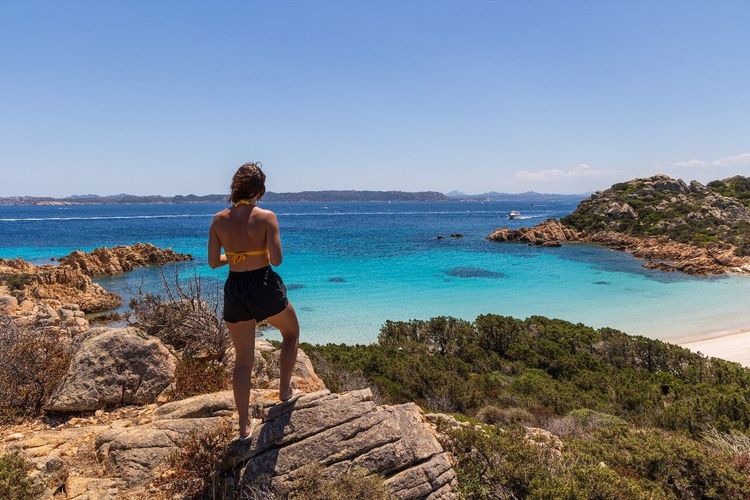
A 20-minute ferry ride from Palau, the La Maddalena archipelago (Piazza Umberto I, 07024 La Maddalena, rated 4.8/5 on Google with 6.4K reviews) brings together seven main islands and around ten islets within a marine and terrestrial national park created by a law in January 1994 — Sardinia's first national park. The extraordinary intensity of the water colours, from pale jade to cobalt blue within less than a hundred metres, is due to the composition of the seabed: very fine white sand over pink granite, with no seaweed and no silt.
The main island, La Maddalena, is connected by a road bridge to Caprera, the island where Giuseppe Garibaldi chose to retire after his military campaigns. His house, now a national museum, preserves the everyday objects of the "hero of two worlds" with a touching simplicity — a camp bed, a worn raincoat, a few letters. It is one of the most unusual museums in Italy.
Boat tours from La Maddalena allow you to reach the beaches of Budelli (famous for its spiaggia rosa, whose pink sand is protected by law — landing is prohibited), Santa Maria and Razzoli. Local companies offer full-day outings for €35 to €55 per person, including two or three swimming stops and lunch on board. Book at least 48 hours in advance in July and August.
The park is also home to a population of common dolphins that regularly accompany boats between the islands. Observation conditions are among the best in the western Mediterranean — a compelling reason to include La Maddalena in your itinerary even if beaches are not your top priority.
Alghero: the Catalan Enclave at the Edge of the World
Alghero is a fascinating cultural anomaly. This town in the northwest of Sardinia still speaks, in part, Algherese — a Catalan dialect introduced by Aragonese settlers in the 14th century. Bilingual Sardinian-Catalan signs line the alleyways of the old town, and some elderly residents will answer you in a language that evokes Barcelona more than Cagliari.
The centro storico of Alghero, encircled by stone ramparts built by the Aragonese, can be explored on foot in two to three hours. The Cattedrale di Santa Maria blends Gothic and Baroque styles in an unexpectedly harmonious way. The seafront bastions, especially at sunset, offer panoramic views over the Sea of Sardinia and, on a clear day, as far as Cap Caccia, 25 km offshore.
12 km to the north, the cliffs of Cap Caccia plunge vertically 300 metres into the sea. The Neptune's Grotto, accessible only by boat from Alghero (45 minutes) or via the Cabirol stairway (656 steps from the top), is one of the most spectacular karst formations in Italy. The stalactite formations and the milk-coloured underground lakes are well worth the detour.
Alghero is also an excellent base for exploring the beaches of the Riviera del Corallo: Maria Pia, Le Bombarde, Lazzaretto — family-friendly beaches with parking and amenities, 5 to 10 minutes from the town centre. The Necropoli di Anghelu Ruju (SP42, 07041 Alghero, rated 4.4/5 on Google with 1,499 reviews), 10 km away, reveals the prehistoric "domus de janas" burial sites carved into the rock — an opportunity to understand that human settlement of Sardinia dates back more than 4,000 years before the Common Era.
Neptune's Grotto: Sardinia's Underground Masterpiece
If Neptune's Grotto deserves a separate mention from Alghero, it is because many travellers miss it due to a lack of logistical knowledge. The boat trip from Alghero harbour takes 45 minutes each way (departures in the morning and early afternoon depending on the season), followed by a mandatory guided tour of approximately one hour. The entrance fee to the grotto is €18 full price in 2026 (reduced rate around €10 for ages 6–17), not including the boat ticket.
The stairway option, known as the "Escala del Cabirol", offers a spectacular descent from the Cap Caccia car park: 656 steps cut into the cliff face, taking 30 to 40 minutes to descend. Plan to arrive at least 40 minutes before your scheduled tour to check in and make your way down at a comfortable pace. The views over the sea along the way are stunning, though this option is less recommended in intense heat or with young children.
Inside, the underground lake Lago Lamarmora and the forest of stalactites several metres tall create a truly timeless atmosphere. The guided tour is the only option available, but Sardinian guides generally avoid the formulaic tourist commentary.
Stintino and Cap Falcone: the Most Photographed Beach in the Mediterranean
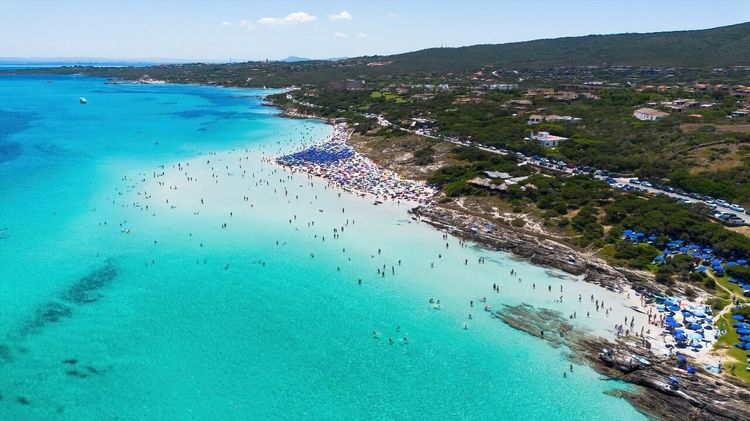
The beach of La Pelosa, at Stintino, accumulates millions of photos on social media every summer. It is not an exaggeration: the water is an almost implausibly turquoise colour, with a 16th-century Aragonese tower in the background. But this success comes at a price — access is subject to a paid reservation (€3.50 per person, from mid-May to mid-October) to limit attendance to 1,500 visitors per day. Reservations are made on the official website or dedicated app, and a QR code is checked at the entrance.
Plan your visit early in the morning or outside of July and August to find some semblance of serenity. Spiaggia della Pelosa Grande, 200 metres away, attracts fewer people while offering equally good water quality.
Cap Falcone (15 km further north), accessible by car then on foot along a 45-minute path, offers views over the Strait of Bonifacio and Corsica, just 12 km away on a clear day. The island of Asinara, visible from this cape, is home to a national park where albino donkeys and peregrine falcons coexist far from any permanent human disturbance.
Castelsardo: the Fortress Village above the Sea
Castelsardo (Piazza Castello, 07031 Castelsardo, rated 4.5/5 on Google with 5,257 reviews), in the north of the island, clings to its volcanic rock like a shell on a cliff. Founded in the 12th century by the Genoese under the name Castelgenovese, the village concentrates within a few hundred metres a medieval citadel, a Romanesque cathedral, and a craft tradition of dwarf-palm basketry (the intreccio sarda) that features on Sardinia's list of intangible cultural heritage.
The Elephant Museum, housed in the fortress towers, presents the connections between Castelsardo and the Mediterranean civilisations that passed through its ports since Antiquity. The visit takes around 45 minutes. The sunset from the ramparts, facing the Tyrrhenian Sea, is one of the most beautiful in the entire north of the island — arrive at least 20 minutes early to find a good spot.
Bosa: the Town of Saffron-Coloured Houses
Few Sardinian towns exude the atmosphere of Bosa. Its warmly coloured houses — ochre, terracotta, saffron — line the banks of the Temo river, Sardinia's only navigable river, at the foot of a hill crowned by the Malaspina castle (Via del Castello, 08013 Bosa, rated 4.2/5 on Google with 3,392 reviews). The whole scene forms a medieval tableau that modernity seems to have spared.
The Sa Pirastrada Tannery, housed in a former hide-processing factory on the banks of the Temo, still operates in an artisanal way and welcomes visitors. It is one of the rare places in Europe where you can observe the entire traditional tanning process. The visit is self-guided and takes 30 to 45 minutes.
From the Malaspina castle (12th century), the view over Bosa and its river is exceptional in the late afternoon. The climb takes 20 minutes from the old town. The castle interior houses a small chapel whose 14th-century frescoes have recently been restored. Bosa also serves as a starting point for the beaches of Bosa Marina 3 km away — long, family-friendly beaches that are quiet outside of July and August.
Oristano and the Sinis Peninsula
Oristano, in the centre-west of the island, is the Sardinian city least featured in mainstream travel guides — which makes it precisely a valuable stop for travellers seeking to get off the beaten track. The town lives at its own pace, with its morning markets, its baroque cathedral and the Sartiglia festival, Sardinia's most spectacular masked equestrian parade, held every year on the Sunday and Tuesday of Carnival.
The Sinis peninsula, 15 km to the west, offers several major reasons to stop. The ruins of Tharros, founded by the Phoenicians in the 8th century BC and later developed by the Romans, spread across a promontory overlooking two seas at once: the Gulf of Oristano to the east and the open Tyrrhenian Sea to the west. It is one of the most photogenic archaeological sites in the entire Mediterranean.
The Sinis beaches — Is Arutas (white quartz sand that resembles rice grains), Mari Ermi (protected), Maimoni — form a remarkable stretch of coastline less than an hour from Oristano. The Cabras Lagoon nature reserve is home to a population of grey mullet whose roe is used to produce bottarga, the Sardinian caviar. The artisanal production facility in Cabras offers visits in season.
The Nuraghe of Barumini: UNESCO's Inland Treasure
60 km north of Cagliari, the Su Nuraxi di Barumini complex (Viale Su Nuraxi, 09021 Barumini, rated 4.7/5 on Google with 8,190 reviews) is the only site in Sardinia inscribed on the UNESCO World Heritage List, since 1997. This central basalt tower, whose core dates back to the 16th–15th century BC and which is surrounded by four secondary towers, is the best-preserved nuraghe on the island among the thousands on record.
The guided tour (mandatory, lasting 45–60 minutes) explains the construction techniques: multi-tonne basalt blocks assembled without mortar, with a precision that still baffles archaeologists. The complete site reveals a genuine Nuragic village of several dozen huts that grew up around the central tower between the 13th and 6th centuries BC. The excavation campaign, led between 1950 and 1957 by local archaeologist Giovanni Lilliu, revealed the exceptional scale of the site.
Nearby, the Giara di Gesturi, a basalt plateau covering 45 km², is the last sanctuary of the small wild horses of Sardinia (giare horses): ponies standing around 1.30 m tall that have roamed this plateau freely for centuries. A dawn hike sometimes allows you to spot dozens of them at the edge of the cork oak groves.
The Su Gorropu Gorge: the Grand Canyon of the Mediterranean
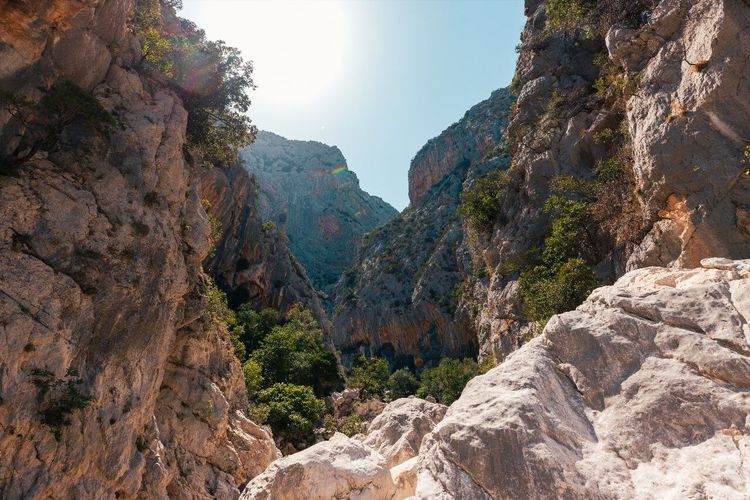
The Su Gorropu gorge, in the Supramonte in the centre-east of the island, is sometimes nicknamed the "Grand Canyon of the Mediterranean". Its limestone walls plunge 500 metres deep to a width of just 4 metres in places, making it the deepest canyon in Italy and one of the deepest gorges in Europe.
Access is from the village of Dorgali (50 km north of Nuoro): a two-hour walk one way from the Genna 'e Silana car park, along a rocky trail that first follows the Flumineddu river. The first few hundred metres inside the gorge are accessible without technical equipment. Deeper progress requires ropes and a local guide.
The landscape around Su Gorropu — holm oak forests, griffon vultures (one of Italy's last colonies, particularly present near Bosa), karst ridges — is alone worth the journey to the centre of the island. Allow a full day from the coast, with a good pair of hiking shoes and at least 2 litres of water per person.
The Gulf of Orosei: the Most Beautiful Wild Beaches in Europe
The Gulf of Orosei stretches over 40 km of coastline between Dorgali and Baunei, without a single driveable road descending to the sea. This is precisely what makes it the most unspoilt coastline in the Mediterranean. The beaches are accessible only on foot or by boat, and some only by swimming from a vessel anchored offshore.
The most famous beaches bear names that sound like promises: Cala Goloritzé (declared a natural monument by the Italian state in 1995, dominated by its 143-metre limestone pinnacle, with translucent blue waters), Cala Luna (Golfo di Orosei, 08022 Dorgali, rated 4.7/5 on Google with 1,009 reviews — 40 minutes by boat or 4 hours on foot), Cala Mariolu (white pebble seabed and transparent water down to 20 metres). Access to Cala Goloritzé is now paid and subject to reservation (around €6), with a strict daily quota to preserve the site.
Boats from Cala Gonone (the area's main port) offer several options: a full-day tour of the calas (€60–75), point-to-point transfers to Cala Luna or Goloritzé (€20–30), or rental of small boats without a licence (from €100 per day for 4 people). Renting a boat gives complete freedom to adjust timings based on how busy the beaches are.
The hiking trail from the Baunei plateau (on the southern side of the gulf) deserves special mention: the route known as Selvaggio Blu, although reserved for experienced hikers with bivouac gear, is ranked among the ten most beautiful hiking trails in Europe. One-day variants allow you to reach Cala Goloritzé from the heights in approximately 3 hours.
The gulf also shelters the Bue Marino Caves — sea caves where the Mediterranean monk seal (bue marino in Sardinian) used to reproduce before 20th-century human disturbances. The stalactite formations in the chambers accessible by boat are of a beauty comparable to Neptune's Grotto.
Orgosolo: the Open-Air Museum of Political Murals
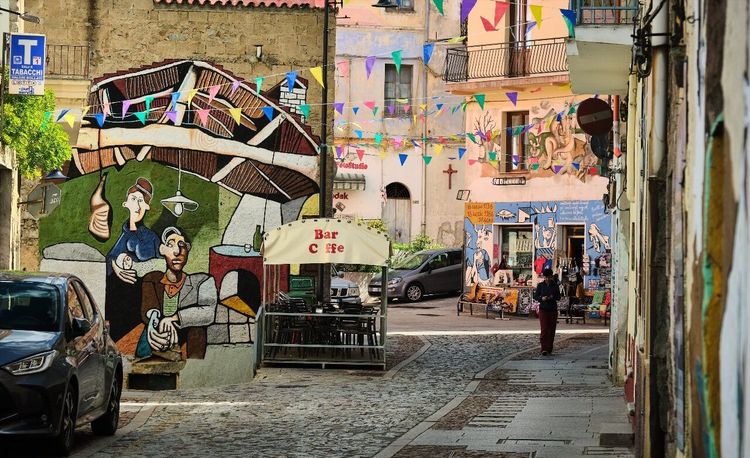
Orgosolo, a mountain village of 4,000 inhabitants in the Gennargentu, is known for its murales — more than 150 frescoes painted on the façades of ordinary houses since the 1960s. These murals tell the story of Sardinian peasant resistance, struggles for land, the 20th-century world conflicts, and the memory of the inland bandits.
A walk through the village to discover these works takes 1 to 2 hours and requires no guide. The atmosphere is that of a living village, not a museum — the frescoes sit alongside parked vehicles, children playing, and washing lines. This ordinariness paradoxically reinforces the impact of the images.
Orgosolo is also a good starting point for exploring the high plateaus of the Gennargentu, a massif peaking at 1,834 metres (Punta La Marmora), where traditional pastoral settlements, high-altitude hiking, and wildlife (Sardinian deer, Bonelli's eagle) offer a Sardinia radically different from the coastline.
Olbia and the Island of Tavolara: the Northeast Gateway to Sardinia
Olbia is the most convenient city for arriving in Sardinia from the mainland: a well-connected international airport and a ferry port with services from Genoa, Civitavecchia and Livorno. The city itself is worth half a day for its Basilica di San Simplicio (11th century, brown granite, interior of great understated elegance) and the Roman ruins scattered throughout the centre.
15 km south of Olbia, the island of Tavolara (07020 Loiri Porto San Paolo, rated 4.7/5 on Google with 411 reviews) is a granite formation that rises abruptly to 565 metres above a flat sea. Classified as a special protection area, it is accessible by boat from Porto San Paolo (15 minutes) and receives visitors only on its eastern beach, with the interior reserved for the military. The beach of Spalmatore di Terra, on the northern side, is one of the most beautiful in the area, with crystal-clear water over a pink granite seabed.
Villasimius: Lagoons and the Southeast Coast
50 km east of Cagliari, Villasimius marks the beginning of an exceptional stretch of coastline. Its appeal is twofold: white-sand beaches with shallow waters on one side, and brackish lagoons populated by flamingos on the other. The road between the two creates a striking visual contrast.
Simius beach, the most popular, is also the finest in the municipality: a kilometre of white sand with turquoise, shallow waters — ideal for families. Campus beach, 10 km to the north, is wilder and accessible via a 2 km dirt track from the main road.
Capo Carbonara (09049 Villasimius, rated 4.8/5 on Google with 283 reviews), the island's south-eastern tip, is home to a marine reserve protecting 20 km² of remarkable seabed: posidonia meadows, grouper, lobster. Local diving clubs offer outings from €45. The Capo Carbonara lighthouse (19th century), visible from the beach, is a photographic landmark of the area.
Chia's Beaches: the Edge of the World in the South of the Island
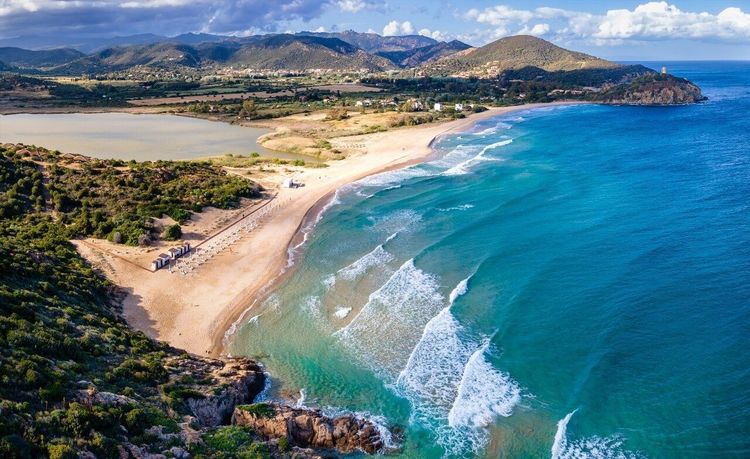
In the southwest corner of Sardinia, Chia concentrates within 10 km of coastline several of the island's most photographed beaches. Chia beach (Località Chia, 09010 Domus de Maria, rated 4.7/5 on Google with 342 reviews) itself, with its juniper-covered dunes and its 17th-century Aragonese tower standing on the sand, evokes a northern Atlantic coast more than a Mediterranean beach.
The Su Giudeu and Tuerredda beaches (accessible by a 15-minute walk from the road) offer excellent snorkelling conditions in shallow water over a bed of rock and posidonia. The area is less touristy than the north of the island in high season — a significant advantage for travellers who prefer to avoid the crowds.
Inland, the ruins of the Phoenician site of Bithia (7th century BC) make a useful archaeological stopover for anyone wishing to understand the succession of civilisations that have inhabited the Sardinian coastline over three millennia.
Carloforte and the Island of San Pietro: Sardinia's Tunisian Town
The island of San Pietro, accessible from Calasetta or Portovesme (30-minute ferry), is home to Carloforte (Piazza Carlo Emanuele III, 09014 Carloforte, rated 4.7/5 on Google with 1.9K reviews), a town of 6,000 inhabitants whose architecture is irresistibly reminiscent of a North African medina. And for good reason: the founders of the town, in 1738, were Ligurian families from Tabarka, a small Tunisian island where they had lived since the 16th century, before obtaining permission from King Charles Emmanuel III to colonise the then-uninhabited island of San Pietro. They brought with them their language (Tabarchino, closely related to Genoese and registered on the intangible cultural heritage list), their culinary recipes, and their colourful façades.
The old town of Carloforte can be explored on foot in two hours: narrow streets, flower-laden balconies, 18th-century fortifications. The local gastronomy is dominated by bluefin tuna — for centuries, the mattanza (traditional tuna fishing) has structured the local calendar. Now largely abandoned for ecological reasons, it lives on in the restaurant recipes: tonno in agrodolce, bottarga di tonno, ventresca.
Costa Verde: the Dunes That Disappear into the Sea
The Costa Verde, in the southwest, is Sardinia's least known and least accessible coastline. There is no continuous coastal road: each beach requires a detour from the interior along unsurfaced tracks. This logistical constraint ensures very low footfall even at the height of summer.
The most impressive site is Piscinas: the largest dunes in Europe, with accumulations of fine sand reaching 50 metres in height, bordering directly onto an intensely blue-green sea. The contrast is dizzying. Only two or three establishments offer accommodation and dining in this area — book well in advance.
The former Montevecchio mine, 20 km inland, is one of Italy's most spectacular industrial complexes. Abandoned in 1991 after a century of zinc and lead extraction, it now hosts guided tours through its partially ruined industrial buildings — an atmosphere reminiscent of Welsh or Belgian mining sites.
When to Visit Sardinia: the Best Time to Go
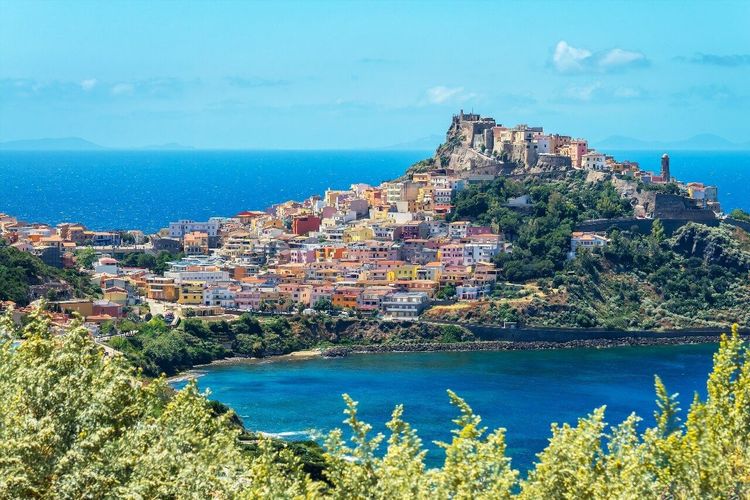
Sardinia can be visited year-round, but the best periods vary considerably depending on what you are looking for.
May and June represent the ideal window for most travellers: the sea reaches 20–22°C (warm enough to swim), the beaches are still uncrowded, and accommodation prices are 30 to 50% lower than in July–August. The vegetation is green, the maquis in flower, and the roads are fully open.
July and August offer the best conditions for swimming (sea at 25–27°C) but bring tourist saturation on the popular beaches. The Costa Smeralda and La Maddalena are packed; accommodation prices double or triple. The mountain roads into the interior remain open and quiet — a good reason to combine the coast in the morning with the interior in the afternoon.
September and October are the second-best period: the sea is still warm (22–24°C in September), the crowds have thinned, and the light is exceptional for photography. The Cannonau vines turn red in the Nuoro area, and the local markets overflow with grapes and figs.
Winter is for travellers who wish to explore the cities (Cagliari, Alghero, Oristano) without compromise on heat. Coastal temperatures remain mild (12–15°C in January), museums and archaeological sites are deserted. Many beach facilities close between November and March.
To find out more about activities to discover year-round, the Ryo article on the unmissable things to do in Sardinia offers a thematic selection that complements this geographical guide.
How to Get Around Sardinia
A car is essential in Sardinia. The public transport network serves the main cities but leaves wild beaches, archaeological sites, and inland villages completely uncovered. Renting a car at Cagliari or Olbia airport is the most logical solution — book several weeks in advance in July and August.
Sardinian roads are generally in good condition on the main routes (the SS131, which crosses the island from north to south, and the SS125 along the east coast). The secondary roads leading to wild beaches — Costa Verde, Gulf of Orosei, Sinis — are often unsurfaced for the last few kilometres. A standard car is sufficient in the vast majority of cases; an SUV or a vehicle with higher ground clearance makes access to the most remote sites easier.
Transport between the main towns is provided by ARST coaches and by train (Cagliari–Oristano–Sassari–Olbia lines — slow but functional). The ferry between Palau and La Maddalena (Delcomar, 20 minutes, frequent departures) is the maritime exception that proves the rule. For more remote islands — San Pietro, Sant'Antioco — ferries from Calasetta or Portovesme complete the network.
In terms of distances, a full crossing of the island (Cagliari in the south to Santa Teresa Gallura in the north) covers around 270 km via the SS131 — about 3 hours of driving without stops. Allow a full day of driving to connect north and south with intermediate stopovers.
Sardinian Gastronomy: Flavours Found Nowhere Else
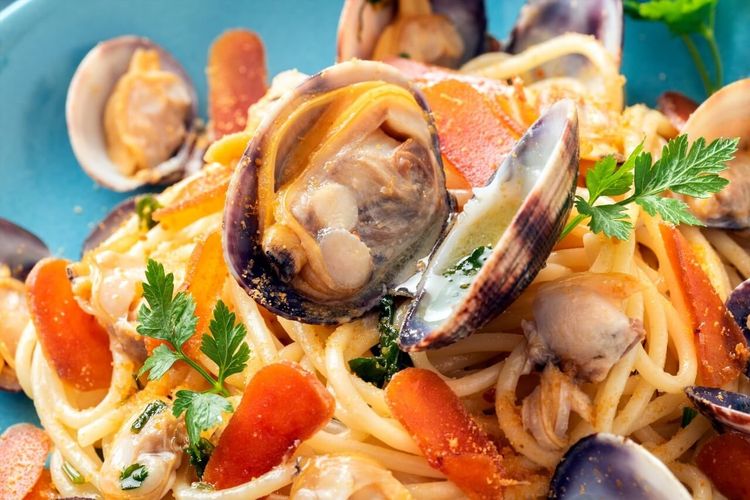
Sardinian cuisine occupies a unique place within Italian gastronomy — and for good reason: the island developed over centuries its own culinary tradition, little influenced by the major trends of mainland cooking.
Porceddu (suckling pig slowly spit-roasted for 4 to 6 hours over a myrtle fire) is the emblematic dish of celebrations and inland restaurants. The texture — crispy skin, tender meat fragrant with maquis herbs — has no equivalent in the Mediterranean. Do not confuse it with the imitations served at beachside restaurants.
Malloreddus (small ridged shell-shaped pasta, sometimes called "gnocchetti sardi") served with a sausage and San Gavino saffron sauce is the typical pasta dish. Culurgiones — ravioli filled with potato, mint and pecorino, hand-sealed using a technique that resembles embroidery — is one of the specialities of the Ogliastra area in the east of the island.
Grey mullet bottarga — dried and pressed mullet roe, grated over pasta or sliced thinly on toast with olive oil — is the pride of Oristano and Cabras. Its intense, briny flavour divides palates, but it is a product that lovers of Mediterranean cuisine must not miss. To explore Cagliari's specialities in detail, the Ryo article on the culinary specialities of Cagliari lists nine must-tries with their addresses.
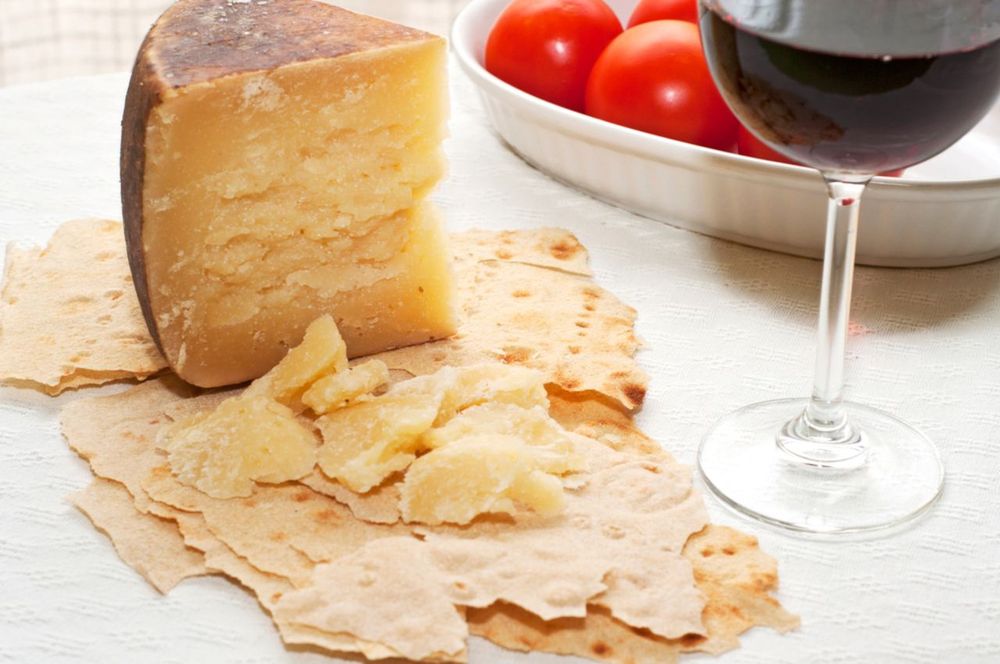
Sardinian wines deserve particular attention: Cannonau di Sardegna (local grenache, full-bodied red, often linked to the exceptional longevity of Ogliastra's inhabitants — a global "Blue Zone") and Vermentino di Gallura (dry, mineral white, perfect with seafood) are the two DOC wines to know without fail.
FAQ
How long does it take to visit Sardinia?
One week is enough to cover one area of the island (the north from Cagliari to La Maddalena, or the west from Alghero to Cagliari). Ten days is the ideal duration. Two weeks allow you to include inland sites (Barumini, Orgosolo, the Su Gorropu gorge) without sacrificing the beaches.
What is the best region for a first visit to Sardinia?
For a first visit, the Cagliari–Villasimius–Chia triangle in the south offers a well-balanced introduction: historic sites (Cagliari), quality beaches, and easy logistics from Cagliari airport. The north (Alghero, La Maddalena, Costa Smeralda) is more spectacular in terms of coastal scenery, but requires a rental car and more careful planning.
Do you need a car in Sardinia?
Yes, without exception, if you want to explore anything beyond Cagliari or Alghero. Public transport does not serve the wild beaches, the nuraghi, or the inland villages. Renting a car at the airport is the only realistic way to organise a complete stay. The road network is of decent quality on the main roads; the tracks leading to isolated beaches sometimes require extra caution.
Are Sardinia's beaches free?
The vast majority of Sardinian beaches are free. Notable exceptions are La Pelosa in Stintino (a ticket of €3.50 per person, from mid-May to mid-October, to limit attendance to 1,500 visitors per day) and Cala Goloritzé in the Gulf of Orosei (around €6, booking required). Some beaches offer paid service areas (sun loungers, parasols) but always maintain free access to the sand and sea.
What are the most beautiful villages in Sardinia?
Bosa, with its colourful houses along the Temo river, is the island's most photogenic village. Castelsardo in the north, Orgosolo for its murals, Carloforte for its unique atmosphere as a Ligurian-Tunisian enclave, and Sant'Antioco in the southwest all deserve a visit. Orosei in the east, a base for exploring the gulf, is also a pleasant historic centre to discover in the evening.
How do you get to Sardinia from France?
Two main options: by plane (direct flights from Paris-CDG, Lyon, Marseille, Nice to Cagliari or Olbia, 1h30 to 2h flight time) or by ferry (from Marseille or Toulon to Cagliari or Porto Torres, 10 to 20 hours depending on the route and operator). The plane remains the most popular choice for one-week stays. The ferry allows you to bring your own car without rental costs on the island — a real economic advantage for families or longer stays.
Conclusion
Sardinia resists simplification. It is not merely a beach island — it is a territory where four millennia of civilisations have left their mark on every headland, in every mountain village, and at the bottom of every gulf. From Cagliari to the La Maddalena archipelago, from Bosa to Cala Goloritzé, the contrasts are breathtaking and the distances manageable — more than enough to freely compose your own list of what to visit in Sardinia according to your desires.
To prepare your visit to Cagliari and the surrounding area, the audio-guided tour of Cagliari — Le Trésor Sarde offers 18 commented stops over 4.5 km to explore the history and neighbourhoods of the Sardinian capital at your own pace. A great way to begin — or end — a stay on one of the richest islands in the Mediterranean.