© Shutterstock
 Votre guide Ryo
The Most Beautiful Beaches of Cagliari and Its Surroundings in 2026
Search "Cagliari beach" online and you'll quickly discover something quite rare for a Mediterranean regional capital: an urban beach of 8 kilometres that begins where the last apartment buildings end. You leave the city centre, cross the road, and lay your towel on white sand. But that's just the opening act. Within a 60-kilometre radius of Cagliari, the southern coast of Sardinia strings together lagoon beaches, sheltered coves, and waters whose colour shifts from turquoise to deep blue with depth. This guide covers Cagliari's beaches in the broadest sense — the city itself, its immediate surroundings, and day trips to Chia, Villasimius or Nora — with practical information on transport and the best times to visit. To explore the city beyond its shoreline, the Ryo audio-guided tour Le trésor sarde in Cagliari makes the perfect complement to a beach holiday.
Poetto: Cagliari's Beach par Excellence
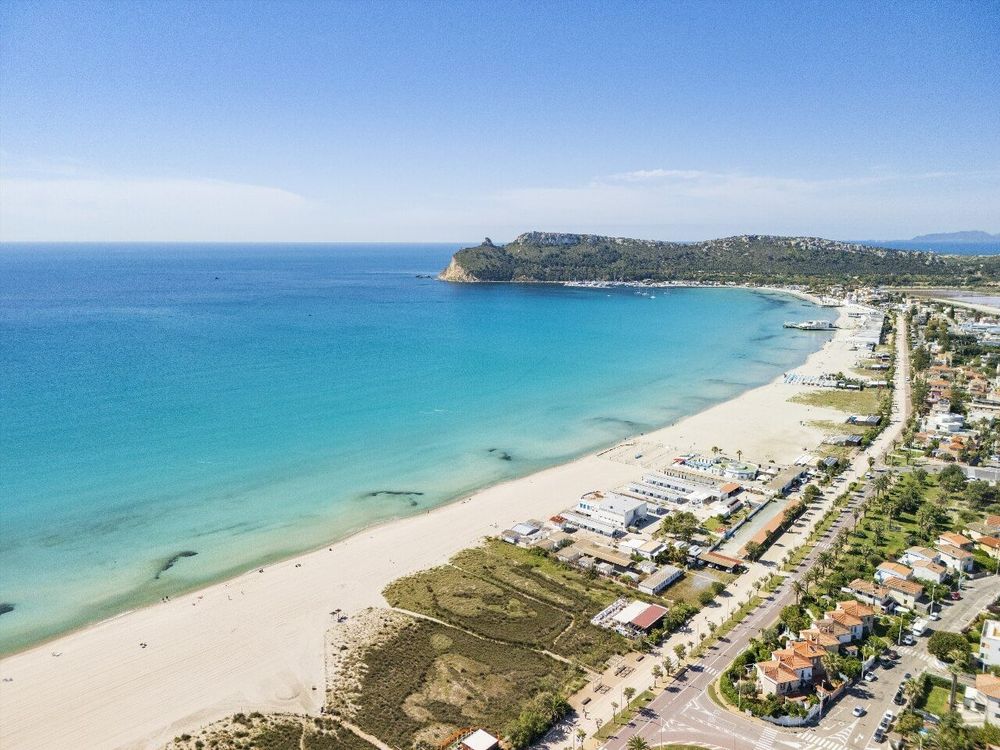
The Poetto is one of the longest urban beaches in Europe: 8 kilometres of fine white sand stretching from the Sella del Diavolo — a saddle-shaped limestone headland — to the flamingo-filled Molentargius lagoon. This proximity to a nature reserve is no coincidence: in the late afternoon, when raking light tints the water pale pink, flamingos wade in the lagoon just a few hundred metres from the busy beach. The scene is both incongruous and unforgettable.
The beach is split into two sections. The western part, known as "delle conchiglie" (the shells), remains public and freely accessible year-round. The central and eastern section is home to the stabilimenti balneari, those quintessentially Italian beach establishments offering parasols, sun loungers and bar service for around €15–20 per day. Access to the sand remains free even in front of the establishments; Italian law guarantees a 5-metre-wide passage between each concession and the water's edge.
In summer, Poetto becomes a genuine social stage for Cagliari's residents. Locals come early in the morning for a swim before work, in the mid-afternoon for family time, and in the evening when the seafront bars open their terraces. The sand is extremely fine — once a pure white, its colour shifted slightly after replenishment works in the 2000s — but water quality has remained impeccable (rated "excellent" by the European Environment Agency).
To get to Poetto from central Cagliari, the PF bus departs from Piazza Matteotti and runs the full length of the beach — allow 20–25 minutes to reach the middle of the beach, with a ticket costing €1.30. By bike, the dedicated cycle path running alongside Poetto is one of the most pleasant in Sardinia.
Calamosca: The City's Hidden Cove
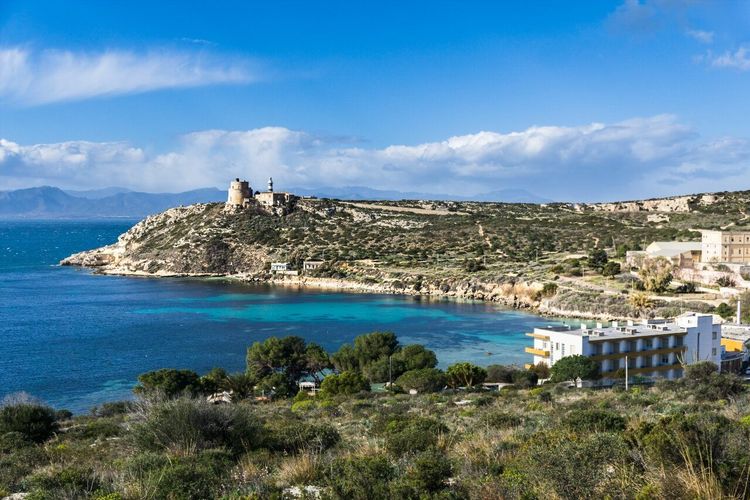
Calamosca is the surprise that awaits those who venture beyond Poetto to Cagliari's southern tip. Nestled at the foot of the Sella del Diavolo, this small beach of 200 metres of golden sand offers remarkably clear water — rocky seabeds and posidonia meadows are visible at depths of three to four metres. The setting is sheltered from the prevailing winds by the headland, making it a valuable option on days when the mistral churns up the Poetto.
Access is by car — allow 10 minutes from the centre — or by the PF bus to the terminus followed by a 20-minute walk. A single beach establishment operates here in season; the rest is free. Halfway up the headland, the Torre di Calamosca (19th century) offers views over both coastlines — Poetto to the north and the beach below. The climb takes barely 15 minutes from the beach and is well worth the effort.
Sant'Elia: The Working-Class Neighbourhood Beach
Less frequented by tourists, the Sant'Elia beach belongs to the working-class district of the same name, to the east of Poetto. It is visited almost exclusively by locals — Cagliari families who know the best spots, fishermen out very early in the morning, and a few athletes using the adjacent cycle path. The sand is coarser than at Poetto, swimming facilities are virtually non-existent, but the atmosphere is authentic and the water clean.
The beach stretches for around 1.5 km towards the Sant'Elia lighthouse. At the very tip of the point, fishermen cast their lines from the rocks — it's a quiet spot that barely features in mainstream travel guides. Accessible by bus (line 30) from the centre or by bike from Poetto along the coast, Sant'Elia suits those looking for a stretch of sea without rows of parasols.
Chia and Its Lagoons: A Visual Feast 60 km from Cagliari
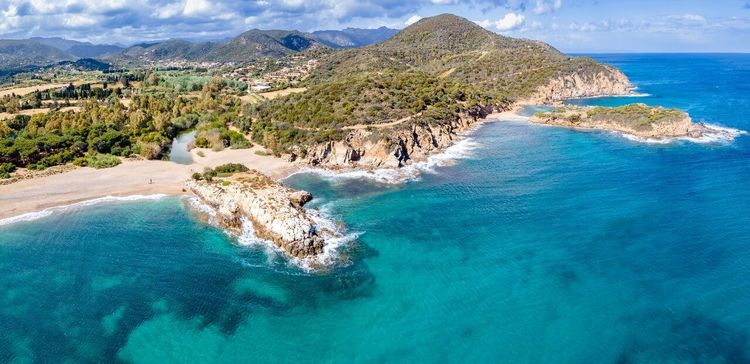
Chia is the name that comes up most often when you ask Cagliari residents where they spend their summer weekends. Located 60 kilometres south-west of the capital, in the south of Sardinia, this village in the municipality of Domus de Maria concentrates a succession of beaches and lagoons of a visual quality that rivals the Maldives — the comparison is well-worn, but when you see juniper-covered dunes rolling down to turquoise water edged with flamingos, it imposes itself naturally.
The main beaches in the area are organised around several coves separated by small headlands:
Su Giudeu is the most spectacular — a wide strip of white sand facing shallow water, with an inner lagoon where migratory flamingos stop to rest. The beach is partly protected by a nature reserve; some areas are accessible on foot only, with no cars or quad bikes permitted.
Tuerredda is smaller and renowned for its intensely green water — the effect of a combination of bright sandy seabeds and very shallow depth at the entrance. It is accessible on foot from a paid car park in season, with around 15 minutes of walking. Access is even capped in summer (a daily visitor quota): the queue for parking can be long in July–August, so plan to arrive before 9am.
Chia main beach (or Spiaggia di Chia (SP71, 09010 Domus de Maria, rated 4.6/5 on Google from 3,033 reviews)) has direct road access, several beach establishments and windsurfing board rentals. The north-westerly wind that sweeps the area makes it a favourite spot for windsurfers and kitesurfers.
To get to Chia from Cagliari, a car remains the most practical option (SS 195 then the turn-off towards Domus de Maria). In high season, summer shuttle services may run from Cagliari; check the ARST Sardegna timetables before you go. Allow around 1 hour for the journey.
Villasimius and the East Coast: Sardinia's Clearest Waters
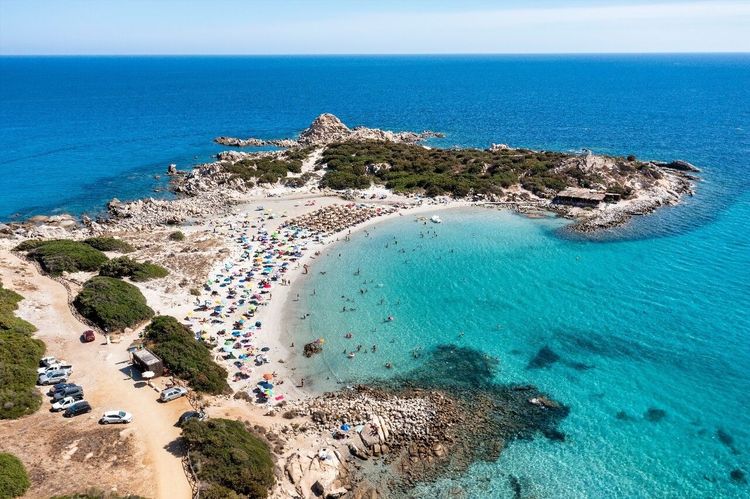
If Chia is the destination on the south-west coast, Villasimius is its counterpart on the east coast. Around fifty kilometres from Cagliari along the SS 125 (Sardinia's famous scenic road), this small seaside town is bordered by the Capo Carbonara Marine Protected Area, established in 1998, which protects kilometres of unspoilt coastline across 86 km². Regulations are strict — no motorised anchoring in certain zones, fishing prohibited within the protected perimeter, limited access to some beaches in season — and it is precisely this that preserves the exceptional water quality.
Porto Giunco is the area's emblematic beach: an arc of white sand between two rocky headlands, with the Notteri lagoon behind it — yet another flamingo lagoon, Sardinia is dotted with them. The beach is divided into a paid section (sun loungers and parasols) and a free section. Parking is paid in season.
Simius (or Spiaggia del Simius (Via del Mare, 09049 Villasimius, rated 4.5/5 on Google from 5,814 reviews)) is a long fine-sand beach accessible from the centre of Villasimius, with shallow waters much appreciated by families. Several establishments offer snorkelling or scuba diving courses — the posidonia seabeds shelter abundant marine life.
Campus is wilder, accessible along an unpaved track — a high-clearance vehicle is preferable. In return, you'll often find a beach with few visitors even at the height of summer. The seabed here is particularly photogenic for snorkelling.
Villasimius is worth an overnight stay to enjoy the beaches early in the morning, before the tourist crowds arrive. Before or after your swim, the Ryo audio guide for Cagliari will give you the historical and cultural keys to the capital to round out your Sardinian stay — discover the Cagliari audio-guided tour The Sardinian Treasure to plan your visit to the city.
Punta Molentis and Cala Regina: The Secret Coves
Between Villasimius and Capo Carbonara, two coves deserve particular attention for those seeking less-frequented spots.
Punta Molentis is accessible only on foot from the designated car park — around 30 minutes of walking along a marked trail through maquis scrubland. The effort is rewarded: a horseshoe-shaped cove with absolutely transparent water over white pebbles and pink granite, and crowd levels that remain reasonable even in August (the walk puts off families with young children and hurried tourists).
Cala Regina (Loc. Cala Regina, 09049 Villasimius, rated 4.4/5 on Google from 1,405 reviews) is even more secluded: accessible by boat from Villasimius or via a hiking trail of around 45 minutes, this fine-pebble cove is surrounded by granite cliffs. When snorkelling, the rocky drop-offs shelter grouper and moray eels.
These two spots make an excellent alternative for travellers visiting Villasimius on a July or August weekend who want to escape the tourist concentration at the main beaches.
Nora and the West Coast: Swimming and Archaeology
The western coast of the Cagliari province offers an unusual combination: quality beaches paired with a major archaeological site. Nora, 35 kilometres from Cagliari on the Pula peninsula, is one of the best-preserved Punic and Roman sites in the Mediterranean — part of it now lies underwater, visible by snorkelling at shallow depth.
The beach at Nora itself sits right next to the site — you can swim in the morning, visit the ruins in the early afternoon (before the heat peaks) and return for a dip at sunset. The water is clear, the sand fine, and the coexistence of ancient ruins and families in swimwear has something endearingly surreal about it.
In the same area, the beaches of Santa Margherita di Pula form a long sandy strip accessible from the coastal road, with several hotel complexes managing beach establishments. More family-oriented and less wild than Chia or Villasimius, this stretch of coast suits travellers looking for services and comfort. Back in the city, our audio walking tour The Sardinian Treasure takes over with 18 stops, from the Saint Remy bastion up to the citadel terraces.
Private or Public Beaches: How to Find Your Way
In Italy, the distinction between a public beach (spiaggia libera) and a private beach establishment (stabilimento balneare) can sometimes confuse foreign visitors. A few rules worth knowing:
All Italian beaches are legally public up to the waterline. Beach establishments lease concessions over part of the sand — they cannot block access to the water's edge. In practice, on very busy beaches, the free strip of sand between concessions can be narrow.
Renting a sun lounger and parasol typically costs €15 to €25 per day for two people in the Cagliari area. Some establishments offer half-day rates. The rental gives access to showers, toilets and usually a bar service — a far from negligible comfort under 35-degree heat.
For fans of infrastructure-free spiagge libere, the most unspoilt stretches are found at the ends of Poetto, at Calamosca, along the Punta Molentis trails and around Capo Carbonara.
Getting to the Beaches: Transport and Practical Tips
Cagliari's city beaches (Poetto, Sant'Elia, Calamosca) are accessible by public transport from the centre.
The PF bus (CTM Cagliari network) covers the full length of Poetto from Piazza Matteotti, the hub of the network. Frequency: every 15–20 minutes in summer. Ticket: €1.30, valid for 90 minutes. For Calamosca, take the same line to the terminus then walk.
The bicycle is a serious option for Poetto and Sant'Elia: a cycle path runs the entire eastern coastline from the centre and beyond Poetto. Bike rentals are available in the city centre and at the start of the path.
For Chia, Villasimius and Nora, a car is essential, or nearly so. Organised excursions from Cagliari exist, but schedules are fixed. Car hire at the airport or in the city runs at around €30–50 per day in low season, more in July–August. The Ryo app lets you organise your urban travels around Cagliari between beach outings: Ryo's — explore the Le trésor sarde audio-guided tour to make the most of your travel time.
When to Visit Cagliari's Beaches
The beach season officially runs from mid-May to late September, but the real tourist peak is concentrated in July and August. These two months are both the hottest (28–32 °C during the day) and the most crowded in terms of prices and people on the beaches.
June is often the best compromise: the water is already warm (22–24 °C), beaches are still reasonably uncrowded, and hotel prices are below summer rates. September offers a similar balance with warmer water than in June (up to 26 °C) — it is the favourite month for mainland Italians.
For wilder beaches (Punta Molentis, Cala Regina), a trip in October is sometimes feasible — beach establishments are closed, but the water is still pleasant and solitude is guaranteed.




FAQ
What is the most beautiful beach in Cagliari?
It depends on what you're looking for. For a convenient urban beach, Poetto is unrivalled — 8 km of sand just 20 minutes from the centre by bus. For raw beauty and water colour, Su Giudeu at Chia (60 km) or Porto Giunco at Villasimius (around 50 km) are generally considered the most spectacular. For tranquillity close to the city, Calamosca is the answer.
How do you get to Poetto Beach from central Cagliari?
Take the PF bus from Piazza Matteotti. The journey takes around 20 to 30 minutes depending on your stop along the beach. The ticket costs €1.30 and is valid for 90 minutes. In summer, the frequency is good (every 15–20 minutes at peak times). By bike from the centre, allow 30 to 40 minutes along the coastal cycle path.
Are Cagliari's beaches free?
The beaches themselves are always free — Italian law requires it. What you pay for is the rental of sun loungers and parasols at beach establishments (€15–25/day for two people). It is perfectly possible to set up on the free sand (spiaggia libera) with your own towel. In the most touristy areas such as Porto Giunco or Tuerredda, paid parking (€3–5) is often unavoidable in high season.
Can you go diving or snorkelling near Cagliari?
Yes, several snorkelling spots exist around Cagliari. The Calamosca area and the Sella del Diavolo offer good rocky seabeds at shallow depth. For scuba diving, centres in Villasimius and Chia offer introductory dives and guided outings. The Nora site is particularly interesting as part of the ancient ruins is submerged, visible by freediving or with a mask and snorkel.
Are the beaches of Chia and Villasimius worth a trip from Cagliari?
Absolutely, provided you have a vehicle. Chia (60 km, 1 hour by road) and Villasimius (around 50 km, 1 hour) are the two benchmark beach destinations on the southern Sardinian coast. The water quality and landscape beauty surpass most Mediterranean beaches. Plan to leave early (before 9am) in July–August to avoid traffic on the access roads and queues at car parks.
Which beaches are best suited for families with children?
The Poetto is ideal for families staying in Cagliari: easy bus access, shallow water over a long stretch, and plenty of beach establishments with showers and catering. Simius at Villasimius is also highly regarded for its calm waters. Avoid coves such as Punta Molentis or Cala Regina with young children — the walk in is long and shade is almost non-existent on the path.
Conclusion
Cagliari's beaches span a spectrum that runs from the urban comfort of Poetto to the wild waters of Villasimius, taking in the flamingo lagoons of Chia and the submerged ruins of Nora along the way. The southern coast of Sardinia is accessible, varied and often underestimated compared to the beaches of the island's north — unfairly so. To explore Cagliari itself between days on the sand, the Ryo audio guide Le trésor sarde takes you through the heights of Castello and the alleyways of Stampace — 17 points of interest over a 1h50 route. Our articles on the most beautiful places in Sardinia and on the must-do things in Sardinia complement this guide to help you plan a complete stay.