
Créé par Romane, le 4 juin 2026
Votre guide Ryo
Murano, Burano, Torcello: history, activities, crossing...
© Shutterstock
Do these names ring a bell? Far from the world, what a surprise! These 3 Venetian islands have each acquired their identity and notoriety alongside Venice. The history, gastronomy and forms of craftsmanship that take place there largely compensate for the few minutes of navigation to get there. A beautiful addition that will certainly be part of your vacation memories in Italy.
So andiamo for an escape off the beaten canals!
The letter "O" at the very end as a memory aid
1. First stop: Murano
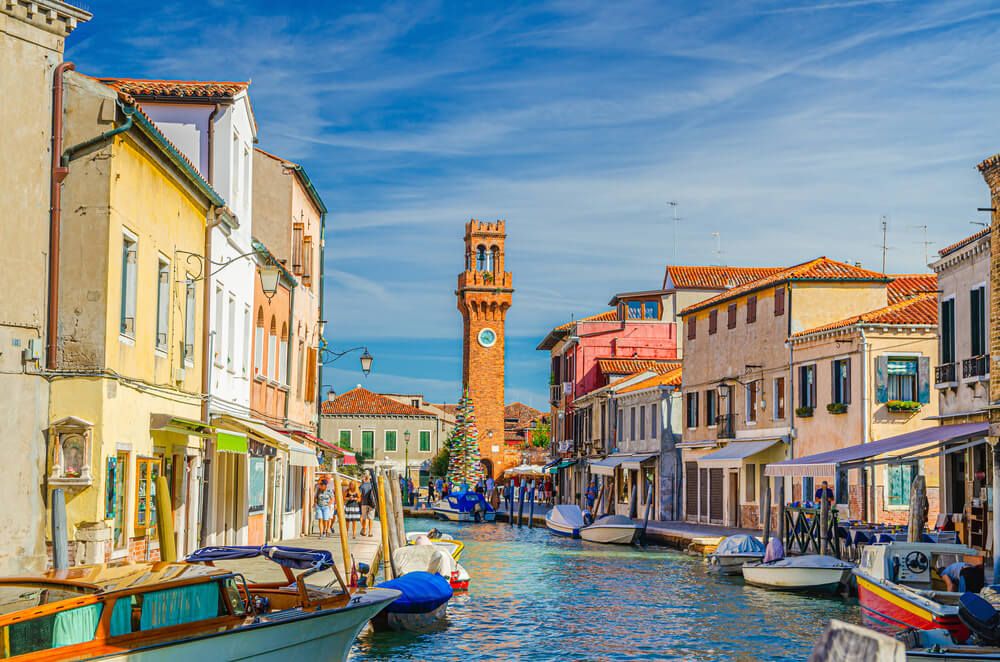
One kilometer northeast of Venice, that's what needs to be covered, or more accurately crossed, to land on one of the largest islands in the lagoon. We present, Murano! With an area of 1.17km², divided in two by a Grand Canal, this little piece of paradise has what it takes to remind us of the Serenissima. In miniature and without all that immense agitation.
Murano, Murano, Murano... The more we repeat this melodious name, the more we're convinced we've heard of it at least once before. The question is knowing why. With words like glassblowing or glassworks, your cloud of confusion should normally clear. In reality, the island of Murano is world-renowned for its blown glass production. And more than a major tourist asset, this craftsmanship has above all shaped the history and DNA of the island.
To understand how it all began, we need to go back at least 11 centuries earlier. At the time, glassblowers had set up their workshops on Venice itself. This way, they more easily sold the fruit of their labor during the numerous commercial exchanges that transited through the port. Problem was, this very profitable situation for some could no longer continue for others.
The furnaces used by the craftsmen increasingly represented a danger for the wooden homes of Venetians. Concerned about putting an end to this general fear, the government of Venice drafted a decree in 1291 obliging glassmakers to practice their activity on the neighboring island of Murano.
Since that date, the destiny of the island and glass production have remained linked. And from generation to generation, the know-how as well as the manufacturing secrets of this practice have been carefully transmitted and preserved.
Given that blown glass occupies a predominant place in the island's life, it's natural to want to learn a bit more about it. For this, what could be better than visiting one or several craftsmen's workshops?
By going behind the curtain, you'll be able to witness the different production stages of the art of glassblowing, from raw material to final composition. Not to mention also setting your sights on one of the unique pieces for sale in the shop. Like a vase for your next bouquet of flowers or the ideal jewelry set to match your latest clothing purchase.
To help you, here are names of glassworks in Murano open for visits:
- Vetreria Artistica Colleoni
- Atelier Salvadore Murano
- Ex Chiesa Santa Chiara
- Gino Mazzucato Murano Glass
Warning: workshops tend to open their doors only a few hours per day. Therefore, check the schedules beforehand and especially reserve your spots.
Before or after this first activity, you can learn more about Murano island by touring or admiring its few sites of interest such as:
- Il Museo del vetro (The Glass Museum) normally open every day from 10am to 5pm with last entry at 4pm.
- The Basilica Santi Marie e Donato normally open for visits Monday to Saturday, from 9am to 5pm, and Sunday from 12pm to 3:30pm.
- The Chiesa San Pietro Martire normally open for visits from 9am to 5pm on Monday plus Wednesday, Thursday and Friday. Then, from 9am to 3:30pm on Tuesday and from 11am to 4:30pm on weekends.
- The Chiesa Santa Maria degli Angeli normally open every day from 7am to 7:30pm.
- The Palazzo da Mula converted into a cultural center.
- The Murano Lighthouse in operation since 1932.
- The "Cometa di Vetro", a blue glass sculpture.
2. Second stop: Burano
Still northeast of greater Venice, but this time within a 7 km radius, floats the beautiful island of Burano. Well... Technically, it's rather an archipelago of four islets (San Mauro, Giudecca, San Martino, Terranova) separated by 3 main canals: the Rio Pontinello, Rio Giudecca and Rio Terranova.
Unlike Murano and Torcello, which bear the title of city, Burano is a simple borough of barely 20 hectares on which 3000 souls live year-round. Reading this, we already imagine that visiting the place will be express. But that's the whole mistake! Once you dock at Burano, time stops, the charm works and it's clear you don't even want to leave anymore. Here's largely why.
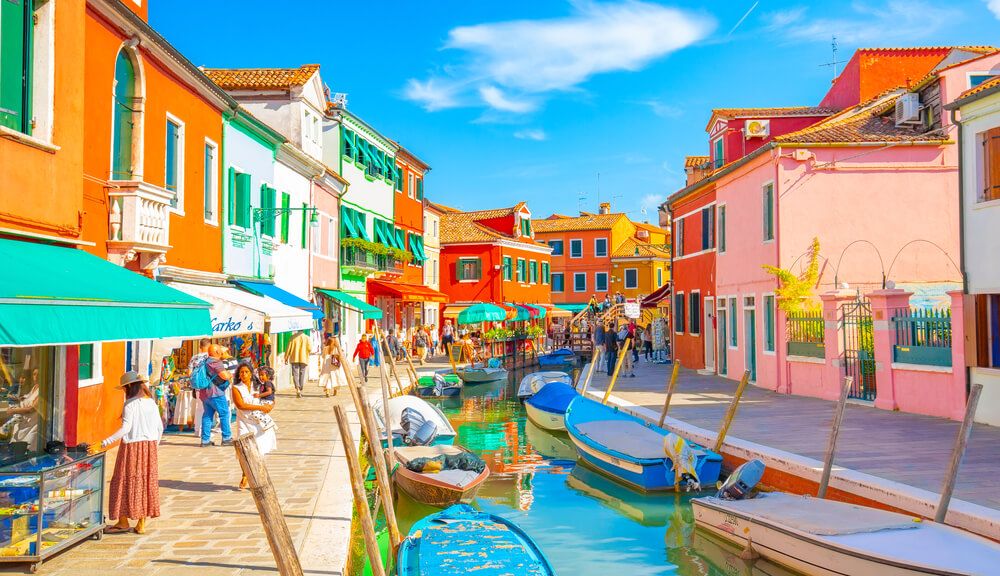
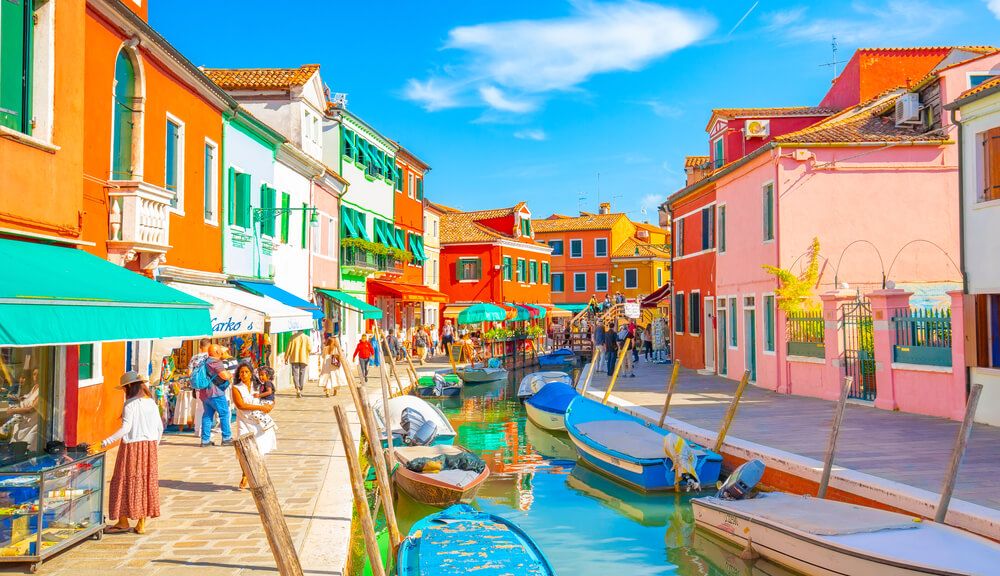
Approaching Burano's coasts already reveals the main reason for our trip: the famous colorful houses. Those without which the island certainly wouldn't have all this notoriety. From canary yellow to poppy red passing through lawn green and candy pink, the "pictural" setting on site is an explosion of colors. The goal being that it's bright!
As surprising as it may seem, Burano hasn't always displayed this totally mismatched but incredibly photogenic decor. It's the thick winter fog that gradually got the better of the first brushstrokes only in yellow and red ochre, for lack of choice.
According to local legend, this initiative would have been launched by the island's fishermen-sailors who struggled to spot their home from offshore. But it happens that other more classic or more wacky versions are heard.
In any case, one thing is sure, behind this delightful color palette exists a whole list of strict administrative rules like:
- Houses must be painted in two to three different colors
- Door and window frames have no choice but to be white
- Residents must contact city hall if they wish to change their house color
- Residents commit to repainting their homes every year, because with tides, wind and salt, the color quickly loses its intensity.
Tip: To appreciate all the originality of this multicolored scenography, you can go to the Tre Ponti bridge or to Piazza Baldassarre Galuppi.
If Burano appears in records from Roman times, it's only in the 16th century that we really begin to hear about it. The explanation? The development of lace craftsmanship on the island!
The women of Burano, very skillful when it came to mending their husbands' fishing nets, began producing needle lace without canvas support. Its signature point, the "Punta in aria" or "point in the air". Its main characteristic, an addition of reliefs and transparency in its design.
What was initially just a mundane occupation became a creative art of excellence exported throughout Europe until the 18th century. Even the greatest personalities of the time, like Catherine de Medici, fought to have a piece of Burano lace in their wardrobe.
To the detriment of industrial lace production, certainly less beautiful, but less expensive and less time-consuming to make, Burano lace saw its popularity decline. Even the Lace School, opened on the island in 1872 for the preservation of this long tradition, didn't survive the competition. Fortunately, we still find today lacemakers on the island who perpetuate this so fine and noble practice.
During your stroll in this unique atmosphere of Burano, dictated by colors, it can be recommended to stop at these different places:
- Il Museo del merletto (Lace Museum) normally open Tuesday to Sunday from 10am to 4pm.
- The Chiesa di San Martino (open every day from 8am to 12pm and from 3pm to 7pm), its leaning bell tower and the Capella di Santa Barbara right next to it.
- The Piazza Baldassarre Galuppi, central square of the island.
- The Casa Bepi, former house of the artist painter Giuseppe Toselli, also known as "Bepi Suà". Address: 339 via al Gottolo.
- The fish market set up every morning on Fondamenta della Pescheria square.
Perfect in every way, Burano will also please you right down to its gastronomy. At restaurants, delicious fish or seafood dishes will delight your meal break. Then, when dessert or snack time comes, pastries will help you fill up on sugar and butter with the two kinds of local cookies. To choose from, you'll have the bussolai buranei of round shape and the essi in S-shape, as their name indicates.
3. Third stop: Torcello
Unless you've had your fill of islands and sea crossings for the day, it would really be a shame not to combine the visit to Burano with that of Torcello. First, the two islands are separated by only 6 minutes of travel. And second, the green and historic Torcello is worth the detour whatever anyone says.
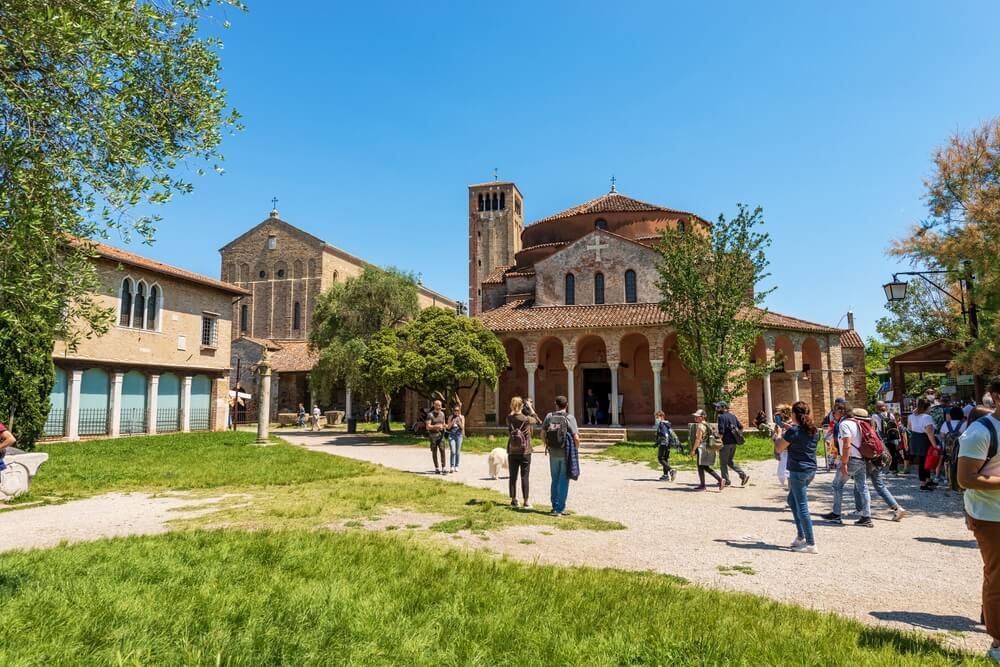
44 hectares of surface area and 20 inhabitants in total (if not less). On paper, we can't say that Torcello has anything to impress with. Yet, more than a hundred years ago, the situation was quite different. But then, what could have happened?
Like other islands in the lagoon, Torcello was inhabited very early for various reasons (vacation spot for Roman nobility, refuge land during Germanic invasions...). A permanent back-and-forth that will allow it, between the 7th and 10th centuries, to experience an important phase of political, cultural as well as commercial development. It's even largely thanks to it that the Venetian State will emerge.
All the stars of success align for Torcello. 10,000 inhabitants populate it and its salt works as well as its attractive port in commercial routes, between east and west Europe, rapidly enrich it. In summary, in the lagoon, it's all about her!
But... From the 12th century, Torcello the "super-powerful" will transform into Torcello "the undesirable". Blame it on the silting of its canals which, in addition to affecting navigation, will be a source of malaria propagation. Consequence of all this, inhabitants desert the island, political power migrates to the future Rialto area, stones from its monuments are reused for Venice's development and its parish is suppressed.
Away from everything, moderately frequented and mainly rural at first glance, Torcello still presents some vestiges of its glorious past to those who take the trouble to come meet it. In visiting the places, which we hope will retain your attention, here are the few marvels you'll encounter:
- The Basilica Santa Maria dell'Assunta (the oldest building in the lagoon) and its museum, normally open every day from 10:30am to 5:30pm. Warning, entry to both attractions is paid.
- The Chiesa Santa Fosca normally open every day from 10:30am to 5:30pm.
- Attila's throne in front of the basilica. Legend tells that the marble seat would have served the Hun chief during his passage in Italy.
- Il ponte del Diavolo or "the Devil's bridge", source of legends.
Murano, Burano, Torcello, here we come!
Whether you're interested in one of these islands or all three, the means of transport to get there will be exactly the same. Namely the boat! By vaporetto (sort of bus on water) or by excursion, that's the only choice you'll have to make. To allow you to compare these 2 options before retaining only one, read this information which will certainly make the scale tip more to one side than the other.
By Vaporetto
The concerned lines:
Warning: Line 7 only operates from April to October.
The approximate travel time according to departure point:
Before anything else, you should know that the vaporetto service starts at 5am and ends at 11pm. Beyond that, only the 2 night lines (Murano and Laguna Nord) operate.
Transport ticket prices:
The single ticket, usable for one journey (75 min from its validation) costs on average €12 per unit from age 6. But if you come to Venice for several days and you're the type to "have itchy feet", it's more profitable to pay for a 24h ticket at the price of €30/person or a 48h ticket at the price of €40/person.
Another tip: If you already know your next travel dates, at least 1 month in advance, think about booking your tickets online directly. Prices are generally discounted!
Via excursions
Using the vaporetto to reach the islands of Murano, Burano and Torcello is a good way to put yourself in locals' shoes. But once the crossing is done, the service immediately ends. However, when traveling, some like to do things thoroughly. Out of curiosity, perhaps, or because they don't know when the opportunity will present itself again. If this is your case, we found something to satisfy you.
From Venice center, it's possible to go on excursions to the 3 lagoon islands at the rate of €30/adult and €20/child on average for an activity duration ranging from 4 to 6 hours. Apart from clicking the "book" button, online, it's up to the service providers to organize everything. In the package, here's (indicatively) what can generally be included:
- Round trip crossing on the lagoon
- Historical explanations given by a French or multilingual guide on the chosen island(s)
- Visits to monuments or flagship addresses of the islands (glassblowing workshop in Murano, lace factory in Burano...)
- Free time for a bit more independence
- An indication of the best addresses to taste local specialties
Unlike the vaporetto, these excursions avoid wasting time unnecessarily in queues.