© Shutterstock
 Votre guide Ryo
Road Trip Around Lake Garda: Complete Itinerary 2026
Lake Garda is Italy's largest lake — 370 km², 51 kilometres long and up to 17 kilometres wide — yet it remains underrated compared to its more celebrated neighbours, Lake Como and Lake Maggiore. What sets it radically apart is an improbable Mediterranean microclimate at this latitude: lemons growing in the open air, centuries-old olive trees on dry-stone terraces, and water so transparent you can see the bottom several metres down. A road trip around Lake Garda means crossing three different administrative regions (Lombardy, Trentino, Veneto) without ever losing sight of that vast blue expanse.
This guide follows a clockwise itinerary from Sirmione in the south, up the western shore to the alpine fjords of Riva del Garda in the north, then back down the eastern shore to the Bardolino vineyards. In seven days you will see a medieval castle planted at the tip of a 4-kilometre peninsula, the eccentric villa-museum of a poet who had a warship sunk in his garden, a sanctuary perched in a rock face at 774 metres above sea level, and the natural thermal baths of Sirmione whose spring rises at 70 °C from the lake bed. The Ryo app offers offline audio guides for several Italian cities, such as Ryo's audio-guided tour of Milan, which are useful for cultural stopovers before or after the lake.
On the logistics side: the road along the western shore is narrow in places, particularly between Gargnano and Limone, and an up-to-date GPS is essential. The full loop is around 160 kilometres of driving, not counting inland detours. The ideal season runs from April to June and from mid-September to late October: the water is navigable, the villages are accessible, and the light on the lake in the early evening surpasses anything photographs can convey.
Why Do a Road Trip Around Lake Garda?
Three concrete reasons explain why Garda lends itself to a road trip better than a fixed-base holiday. First, the geography: each shore has a distinct personality. The western shore is more romantic and lush, with medieval villages clinging to the mountainside and Mediterranean-style gardens. The eastern shore is wider and windier — this is where windsurfing and kitesurfing spots are concentrated, along with most of the Bardolino DOC vineyards. The north is alpine, wedged between the cliffs of Trentino, with an architecture and cuisine that feel closer to Austria than to Tuscany.
Second, the distances are manageable: the full loop is 160 km, roughly three hours of pure driving. Legs between stops rarely exceed 30 minutes, which leaves plenty of time to explore each village on foot.
Third, the density of remarkable sites is exceptional. Within an 80-kilometre radius, you alternate between a medieval castle, an amusement park (Gardaland is Italy's most visited), a via ferrata hike, a pebble beach, a trout market and a red-wine tasting in a century-old cellar. That level of variety within such a compact area is rare in northern Italy, which usually scatters its treasures across cities separated by 100 km or more.
The lake also has a practical advantage that is rarely highlighted: the major cultural sites are either on the waterfront or within 15 minutes by road. You do not spend three hours a day in a car getting from one attraction to the next, which fundamentally changes the quality of a stay.
How Long Should You Plan for Your Road Trip?
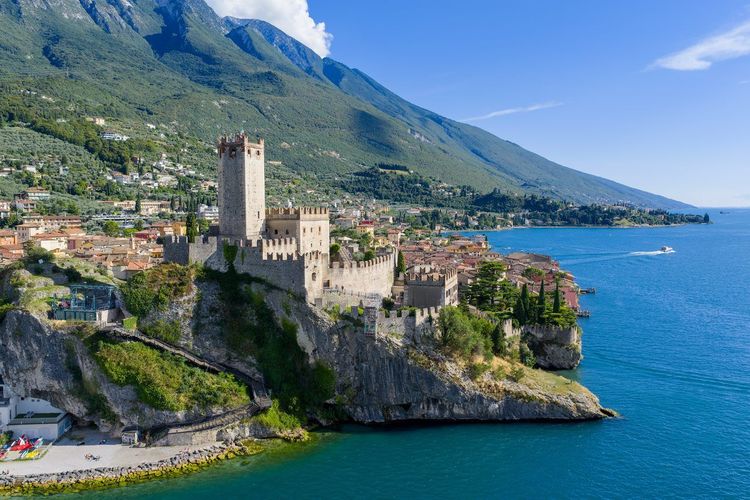
Seven days is the minimum for a comfortable full loop without sacrificing the moments that deserve lingering: a full morning in Sirmione, an hour in the gardens of the Vittoriale in Gardone Riviera, a sunset from the terrace of Malcesine Castle.
Five days is doable but the detours fall away. No cable-car ride up to Monte Baldo from Malcesine, no visit to the Madonna della Corona sanctuary, and one of the two shores inevitably gets rushed. With ten days you can add excursions from the lake: Vérone 30 km to the south (the Arena amphitheatre, Juliet's house, the UNESCO-listed historic centre), Brescia 50 km to the west (one of Italy's finest Roman museums, rarely mentioned in guidebooks), or the Ledro and Idro lakes in the alpine foothills.
For a four-day long weekend, focus on the southern third of the lake — Sirmione, Desenzano, Salò — with a quick excursion up to Riva del Garda. This format works particularly well for travellers driving from Milan or Vérone.
Summary by available duration:
- 4 days: Sirmione + Desenzano + Salò + return trip to Riva del Garda
- 5 days: express full loop, without Monte Baldo or Madonna della Corona
- 7 days: full loop with all major sites and a few hikes
- 10 days: full loop + Vérone + high-altitude excursions
Getting Around Lake Garda
The car is the go-to mode of transport for this type of itinerary. The A4 Milan–Venice motorway runs along the southern end of the lake with exits at Desenzano del Garda and Peschiera del Garda, making access easy from both major northern Italian metropolises. For the rest of the route you use the SS45bis on the western shore and the SS249 on the eastern shore — two winding national roads that hug the waterfront just metres from the lake.
An important warning for the western shore between Gargnano and Limone sul Garda: the road is carved into the cliff face, with alternating single-lane tunnels (3 to 7 minutes' wait before entering), passages only 3.5 metres wide between the rock and the lake, and no possibility whatsoever of passing a motorhome. Opt for a standard-sized vehicle and avoid peak hours in July and August — the queue in front of some tunnels can exceed 20 minutes.
The ferries and hydrofoils operated by Navigarda offer a serious alternative to driving. The Maderno–Torri del Benaco crossing (west shore to east shore) takes 30 minutes and accepts cars — very handy if you want to avoid driving a mountain road at night. Passenger lines also connect the main towns, ideal for day trips from your accommodation base without moving the car.
Electric bikes are growing in popularity, with cycle paths now covering almost the entire eastern shore. On the western shore the gradients make a conventional bike impractical, but e-bike rental shops are found in every major village. Expect to pay €25 to €40 per day for an e-bike rental, with weekly packages available in Riva del Garda and Malcesine.
Day 1: Sirmione, the Impregnable Peninsula
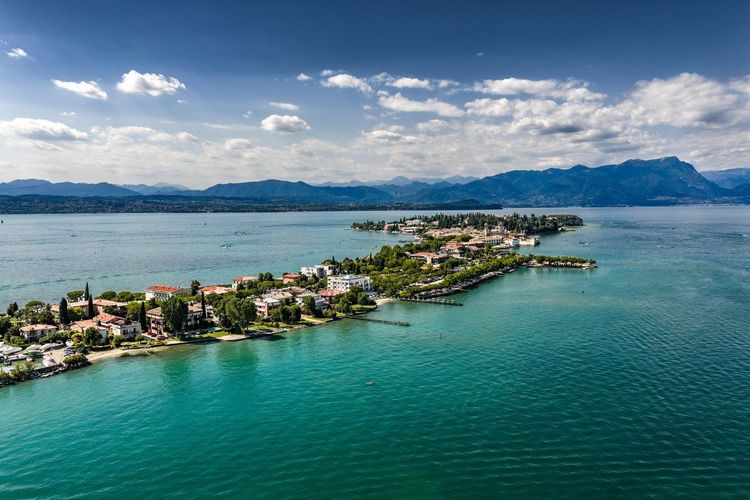
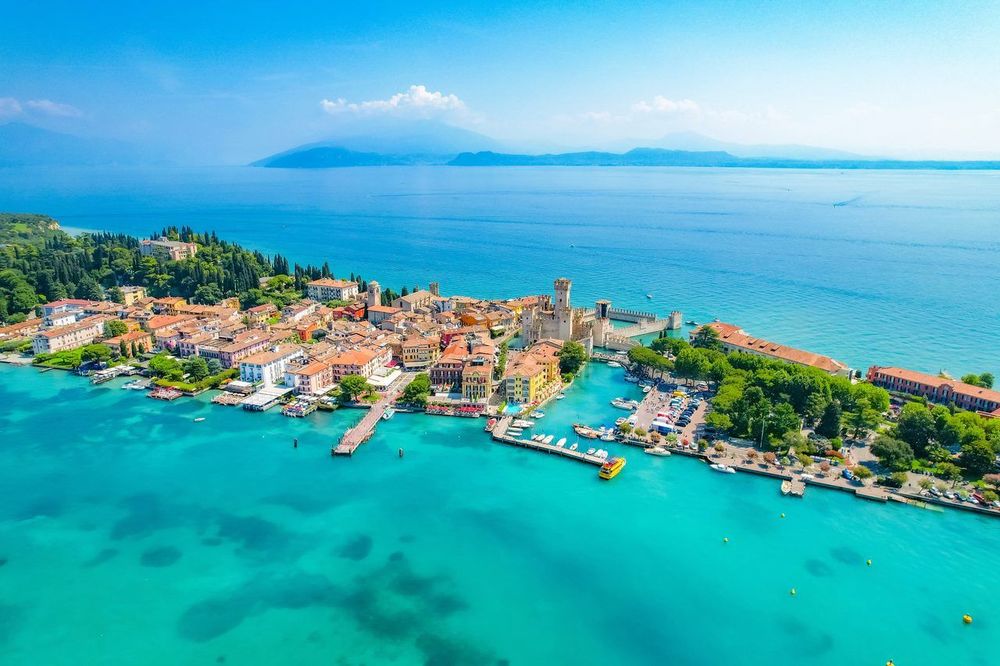
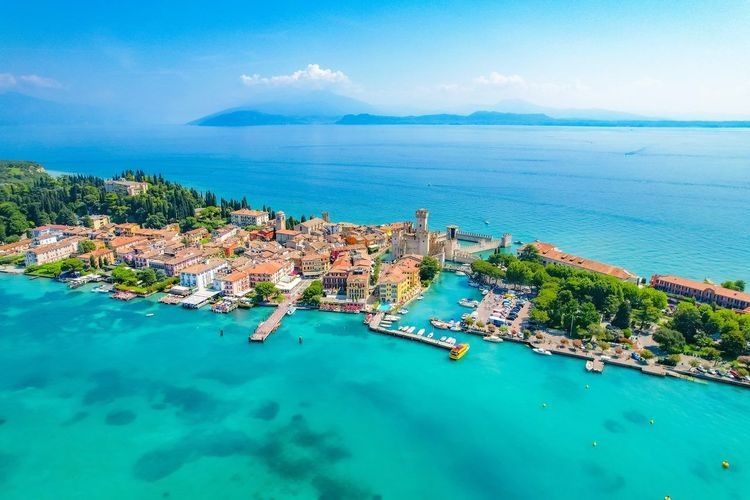
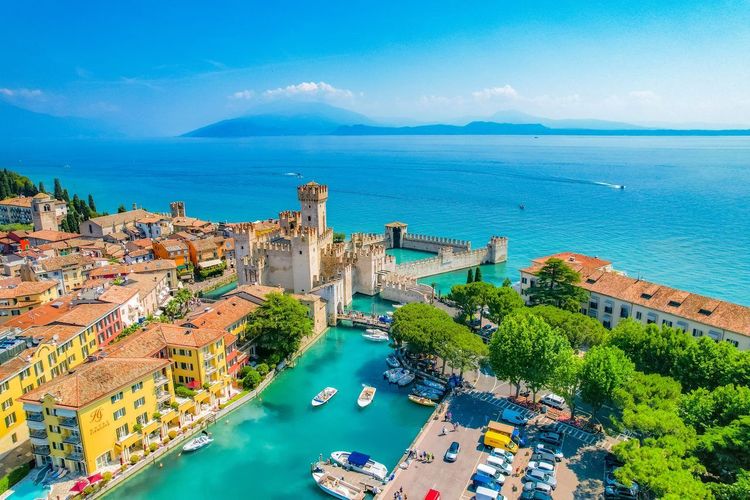
The Sirmione peninsula juts 4 kilometres into the lake like an arrow of stone and olive trees. It is one of the most spectacular geographical configurations in all of northern Italy: a strip of land so narrow that you can see the lake on both sides simultaneously from the central lanes. The town is closed to private traffic beyond the entrance bridge — park in one of the paid car parks outside (€2 to €3 per hour in high season) and explore on foot. The drive from Milan takes 1h30 via the A4 motorway; from Vérone, allow 35 minutes.
First unmissable stop: the Castello Scaligero di Sirmione, a medieval fortress built by the Scaligeri lords of Vérone in the 13th century, with its crenellated towers and an inner harbour directly accessible from the lake. The castle is in excellent condition and climbing the ramparts offers a 360° panorama over the peninsula and the surrounding lake. Allow an hour for the full visit; tickets can be booked online to avoid queues in July and August.
From the castle, follow Via Vittorio Emanuele towards the northern tip of the peninsula through a maze of medieval lanes lined with artisan limoncello shops and terrace restaurants. Sirmione is also one of Italy's best-known spa towns: the Catullo spring rises at 70 °C from the lake bed, an extraordinarily rare geothermal anomaly in a freshwater lake. The Terme di Virgilio and the Terme del Catullo offer treatments from €30 to €40 for a half-day.
At the northern tip of the peninsula, the Grotte di Catullo (Piazza Orti Manara 1, 25019 Sirmione, rated 4.5/5 on Google with 17,584 reviews) are the largest Roman ruins in northern Italy: 150 metres long, brick vaults emerging between centuries-old olive trees, towering about ten metres above the lake. Despite their romantic name, these are not natural caves but the remains of a 1st-century AD villa — some historians attribute it to the poet Catullus, a native of the Vérone area. The olive tree planted in the middle of the ruins, whose trunk measures two metres in circumference, is worth the detour on its own.
For lunch, lakefront restaurants charge high prices (pasta between €15 and €22), but quality is generally solid: lake trout, salmon carpaccio with capers and risotto alla gardesana — local olive oil and fresh herbs — are the specialities to go for. For a more affordable meal, move one street back from the waterfront terraces.
In the afternoon, from June to September, the pebble beach north of the Castello Scaligero is accessible for swimming directly from the shore. Lake water reaches 24 to 26 °C in July, with clarity that lets you see the bottom at 4 or 5 metres. Kayak and pedalo rentals are available on the eastern side of the peninsula, from €12 to €20 per hour depending on the type of craft.
For the night, stay in Sirmione and book ahead if you are visiting in July or August: tables with a view of the illuminated castle go quickly, and the peninsula's thermal hotels fill up weeks in advance.
Day 2: Desenzano del Garda and Salò
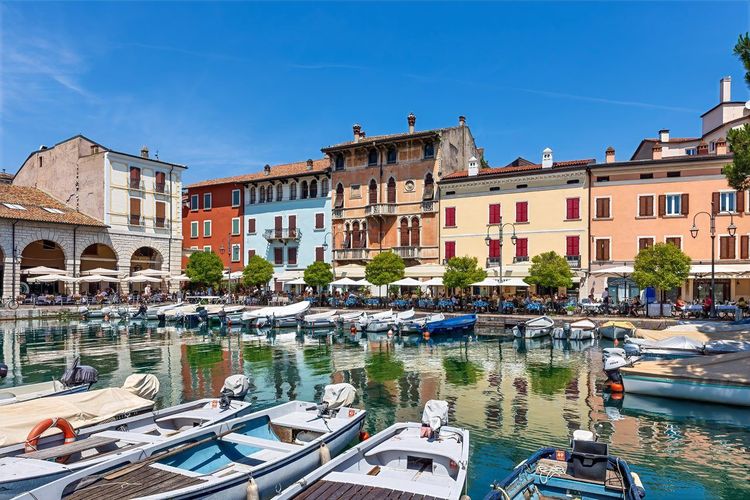
Nine kilometres west of Sirmione, Desenzano del Garda is the lake's most populous town (around 30,000 inhabitants) and its practical hub: this is where the A4 motorway exits, where the railway station is located (1h15 from Milan by fast train), and where logistical services — car rentals, supermarkets, pharmacies — are concentrated. Don't be misled by this functional side: Desenzano's old harbour is one of the liveliest on the lake, lined with restaurant terraces that stay open late into the evening.
The unmissable sight here is the Villa Romana di Desenzano del Garda, a 4th-century AD residence housing the largest and best-preserved Roman mosaics in northern Italy. The interpretation panels are understated, but the mosaics themselves — hunting scenes, mythological figures, carpets of geometric patterns — deserve an hour of careful attention. Entry is around €4; open every day except Monday.
From Desenzano, the national road climbs northward along the western shore. After 20 kilometres, Salò appears in an almost enclosed bay, sheltered from the wind by an arc of wooded hills. This town of 10,000 inhabitants is known in history books as the seat of the Italian Social Republic between 1943 and 1945 — the last Italian fascist administration under German protection. The municipal museum addresses this period seriously, through period documents and photographs.
But Salò is also worth visiting for its everyday atmosphere. The Duomo di Salò (Piazza del Duomo, 25087 Salò, rated 4.7/5 on Google with 557 reviews) is a fine example of late Lombard Gothic with a pink marble façade and works attributed to Venetian painters of the 16th century. The Tuesday morning market spills across the entire waterfront, and the local artisan shops — olive oils, limoncello, Grappa di Salò — are worth browsing before heading north. The lakeside promenade at sunset is one of the most peaceful on the entire circuit.
Day 3: Gardone Riviera and Gargnano
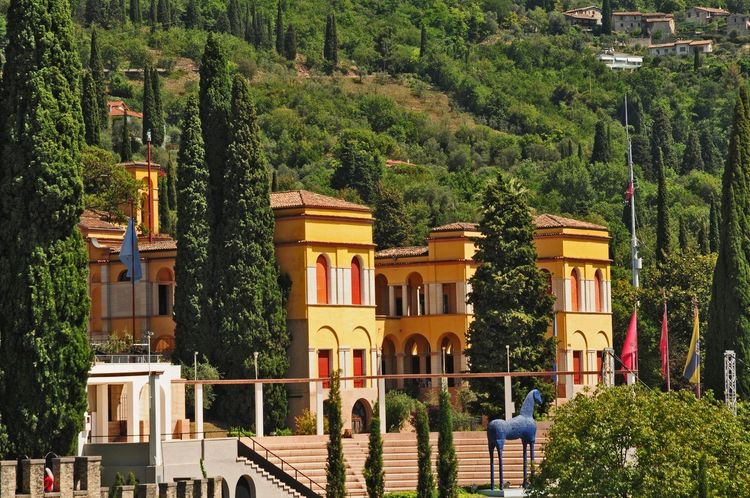
Gardone Riviera concentrates within a few hectares one of Italy's most eccentric and fascinating sites: the Vittoriale degli Italiani, the estate of poet, aviator and nationalist Gabriele d'Annunzio, who lived there from 1921 until his death in 1938. The place defies any reasonable description: in the terraced gardens overlooking the lake, d'Annunzio had the prow of a warship (the MAS Puglia) installed, a twin-engine aircraft suspended between cypress trees, and an open-air amphitheatre. He fitted out a dozen interior rooms in a state of baroque decorative overload that is equal parts obsessive collecting and eccentric art de vivre.
The guided tour of the interiors — 45 minutes, priced separately from the garden entry — is worth the investment: without it you miss the room crammed with 10,000 objects, the personal war museum and the 'priory' d'Annunzio built for himself to die in peace. Allow a full half-day for the entire site including the gardens. Overall admission: €12 to €22 depending on the options chosen.
The Giardino Botanico André Heller adjoins the Vittoriale with a collection of contemporary sculptures set within a tropical garden — palms, giant bamboo, banana trees — illustrating the exceptional microclimate of this part of the lake. The contrast between tropical vegetation and snow-capped Alps visible in the background creates a visual effect that few gardens in Europe can replicate.
In the afternoon, take the road north for 18 kilometres to reach Gargnano (Lungolago Zanardelli, 25084 Gargnano, rated 4.6/5 on Google with 15 reviews). This village of 3,000 inhabitants is one of the most authentic on the western shore: no large hotel, no beach tailored for tour-bus crowds, just ochre and red houses descending to the lake between lemon trees and olive groves. Mussolini himself stayed here during the Republic of Salò, in the Villa Feltrinelli, now converted into a luxury hotel. The old harbour quay, the moored fishing boats and the Limonaia del Castel — a 17th-century lemon greenhouse converted into a cultural space — give a sense of what Lake Garda was like before mass tourism.
Day 4: Limone sul Garda
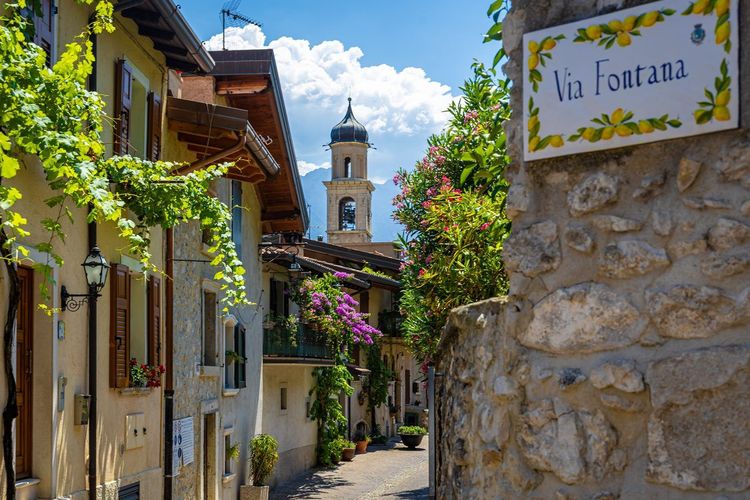
Twenty kilometres north of Gargnano, Limone sul Garda is the most photographed village on the western shore. Its historic centre climbs a limestone cliff that drops vertically into the lake, colourful-shuttered houses stacked one above the other between pine trees and lemon groves. The village owes its name not to lemons but, according to the most plausible etymology, to the Latin word "limen" (border) — although lemon trees have indeed been cultivated here since the 14th century in stone greenhouses called limonaie, a unique architectural heritage in northern Italy.
The heart of the village can be explored on foot in 45 minutes: Via Caldogno with its craft shops, the small black-pebble beach to the north, the old harbour with its painted wooden boats, and the belvedere above the village — 15 minutes' walk along a marked path — which takes in the entire northern end of the lake with the Trentino Alps as a backdrop.
Limone is also associated with a remarkable medical discovery: several inhabitants carry a rare genetic mutation, Apolipoprotein A-1 Milano, which confers natural resistance to cardiovascular disease. Identified in the 1980s, this anomaly has led to ongoing pharmaceutical research into cholesterol in American and European laboratories to this day.
The Limonaia del Castel (Via IV Novembre 11, 25010 Limone sul Garda, rated 4.6/5 on Google with 7,301 reviews) is one of these historic lemon greenhouses whose interior architecture is now open to visitors. The square stone columns that supported the winter protective roof timbers, the carved-stone irrigation channels and the water-retention basins form a coherent whole that bears witness to an ingenious form of agriculture adapted to a vertical cliff face.
The road between Limone and Riva del Garda (12 kilometres) is the most spectacular section of the western circuit: the cliff plunges into the lake, the Ciclabile del Ponale tunnel — a former carriageway converted into a cycle path suspended in the rock face — is visible from the road, and the lake gradually narrows between the mountains as you enter Trentino.
Day 5: Riva del Garda, the Alpine End of the World
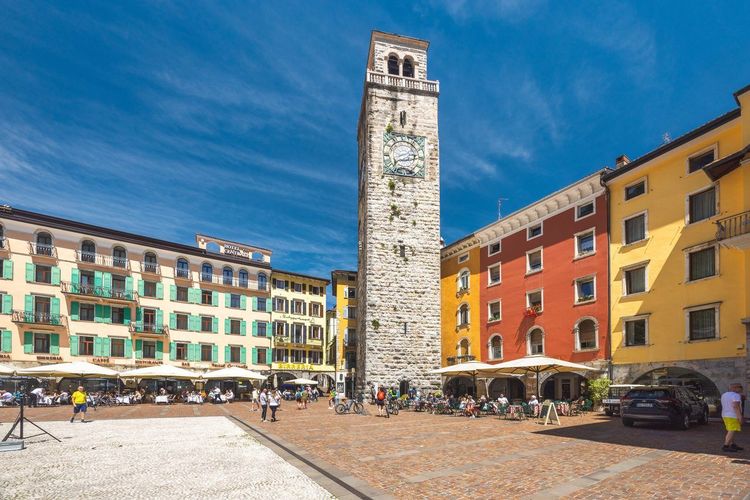
Riva del Garda breaks with everything that came before. At the northern tip of the lake, flanked by 600-metre cliffs and dominated by the medieval Torre Apponale, it belongs to the autonomous province of Trento, and you feel it immediately: the architecture is Austro-Hungarian rather than Italian, signage is bilingual, and the cuisine incorporates canederli (bread dumplings) and strudel alongside pasta and polenta.
The town of 17,000 inhabitants has managed to preserve its historic centre despite heavy tourist traffic. It is one of Europe's windsurfing and kitesurfing capitals — the Pelèr northerly wind blows every morning between April and October, virtually guaranteeing daily conditions for practitioners. Piazza III Novembre, lined with medieval arcades and opening directly onto the lake, is the heart of the town. The Torre Apponale (13th century, 34 metres tall) can be visited for €1.50 and offers an unobstructed view over the harbour and surrounding cliffs.
Three kilometres north of the centre, the Cascate del Varone (Via Cascate 12, 38066 Riva del Garda, rated 4.6/5 on Google with 32,744 reviews) are an underground waterfall carved into a narrow limestone gorge: the water drops 87 metres in two successive cascades observed from metal walkways installed within the gorge itself, amid spray and wall vegetation. The visit takes 30 to 40 minutes; the visual impact is particularly powerful during the high-water season in April and May.
For outdoor enthusiasts, Riva del Garda is the most complete base on the circuit. The via del Ponale is a former 19th-century carriageway carved into the western cliff face, converted into a cycling and walking track with vertiginous views over the lake and access to Lago di Ledro — a high-altitude lake with turquoise waters and UNESCO-listed prehistoric pile dwellings — 9 kilometres away with 350 metres of elevation gain. Local operators offer canyoning in the Varone gorge, via ferrata on the north face (Cima Rocca, AD grade) and introductory windsurfing lessons from €30 per hour with equipment provided.
In the evening, Riva's centro storico has several good addresses for Trentino cuisine: try the venison goulash or the filetto di salmerino — grilled mountain trout with local olive oil — in the restaurants around Piazza del Vittoria. Trentino wines (Nosiola, Teroldego, Marzemino) pair well with this cuisine that blends alpine and Mediterranean influences. An overnight stay in Riva del Garda is recommended — it is the only town on the northern lake with a sufficient range of accommodation in all seasons.
Day 6: Malcesine and Torri del Benaco
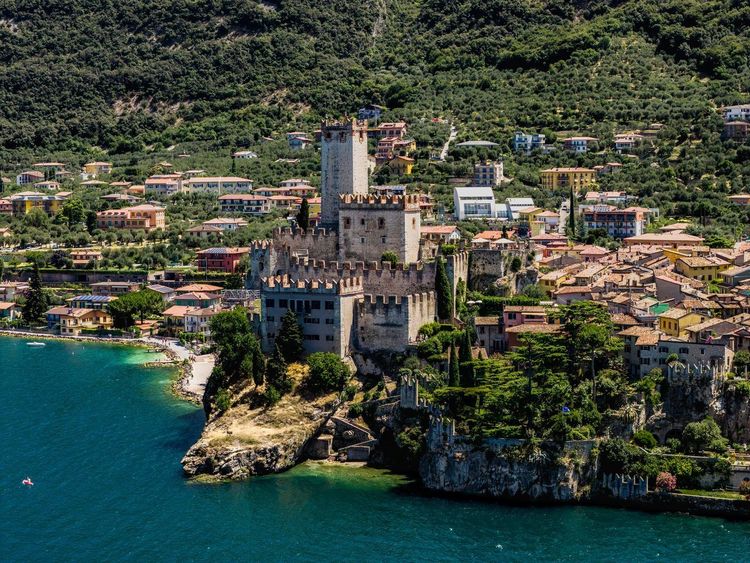
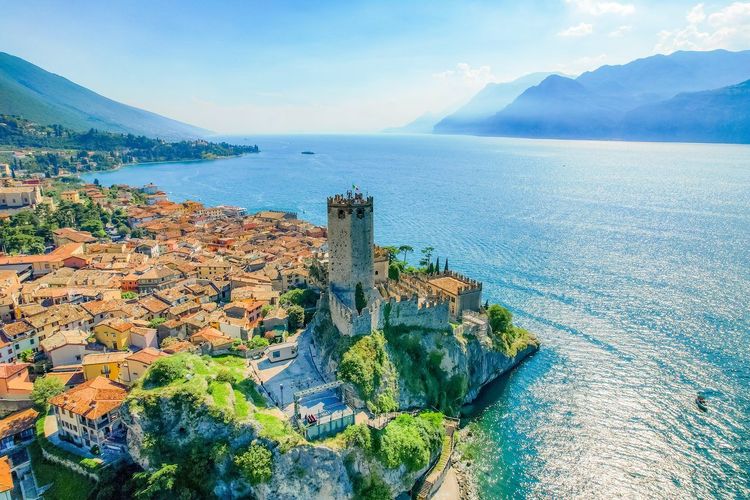
Leaving Riva del Garda southward along the eastern shore, the road quickly descends into the province of Vérone. First significant stop after 30 kilometres: Malcesine, a medieval village of 3,700 inhabitants dominated by its Castello Scaligero di Malcesine (14th century) — the same Scaligeri clan as in Sirmione, the lords of Vérone who seemingly could never have enough castles on this lake. The village also has a literary distinction: Goethe was arrested here in 1786 while sketching the castle, suspected of being an Austrian spy. The anecdote features in his "Italian Journey".
The main attraction in Malcesine is the Malcesine–Monte Baldo cable car, which climbs in two stages to 1,760 metres above sea level. The 360° rotating cabins offer a progressive view over the lake below, then over the Trentino alpine chain and the Dolomites on a clear day. At the summit, several hiking trails lead to the Rifugio Fiori del Baldo and the Corno della Paura ridge (2,218 m). Expect to pay €25 to €30 for a return ticket; arrive before 9 a.m. in summer to avoid queues that can exceed 45 minutes in the height of August.
Fifteen kilometres to the south, Torri del Benaco is one of the least-known villages on the eastern shore and among the most pleasant. Its 3,000 inhabitants live in a medieval town whose 14th-century Scaligeri castle has been converted into a museum of fishing and olive-growing. The castle terrace overlooks the marina and offers a privileged view of the western shore, particularly spectacular in the golden hour late in the afternoon.
A detour is well worth it from Malcesine for lovers of exceptional sites: the Santuario della Madonna della Corona (Via Santuario 1, 37010 Spiazzi, rated 4.8/5 on Google with 14,768 reviews), clinging at 774 metres above sea level to the vertical face of Monte Baldo, above the village of Spiazzi. The sanctuary was built into the cliff between the 15th and 17th centuries, literally embedded in the rock, and is accessible only on foot via a 1.5 km path from Spiazzi (35 minutes one way, 280 metres of elevation gain). The view from the forecourt over the Adige valley and the Veronese Pre-Alps is well worth the physical effort.
Day 7: Lazise, Bardolino, and Garda
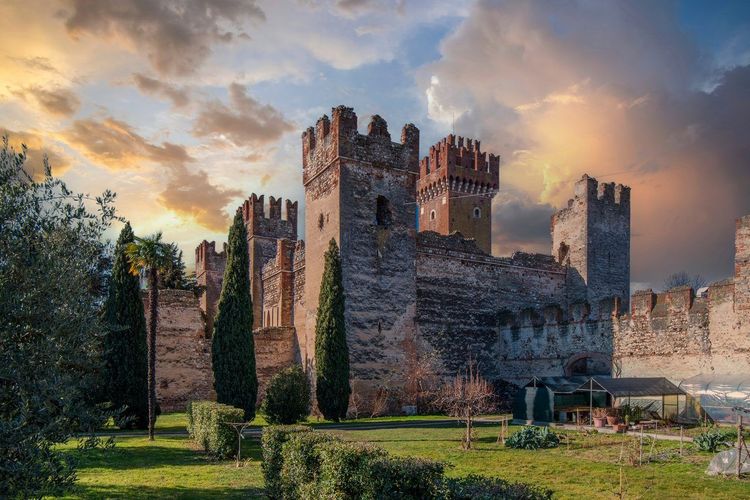
The final stage runs along the eastern shore through its most populous and most touristic section. Lazise is the first fully walled medieval village on the eastern shore — its 14th-century ramparts are almost complete — and the rectangular old harbour with its Venetian warehouses, the Dogane veneziane, is photogenic from every angle. It is also the village closest to Gardaland, Italy's largest theme park, located 2 kilometres to the north.
If you are travelling with children, Gardaland deserves a full day: 42 attractions, a themed aquarium, several evening shows and an on-site hotel. It is Italy's most visited theme park, with nearly 3 million visitors per year. Outside the July–August peaks, queues remain manageable for most rides. Book your tickets online (€42 to €55 per adult depending on the date) for a reduced rate and to skip the ticket booths.
Five kilometres south of Lazise, Bardolino is the wine capital of the eastern shore. Bardolino DOC is a light, fruity red produced on the amphitheatre-shaped hills between the lake and the Adige river, vinified from Corvina, Rondinella and Molinara grapes. The Museo del Vino Zeni offers a clear introduction to the region's wine history with a tasting of several cuvées included in the entry price. The Bardolino wine route, cyclable from the lakeside, passes through a dozen estates that all practise direct sales.
To close the circuit, Garda — the town that gives the lake its name — provides an elegant finale. Its pedestrian centre, its lakeside promenade and the small Punta San Vigilio peninsula (Strada Punta San Vigilio, 37016 Garda, rated 4.7/5 on Google with 4,000 reviews) 3 kilometres to the north — with its 16th-century private harbour in turquoise water, its cypresses and centuries-old olive trees — make for a striking final scene. It was from the shores of Garda that medieval merchants crossed the lake towards Salò: the town played a central commercial role for centuries, and its lanes retain a quiet elegance that contrasts favourably with the bustle of Sirmione or Malcesine.
Where to Stay Around Lake Garda
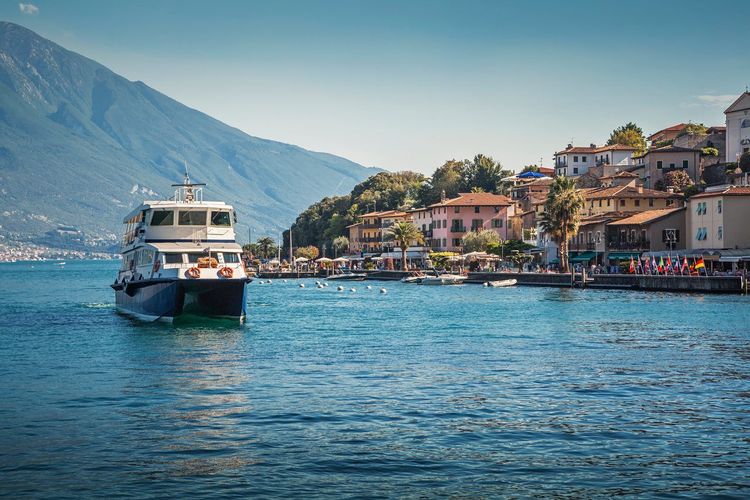
Accommodation around Lake Garda is plentiful — the lake welcomes more than 20 million visitors per year in high season — but prices vary considerably depending on the shore, the village and the time of year.
Western shore (Salò–Gardone–Gargnano): the most romantic and the most expensive. Late-19th-century villas converted into hotels charge between €180 and €500 per night in high season, with terraced gardens overlooking the lake. For a more reasonable budget, weekly apartment rentals in the villages (Gargnano, Muslone, Campione del Garda) stay below €100 per night outside July and August.
Eastern shore (Malcesine–Bardolino–Lazise): more campsites and mid-range hotels (€60 to €120 per night). This is the zone most popular with families with children, the proximity of Gardaland playing an obvious role. Upmarket campsites offer mobile homes and chalets with direct lake access, often cheaper than a hotel for a family of four.
Sirmione: the peninsula is the most expensive zone in the southern third. Expect €150 to €300 for a night in a hotel with a view in the medieval section. Thermal hotels generally include access to spa treatments in the room rate, which puts the apparent premium in perspective.
Riva del Garda: the most diverse range in the north, from hostels at €25 per night to four-star hotels at €200. The town is also the most accessible out of season, with several establishments open year-round, making it the best base for a stay in April or October.
A few practical pointers:
- Book two to three months in advance for July and the first half of August
- Villages on the eastern shore (Torri del Benaco, Garda, Bardolino) are less saturated than Sirmione or Riva del Garda
- Agritourism properties on the heights (200 to 400 metres altitude) often offer better bird's-eye views over the lake than waterfront hotels, at a lower price
- Monday nights are systematically cheaper than Friday or Saturday
Budget and Practical Tips
Estimated budget for 7 days at Lake Garda:
| Item | Budget option | Comfort option | |------|--------------|----------------| | Accommodation (per night) | €60–80 | €120–250 | | Meals (per person/day) | €25–35 | €45–65 | | Cultural site entry | €8–15 per site | €15–22 per site | | Fuel (full circuit) | ~€80 | ~€80 | | Navigarda ferries | €3.50 passenger | €13–15 with car | | Gardaland (if applicable) | €42 (early booking) | €55 (full price) |
Estimated total budget per person for 7 days (3-star hotel, local dining, major entry fees): €900 to €1,400.
Which season to choose:
April to June offers flowering vegetation, temperatures between 18 and 25 °C and still-manageable crowds. Mid-September to mid-October is the Bardolino harvest season, with particularly beautiful autumn light over the lake and accommodation prices down 20 to 30%. July and August are the hottest months (30 to 35 °C), the busiest and the most expensive, but also the only months when all ferries, cable cars and cultural sites operate on maximum schedules.
Logistical tips:
The Trentino Guest Card is available to visitors staying in the autonomous province of Trento (which includes Riva del Garda). It gives free access to local public transport, certain museums and cable cars — ask your accommodation whether it is distributed automatically on arrival.
For the western shore between Gargnano and Limone, standard navigation apps do not always handle the alternating single-lane tunnels well. Waze is more reliably updated than Google Maps for one-way sections on this stretch. Fill up your tank before entering the area — petrol stations are scarce between Gargnano and Riva del Garda.
Lake Garda's waters are officially safe for swimming almost everywhere, with regular water-quality monitoring by the lakeside municipalities. The best pebble beaches are on the western shore (Gargnano, Limone) and at Riva del Garda in the north. The eastern shore has a few sandy beaches around Lazise and Peschiera del Garda. The Ryo app can complement your preparation for the Italian and European cities you plan to visit before or after this road trip.
FAQ
How many days do you need to drive around Lake Garda?
Seven days is the ideal length for a complete loop without rushing. This allows you to visit the main sites (Sirmione, the Vittoriale in Gardone Riviera, Riva del Garda, Malcesine and its cable car, Bardolino) with a few half-days set aside for hiking or swimming. In five days the loop is doable, but you will have to skip certain detours such as the Madonna della Corona sanctuary or the via del Ponale at Riva del Garda. A four-day long weekend comfortably covers the southern third of the lake with an excursion up to Riva del Garda.
What is the best time to visit Lake Garda?
April, May, June and September are the best months: pleasant temperatures between 18 and 28 °C, manageable crowds and moderate prices. Spring brings flowering vegetation, and the autumn light of September over the Bardolino vineyards is particularly beautiful. July and August concentrate the bulk of summer visitors — Sirmione's car parks fill up by 9 a.m., and queues at Malcesine Monte Baldo can exceed 45 minutes. Those two months are, however, the only period when all water-based activities are available simultaneously.
Can you cycle around Lake Garda?
The eastern shore is accessible by bike along almost its entire length thanks to dedicated cycle paths. The western shore is far more demanding: the elevation changes between Salò and Riva del Garda are significant, and the main road leaves little room for cyclists on certain stretches. Electric bikes have transformed this journey — e-bike rental shops are found in every major lakeside town, with rates of €25 to €40 per day. Allow 5 to 7 days for the full loop on an e-bike, with daily stages of 25 to 40 km.
Do you need to book in advance to visit Sirmione?
In July and August, absolutely. The Sirmione peninsula is accessible by car only for residents and hotel guests with a validated parking reservation. The public car parks at the entrance (Parcheggio Colombare, Parcheggio Villa Cortine) fill up early in the morning and operate on a waiting-list system during peak season. To avoid frustration, enter Sirmione before 9 a.m. or after 6 p.m. in July and August. Tickets for the Castello Scaligero can be booked online via the official website.
Where are the best beaches on Lake Garda?
The clearest pebble beaches are found on the western shore between Gargnano and Limone sul Garda, and at Riva del Garda in the north. The water is very clear, with the bottom visible at 4 to 5 metres depth. Sandy beaches are rare but do exist around Lazise and Peschiera del Garda on the eastern shore. Sirmione has a natural beach (Spiaggia delle Muse) accessible on foot from the castle, and a paid thermal bathing area (Lido delle Bionde, entry between €8 and €20 per day depending on facilities). Public beaches are free of charge.
What is the ideal starting point from France?
From France, the main entry points are the Mont-Blanc motorway from Chamonix (about 3 hours to Riva del Garda), the Fréjus tunnel towards Milan (4h30 to Sirmione), or a flight to Milan Bergamo (BGY) or Vérone (VRN) with an onward train or shuttle to the lake. Driving from Lyon, allow 5h30 to the lake via Mont-Blanc. The most economical option remains low-cost carriers to Bergamo with a car rental on site — agencies at Bergamo airport offer competitive rates for weekly rentals.
This road trip around Lake Garda rewards travellers who are willing to take it at their own pace: sitting for an hour by the lake with a glass of Bardolino, catching the morning ferry between Maderno and Torri del Benaco for the sheer pleasure of the crossing, or reaching Monte Baldo before the first tour groups arrive. That is the lake travellers talk about long after they return.
If you extend your itinerary to Vérone, Milan or other stops after Lake Garda, Ryo's audio-guided tours will let you explore those cities in complete independence, without relying on a physical guide or a group. The Ryo app provides offline content for many European destinations, available to download before you leave. Lake Garda delivers on a rare promise: the diversity of its landscapes, the density of its cultural sites and the logistical ease of the circuit make it one of the most complete destinations in northern Italy.