
Créé par Romane, le 26 juin 2026
Votre guide Ryo
Experience and Feel Coimbra Fado
© Shutterstock
In Portugal, people like to say that life generally comes down to the "3Fs". There's Fatima, Football (almost a religion in itself) and the musical song Fado.
Initially music of the destitute of Lisbon then of the romantic and somewhat rebellious students of Coimbra, fado is a kind of spleen inseparable from Portugal. The essence of this ancient song remains in the expression or even the cry of melancholy and other inadequacies of life that the eternal and mysterious "saudade" knows how to define so well.
In Lisbon as in Coimbra, the genesis of this essential component of Portuguese heritage is daily maintained and defended. In intimacy and total darkness, fado brings together singers, musicians and listeners towards the same radiance. That of the Portuguese soul.
Fado: where and when?
If we wisely refer to the primary etymology of the word, fado would come from the Latin "fatum" which means "destiny", "death" or "statement". Yes, we agree, it's not very cheerful! But coming from one of the saddest musical songs in the world, we shouldn't expect anything else...
Saying exactly when the very first notes of fado date back to is a very thorny subject. Simply because the origins are ancient and, as each time in this kind of situation, they don't always have written traces. What's more, preserved over time. Only a few "reliable" pieces of information would have allowed a handful of historians, like Rui Vieira Nery, to trace the official beginnings of fado in the 1820s-1830s.
At this period, we are obviously in Portugal and in Lisbon more particularly. Always open to the world, the Portuguese capital sees various cultures confronting and mixing at all levels. In the musical register, it won't take more for fado to take root and gradually make a place for itself in the popular neighborhoods of what is nicknamed the "city of 7 hills".
Fado: what and how?
Fado, born from the encounter of sailor songs and Afro-Brazilian music (lumdum and modhina), is initially a marginalized musical genre ignored by intellectuals. It resonates in the taverns and disreputable streets of Bairro Alto, Mouraria and Alfama, through the voices of bohemians, courtesans, port workers and other figures of the urban working class.
People dance, they fight, but above all they sing fado with sadness, heartbreak and feelings of loss or lack at first. This is what the term "saudade" defines perfectly, assimilated to nostalgia, but not quite. Between us, only the Portuguese really know what it's about.
Fado is a song that gives color to the repertoire and greatly values vocal performances. Among all its stylistic particularities, there's one that we easily recognize. It's the use of rubato which translates into a marked stop of the music at the end of a phrase while the artist holds the last note for a poignant effect.
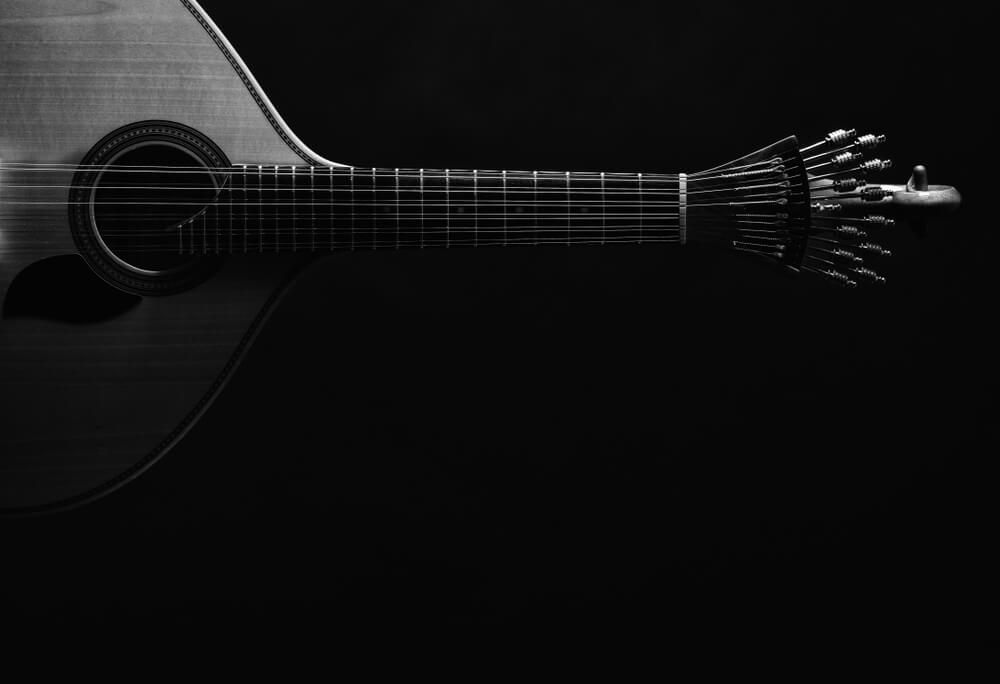
To bring fado to life, you need to gather several talents. First, a male or female singer with a great voice and very expressive face called "fadista" in Portuguese. And second, a small troupe of musicians who make their "guitarra" (Portuguese 12-string guitar shaped like a mandolin) and their "violão" (acoustic guitar) sound, in chorus or not. Nothing more, nothing less to enchant the audience!
From the depths of the city, fado will gradually climb the social ladder to be appreciated by the bourgeoisie. It becomes more refined and obtains its credentials in the 1950s, when Amália Rodrigues, ultra-famous "fadista", propels the art of fado throughout Portugal and beyond borders. The interest and love given to the national song by each new generation are such that on November 27, 2011, UNESCO inscribed fado in the Intangible Cultural Heritage of Humanity. The sustainability of the musical style is affirmed.
While we like to talk about fado in the singular, in reality there are two main varieties. That of Lisbon in the South and that of Coimbra in the North. Promise, it doesn't complicate things. From the moment you know the 2-3 differences that oppose them, you won't be able to confuse them anymore.
Lisbon's Saudade
Lisbon fado is the best known and most widespread. It resonates specifically in the neighborhoods of Alfama, Mouraria, Bairro Alto or Madragoa. Both men and women sing it through very specific themes such as disappointed love, separation, poverty, loss of a loved one... Thus, spectators' hearts are won over by an overflow of "saudade", bitterness and melancholy.
Some titles to help you better understand Lisbon fado:
- "Abandono" by Amália Rodrigues
- "Ó gente da minha terra" by Mariza
- "Loucura" by Lucilia do Carmo
- "Gaivota" by Amália Rodrigues
Coimbra's Student Youth
In Coimbra, in northern Portugal, fado categorically has its second home. Unlike that of the Portuguese capital, it is there exclusively sung by men. A rather discriminatory detail at first glance, but which deep down hides a strong history of academic tradition.
Indeed, since the 16th century, university students have had the habit and pleasure of singing in the city streets. All musical styles are allowed until in the 1900s, fado mainly occupies the forefront of the stage.
In their academic uniform, composed of a suit and a long black cape as well as gaiters, the singer alone or accompanied by musicians indulges in serenades or ironic, even critical texts. During the 60s, Coimbra fado was a protest song used as a form of resistance to Salazar's repressive regime.
Even if the sounds of Coimbra fado, more ceremonial, differ from that of Lisbon, the instruments that play them are in both cases identical. We're talking about the "violão" and the "guitarra portuguesa", which nevertheless has its own tuning, its own construction and its own sound coloring in Coimbra.
Some titles to help you better understand Coimbra fado:
- "Trova do vento che passa" by Adriano Correia de Oliveira
- "Do Choupal Até Á Lapa" by Zeca (José) Afonso
- "Balada da Despedida" by 5º Ano Jurídico 88/89
- "O meu menino é d'Oiro" by Zeca (José) Afonso
- "Verdes Anos" by Carlos Paredes
You're about to take a trip to Coimbra and you've rarely, if ever, had the opportunity to attend a fado show? Might as well combine business with pleasure! After discovering the array of monuments in Portugal's oldest university city, let yourself be transported on a few fado notes in specific addresses or in less formal places, but just as suitable.
The best official places to appreciate Coimbra fado:
Fado ao Centro
Address: 7 R. Quebras Costa
Contact: +351 239 837 060
À Capella – Casa de Fados
Address: Capela da Victória, R. do Corpo de Deus
Contact: +351 239 833 985
Attention, these two addresses are renowned among fado enthusiasts. A reservation beforehand is more than strongly advised!
If these 2 addresses or others, victims of their success, are no longer able to receive you or if the price of the shows seems too expensive to you, know that all is not yet lost. Sometimes, at the corner of an alley, fado serenades can quickly resonate. Usually, the steps of the old cathedral (Sé de Coimbra) are requisitioned for the occasion. So, get lost in Coimbra and above all listen carefully!
During one of her performances, Amália Rodrigues, "Queen of fado", not really having adequate attire to wear, supposedly entered the stage wrapped in a shawl. An accessory that finally accompanied her throughout her incredible career and that the following fado singers adopted as an almost indispensable element of their "fadista" outfit.