
Créé par Emilie, le 20 juin 2026
Votre guide Ryo
The Deserts of Spain: Complete Guide to Exploring 6 Extraordinary Landscapes (2026)
© Shutterstock
Spain: land of sun and fiestas? Yes. But also the only country in Western Europe to possess a true hot desert classified as semi-arid, lunar plateaus frequented by Sergio Leone, gorges carved by millennia of wind, and dunes stretching as far as the eye can see across Atlantic islands. As soon as you move away from the coasts and major cities, Spain reveals a radically different geography — dry, silent, and often spectacular. The desert of Spain is not a single desert: it is several arid territories, each with its own personality, colors, and seasons.
In this guide, you will discover six desert areas worth the detour: the Bardenas Reales in Navarre, a clay and sandstone plateau that resembles an alien planet; the Tabernas Desert in Andalusia, a unique Western film set in Europe; Los Monegros in Aragon, a cereal steppe of absolute austerity; the Gorafe Desert near Granada, with its prehistoric dolmens and exceptional starry skies; the Mahoya Desert in Murcia, a small wonder of volcanic landscapes; and the Corralejo Dunes in Fuerteventura, an insular desert swept by trade winds. You will also find the best seasons to travel, how to get around, and how to combine these wild landscapes with Spain's must-see cities, reachable within a few hours — including the Ryo audio-guided tour of Granada, which makes an excellent starting point for Gorafe and Tabernas, not to mention Córdoba or Valencia.
The Deserts of Spain: Geography, Climatology, and Common Misconceptions
Many travelers arrive in Spain without realizing the extent of its arid zones. Yet approximately one third of Spanish territory exhibits semi-arid or arid characteristics, with annual rainfall below 300 mm in the driest areas. The Iberian Peninsula is the most arid region in Western Europe, the result of a combination of geographic position, topography, and atmospheric currents.
The first misconception to dispel: the Tabernas Desert is the only true hot desert in Europe, in the strict climatological sense. The other areas — Bardenas Reales, Gorafe, Monegros — are semi-deserts or arid steppes, but the visual intensity of these landscapes is often more striking than that of many 'official' deserts.
Two types of deserts coexist in Spain:
- Continental deserts (interior of the Peninsula): Tabernas, Gorafe, Mahoya, Los Monegros. Characterized by scorching summers and cold winters, rainfall below 250 mm/year, and sparse vegetation of esparto grass bushes and stunted junipers.
- Island deserts (Canary Islands): the plains of Fuerteventura and Lanzarote, shaped by climatic aridity, wind, and Atlantic trade winds. Fine sand dunes stand alongside fields of black lava.
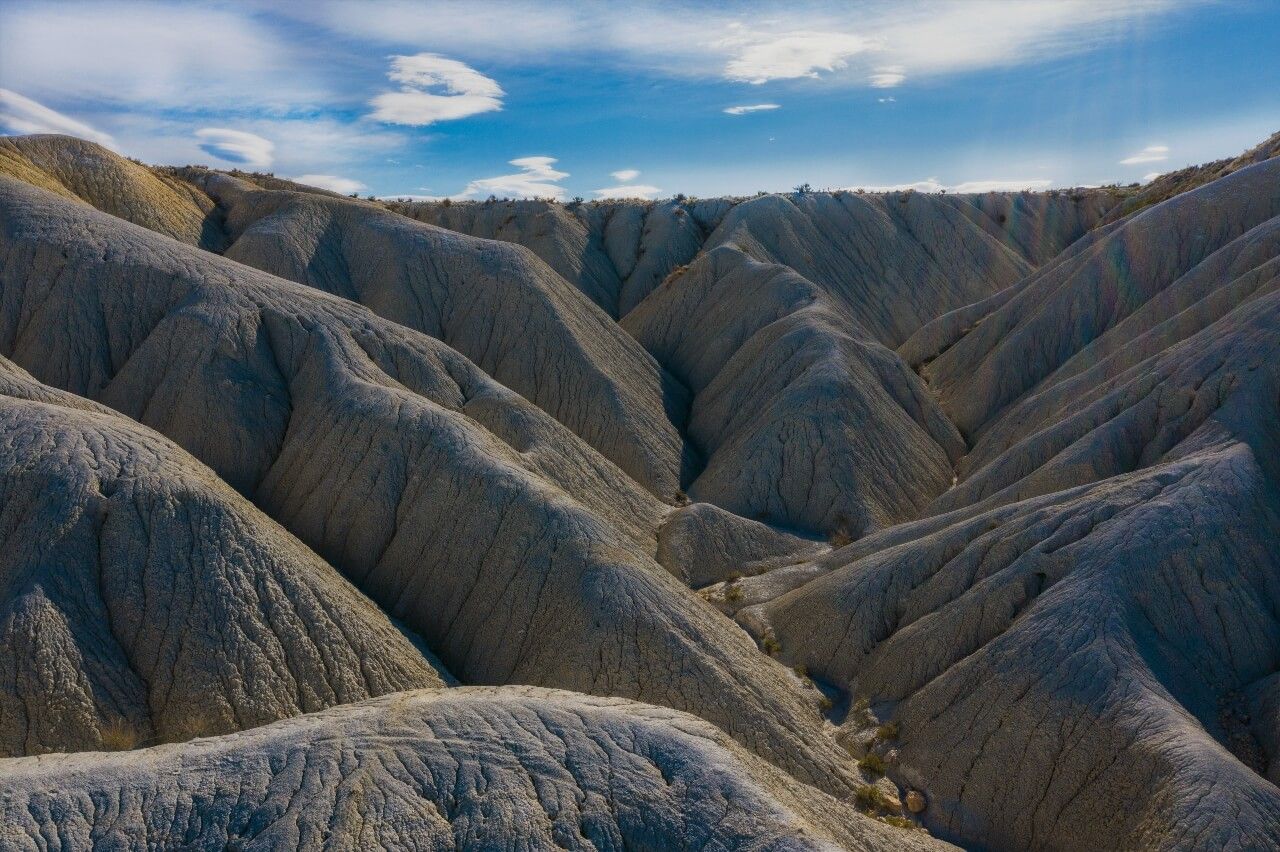
The Bardenas Reales occupy a category of their own: this is not a climatological desert, but a landscape of spectacular erosion. The soft rock — clay, gypsum, sandstone — sculpted by flash floods and wind over millions of years produces landforms of cabezos (tabletop mounds) and barrancos (ravines) that have no equivalent in temperate Europe. Listed as a UNESCO Biosphere Reserve in 2000, the site covers approximately 42,500 hectares in the southeast of Navarre, at the heart of the Ebro Depression.
Why do these landscapes fascinate so many people? Partly because they contrast sharply with the green Spain of the north and the beach resorts of the south. Crossing the Bardenas after a stay in Bilbao, or skirting the gorges of Gorafe after visiting the Alhambra in Granada, produces a striking sense of rupture. These deserts are not visited like a museum: you inhabit them for a few hours, by bike or on foot, letting the silence settle in.
Bardenas Reales (Navarre): the Desert That Looks Like Another Planet
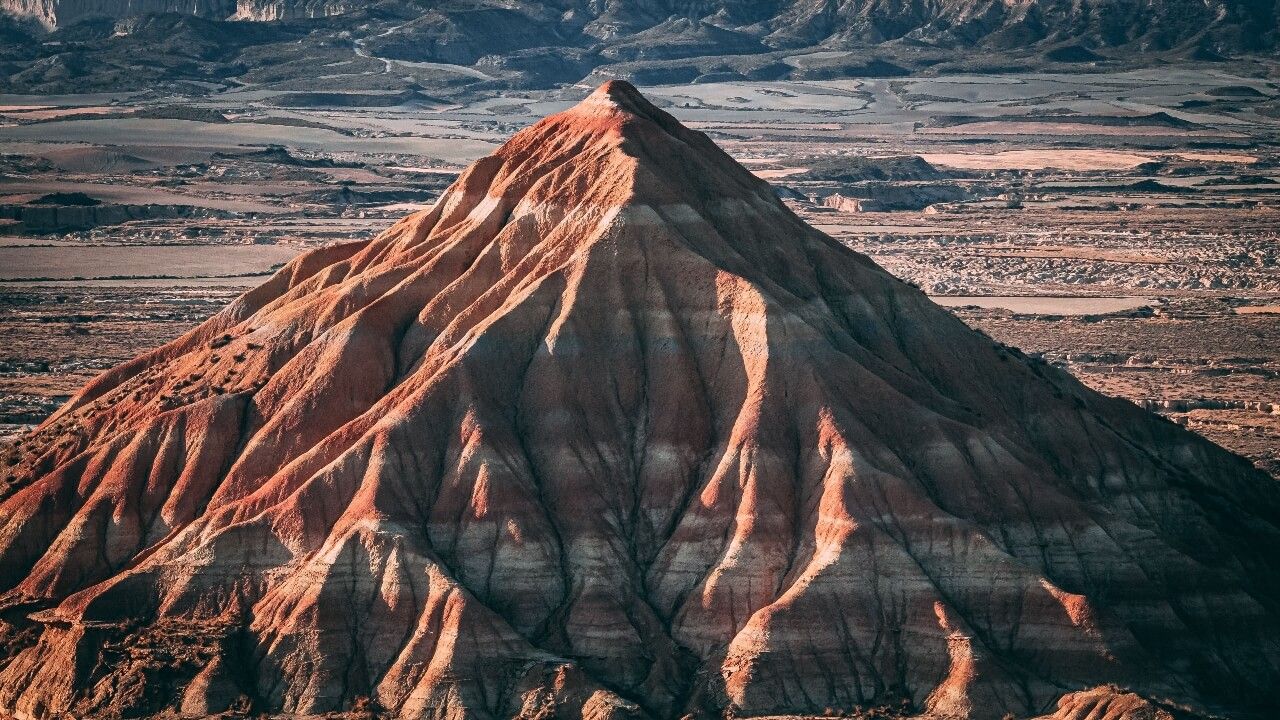
When people talk about the Bardenas Reales desert, superlatives are inevitable — and well deserved. This nature park in southern Navarre, about sixty kilometers from Pamplona, is one of the most photogenic landscapes in Europe. The light plays differently depending on the time of day: golden and horizontal at dawn, white and harsh at noon, orange and long-lingering at sunset. Photographers have known this for a long time; the site also served as a filming location for Game of Thrones.
The park is divided into three main zones. The Bardena Blanca ('white desert') is the best known and most spectacular: here, cabezos of sandstone and white clay rise like natural towers above a bare plateau. The Cabezo de Castildetierra (Bardenas Reales, 31590 Arguedas, rated 4.8/5 on Google with 1,094 reviews) is the symbol of the park — a column topped with a 'hat' of resistant sandstone, impossible to forget once seen. The Bardena Negra ('black desert') contrasts with its dark colors: here, slate-grey and brown-ochre tones dominate, vegetation is slightly denser, and the terrain less deeply carved. Finally, El Plano occupies the northern part of the park, an agricultural plain where cereals are still grown, partly used as a military training zone (one sector remains closed to the public).
How to visit the Bardenas Reales? Three main options:
- By car or 4×4: the main track (Bardenas Route) crosses the park for about 45 km. It is passable in a regular car in summer when the ground is dry, but autumn rains can make it tricky. Allow 2 to 3 hours for a round trip with several stops. The classic starting point is the Interpretation Center in Arguedas.
- By bike: increasingly popular, especially from Tudela. Several rental shops offer mountain bikes suited to the terrain. Allow 4 to 5 hours for a full circuit; water and sun protection are essential from March onward.
- On horseback: a few local stables offer guided outings from 2 hours to a full day — the quietest way to cross the park.
Entrance to the park is free, but a voluntary contribution is suggested at the interpretation center. Parking is paid in high season (May–September): around €5 per vehicle. A practical tip: there are no shops or water points inside the park, so stock up on supplies and fuel in Arguedas or Tudela before entering.
The wildlife is one of the true surprises of the Bardenas. The park is home to a breeding colony of griffon vultures (around a hundred pairs), golden eagles, common kestrels, little bustards, and — if you're lucky and arrive early in the morning — pin-tailed sandgrouse, steppe birds that are difficult to observe elsewhere in Europe. The park is also home to rabbits, foxes, and a few Iberian hares.
From Pamplona, the Bardenas are about a 1-hour drive. From Bilbao, allow 1.5 hours. The Bilbao → Bardenas Reales → Logroño → Madrid itinerary is one of the most memorable road trips in northern Spain.
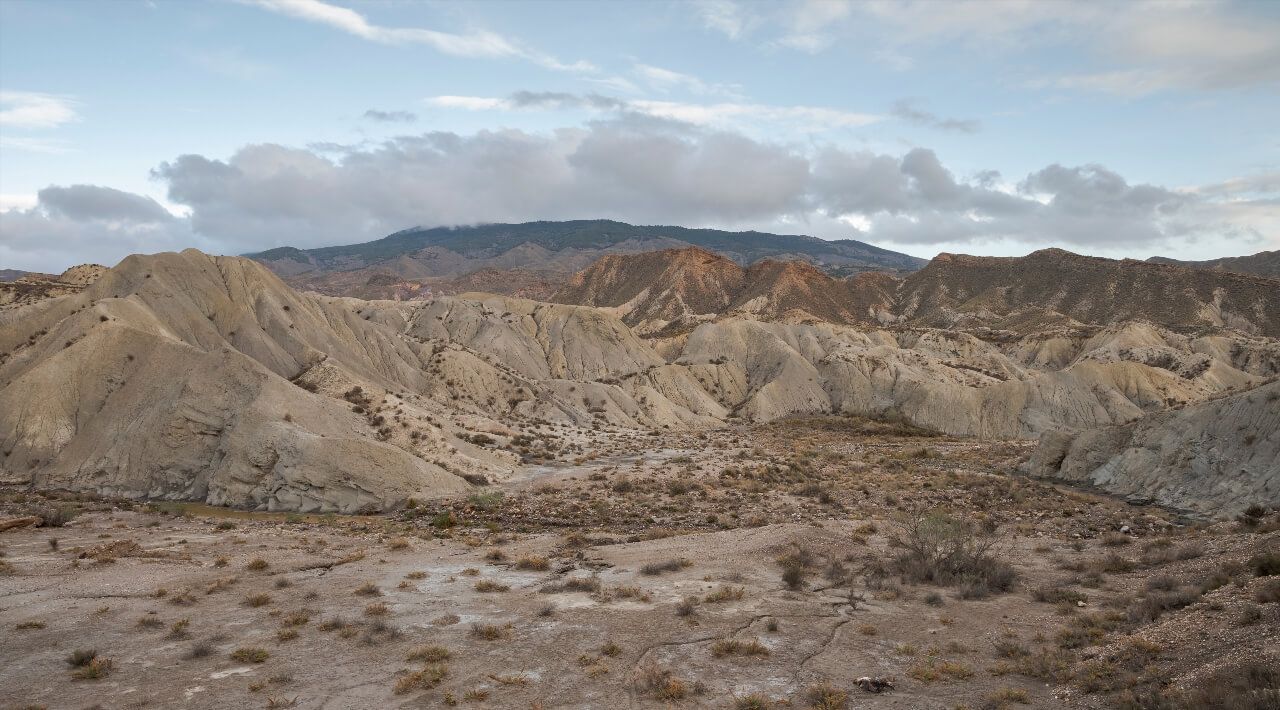
The Tabernas Desert (Andalusia): Europe's Only True Desert
Thirty kilometers north of Almería, the Tabernas Desert (Carretera N-340, 04200 Tabernas, Almería, rated 4.4/5 on Google with 2,800 reviews) occupies a basin of 280 km² framed by the Sierra Nevada to the north and the Sierra de los Filabres to the east. It is here, under a sky that records an average of 3,000 hours of sunshine per year, that Sergio Leone filmed his westerns: A Fistful of Dollars, The Good, the Bad and the Ugly, Once Upon a Time in the West. These films put the Tabernas Desert on the world map, and the theme parks built for the occasion still exist today.
The 'hot desert' classification is official: less than 200 mm of rainfall per year on average, summers that regularly exceed 45 °C in July–August, and vegetation reduced to esparto bushes, a few cacti, and dwarf palms. The soil is dry clay that cracks into geometric patterns, crossed by ramblas — dry riverbeds that can become torrential during the rare violent autumn rains.
The Western film sets are the best-known attraction. Three parks are open to the public:
- Mini Hollywood (officially 'Oasys Theme Park'): the most famous, open year-round, with stunt shows and a zoo. Expect around €26 for adults and €19 for children. Entrance is on the N-340, a few kilometers west of Tabernas.
- Fort Bravo Texas Hollywood: a more authentic, less touristy atmosphere. Still frequently used for film shoots (Spanish series, commercials). Admission around €16.
- Western Leone: the smallest and most preserved of the three.
But Tabernas is more than a film set. Since the 1980s, the desert has been home to the Almería Solar Platform (PSA), one of Europe's largest solar energy research centers. Mirror towers and fields of parabolic panels punctuate the landscape — a futuristic vision in the middle of the scrubland.
To explore the desert without going through the theme parks, hiking trails cross the nature reserve. The Río Tabernas trail (approximately 8 km round trip) runs along a sunken rambla: this is where the ramblas are most photogenic, with their clay walls sculpted into mini-canyons. The trail can be started from the village of Tabernas itself.
The city of Almería is the natural logistical base, 30 minutes away by car. From Granada, the journey takes about 2 hours. If you continue south, Cabo de Gata, Spain's first marine nature reserve, is 45 minutes away, offering a striking contrast between the arid desert and turquoise-blue waters. Insider tip: plan your visit to the Western film sets in the morning and save the rambla hikes for late afternoon, when the raking light sculpts the clay landforms.
Los Monegros (Aragon): the Forgotten Steppe Between Two Motorways
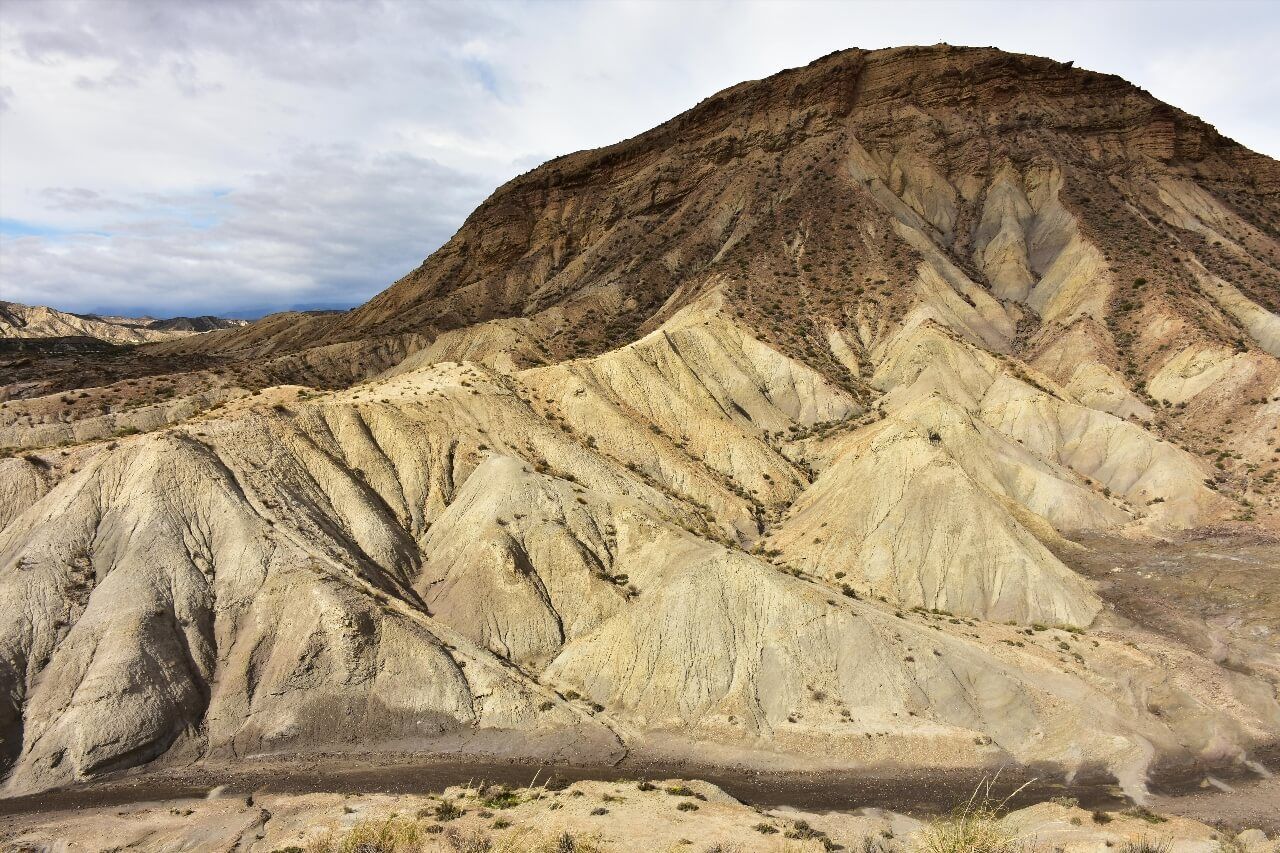
Los Monegros (Comarca de Los Monegros, 50250 Sariñena, Huesca, rated 4.2/5 on Google with 890 reviews) is the least-known Spanish desert among French travelers, and often the most surprising for those who take the time to stop. This vast steppe in Aragon, between Zaragoza and Lleida, covers approximately 2,600 km². It is not a spectacular desert in the sense of the Bardenas or Tabernas: no sculpted landforms, no sand. It is an extremely dry agricultural plain, covered in esparto grass and a few irrigated crops, with a particularly intense quality of light.
What makes Los Monegros unique is its biological climax: it is one of the driest regions on the Peninsula (200 to 350 mm of annual rainfall) and one of the richest in steppe biodiversity. The paradox lies in its isolation: little cultivated, little urbanized, the territory has preserved habitats that have disappeared elsewhere. Here you can observe the European roller (a bird with turquoise and russet plumage), the great bustard (the world's heaviest flying bird), red-legged partridges, and Montagu's harriers.
Fraga is the eastern gateway, on the banks of the Río Cinca. Sariñena, in the center, is the starting point for locally organized cycling circuits. The Balsa de Sancho Abarca lagoon is one of the most important birdwatching sites in the area; flamingos land here in winter when conditions allow.
For visitors, Los Monegros is best explored by car or bike, on quiet secondary roads. The atmosphere is that of a road trip through a timeless Spain: villages of 200 inhabitants, grain silos, Romanesque chapels isolated in the plain. Bring water and fuel — petrol stations are rare.
Recommended combination: Zaragoza (1 day) → Los Monegros (1 day) → Bardenas Reales (1 day). The whole loop can be done in 3 days from Barcelona or Madrid.
The Gorafe Desert (Granada): Dolmens and Starry Skies
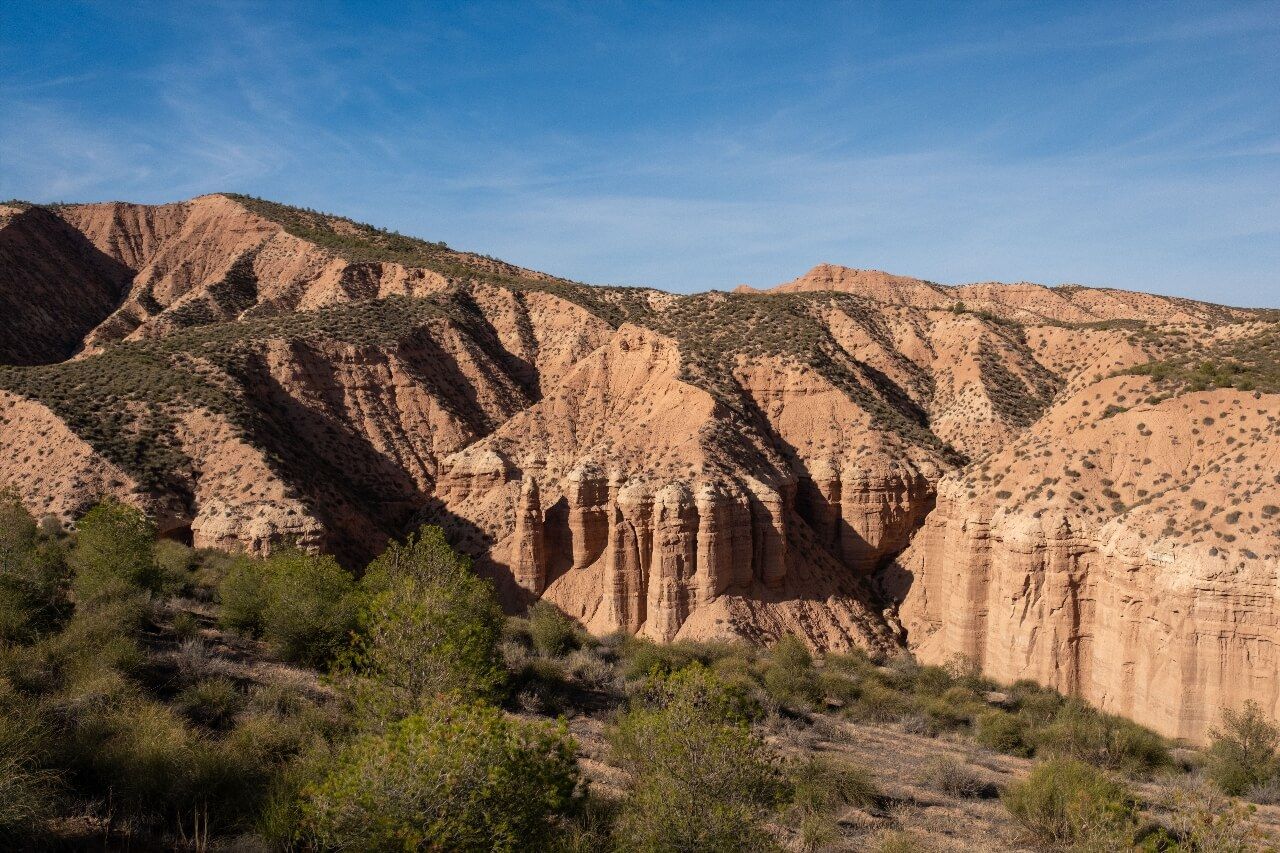
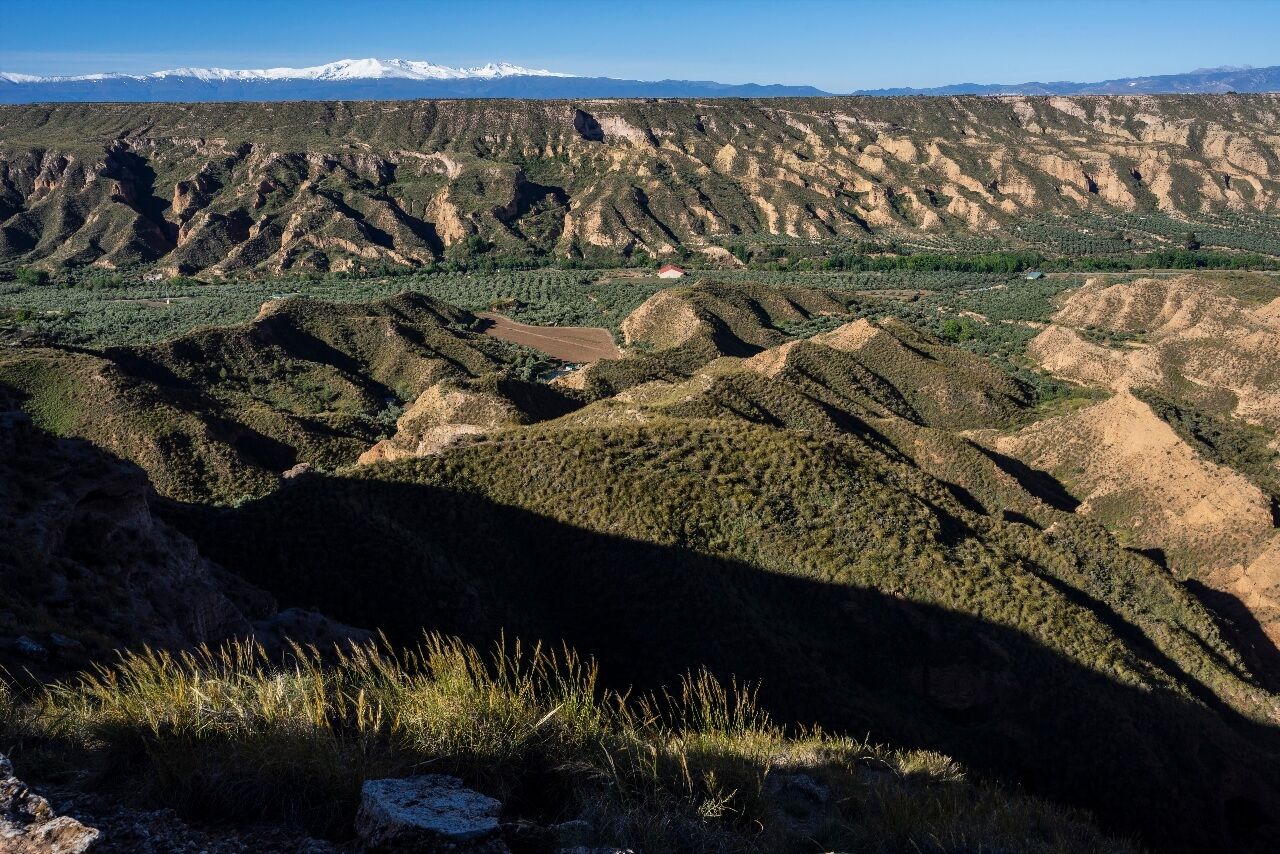
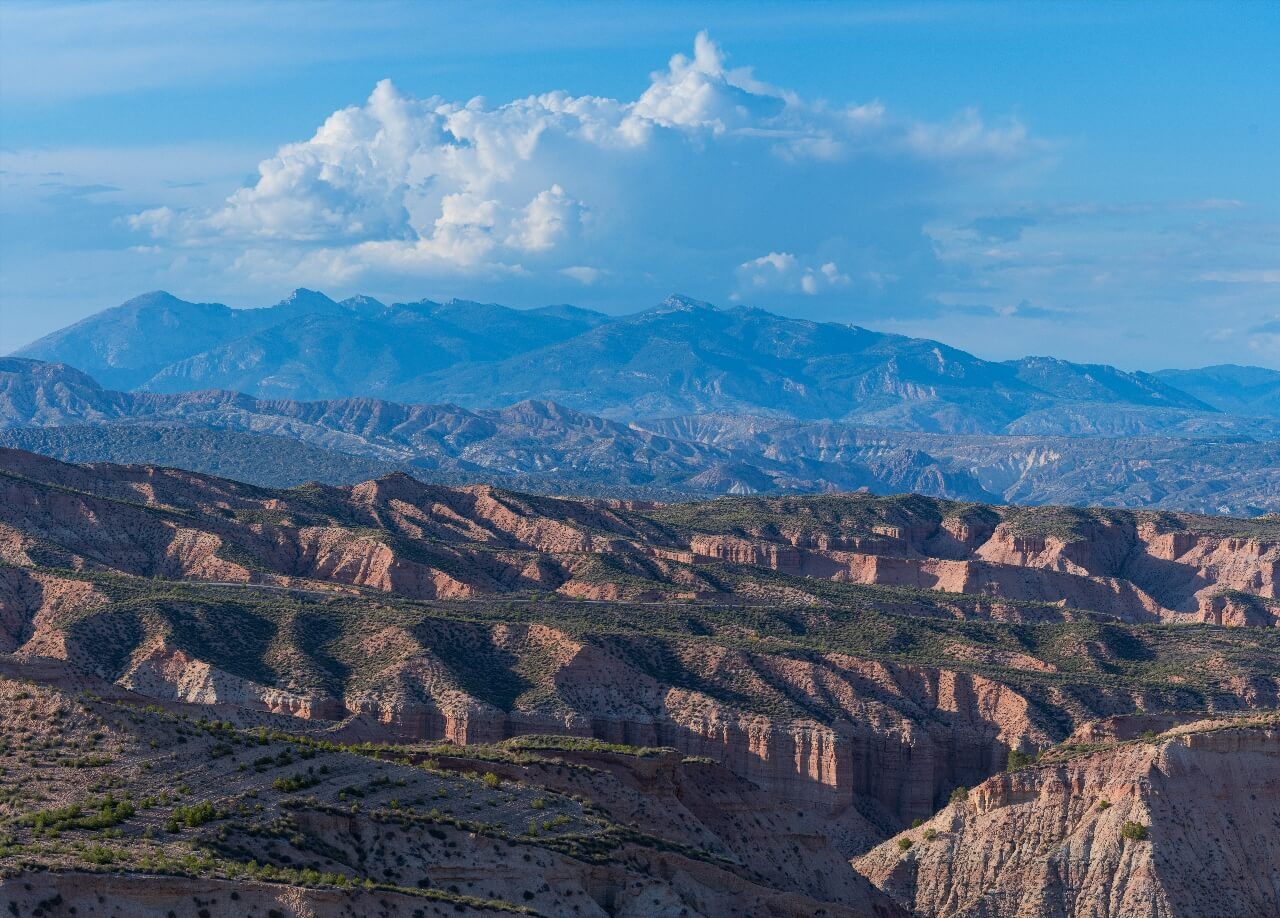
Eighty kilometers northeast of Granada, the Gorafe Desert (Calle Real, 18840 Gorafe, Granada, rated 5/5 on Google with 140 reviews) is one of the least-visited areas in eastern Andalusia. This semi-desert occupies the sunken gorges of the Río Gor, between 700 and 1,000 meters above sea level — a geography that gives it colder winters than Tabernas and an exceptionally pure night sky.
Two main reasons to visit:
The dolmens: with more than 240 megalithic tombs spread across around ten necropoli along the Río Gor, dating from the Chalcolithic period (between 3500 and 2500 BC), Gorafe is home to one of the largest collections of dolmens in Spain, comparable to that of Antequera. These funerary monuments are scattered across the gorge slopes; some still bear their capstone, others are reduced to their uprights. Three marked trails (from 1.2 to 3.6 km) allow you to explore the most remarkable ones — and you will often find yourself entirely alone on the path.
Astronomy: the low population density and altitude make Gorafe one of the best astronomical observation sites in Spain. A public observatory is located near the village (Astrogorafe) and offers guided nighttime sessions with telescopes. Booking is recommended as places are limited. The Gorafe sky has received Starlight certification, an accreditation awarded to sites that preserve nighttime quality.
The village of Gorafe itself has a few hundred inhabitants. You will find rural accommodation and a few cave houses still inhabited, carved into the rock of the gorges. The road that descends into the gorges from the A-92N is narrow — a small car or motorbike is preferable.
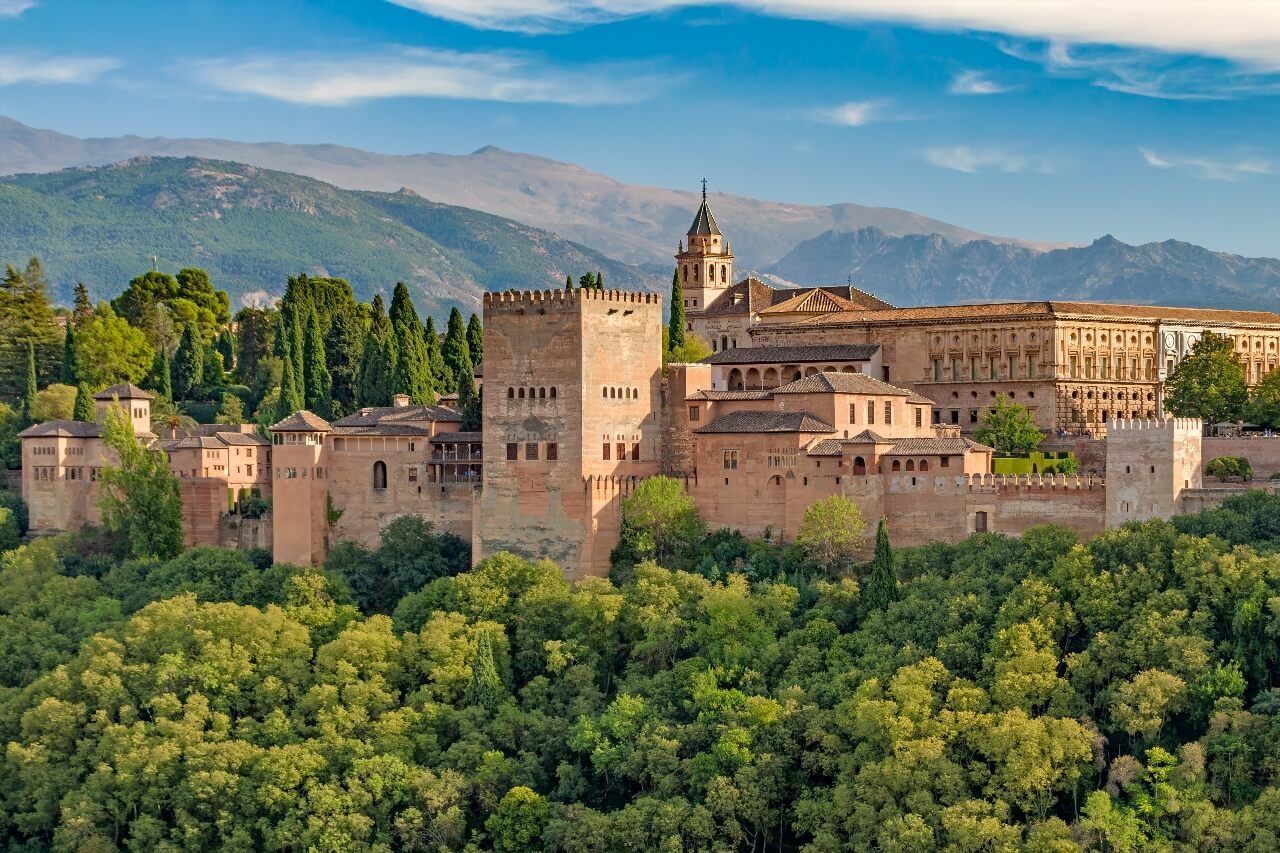
From Granada, the journey is about 1 hour 15 minutes via the A-92N. Best combined with a visit to the Alhambra. The Ryo audio-guided tour of Granada will let you explore the city and its famous Nasrid palace before or after your day in the desert.
The Mahoya Desert (Murcia): Lunar Landscapes in the Heart of the Southeast
The Mahoya Desert (Paraje de Mahoya, 30880 Águilas, Murcia, rated 4.5/5 on Google with 218 reviews) is undoubtedly the most under-the-radar of Spain's deserts. Located in the Murcia region, about thirty kilometers from Águilas, this small volcanic ensemble covers a few dozen square kilometers, but makes up for its size with the intensity of its landscapes.
What makes Mahoya distinctive is its volcanic origin: unlike the sedimentary deserts (Tabernas, Gorafe) or erosion landscapes (Bardenas), Mahoya was shaped by ancient volcanic activity that left behind black and tortured landforms, eroded eruption cones, and fossilized lava flows. The dominant color is charcoal black, punctuated by a few grey-green bushes. The light of late afternoon, raking across the surface, reveals textures of photographic precision.
No visitor center, no interpretation panels: Mahoya is explored on foot, on unmarked tracks. Good shoes, a hat, and water are essential — there is no shade whatsoever. Access is from the small road linking Águilas to Mazarrón, turning off the main road near the valley hamlets.
Best combined with the Murcian coast (Calnegre, Puntas de Calnegre) and, for history enthusiasts, with the city of Cartagena, a former Roman naval base 90 km away, whose Roman theater and forum remains make for a solid cultural stop.
Fuerteventura: Dunes of the Island Desert
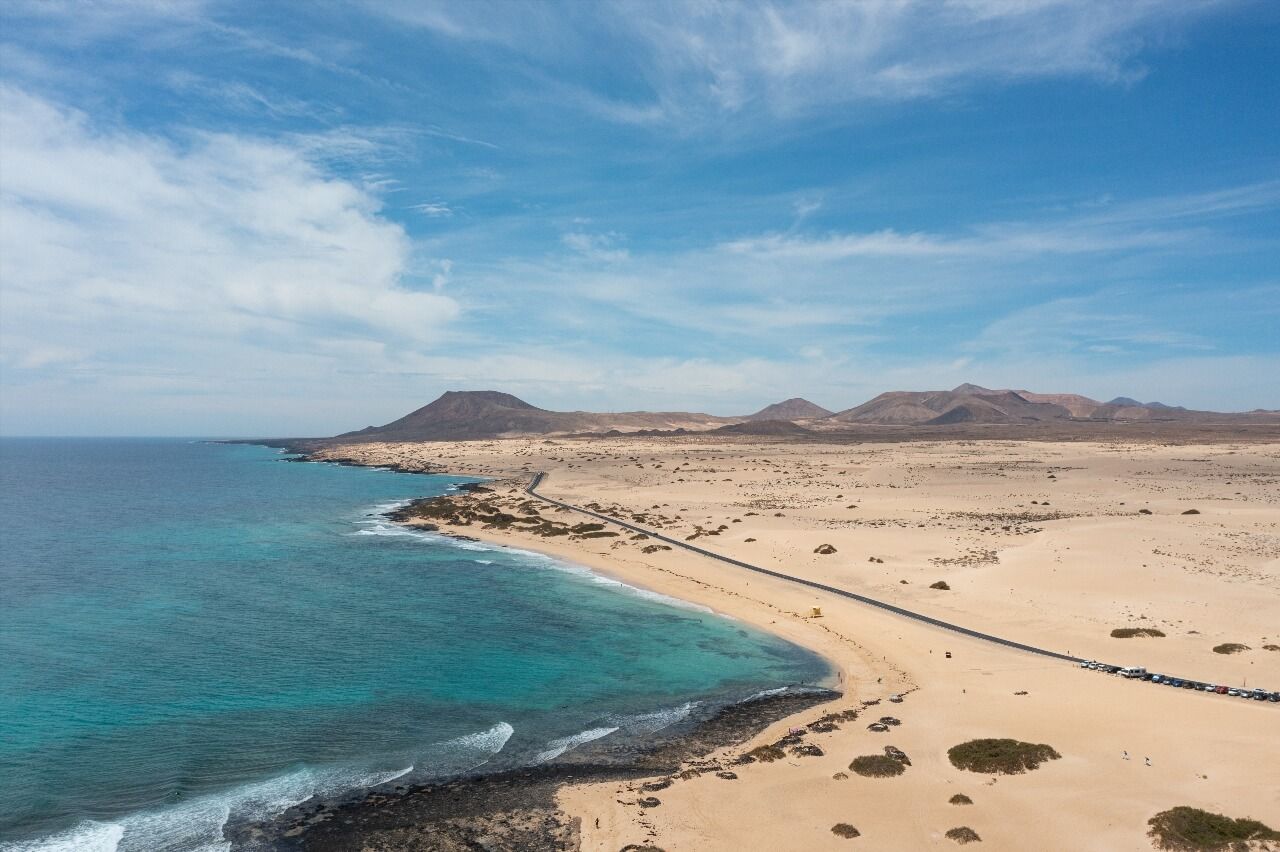
Fuerteventura is the second largest of the Canary Islands and the closest to the African continent, just a hundred kilometers from the Moroccan coast. This proximity partly explains its climate: trade winds blow constantly and aridity is extreme. On the northern tip of the island stretches one of the finest dune fields in the archipelago — the Corralejo Dunes (Parque Natural Corralejo, 35660 Corralejo, Las Palmas, rated 4.8/5 on Google with 8,635 reviews), whose white sand is predominantly of marine origin (pulverized shells and organisms) — not Saharan, as a widespread belief suggests.
The Corralejo Dunes Natural Park, designated in 1994, covers more than 2,600 hectares of white sand and moving dunes — the largest dune field in the Canary Islands. Dune height varies from a few meters to about twenty meters depending on the area. The dune vegetation is sparse: a few clumps of Traganum moquinii (a halophytic shrub) resist the wind and salinity. The contrast between white sand, the intense blue of the Atlantic, and the volcanic brown of the islets opposite (Lobos, Lanzarote) creates images of a particular serenity.
But Fuerteventura is more than a beach destination. The island's interior, rarely visited, resembles a lunar volcanic steppe: dry valleys, extinct volcanoes, white stone villages lost in an expanse of orange-brown. The Betancuria massif (with the eponymous village, the island's former capital) is worth a half-day detour from the northern coast.
The island lends itself to a road trip in a rental car; distances are short (about a hundred kilometers from north to south), but the landscapes change radically from one region to the next. The natural starting point is the airport at Puerto del Rosario.
When to Go? Seasons and Weather in the Spanish Deserts
Choosing the right season is crucial for enjoying Spain's deserts without suffering.
Spring (March–May): the best period for most continental deserts. Temperatures are mild (15–25 °C), the light is beautiful, and some desert plants briefly flower after winter rains — a rare spectacle. The Bardenas Reales are particularly photogenic in April, when the clay soil takes on pinkish hues and the vegetation begins to timidly turn green.
Summer (June–August): avoid the continental deserts (Tabernas, Gorafe, Mahoya, Monegros) if you are not equipped for temperatures of 40–45 °C. Early starts (6–8 a.m.) allow a visit to Tabernas before the heat sets in, but afternoons are genuinely dangerous without water and shade. Fuerteventura, on the other hand, remains manageable thanks to the constant breeze (25–28 °C).
Autumn (September–October): excellent for Tabernas, Gorafe, and Mahoya. After the summer heat, temperatures drop back to 20–30 °C. The ramblas can experience sudden flash floods during storms (the famous DANA, isolated upper-level lows); stay vigilant if visiting a canyon or ravine.
Winter (November–February): Fuerteventura is ideal (20–22 °C year-round). The Bardenas Reales are accessible and less crowded, though some tracks can become muddy after rain. Gorafe offers its best astronomy nights in winter, when the air is drier and more transparent.
General rule: avoid July and August in the continental deserts unless you are an experienced hiker with appropriate equipment. Prioritize the months of March to May or September to November.
How to Get There and Get Around
The Bardenas Reales are easily reached from Pamplona (1 hour), Logroño (1 hour), or Zaragoza (1.5 hours). A car is essential — there is no public transport inside the park. From Paris, a low-cost flight to Pamplona or Bilbao followed by a car rental is the most economical combination.
The Tabernas Desert is reached from Almería (30 minutes), Granada (2 hours), or Malaga (2.5 hours). Almería is served by direct flights from several French cities in summer. The N-340 and A-92 cross the area; a car remains the only practical way to visit the canyons and western parks.
Los Monegros is accessible by car from Zaragoza (45 minutes) or Barcelona (2 hours). Regional buses serve Sariñena from Zaragoza, but a car is needed to explore the steppe freely.
Gorafe is 1 hour 15 minutes from Granada via the A-92N and GR-6101. There is no public transport to the village.
Fuerteventura: direct flights from Paris, Lyon, Marseille, Bordeaux, and Nantes to Puerto del Rosario airport. Car rental from the airport is recommended, as public transport covers the island's interior poorly.
Fuel budget: in Spain, petrol costs approximately €1.60–1.75/L in 2026. Budget €50–80 for fuel on a Tabernas–Gorafe–Cabo de Gata road trip.
If you combine several deserts in a single trip, the Madrid → Tabernas → Gorafe → Granada route by car (approximately 550 km in total) is achievable in 4 to 5 days. From Madrid, the Ryo audio guide for Madrid is a great cultural warm-up before diving into the geology.
Deserts and Cities: Combinations That Really Work
One of Spain's great advantages is how easily you can move from wild landscapes to dense cities in just a few hours. Here are the most rewarding combinations:
Tabernas + Granada + Málaga (4–5 Days)
This is the quintessential Andalusian circuit for lovers of contrasting landscapes. Start with Granada (2 days): the Alhambra, the alleyways of the Albaicín, free tapas with every drink. Then head to Tabernas (1 day): leave in the morning from Granada, visit a western park, hike through the ramblas, and have dinner in Almería. Finish in Málaga (1 day): museums, the harbor, a lively atmosphere. The Ryo Ryocity for Málaga offers an audio-guided tour of Málaga covering the historic district around the cathedral and the Castillo de Gibralfaro.
Bardenas Reales + Pamplona + Logroño (3 Days)
A northern itinerary. One full day in the Bardenas (the track route by car or bike). That evening, stop in Pamplona, the city of the San Fermines (more peaceful off-season) with its lively old-town streets. The following day: drive to Logroño and La Rioja, with stops at roadside wineries. A road trip that blends mineral aridity with viticulture.
Los Monegros + Zaragoza + Barcelona (3–4 Days)
Depart from Barcelona: just 2 hours west by road to reach the Monegros steppe. A day of birdwatching and photography. Stop in Zaragoza (an underrated city: the Basílica del Pilar, the Aljafería palace). Return to Barcelona via the A-2. An ideal circuit for travelers who already know the Catalan coast and want to see a different side of Spain. The Ryo Ryocity for Barcelona is the natural companion app for preparing or closing this road trip in the city.
Gorafe + Córdoba (Extended Weekend)
From Córdoba, you can reach Gorafe in 2.5 hours via the A-92. An extended weekend (Friday to Monday) allows you to combine gorge and dolmen exploration on Saturday, a night at the observatory on Saturday evening, and a return via Granada on Sunday with a stop at the Alhambra. Córdoba deserves its own half-day on the return; the Mezquita-Catedral and the Jewish quarter are within a 30-minute walk. The Ryo audio-guided tour of Córdoba covers the main sites with 23 audio commentaries spread over 8.2 km.
The Complete Andalusian Circuit with the Ryo Andalusia Ryotrip
For travelers who want to discover Andalusia in depth — Seville, Córdoba, Granada, Ronda, Málaga — with an excursion to Tabernas or Gorafe, the Ryo Andalusia Ryotrip is the ideal tool: a multi-city audio-guided itinerary that connects the region's major highlights.
Accommodation and Budget
Accommodation in desert areas: options are scarce within the deserts themselves. Nearby towns and villages serve as base camps.
- Bardenas Reales: Tudela (15 km) is the nearest town with several hotels at €60–100 per night. A few cortijos (farmhouses) offer B&B rooms within a 20 km radius — a more authentic experience.
- Tabernas: Almería has a good hotel offer (€40–120/night) and many Airbnb options. In Tabernas itself, a rural guesthouse opened in 2022 on the heights of the village.
- Gorafe: the village offers a few cuevas-casas (converted cave houses) available to rent by the night (€60–90). Sleeping in a cave carved out of the clay rock of the gorges is a unique experience.
- Fuerteventura: the supply is massive in Corralejo, with apartments and hotels for all budgets (€50–200/night depending on season). Book well in advance for French school holiday periods.
Estimated daily budget (2 people, rental car included):
- Accommodation: €70–120
- Fuel: €15–25
- Food: €30–50 (Spanish set lunch menu at €12–15 per person, wine included at some restaurants)
- Entrance fees: €0–30 depending on sites (Bardenas: free; Tabernas western parks: €16–26)
Indicative total: €115–225 per day for two, car included.
FAQ
What Is the Largest Desert in Spain?
The answer depends on the definition used. In terms of surface area within semi-arid or arid zones, the central Meseta (the high plateaus of Castile and Extremadura) represents the largest dry zone in Spain, though it is not visually perceived as a desert, being covered with cereal crops. For areas with a visibly desert-dominant landscape, the Bardenas Reales in Navarre (approximately 42,500 classified hectares) are often cited as the largest 'desert in Spain' in the popular sense. The Tabernas Desert (280 km²) is the only hot desert in Europe in the strict climatological sense.
Can You Camp in the Spanish Deserts?
In the Bardenas Reales, wild camping is prohibited inside the nature park. A municipal campsite exists in Arguedas, at the park entrance. For Tabernas, there are no official bivouac areas within the desert; the nearest campsites are on the Almería coast. In Gorafe, supervised bivouacs are sometimes organized by the observatory (astronomy night + bivouac) — contact Astrogorafe for details. In Fuerteventura, wild camping is prohibited in the Corralejo nature park, but official campsites exist near the dunes.
Where Is the Bardenas Desert Located in Spain?
The Bardenas Reales desert is located in southern Navarre, on the Iberian Peninsula, at the heart of the Ebro Depression. Its center is approximately 60 km south of Pamplona and about twenty kilometers east of Tudela. In GPS coordinates, the interpretation center (recommended starting point) is located around 42°13'N, 1°31'W. Access from France is via Pamplona (A-15 from Bayonne) or via Logroño.
Is the Tabernas Desert Open Year-Round?
Yes, the Tabernas Desert is accessible year-round. The natural trails are permanently open and free of charge. The theme parks (Mini Hollywood, Fort Bravo) generally close for a few days in December–January; check exact dates on their websites before visiting. The best time to visit is from October to May: bearable temperatures, beautiful light, and no summer crowds. In summer, hikes should be reserved for the early morning hours (before 9 a.m.).
Can You See Shooting Stars in Gorafe?
The Gorafe Desert is one of the best stargazing sites in Spain. Its Starlight certification attests to a very low level of light pollution. The Perseids (around August 11–12) and the Geminids (around December 13–14) are the two most spectacular meteor showers of the year. The Astrogorafe observatory organizes guided nighttime sessions for these events; spots fill up quickly, so book several weeks in advance. Outside these dates, any moonless night between October and March offers a Milky Way visible to the naked eye.
Conclusion
Between its crowded beaches and major cities, Spain conceals a desert geography of rare richness in Europe. From the Bardenas Reales in Navarre to the Corralejo Dunes in Fuerteventura, by way of the clay canyons of Tabernas and the starry skies of Gorafe, each desert deserves at least a full day — and often much more.
These landscapes are best experienced when combined with the cities that surround them. Granada, Córdoba, Málaga, Madrid, Barcelona — each has its own Ryo audio-guided tour that lets you explore local history and architecture at your own pace, smartphone in hand, with no guide or group required. Browse the Ryocities available on Ryo to plan the urban stage that will complete your desert adventure.