





RyoCity
Echoes of the Middle Ages
Sarlat-la-Canéda, France
RyoCity
Echoes of the Middle Ages
Sarlat-la-Canéda, France
1.1 km
Distance
1h00
Durée
16
Audios
Boucle
Parcours
Shutterstock
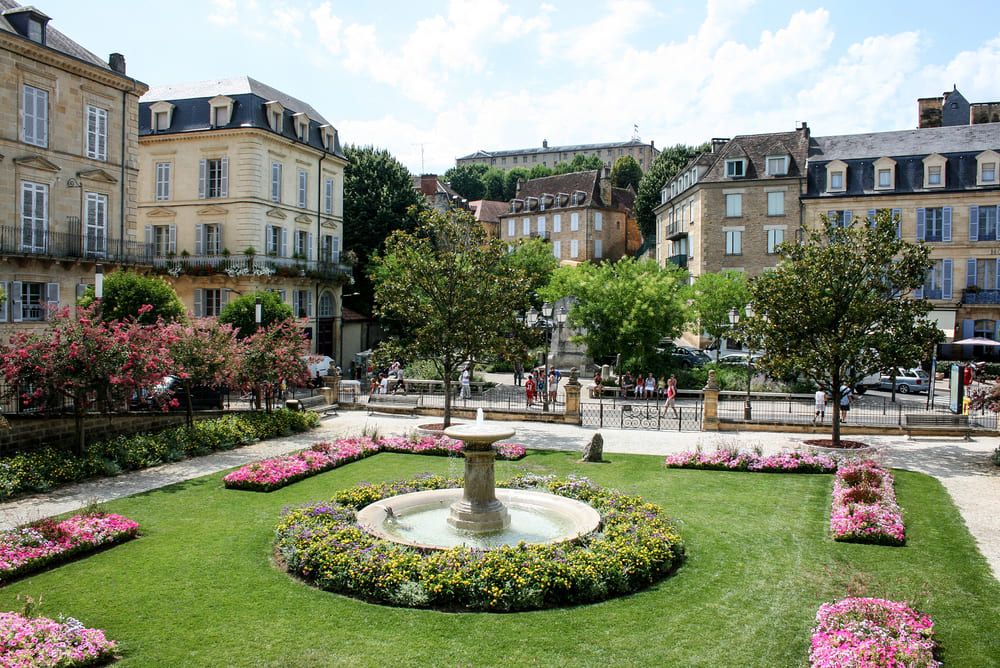
You’re now standing on Place de la Petite Rigaudie, one of the gateways to Sarlat’s historic centre. Just a short stroll from the medieval lanes lined with honey-coloured stone houses, this square offers a striking contrast — it belongs to the 19th century, a world apart from the town’s ancient heart. Designed after 1837, it was part of a major urban project to modernise Sarlat, improve sanitation, and protect the town from flooding by the Cuze River. So here, it’s not the Middle Ages that speak to us, but a more recent chapter of the town’s story. The square’s most eye-catching feature is the War Memorial, built in 1923. On it, you can read the long list of Sarlat’s sons who died in the First World War — a solemn reminder of how deeply the Great War scarred this region. A little later, in 1946, a second monument was added, dedicated to the Resistance fighters and victims of Nazi brutality. Together, these memorials make this square a powerful place of remembrance, where ceremonies are still held each year on May 8th, July 14th, and the day of the Liberation. But the square has also seen darker days. During the German Occupation, the Hôtel de La Madeleine — the large building overlooking the square — served as the Wehrmacht’s headquarters. In 1942, the Gestapo set up its offices there. Across the Sarlat district, nearly five hundred people fell victim to Nazi persecution — a chilling reminder of those terrible years. Today, Place de la Petite Rigaudie stands as both a gateway to the old town and a space of memory, where modern urban design, the legacy of war, and the pulse of everyday life all come together.
