





RyoCity
Timeless Medieval Beauty
Siena, Italy
RyoCity
Timeless Medieval Beauty
Siena, Italy
3 km
Distance
1h30
Durée
21
Audios
Boucle
Parcours
Shutterstock
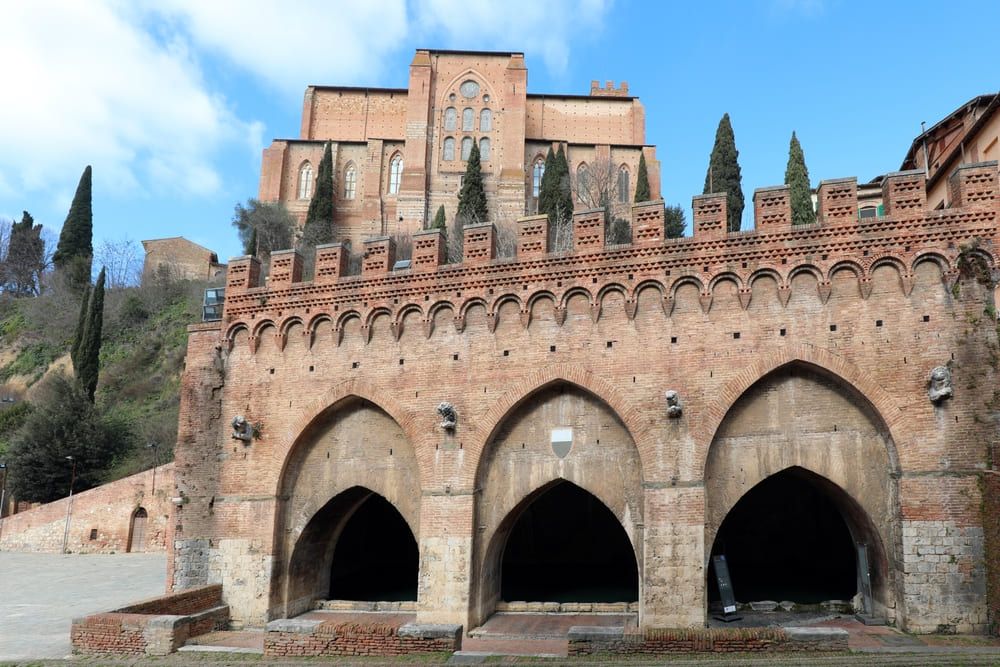
This is Siena’s most famous medieval fountain: Fontebranda. First mentioned in 1081, enlarged in the 12th century, and rebuilt in 1246, it still shows off its Gothic façade with three wide arches crowned by a row of battlements. Yet behind its picturesque charm lies a remarkable feat of hydraulic engineering. The fountain was fed by the Bottini, Siena’s extraordinary underground aqueduct system stretching more than 25 kilometers. Water reached Fontebranda after traveling seven kilometers through vaulted tunnels, then flowed into three separate basins, each with its own purpose: one for drinking, another for animals, and the last for laundry. And nothing went to waste—whatever spilled over went on to serve tanners, dyers, and mills. In this way, Fontebranda became one of the beating hearts of Siena’s thriving textile economy. Its fame was such that Dante mentioned it in the Divine Comedy and Boccaccio in the Decameron. But it also has a more intimate connection to the city’s history. Saint Catherine of Siena grew up nearby and is sometimes called the “saint of Fontebranda.” Her father, a dyer, came here to draw the water he needed for his trade. The fountain is still closely tied to the life of the neighborhood, as it belongs to the Contrada dell’Oca. Some traditions are kept alive here, including a symbolic baptism: new contradaioli, or members of the contrada, are immersed in its waters to mark their belonging to the community. Three arches, three basins, and water that sustained Siena for centuries: Fontebranda, tucked beneath the Basilica of San Domenico, is not just a charming monument but a living reminder of the city’s history, faith, and identity.
