





RyoCity
See Naples and Die
Naples, Italy
RyoCity
See Naples and Die
Naples, Italy
3.8 km
Distance
1h30
Durée
19
Audios
Boucle
Parcours
Shutterstock
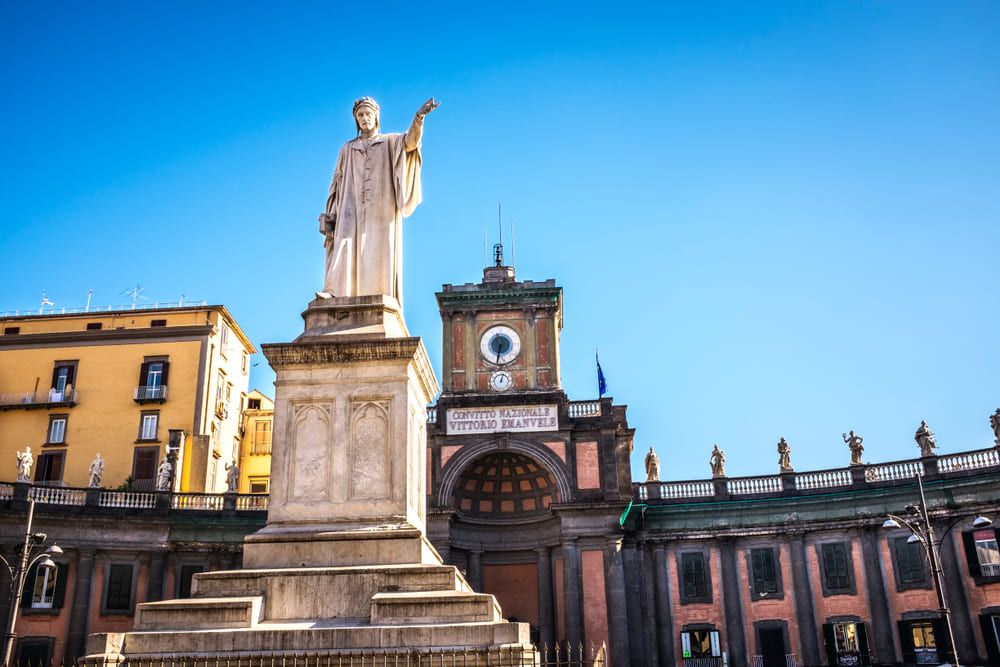
You're now on Dante Square, one of the most important squares in Naples, as you may have already guessed. It was built outside the walls of the historic center during the city’s expansion toward what became the monument district, the new seat of power under the Spanish viceroys. The square started out as a marketplace, known as Mercatello. Then, in 1757, Charles of Bourbon showed up with a desire for a bit of glory. So, he had this grand semi-circular portico built, adorned with 26 statues, each representing one of his many virtues. Good luck finding the one for modesty! In the center stands Dante, after whom the square is named. But that wasn’t the original plan. There was supposed to be an equestrian statue, which never saw the light of day after the Parthenopean Republic cut short the king's wishes. Instead, they built a Arch for Freedom, later replaced by a statue of Napoleon, who in turn was eventually ousted by Dante at the end of the 19th century. And let’s be honest, no one can really outshine Dante. He’s the father of the Italian language, after all, and his Divine Comedy is the most iconic work ever written in Italian and one of the greatest masterpieces of global literature. We often talk about the unification of Italy, but rarely about what that meant for the language. Each region had its own dialect, so how do you pick just one official language? Dante led the way by choosing to write his Divine Comedy in Tuscan instead of Latin. His success inspired others to follow, and Tuscan eventually rose above the rest. No wonder then that the Dante Alighieri Society, whose goal is to promote the Italian language around the world, proudly bears his name. Be sure to take a moment and tip your hat to the man who gave us what many consider the most beautiful language in the world.
