





RyoCity
A humble Arabia
Muscat, Oman
RyoCity
A humble Arabia
Muscat, Oman
10.4 km
Distance
4h00
Durée
29
Audios
Boucle
Parcours
Shutterstock
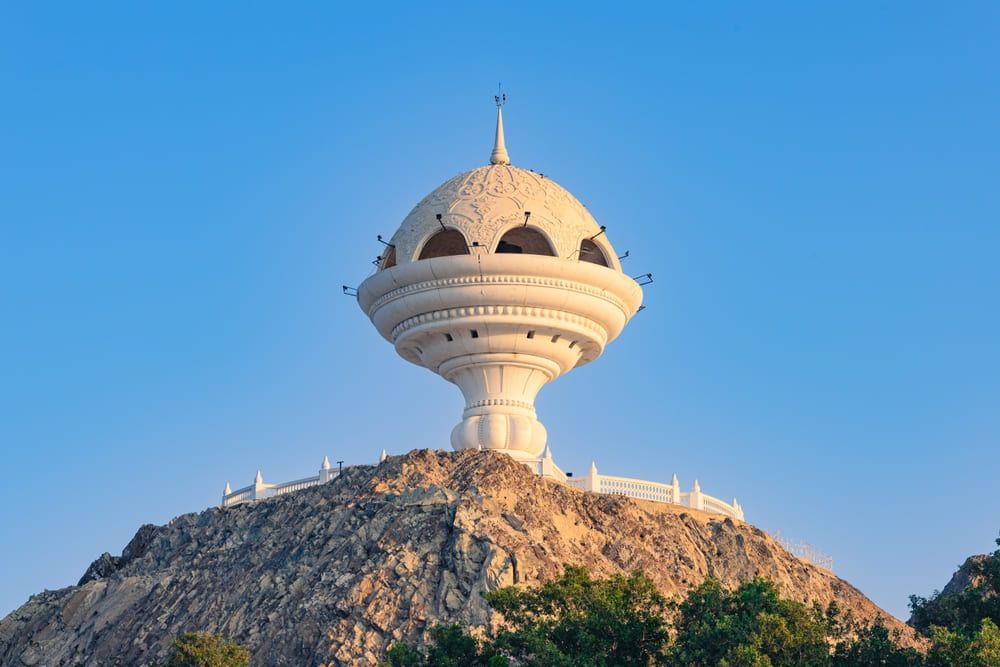
You’re standing at the foot of the Riyam Monument, also known as the Riyam Censer or Incense Burner, or in Arabic, the Mabkhara of Riyam, one of Muscat’s most recognisable landmarks. Even from far away, its silhouette acts as a visual marker between Muscat and Muttrah, like a beacon set into the hillside. The monument was built in 1990 to mark Oman’s 20th National Day, celebrating twenty years of the reign of Sultan Qaboos bin Said and the profound transformation of the country during that period. The architect is not clearly identified in public sources, which is why attention is usually placed on the monument’s striking form rather than its designer. As you approach through the park, you’ll notice that the structure takes the shape of a traditional Omani incense burner, known as a mabkhara, an everyday object closely linked to hospitality, domestic rituals and the art of welcoming guests. Here, that familiar form has been enlarged to a monumental scale, reminding us that incense, or luban, is one of the strongest symbols of Omani heritage, long connected to trade routes and the country’s influence across the region. Oman, and especially the Dhofar region, is famous for producing Boswellia sacra, a highly prized resin often described as one of the finest types of frankincense. Popular accounts sometimes call it “white gold” and highlight its role in ancient exchanges linking Arabia, Africa, India and the Mediterranean, even if the exact scale of that trade varies depending on sources. Many visitors say the monument looks like a UFO or a spaceship perched on the hill, a subjective comparison, but one that captures the strong visual impact of its bold lines and isolated position. The monument once had a more practical role too, as it is said to have housed an observatory with telescopes, but access to the interior has been closed since the 90s, and today it can only be admired from the outside.