




RyoCity
Suspended between Sky and Peaks
Ronda, Spain
RyoCity
Suspended between Sky and Peaks
Ronda, Spain
2.6 km
Distance
1h15
Durée
27
Audios
Boucle
Parcours
Shutterstock
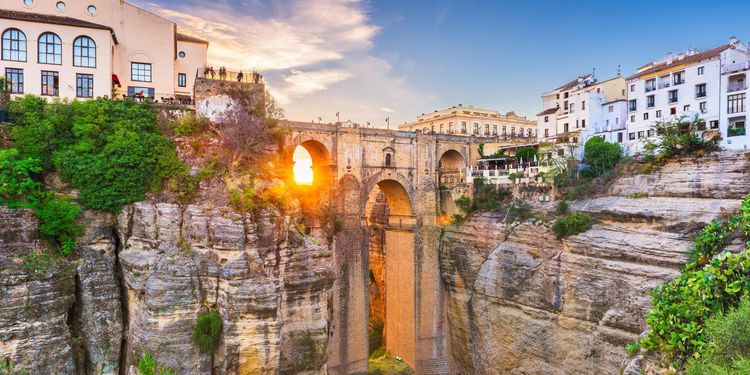
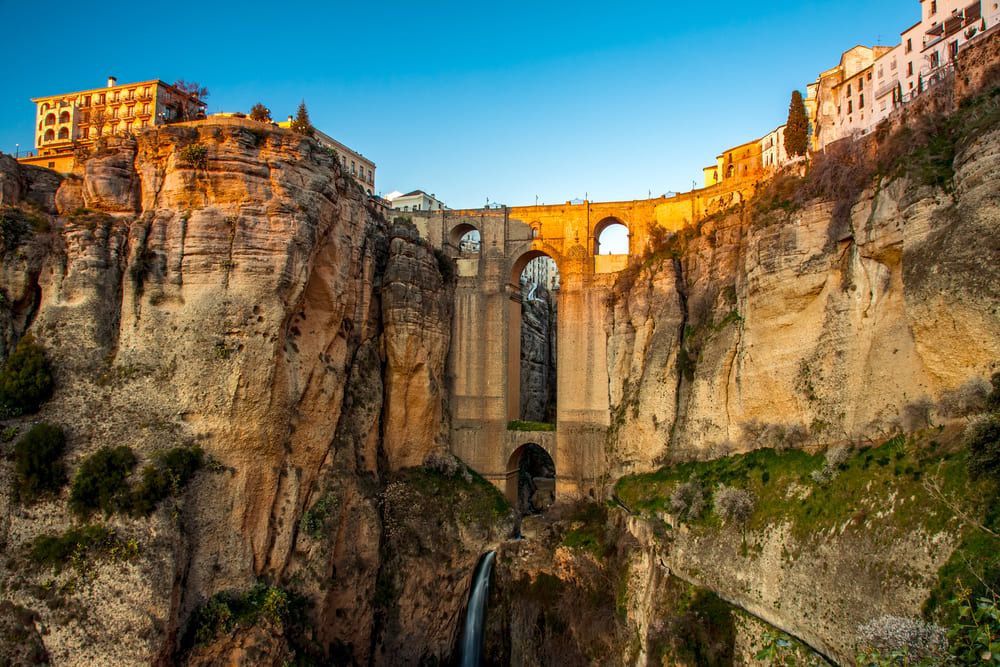
Here, of course, we’re going to talk about Ronda’s famous Puente Nuevo, but to really appreciate it, feel free to turn to your right and walk a little farther toward the viewpoint just ahead. From here, the bridge reveals its full scale: a nearly ninety-eight-metre-high structure linking the old Moorish town to the newer part of Ronda above the El Tajo gorge carved by the Guadalevín River. Its construction, begun in 1759 and completed in 1793, took thirty-four years and followed the tragic collapse of an earlier bridge in 1741 that cost fifty lives. The present bridge, built from massive stone blocks, rises in three tiers of arches and rests on foundations anchored directly into the canyon walls, a technical achievement made possible by an ingenious lifting system created by Ronda-born chief engineer Juan Antonio Díaz Machuca. Above the central arch is a chamber of about sixty square metres that served at different times as a prison for bandits and later as a holding cell for political prisoners during the Civil War, before becoming an interpretation centre dedicated to the bridge’s history. Looking at this spectacular structure today, you can sense both its practical purpose—uniting the city—and the weight of its past, shaped by remarkable human skill as well as the tragedies woven into its story.
