





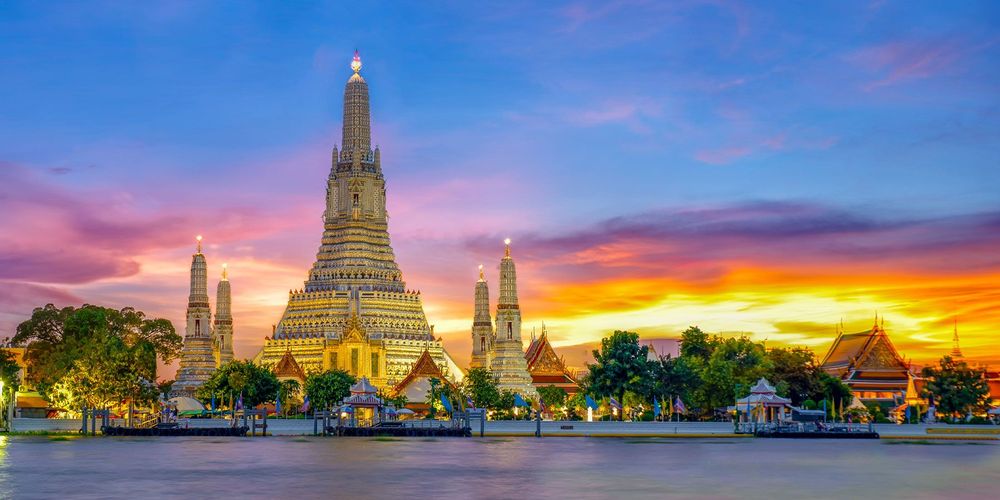
Walk
City of Angels
Bangkok, Thailand
Walk
City of Angels
Bangkok, Thailand
6.6 km
Distance
2h40
Durée
23
Audios
Loop
Parcours
An explanatory and respectful stop on the Bangkok audio-guided tour, this pause reveals the secrets of temple architecture. With nearly four hundred Buddhist temples, the city offers an exceptional religious heritage, most of which follow a common plan.
A wat, the Thai word for temple, generally consists of three main buildings. The sala is an open pavilion where monks and faithful gather for daily activities. The vihara is the great assembly hall, where one prays and listens to teachings. The bot, or ubosot, is the ordination hall, the most sacred space, marked out by eight sacred stones called sema.
Around them gravitate other buildings: the ho trai, library of Buddhist texts, the chedi, a stupa holding relics, or the prang, a tall Khmer-inspired tower recalling the Hindu roots of the kingdom. Temples are sometimes ringed by cloisters housing rows of Buddhas, or dotted with gardens where the Bodhi fig tree grows. Keep these markers in mind to better appreciate each sanctuary.
This stop is an explanatory pause on the route, to be experienced in front of the temples of the Phra Nakhon district. When visiting wats, appropriate dress covering shoulders and knees and respect for silence are required.
The sala, an open pavilion; the vihara, an assembly hall; and the bot or ubosot, the sacred ordination hall.
A stupa, a building holding relics, common within the grounds of Thai temples.
Aucun avis pour le moment
