




Walk
From Pacific Royalty to the Aloha Spirit
Honolulu, United States
Walk
From Pacific Royalty to the Aloha Spirit
Honolulu, United States
Distance
4.8 kmDurée
2h00Audios
25Parcours
Loop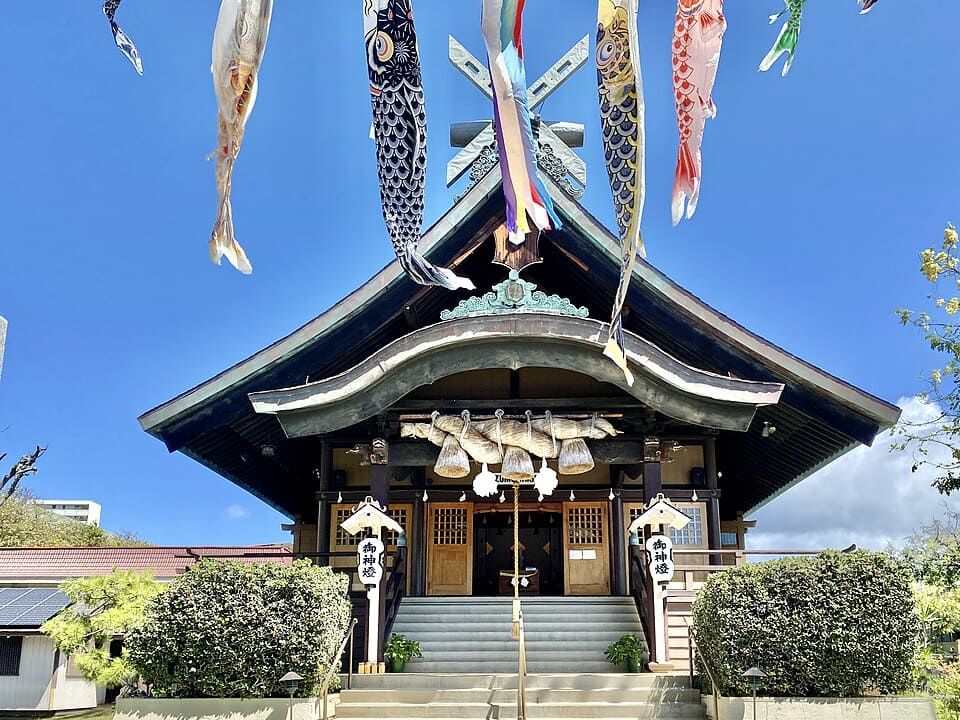
©w_lemay, CC BY-SA 2.0. <https://creativecommons.org/licenses/by-sa/2.0/deed.fr>via Wikipedia Commons
You're standing in front of Lum Sai Ho Tong, one of Chinatown's best-kept secrets. Most tourists walk right past it, unaware that this building has played an important role in the neighborhood's history for well over a century. Founded in 1889, Lum Sai Ho Tong wasn't simply a place of worship. It was also a mutual aid society, established by Chinese immigrants to support one another as they built new lives in Hawaii. At a time when many workers were leaving the harsh conditions of the sugarcane plantations to settle in the city, this institution provided a vital support network. People came here to find housing, get financial help when illness struck, or simply collect letters sent from back home. And here's an interesting detail: the original wooden building miraculously survived Chinatown's devastating fire of 1900, simply because it stood right on the edge of the evacuated area! That building was eventually replaced by the one you see today, which dates from the 1950s. But Lum Sai Ho Tong also has another remarkable distinction, one that was well ahead of its time. In 1931, it became the first Chinese society in Hawaii to grant women exactly the same membership rights, privileges, and responsibilities as men. A small social revolution within a deeply traditional community. To discover the temple's spiritual side, you'll need to head up to the second floor. There, you'll find yourself surrounded by vivid reds and golds, intricately carved dragons, and the unmistakable scent of burning incense. The sanctuary is dedicated to Tin Hau, also known as Mazu, the Queen of Heaven and goddess of the sea. According to legend, she was once a courageous young woman from Guangdong, renowned for rescuing sailors caught in terrible storms. After her death, she became the patron saint of seafarers. For Chinese immigrants who had made the dangerous journey across the Pacific, burning incense before her golden statue was a way of thanking her for protecting their families during the crossing. And this tradition is still very much alive. During Lunar New Year, hundreds of worshippers climb these stairs to pray to Tin Hau, as well as the Dragon Queen, who controls the weather, and other deities associated with prosperity and good health. If you decide to go inside, you'll receive a warm welcome and may even have the chance to light a stick of incense or have your fortune read.
Aucun avis pour le moment
