



Walk
From Gold Rush to Coffee Culture
Seattle, Estados Unidos
Walk
From Gold Rush to Coffee Culture
Seattle, Estados Unidos
Distance
4.9 kmDurée
2h20Audios
22Parcours
Loop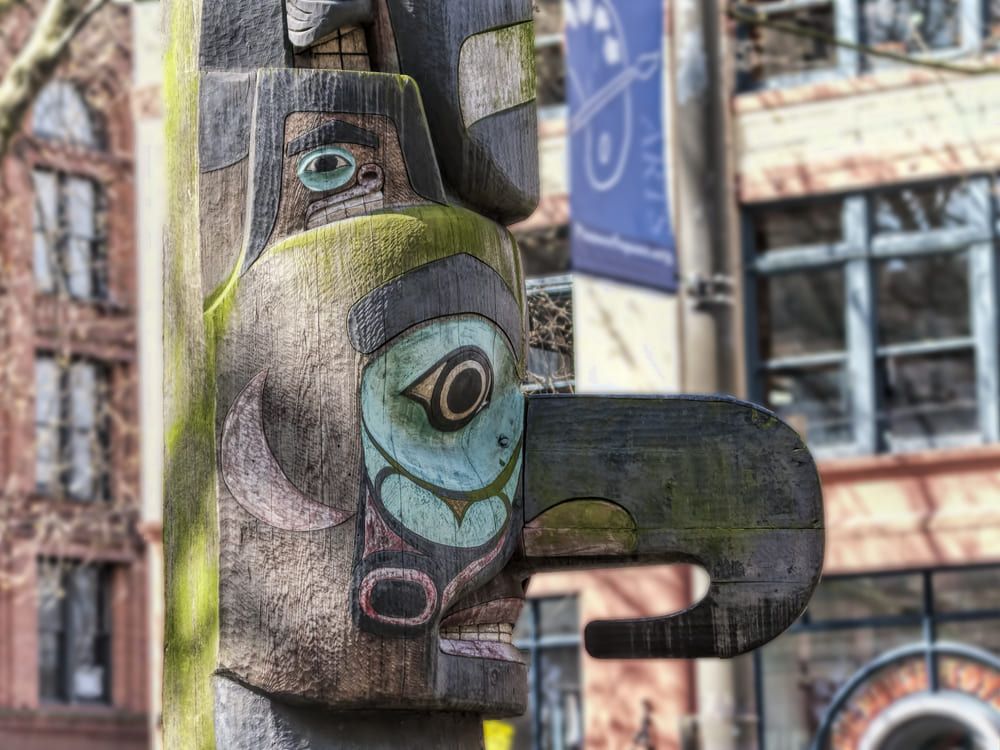
Shutterstock
Find yourself a bench in Pioneer Square, because we're about to travel through centuries of history, ambitious dreams, and a few rather questionable business dealings! This little square might not look like much at first, but it holds some of the most important chapters in Seattle's story. Long before the first European-American settlers arrived, this land was home to the Coast Salish peoples, particularly the Duwamish. As colonization gradually forced them from their ancestral lands, they continued to return by canoe to trade. In 1855, Indigenous leaders signed the Treaty of Point Elliott, giving up vast territories while securing promises that their traditional fishing rights would be protected. One of the leading figures in those negotiations was Chief Si'ahl, whose name was eventually anglicized to Seattle. And you can see him right here! Look toward the center of the square, where his bronze bust stands as a tribute to the man who gave the city its name. With ties to both the Duwamish and Suquamish peoples, Chief Si'ahl became known for his efforts to maintain peaceful relations with the newcomers. In 1909, sculptor James Wehn honored him with this portrait, using the only known photograph of the chief, taken in 1865, as his reference. And here's a detail you might not expect: the structure beneath the bust was originally a three-tiered drinking fountain, designed to provide water for people, horses, and dogs. Everyone was catered for, even the four-legged visitors! Now, look up at the towering totem pole, standing some 60 feet (18 meters) tall. Its story is considerably less heartwarming. In October 1899, Seattle proudly unveiled the pole in a grand public ceremony. There was just one rather awkward detail: it had been stolen! A few weeks earlier, a group of Seattle businessmen on a sightseeing cruise in Alaska had taken the pole from a Tlingit village. And this wasn't simply a decorative object. The original pole was a memorial honoring a Tlingit woman known as Chief-of-all-Women, who had died in 1870. It held a special meaning for her community, making its theft all the more troubling. When the Tlingit demanded its return and $20,000 in damages, the dispute eventually ended with a settlement of just $500, paid by a Seattle newspaper. The pole remained in the city. There's another interesting twist to this story. The Coast Salish peoples native to the Seattle area didn't traditionally carve these towering totem poles. This particular art form came from Indigenous communities farther north, including the Tlingit of Alaska. So, while the pole has become a familiar symbol of Pioneer Square, it also carries the uncomfortable memory of a stolen piece of cultural heritage. And the one you're looking at today isn't even the original! After an arsonist badly damaged the first pole in 1938, Tlingit carvers, including descendants of its original makers, created a replica that was installed in 1940. From the history of Seattle's first inhabitants to the questionable exploits of its early businessmen, Pioneer Square has quite a few stories to tell. And not all of them are ones the city can be proud of.
Aucun avis pour le moment
