



Walk
From Pacific Royalty to the Aloha Spirit
Honolulu, United States
Walk
From Pacific Royalty to the Aloha Spirit
Honolulu, United States
Distance
4.8 kmDurée
2h00Audios
25Parcours
Loop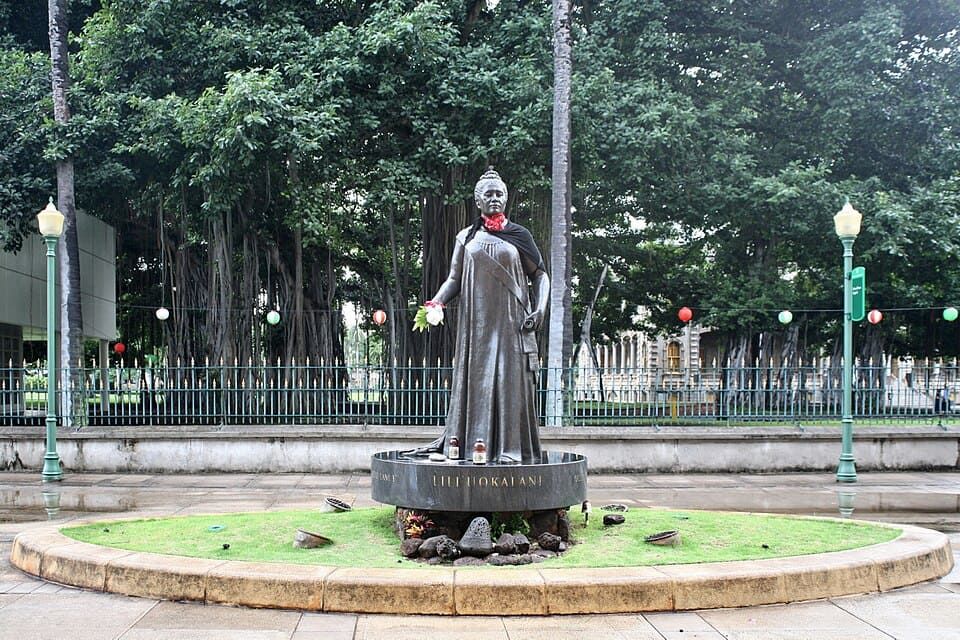
©Cliff from Arlington, Virginia, USA, CC BY 2.0 <https://creativecommons.org/licenses/by/2.0/deed.fr>via Wikipedia Commons
The statue in front of you tells the story of one of the most important turning points in Hawaiian history. It honors Queen Liliʻuokalani, Hawaii's last reigning monarch, whose struggle to defend her kingdom is still remembered today. And the statue itself has quite an unusual history. Although it was unveiled in 1982, the bronze sculpture spent more than a year sitting in its shipping crate before it was finally put in place. Even in the late 20th century, the queen's story was powerful enough to bring old tensions back to the surface. To understand why, we need to go back to January 1893. That year, a group of wealthy sugar merchants and foreign businessmen, with the backing of American military forces behind the scenes, organized a coup to overthrow the Hawaiian monarchy. Faced with the possibility of bloodshed, Liliʻuokalani made the painful decision to temporarily surrender her authority rather than put her people in danger. She hoped that the situation could still be reversed, but what she intended as a temporary measure ultimately marked the end of royal rule in Hawaii. Now take a closer look at the statue, particularly at what the queen is holding. Instead of the crown or scepter you might expect, she carries three partially unrolled documents, each representing a different part of her struggle to protect her people's rights, history, and culture. The first is her proposed Constitution of 1893, which she hoped would restore political power to Native Hawaiians. The second is the Kumulipo, the great sacred Polynesian chant that tells the story of creation. And the third is Aloha ʻOe, her famous farewell song. You see, Liliʻuokalani wasn't only a queen. She was also a gifted musician and poet, and when she could no longer defend her kingdom through political power, she continued her resistance through words, music, and the preservation of Hawaiian culture. That determination is captured in a word closely associated with her: ʻOnipaʻa. It's a Hawaiian expression meaning "to remain firm and steadfast," even in the face of a storm. And for many Hawaiians, it continues to represent the quiet strength of their people. The queen's legacy is still very much alive, as a remarkable discovery recently reminded the islands. During the coup of 1893, insurgents seized Liliʻuokalani's personal royal standard, which then disappeared for 130 years. In 2023, the long-lost flag was finally returned to Hawaii after being rediscovered on the American mainland, stirring deep emotion across the islands. And you don't have to look far to see how much the queen still means to the people of Hawaii. Notice the statue's hands and the base beneath her feet. They're often decorated with fresh flower leis and ceremonial offerings left by local residents. It's a touching reminder that, more than a century after the fall of the monarchy, Liliʻuokalani still holds a special place in the hearts of the Hawaiian people.
Aucun avis pour le moment
