© Shutterstock
 Votre guide Ryo
Activities in Amiens and Surroundings: The Complete 2026 Guide
Activities in Amiens and surroundings hold a surprise: those who stop one night to "see the cathedral" often leave two days later. The capital of the Somme is like that: you think you're visiting a stopover town, only to discover centuries-old navigable floating gardens, a regional museum that rivals the great Parisian institutions, and medieval streets along canals that most guides dismiss in two lines. Forty-five kilometres to the west, the Baie de Somme adds a colony of seals, hundreds of thousands of migratory birds in autumn, and an estuary ranked among the richest in Europe.
The surroundings complete the picture with striking contrasts: the catacombs of Naours carved into the chalk over several centuries, the Great War memorials dotting the fields for dozens of kilometres, the flower-filled village of Gerberoy and its rose-lined lanes every summer. To plan your activities in Amiens and surroundings, note that Ryo offers an audio-guided tour of Amiens covering 27 sites over 7.4 km, with 3h15 of audio content on the city's history. Find the Ryo audio-guided tour of Amiens to begin your exploration before you even arrive.
Notre-Dame Cathedral: The Monument That Redefines "Grand"
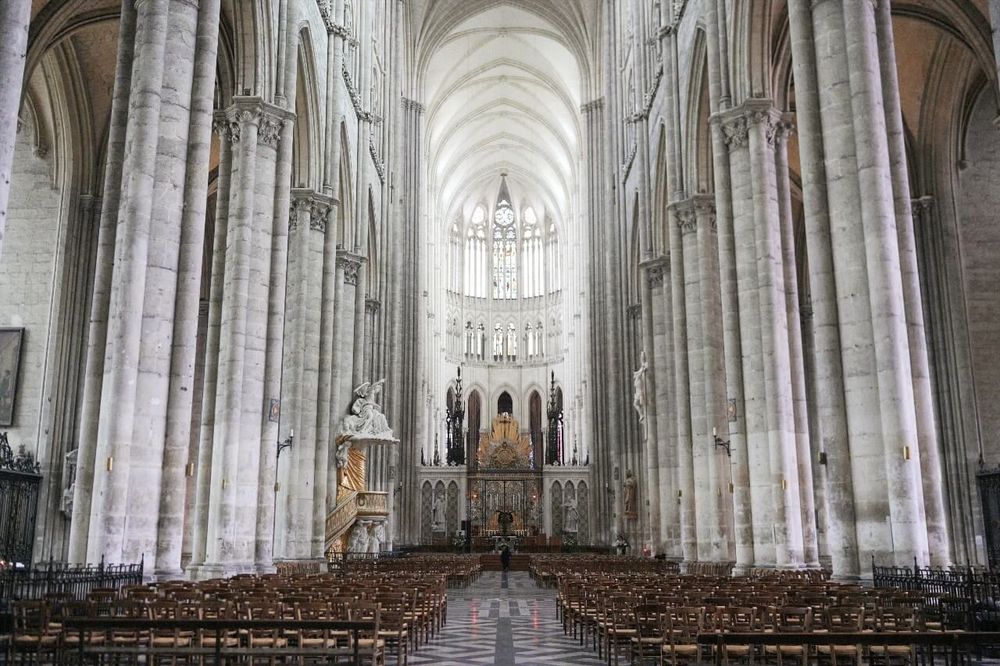
The superlatives speak for themselves. The Notre-Dame Cathedral of Amiens (Place Notre-Dame, 80000 Amiens, rated 4.8/5 on Google with 17,397 reviews) is the largest Gothic cathedral in France by interior volume: 200,000 m³, roughly twice that of Notre-Dame de Paris. It has been a UNESCO World Heritage Site since 1981, and its western facade, covered with more than 3,000 sculptures, is considered one of the most complete iconographic ensembles of the European Middle Ages.
Construction began in 1220 under Bishop Évrard de Fouilloy. The bulk of the building was completed in under 70 years, an exceptional pace for the time that accounts for the stylistic homogeneity of the structure. The central nave rises to 42.3 metres, making it the tallest Gothic nave in France. Inside, the labyrinth inlaid in the floor, dating from 1288, is one of the best-preserved from the entire medieval period.
The facade deserves a slow look. The portals are arranged like a stone comic strip: each archivolt, each tympanum, each plinth tells a biblical episode or a scene from the lives of the saints. The central portal is dedicated to the Last Judgement; those on the sides to the Virgin and to Saint Firmin, the first bishop of Amiens. The "Beau Dieu", the Christ in Majesty sculpted on the central trumeau, is one of the most studied works of medieval sculpture in Europe.
Inside, the choir stalls are a marvel of late Gothic woodcarving: 110 oak stalls, carved between 1508 and 1519, depict more than 4,000 figures in scenes drawn from both Testaments. The natural light filtering through the 13th-century stained glass changes dramatically depending on the time of day. Visiting the cathedral in the late afternoon, when the sun grazes the south transept windows, is a completely different experience from a morning visit.
In the evening, a sound and light show recreates the original colours on the facade. The sculptures, now grey, were painted in red, ochre, and blue during the Middle Ages. The light show lasts about 15 minutes and repeats every half hour from nightfall. Free admission.
Free entry to the cathedral. The in-house audio guide is available in several languages at the ticket desk. Allow at least 1h30 for a thorough visit, more if you stay for the sound and light show.
The Hortillonnages: Amiens from the Water
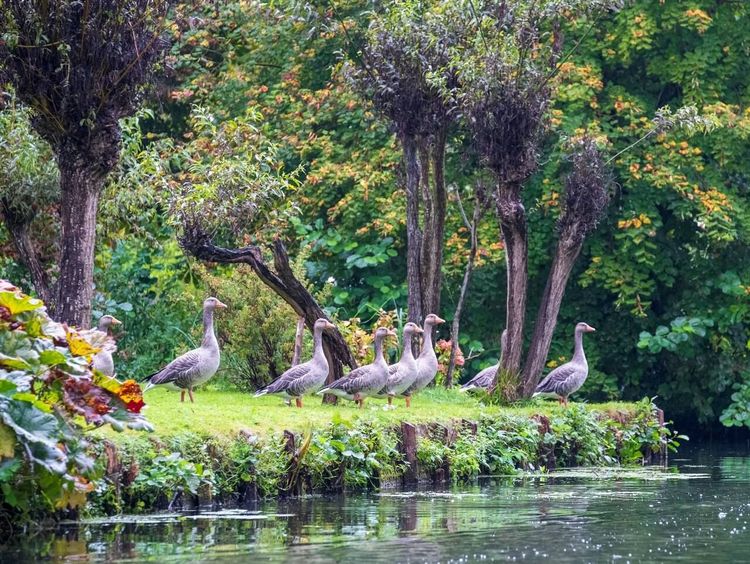
Fifteen minutes on foot from the cathedral, the hortillonnages form a network of 300 hectares of floating market gardens criss-crossed by more than 65 km of canals. This landscape has existed since the Middle Ages: market gardeners grew vegetables and flowers here for the city's markets, travelling by flat-bottomed boats known as "cornets". Today, a few professional growers remain; many plots have become private gardens or quiet natural spaces right in the heart of the city.
A trip by electric boat from the chemin de Halage is the easiest way to discover the site. Guided tours last between 45 minutes and one hour; guides recount the history of the market gardeners, the local wildlife — mallards, grey herons, and sometimes kingfishers skimming the surface — and the botanical features of the gardens along the way. Outside peak periods, boats can be hired independently to explore at your own pace.
The floating market of the hortillonnages is held each summer at the beginning of September: growers arrive by cornet to sell flowers, vegetables, and crafts directly from their boats. It is one of the most distinctive sights in Picardy, and one of the few surviving nautical market-gardening traditions in France.
The seasons change the feel of the site entirely. In spring, the banks are covered in blackthorn and hawthorn blossom. In autumn, the reflections of the poplars in the canals turn the gravel paths into almost surreal settings. In winter, the site is largely empty and silent — another way to appreciate it for those seeking solitude rather than activity.
Practical tip: in July and August, guided boats are often fully booked by 11am at weekends. Book the day before or arrive before 10am.
The Saint-Leu District and Its Canals
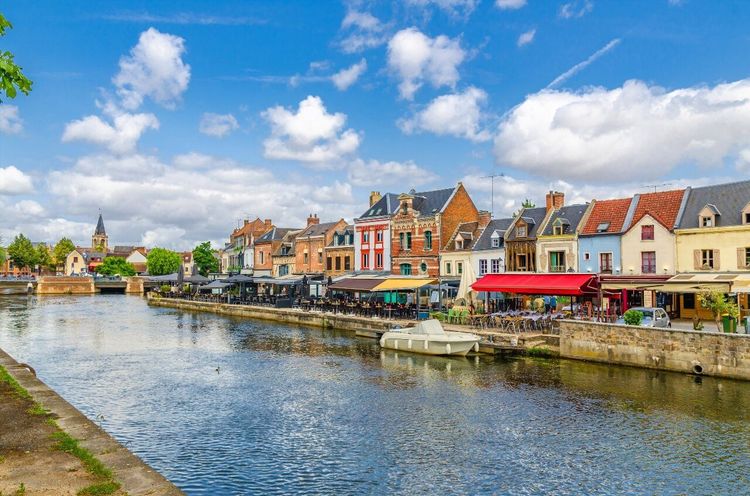
The Saint-Leu district stretches at the foot of the cathedral, on the other side of the branches of the Somme. It was once the neighbourhood of water craftsmen: tanners and dyers whose workshops required direct access to the river. The medieval street plan is still legible — narrow lanes, half-timbered houses, low stone bridges spanning the inner canals.
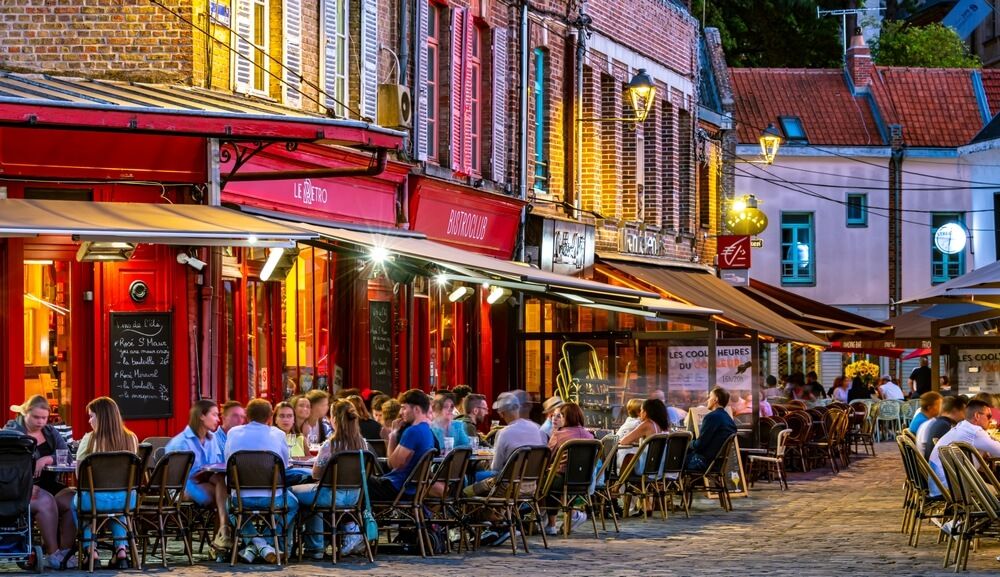
Today, Saint-Leu is Amiens' liveliest district for dining and nightlife. The banks of the Somme have been transformed into terraces since the 1990s, with restaurants installed in former boathouses. The atmosphere is particularly pleasant in the evening, when the cathedral's lights are reflected in the water.
To explore on foot, start from Place du Don and head up towards Rue des Bondes, which runs alongside the canal in a highly photogenic stretch. Art galleries and small independent shops have moved into the old warehouses. Rue Belu is the most famous: its houses look directly onto the canals, red brick facades and half-timbering above the water. Head to Pont du Cange in the late afternoon; the overhead view of the branches of the Somme with the cathedral in the background is one of the most reproduced images of the city. The district takes 1 to 1h30 to visit, and pairs well with the hortillonnages for a full half-day on the water. Our audio-guided tour follows the same thread, from Place du Don into the Saint-Leu canals.
Musée de Picardie and Maison Jules Verne
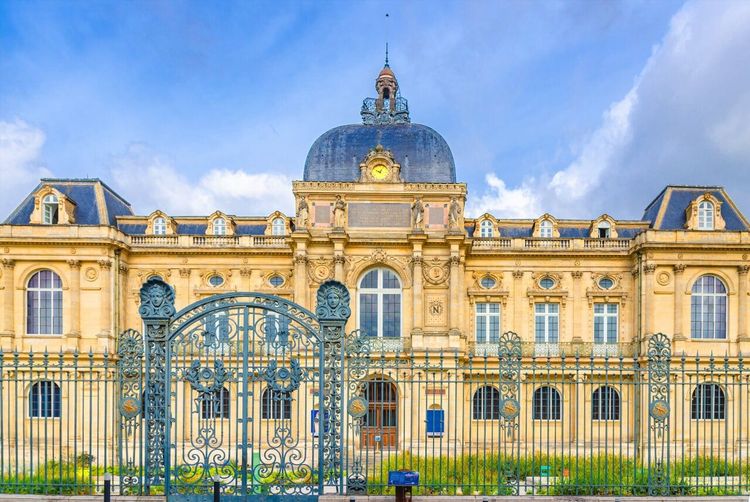
Amiens' cultural life revolves around two very different institutions, ten minutes' walk apart.
The Musée de Picardie is one of the most important regional museums in France. Housed in a Napoleon III building constructed specifically for it between 1855 and 1867, it holds collections ranging from prehistory to contemporary art. The Merovingian archaeological section is particularly rich: the Somme region was intensively occupied in the 5th and 6th centuries, and excavations have yielded fibulae, weapons, and jewellery of great refinement. In painting, the museum holds a collection of Dutch and Flemish Renaissance canvases, several works by Puvis de Chavannes, and a few pieces by El Greco from the Spanish royal collections.
Renovated and reopened in 2020, the building has retained its original ceilings and the enfilade rooms characteristic of 19th-century museum architecture. The overhead natural light in the large painting galleries is a rare asset in a museum of this size. Allow at least an hour and a half for the permanent collections.
The Maison de Jules Verne (2 Rue Charles Dubois, 80000 Amiens, rated 4.5/5 on Google with 4,219 reviews) is a discovery of an entirely different kind. Jules Verne lived in Amiens from 1871 to 1905 — 34 years, the greater part of his writing career. It was in this house on Rue Charles Dubois that he wrote or completed much of his work: "Michel Strogoff", "Robur the Conqueror", "Topsy-Turvy". His study is preserved with its unfolded maritime charts, scientific instruments, and personal library. Verne's political commitment is also documented: he sat on the Amiens city council for fifteen years and was actively involved in the city's civic life.
For shows and events, the Cirque Jules Verne (Amiens' main concert hall) and the Maison de la Culture regularly programme concerts, plays, and temporary exhibitions. Check the events calendar for Amiens before you leave to combine sightseeing with a show. Both the circus and the Musée de Picardie are stops on our audio-guided tour of the city.
Parks and Nature in the City
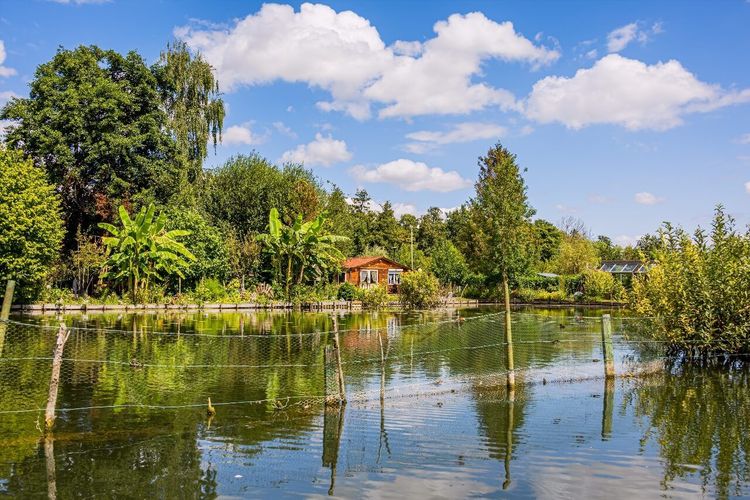
The Somme flows through Amiens in several branches, and the city has developed pedestrian and cycling paths along its banks. The Promenade des Bateliers, north of Saint-Leu, allows you to follow the river for nearly 2 km without traffic, with views over former industrial sites now rehabilitated as green spaces. By bike, the path extends naturally to the first gardens of the hortillonnages.
The Parc Saint-Pierre is Amiens' main urban park. Its 22 hectares feature a lake for pedalo boats and wide lawns shaded by century-old plane trees. A pleasant stop between two museums or after a morning on the canals.
Less well known, the Jardin des Plantes d'Amiens runs along the old ramparts and houses a tropical greenhouse and a rose garden. Free entry. For cycling enthusiasts, Amiens' near-flat terrain makes bike rides accessible to all levels: the cycle path network along the Somme allows you to reach the first valley villages from the city centre in 30 to 45 minutes of pedalling.
Parc de Samara: A Day Between Prehistory and Nature
Just 15 km south of Amiens, the Parc de Samara (Route de Samara, 80310 La Chaussée-Tirancourt, rated 4.3/5 on Google with 2,592 reviews) covers 30 hectares of wooded hills overlooking the Somme and recreates the life of prehistoric populations in the valley. The region is one of the most significant Palaeolithic sites in Europe: flint tools dated to 500,000 years ago were discovered here in the 19th century, placing the Somme valley at the heart of research into human evolution.
The visit follows reconstructed "villages" covering different periods: Lower Palaeolithic, Neolithic, Bronze Age, Iron Age, and Gaulish times. Costumed craftspeople bring each area to life and demonstrate flint knapping, pottery, and weaving techniques. These demonstrations are interactive — visitors can try their hand — making the visit engaging for curious adults as well as children.
A 20-hectare arboretum surrounds the site. From the viewpoint at the top of the hill, the view over the Somme valley and its meanders is one of the finest in the Picardy region. Samara is open from April to November. Allow half a day for the guided visit, a full day if you come as a family with children who want to try everything.
The Baie de Somme: The Essential Nature Excursion
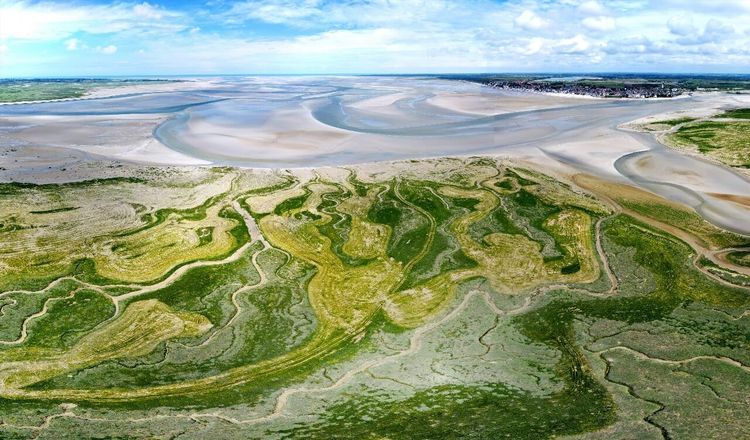
Just 45 km west of Amiens, the Baie de Somme is one of the great natural sites of northern France. The estuary covers 7,000 hectares of salt marshes and mudflats listed under Natura 2000 and the Ramsar Convention for their ecological value. Every autumn, several hundred thousand migratory birds stop here, making the bay one of the most active birdwatching zones in the country.
The harbour seal colony is the main draw for many visitors. Around 200 seals live in the bay year-round; it is common to spot them resting on sandbanks exposed at low tide, particularly near le Hourdel. Zodiac and boat trips are organised from Saint-Valery-sur-Somme and Le Crotoy (Rue Carnot, 80550 Le Crotoy, rated 4.4/5 on Google with 2.8K reviews) by several local naturalist associations.
Saint-Valery-sur-Somme is worth a visit in its own right. This medieval port, whose ramparts are largely intact, holds a place in European history: it was from its quays that William the Conqueror set sail for England in 1066. The upper town, reached from the harbour through the Porte Guillaume, offers a panoramic view over the bay and the marshes at high tide. Allow two hours to wander through the lanes, the collegiate church of Saint-Martin, and the red-brick houses that characterise the port.
Le Crotoy, on the north bank of the bay, is a fishing village with an active harbour. Jules Verne stayed here regularly; Toulouse-Lautrec and Degas also painted its landscapes. Le Crotoy beach, facing due south, is one of the few beaches in northern France exposed to sunlight all day — swimmers appreciate it in summer.
For wildlife enthusiasts, several associations offer guided naturalist outings: wader watching at ebb tide, bird counts in October, discovery of halophytic plants on the salt marshes. These outings generally last 2 to 3 hours and require advance booking.
The Chemin de Fer de la Baie de Somme, a steam train run by an enthusiasts' association since 1887, connects Saint-Valery-sur-Somme to Le Crotoy and Cayeux-sur-Mer. The journey takes between 45 minutes and 1h30 depending on the route. It is a picturesque way to cross the bay while skirting the marshes and tidal flats, particularly popular with families.
From Amiens by car, allow 45 to 55 minutes via the A16 towards Abbeville, then the D940 towards the coast. By train, the Amiens-Abbeville line takes 30 minutes; from Abbeville, buses or taxis serve the coast.
Nearby Villages Worth Exploring
Among the activities in Amiens and surroundings, the countryside villages are the most overlooked: between Amiens, the Oise, and the coastal Picardy, the region holds villages that locals know well and passing visitors often miss entirely. By car, most are reachable in under an hour from the centre of Amiens.
Gerberoy, 55 km to the south-east of Amiens in the Oise, is listed among the "Most Beautiful Villages of France". Its wattle-and-daub and brick houses are, from June to July, literally covered in roses: several hundred varieties were planted in the early 20th century by Henri Le Sidaner, an Impressionist painter who made the village his experimental garden. In season, Gerberoy can be crowded at weekends; opt for a weekday visit or arrive before 10am. The walk through the lanes takes about an hour.
Naours, 15 km north of Amiens, is home to one of Picardy's most singular curiosities: the Grottes de Naours (Route de la Cave, 80260 Naours, rated 4.5/5 on Google with 2,752 reviews), also known as "muches". This underground network of 300 galleries carved into the chalk comprises 2.5 km of tunnels dating from the 9th to the 17th century. Inhabitants took refuge here during invasions, stored provisions, and fitted out chapels and communal rooms. During the First World War, Allied soldiers — notably Australians — carved their names into the walls; nearly 2,000 inscriptions have been recorded. The guided tour, lasting about an hour, is available year-round.
Picquigny, 15 km west of Amiens on the banks of the Somme, gave its name to the 1475 treaty that ended the war between France and England during the reign of Louis XI. Its medieval castle, perched on a limestone cliff above the river, is partly under restoration. The medieval market hall and the church of Saint-Martin are worth a one-hour stop, especially if you then walk along the river.
To explore more of the region's villages in depth, see our selection of the most beautiful villages around Amiens.
In the Footsteps of the Great War
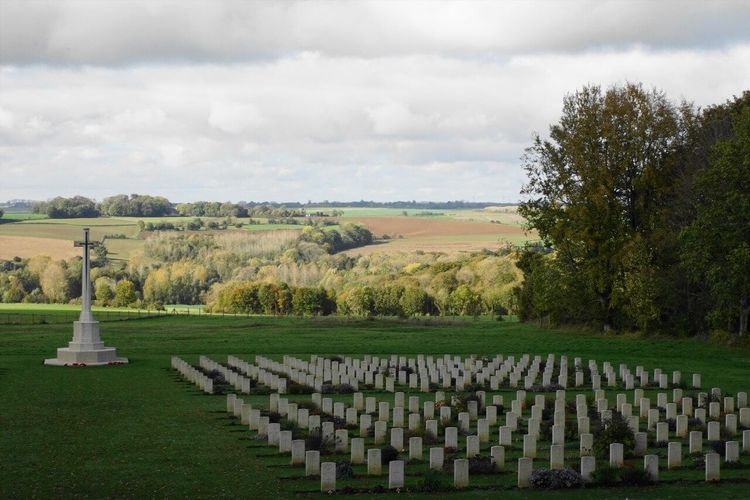
The Somme is one of the departments most marked by the First World War. Between July and November 1916, the Battle of the Somme caused more than one million casualties on both sides, one of the heaviest human tolls of the entire war. The fields to the north and east of Amiens are punctuated by military cemeteries, still-visible craters, and memorials of quiet, powerful solemnity.
The Thiepval Memorial, 35 km north-east of Amiens, is the largest British war memorial abroad. This monumental red-brick arch, designed by Edwin Lutyens and inaugurated in 1932, bears the names of more than 72,000 British and South African soldiers who have no known grave. The adjacent interpretation centre traces the battle through testimonies and period artefacts — start here before visiting the surrounding sites.
A few kilometres away, the Beaumont-Hamel Memorial (D919, 80300 Beaumont-Hamel, rated 4.8/5 on Google with 2,126 reviews) (Newfoundland), managed by the Canadian government, preserves the original trenches in an extraordinarily legible state. The front-line walls are still visible a century later, and vegetation does not grow normally on the former no man's land: the soil suffered so greatly that grass grows only in patches. Volunteer guides in period uniform accompany you around the site free of charge.
The Lochnagar Crater at La Boisselle, created by the explosion of a British mine on 1 July 1916 at 7:28am, originally measured 100 metres in diameter and 30 metres deep (erosion has since reduced it slightly). It is the largest preserved mine crater on the Somme battlefields. Surrounded by trees and an almost total silence outside commemorations, the place produces an effect that is difficult to anticipate. Free entry.
To organise a circuit from Amiens, allow a full day: start at the Thiepval interpretation centre, then move on to Beaumont-Hamel followed by La Boisselle. The Commonwealth War Graves Commission (CWGC) cemeteries, open year-round and free, fit naturally between the main sites for moments of quiet reflection.
Amiens with Children
The hortillonnages work well with children from around 5–6 years old: the boat trip is short, the wildlife captivating (frogs, ducks, dragonflies), and the gardens spark plenty of questions. The Parc de Samara is designed with families in mind: the costumed craftspeople explaining flint knapping or Neolithic pottery-making keep children engaged for several hours.
For a water activity, ZéniPark (Parc du Val, 80440 Glisy, rated 3.9/5 on Google with 1.2K reviews) is a water park 10 km north of Amiens, in Glisy. It offers slides, indoor and outdoor pools, and relaxation areas for adults. Open mainly during the summer season.
The Musée de Picardie regularly organises children's workshops on Wednesdays and during school holidays. These workshops — modelling and creation inspired by the collections — must be booked in advance on the museum's website. The cathedral, with its narrative sculptures at child height and its floor labyrinth, also captures younger visitors' attention if you take the time to tell the stories behind them.
Gastronomy: Picardy Flavours in Amiens
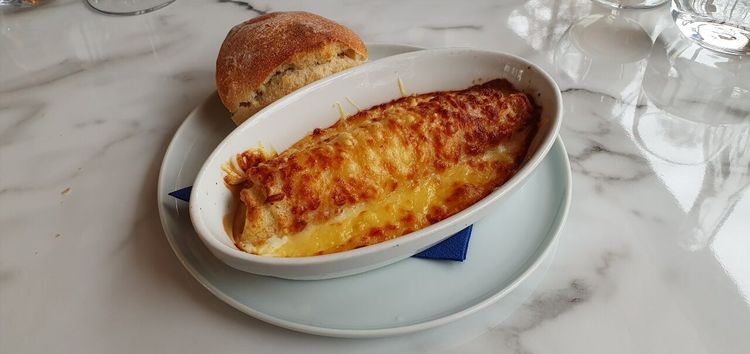
Picardy cuisine is generous, honest, and often underestimated by visitors who don't linger.
The ficelle picarde is the emblem of the region: a wheat crêpe filled with cured ham, mushrooms, and crème fraîche, baked in the oven. Hearty and comforting, it is found in most bistros and brasseries in central Amiens. The macaron d'Amiens is very different from the Parisian macaron: thicker, softer, made with almonds, honey, and sugar, with a recipe dating back to the 16th century. Several Amiens pastry shops offer it in its traditional form.
The Saint-Leu district concentrates most of the best addresses, across all price ranges, with restaurants along the canal banks. For shopping, the Marché de la Hotoie (Saturday morning, Place de la Hotoie) brings together local producers selling directly: aged cheeses and vegetables from the hortillonnages. For a full guide to addresses and recipes, see our culinary specialities of Amiens.
Transport and Practical Information
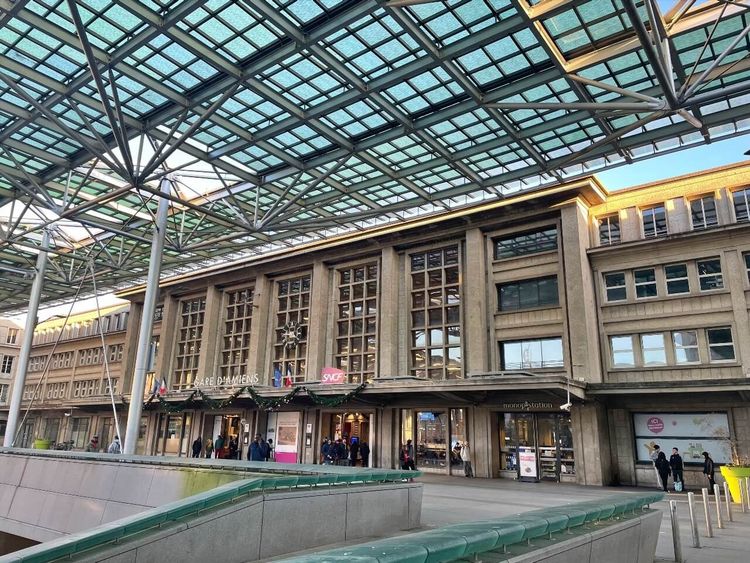
Amiens is well served from major northern cities. Amiens station receives Intercités trains from Paris-Nord in 1h15 (around 12 services per day). From Lille: 1 hour by regional train. From Rouen: 1h30 with one connection.
By car, Amiens is 135 km from Paris (A16, 1h30 outside rush hours), 115 km from Lille, and 160 km from Rouen. Parking in the city centre is metered within the area around the cathedral, with several well-signposted covered car parks.
The urban bus network Ametis covers the centre and outer districts. Single ticket: €1.60. The cathedral, Saint-Leu, and the hortillonnages are all reachable on foot from the station in under 20 minutes. Self-service bikes (Vélam) are available at several stations in the centre.
Where to Stay in Amiens
The hotel offer is concentrated in the city centre, within walking distance of the cathedral. Several 3-star hotels occupy renovated Haussmann-era buildings around Place René Goblet and Rue des Otages, 5 minutes' walk from the cathedral. Price ranges vary, from bed and breakfasts in the centre to chain hotels near the station.
For those who prefer the countryside, guest houses have developed in villages 15–20 km from Amiens, particularly towards Naours and Picquigny. Practical for stays focused on excursions in the surroundings without returning to the city centre each evening.
In high season (July–August) and during the Amiens Christmas market (late November to early January, one of the largest in northern France), establishments fill up several weeks in advance. Book early.
FAQ
What is there to do in Amiens?
Activities in Amiens and surroundings form a rich combination: exceptional religious heritage (the UNESCO-listed Notre-Dame Cathedral, the largest in France), unique natural spaces (the navigable hortillonnages), leading museums (Musée de Picardie, Maison Jules Verne), and a lively historic district along the canals (Saint-Leu). The city is also the ideal base for the Baie de Somme, the Great War memorials, and the villages of the Picardy region.
How long does it take to visit Amiens?
A minimum of 2 days is recommended for the city centre: cathedral (1h30), hortillonnages (2h), Musée de Picardie (1h30), Saint-Leu district (1h). Add 1 to 2 days for excursions: one day for the Baie de Somme, half a day for Naours and Gerberoy, a full day for the Great War sites.
Is Amiens Cathedral bigger than Notre-Dame de Paris?
Yes, in terms of interior volume. The Notre-Dame Cathedral in Amiens measures 200,000 m³, compared to approximately 100,000 m³ for Notre-Dame de Paris. It is the largest Gothic cathedral in France by this measure. Its nave reaches 42.3 metres in height, compared to 33 metres for Paris. The sculpted facade of Amiens is also richer in iconographic detail.
How do you get to the Baie de Somme from Amiens?
By car, allow 45 to 55 minutes via the A16 towards Abbeville, then the D940 towards the coast. By train, the Amiens-Abbeville line takes 30 minutes; from Abbeville, buses or taxis serve Saint-Valery-sur-Somme and Le Crotoy. The Baie de Somme steam train does not serve Amiens directly, but connects Saint-Valery, Le Crotoy, and Cayeux-sur-Mer.
What are the culinary specialities of Amiens?
The ficelle picarde (a ham and crème fraîche crêpe baked in the oven) and the macaron d'Amiens (a soft almond and honey biscuit, very different from the Parisian macaron) are the two specialities to know. The bistros of the Saint-Leu district serve both. The gâteau battu, a very buttery cylindrical brioche, is the dessert or souvenir to take home from the region.
What is the best season to visit Amiens?
Spring (April–June) is ideal: soft light, blooming hortillonnages, and few crowds. Autumn (September–October) is the best time for the Baie de Somme, with bird migration and seals highly visible on the sandbanks. The Amiens Christmas market (late November to early January) brings the illuminated cathedral square magnificently to life. Avoid the 15 August weekends in the Baie de Somme: beaches and car parks are packed.
Are the Somme battlefields worth visiting from Amiens?
Absolutely. The memorials at Thiepval, Beaumont-Hamel, and the La Boisselle crater form one of the most powerful historical circuits in Europe. Almost all sites are free; only the Thiepval interpretation centre charges admission. Allow a full day for the circuit at a relaxed pace, and keep another morning for Amiens itself, where our audio walking tour links the Musée de Picardie to the Saint-Leu district.
Amiens: A City You Can't Sum Up in an Afternoon
Activities in Amiens and surroundings reward those who take the time to look beyond the cathedral. The compact, dense city centre can be explored over two days without a car: the cathedral, hortillonnages, Musée de Picardie, and Saint-Leu form a coherent and highly varied whole. The surroundings require a vehicle or a combination of transport options, but offer experiences with nothing in common with one another — the serenity of the Baie de Somme, the historical density of the battlefields, and the rural gentleness of the Oise villages.
To explore the historic heart at your own pace with audio stories at every major site, the Ryo audio guide to Amiens — our audio-guided tour of the city — covers 28 stops over 6.3 km. A solid foundation before venturing out into the surroundings.