© Shutterstock
 Votre guide Ryo
15 Villages to Visit Around Brest in 2026: the Best of Finistère
Finistère lives up to its name: here, the land ends and something begins. Within an hour and a half of Brest, a series of villages resist the passage of time with a stubbornly Breton determination — half-timbered façades, chapels with calvaries, fishing ports where boats still come in laden. If you are looking for the most beautiful villages around Brest, you are not dealing with a list of frozen postcards, but with living, breathing places that tell fifteen centuries of maritime and rural history. Before setting off to explore the Finistère countryside and coastline, note that the Ryo audio-guided tour of Brest offers 27 audio tracks over 8.2 km to discover the capital of the rade — a great starting point before venturing out into the hinterland.
Some of the villages in this selection will surprise you: Locronan has served as the backdrop for international films without ever betraying its 15th-century authenticity. Huelgoat hides a forest of granite chaos worthy of a Celtic tale, with boulders weighing several hundred tonnes balanced in place since the Ice Age. Le Conquet has fewer than 3,000 inhabitants yet is home to one of the busiest island-departure ports in northern Brittany. And Guerlesquin, 70 km to the east, remains one of the rare market towns in Finistère that still has a standing, visitable 17th-century prison-castle. Enough to fill several weekends without ever repeating yourself.
1. Locronan, Royal City of Craftsmen 35 km from Brest
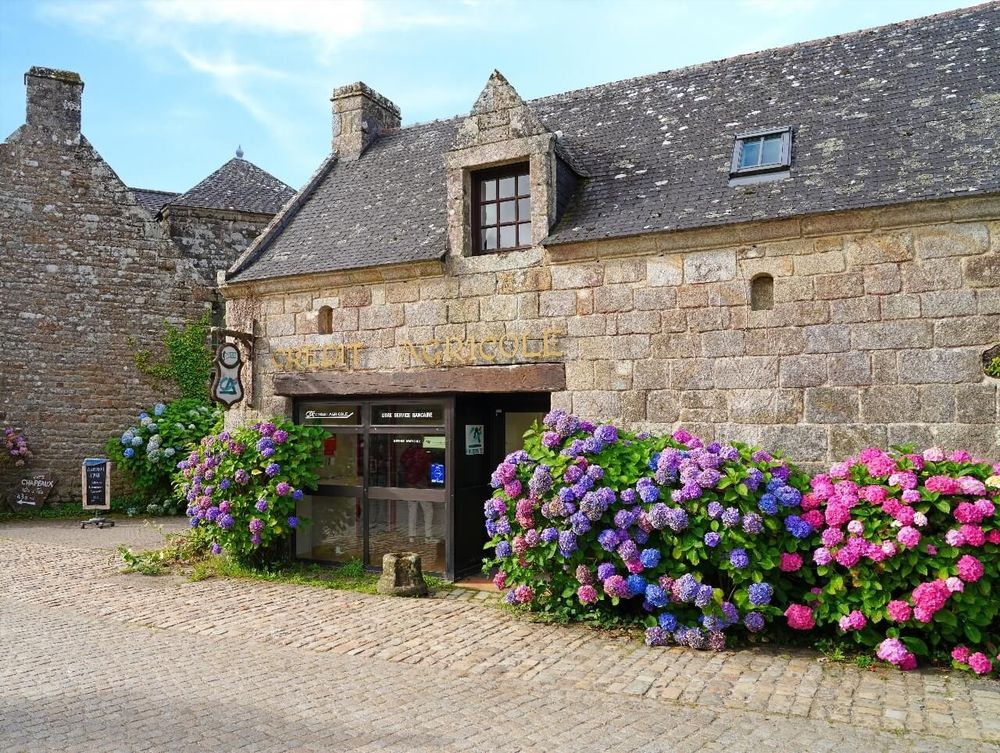
Locronan regularly features in rankings of France's most beautiful villages, and for a simple reason: its historic centre is one of the best-preserved Breton architectural ensembles in Europe. Not a ruin, not a clumsily altered façade — the cobbled main square, the blue-grey granite houses from the 15th and 16th centuries, the church of Saint-Ronan and the Pénity chapel form a tableau that time seems to have spared.
The village owes its past wealth to the manufacture of canvas sails for the royal navy. From the 17th to the 18th century, the workshops of Locronan produced the sails for the ships of Louis XIV and Louis XV. When the navy stopped placing orders, the town froze in its then-current state — which is today the source of its intact charm. Roman Polanski shot Tess here in 1979, and scenes from Philippe de Broca's Chouans! were also filmed here: the square served as a set on two occasions with very little dressing.
The Troménie pardon takes place every six years (the next one in 2028): a 12 km procession around the town draws tens of thousands of pilgrims and curious onlookers. But even outside the pardon, a stroll through the lanes is well worth the trip. Allow 2 hours to explore the church, the craftsmen's house and the still-active pottery workshops. On weekdays in July and August, arrive before 10 am or after 5 pm to avoid the tourist coaches — the square turns into a human car park between those hours.
Just a short distance away, the chapel of Notre-Dame-de-Bonne-Nouvelle overlooks a wooded valley. Rarely mentioned in mainstream guides, it offers a peaceful vantage point over the granite rooftops and makes a natural second stop after the main square. Hikers will appreciate the trail connecting Locronan to the pointe du Raz via the moorlands of the montagne de Locronan, manageable as a day walk.
2. Daoulas, 2,000 Years of History Between Estuary and Abbey
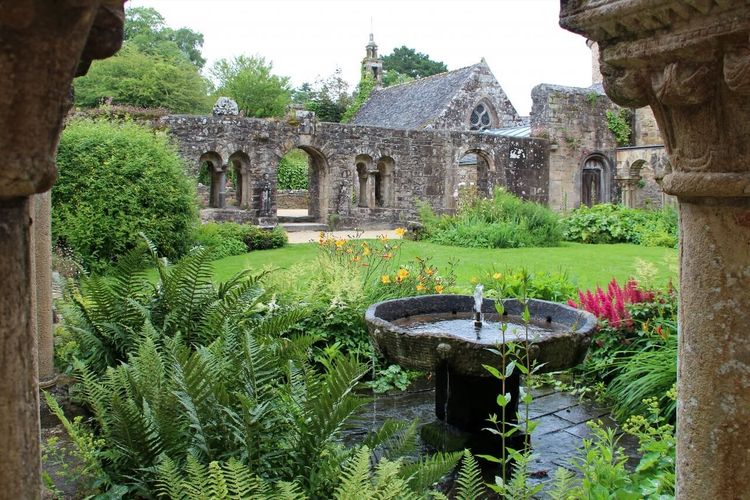
Some 25 km south-east of Brest, Daoulas sits on the banks of the Aulne in a geographical position that explains its history: a natural harbour at the head of the rade, the town was Christianised as early as the 6th century by Irish monks who came to evangelise the Armorican peninsula.
The Daoulas Abbey (5 Rue de l'Église, 29460 Daoulas, rated 4.4/5 on Google from 1,409 reviews) is the unmissable monument. Founded in the 12th century by regular canons, it preserves an exceptional Romanesque cloister — one of the rare examples in Brittany — with its twisted columns and capitals carved with stylised foliage. The medieval fountain in the herb garden, where medicinal plants of old still grow, adds a rare contemplative touch. The site hosts international-level contemporary art exhibitions every summer, giving it a dual identity that balances medieval memory with present-day creation.
The town itself is worth a wander. Several 16th-century corbelled houses survive along the lanes that descend towards the estuary. The Chapelle du Calvaire, on the heights, offers a panoramic view over the rade de Brest on clear days. Allow 1h30 to 2h for the abbey and its gardens, plus half an hour to stroll around the town. Admission to the abbey is charged (around €7 for adults), but the temporary exhibitions more than justify the price.
3. Le Faou, the Medieval Village Reflected in the Aulne
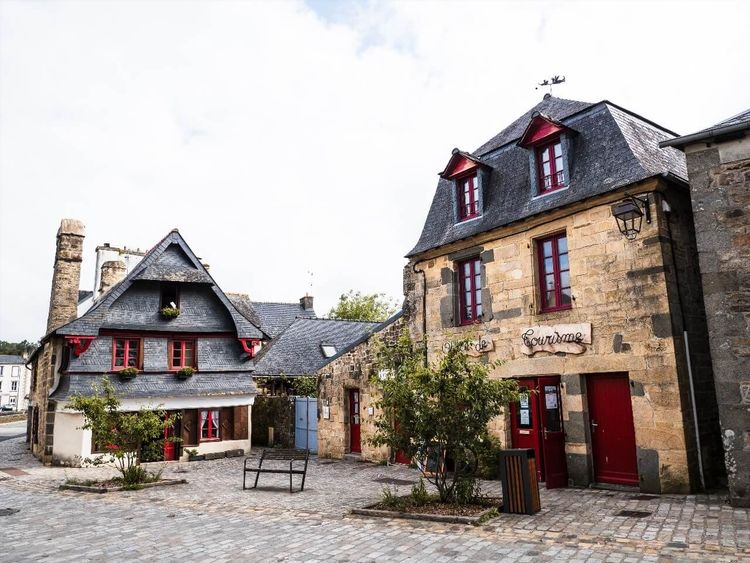
Le Faou is a town of 1,700 inhabitants set at the tip of a tidal inlet that the sea transforms twice a day. When the waters rise, the reflections of the 16th-century corbelled houses pour into the Aulne with a striking photographic clarity. This spectacle — free and repeated at every high tide — earned Le Faou a place among France's most beautiful villages in 2007.
The Rue Principale concentrates most of the heritage: a row of half-timbered and granite houses, some dating from the reign of François I. The 16th-century church of Saint-Sauveur, with its Flamboyant porch and period stained glass, is the architectural highlight of the village. Le Faou is perfectly suited to a ninety-minute stop between Brest and the Crozon peninsula — it sits exactly on that route.
Nature lovers will appreciate the Aulne estuary nature reserve, observable from the riverbanks. In autumn and winter, migratory birds stop there in numbers: grey herons, egrets and cormorants are the usual cast. Plan to arrive at high tide to catch the reflections — check the tide times before you set off.
4. Huelgoat, the Granite Chaos at the Heart of the Monts d'Arrée
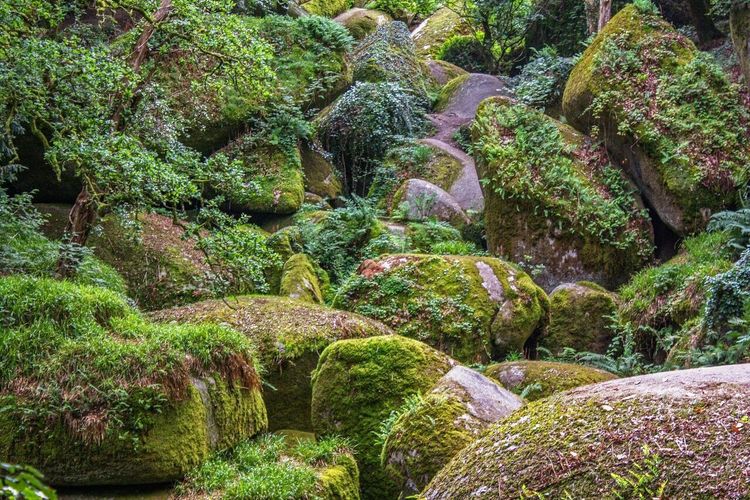
The Breton name means 'the high wood', and the forest of Huelgoat (Route de la Forêt, 29690 Huelgoat, rated 4.8/5 on Google from 5,497 reviews) fully deserves that etymology. Some 60 km from Brest, this village of 1,600 inhabitants gives access to one of Brittany's most spectacular natural sites: a chaos of granite boulders shaped by erosion over hundreds of thousands of years, some weighing several hundred tonnes, some appearing to balance in defiance of all logic.
The most famous rock is the Roche Tremblante: a block weighing several hundred tonnes that, if you push it at exactly the right spot, will gently oscillate. Children love it; adults are left puzzled by the physics. Nearby, the Camp d'Artus, a Gaulish enclosure occupied since the Iron Age, is a reminder that these forests have always been inhabited by peoples who regarded them as sacred.
Arthurian legend has also taken root at Huelgoat: the Rivière d'Argent, which flows through the woods, is associated in local tradition with Merlin the Enchanter. The waymarked forest walk (about 6 km for the full circuit) passes the Gouffre, the Grotte d'Artus and the Mare aux Sangliers. Allow 2h30 to 3h of leisurely walking. The village itself has several crêperies and restaurants around the central lake — a lunch by the water before or after the forest is a must.
Huelgoat is also the gateway to the monts d'Arrée, Brittany's highest point, with Roc'h Trévezel at 384 metres. For lovers of wide open spaces and wind-swept moorlands, a day's extension into the Parc Naturel Régional d'Armorique follows naturally from here.
5. Le Conquet, Facing the Islands at the Edge of the World
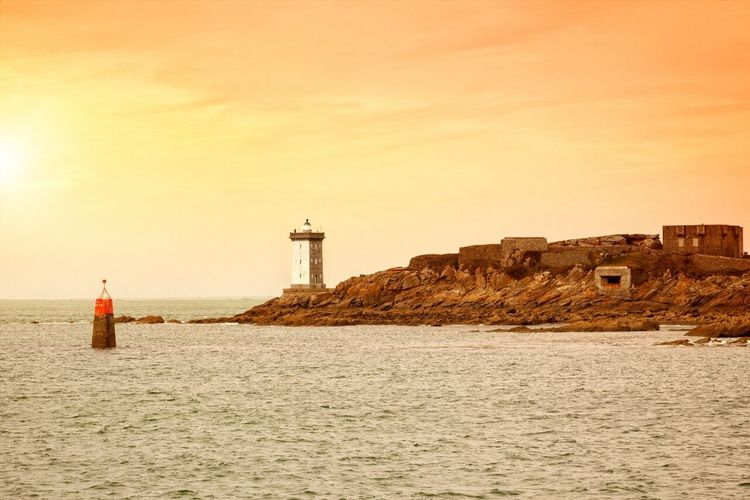
If you can only choose one coastal village around Brest, Le Conquet has strong arguments. Just 24 km to the west, this active fishing port is also the embarkation point for Ouessant and Molène, the two wildest islands in Finistère. But even without taking the boat, the village is worth the journey in its own right.
The harbour, sheltered by a granite jetty, still berths around thirty professional fishing boats. When the lobster pots come in, early in the morning, the scene is authentic and largely unstaged — a rarity in tourist Brittany. The Kerouartz manor house (16th century), visible from the harbour, is one of the finest rural noble residences in the pays de Brest, recognisable by its carved granite dormers.
The beaches of Blancs Sablons and Kermorvan, less than 2 km from the harbour, rank among the finest in northern Finistère: white sand, rocks, views of the lighthouses and, on clear days, the silhouette of Ouessant on the horizon. The pointe de Kermorvan, reachable on foot from the beach, offers a 360° panorama over the mer d'Iroise — the sunsets there are of rare quality. The Ryo audio guide to Brest also covers the immediate surroundings of the rade, and Le Conquet features among the recommended day-trip destinations from the city.
Practical tip: prefer a weekday visit between May and September. The harbour car park fills up quickly at weekends during high season.
6. Camaret-sur-Mer, the Tip of the Crozon Peninsula
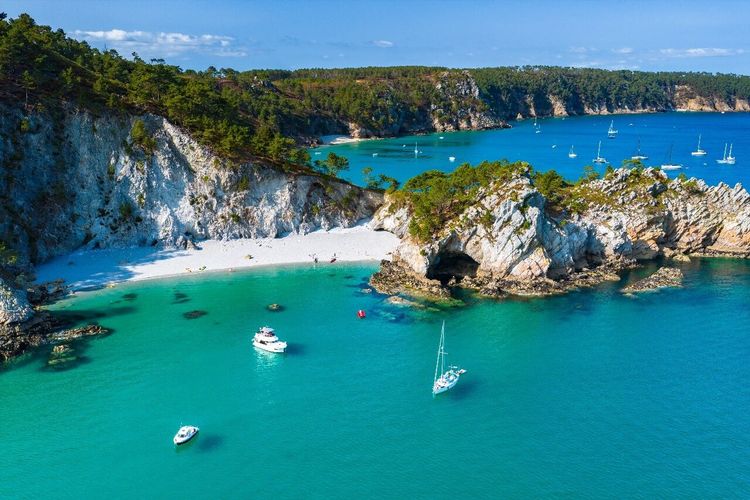
Camaret occupies the tip of the Crozon peninsula in an exceptional geographical position: surrounded by water on three sides, the town enjoys a particular maritime light that attracted numerous painters at the turn of the 20th century. Eugène Boudin, Charles Cottet and Gustave Loiseau are among the artists who stayed and painted here. This pictorial tradition continues today with several active art galleries.
The Sillon de Camaret is the first visual element that commands attention: a natural shingle spit that closes off the bay like a protective arm. At its tip, the Tour Vauban (listed as a UNESCO World Heritage Site in 2008) has stood guard since 1696. Built to defend the rade de Brest, it helped repel the Anglo-Dutch attack of 1694 even before construction was complete — one of the few notable defensive victories of that era. The interior is open to visitors and houses an exhibition on the region's maritime history.
A few metres from the tower, the Camaret boat cemetery is a melancholy and photogenic spectacle: around twenty rusting hulls lean into the mud of the bay, vestiges of the trawlers and sardine boats of the last century. No other site in Finistère brings together maritime industrial memory and wild landscape with such authenticity.
The alignements de Lagatjar, 1.5 km from the centre, bring together nearly 143 menhirs in an open field, erected in the Neolithic era. Less well known than Carnac, they constitute a megalithic site of remarkable silent power, and completely accessible — no queues, no tickets. The Crozon peninsula as a whole deserves a full day, with the pointes de Pen Hir and du Toulinguet as unmissable stops.
7. Locquirec, the Little Saint-Tropez of Northern Finistère
Locquirec is a peninsula within a peninsula: the village occupies a tongue of land jutting into the baie de Lannion, with beaches on both sides. Some 65 km north-east of Brest, this village of 1,500 inhabitants boasts a dozen beaches within a 3 km radius — a record for northern Finistère.
The comparison with Saint-Tropez comes from the wealthy summer clientele who have gathered here since the 1960s, and from the Belle Époque holiday villas that line the harbour. The atmosphere is lively but never brash. The television series L'Instit was partly filmed here in the 1990s, bringing it unexpected national fame. The church of Saint-Jacques, perched at the end of the point with its view over both bays, is worth the few minutes' climb. Outside July and August, Locquirec regains the serenity of an ordinary Breton village — and that may be the best time to enjoy it.
8. Landerneau, the City of the Inhabited Bridge and Contemporary Art
Landerneau is not strictly a village — its 16,000 inhabitants make it the largest town in the rade de Brest after Brest itself. But its historic centre, built around the pont de Rohan, has a village character rare at that scale.
The pont de Rohan dates from the 16th century (rebuilt in 1510) and carries multi-storey houses along its full length: it is one of the rare inhabited bridges still surviving in France, alongside those of Pont-l'Abbé and Narbonne, and one of the oldest in Europe. The view from the banks of the Élorn, with the houses overhanging the water, is one of the most distinctive in Finistère. Since 2014, the town has been home to the FHEL (Fonds Hélène et Édouard Leclerc pour la Culture), a contemporary art space occupying a restored former convent that draws major exhibitions — Francis Bacon, Basquiat, Hergé. Full-price admission is around €5, making it one of the best cultural value-for-money experiences in Brittany. Allow 2 to 3 hours to combine the bridge, the old town and the exhibition.
9. Pont-Croix, the Intact Middle Ages in the Bigouden Country
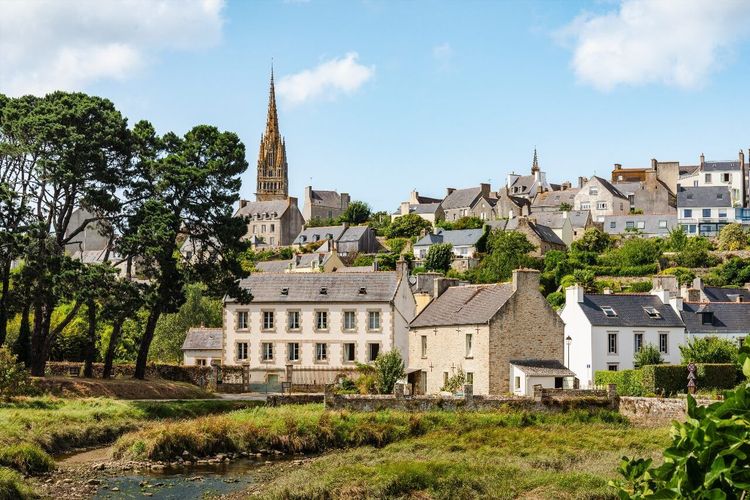
Pont-Croix, 110 km south of Brest, is one of the least visited medieval villages in Finistère despite its considerable assets. Its staircase lanes descend towards the Goyen, a tranquil river that flows into the baie d'Audierne a few kilometres away.
The collégiale Notre-Dame de Roscudon is the centrepiece: a Gothic building whose oldest parts date from the 13th century, and whose porch tower served as the model for the one on Quimper cathedral. The interior contains recumbent effigies and baptismal fonts of exceptional quality for a town of this size. The Grand'Rue, which descends in steps towards the Goyen from the collegiate church, is lined with medieval houses bearing half-timbered façades that have withstood the centuries. Pont-Croix is also midway between the pointe du Raz and the baie des Trépassés, two major natural sites you can link in the same day. If you love the deep, untrodden Brittany, this is where you will find what you are looking for — far from the tourist flows of Locronan or Camaret. To continue exploring the region, the Ryo audio-guided tour of Brest remains an ideal base from which to venture out into these end-of-the-world landscapes.
10. Guerlesquin, the Prison-Castle Watching over the Argoat
In the heart of the Trégor finistérien, 70 km east of Brest, Guerlesquin easily goes unnoticed. This market town of 1,400 inhabitants is neither coastal nor backed by a monumental landmark. Yet it deserves a stop for one precise reason: the Presidial, a 17th-century prison-castle that stands in the centre of the main square.
Built to serve as both courthouse and prison, the Presidial is one of the rare examples of this type of building still standing in Brittany. The square surrounding it, with its granite houses and century-old lime tree, composes a tableau of Ancien Régime rural France of rare coherence. Guerlesquin is also a good base for exploring the monts d'Arrée off the beaten track. Market on Monday mornings — one of the most authentic rural markets in inland Finistère.
11. Île de Batz, the Exotic Garden of the Channel
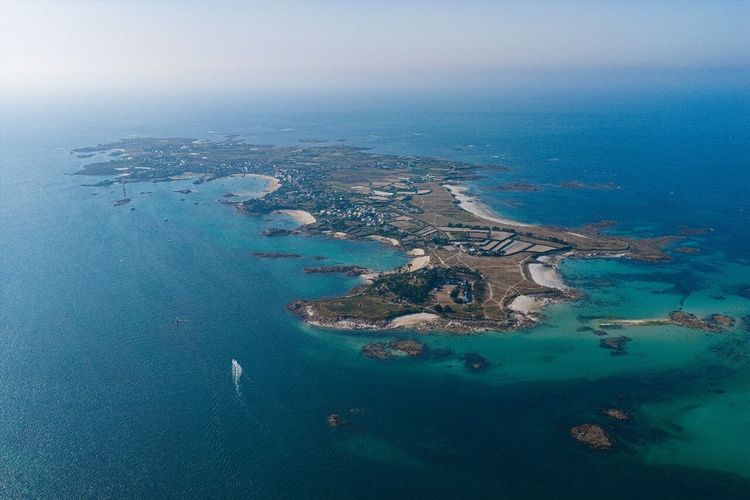
Just 15 minutes by ferry from Roscoff and 1h15 from Brest, the île de Batz is one of the most accessible of the Finistère islands. Some 4 km long and barely 1.5 km wide, it has around 450 permanent residents and no cars — tractors and bicycles make up its entire vehicle fleet.
The Jardin Exotique Georges Delaselle, created at the end of the 19th century, shelters more than 1,500 plant species from around the world, made possible by the island's exceptional microclimate: virtually frost-free, constantly humid, with winds buffered by the lie of the land. Palms and agaves grow alongside plants from South Africa and the South Pacific in a Breton setting that is pleasantly disorienting. The Plage de Grève Blanche, on the north of the island, offers some of the finest sand in Finistère, sheltered from the wind by dunes. A single day is enough to walk around the island — about 12 km — including the lighthouse and the garden.
12. Pont-Aven, in the Footsteps of Gauguin and the Pont-Aven School
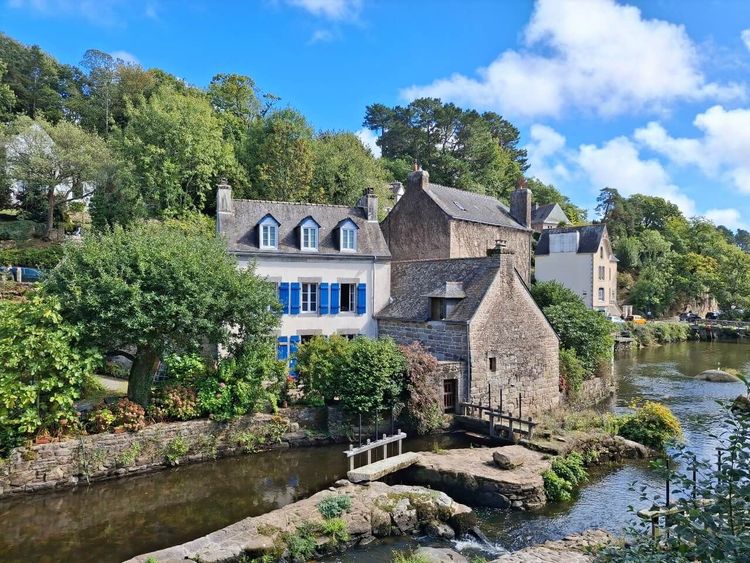
Paul Gauguin first came to Pont-Aven in 1886. He returned in 1888, accompanied by around ten painters who would form what came to be known as the Pont-Aven School — a movement foundational to Synthetism and a precursor of Fauvism. Some 95 km from Brest, this village of 2,900 inhabitants on the banks of the Aven still lives largely under the painter's towering shadow.
The musée de Pont-Aven (Place Julia, 29930 Pont-Aven, rated 4.4/5 on Google from 2,106 reviews) holds a representative collection of the school: Gauguin, Émile Bernard, Paul Sérusier, Henry Moret. Even if Gauguin's major canvases are in Paris and Denmark, the paintings gathered here give a clear sense of the movement's stylistic project — simplification of forms, flat areas of colour, rejection of Impressionist naturalism. Full-price admission is around €8.
Beyond the museum, Pont-Aven is worth visiting for its mills on the Aven — several survive — and for its contemporary art galleries that carry on the pictorial tradition. The promenade des moulins, along the river, takes about 45 minutes and passes the sites depicted by the painters. The famous Breton butter biscuits of Pont-Aven, the Traou Mad, have been industrialised and exported worldwide since 1920, but the village's artisan biscuit makers still offer versions that differ from the commercial one. Not to be confused.
13. Concarneau, the Walled Town on Its Granite Island
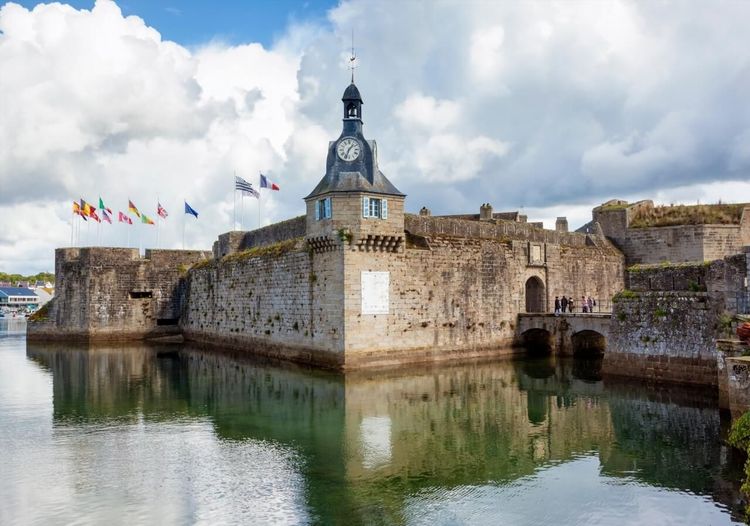
Concarneau is one of France's leading fishing ports by volume of landings. Its 20,000 inhabitants and industrial harbour might seem at odds with the village spirit, but its ville close — a fortified island connected to the mainland by a bridge — changes everything.
The ramparts of the walled town date from the Middle Ages (14th–15th century), even if Vauban remodelled and reinforced them in the 17th. You can walk the parapet walk for several hundred metres, with views on one side over the harbour and on the other over the baie de la Forêt — one of the finest coastal vistas in Finistère. Inside the walls, the lanes are lined with shops, crêperies and the musée de la Pêche, which traces centuries of maritime history with a collection of navigation instruments, models and period nets.
The fishing harbour, visible from the quai Carnot, gives a sense of contemporary maritime activity: the fish auctions at Concarneau are among the most active in Brittany, with regular arrivals of white tuna, langoustines and mackerel. If you are interested in the culinary specialities of Brest, note that the culinary specialities of Brest and the surrounding area owe a great deal to the fish caught along this coastline. The festival des Filets Bleus, held every summer in August since 1905, turns Concarneau into a Breton music stage for a week: it is one of Brittany's oldest festivals.
14. Île de Sein, the Rock of the Free Men
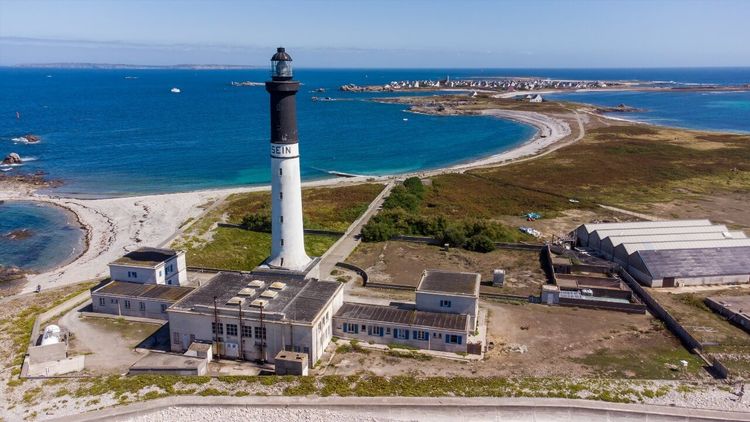
The île de Sein is a challenge to geography: a flat island that barely emerges a few metres above the water, 2 km long, populated by fewer than 200 permanent residents. Some 180 km from Brest by road and then 1 hour by ferry from Audierne, it is not the most accessible destination on this list. But those who make the effort come back transformed.
In June 1940, the 128 men of the island answered General de Gaulle's call and sailed to England in their fishing boats — virtually the entire male population of fighting age. De Gaulle said of them: 'L'île de Sein, c'est le quart de la France.' The memorial on the harbour recalls this episode with quiet dignity. On the island, no cars, no trees (the wind prevents any tall vegetation), but paths that circle the island in 1h30 and a quality of light that explains the appeal for painters and photographers. A day trip, return from Audierne, or a night in the island's only hotel for a fully immersive experience of isolation.
15. Île-Tudy, the Peaceful Edge of the World
Île-Tudy bears its name for good reason: this peninsula in the Bigouden country, connected to the mainland by a sandy strip, was long cut off from the continent at high tide. Now accessible without interruption, it retains a proudly island spirit.
Its roughly 750 permanent residents live in a fishing village where white houses with blue shutters look directly onto the harbour. The view across to Loctudy on the other side of the Pont-l'Abbé estuary, and over the open ocean to the south, is alone worth the trip from Brest (105 km). An ideal stop at the end of the day, before or after the pointe de Penmarch.



FAQ
Which is the most beautiful village around Brest?
Locronan is most often cited first: its 15th-century granite historic centre is one of the best-preserved in Brittany, and it appears in several official rankings of France's most beautiful villages. On the coast, Le Conquet or Camaret-sur-Mer offer an equally memorable experience, depending on whether you prefer an active fishing port or a historic site facing the sea.
How far are these villages from Brest?
Distances range from 24 km (Le Conquet, 30 minutes away) to 110 km (Pont-Croix, 1h30). Most of the most typical villages — Locronan, Daoulas, Le Faou, Camaret — are between 30 and 60 km away, roughly 45 minutes to 1 hour's drive from Brest.
What is the best time to visit the villages around Brest?
Spring (April–June) and early autumn (September–October) offer the best balance of acceptable weather, smaller crowds and villages still full of life. July–August guarantees warmth but brings traffic jams and overflowing car parks, particularly at Locronan and Camaret. Huelgoat and the inland villages are less affected by summer tourist pressure.
Are there villages worth seeing in northern Finistère?
Le Conquet, Locquirec and the île de Batz (from Roscoff) are the three must-sees of northern Finistère. Guerlesquin deserves a stop for lovers of history and authentic inland Brittany. Landerneau, though more urban, is reachable in 20 minutes from Brest and offers a lived-in bridge that is unique in France.
Can you visit several villages in a single day from Brest?
Yes, as long as you plan the itinerary carefully. A classic day-trip combines Daoulas in the morning (30 min from Brest), Le Faou at midday (15 min from Daoulas) and Camaret-sur-Mer in the afternoon (45 min from Le Faou). This loop of around 120 km lets you see three very different villages — estuary, medieval and maritime — without rushing.
Brest, the Base — To prepare your stay, the Ryo audio guide to Brest, with its 27 audio tracks and 8.2 km of itinerary, is an ideal introduction to the city before branching out to these fifteen destinations.
Each village on this list answers a different expectation: medieval architectural splendour at Locronan, wild nature at Huelgoat, authentic maritime life at Le Conquet, pictorial history at Pont-Aven, absolute isolation at the île de Sein. Finistère is not visited — it is felt, village by village, with the rhythm of the tides and the calvaries.
À lire également