© Shutterstock
 Votre guide Ryo
The Domaine de Miromesnil near Dieppe: Complete Visitor's Guide 2026
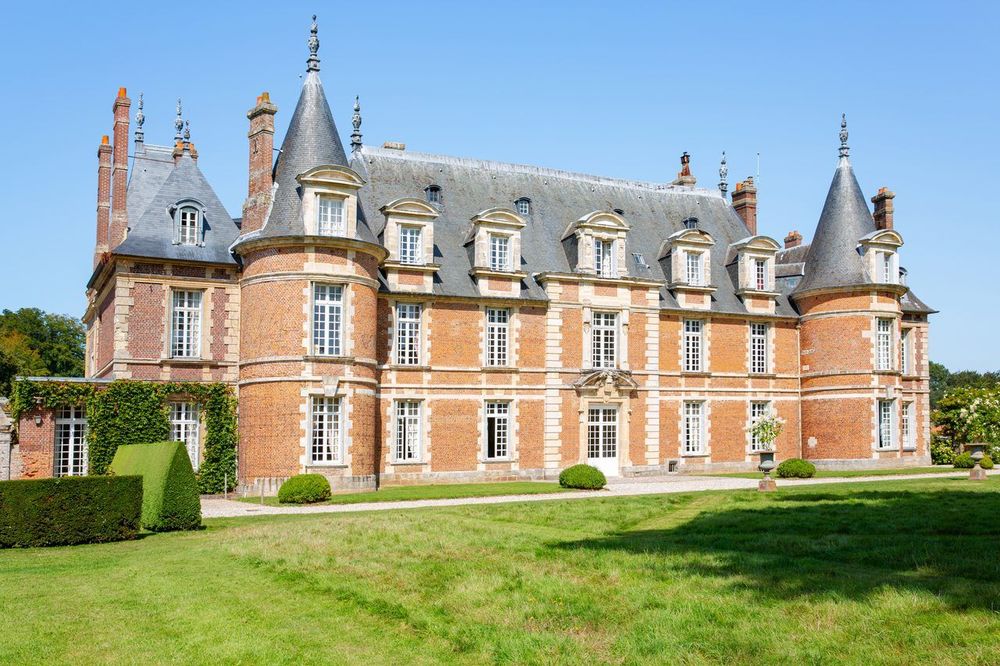
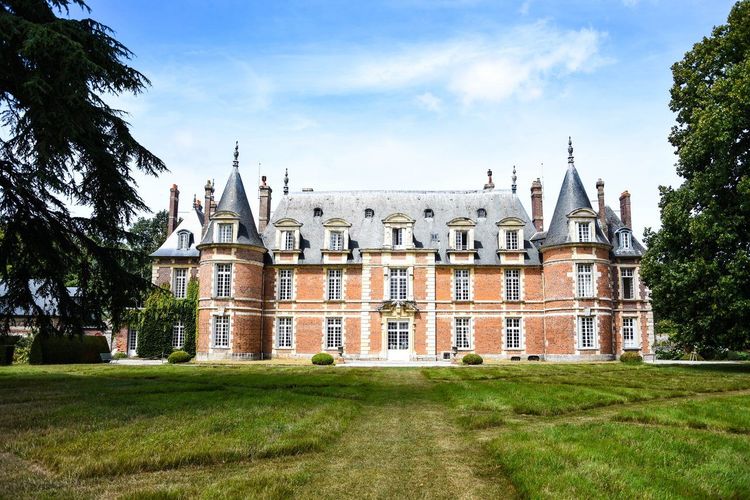
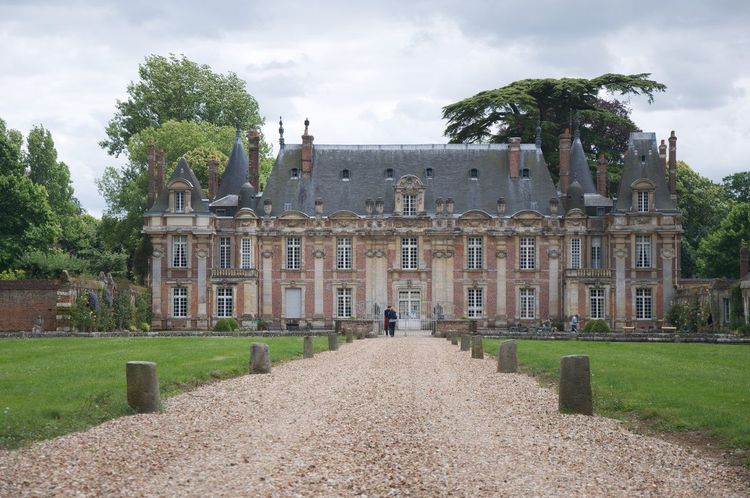
Searching for "Domaine Miromesnil Dieppe" on a map actually leads to Tourville-sur-Arques, about ten kilometers south of the port city, and this short journey spans four centuries. The Domaine de Miromesnil announces itself via an avenue of hornbeams clipped into a palisade before revealing a 17th-century château in red brick and white stone, preserved in a state of exceptional rarity for Normandy. This is where Guy de Maupassant was born on 5 August 1850, in a room his family occupied during the summer season. And this is where one understands why the Pays de Caux has for centuries produced a discreet aristocracy, attached to its land and its kitchen gardens.
The Domaine de Miromesnil near Dieppe is not a site frozen in a museified reconstruction. It is a privately owned property that is still inhabited, with actively cultivated gardens, salons that host events, and outbuildings that accommodate visitors. In summer, actors perform scenes from Maupassant between the box hedges at nightfall. In May, the historic kitchen garden overflows with varieties long forgotten by modern supply chains. Before setting out on the road to Tourville-sur-Arques, start with a few hours in Dieppe with the Ryo audio guide tour of Dieppe, 22 stops, 5 km, to grasp the historical depth of this port city before exploring its hinterland.
Five Centuries of History: from the Hue de Miromesnil Family to Today
The Château de Miromesnil (76550 Tourville-sur-Arques, rated 4.5/5 on Google based on 1,075 reviews) as it stands today owes the essence of its silhouette to the early 17th century. Construction of the main body began around 1600, on foundations that may date back to a medieval stronghold. The chapel, slightly older, dates from the 16th century: its barrel vaults and buttresses recall the Norman late Gothic style, and it constitutes the oldest element of the estate open to the public.
The family that gave the property its name, the Hue de Miromesnil, took possession of it in the 17th century. The most celebrated member of this lineage, Armand Thomas Hue de Miromesnil, served as Keeper of the Seals under Louis XVI from 1774 to 1787. Under his influence, the estate enjoyed its finest hours of worldly renown, welcoming the noblesse de robe who moved between Paris and the lands of Normandy. His disgrace on the eve of the Revolution marked the end of an era for Miromesnil.
After 1789, the château changed hands several times without ever falling into the prolonged abandonment that condemned so many similar residences. No conversion into a military hospital, no transformation into a collective farm, no dismantling of façades for salvaged materials: Miromesnil passed through the 19th century retaining its residential vocation. This continuity of use explains the building's exceptional condition. Successive owners maintained the façades, woodwork and gardens with remarkable consistency, favouring historical integrity over spectacular modernisations.
The property today covers approximately 80 hectares, a large part of which consists of woodland, meadows and orchards. At the heart of this expanse, the rectangular cour d'honneur is bounded by brick outbuildings — former stables, carriage houses and service quarters — which form an architecturally homogeneous ensemble rarely preserved with such coherence in Normandy. Few estates of this scale have survived so many centuries without losing their soul.
The Architecture: Norman Brick, Caen Stone and Classical Symmetry
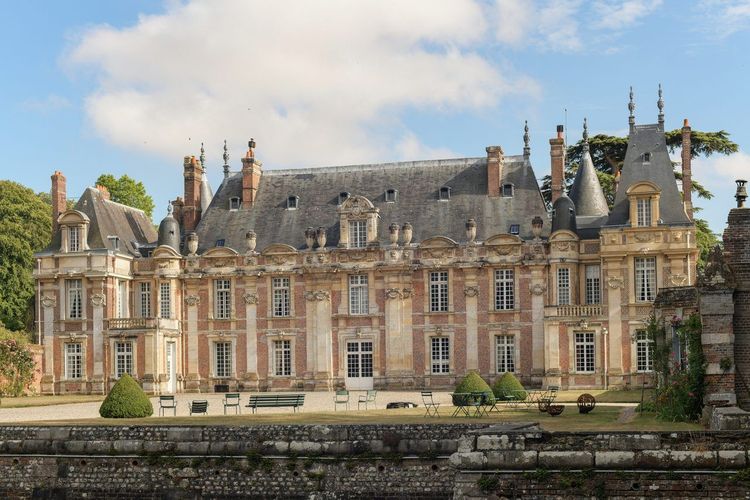
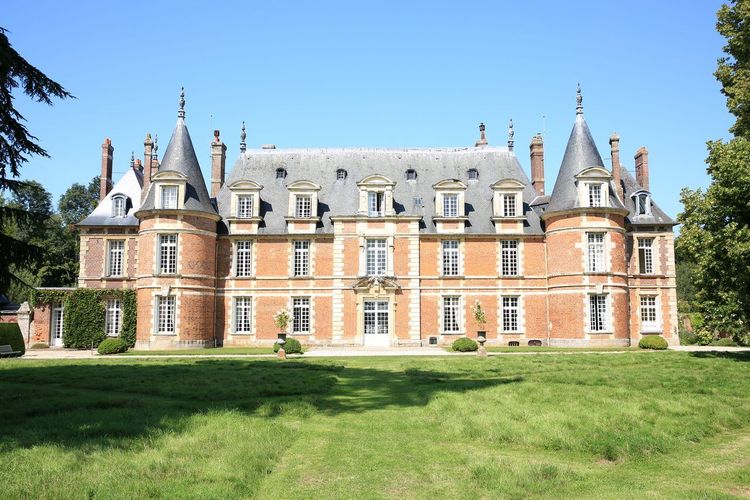
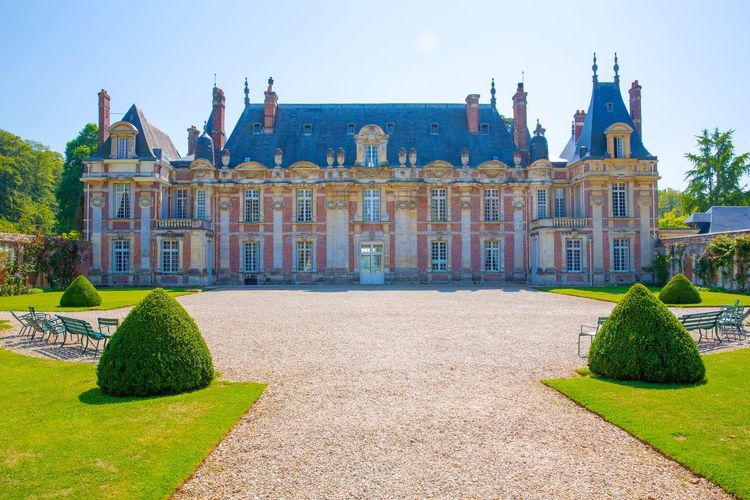
What strikes one first at Miromesnil is the chromatic coherence of the whole. The façades alternate red brick from the quarries of the Pays de Caux with white Caen stone, in a pattern of quoins and window surrounds characteristic of 17th-century Norman civic architecture. This technique, which combines the thermal robustness of brick with the sculptable elegance of limestone, appears throughout the region in various forms — one finds it in the townhouses of Rouen as well as in the isolated manor houses of the Caux plateau.
The main courtyard façade displays an almost austere formal rigour. The bays are regular, the cornice understated, and the two round turrets flanking the lateral wings provide the only medieval note in an otherwise thoroughly classical arrangement. Inside, the ground-floor and first-floor rooms have retained their Louis XV woodwork, marble fireplaces and Hungarian-point parquet floors. Several salons are still furnished with period pieces, creating the atmosphere of a living residence rather than a museum.
The garden façade, on the kitchen-garden side, opens differently. The large salon windows communicate visually with the terrace, and the gentle slope of the ground towards the garden creates a natural sense of continuity between the architecture and the planted landscape. This dialogue between building and garden is characteristic of the great French classical residences, but at Miromesnil the intimate scale of the estate makes it particularly legible.
The Historic Kitchen Garden, the Estate's Underrated Jewel
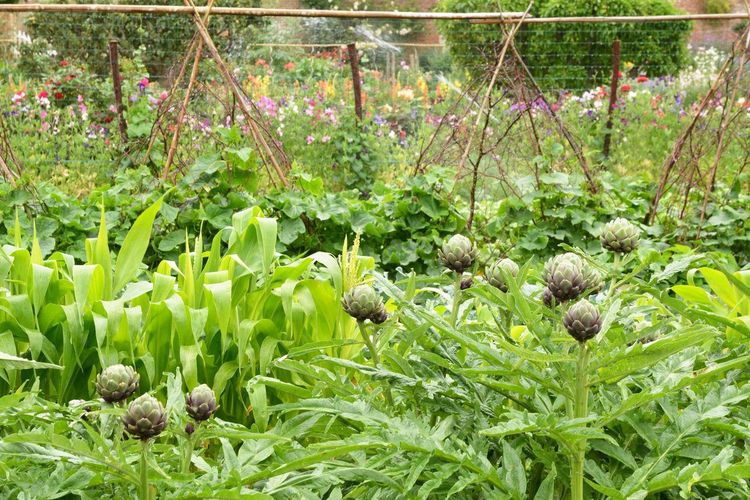
If the château justifies the journey, the kitchen garden is the real discovery. Behind the main building, on a gentle south-facing slope, stretches a kitchen garden in the 17th-century tradition, whose layout of regular squares follows the principles of the formal French garden codified by La Quintinie under Louis XIV.
The squares alternate heritage vegetables, cut flowers and aromatic herbs in an arrangement that is both aesthetic and productive. One encounters varieties that mainstream distribution chains abandoned long ago: purple parsnip, Breton artichoke, haricot du Soissons, planted in tight rows separated with precision by gravel paths. The kitchen garden is not a stage set: it is active, cultivated through the seasons, and partially supplies the owners' table.
What sets it apart from the château gardens one typically visits is its sense of scale. Without reaching the proportions of the Potager du Roi at Versailles, it covers enough ground for a visitor to lose sight of its boundaries. The clipped box hedges define the interior paths, espalier pear and heritage apple trees line the brick walls, and topiary punctuates the space with an almost musical regularity. The whole obeys a formal logic that does not exclude the poetry of growing things.
The best time to visit? June and July offer the ideal combination: the summer vegetables and heritage roses are simultaneously at their peak, the paths are dry and clear. In September, the apple trees are laden and the first autumn tones begin to colour the hedges, but some of the squares will already have been cleared after harvest. In May, the kitchen garden is growing, green and full of promise, but less spectacular than at the height of summer.
Maupassant at Miromesnil: a Birth, Not a Life
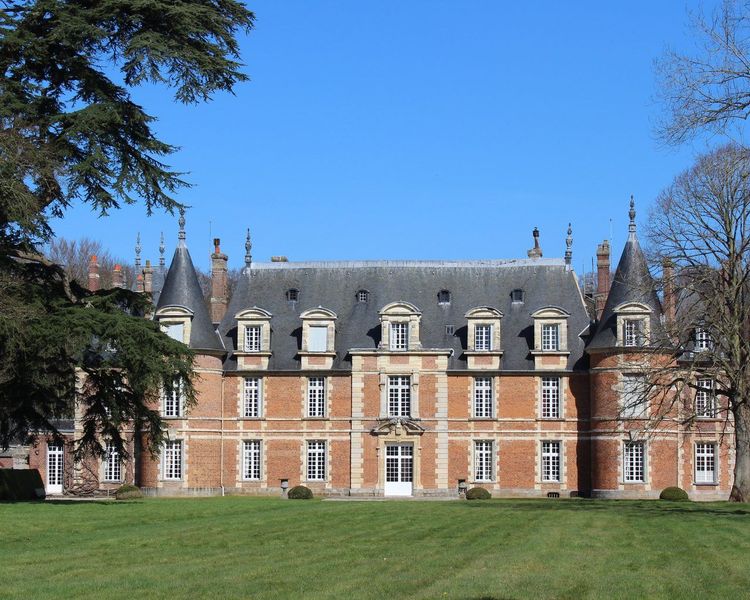
The birth of Guy de Maupassant at Miromesnil on 5 August 1850 is an established fact, but it deserves to be precisely contextualised. The Maupassant family did not own the château. His mother, Laure Le Poittevin, from a well-established Norman bourgeois family, was staying at Miromesnil during the summer season — a common practice of the time, when affluent families rented apartments in the great properties of the region to enjoy the countryside without owning them. The child was born in the château itself, but the family left shortly afterwards, and Maupassant did not grow up at Miromesnil.
As an adult, the writer returned to the château, walked its grounds and mentioned it in his correspondence. But it is the shores of the Channel, the cliffs at Étretat, the peasants of the Pays de Caux and the stories heard on Norman farms that fed his work far more than this birthplace. Miromesnil is in his biography a geographical parenthesis, a symbolic origin rather than an intimate foundation.
In the estate's chapel, a commemorative plaque marks the writer's birth. It is a quiet spot, in the shade of the hornbeams, where one can reread a few lines of his Norman short stories with a particular intensity. Guides typically devote a notable portion of their commentary to Maupassant's life: the blazing arc of a brief existence — he died at 42 in 1893, after years of intense creativity followed by a brutal physical decline — but an extraordinarily productive one. More than 300 short stories, six novels and thousands of pages of journalism constitute a literary monument that his Norman birth helps to illuminate.
The first-floor room associated with his birth is one of the rooms visited on the guided tour. It is furnished simply, without any spectacular reconstruction, which lends it a quiet credibility that overly theatrical stagings could never achieve.
Guided, Self-Guided and Theatrical Tours
The Domaine de Miromesnil offers several formats depending on the season and each visitor's preferences.
The classic guided tour lasts between 45 minutes and 1 hour. A guide leads the group through the ground-floor and first-floor rooms, lingering over the 18th-century family portraits, the salon woodwork and the room associated with Maupassant's birth. The tour then continues into the kitchen garden and chapel for a complete overview of the estate. These tours generally depart at fixed times in the afternoon.
The theatrical tours are the most distinctive feature of the summer programme. Actors take charge of groups and perform scenes drawn from Maupassant's Norman short stories in the various spaces of the château and garden. The format takes place in the evening, when the fading light radically transforms the atmosphere of the estate. Advance booking is essential and places are limited; these sessions regularly sell out in high season, so it is best to reserve several weeks ahead.
The self-guided tour of the gardens and kitchen garden is available without prior reservation. It suits families with children who prefer to take their time, and photographers who wish to linger in the garden without the constraints of a group.
A range of one-off events complement the programme throughout the season: chamber music concerts in the cour d'honneur, local producers' markets, temporary exhibitions in the outbuildings. The programme changes each year, so check the château's website before planning your visit.
The Park and Woodland Paths
Beyond the formal kitchen garden, the Domaine de Miromesnil extends across woodland and meadows that can be explored freely during opening hours. The hornbeam avenues framing the cour d'honneur date in part from the 17th century. Their regular clipping into a palisade — rows of trees forming a living wall of striking precision — is one of the estate's most photogenic signatures, particularly in the late afternoon when the low-raking light emphasises the volumes.
On the north side of the château, a path descends towards the small valley. One follows a stretch of water, passes through a beech wood whose understorey remains cool even in the height of a Norman summer. This is not a park designed for strollers with interpretive panels and evenly spaced benches. It is a maintained natural space that follows its own logic, between damp paths and sun-filled clearings. Children generally love this wilder part of the estate, less formal than the kitchen garden and more conducive to spontaneous exploration.
Wear sturdy shoes in any season. The woodland paths retain Norman moisture long after rainfall, and even a sunny July leaves slippery patches in the understorey. In return, the coolness of these woods in the height of summer is worth any air conditioning.
Staying at the Estate: Sleeping in the Château's Outbuildings
The Domaine de Miromesnil offers accommodation in the former outbuildings of the château, allowing guests to experience the estate in a way that goes far beyond a passing visit. The gîtes are arranged in carefully renovated buildings that retain their original materials: exposed stonework, oak beams and old terracotta floor tiles. The result strikes a balance between contemporary comfort and authentic Norman atmosphere.
Spending a night or two at the estate fundamentally changes one's perception of the place. Early in the morning, before the estate opens to the public, the kitchen garden belongs to the residents. The cour d'honneur has not yet acquired the ambient tourist soundtrack that settles in by midday. The dawn light on the red-brick façades has a quality that midday photographs fail to capture. It is in those moments, between 7 and 9 in the morning, that Miromesnil reveals what it truly is: a living property, not a stage set.
In high season (July–August), reservations should be made several weeks in advance. The minimum stay is generally two nights. Prices vary according to the capacity of the gîtes and the time of year; contact the owners directly for current availability. And a day in Dieppe itself unfolds in 23 commented stops with our audio walking tour.
Seminars and Receptions: Hosting an Event in an Exceptional Setting
The estate welcomes professional and private events. The layout of the venue suits a variety of formats: the cour d'honneur can accommodate several dozen people outdoors for cocktail receptions or ceremonies, the château's salons adapt to smaller meetings and presentations, and the gîtes can house participants over several days if required.
The central asset is the setting. Holding a board meeting in a Louis XV salon overlooking a 17th-century kitchen garden produces a sense of displacement that is difficult to achieve in a business hotel. This unusually serene environment, cut off from the usual urban context, encourages freer exchanges and clearer decisions, according to teams who have already tried the formula at Miromesnil.
For private events — weddings, birthdays, family receptions — the kitchen garden provides a naturally spectacular backdrop that requires no additional decoration. Services are modular according to requirements. Contact the owners directly for any event planning.
Practical Information: Opening Hours, Prices and Access from Dieppe
Address: Château de Miromesnil, 76550 Tourville-sur-Arques.
Access from Dieppe: approximately 10 km southeast via the D154 towards Arques-la-Bataille, then the D54 towards Tourville-sur-Arques. The journey takes 12 to 15 minutes by car. No regular bus line serves the château from Dieppe city centre: a personal vehicle or taxi remain the only practical options. Some Dieppe accommodation providers offer shuttles on request during high season; enquire at the tourist office.
Opening season: the estate is open to the public from late March to late September, with a reopening during the All Saints' school holidays. Exact dates vary each year: check the current season on the château's website before setting out. Guided tours take place in the afternoon, generally from 2 p.m., and self-guided garden visits follow the same hours in season.
Indicative prices (2026):
- Guided tour (chapel, château and gardens): €17 per adult, €15 concession rate
- Self-guided tour of the gardens and kitchen garden: €10 per adult, €8 concession rate
- Free for children under 4
- Theatrical tours: supplement, booking required via the château's website
These prices are given as a guide and may change from one season to the next.
Parking: free parking is available at the entrance to the estate, reached via a gravel drive of approximately 500 metres from the main road. Capacity is sufficient for coach groups, with turning space available.
Recommended visit duration: allow a minimum of 2 hours for the guided tour, the kitchen garden and a walk in the park. Those with a passion for historic gardens or families with children would do well to allow 3 hours. Theatrical sessions are additional and can extend the evening further.
Accessibility: the château's ground floor and the main kitchen-garden paths are accessible to visitors with reduced mobility. The upper floors of the château and the woodland paths in the park present greater access difficulties; please enquire at the time of booking regarding specific requirements.
Nearby: What to See in Dieppe and the Arques Valley
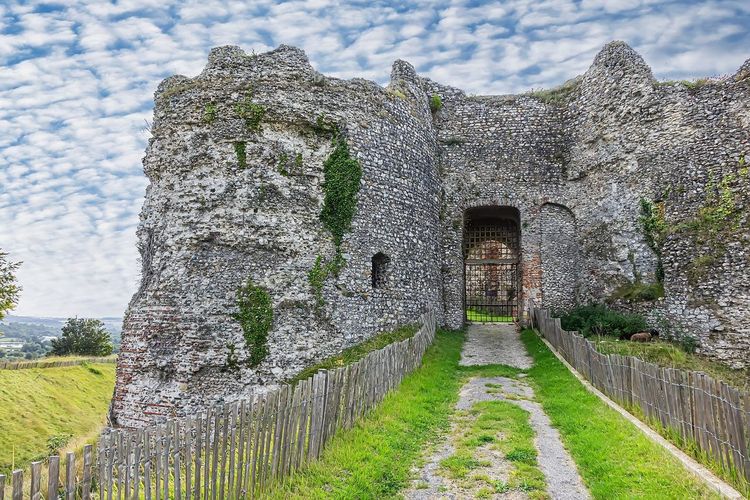
Tourville-sur-Arques lies in the Arques valley, which leads up to a site often overlooked by visitors in a hurry: the château d'Arques-la-Bataille (76880 Arques-la-Bataille, rated 4.3/5 on Google based on 382 reviews), an 11th-century medieval fortress whose imposing ruins dominate the valley from a limestone promontory. The site offers one of the widest panoramic views across the Pays de Caux, as far as the sea on a clear day. Entry is free and a visit takes about an hour.
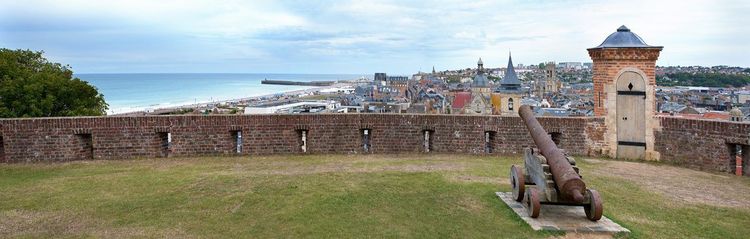
Ten kilometres to the west, Dieppe itself warrants a full day. The Ryo audio guide for Dieppe covers 22 audio-guided points of interest over 5 kilometres, from the château-museum and its unique collection of carved ivories to the cliffs at Pourville. Also check out the 6 must-do activities in Dieppe according to Ryo to select stops according to your interests.
The region's gastronomy is well worth lingering over. The Ryo guide to Dieppe's culinary specialities lists the essentials: locally caught scallops in season, smoked herrings from the port's fish auction, calvados from farms in the Caux hinterland. Lunch or dinner in Dieppe after visiting Miromesnil feels almost inevitable.
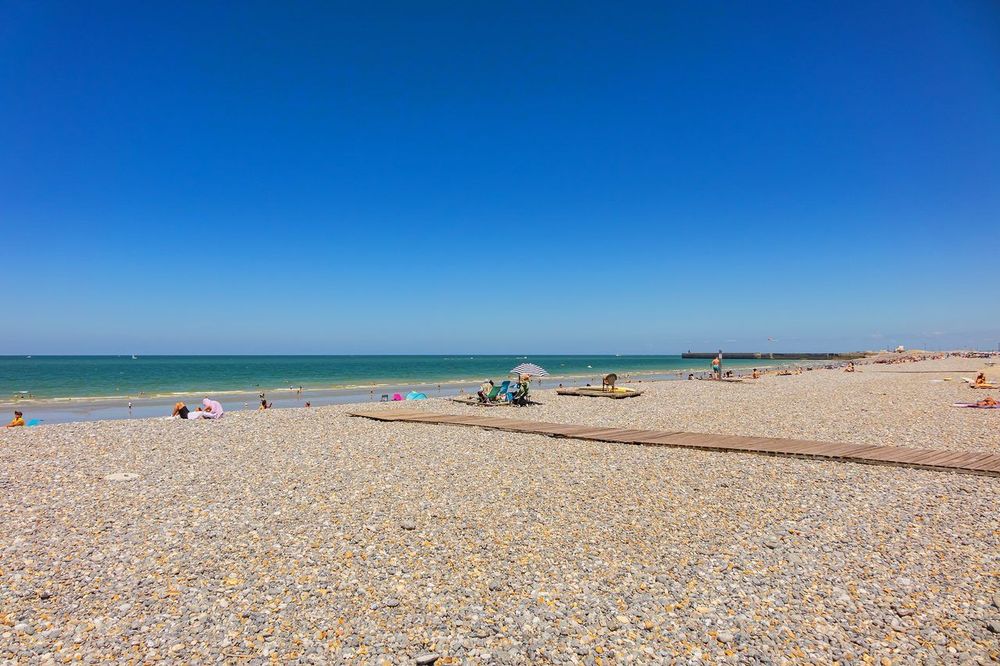
In September of even-numbered years, Dieppe is transformed by the international kite festival, one of the world's largest gatherings of its kind, which takes over the pebble beach for an entire week and turns the sky into a permanent spectacle.



FAQ
How far is the Château de Miromesnil from Dieppe?
The Domaine de Miromesnil is located in Tourville-sur-Arques, approximately 10 kilometres southeast of Dieppe. Via the D154 and then the D54, the journey takes about fifteen minutes by car. No regular bus line serves the château from Dieppe city centre: a personal vehicle or taxi remain the most practical options for visitors without a car. Some accommodation providers or local tourist offices may be able to advise on shuttle solutions during the high season.
When is the Domaine de Miromesnil open to the public?
The château and its gardens are open from late March to late September, with a reopening during the All Saints' school holidays; exact dates change each season, so it is best to check them on the château's website. Guided tours take place in the afternoon, generally from 2 p.m. Theatrical tours, scheduled during the summer season, take place mainly in July and August. Outside the opening periods, the estate remains closed to individual visitors, but may occasionally host groups or private events upon direct request to the owners.
Did Guy de Maupassant really grow up at the Château de Miromesnil?
Maupassant was born there on 5 August 1850, but did not grow up there. His family, who did not own the château but occupied apartments there during the summer season, left shortly after his birth. The writer returned to Miromesnil as an adult, but it is above all Étretat, Fécamp and the coastal landscapes of the Caux region that centrally nourish his work. The estate's chapel contains a commemorative plaque marking this birth.
Can you stay overnight at the Domaine de Miromesnil?
Yes. Gîtes arranged in the former outbuildings of the château welcome visitors wishing to spend one or more nights on the estate. These accommodations offer privileged access to the park and kitchen garden before the estate opens to the public, a very different experience from a day visit. In high season (July–August), reservations should be made several weeks in advance. Prices vary depending on the capacity of the gîte and the length of stay.
What is there to see near the Château de Miromesnil?
In the immediate vicinity, the château d'Arques-la-Bataille (an 11th-century medieval fortress, about 3 km away) offers free entry with a panoramic view over the Arques valley. Further afield, Dieppe is home to the château-museum, the Saturday markets on the place Nationale and the cliffs at Pourville. For a complete exploration of Dieppe, the Ryo audio guide available on the Ryo app covers 22 points of interest in a 2-hour audio-guided walk.
Conclusion
The Domaine de Miromesnil delivers a rare promise: that of a fully inhabited and cultivated Norman château, where a visit to the heritage does not reduce itself to wandering through empty rooms. The centuries-old brick of the façades, the active kitchen garden, the theatrical evenings with Maupassant as phantom guide — everything conspires to make this property a singular stop in the heritage of Seine-Maritime.
To continue exploring the region, the Ryo audio guide for Dieppe awaits you 10 kilometres away: 22 audio tracks, a 2-hour walk over 5 km, to discover in depth a port city that regularly surprises those who visit it for the first time. The Ryo audio guide for Dieppe takes you from the château to the seafront via lanes that printed guides rarely mention.
À lire également