© Shutterstock
 Votre guide Ryo
Dieppe International Kite Festival 2027: Complete Guide to Experience the Event
Imagine hundreds of kites simultaneously suspended in Normandy's pearl-grey sky: giant octopuses, articulated dragons forty metres long, mandalas slowly spinning above the pebbles. Since 1980, attending the Dieppe International Kite Festival has become an unmissable event: every two years, the town's long pebble beach transforms into the world's largest aerial stage. The next edition is planned for September 2027, and hotel rooms in the town are already selling fast. Ryo's audio-guided tour of Dieppe starts just two minutes' walk from the seafront where it all takes place, making it easy to combine the festival with exploring the town in a single stay.
If you are planning your visit, you will find everything you need here: dates, detailed programme, types of activities, accommodation, transport and ideas for extending your stay in a port town that deserves far more than a single day.
The History of the Festival: over Forty Years of Kites in the Norman Sky
It all began with a local club of enthusiasts and a beach. In 1980, kite enthusiast Max Gaillard and a handful of Norman kite flyers organised a first gathering on Dieppe's beach. Success was immediate: the length of the beach, the constant sea breeze and the town's accessibility made this an ideal venue. Within less than a decade, delegations from Japan, China, Brazil and across Europe began making the journey.
Today, the event brings together an average of more than 400 kite flyers from around forty countries, over a period of nine days. It attracts more than 500,000 visitors per edition, a figure that places Dieppe among the most visited outdoor events in Normandy. The biennial nature of the event (one edition every two years) helps maintain strong anticipation and a high level of artistic ambition among participants.
What sets Dieppe apart from other festivals of its kind in Europe is the available space. The beach stretches for around four kilometres, allowing works in flight to be arranged so as to create genuine visual compositions. The organisers divide the seafront into themed zones, a curatorial approach applied to the wind. Each zone has its own identity: inflatable giants, artistic balloons, aerobatic flying demonstrators.
The 2027 edition promises several world premieres in luminous kites, with around forty nations represented.
Weekly Programme: What Happens Each Day
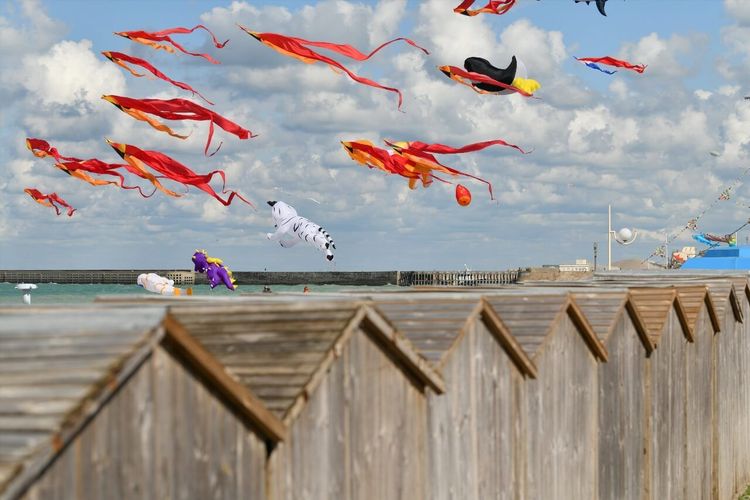
The festival runs over nine consecutive days in September, generally around the third week of the month. Wind conditions over the English Channel are then optimal for flying large kites: a steady wind between 15 and 30 km/h, without the unpredictable gusts of spring or the flat calms of summer. The exact dates for the 2027 edition will be confirmed on the official website during 2026.
A typical day follows a well-established rhythm. From 9am, kite flyers begin setting up their creations on the beach. Between 10am and 6pm, the action is in full swing: the giant fabric kites are in flight, demonstrations follow one another, and workshops are open. Late in the afternoon, when the sea breeze often eases slightly, artists leave their zones to engage with the public — a privileged moment to understand the techniques and history behind each piece.
Highlights of each edition:
- Opening ceremony: simultaneous raising of the flags of all participating nations, followed by a collective launch of the official kites. This is the most photographed moment of the week — not to be missed.
- Night light shows (usually Thursday and Saturday evenings): kites fitted with LEDs and fibre optics flown in complete darkness, accompanied by a specially composed soundtrack. Arrive at least an hour early to find a good spot on the pebbles.
- Family day: mid-week, with intensive making workshops, free piloting introductions for children from age 6, and amateur competitions with prize-giving at the end of the afternoon.
- Sunday grand finale: formation flight of all the giant fabric kites, followed by a closing parade through the town centre streets with the international delegations.
- Markets and exhibitions: throughout the week, exhibitors offer handcrafted kites and accessories from participating countries.
If you can only come for one day, choose a Saturday: flying displays in the morning, a workshop in the afternoon, and a light show in the evening. It is the most packed day of the programme.
Entry to the beach and main activities is entirely free. Some specific workshops with materials provided are paid, generally between 5 and 10 euros, and booking in advance is strongly recommended for weekend sessions.
The Giant Kites: a Spectacle of Rare Scale
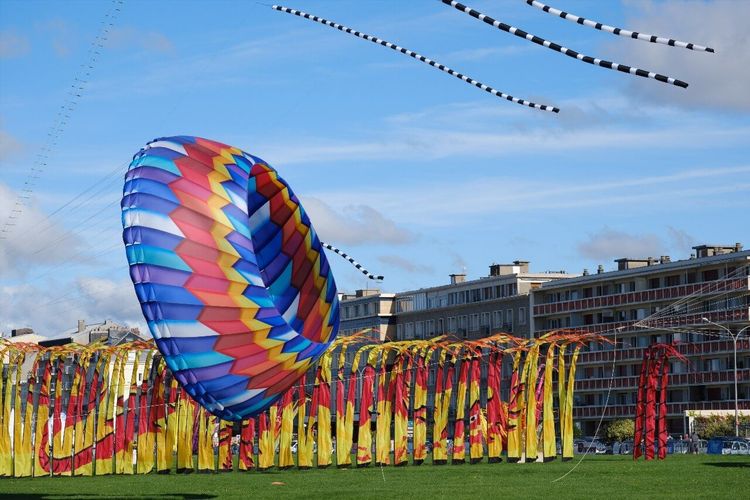
What surprises first-time visitors is the scale. You arrive expecting to see simple beach models and find yourself face to face with flying sculptures twenty, thirty, sometimes fifty metres long. A giant octopus deployed by a Japanese delegation can weigh several dozen kilograms and require a team of six people to keep it airborne in the right conditions.
The invited artists are world specialists in their discipline. Some come from kite-flying families spanning several generations, including Chinese craftspeople whose knowledge is listed as UNESCO Intangible Cultural Heritage. They practise very different techniques: train flying (several kites aligned on the same line), aerial ballet (choreography of sport kites controlled on two or four lines), inflatable sculpture (nylon structures held open by the wind, with no rigid frame) and solo artistic flying.
Over past editions, the sky above Dieppe has welcomed an eighteen-metre astronaut, blue whales in formation, an articulated Chinese dragon, and giant mandalas slowly spinning on their own axis. Each edition brings new creations, often developed specifically for the occasion.
The sport kites, smaller but ultra-manoeuvrable, give rise to timed aerobatic demonstrations. Pilots perform figures to the centimetre, synchronised in pairs or in teams of four. These aerial choreographies are among the most technically demanding displays of the entire week.
Workshops, Introductions and Activities for All Ages
The festival is designed so that everyone can take part, not just watch. Piloting initiation workshops run continuously throughout the week in a marked-off area of the beach, led by trained volunteers and professional artists. Children from age 6 and adult beginners learn the basics in about twenty minutes.
The making workshops let you go home with your own creation. Formats vary by edition: Japanese washi paper models, plastic assembly kits, or more elaborate ripstop fabric constructions. These sessions generally last between one and two hours, in small groups of ten to fifteen people. Booking in advance is strongly recommended for weekend sessions, which are regularly fully booked several weeks ahead.
For families, several areas of the beach are reserved for amateur competitions: who will keep their kite in the air the longest, who will build the longest train, who will perform the most original figure. The prizes are symbolic, but the atmosphere is festive and children throw themselves into it with great enthusiasm.
In the event of unfavourable weather (wind too strong or persistent rain), talks and exhibitions are held in covered venues around town: the history of kites across cultures, comparative making techniques, photographs from past editions. The festival never truly stops, but some outdoor activities are moved indoors if conditions require it.
The Night Parade: the Highlight You Will Never Forget
Among all the moments of the festival, the night parade is the one that stays in the memory. It takes place on Saturday evening, generally around 9:30pm, and brings several tens of thousands of people to the seafront, settled on the pebbles or standing along the promenade.
Luminous kites rise into a completely dark sky, guided by pilots whose silhouettes are barely visible. Integrated LEDs create colour effects that shift in time with music broadcast along the full length of the beach. Some giants are fitted with fibre optics that produce unpredictable flashes — a spectacle whose magic is difficult to anticipate from photographs.
Arrive at least one hour before it begins to find a decent spot. Bring a thick blanket or rug: September evenings on the English Channel are cool, and the sea breeze does not drop at nightfall. The seafront shops remain open that evening until midnight.
The Venue: Dieppe Beach and the Seafront
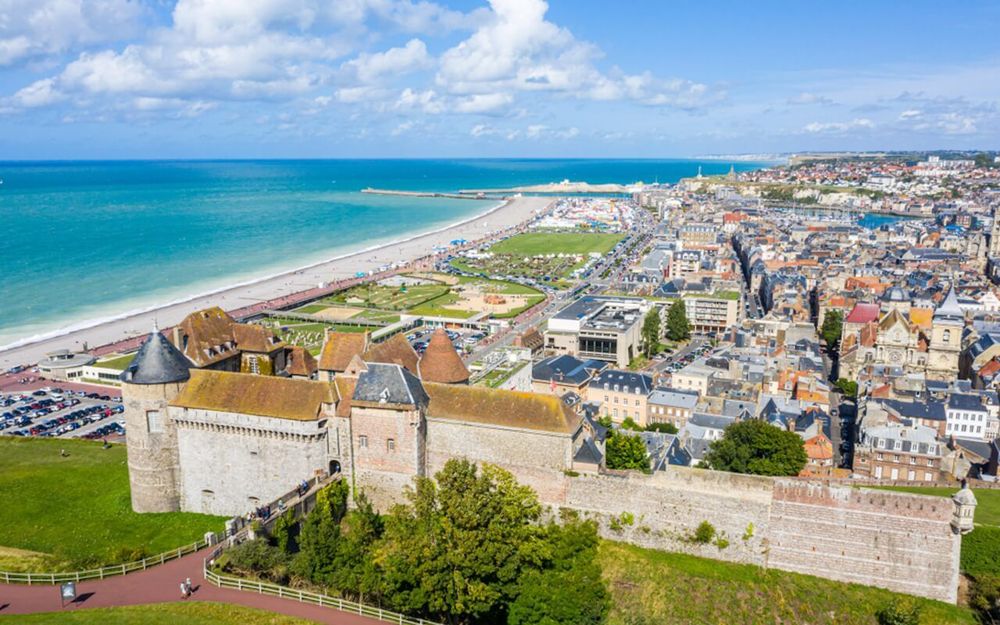
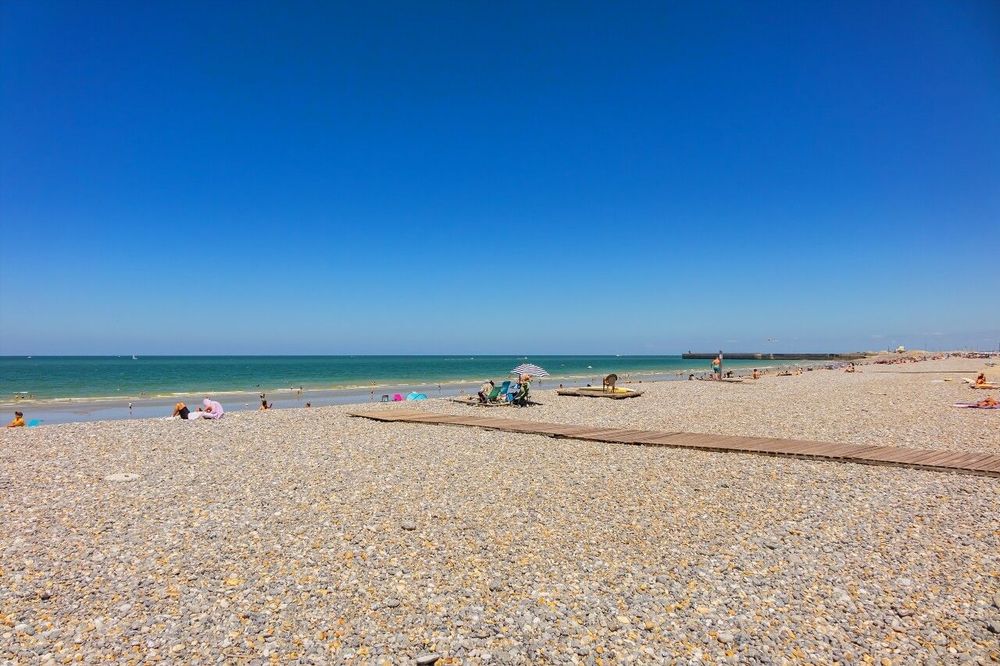
All the action is concentrated on Dieppe beach, a long strip of pebbles stretching from the harbour to the western cliffs over approximately four kilometres. Access is free from the seafront promenade, and numerous areas allow you to settle directly on the pebbles to watch the spectacle.
Dieppe Beach
The promenade runs along the full length of the beach and offers an unobstructed view of the entire display. Information panels are dotted along the route. The château de Dieppe, which overlooks the beach from its chalk spur to the west, offers an exceptional vantage point over the whole seafront, with free access on certain days during the event.
Château de Dieppe
The port de Dieppe, to the east of the beach, is another lively area: large kites are sometimes installed there, and the quayside restaurant terraces are fully booked from midday during the festival. Ryo's Against Wind and Tide audio-guided tour is a good way to see the rest of the city on foot after the festival.
How to Get to Dieppe for the Festival
Dieppe is two hours from Paris by car (A13 then D915) and around 2h15 by train from Gare Saint-Lazare, with a connection at Rouen. During the festival, additional trains are generally put on by SNCF on this route; check timetables as the official dates approach.
From Rouen, Dieppe is accessible in 45 minutes by car or train (around twenty return services daily). From Caen, allow around two hours by road via Lisieux.
If you come by car, plan ahead for parking difficulties. Attendance reaches tens of thousands of visitors every weekend, and seafront car parks are full by 9:30am on Saturdays. Make use of park-and-ride facilities set up on the outskirts of town (signposted with 'P Festival' signs) with free shuttle buses to the seafront. During the week, the situation is much more relaxed and you can park easily in the town centre.
From Dieppe station, the seafront is a 15-minute walk heading north. The town is compact and the event is well signposted.
Where to Stay in Dieppe during the Festival
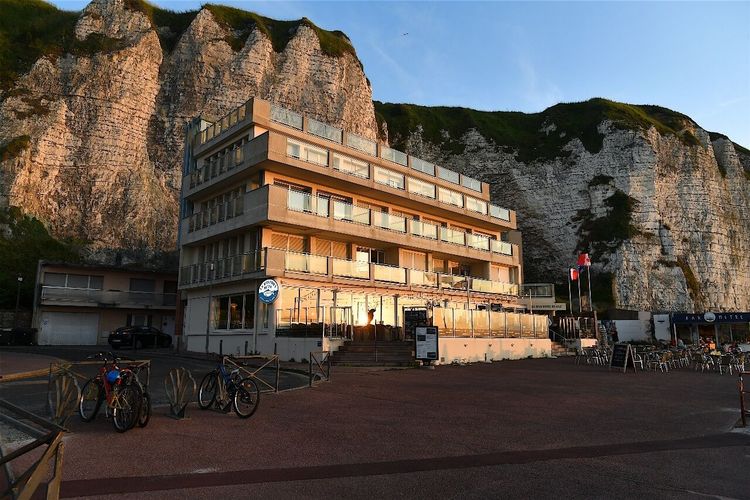
Accommodation in Dieppe must be booked six to twelve months in advance for festival nights — it is one of the events that most overwhelms hotel availability across the whole of Normandy. Here are the options depending on when you book.
In Dieppe itself: seafront and town-centre hotels fill up first. Some rooms with a view of the beach offer a particularly special experience during the festival, at a premium price that is well justified. Bed and breakfasts in the historic centre, around église Saint-Jacques, are a charming alternative at prices that are often more accessible.
On the outskirts: within a fifteen-kilometre radius, the villages of Saint-Aubin-sur-Mer, Hautot-sur-Mer and Berneval-le-Grand offer gîtes and bed and breakfasts available later in the booking window. The campsite at Pourville-sur-Mer, five kilometres from Dieppe, is very popular during the festival.
Rouen (45 minutes) is a logical fallback if Dieppe is completely full. The hotel offer there is wide, trains are frequent, and you can make the return journey each day without a car. It is also a way to enjoy a first-rate heritage city beyond the festival.
For families with children, apartment or house rentals are more comfortable than a hotel for a week-long festival stay: you will have space to dry clothes dampened by the Norman drizzle and store kites bought on site.
What to Do in Dieppe outside the Festival
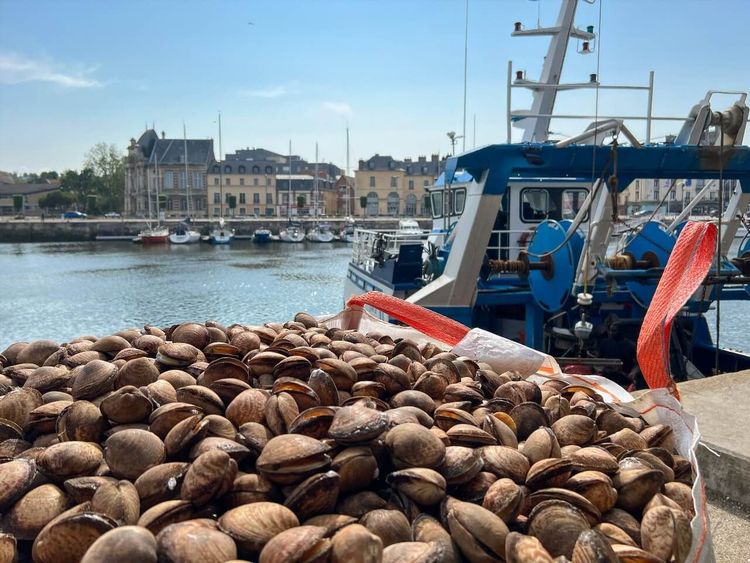
Dieppe is a Norman port town with a heritage that is often underestimated. If you are spending several days here, there is no shortage of things to do. Ryo's Dieppe audio guide covers 22 stops in a two-hour commented walk — a great way to make the most of the historic centre between sessions on the beach.
The Musée du château de Dieppe houses a unique collection of ivory sculptures, a legacy of the centuries when Dieppe was Europe's main ivory import port. The pieces are of remarkable fineness. The château itself, of Gothic architecture, offers from its terraces a view over the town and the English Channel that is worth the climb even without the collection.
The Grande Rue, the town centre's pedestrian axis, brings together shops, brasseries and cafés in a well-preserved half-timbered setting. This is where kite flyers gather at the end of the day, over a Norman beer or a plate of mussels and chips.
The fishing port remains very active. The fish market, open to the public, and the morning fish auctions, visible from the quays, give a vivid picture of Dieppe's maritime economy.
About ten kilometres away, the Domaine de Miromesnil is one of the finest estates in Normandy, with its 17th-century château and formal French gardens. Ryo has put together a complete guide to the Domaine de Miromesnil for an organised visit. The estate is open from April to November.
The Aval and Amont cliffs, accessible on foot from the beach, offer short coastal walks with spectacular views over the English Channel. The climb towards Pourville-sur-Mer (30 minutes on foot from the beach) is particularly beautiful at sunset. For a full selection of things to do in the town, discover Ryo's top activities in Dieppe.
FAQ
When does the Dieppe International Kite Festival take place in 2027?
The festival is scheduled for September 2027, likely around the third week of the month. Exact dates will be published on the official website during 2026. Historically, the event lasts nine days and is held when wind conditions over the English Channel are most favourable, generally in the second half of September.
Is Admission to the Festival Free?
Yes, access to the beach and main activities is entirely free. Some specific workshops (with materials provided) are paid, generally between 5 and 10 euros. Booking for these workshops is recommended, especially for weekend slots which are often fully booked several weeks in advance.
How Much Time Should I Plan for the Festival?
A full day is enough to get a good overview: arrive at 10am, flying displays all day, light show in the evening if you come on a Saturday. Two days allow you to truly enjoy the event: the first to explore the themed zones and watch technical demonstrations, the second for workshops and discovering Dieppe beyond the seafront.
Is the Festival Suitable for Families with Children?
Yes, the festival is particularly designed for families. Piloting initiation workshops welcome children from age 6, and making sessions from age 8. The pebble beach is accessible with a pushchair (bring wheels suited to uneven terrain). Amateur competitions for children take place every afternoon. The mid-week family day is the least crowded, making it the best time to come with young children.
What Weather Should I Expect in Dieppe in September?
September in Dieppe is mild but windy, with temperatures between 14 and 21°C depending on the day. Norman drizzle showers are frequent and unpredictable. Bring a light waterproof, shoes that can handle pebbles, and an extra layer for the evenings. The wind is good news for the event: it is what keeps the kites in the air all day long.
Dieppe Hotels Are Fully Booked: What Should I Do?
Widen your search to a radius of 20 to 30 km. Rouen (45 min), Le Tréport (30 min to the east) and Fécamp (50 min to the west) have hotels available even a few weeks before the event. Trains or car journeys make it easy to reach Dieppe each morning. The campsites at Pourville-sur-Mer and Varengeville-sur-Mer remain available later than hotels and are a pleasant option for family stays.
Conclusion
The Dieppe International Kite Festival is not just another event: it is one of the most visually striking outdoor spectacles in Europe, and one of the rare popular gatherings to have maintained a standard of artistic excellence for more than forty years. Whether you come for a single evening or for an entire week, Dieppe beach in September remains an experience that is difficult to forget.
Before or after the festival, the town deserves a longer stay. The Ryo audio-guided tour of Dieppe offers a 23-stop walk to discover the château, the port, the historic centre and the cliffs in two hours of commentary — an ideal way to begin or end your stay with your eyes on the ground, after spending all day looking up at the sky.
À lire également