© Shutterstock
 Votre guide Ryo
Visiting Dieppe with Family in 2026: Castle Museum, Cliffs, and Fresh Air on the English Channel
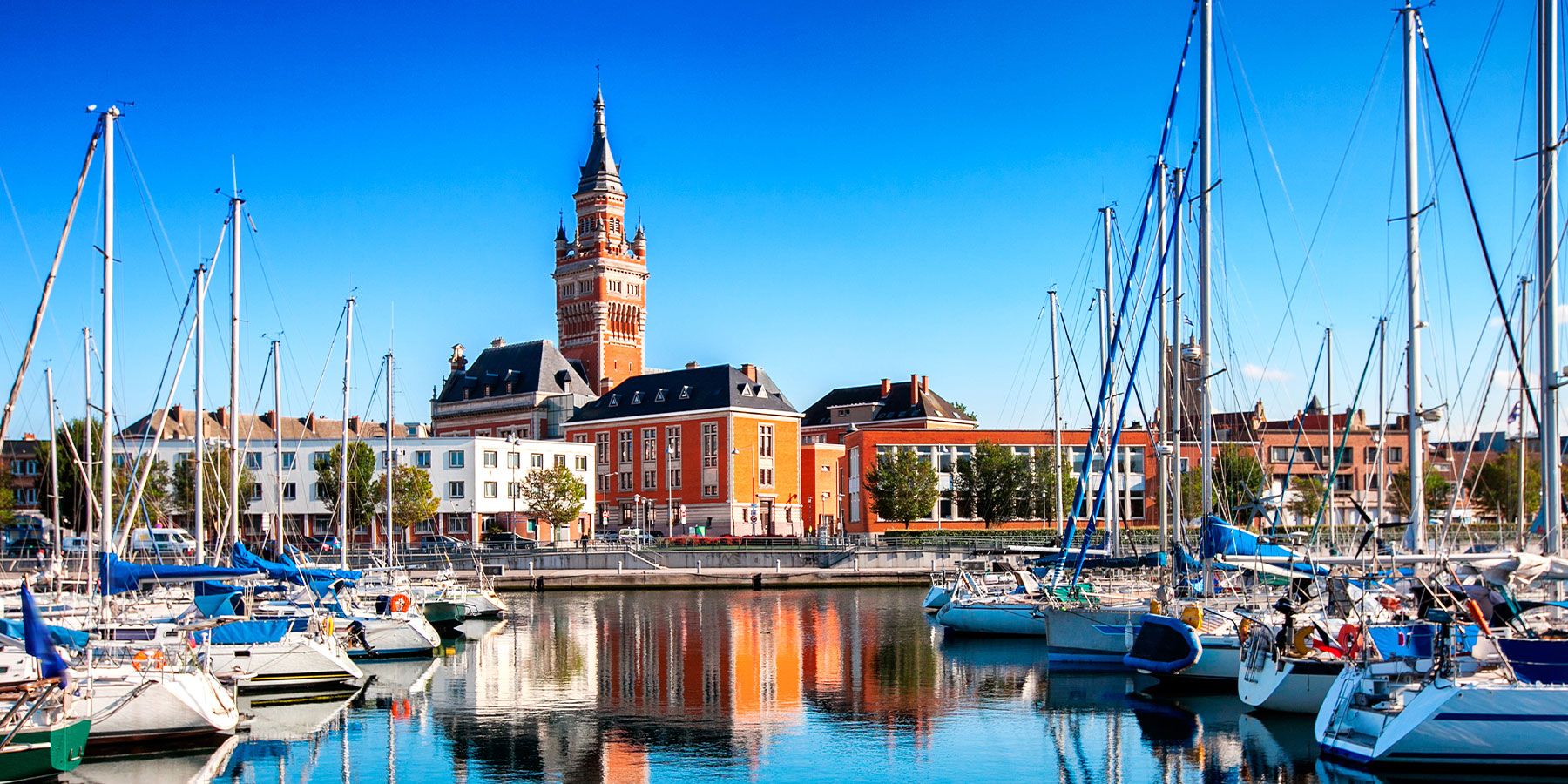
In Dieppe, the sea announces itself first through sound: pebbles rolling under the waves, a gentle roar the town has turned into its very own signature. Facing the English Channel, between chalk cliffs and a still-active fishing harbour, this Norman seaside resort bets on fresh air rather than theme parks. To visit Dieppe with your family in the best possible conditions, you just need to know in what order to plan your days: the castle museum has overlooked the beach from its 15th-century ramparts for centuries, kayaks glide along the Arques just a short walk from the centre, the Estran Cité de la Mer rescues rainy afternoons, and kites fill the September sky at one of the largest gatherings of its kind in Europe.
From the Ailly lighthouse accessible with an all-terrain pushchair, to the treetop adventure park at Dénestanville, the Saturday morning market voted most beautiful market in France, and the great cliffs of Criel-sur-Mer, this guide lays out a stay of two days to a full week without having to get back in the car every morning. The Ryo audio-guided tour of Dieppe serves as a guiding thread to explore the historic centre and the seafront before heading out along the Alabaster Coast. Throughout each section you will find walking times, minimum ages, and driving distances to know before booking anything.
The Dieppe Castle Museum and Its Maritime Heritage
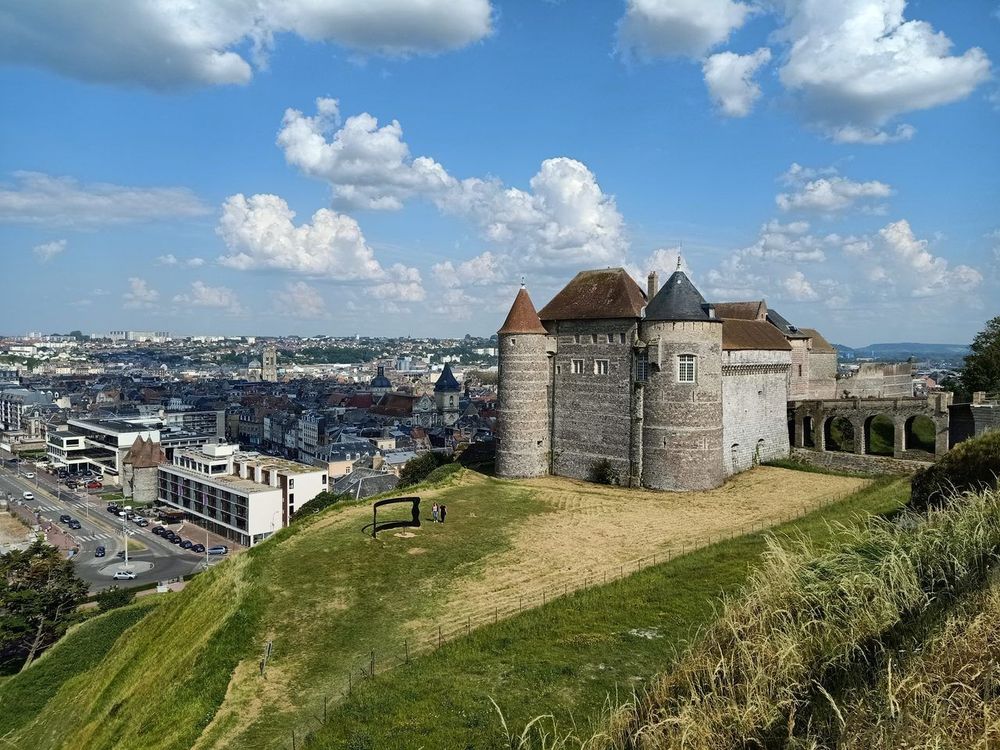
Perched on the western cliff, between ramparts and sea spray, the Dieppe castle museum (Rue de Chastes, 76200 Dieppe, rated 4.3/5 on Google from 3,873 reviews) occupies the former 15th-century fortress that once guarded the harbour entrance. You don't need to know the town's history to be captivated by the place: the crenellated towers, the cannons aimed at the sea, and the panoramic view over the English Channel catch the attention of younger visitors before they even reach the first room. The climb from the seafront takes about ten minutes up a steep path, a little longer via the Rue de Chastes if you are pushing a pram.
Inside, the collections tell another side of the town's story. That of a cod-fishing port that sent its vessels to fish off Newfoundland, that of shipowners who sailed to Africa and Brazil from the 16th century onwards, and above all that of Dieppe's ivory carvers: since the 17th century, the town's workshops have sculpted ivory brought back by ships, and the museum holds one of the most important public collections of its kind, including tobacco graters, fans, and miniature boats. Allow an hour's visit with children aged 5 or 6, longer if teenagers linger over the ship models or in front of the account of the raid of 19 August 1942, when thousands of Allied soldiers, Canadians chief among them, landed on these pebbles.
This maritime heritage spills well beyond the castle walls. Dieppe remains an active fishing port, where boats come in to sell their catch at the quayside, and a cross-Channel port linked to Newhaven, a reminder that the town has looked towards England for centuries. Heading back down towards the centre, the bustle of the quays and café terraces sets the tone for a town that buzzes all year round, not just in July: Saturday market, regattas, returning trawlers, the herring fair in November. The castle features among the must-sees listed in our Ryo article on the best things to do in Dieppe, alongside the harbour and the great beaches along the coast.
Dieppe Beach and Water Activities
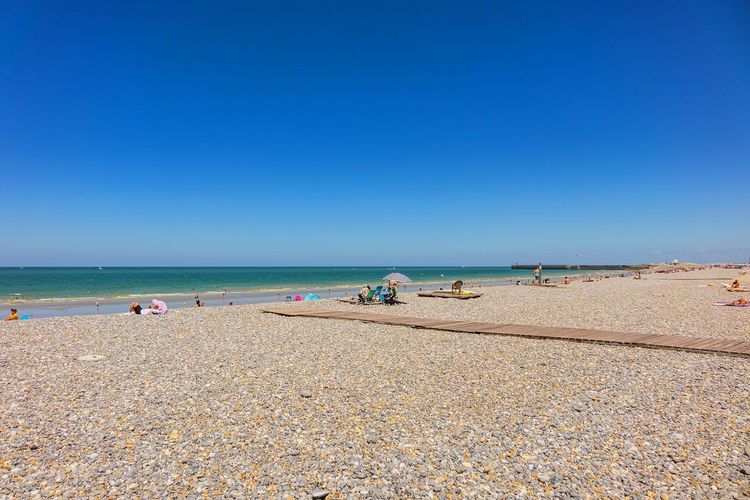
Unlike most Norman seaside resorts, Dieppe embraces its pebbles rather than hiding them under imported sand. This distinctive texture, less practical for building sandcastles but unbeatable for skimming stones, shapes the entire atmosphere of the seafront and the activities that revolve around it.
The Pebble Beach and the Seafront
The Dieppe beach stretches along the boulevard de Verdun, between the harbour and the first cliffs, bordered by a vast lawn where picnics, kites, and ball games take over from the first fine days of the year. This grassy esplanade, a legacy of post-war reconstruction, is what makes the beach so comfortable: you lay your blanket on the grass rather than the pebbles, three minutes from the water's edge.
On the western side, the seafront playground and mini-golf easily fill a late afternoon, and swimming is supervised in July and August within the marked zone. The pebbles heat up quickly in the sun and roll underfoot: bring water shoes rather than flip-flops for younger children, and aim for low tide, when strips of sand appear at the water's edge. From the campsites on the heights of the town, the walk down to the sea takes about a quarter of an hour.
Water Sports: Canoeing, Kayaking, and Sea Trips
Canoeing and kayaking are practised here in two very different forms: at sea, along the cliffs, for those already confident in the water, or on the Arques, the small river that meets the English Channel at the back of the harbour, for a considerably more relaxed outing. The nautical clubs at the harbour rent equipment by the hour and lead guided outings from age 7 or 8 depending on the provider, with paddles and life jackets adapted to smaller frames. A swimming ability test or a 25-metre swimming certificate is often required: check before booking rather than on the pontoon.
The harbour also offers half-day trips at sea, on traditional sailing boats or motor vessels, sometimes with seabird watching at the foot of the cliffs. It is the best way to see the town from the water, castle and valleuse included, and to understand why local sailors used to navigate by the colour of the chalk rather than by church steeples.
Thrills for Older Kids: Rock Climbing and Skydiving

Once children reach 10 or 12, the playground rarely excites anyone. Local climbing clubs lead sessions at natural sites in the surrounding area, including Val Saint-Martin, where top-rope climbing on easy routes is available from age 8, with harness and helmet provided.
For those wanting more, tandem skydiving over the Alabaster Coast is available from aerodromes in the region, with a bird's-eye view of the chalk cliffs and the estuary. The minimum age is around 15 with parental consent, and the passenger's weight often conditions the booking: two points to check before promising anything to a teenager.
Hikes and Cliffs Along the Alabaster Coast
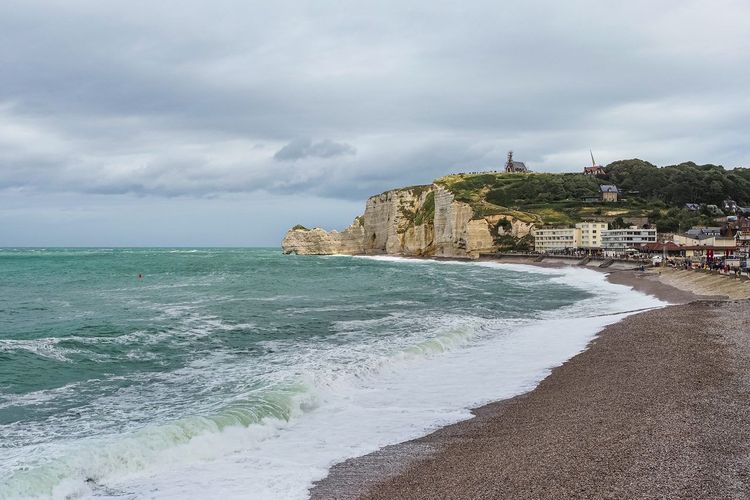
The great draw of the Alabaster Coast is its white chalk cliffs plunging into the English Channel over more than 100 kilometres, from Le Tréport to Le Havre. Around Dieppe, the GR 21 and the coastal paths allow you to walk alongside them without any technical passages, on short loops or full days depending on the legs available.
Easy Hikes Accessible with Young Walkers
The Ailly lighthouse at Sainte-Marguerite-sur-Mer is the easiest outing from Dieppe: a quarter of an hour's drive, then an 8 km round trip taking around 2h30, on a path that alternates through the Ailly forest and along the clifftop. The lighthouse, white with a red top, can be photographed from outside and makes a perfectly worthwhile destination for legs as young as 6.
Veules-les-Roses, about thirty minutes to the west, plays an entirely different card: the Veules, the shortest river in France at just over a kilometre long, flows through the village between watercress beds, washhouses, and mills before reaching the sea. The walk from the source to the beach is flat, pushchair-friendly, and takes just under an hour. The village is one of the Plus Beaux Villages de France, and the seafront ice-cream parlours reward what is admittedly a modest effort.
The Great Chalk Cliffs to Discover on a Day Trip
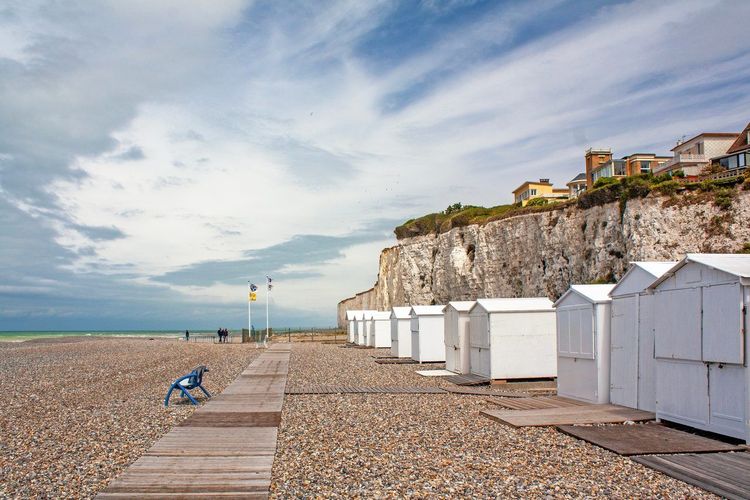
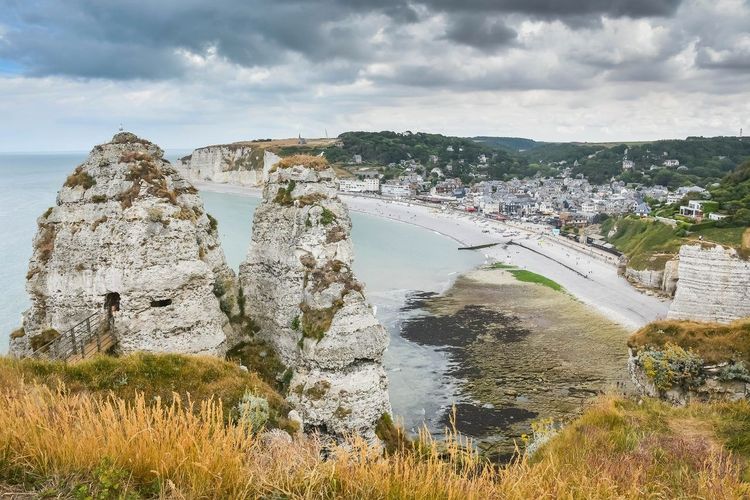
For a full day with walkers aged 10 and over, the cliffs of Criel-sur-Mer, about thirty kilometres to the north-east, offer around ten kilometres of trail in approximately 3h20, with views over the valleuses cutting into the coast and the seaside hamlet of Mesnil-Val. The route climbs and descends through hanging valleys: sturdy footwear is essential, and caution near the edge is a must, as the chalk regularly collapses in large sections.
Further to the south-west, the cliffs of Saint-Pierre-en-Port (76540 Saint-Pierre-en-Port) require around 3h40 for a ten-kilometre circuit, with more serious elevation gain and far fewer visitors than elsewhere on the coast.
Finally, the iconic cliffs of Etretat (76790 Étretat, rated 4.8/5 on Google from 1,204 reviews) are well worth the hour and a quarter's drive from Dieppe: the classic loop via the Porte d'Aval, the Needle, and the Notre-Dame-de-la-Garde chapel covers 9 km in around 3h15, with a steep staircase right from the start. Leave early, very early: this is one of the most visited sites in Normandy and the car parks fill up before 10am in summer.
These hikes combine easily with a morning at the castle museum or a late afternoon on the pebbles, without having to sacrifice one for the other.
Nature and Wildlife Parks for Little Adventurers

When the beach is no longer enough to fill a full day, the surrounding area has several wildlife parks and remarkable gardens to offer. Their distances by road vary enormously: it is worth knowing them before loading the car.
The Clères Park and the Biotropica Wildlife Gardens
The Clères park, about 45 minutes south of Dieppe, combines a château, an English-style garden, and a semi-free-range zoological park: cranes, ibises, flamingos, and wallabies roam freely among the ponds, under the watchful eye of gibbons settled on their islands. The estate is managed by the Seine-Maritime Department, which keeps admission prices very reasonable. Allow a good half-day and bring a picnic.
Biotropica, often mentioned in the same breath, is actually much further away: in Val-de-Reuil, near Louviers, about 1h15 by road from Dieppe. Its tropical greenhouse maintains a steamy warmth all year round, filled with crocodiles, sloths, and free-flying butterflies. Best saved for a full day on the Seine valley side, therefore, rather than as an impromptu wet-weather fallback.
The William Farcy Floral Park and the Gardens of the Château de Miromesnil
In Offranville, ten minutes from Dieppe, the William Farcy floral park features a rose garden, remarkable trees, and wide lawns, a short walk from the Saint-Ouen church and its hollow yew tree over a thousand years old, which you can actually step inside. There is a playground on site, no road to watch out for, and plenty of shade when the coast is baking in the sun.
A few kilometres away, in Tourville-sur-Arques, the château de Miromesnil opens its park, its centuries-old beech trees, and above all its flower-filled kitchen garden arranged in raised beds, one of the most photographed in Normandy. This is where Guy de Maupassant was born in 1850, an irresistible argument for secondary school pupils who study him in class. The interior is discovered on a guided tour at set times, a format less suited to young children, but the park can be explored freely. This estate is the subject of a dedicated Ryo article, which details visiting hours and seasonal events.
The Dénestanville Treetop Adventure Park
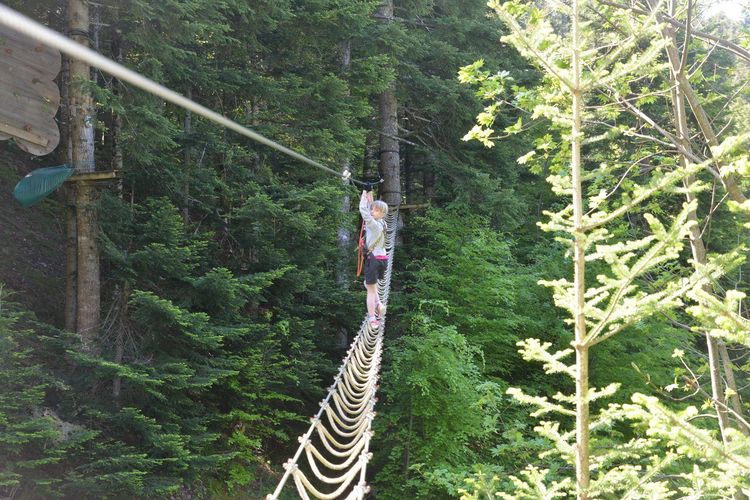
A quarter of an hour from Dieppe, the Dénestanville treetop adventure park (76590 Dénestanville, rated 4.9/5 on Google from 2,091 reviews) winds its courses through the trees above the Scie valley, from a discovery circuit accessible to the smallest children to routes reserved for larger frames. Sessions generally last two hours and must be booked in advance in summer. Closed-toe shoes and tied-back hair are compulsory; helmets and harnesses are provided on site.
Cycling Trips Around Dieppe
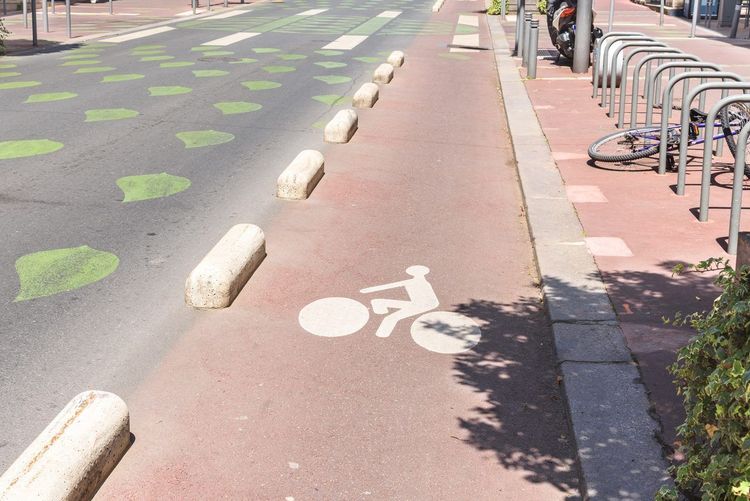
The Dieppe hinterland can also be explored by bike, largely along former railway lines converted into car-free trails. Three routes set off almost from the doorstep, with very different difficulty levels.
The Vélo-Route du Lin, from Offranville to Fécamp
The Vélo-route du Lin links Offranville to Fécamp through the Pays de Caux, crossing fields of flax that bloom blue for just a few days in June. The full route is well beyond the capabilities of an 8-year-old cyclist, but there is nothing to stop you tackling a 10 to 15 km section between two villages, returning by train or with a car shuttle.
The Avenue Verte London–Paris Greenway
The Avenue Verte London–Paris sets off from Dieppe and heads towards Forges-les-Eaux along around forty kilometres of former railway line: smooth surface, almost no gradient, no road crossings. It is the best terrain in the area for those who have just taken off their stabilisers, and the return trip to Arques-la-Bataille, 7 km from the centre, is more than enough for a first outing.
The Seine Valley Cycling Route
Further south, the Seine Valley cycling route follows the river between Rouen and the estuary, with free ferries to cross from one bank to the other: a highlight for passengers under 10, who generally demand a second crossing. Flat profile, abbeys, and limestone cliffs as a backdrop — best saved for a full day if you are combining Dieppe and Rouen.
Outdoor Festivals and Events Not to Miss
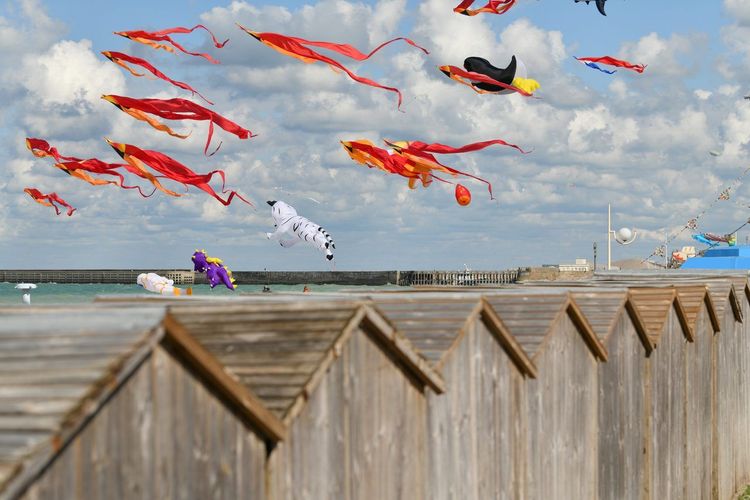
Dieppe has built a reputation that extends well beyond Normandy thanks to two major outdoor events.
The international kite festival takes place every two years, in even-numbered years, in September, on the seafront lawns. For a week and a half, delegations from dozens of countries fly giant creations — octopuses, dragons, and fish stretching dozens of metres — while kite-making workshops and free-flight zones keep beginners busy. The first edition dates back to 1980: since then, the town has claimed its title of kite capital, and access to the lawns remains free. Next edition: September 2026.
Our Ryo article on the Dieppe international kite festival details the dates, how to get there, and the best vantage points for watching the giant figures without getting caught in the crowds.
The Armada of Rouen takes place an hour's drive away, along the Seine quays: the world's largest tall ships moor side by side for around ten days, with free boarding, every four to six years. The last edition was in 2023, so it is worth watching for the announcement of the next one if your stay falls in the right year. Back in Dieppe, Ryo's audio-guided tour of the town makes a nice complement to a day trip to Rouen.
The Dieppe Market and Norman Food Specialities
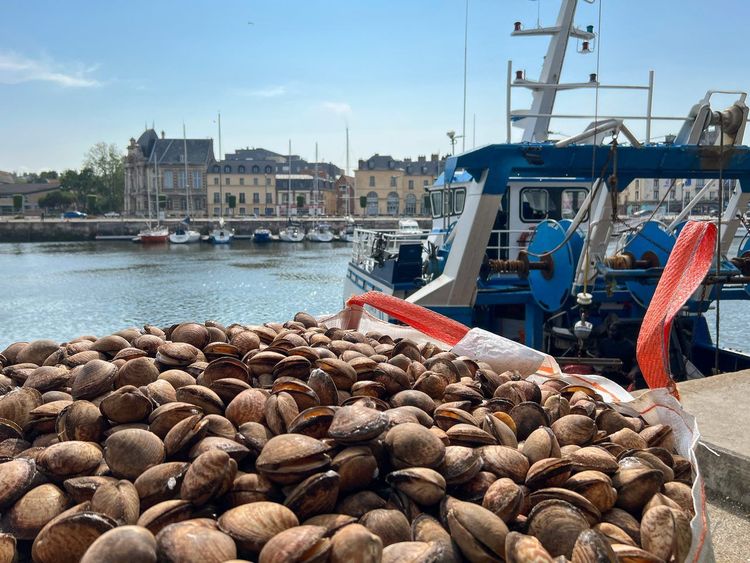
On Saturday mornings, the Grande Rue, the place Nationale, and the surrounding streets disappear under several hundred stalls. The Dieppe market (Place Nationale, 76200 Dieppe, rated 4.6/5 on Google from 1,337 reviews) is one of the largest in Normandy and was voted the most beautiful market in France in 2020 following a national vote. The atmosphere speaks for itself, between street vendors, the smell of rotisserie, and crates of shellfish freshly unloaded.
Fish is the star: Dieppe is one of France's leading shellfish ports, and from October to May, scallops are piled high on the stalls along the quai Henri IV. Around them, producers from the Caux region offer cider, neufchâtel — the heart-shaped cheese that always delights younger visitors — teurgoule, and apples. Everything you need to put together a complete picnic before heading to the seafront lawn.
At the table, the local speciality is the marmite dieppoise, a creamy stew of fish and shellfish that is easily shared among several diners; more cautious palates can fall back on a sole meunière or a crêpe. And if you visit in November, the herring and scallop fair takes over the quays for two weekends, with grilled fish in the streets and the smell of smoke drifting into the alleyways. Our Ryo article on Dieppe's culinary specialities lists the products to try and the addresses where to find them.
What to Do in Dieppe When It Rains
The Alabaster Coast is no stranger to showers, and it is best to have a Plan B ready before you set out.
The Estran Cité de la Mer (37 Rue de l'Asile Thomas, 76200 Dieppe, rated 4.1/5 on Google from 1,191 reviews) is the area's safest bet: this science and culture centre located a short walk from the harbour covers shipbuilding, fishing, and the coastline, with aquariums of English Channel species and hands-on activities at child height. An hour and a half to two hours of exploration, and probably the best-designed spot in town for 6 to 12 year olds.
The castle museum plays a supporting role, with its covered rooms, ship models, and ivory collections. For burning off real energy, the seafront swimming pool with its basins facing the English Channel does the job, as does an escape room in the town centre: scenarios are generally suitable from age 8 to 10, played as a team, for one timed hour. And if the shower doesn't last, the seafront arcades and the cafés in the Pollet neighbourhood offer shelter without giving up on the walk entirely.
How to Get to Dieppe and Get Around without a Car
Dieppe can be reached by train from Paris Saint-Lazare in around 2h15, with a few direct services per day and a change at Rouen for the rest. From Rouen, allow about 50 minutes: enough to link two stages of a Norman stay without ever renting a car.
By car, Paris is 2h15 to 2h30 away via the A13, then the A150 and the N27 through Rouen, covering just under 200 km. From Rouen, the N27 covers the sixty-odd kilometres in under an hour. Parking is concentrated along the seafront and around the harbour: spaces on the boulevard de Verdun go quickly in July and August, while those along the quays and in the town centre car parks are a more reliable fallback.
A third, more unusual option: the ferry from Newhaven, England, which crosses the English Channel in around four hours and docks directly at Dieppe harbour. Many British visitors arrive this way, on foot or with their car.
Once there, the car quickly becomes unnecessary. The town centre, the quays, the beach, and the castle are all reachable on foot within 15 to 20 minutes, on flat ground except for the climb up to the castle. The urban bus network serves the outlying neighbourhoods and nearby towns at low cost, and bikes can be hired in the town centre to reach the Avenue Verte. This is what makes Dieppe a very well-suited destination for low-carbon stays: train on the way there, walking, bus, and cycling on the ground, and not a litre of petrol burned all week.
Where to Stay and Where to Eat in Dieppe
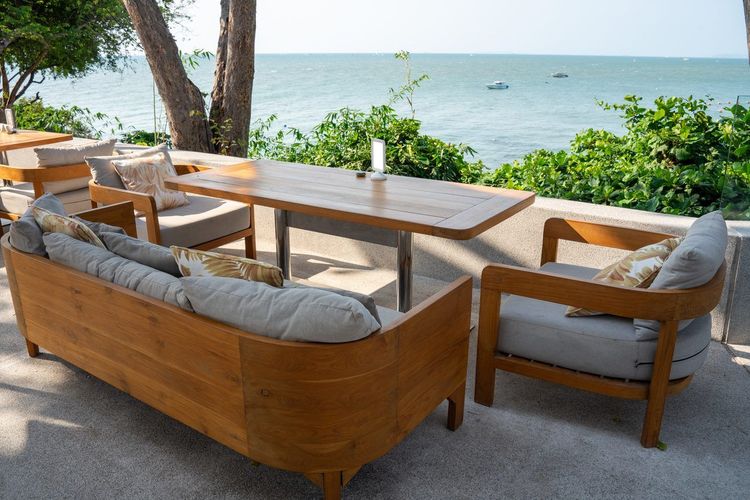
Accommodation falls into three main categories. Hotels along the boulevard de Verdun offer views over the English Channel and easy access to the pebbles, at understandably higher prices in summer. Holiday apartments and rentals in the town centre offer flats with kitchenettes, very practical when you need to put a meal together at 6:30pm for a hungry four-year-old. Finally, several rated campsites are spread across the heights of the town and along the coast, with pools, entertainment, and shaded pitches, often the most economical option for a full week. In all cases, book several weeks in advance in July and August and during the kite festival week, when the town is fully booked well into the surrounding villages.
For eating out, the town centre and the quays hold most of the options: crêperies, pizzerias, and fish restaurants line the Grande Rue and the quai Henri IV, with set menus available in most establishments. The seafront brasseries focus on seafood and fish landed that morning, a great way to introduce younger diners to local fishing without blowing the holiday budget. Two useful habits: book on Saturday evening, the busiest night of the market day, and aim for an early sitting around 7pm if you are travelling with young appetites that won't last until 9pm.
To plan the rest of your stay in the right order, it helps to get your bearings in the historic centre before heading out to scramble along the cliffs or cycle along the coast: that is precisely what the Ryo audio guide for the town offers from its very first stop.

FAQ
How many days should you plan to visit Dieppe?
Allow a minimum of 2 to 3 days to enjoy the castle museum, the beach, and a hike along the cliffs without rushing. A full week lets you add wildlife parks, a cycling outing, and a day trip to Etretat or Rouen without leaving exhausted.
Is Dieppe suitable for a trip with young children?
Yes: the town centre is easily walkable on flat ground, the beach is supervised in season, and the large lawn along the seafront serves as a permanent playground. The pebbles simply call for water shoes rather than flip-flops, and an all-terrain pushchair comes in handy on the coastal paths.
What is there to do in Dieppe when it rains?
The Estran Cité de la Mer and its aquariums, the castle museum, the seafront swimming pool, and the escape rooms in the town centre offer four indoor options without leaving town, so you don't have to write off an entire day of your stay.
Is the Dieppe castle museum suitable for younger children?
Yes: the towers, the cannons, and the panoramic view over the sea hold attention from as young as 4 or 5, for a visit of about an hour. The ivory collections and ship models appeal more from age 8, and the room dedicated to the 1942 raid is of greatest interest to teenagers.
What is the best time of year to visit Dieppe?
Spring and early autumn offer the best balance between mild weather and moderate crowds. Summer guarantees supervised swimming and events, even-year Septembers add the kite festival, and November brings the herring fair.
How do you get to Dieppe from Paris?
The train from Gare Saint-Lazare takes around 2h15, either direct or with a change at Rouen. By car, allow 2h15 to 2h30 via the A13, A150, and then the N27, covering just under 200 km.
Where should you park in Dieppe?
Parking is concentrated along the boulevard de Verdun, along the quays, and around the harbour. In high season, arriving before 10am makes finding a spot near the beach and the castle considerably easier.
Between chalk cliffs, a pebble beach, and a castle open to the sea, Dieppe makes for a stay that alternates fresh air and foodie breaks without ever requiring a car once you have arrived. Whether you stay for a weekend or a full week, the Ryo audio-guided tour of Dieppe is a great way to structure your exploration of the historic centre before heading out along the coastal paths or cycling to Arques-la-Bataille.
À lire également