© Shutterstock
 Votre guide Ryo
Dieppe Beach: Complete 2026 Guide, Pebbles and Blue Flag
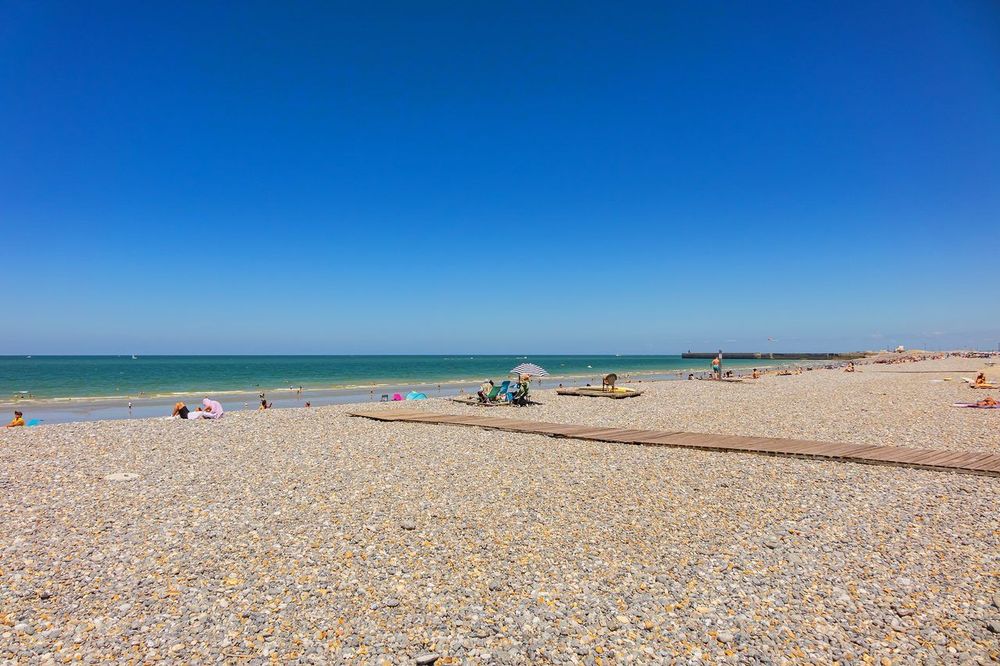
At low tide, the sea retreats several hundred metres from the casino, revealing a vast shoreline where the people of Dieppe have come to fish on foot for generations. Those who type "Dieppe beach" into a search engine often picture fine sand: here, it is the crunch of pebbles underfoot that greets visitors, on this urban seafront backed by chalk cliffs and dominated by a fortified castle. Holding the Blue Flag label for the quality of its bathing water, Dieppe beach combines seaside heritage with a lively port town, just a stone's throw from the Ryo audio-guided tour of Dieppe that traces five centuries of history through the lanes of the town centre.
In this guide, you will find everything you need to plan your day by the English Channel: a welcome point open in summer with supervised swimming, five neighbouring beaches and coves less than twenty minutes' drive away (from Puys to Quiberville-sur-Mer), the best spots for sand yachting and kite flying, the rules for bringing your dog, the little-known history of France's first sea bathing, and the key addresses for sleeping and eating without leaving the seafront.
Dieppe Beach: Setting, Sand and the Blue Flag Label
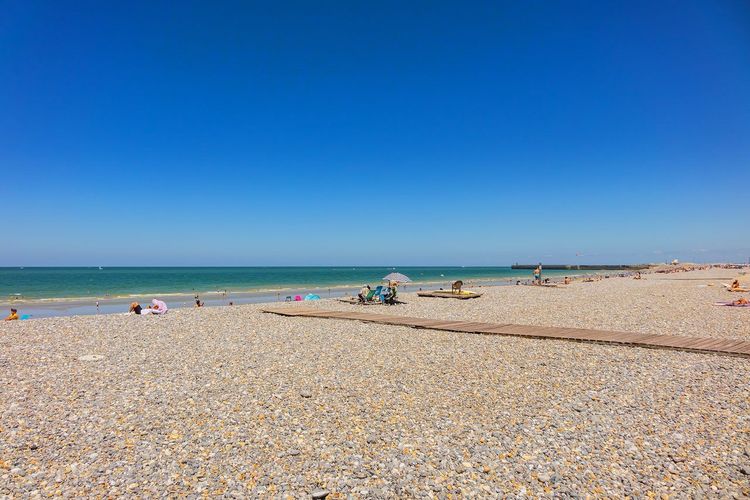
Searches for "Dieppe sandy beach" come up frequently, and the answer is worth stating upfront: the Dieppe shoreline is above all an expanse of pebbles, fringed by a vast lawn running the length of the seafront. This blend of lawn, pebbles and sea, quite unusual along the Normandy coast, makes it a place where people picnic as much as they swim, under the watchful eye of the castle perched on the western cliff.
Atmosphere, Extent and Water Quality
The beach stretches for about one and a half kilometres between the port entrance to the east and the foot of the castle cliff to the west, with a backdrop of lawns along boulevard de Verdun, planted with flower beds and lined by a continuous promenade. At low tide, the foreshore reveals a strip several hundred metres wide where local shoreline fishers search for mussels, shrimps and cockles. The contrast with the long sandy beaches of the Somme Bay is striking: here you walk on firm ground rather than sinking into sand.
For several years, the town has held the Blue Flag label, awarded to municipalities that guarantee high-quality bathing water and rigorous environmental management of their coastline. Health samples are taken regularly during the bathing season and the results are displayed on site. Good news for anyone still hesitating between Dieppe and the neighbouring resorts of the Côte d'Albâtre.
The wind, ever-present, is the other signature of this place: it shapes the ever-changing sky so often photographed from the promenade, and explains why Dieppe remains as much a town of sailors as of swimmers.
Facilities, Supervision and the Beach Information Point
During the summer season, a Beach Information Point set up on the seafront brings together useful information: supervised swimming hours, the day's weather, lost property and current activities. Lifeguards are on duty during the summer school holidays, from mid-morning to late afternoon, with safety flags (green, orange, red) to check before entering the water.
You will also find showers and public toilets, games areas and pétanque pitches on the lawns, as well as an accessible bathing facility for people with reduced mobility, available on request at the lifeguard post. Everything you need to spend the whole day without going back into town.
As evening falls, the lawns fill with families picnicking as the sun sets over the sea, a local ritual that few guides mention but that regulars would not miss for the world. Practical tip: park at the ends of the seafront early in the morning, as the central section fills up by 11am in July and August.
Dieppe, the Birthplace of Sea Bathing in France
It is hard to understand this seafront without a look at its past. Dieppe is considered France's first seaside resort: it was here that a bathing establishment opened as early as the 1820s, before the Duchess of Berry came to bathe in 1824 and launched the fashion for "wave bathing" among the Parisian aristocracy. People came to plunge into the cold water on medical prescription, escorted by professional bathers, long before sunbathing became fashionable.
The arrival of the railway from Paris in the mid-nineteenth century transformed the town into a fashionable retreat. Villas lined boulevard de Verdun, a casino was installed facing the sea, and painters followed: Renoir, Boudin, Pissarro, then Monet a little further along the coast, all came to capture those low skies and shifting light.
The seafront also bears witness to a very different episode. On 19 August 1942, Operation Jubilee landed several thousand soldiers, mostly Canadian, on these pebbles for a raid that turned into a disaster within hours. Plaques and a memorial along the promenade now commemorate this landing, and the square du Canada in town keeps alive the bond forged with Quebec ever since. Walking on this shore with that history in mind is a quite different experience.
The Most Beautiful Beaches around Dieppe
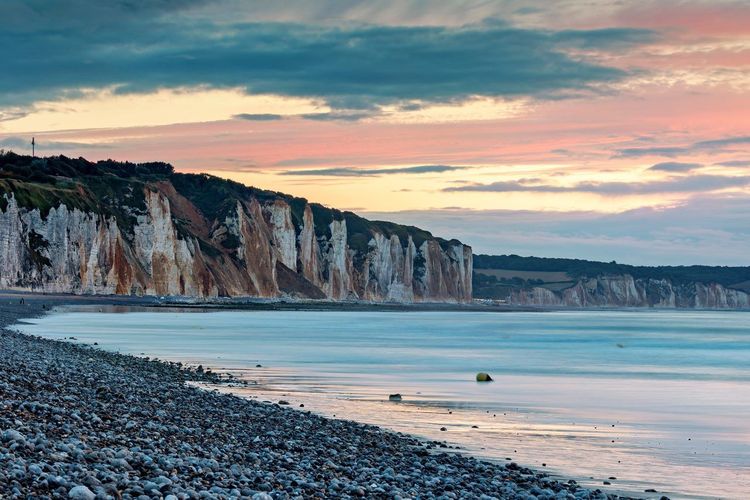
From the town centre, half a dozen beaches reachable in less than twenty minutes by car offer radically different atmospheres: cliff-lined coves, wide expanses uncovered at low tide, wooded valleys. A real playground for varying experiences without changing base. To gauge distances: allow around ten minutes to Puys or Pourville-sur-Mer, around fifteen to Varengeville-sur-Mer and Petit Ailly, and around twenty to Quiberville-sur-Mer.
To the East: Puys and Pourville-sur-Mer
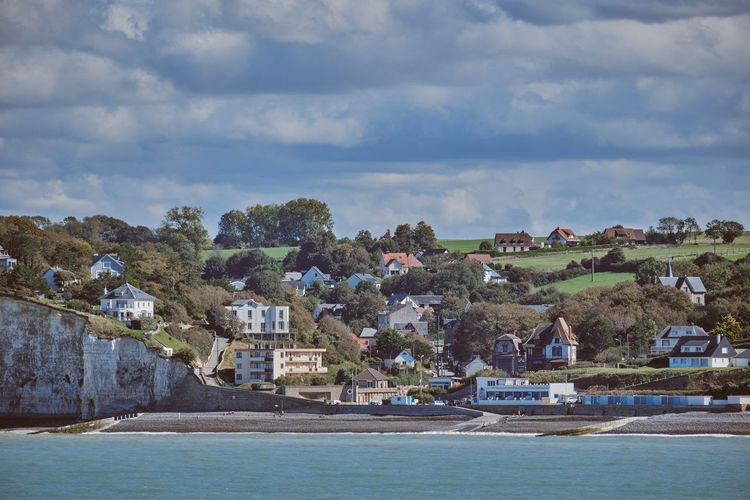
About three kilometres from the town centre, the hamlet of Puys, part of Dieppe, shelters a narrow cove tucked between two chalk cliff headlands laid down in the Cretaceous period. Far quieter than the Dieppe seafront, it draws mainly regulars: families with children, shoreline anglers and swimmers looking for a few lengths. Parking is limited to a few dozen spaces, making it a valuable alternative on busy days, provided you arrive early.
A little further west, Pourville beach, in the commune of Hautot-sur-Mer, owes part of its fame to Claude Monet, who set up his easel here in the early 1880s and produced several celebrated canvases, including his views of the cliff and the customs officer's cabin. The beach, a mix of pebbles and sand depending on the tide, nestles at the mouth of the Scie river, with a car park just behind the sea wall. People come for the peace, the views of the chalk cliffs and a plate of moules-frites on a terrace in summer.
To the West: Varengeville-sur-Mer, Quiberville-sur-Mer and Petit Ailly
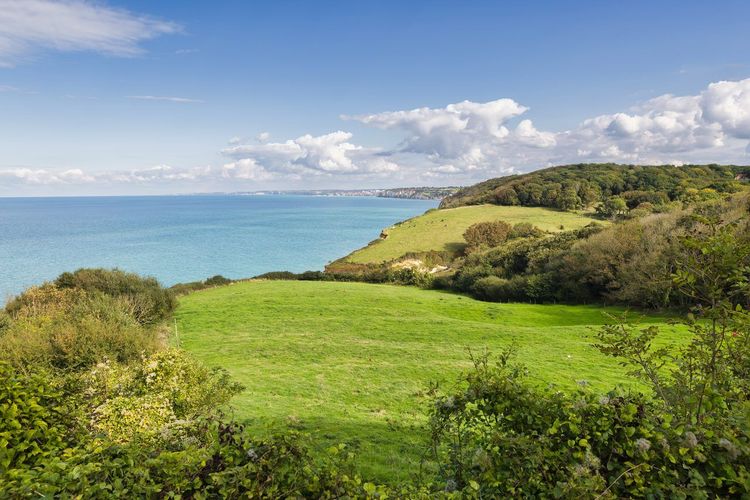
Further along the coast, the landscape grows wilder. Varengeville-sur-Mer rewards the effort to get there: the village, known for its clifftop sea church, its marine cemetery where painter Georges Braque is buried and the Bois des Moutiers park, reaches the sea only through narrow valley paths. At the bottom, a pebble cove edged with the remains of blockhouses, in a silence broken only by the cries of seagulls.
Right next door, the cove of Petit Ailly, overlooked by the Ailly lighthouse, is popular with surfers when a westerly swell rolls in. Access is physically demanding: a descent through the valley path on foot from the nearest car park, with nothing on site, no café or toilets. Bring water and sturdy footwear.
About fifteen kilometres from Dieppe, Quiberville-sur-Mer offers yet another atmosphere: a long pebble beach that reveals wide sandbanks at low tide, a developed seafront, a few businesses open in season and a campsite on the hillside above. It is also one of the best stretches of coastline for beginners in sand yachting, with the foreshore offering the space needed when the tide goes out. A good compromise if you want more facilities than at Varengeville without giving up the natural feel.
What to Do on the Beach and Nearby
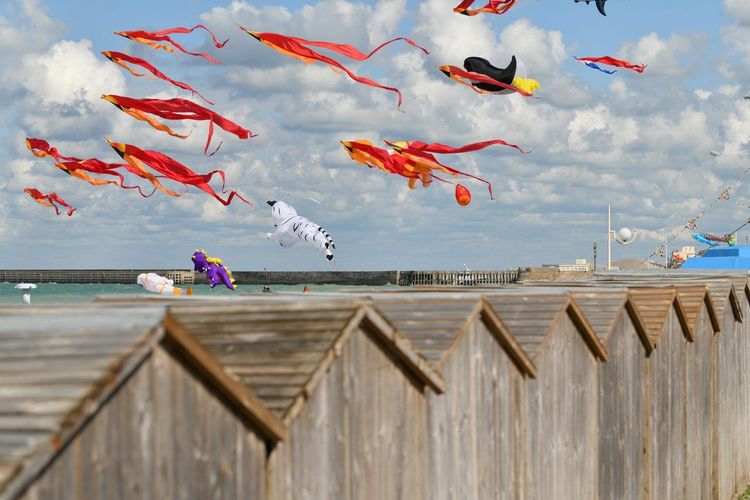
Between wind-driven sports, maritime heritage and views over the fishing port, it is hard to be bored on the Dieppe seafront. Here is enough to fill a full day, swimming included.
Water and Outdoor Sports
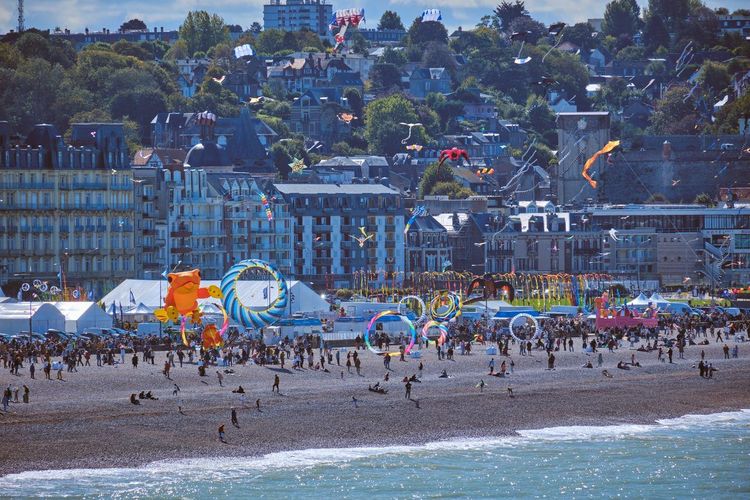
The near-constant wind blowing over this stretch of the English Channel has made the area a recognised spot for sand yachting, practised on the foreshore at low tide by local clubs offering taster sessions and courses from a young age. The same applies to kitesurfing and kite flying: in even-numbered years, Dieppe hosts one of the world's largest international kite festivals, which unfurls its sails across the seafront lawns in September. If you time your visit to coincide with it, our article on the Dieppe international kite festival details the programme and the best vantage points.
For a more relaxed experience, supervised swimming, beach volleyball and pétanque are all available directly on site, with no equipment required. Experienced swimmers will appreciate the lively Channel water; others will make do with a quick dip, as the temperature rarely exceeds 18 °C at the height of summer.
To plan a more complete outing, our article Top 6 Things to Do in Dieppe According to Ryo details providers and opening hours by season.
Must-Sees in the Immediate Vicinity

Directly above the beach, the Dieppe castle museum (Rue de Chastes, 76200 Dieppe, rated 4.3/5 on Google from 3,874 reviews), a medieval fortress remodelled over the centuries, houses a collection of carved ivories unique in France, a legacy of Dieppe's navigators who brought back the raw material from Africa. From its grounds, the view sweeps across the entire bay. Its grey stone silhouette serves as a landmark for anyone who gets turned around on the seafront.
Head back down to the fishing port, where fishmongers' stalls come alive along the quay, or to the casino, set against the lawns, for a break on a terrace facing the sea. The curious can continue to the Estran Cité de la Mer, a museum dedicated to fishing, shipbuilding and the Norman cliffs, about ten minutes on foot. A great way to understand why Dieppe remains, above all, a town of sailors.
And if the weather turns, on Saturday mornings the town-centre market, reputed to be one of the finest in Normandy, easily fills two hours browsing stalls of fish, cider and cheeses from the Pays de Caux.
Bringing Your Dog to the Beach
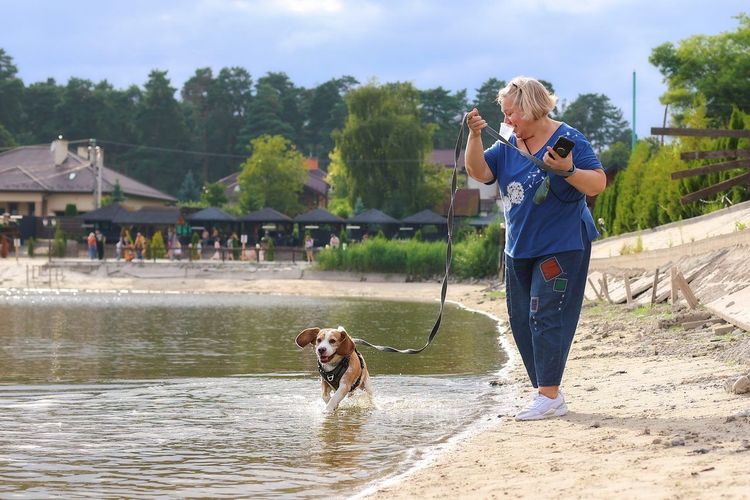
Dogs are welcome on the Dieppe seafront, but with rules that vary by season. Outside the summer period, they can generally move freely on a lead along the entire promenade and beach. In the height of summer, a municipal by-law restricts their presence in the supervised bathing area during peak hours: it is better to head to the ends of the seafront or to come early or late in the day. Check with the lifeguard post, as the by-law and its boundaries are updated each season.
Always pick up after your dog; bag dispensers are dotted along the promenade. If you are travelling with a dog at the height of the season, the beaches of Puys and Pourville, less crowded, remain a reliable option for a long walk by the sea with no time restrictions.
When to Visit: Season, Tides and Weather
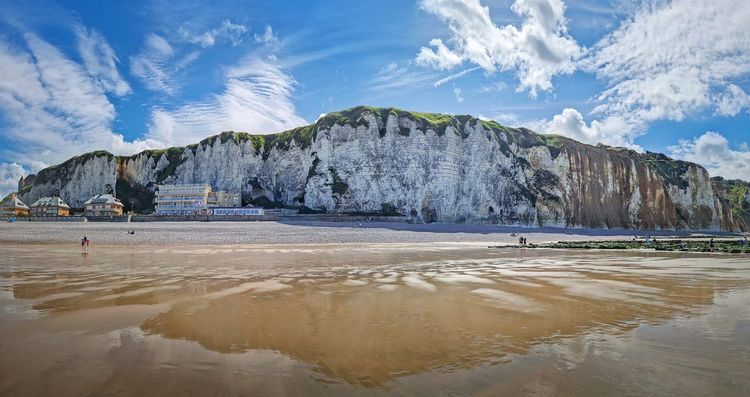
Choosing the right date matters at least as much as choosing the right spot, on a coast where the sea retreats far and the sky can change within an hour.
The Best Time for Swimming
July and August concentrate the activity, supervised swimming and full opening of seafront businesses, at the cost of difficult parking in the middle of the day. June and September offer the best of both worlds: the days are still long, the water retains the warmth built up through late summer, and the lawns become breathable again. Out of season, Dieppe does not close down — it is a town that lives all year round, and the wind-swept winter promenade has its devoted regulars.
Tides, Wind and Water Temperature
The tidal range here is considerable, up to around ten metres during spring tides: between high and low water, it is not the same beach. Check the tide table before you set out, especially if you plan to fish on foot, swim or walk at the foot of the cliffs, where the incoming tide can creep up surprisingly fast. At high tide, the sea sometimes reaches the top of the beach and the available space shrinks considerably.
Weather-wise, be prepared for changeable conditions in any season, with a near-constant wind that noticeably lowers the feels-like temperature. The water rarely exceeds 18 °C at the warmest point of summer, even when the air temperature reaches 24 or 25 °C: a windproof jacket in your bag is never a bad idea, even in August.
Getting There, Opening Hours and Prices: Practical Information
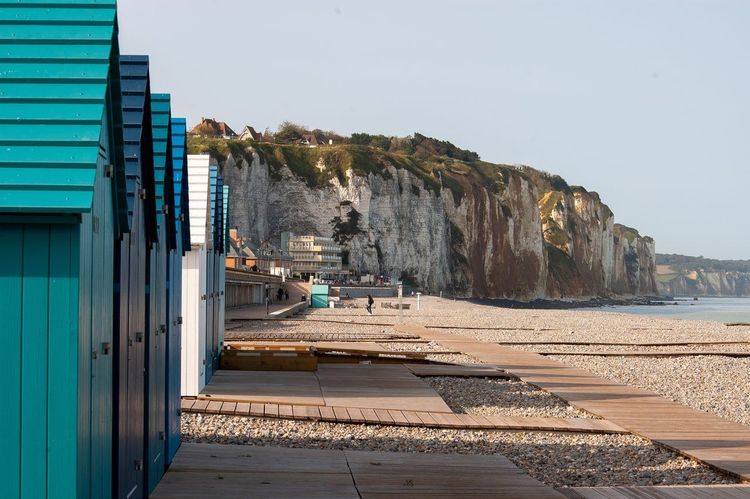
Before hitting the road, here is the essential information to avoid any unpleasant surprises regarding parking, supervision hours and budget.
How to Get There and Where to Park
From Paris, allow around two hours by road via the A13 to Rouen then the N27 (approximately 190 km), or a comparable journey by train from Gare Saint-Lazare, direct or with a change at Rouen depending on the timetable; from Dieppe station, the sea is about ten minutes on foot. By car, several paid parking zones line boulevard de Verdun and the side streets, with an hourly rate of a few euros in peak season; free spaces remain further back, towards the Pollet neighbourhood or in the direction of Puys, five to ten minutes' walk away. Spaces reserved for people with reduced mobility are available along the seafront.
For precise directions, enter "Dieppe beach" in your sat-nav or Google Maps: the reference address is boulevard de Verdun, 76200 Dieppe, opposite the casino. From neighbouring towns, the D75 follows the coast towards Pourville and Varengeville, a scenic route considerably more enjoyable than the inland road.
To find all these spots without endless searching, the Dieppe audio-guided tour brings together the seafront, the port and the old town along a single two-hour route.
Prices, Supervision Hours and Budget
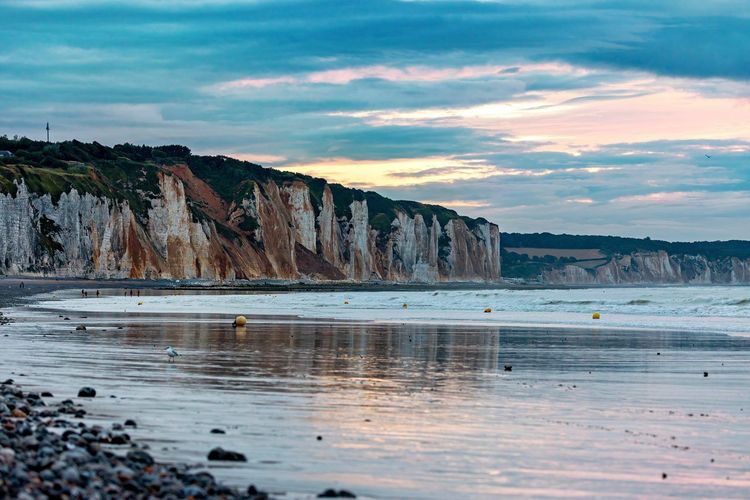
Access to the beach is free; only parking is charged, depending on the zone and time of year. Bathing supervision is provided during the summer holidays, covering the middle of the day and the afternoon, with daily hours displayed on site.
For a day's budget, factor in parking, any equipment hire and food: the port cabins serve herrings and mussels at reasonable prices, and a picnic on the lawns remains the most economical option. Entry to the castle museum, if you round off the day with a visit, is around a few euros per adult, with free admission for younger visitors. Dieppe's audio-guided tour is one more way to fill the day without adding to that budget.
Welcome, Contacts and On-Site Services
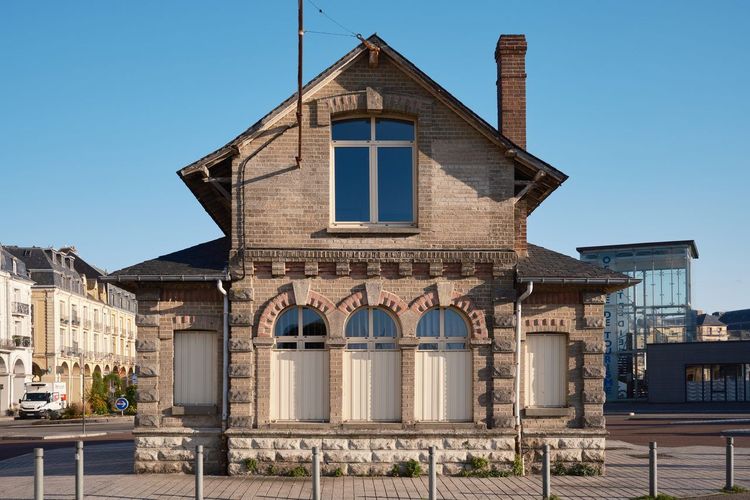
The first useful step on arrival is to stop by the Dieppe-Maritime tourist office, located near the port on the quai du Carénage, a few minutes from the seafront. There you will find a town map, the tide table, the summer events calendar and the contact details of sailing clubs: far more reliable than a rough search on your phone.
On the beach itself, the Beach Information Point acts as a seasonal counter for swimming hours, lost property and activity sign-ups. In the event of a coastal emergency, 196 connects directly with the CROSS maritime rescue coordination centre, while 112 remains valid everywhere.
On the payments front, bring a bank card: the seafront parking meters generally accept card and, in some cases, mobile payment, with coins becoming increasingly rare. Seafront and port businesses accept cards without difficulty, but a few fish stalls and street vendors are cash only, a detail that matters on a Sunday in August.
What Visitors Say
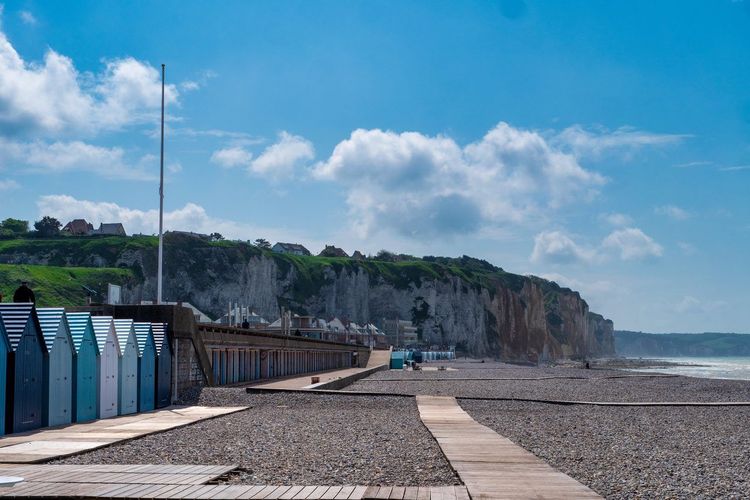
Online reviews paint a fairly consistent picture. What comes up as positive: the cleanliness of the site, the vast open view at low tide, the presence of lawns that allow visitors to settle comfortably without battling sand, and the silhouette of the castle that gives the whole place the feel of a postcard. Many also highlight the immediate proximity of the town centre, rare for a beach of this size.
The most frequent reservations? The pebbles, uncomfortable to lie on without a thick mat and sometimes slippery when entering the water, the weekend crowds in July and August, and water that feels cool to those used to the Mediterranean. Nothing off-putting, provided you come prepared: water shoes, a thick mat or deckchair, and a windproof jacket.
The piece of advice that comes up most often from regular visitors can be summed up in one sentence: come at falling tide. That is the moment when the beach spreads out, shore fishing becomes possible and you truly understand what makes this stretch of coastline so special.
Where to Stay and Eat near the Beach
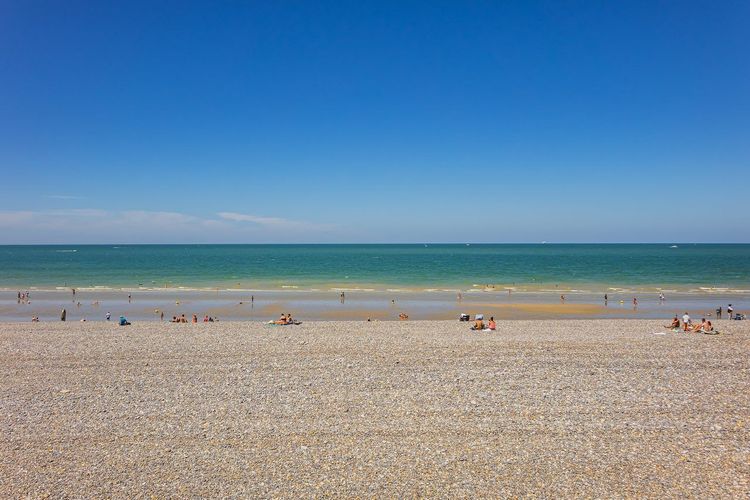
Unlike many seaside resorts, Dieppe remains a genuine town all year round, which translates into a wider choice of accommodation and dining than elsewhere on the Côte d'Albâtre.
Hotels and Campsites by the Sea
In the seafront and port area, Hôtel La Tour aux Crabes (Quai de la Marne, 76200 Dieppe, rated 3.9/5 on Google from 713 reviews) regularly features in searches by those who want to sleep a stone's throw from the sea without sacrificing comfort: sea-view rooms, a wellness space at the La Tour aux Crabes spa for a relaxing moment after a swim, and a pleasant courtyard for the end of the day. An address that works equally well for a weekend as a couple or a family stopover.
Boulevard de Verdun also lines up several seafront hotels, and the guest houses of the Pollet neighbourhood offer a more intimate alternative, ten minutes on foot. For a more budget-friendly stay, several campsites dot the coast between Dieppe and Quiberville-sur-Mer, generally open from April to September, with pitches, mobile homes and sea views at some. Book early in July and August, as seafront pitches go quickly.
Restaurants and Food Stops
The restaurant La Tour aux Crabes celebrates local catch, starting with the coquille Saint-Jacques, the star of Dieppe's gastronomy celebrated each autumn at a dedicated festival in the town centre. At the port, fishmongers and brasseries offer marinated herrings, mussels and daily set menus at reasonable prices, a few minutes' walk from the seafront. Be sure to try the marmite dieppoise, a dish of fish and shellfish in cream that encapsulates local cuisine in a single bowl.
For a more complete overview of local specialities, head to our article Top 10 Culinary Specialities in Dieppe According to Ryo, which lists the locals' favourite addresses.

FAQ
What is the best beach in Dieppe?
It depends on what you are looking for. The seafront along boulevard de Verdun is the most convenient for combining swimming, restaurants and heritage on foot. For more peace and quiet, Puys and Pourville appeal to regulars, while Quiberville-sur-Mer, wider and sandier at low tide, is more suited to families with young children.
Does Dieppe beach hold the Blue Flag label?
Yes, the town holds the Blue Flag label, awarded each year to municipalities that meet strict criteria for bathing water quality, facilities and environmental management of the coastline. The results of analyses carried out during the season are displayed on the seafront.
Can you bring your dog to Dieppe beach?
Yes, on a lead, with restrictions during peak season in the supervised bathing area. Outside this period and zone, dogs move freely along the rest of the Dieppe coastline, with waste collection mandatory. As the municipal by-law is reviewed each year, check the notices on site.
Where can you park near Dieppe beach and how much does it cost?
The paid zones along boulevard de Verdun and the adjacent streets, right in front of the sea, are paid at the parking meter, with credit card accepted, for a few euros for a morning during peak season. Free spaces exist a little further away, towards le Pollet or in the direction of Puys, less than ten minutes on foot.
What are the most beautiful beaches near Dieppe?
Puys charms with its tranquillity close to the centre, while Pourville, Varengeville-sur-Mer, the cove of Petit Ailly and Quiberville-sur-Mer offer varied landscapes, from cliff-lined coves to wide exposed foreshores. All are less than twenty minutes' drive from the town centre.
Is Dieppe beach a sandy beach or a pebble beach?
It is mainly a pebble expanse, bordered by a wide lawn rather than dunes. At low tide, a strip of sand and silt appears on the foreshore, used by shoreline anglers, but the upper part remains dominated by pebbles: water shoes and a thick mat are good allies.
Extending Your Visit
Between its lawn-fringed pebble beach, its Blue Flag label, its status as France's first seaside resort and the handful of wild coves surrounding it, the Dieppe seafront has enough to fill an entire stay without ever venturing more than twenty minutes from the town centre. Add a castle commanding the bay, a handful of good restaurants around the port and clear rules for travelling with your dog, and you have a complete Norman destination, far from the image of a mere stopover between better-known resorts.
To continue exploring beyond the pebbles, head to the Dieppe audio-guided tour: this Ryo itinerary links the seafront, the port and the old town in two hours, with 23 commented stops to understand how this maritime city navigated five centuries of history, from privateers and fishermen to summer visitors.
À lire également