© Shutterstock
 Votre guide Ryo
What to Do in Mont-Dore: 15 Must-Sees to Explore the Sancy Massif (2026)
Wondering what to do in Mont-Dore? This Auvergne town surprises those who imagine it as just another ski resort among others. Perched at 1,050 meters altitude in Puy-de-Dôme, it combines a dominating volcano at 1,886 meters, thermal waters exploited since the Romans, waterfalls reachable on foot in twenty minutes from downtown, and a trail network that crisscrosses one of Europe's best-preserved volcanic massifs. What to do in Mont-Dore when you only have a weekend? Options abound, whether windy or snowy, in July or November.
This article lists 15 concrete experiences, from climbing Puy de Sancy via the ridges to medieval villages hidden in surrounding valleys. You'll find France's oldest electric funicular, still in service since 1898, a glacial lake at 1,244 meters that few guides mention correctly, a summer luge track operational from fair weather days, and several tips to make the most of rainy days, frequent in Auvergne mountains.
1. Climb Puy de Sancy, Roof of the Central Massif
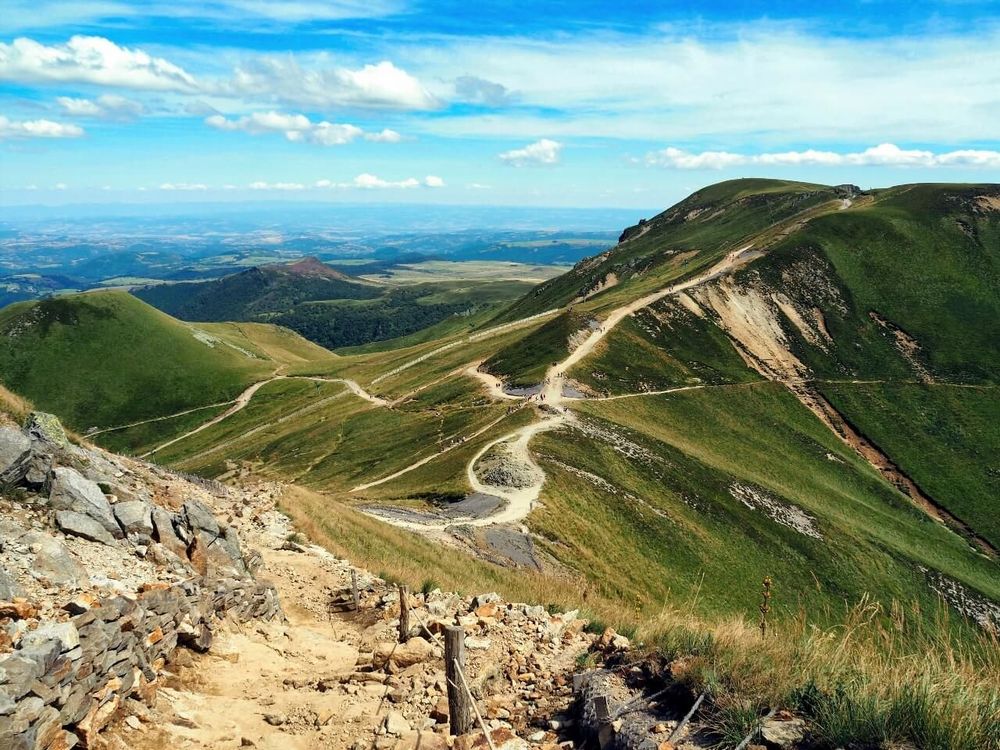
The Puy de Sancy (Summit of Puy de Sancy, 63240 Mont-Dore, rated 4.8/5 on Google for 135 reviews) peaks at 1,886 meters, making it the highest point of the Central Massif and one of France's most accessible summits for its altitude. The hike on foot from the resort base takes about 2 hours one way for an average hiker, with positive elevation gain of about 600 meters. The main trail first follows the cable car line, then branches toward the ridges before reaching the summit via an exposed ridge.
The view from the summit cairn embraces, on clear days, Auvergne volcanoes and, on some winter days, Pyrenean peaks more than 150 kilometers away. This 360° panorama alone justifies the trip: to the north, the Chaîne des Puys with Puy de Dôme; to the west, the Cantal mountains; to the east, the Forez foothills.
Two practical tips before departing. First, check the weather the day before: the summit can be in fog while the village is sunny, and vice versa. Second, if you go in July or August, leave before 9 o'clock to avoid crowds on the ridges and enjoy morning light. The ascent via the east slope (from Col de la Croix Saint-Robert) offers a less crowded alternative with different views over the Fontaine Salée valley.
In winter, Puy de Sancy becomes a snowshoe and ski touring terrain. Snow conditions are generally good from December to March, with significant snowfall some years exceeding one meter at altitude.
2. Take the Sancy Cable Car to the Summit
The Sancy cable car (Route du Sancy, 63240 Mont-Dore, rated 4.3/5 on Google for 3,284 reviews) is the quick option to reach the summit area without effort. It transports passengers from the base station (around 1,325 meters) up to about 1,775 meters in four minutes, reducing to about a hundred meters of elevation the section to climb on foot to reach the summit.
It's not the most memorable ascent, but it has two real advantages. For families with young children or hikers who want to spare their knees on the descent, it offers appreciable flexibility. And the view from the cabins, which overlook alpine meadows dotted with Salers cattle herds in summer, has its own photographic quality.
The cable car operates most of the year, with a maintenance break generally in autumn. Rates are moderate, expect around 10 euros round trip for an adult, and schedules adapt to the season. Check directly at the ticket office for operating conditions in case of strong winds.
3. Mont-Dore Waterfalls: Grande Cascade, Queureuilh and Rossignolet
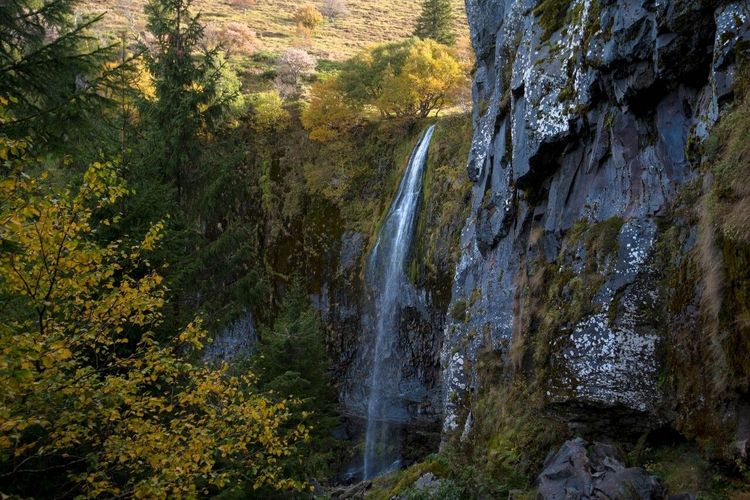
Several waterfalls are worth the detour from Mont-Dore center, and they're accessible without special equipment, even with children.
The Grande Cascade du Mont-Dore (Place du Panthéon, 63240 Mont-Dore, rated 4.5/5 on Google for 1,857 reviews) (Chemin de la Grande Cascade, 63240 Mont-Dore, rated 4.8/5 on Google for 1,090 reviews) is the most impressive: it falls about 30 meters into a rocky cirque overrun with ferns and moss. It's accessed by a marked trail from downtown, along the course of the nascent Dordogne (yes, the Dordogne has its source a few kilometers from the town). The one-way journey takes 25 to 30 minutes on foot at a good pace, with very moderate elevation gain.
The Queureuilh and Rossignolet waterfalls form an easy family loop, accessible most of the year. The Queureuilh cascades about 32 meters over basaltic organ pipes, while the Rossignolet, more intimate, owes its name to the stream's murmur that evokes a nightingale's song. This circuit takes about an hour round trip, and remains practicable even outside summer season.
The best time to see the waterfalls? Spring (May-June), when waters are at their highest. In summer, flow decreases but surrounding vegetation is at its peak. In winter after a cold spell, partially frozen waterfalls create a rare spectacle, provided you exercise extra caution on icy paths.
If you have particular interest in volcanic geology, note that rock walls reveal basaltic lava flows several million years old, visible to the naked eye in the cirque strata.
4. The Mont-Dore Thermal Baths, Spa Resort Since Antiquity
Mont-Dore has been a thermal spa resort since at least Gallo-Roman times. Roman basin remains have been found under the current establishment, testifying to mineral spring exploitation dating back nearly 2,000 years. The Thermal Baths as seen today were built in the 19th century in a singular neo-Byzantine style, with mosaics and painted coffered ceiling that rivals the great European thermal baths.
The establishment offers two types of services. Medical thermal cure (respiratory and rheumatological conditions, reimbursed by Social Security under conditions) lasts 21 days and attracts several thousand spa guests each year between May and October. But for a visiting tourist, it's the discovery offer that matters: short treatments, thermal baths, relaxation areas accessible without medical prescription.
Even if you don't take a treatment, the building's architecture justifies an exterior visit. The main facade, with its arcades and bell tower, dominates Place du Panthéon and constitutes one of the town's emblematic images. Discovery treatment schedules and rates vary by season; reservation recommended in July and August.
5. Pic du Capucin via France's Oldest Electric Funicular
The Capucin funicular (Rue du Funiculaire, 63240 Mont-Dore, rated 4.5/5 on Google for 2,113 reviews) is France's oldest electric funicular, classified as a historic monument. Put into service in 1898, it climbs from Mont-Dore center to the Capucin salon, around 1,245 meters, in a few minutes, on a slope that exceeds 50% in places. It celebrated its 125th anniversary in 2023 and retains its original wooden cabins.
At the top, the panorama over Mont-Dore valley and Sancy ridges is striking. A trail connects the funicular terminus to several developed viewpoints, and you can walk down following the wooded path switchbacks, count 45 minutes for the leisurely descent through firs and beeches.
The funicular is an attraction in itself: its wooden cabins retain a period atmosphere, and the journey remains an experience children particularly appreciate. It operates in summer season and during winter school holidays. Accessible rate, often combined with other local attractions in resort passes.
6. Lake Guéry, Auvergne's Highest Lake
Lake Guéry (Col de Guéry, 63210 Rochefort-Montagne, rated 4.7/5 on Google for 760 reviews) is Auvergne's highest natural lake, set at 1,244 meters altitude in a setting of peat bogs and wet meadows. It's about ten kilometers from Mont-Dore, accessible by car in less than 20 minutes via the Col de Guéry road.
This glacial lake occupies a 66-hectare basin framed by Roches Tuilière and Sanadoire, two volcanic dykes that rise like stone fingers above the water surface. The view of these formations from the lake shore is particularly striking in autumn, when surrounding forests turn yellow.
A discovery trail circles the lake in about 1h30, with panels explaining volcanic geology and wetland fauna (grey herons, mallard ducks). Fishing is allowed with a permit valid for the department.
Lake Guéry is often cited as a stop on itineraries connecting Mont-Dore to Clermont-Ferrand via high plateaus. However, it deserves at least an hour and a half, not just a photo from the road.
7. Hiking the Marked Trails of Sancy Massif
The Sancy massif offers a network of several hundred kilometers of marked trails, accessible from Mont-Dore or surrounding villages. Several major hiking categories correspond to different profiles.
The family trails (yellow marking) start from downtown and stay under 500 meters elevation gain: the waterfall loop, Lake Guéry tour or climb to Croix de Sancy are most popular. For intermediate hikers, the GR 30, the Auvergne lakes tour, crosses the sector with stages of 15 to 20 kilometers per day, linking Mont-Dore to Besse-en-Chandesse and beyond over several days.
The most athletic aim for ridge crossings between Puy de Sancy and Puy de l'Angle, with unobstructed views over both massif slopes and passages on open terrain requiring good shoes. The descent toward Fontaine Salée, a protected wetland at the bottom of a valley, offers a different experience: the spongy ground, covered with rushes and cotton grass, reminds that this territory is as much an altitude zone as a fragile ecosystem.
For ambitious hiking enthusiasts, the Sancy tour (about 30 kilometers, over 1,000 meters cumulative elevation gain) can be completed in one long day or split over two days with overnight in a stage lodge. Topo-guides are available at Mont-Dore tourist office (Avenue de la Libération, 63240 Mont-Dore, rated 4.2/5 on Google for 1,336 reviews).
A tip few sites mention: west slope trails, which descend toward La Bourboule, are much less crowded than east slope ones while offering comparable landscapes. If you want to walk without encountering too many people in mid-August, that's where to go. And if you still wonder what to do in Mont-Dore on fine days, hiking remains probably the most obvious answer.
8. Mont-Dore Ski Area in Winter
The Mont-Dore ski area extends over two slopes and connects to neighboring Super-Besse area via a common pass, within the Sancy perimeter. For a medium mountain resort, it's a serious area: elevation drops exceed 600 meters on the longest runs, and the resort also offers cross-country ski trails marked through forests.
The season generally covers December to end of March, with natural snow reinforced by snow cannons on lower slopes. The area suits all levels: beginners find wide, gently sloping green runs from the cable car departure, while experienced skiers appreciate north face black runs.
Beyond skiing, the resort offers skijöring, guided snowshoes and night snowshoe outings organized by local mountain guides. In the evening, some slopes are sometimes lit for night skiing, a program that varies by season, check the resort website.
9. Sancy Park: Tree Climbing, Zip Line and Leisure Activities
The Sancy Park (Route du Sancy, 63240 Mont-Dore, rated 3.8/5 on Google for 26 reviews) is the resort's adventure park, open mainly in summer. It offers tree climbing courses on several difficulty levels, zip lines, and inflatable games for little ones.
It's a family-friendly place well suited for a half-day when weather conditions don't allow hiking, or simply to change pace after several days of walking. Instructors supervise high courses and provide equipment (harness, helmet). Opening is seasonal, July, August and part of September, sometimes with additional weekends in June depending on years. Rates vary by age and number of courses chosen.
A practical detail: book online if coming on a July or August weekend. Morning slots fill quickly, and the park may be fully booked for adult courses by 10 AM.
10. Summer Luge at Mont-Dore
The Mont-Dore summer luge is a track that races down the mountain on wheeled sleds guided on rails. Pilots control their own speed via a brake handle, making it an activity as reassuring for children as thrilling for adults.
The attraction is open from summer to early autumn approximately, subject to favorable weather conditions. It's accessible from a certain age or minimum height for accompanied children. The ascent is by mechanical lift, descent lasts a few minutes depending on chosen speed. It's a short but much-appreciated family activity, often a pleasant surprise for adults too.
Tickets are purchased at the resort cashier, sometimes included in multi-activity passes. Avoid Mondays if the resort was closed the previous weekend for bad weather: everyone falls back on the same time slots.
11. Mont-Dore Town Center and Its Thermal Architecture
Mont-Dore's center has retained the appearance of its great 19th-century thermal heyday. Hotels and villas built between 1850 and 1920 give the main streets an architectural charm that few French mountain resorts still possess.
Stroll around Place du Panthéon and Avenue de la Libération to see the town hall, thermal bath facades and some beautiful holiday villas with dormers and stone balustrades. The area around Rue Favart concentrates local shops, restaurants and ice cream parlors where artisanal gentian ice cream is served, from an alpine plant whose bitter root also flavors the local liqueur.
In summer evenings, life concentrates on main street terraces, with a relaxed atmosphere typical of resorts welcoming both hikers and spa guests. The town isn't large, just over 1,000 inhabitants, but it's well equipped for visitors, with several bakeries, regional delicatessens and outdoor gear shops.
12. Villages Around Mont-Dore: La Bourboule, Besse, Orcival
Mont-Dore is an ideal starting point to discover three villages each worth a half-day visit.
La Bourboule, just 7 kilometers away, is another Auvergne thermal resort whose waters are renowned for pediatric dermatological conditions. Its Belle Époque architecture is even better preserved than Mont-Dore's, with ornate facades and French-style parks. The town hosts a family carnival each summer attracting several thousand visitors.
Besse-en-Chandesse, about twenty kilometers east, is a characterful medieval village. Its cobbled streets in dark volcanic stone, old houses and Romanesque church make it one of the region's most beautiful villages. Besse also has its own ski resort, Super-Besse, connected to Mont-Dore area for Sancy pass holders.
Orcival, about twenty kilometers north, houses one of Auvergne's most remarkable Romanesque basilicas. The Notre-Dame d'Orcival Basilica (Village d'Orcival, 63210 Orcival, rated 4.5/5 on Google for 1,524 reviews), built in the 12th century in pure Auvergne Romanesque style, is a still-active pilgrimage site. The interior is simple but magnificent, with sculpted capitals and a polychrome wooden Virgin in Majesty. Access is free.
These three villages easily integrate into a day car loop, or into a hiking itinerary for those who prefer linking stages on foot via GR trails.
13. What to Do in Mont-Dore When It Rains
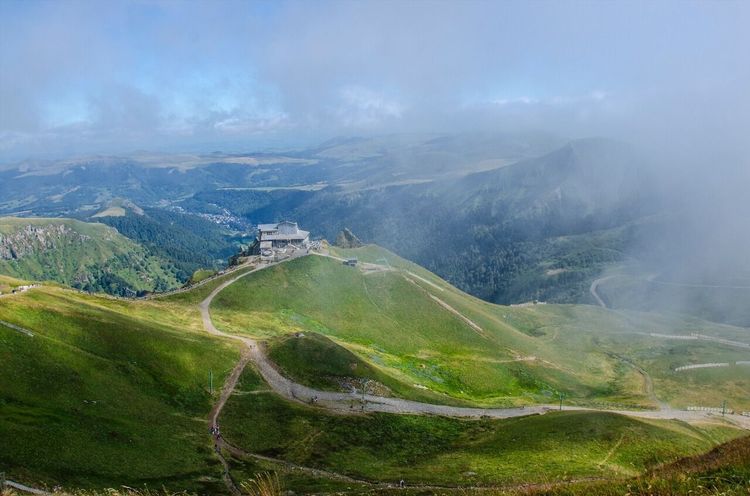
Mountain weather is unpredictable, and a rainy day in Mont-Dore is not a lost day.
First option: the Thermal Baths. Even without medical cure, discovery treatments (baths, massages, thermal poultices) are accessible by the day. It's a rare opportunity to experience these classified buildings from the inside, between sulfurous vapors and decorative columns.
Second option: local collections and museums. Mont-Dore and surroundings offer several small spaces dedicated to Auvergne traditions, volcanic geology and thermal history. Some are free access, others paid but inexpensive.
Third option: the cheese route. Puy-de-Dôme is the birthplace of Saint-Nectaire, AOC cheese aged on rye straw. Several farms around Mont-Dore offer visits and tastings, even in bad weather. Count 30 to 45 minutes for a farm visit-tasting, often followed by direct sales at producer prices.
Fourth option if traveling with family: covered leisure facilities in La Bourboule (to check by season), or simply an afternoon in a crêperie or inn restaurant offering board games, a living tradition in medium mountain resorts.
14. Panoramas and Sunsets Over the Massif
Mont-Dore offers several viewpoints accessible by car or short walk for memorable sunsets. The Col de la Croix Morand (Route des Cols, 63240 Mont-Dore, rated 4.8/5 on Google for 229 reviews) (1,401 meters) is accessible by car from Mont-Dore in 15 minutes and offers panorama over Cantal mountains and Chaîne des Puys. In late afternoon on clear days, low-angle light over alpine meadows turns golden.
The Roche Vendeix viewpoint, less known, is reached by a 20-minute trail from the road and reveals panorama over the nascent Dordogne gorges. Ideal sunset in September, when surrounding forests begin taking their autumn colors.
15. What to Do in Mont-Dore in the Evening
Mont-Dore is not a lively resort after 10 PM, and that's often what those who choose it seek. Nightlife is limited to a few bars, restaurants and, in winter, evenings organized by the resort for groups.
For dining, restaurants on Rue Favart (Rue Favart, 63240 Mont-Dore) and Place du Panthéon mainly offer Auvergne regional cuisine: tripoux, truffade, potée, local cheeses. Several establishments work with local producers, particularly for Saint-Nectaire and Auvergne ham. In high season (summer and Christmas holidays), book the day before for reputed tables.
Some bars organize musical evenings in summer, with folk or jazz concerts on terraces. The atmosphere remains family-friendly and relaxed, typical of a resort welcoming both seasoned hikers and families with children.
FAQ
What is the Best Season to Visit Mont-Dore?
Mont-Dore operates on two distinct seasons. Summer (June-September) is dedicated to hiking, waterfalls and outdoor activities, with long, bright days. Winter (December-March) is the season for skiing and snow sports, with a well-equipped ski area. Spring (April-May) is magnificent but less crowded: the waterfalls are at their maximum flow and the meadows are in bloom, before the summer tourist influx.
How to Get to Mont-Dore by Public Transport?
Mont-Dore is accessible by train from Clermont-Ferrand, in about 2 hours depending on connections. Regional buses complement the offer in season. To explore the massif and surrounding villages, a vehicle remains almost essential.
Are There Free Activities in Mont-Dore?
Yes, several. Hiking trails are free access, as are the shores of Lake Guéry, waterfalls (free trail access), and the exterior visit of the Thermal Baths and town center. The basilica of Orcival is also free access. Paid activities (cable car, funicular, discovery spa treatments) cost around 8 to 15 euros per person.
Is Mont-Dore Suitable for Families with Children?
Yes, particularly. The Capucin funicular, summer luge, Sancy Park and waterfalls accessible on foot are all activities tailored for families. In winter, the ski area offers slopes and lessons for beginners of all ages. The human scale of the resort makes getting around with children easy.
Can You Visit Puy de Sancy Without Hiking?
Yes. The Sancy cable car goes up to 1,775 meters, and from the upper station, a short trail is enough to reach the summit at 1,886 meters. The path is marked and accessible to any walker in good physical condition. People with reduced mobility or very young children can enjoy the panorama from the cable car upper station terrace.
Where to Stay in Mont-Dore?
The resort offers a complete range of accommodations: thermal hotels (some with direct access to treatments), chalets and seasonal rental apartments, rural lodges and a youth hostel. In summer, book at least 6 to 8 weeks in advance for July-August. In winter, school holiday periods are in high demand; favor ski residences with kitchenette access for week-long stays.
You now know what to do in Mont-Dore in all seasons. The resort concentrates within a few kilometers radius what medium mountain resorts often struggle to offer together: a first-rate summit, authentic thermal waters, preserved architecture and a hiking network that addresses all levels. Whether you spend a weekend or a week, the agenda fills up quickly, and rainy days, ultimately, are part of the charm.
If you are preparing your stay and want to discover other mountain destinations with an audio guide in your pocket, take a look at the Chamonix audio tour by Ryo, another great alpine resort accessible in digital format via our Ryo app. For urban stays complementing a nature getaway, the audio guide also offers audio walking tours in characterful towns like Mont-de-Marsan, in the heart of the Landes.