© Shutterstock
 Votre guide Ryo
The 13 Most Beautiful Villages in Dordogne to Visit in 2026
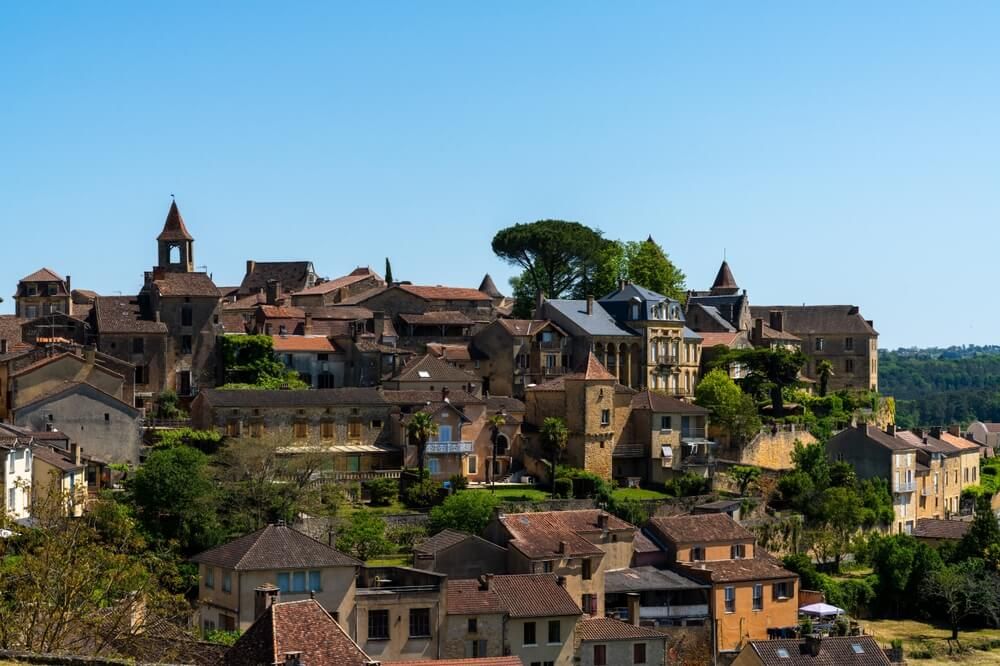
Choosing the most beautiful village in Dordogne is mission impossible: the department has one of the highest numbers of villages labeled "Most Beautiful Villages of France" — ten within the official territory — alongside several towns that rival this ranking in every way. Golden cliffs towering above the river, medieval lanes paved with ochre stone, fortified châteaux perched above the poplar trees: here, every bend in a country road can open onto a postcard panorama. But Dordogne is more than a backdrop. It is a living landscape where foie gras markets sit alongside prehistoric caves, where a village of 400 inhabitants can conceal a 12th-century Romanesque abbey listed as a historic monument.
This guide takes you through the 13 unmissable villages of the department, from the Périgord Noir in the east to the Périgord Pourpre in the west, by way of the green hills of the Périgord Vert in the north. You will find the well-known gems (Sarlat, Domme, La Roque-Gageac) and a few lesser-visited secrets (Limeuil, Saint-Amand-de-Coly, Aubeterre-sur-Dronne). For each village, practical advice on what not to miss, the best times to go and the mistakes to avoid in high season. And to prepare your exploration, the Ryo audio guide of Sarlat-la-Canéda opens the doors of the Middle Ages in 15 audio stops along a 1.1 km stroll.
Sarlat-la-Canéda: the Jewel of the Périgord Noir
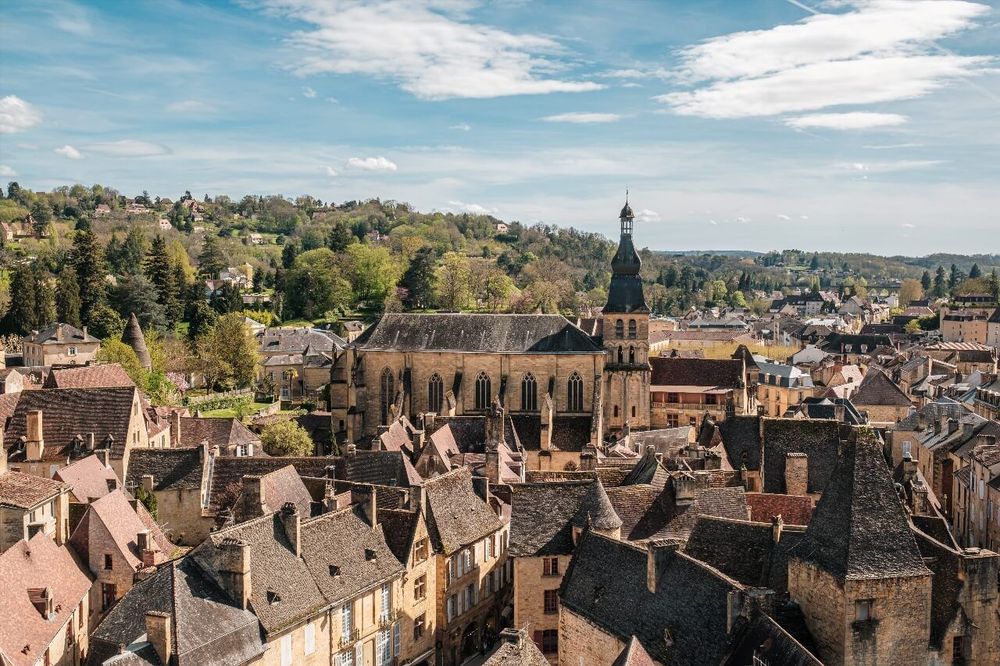
Sarlat-la-Canéda is the absolute benchmark when talking about the most beautiful villages in Dordogne. With one of the best-preserved medieval town centers in France, the town attracts more than one million visitors every year — a figure that says everything about the place, and also explains why you absolutely must go there early in the morning or outside of July and August.
The Place de la Liberté is the beating heart of the town. On Saturday mornings, the market spreads across it with walnuts, black truffles (in season, from November to March), foie gras and old-fashioned jams. Around the square, the Renaissance mansions form a rare architectural ensemble: the yellow limestone takes on honey-coloured tones in the late afternoon light.
Do not miss the Cathédrale Saint-Sacerdos (Rue de la Cathédrale, 24200 Sarlat-la-Canéda, rated 4.5/5 on Google with 1,203 reviews), whose Flamboyant Gothic façade is one of the finest in the Périgord, nor the lanterne des morts, a curious cylindrical tower from the 12th century whose function historians still debate — some suggest a beacon for pilgrims, others a symbolic ossuary. The Rue des Consuls, the Rue de la Salamandre and the Passage Henri-de-Segogne each deserve a slow, unplanned exploration on foot.
To go beyond the visual stroll, the Ryo audio tour Murmures du Moyen Âge covers 1.1 km in 15 audio stops. You will learn why Sarlat survived the Hundred Years' War almost intact, and how the Wars of Religion left visible marks on certain façades.
Allow at least 3 hours on site so you are not rushed. If you are staying in Sarlat, head into the center before 8:30 am — the light is magnificent and the lanes are still empty.
Domme: the Balcony of the Dordogne
Domme (La Barre, 24250 Domme, rated 4.4/5 on Google with 115 reviews) is a 13th-century bastide perched 250 meters above sea level on a rocky promontory. The view over the Dordogne valley from the Barre de Domme is simply one of the most beautiful in the entire Périgord Noir: meanders of the river, the châteaux of Beynac and Castelnaud in the background, poplar trees lined up across the meadows. It is a panorama that photographers chase at the golden hour of the evening.
The bastide itself is worth a leisurely wander through its grid-pattern lanes, characteristic of planned medieval urbanism. The Porte des Tours, the only fortified gates still standing, served as a prison for the Knights Templar in the early 14th century. Their graffiti can still be seen on the interior walls.
Beneath the bastide lie natural caves accessible from the Place de la Halle. Less famous than Lascaux or Font-de-Gaume, they make a fine addition to the visit, particularly with children. Allow 45 minutes for the guided tour. In midsummer, the natural cool of the galleries (a constant 13°C) is an added incentive.
On Thursday mornings, the Domme market offers Périgord local produce in a medieval setting that heightens the pleasure of shopping. Prefer this slot to visit the village and avoid weekends in July and August, when the car park overflows by 10 am.
La Roque-Gageac: the Cliffs and the River
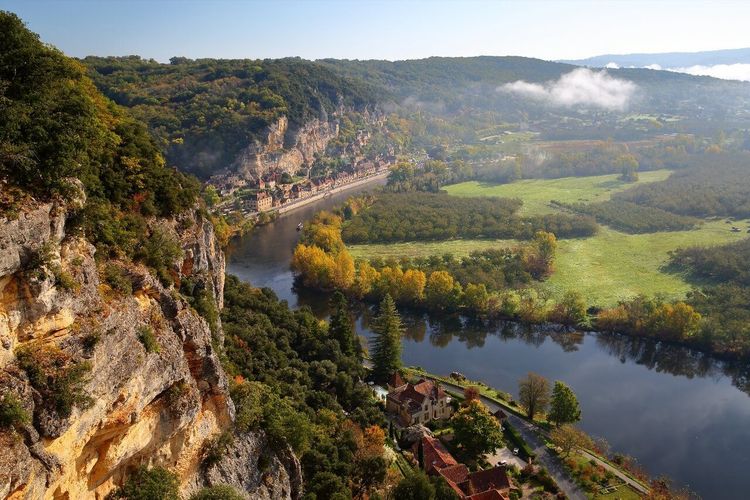
La Roque-Gageac (La Roque-Gageac, 24250 La Roque-Gageac, rated 4.7/5 on Google with 6.8K reviews) stretches at the foot of a sheer cliff, between the pale limestone and the emerald-green waters of the Dordogne. The village is so tightly wedged between the rock and the river that a single street runs through its center, lined with beige stone houses topped with lauze rooftiles. The effect is striking from the water — canoes and kayaks drifting down the river alongside the village offer the most photographed viewpoint in the entire valley.
The botanical curiosity of the place: a troglodyte tropical garden shelters century-old palm trees and banana plants growing right against the cliff face. The microclimate created by the calcified limestone maintains milder temperatures than elsewhere in the region. Do not look for it on a signpost — it is discretely indicated from the main lane.
From the village, traditional flat-bottomed boats known as gabarres offer commented excursions on the Dordogne lasting about an hour. It is the ideal way to see La Roque-Gageac, Castelnaud and Beynac from an unexpected angle. Book in advance in July and August.
The village has around 400 permanent residents. Despite the tourist influx, a few food shops survive and give a touch of everyday life to the place. Park at the entrance — the center is pedestrianized in season.
Beynac-et-Cazenac: the Château on the Heights
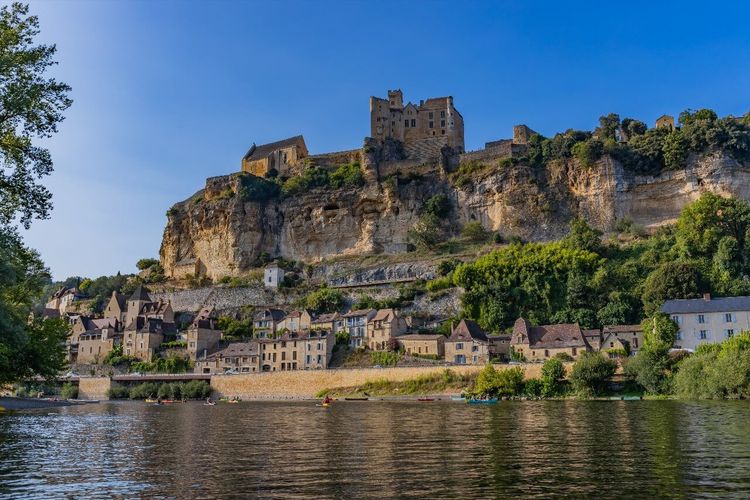
Beynac-et-Cazenac is divided into two distinct parts: the lower village, on the banks of the Dordogne, with its bargemen's houses and old stones smothered in wisteria, and the Château de Beynac (Beynac, 24220 Beynac-et-Cazenac, rated 4.6/5 on Google with 17,758 reviews), which stands 150 meters above the river on an almost vertical limestone outcrop. This duality creates a striking architectural dialogue.
The château is one of the best-preserved in Aquitaine. Built in the 12th century, it was successively held by the English and then recaptured by the French during the Hundred Years' War — an invisible front line once separated Beynac (French) from Castelnaud, visible across the river (English). The guided tour recounts this history effectively.
The lower village deserves as much attention as the château. Walk slowly up from the water's edge along the main lane: the blonde stone houses with their gardens overflowing with roses form a remarkably cohesive ensemble. Beynac regularly appears as a location for French historical films, which comes as no surprise.
Be prepared for a good level of fitness for the climb up to the château from the lower village — the elevation gain is short but steep. In midsummer, set off early in the morning.
Castelnaud-la-Chapelle: the Medieval Fortress
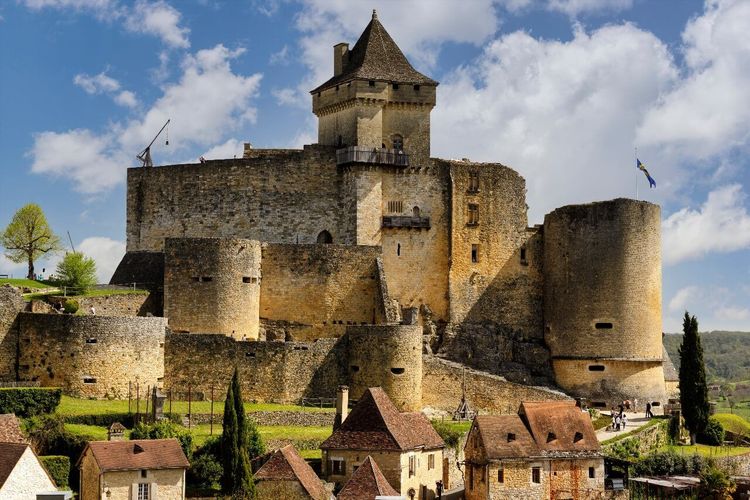
Castelnaud-la-Chapelle is home to the Château de Castelnaud, one of the most visited medieval fortresses in France with 240,000 visitors per year. Perched opposite Beynac, it houses a particularly well-designed museum of medieval warfare, with siege machines reconstructed in working order — a highlight for families and anyone with an interest in military history.
Below the château, the village is arranged around a few narrow streets where local shops survive. The panorama from the château's terraces over the valley differs from that of Beynac — here you can see the confluence of the Dordogne and the Céou, and the gardens of Marqueyssac (Les Jardins de Marqueyssac, 24220 Vézac, rated 4.6/5 on Google with 14,431 reviews) in the background.
The gardens of Marqueyssac, two kilometers from Castelnaud, ideally complement the visit. Their 150,000 century-old hand-clipped boxwood plants are a unique spectacle in Europe — the curved pathways follow the contours of the rocky promontory. On summer evenings in August, the candlelit nocturnal events transform the place into something unforgettable.
Limeuil: the Secret Confluence
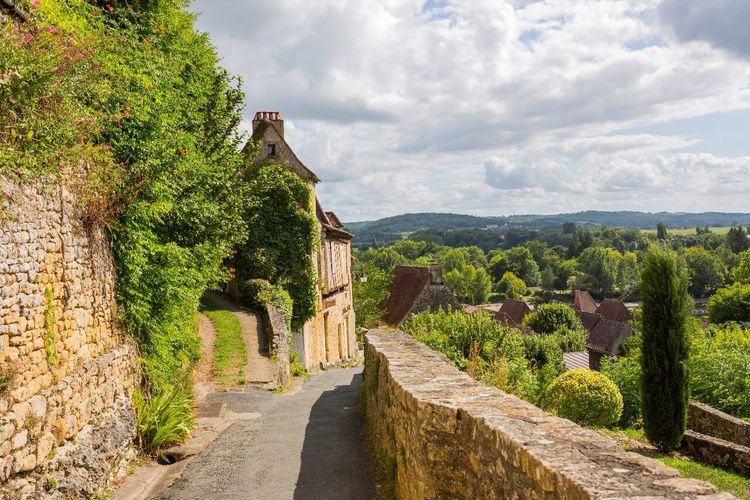
Limeuil (Place du Maupas, 24510 Limeuil, rated 4/5 on Google with 722 reviews) is perhaps the least well-known village on this list, and that is precisely why it is worth the detour. Listed among the Most Beautiful Villages of France, it occupies an exceptional geographical position: exactly at the confluence of the Dordogne and the Vézère, two rivers that meet at an almost right angle visible from the heights of the village.
The village climbs steeply up a hill from the water's edge. The sloping streets, the carefully restored medieval houses and the gardens suspended above the river compose a setting that is far less crowded than Domme or La Roque-Gageac. The old medieval park at the summit offers the most complete view of the confluence — free of charge, open in spring and summer.
Limeuil is easily visited from Sarlat (40 km) or Bergerac (55 km). The village is particularly pleasant in May and June, before the summer influx, when wisteria blooms on the façades and the café terraces are still peaceful. Allow an hour and a half for the visit.
Saint-Léon-sur-Vézère: the Quiet Vézère
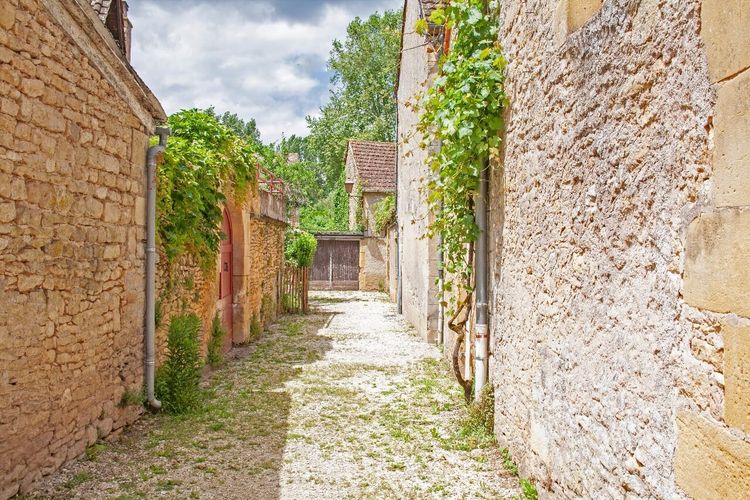
Saint-Léon-sur-Vézère (Saint-Léon-sur-Vézère, 24290 Saint-Léon-sur-Vézère, rated 4.5/5 on Google with 876 reviews) is a village of 350 inhabitants that brings together, within a perimeter of just a few hundred meters, a medieval château, an 11th-century Romanesque church and a Renaissance manor house — all on the banks of the Vézère, in a river bend shaded by hazel trees and poplars.
The Église Saint-Léon is one of the rare Périgord Romanesque churches to have partially preserved its medieval frescoes. Inside, the austerity of the architecture — rounded barrel vaults, bare stone — creates a particular silence that contrasts with the bustle of the nearby tourist sites. The village is 8 km from Montignac-Lascaux, making it a quiet base from which to explore the region.
A tip for summer swimming: the pebble beach on the Vézère, just below the church, is one of the most peaceful bathing spots in the valley.
Saint-Amand-de-Coly: the Abbey at the Gates of Silence
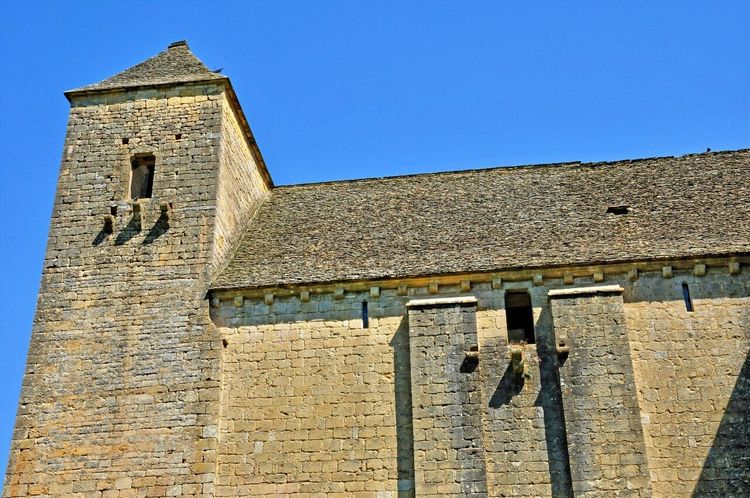
Saint-Amand-de-Coly is home to what many specialists consider to be the finest fortified Romanesque abbey in Dordogne. The 12th-century building dominates the small village from a height of 28 meters — an impressive scale for a hamlet that counts only around a hundred year-round residents.
The abbey was designed as a genuine defensive castle: machicolations, arrow slits, a wall walk. The Augustinian monks of the Middle Ages had to defend themselves as much as they had to pray. The guided tour (available in July and August) illuminates this fascinating contradiction between spiritual and military architecture.
The surrounding village is of a rare tranquility. A few houses in Périgord's dark stone, a dovecote, a wash house. Saint-Amand-de-Coly has to be earned: the roads leading there from Sarlat are narrow and winding. That is also what has preserved it.
Belvès: the Underground Bastide
Belvès (Place de la Croix-des-Frères, 24170 Belvès, rated 4.5/5 on Google with 1.6K reviews) is a 13th-century bastide built on a rocky outcrop at 175 meters above sea level, in the Nauze valley in the southern Périgord Noir. What sets it apart from its neighbors: a series of troglodyte cave dwellings carved into the rock beneath the main square, which served as homes from the Middle Ages right through to the French Revolution — the last occupants left in 1944.
The guided tour of the caves (tourist office, 45 minutes) is one of the most original experiences in the region. The bastide itself is well worth a stroll: the medieval covered market hall with its wooden columns, the Tour de l'Auditeur and the grid-pattern lanes typical of 13th-century planned urbanism make Belvès a condensed slice of Périgord history.
Belvès hosts a well-regarded baroque music festival every summer, attracting musicians from around the world to a striking medieval setting. Check the dates if you are visiting in July or August.
Saint-Jean-de-Côle: the Périgord Vert
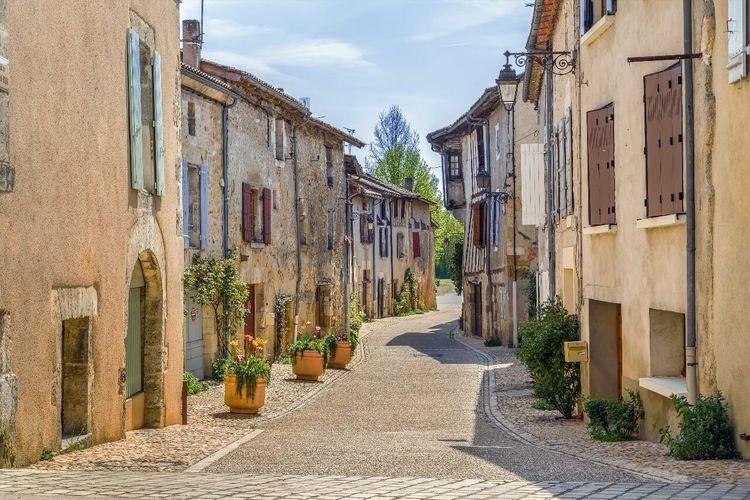
Saint-Jean-de-Côle (Saint-Jean-de-Côle, 24800 Saint-Jean-de-Côle, rated 4.6/5 on Google with 1.4K reviews) is often described as the most beautiful village in the Périgord Vert, the northern part of Dordogne, more wooded and less touristy than the Périgord Noir. The village is organized around a remarkably cohesive architectural ensemble: château, Romanesque priory, church and medieval bridge over the Côle follow one another within just a few dozen meters.
The priory church has a rare architectural peculiarity: its Romanesque dome collapsed twice (in the 17th and 19th centuries) and was never rebuilt to its original form. What you visit today is a hybrid building — part medieval, part 19th-century — that tells its own story of historical accidents.
Every spring (usually the last weekend of April), Saint-Jean-de-Côle hosts the Fête des fleurs, a plant and flower market that spills through the medieval lanes and draws thousands of visitors to one of the most picturesque events in the department.
Monpazier: the Model Bastide of the Périgord Pourpre
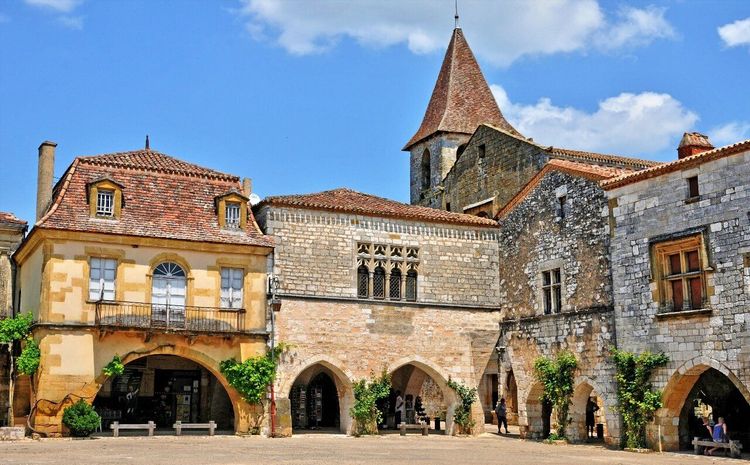
Monpazier (Place des Cornières, 24540 Monpazier, rated 4.7/5 on Google with 3.7K reviews) is the best-preserved bastide in France. Founded in 1284 by Edward I of England, it has retained its perfect grid plan, its covered arcades around the central square and its perpendicular lanes — 13th-century urbanism as readable as a history book. It has been listed among the Most Beautiful Villages of France since the earliest years of the label.
The Place des Cornières is the heart of the village. The covered arcades surrounding it shelter merchant houses that are practically unchanged since the Middle Ages — even the stone grain measures are still visible beneath the arches. On Thursday mornings, the market transforms the square into a lively scene that makes no concessions to artificial charm.
Monpazier is 30 km south of Bergerac. The road connecting the two towns winds through a landscape of hills covered in vineyards and orchards, typical of the Périgord Pourpre. Allow 40 minutes by the secondary roads. If you pass through Issigeac on the way, stop — this small circular village is well worth a visit too.
Everyday life in the village is still very much real: grocery shop, bakery, café, post office. Monpazier is not a museum village, and that is its greatest quality.
Bergerac: the Gateway to the Périgord Pourpre
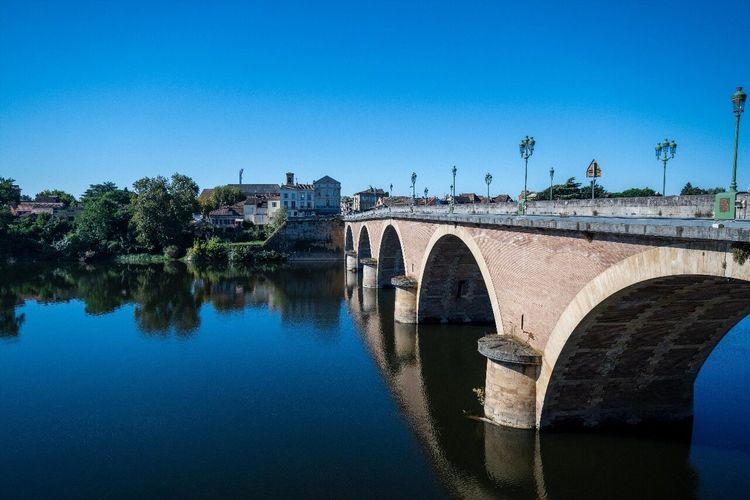
Bergerac is not strictly speaking a village — it is a town of 26,000 inhabitants and the district's administrative center. But its old town (Place du Docteur-Cayla, 24100 Bergerac, rated 4.4/5 on Google with 51 reviews), concentrated along a few streets around the Place du Docteur-Cayla, has the understated charm of a medieval borough that mass tourism has not yet standardized.
The statue of Cyrano de Bergerac on the main square inevitably draws photographers, even though the playwright Edmond Rostand never set foot in Bergerac and his character is a fictional creation. The real Bergerac lies elsewhere: in the lanes of the old town, the half-timbered houses leaning slightly over the cobblestones, and above all on the Dordogne quaysides that come alive on summer evenings.
The town is the nerve center of the Bergerac wine region, which spans 93 communes and produces red wines (Pécharmant, Bergerac rouge), whites (Bergerac blanc, Saussignac, Monbazillac) and rosés. The Museum of Wine, River Trade and Cooperage traces the history of this river-borne commerce that drove the town's prosperity until the 19th century.
Bergerac is also an excellent base for exploring the Périgord Pourpre by car. From the town, Monpazier is 30 minutes away, Issigeac 20 minutes and the Monbazillac vineyards (with their Renaissance château visible from afar) just 10 minutes. To discover the old town on foot with historical and literary anecdotes, the Ryo audio tour of Bergerac offers 17 stops over 2.7 km — one hour of commented strolling along the river Espérance.
Bergerac station is connected to Bordeaux (1h15 by regional train) and to Périgueux, making it the most practical entry point if you are traveling without a car.
Aubeterre-sur-Dronne: the Troglodyte Town
Aubeterre-sur-Dronne (Place Ludovic Trarieux, 16390 Aubeterre-sur-Dronne, rated 4.6/5 on Google with 2.5K reviews) is often described as the jewel of the Périgord Blanc, in the west of the department, on the borders of the Charente. Listed as a Most Beautiful Village of France, the town clings to a white tufa cliff above the Dronne — hence its name, "alba terra", meaning white earth in Latin.
The main attraction is the monolithic church of Saint-Jean, carved directly into the limestone rock between the 12th and 16th centuries. With its 20-meter vault height (over 27 meters in length) and its baptistery hewn from the rock, it is one of the largest monolithic churches in Europe. The interior, with its disproportionate scale for a troglodyte construction, creates an overwhelming sense of awe and indescribable silence.
The village itself, with its white houses and flower-filled alleyways, makes a pleasant contrast with the ochre tones of the Périgord Noir. The Sunday morning market on the central square is one of the liveliest in the region. Aubeterre is 60 km west of Périgueux and 50 km from Bergerac — a day trip from either town.
Practical Information: When to Visit and How to Plan
When to Go to Dordogne?
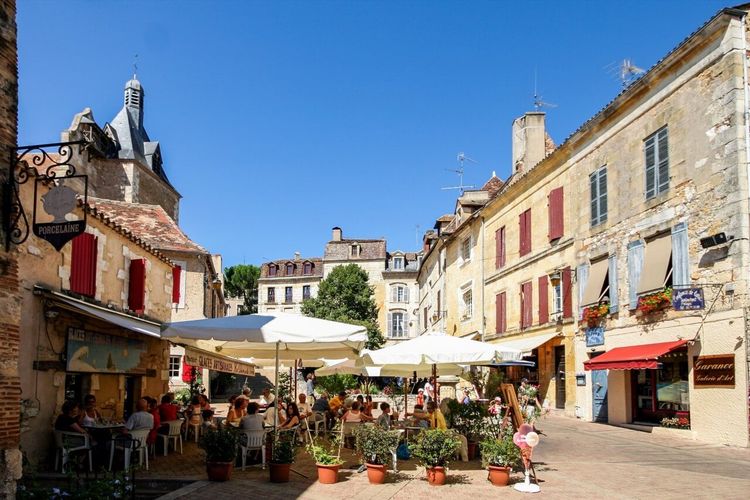
The high season (July–August) concentrates 40 to 50% of annual visitors into a third of the year. The villages are very busy, car parks are full before 10 am and restaurants are packed without a reservation. The crowds are real but manageable if you adapt your schedule: leave early (before 9 am in the most popular villages), have lunch at 11:30 am and get back on the road around 3 pm.
The best periods are late spring (mid-May to mid-June) and early autumn (mid-September to end of October). Pleasant temperatures, beautiful light, active markets, available and cheaper accommodation. Dordogne in October, with russet vines and walnut trees laden with fruit, is a spectacle hard to beat.
How to Get Around?
A car is almost essential for getting between the villages — public transport connections are rare and impractical outside the Bergerac–Périgueux–Sarlat axis. Ideally, hire a car on arrival at Bergerac station or at Bergerac-Périgord airport (direct flights from Paris-Orly, Lyon, Bordeaux and several European cities in season).
For those wishing to explore without a car, Sarlat is accessible by train from Bordeaux (Bordeaux–Sarlat line, approximately 2h30). From Sarlat, seasonal shuttles serve Domme, La Roque-Gageac, Beynac and Castelnaud in July and August.
Suggested Itineraries
If you have 3 days, focus on the Périgord Noir: use Sarlat as your base, visit Domme and La Roque-Gageac on the first day, Beynac and Castelnaud on the second, and Limeuil and Saint-Léon-sur-Vézère on the third.
With 5 to 7 days, add the Périgord Pourpre (Bergerac, Monpazier, Issigeac) and a foray into the Périgord Vert (Saint-Jean-de-Côle) or Blanc (Aubeterre-sur-Dronne). Work the markets into your schedule: Sarlat on Saturday, Domme on Thursday, Monpazier on Thursday, Bergerac on Wednesday and Saturday.
Accommodation
Sarlat offers the widest choice of accommodation within a 20 km radius (hotels, B&Bs, gîtes). Bergerac is a calmer alternative, better connected by train and less expensive in summer. Riverside campsites (notably along the Dordogne between Beynac and La Roque-Gageac) are extremely popular — book from January for July and August.
FAQ
Which is the most beautiful village in Dordogne?
Sarlat-la-Canéda is generally cited as the most beautiful village in Dordogne for the density and quality of its medieval architecture. But the official "Most Beautiful Villages of France" label also distinguishes Domme, La Roque-Gageac, Beynac-et-Cazenac, Castelnaud-la-Chapelle, Limeuil, Saint-Léon-sur-Vézère, Saint-Amand-de-Coly, Monpazier, Saint-Jean-de-Côle and Belvès. Each village has its own character: Domme for the panorama, La Roque-Gageac for the atmosphere, Monpazier for its bastide architecture.
How many Most Beautiful Villages of France does Dordogne have?
Dordogne has ten villages labeled "Most Beautiful Villages of France", making it one of the most represented departments in the national network. They are concentrated mainly in the Périgord Noir (Dordogne and Vézère valleys) and in the Périgord Pourpre.
Is it better to visit Dordogne in summer or spring?
Spring (May–June) and early autumn (September–October) offer the best conditions: fewer crowds, softer light, active markets and more affordable accommodation rates. Summer is magnificent but the major sites (Sarlat, Lascaux, châteaux) reach full capacity in July and August. If you visit in summer, leave early in the morning and book accommodation and restaurants several weeks in advance.
Can you visit the villages of Dordogne without a car?
With difficulty, except from Sarlat. Seasonal shuttles connect Sarlat to the villages of the Dordogne valley (Domme, La Roque-Gageac, Beynac, Castelnaud) in July and August. Outside of season, a car remains essential for exploring the department as a whole. Bergerac station offers regular connections to Bordeaux for those wishing to arrive by train.
What are the most beautiful villages in the Périgord Pourpre?
In the Périgord Pourpre, in the west of the department, Bergerac serves as an ideal starting point. The must-sees are Monpazier, the best-preserved bastide in France founded in 1284, and Issigeac, a small circular village with an atypical medieval layout. Old Bergerac, with its half-timbered houses and quaysides, and the Monbazillac vineyards with their Renaissance château complete the discovery of this wine-producing Périgord, less visited than the Périgord Noir.
Conclusion
Dordogne is a region that rewards those who take the time to stop. Not just to stop at the most famous villages, but to turn off onto small roads, to pull over when the view is beautiful, to miss a planned village and discover another that was never in the plan. That is what the region does best: surprise you.
To prepare your visit to Sarlat, start with the audio-guided tour of Sarlat-la-Canéda, Murmures du Moyen Âge — 15 audio stops, 1.1 km and one hour to understand why this town has crossed the centuries without losing its soul. And to explore Bergerac and the Périgord Pourpre, the Ryo audio guide of Bergerac takes you in the footsteps of river trade and wine across 17 commented stops.