© Shutterstock
 Votre guide Ryo
Berlin, 2,000 Years of Monuments: The Complete Guide 2026
Berlin's monuments have a rare quality in Europe: they simultaneously tell the story of several centuries and several political regimes. The Brandenburg Gate, built in 1791, has witnessed Napoleon's troops, Nazi parades, the division of a city in two, and then reunification in 1989. Within a few kilometers on foot, you can move from an 18th-century Baroque palace to a 20th-century memorial, from a Neo-Renaissance cathedral to a remnant of the Wall covered in graffiti. To discover all of this in order and with the context that gives it meaning, the Ryo audio guide tour of Berlin covers 30 points of interest in 2h40 over 6.5 km.
This guide covers the main monuments in Berlin not to be missed in 2026: from the imperial buildings of Unter den Linden to the traces of the Wall, including the UNESCO World Heritage-listed Museum Island, the Reichstag with its freely accessible glass dome, and Charlottenburg Palace in the west of the city. Each site is presented with its opening hours, admission prices, and practical tips for avoiding crowds or planning your visit.
The Brandenburg Gate: Berlin's Most Iconic Symbol
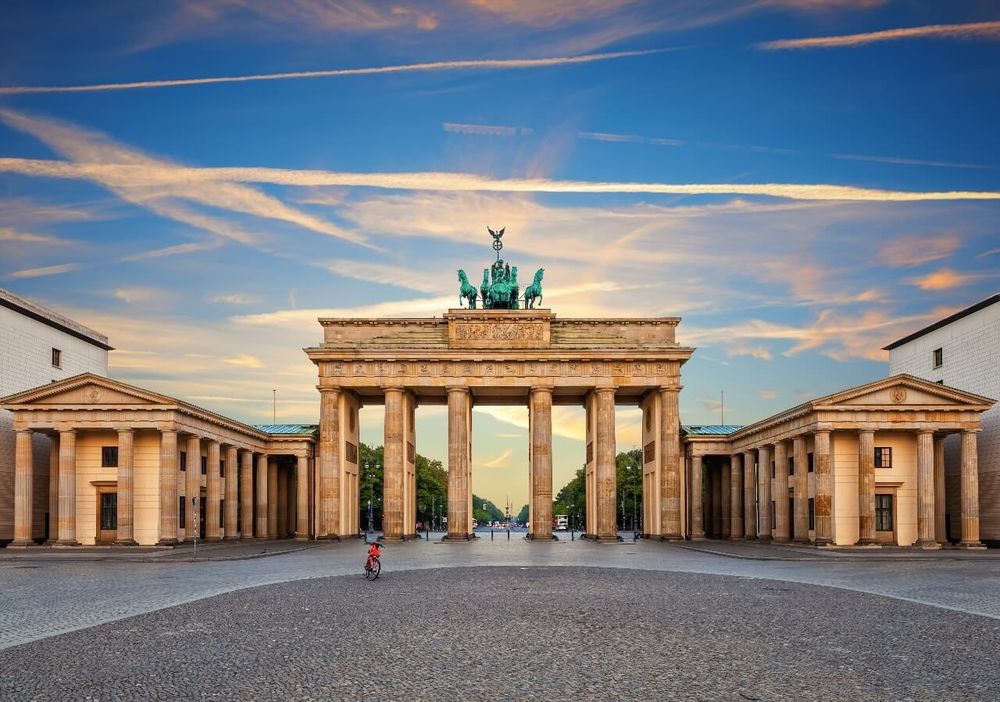
Few buildings in Europe carry as much meaning in their silhouette. The Brandenburg Gate is not merely photogenic — it is the pivot around which all of Berlin's modern history revolves. Built between 1788 and 1791 on the orders of Frederick William II of Prussia, it was inspired by the Propylaea of the Acropolis in Athens. Architect Carl Gotthard Langhans designed a structure 26 meters high, supported by 12 Doric columns and topped by a bronze quadriga representing the goddess of Victory.
During the division of the city (1961–1989), the Gate stood exactly in the no man's land between the two sectors, inaccessible to civilians on either side. Its reopening on December 22, 1989 became one of the defining images of German reunification. Today it faces Pariser Platz, a square redesigned after reunification that is home to the American Embassy, DZ Bank, and the Hotel Adlon. Access is free and permanent; the Gate cannot be visited from the inside, but you can walk or cycle through it.
The best time to photograph it without crowds: early in the morning, before 8 a.m., when the morning light strikes the columns from the east. In summer, hundreds of tourists gather there from 10 a.m. onward. If you plan an evening visit, the nighttime lighting dramatically highlights the reliefs of the pediment. The Gate is the natural starting point for any exploration of Berlin's historic center — Unter den Linden begins just behind it, heading east.
To explore the architectural and political history of the area in greater depth, Ryo's Symbolic and Dynamic Capital audio-guided tour of Berlin devotes several audio sequences to this neighborhood (28 audios, 2h15, 5.7 km).
The Reichstag: A Glass Dome Open to Everyone
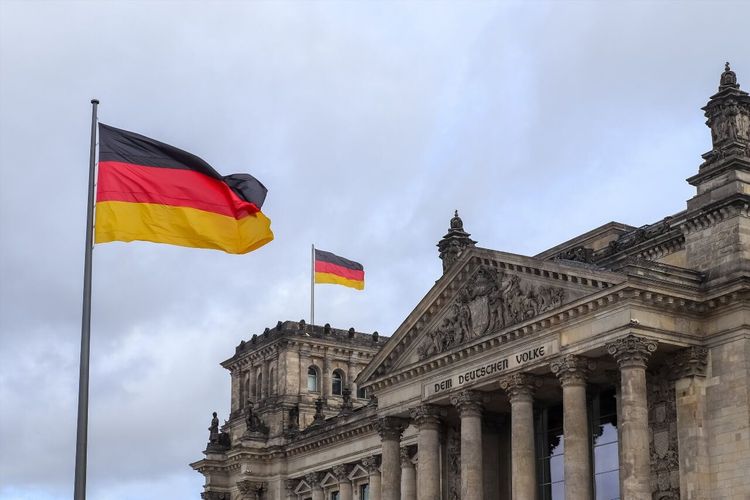
The Reichstag has been the seat of the Bundestag, Germany's federal parliament, since 1999. Its architectural history is both long and turbulent: inaugurated in 1894 under the Wilhelmine Empire, set on fire in 1933 (under circumstances that served as a pretext for the Nazi seizure of power), damaged in the fighting of 1945, then left abandoned throughout the Cold War due to its position on the edge of West Berlin. Reunification gave the building a new purpose: British architect Norman Foster was commissioned to rebuild it in the 1990s, adding the famous glass dome inaugurated in 1999.
This dome is one of the rare contemporary architectural symbols of democracy: transparent and open to the public, it literally allows citizens to "see" the work of their representatives from above. A central cone of mirrors reflects natural light down into the debating chamber below. A helical ramp leads up to the summit for a panoramic view over Berlin, the Tiergarten, and the city's historic axis.
Access to the dome is free, but an online reservation is mandatory through the official Bundestag website (bundestag.de), at least three days in advance. Available time slots often book up several weeks ahead during peak season. If you have not reserved, it is possible to try registering on-site on the morning of your visit, as cancellations sometimes free up spots. Bring your passport or national ID for the security check at the entrance.
The building is open every day from 8 a.m. to midnight (last entry at 10 p.m.). The café at the top offers a stunning view over the Federal Chancellery and the government quarter, nicknamed the "Spreebogen" after the curve of the Spree. Allow 45 minutes to 1 hour for the full visit. Themed guided tours (architecture, parliamentary history) are available in German and English by reservation.
Unter den Linden: The Avenue of Monuments
"Under the linden trees" is the literal translation of Unter den Linden (Unter den Linden, 10117 Berlin, rated 4.7/5 on Google with 798 reviews), Berlin's historic boulevard linking the Brandenburg Gate to the Berlin Palace over 1.4 kilometers. Laid out in the 17th century as a riding path for the Great Elector, it became in the 18th century a symbol of Prussian grandeur, lined with palaces, academies, and embassies.
The boulevard is home to several monuments in its own right. The Neue Wache (New Guardhouse), designed by Karl Friedrich Schinkel in 1818, now serves as the Federal Republic's central memorial to the victims of war and tyranny. The Unter den Linden Opera (Staatsoper), inaugurated in 1742, is one of Germany's finest Baroque opera houses. Further along, Humboldt University (Humboldt-Universität), founded in 1810 under the auspices of Wilhelm von Humboldt, occupies the former Palace of Prince Henry. On the adjacent square, Bebelplatz commemorates a defining event of 1933: a glass installation in the ground by Micha Ullman depicts an empty underground library, in memory of the Nazi book burnings.
Walking along Unter den Linden takes between 30 and 45 minutes without stopping. With monuments and breaks included, allow half a day to cover the axis from the Brandenburg Gate to Museum Island. It is one of the most historically dense walks in all of central Europe, and our On the Other Side of the Wall audio walking tour threads 31 stops and 6.5 km through this very stretch of the city, Brandenburg Gate included.
Museum Island: Five Museums, One World Heritage Site
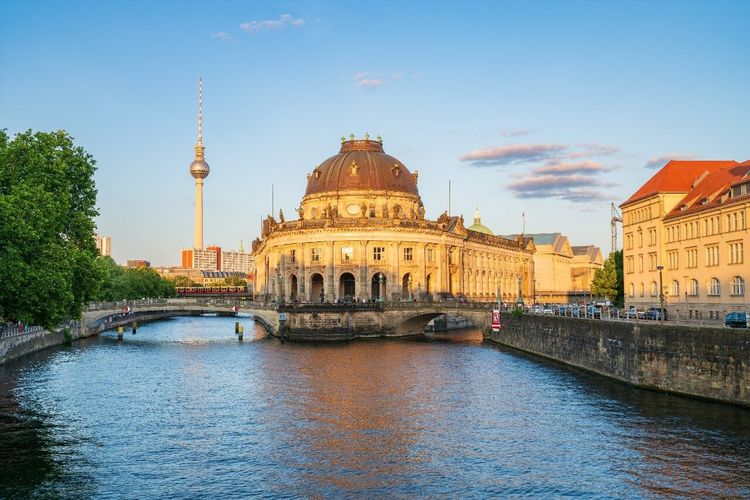
At the end of Unter den Linden, at the confluence of the Spree, lies one of Europe's most exceptional heritage sites. Museum Island (Bodestraße 1-3, 10178 Berlin, rated 4.8/5 on Google with 46K reviews) (Museumsinsel) brings together five museums built between 1830 and 1930, inscribed on the UNESCO World Heritage List since 1999: the Old Museum (Altes Museum, 1830), the New Museum (Neues Museum, 1859, rebuilt in 2009), the Old National Gallery (Alte Nationalgalerie, 1876), the Bode Museum (Bode-Museum, 1904), and the Pergamon Museum (Pergamonmuseum, 1930).
The Pergamon Museum is usually the most visited, with its 1:1 scale reconstructions of ancient architecture: the Pergamon Altar (2nd century BC) and the Miletus Gate are its highlights. However, please note: the Pergamonmuseum has been entirely closed for renovation since October 2023. A partial reopening (north wing and Pergamon Hall) is announced for June 2027, with a full reopening not expected for several more years. Until then, the Pergamon Altar is not on view; check the progress of the works on the Staatliche Museen zu Berlin website before planning your visit.
The Neues Museum houses the Egyptological collection, including the famous bust of Nefertiti (14th century BC), one of the most visited sculptures in the world. The queue can reach two hours at peak times. The solution: book your ticket online on the official website (smb.museum), or opt for an early morning visit on weekdays.
A combined "Museumsinsel" ticket (€18 adult in 2025) gives access to the open museums on the island for one day, good value if you wish to see several collections. Allow a full day to properly visit two or three museums. To explore the collections and their history in greater depth, our article on must-see museums in Berlin details the collections, admission prices, and itineraries by interest. Our Symbolic and Dynamic Capital audio-guided tour takes in the Spree at the foot of the island, along with Alexanderplatz and the TV Tower.
Berlin Cathedral: The Neo-Renaissance Dome
Facing Museum Island, on the former esplanade of the Hohenzollern Palace, stands Berlin Cathedral (Am Lustgarten 1, 10178 Berlin, rated 4.6/5 on Google with 46,139 reviews) (Berliner Dom). Completed in 1905 under Wilhelm II, it is the largest Protestant church in Germany: 114 meters high, a main dome surrounded by four secondary domes, and a Neo-Renaissance and Neo-Baroque façade that draws on several centuries of European styles.
The interior lives up to the exterior: the main nave can seat 1,500 worshippers, and the dynastic crypt houses the coffins of 95 members of the Hohenzollern family, including Frederick I of Prussia. The climb to the dome (270 steps) offers a panoramic view over Museum Island and Berlin's historic center — less crowded than the Reichstag dome, but just as enlightening about the city's topography.
Admission costs €9 for adults (2025 price), which includes access to the nave, the crypt, and the dome gallery. Organ concerts are held regularly; the programme is available at berlinerdom.de. Usual opening hours: 9 a.m.–8 p.m. in summer, 9 a.m.–7 p.m. in winter (closed during religious services, generally on Sunday mornings).
The Holocaust Memorial
Just steps from the Brandenburg Gate, on a 19,000 m² plot, the Memorial to the Murdered Jews of Europe (Denkmal für die ermordeten Juden Europas) was inaugurated in 2005. American architect Peter Eisenman designed a field of 2,711 concrete stelae of varying heights — from 20 centimeters to nearly 5 meters — set on slightly undulating ground.
The spatial experience is deliberately disorienting: as you walk deeper into the rows, the stelae rise and the ground dips, creating a growing sense of isolation. The memorial is freely accessible at any time of day. Beneath the stelae, the Place of Information (Ort der Information) offers a sober historical documentation of the extermination of Europe's Jews — free admission, audio guides available. Allow 45 minutes to 1 hour for the memorial and the underground documentation center.
In terms of memorial culture, Berlin is a singular city in Europe for the density and restraint of its spaces of remembrance. To explore the history of the Wall and the city's divisions in greater depth, our article on the history of the Berlin Wall traces the events from 1961 to the fall.
Checkpoint Charlie and the Remains of the Wall
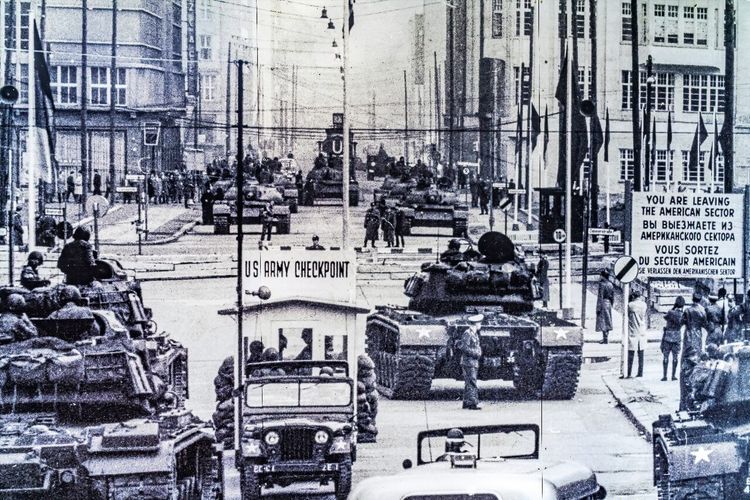
Checkpoint Charlie, the American checkpoint between West Berlin and East Berlin from 1961 to 1990, is today one of Berlin's most visited sites, even though almost nothing remains of the original post. The reconstructed guardhouse and historical panels are surrounded by tourist shops, which can disappoint visitors expecting a preserved site. The historical context is nonetheless legible thanks to the on-site explanations.
For a more authentic experience of the Wall's remains, two sites are well worth visiting. The Topography of Terror (Topographie des Terrors), built on the ruins of the former Gestapo and SS headquarters, presents in-depth historical documentation both outdoors and in its exhibition pavilion — entirely free of charge. A few hundred meters away, one of the last continuous segments of the Berlin Wall can be found.
The other essential site is the East Side Gallery, along the banks of the Spree: 1.3 km of preserved wall transformed into an open-air art gallery in 1990, with murals by artists from around the world. The most famous piece, "Mein Gott, hilf mir, diese tödliche Liebe zu überleben" by Dmitri Vrubel, depicts the kiss between Brezhnev and Honecker. Access is free, permanent, and evening light is the best time to photograph the paintings.
Finally, the Berlin Wall Memorial (Bernauer Str. 111, 13355 Berlin, rated 4.6/5 on Google with 45,983 reviews) (Gedenkstätte Berliner Mauer), on Bernauer Strasse, is the most comprehensive official memorial site: it reconstructs the Wall's architecture over 1.4 km, with the double row of barbed wire, watchtowers, and historical explanations. Free admission; documentation available in an adjacent visitor center. Our On the Other Side of the Wall audio walking tour carries the story further north, from the Palace of Tears to the white crosses beside the Spree.
The TV Tower: Berlin from 368 Meters
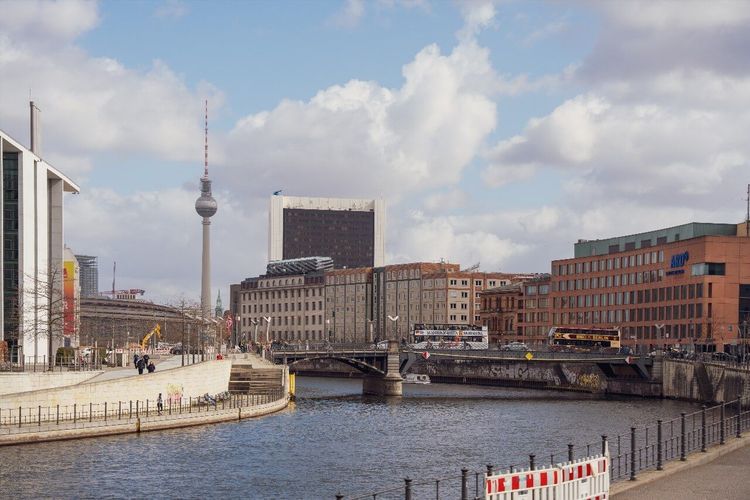
The Berlin TV Tower (Panoramastraße 1A, 10178 Berlin, rated 4.4/5 on Google with 51,837 reviews) (Berliner Fernsehturm) is Germany's tallest monument at 368 meters. Built by the GDR between 1965 and 1969, it was a symbol of technological prestige for the East German regime. Today it remains Berlin's central visual landmark, visible from almost everywhere in the city.
The sphere at 203 meters houses an observation platform and a revolving restaurant. The standard entry ticket is around €27.50 for adults (2026); a "fast view" ticket (around €40) allows you to skip the queues. Views extend up to 40 km on clear days. Waiting times can exceed one hour during peak season; online booking is recommended at tv-turm.de. The Tower is open from 10 a.m. to midnight.
Charlottenburg Palace
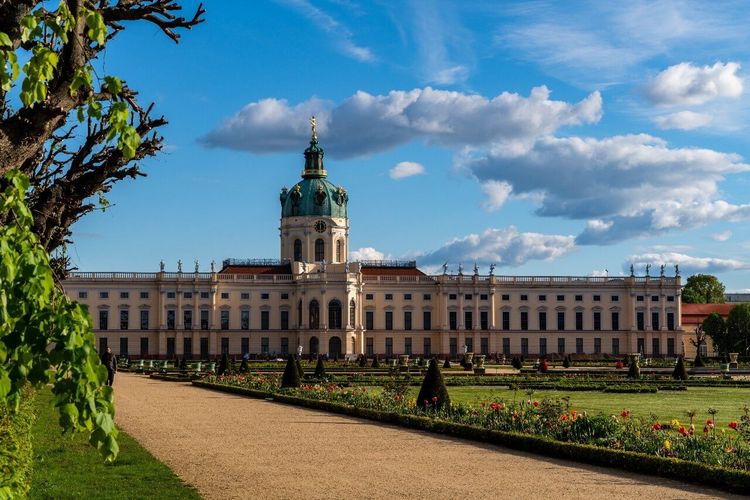
To the west of the center, Charlottenburg Palace (Spandauer Damm 10-22, 14059 Berlin, rated 4.6/5 on Google with 31,207 reviews) (Schloss Charlottenburg) is Berlin's largest palace and the only royal Baroque building preserved in the city. Built from 1699 for Queen Sophie Charlotte, wife of Frederick I of Prussia, it was extended over successive reigns until the mid-18th century. The central domed tower, topped by a gilded sculpture of Fortune, dominates the complex at 48 meters.
The interior includes the period-furnished royal apartments, the Painting Gallery (with exceptional Watteaus), Chinese porcelain, and the Balthasar Neumann Hall. The French-style gardens, redesigned in the English style in the 19th century, extend over several hectares along the Spree. Palace admission: €12 for adults; the gardens are freely accessible. The palace is closed on Mondays.
Charlottenburg is outside the usual tourist circuit of the center (allow 30 minutes by metro from Mitte), which means it is noticeably quieter than the sites on Museum Island or Unter den Linden. A real advantage if you want to visit a Baroque palace without queuing.
Practical Tips for Visiting Berlin's Monuments
Most of the historic monuments in the center are concentrated in the Mitte and Tiergarten districts, reachable on foot from the Brandenburg Gate. The U-Bahn (lines U2, U5, U6) and the S-Bahn (S1, S2, S25) serve the vast majority of sites. A day travel pass costs around €10.20 for adults (AB zone, 2025) and covers all modes of transport for 24 hours.
For the museums on Museum Island and the Reichstag, advance online booking is strongly recommended in July and August. For Charlottenburg, East Berlin, or Prenzlauer Berg, online tickets on official websites often allow you to skip the entry queues directly. The Ryo Berlin audio guide is a practical alternative for discovering the central monuments at your own pace, with no registration or fixed schedule required (30 audios, 2h40, 6.5 km).
FAQ
What are the most famous monuments in Berlin?
The most iconic monuments in Berlin are the Brandenburg Gate, the Reichstag, the TV Tower, and Museum Island. The Holocaust Memorial and the East Side Gallery are among the most visited memorial sites. For fans of Baroque architecture, Charlottenburg Palace in the west of the city is well worth the trip.
Is the Reichstag dome really free?
Yes, access to the Reichstag dome is completely free. An online reservation is required through the official Bundestag website (bundestag.de), at least three days before your visit. You will need to present a valid ID at the entrance. Time slots fill up quickly during peak season, so book several weeks in advance.
How long does it take to visit Berlin's main monuments?
One to two days is enough to cover the monuments of the historic center (Brandenburg Gate, Reichstag, Unter den Linden, Museum Island, Holocaust Memorial). Add half a day for the Wall sites (East Side Gallery, Bernauer Strasse Memorial, Checkpoint Charlie) and another half day for Charlottenburg. In total, three full days allow for an unhurried visit.
Are there any free monuments to visit in Berlin?
Yes, several sites are free: the Brandenburg Gate (open access), the Holocaust Memorial (exterior and documentation center), the Topography of Terror, the East Side Gallery, the Berlin Wall Memorial (Bernauer Strasse), and the Reichstag dome with a reservation. Admission to the museums on Museum Island is paid (combined ticket €18).
What is the best time to visit Berlin's monuments?
Spring (April–May) and autumn (September–October) are the best times: crowds are smaller than in July–August, and temperatures are pleasant for outdoor visits. Summer remains peak season, so book your reservations (Reichstag, Neues Museum) several weeks in advance. In winter, some sites are less crowded and the nighttime lighting of the monuments is particularly beautiful.
Conclusion
Berlin packs into a few square kilometers a density of historical monuments that is rare in Europe: from 18th-century Prussian Baroque to the most historically charged architectures of the 20th century, each site tells the story of an era and often of several regimes. The city's strength lies precisely in this continuity made visible in stone — a palace, a rebuilt parliament, a memorial, a wall — with nothing erased.
To approach these monuments with the context and historical depth they deserve, the Ryo Berlin audio-guided tour is an ideal starting point: 31 audio sequences across 2h40 of walking, available on your smartphone, letting you explore at your own pace without depending on a guided tour schedule.
À lire également