© Shutterstock
 Votre guide Ryo
The Berlin Wall: History, Fall, and Memorial Sites to Visit in 2026
It existed for twenty-eight years, two months, and twenty-seven days. Not long on the scale of history, yet the Berlin Wall remains one of the deepest scars of the twentieth century — a structure of concrete and barbed wire that separated families, killed ordinary people who simply wanted to cross a street, and gave the Cold War its most tangible form. Today, only fragments remain: a few preserved sections, lines of cobblestones in the Berlin asphalt, and museums that rank among the most visited in Europe. To explore these traces in depth, Ryo's audio-guided tour of Berlin guides you across 6.5 km with 30 audio commentaries through a city that has made memory into a way of life.
This guide traces the Wall's complete history: from the partition of Germany after 1945, to the construction during the night of August 12–13, 1961, the 140 confirmed victims who attempted to cross the "death strip," and the surprise announcement of November 9, 1989, which unleashed scenes of collective joy and disbelief. You will also find a full tour of the essential memorial sites: the East Side Gallery with its monumental murals, the Berlin Wall Memorial on Bernauer Strasse with its 200 documentation panels, Checkpoint Charlie, the Topography of Terror, and Mauerpark. Practical visitor information is provided for each site. Our On the Other Side of the Wall audio-guided tour covers 6.5 km of that story, from the Reichstag to the memorial of white crosses.
Berlin in 1945: A City Cut into Four
To understand why a fortified border was erected in the middle of the city, we must go back to the surrender of Nazi Germany on May 8, 1945. The four victorious powers — the United States, the United Kingdom, France, and the Soviet Union — then decided to divide Germany into four occupation zones. Berlin, capital of the defeated Reich, suffered the same fate despite being located entirely within the Soviet zone: it was divided into four sectors.
As early as 1948, tensions between the Western Allies and the USSR were becoming palpable. The Berlin Blockade (June 24, 1948 – May 12, 1949) was the first major crisis: Stalin cut all land access to the western part of the city in an attempt to force its capitulation. The Western response — an airlift that delivered 2.3 million tons of supplies over eleven months — was a resounding symbolic victory for the democracies.
In 1949, Germany officially split into two states: in the West, the Federal Republic of Germany (FRG), democratic and tied to a market economy; in the East, the German Democratic Republic (GDR), a Soviet satellite state led by the Socialist Unity Party (SED). Berlin followed the same logic: West Berlin became an enclave of the FRG in the heart of the GDR, while East Berlin became the official capital of the Democratic Republic.
During the 1950s, the border between the two Berlins was still permeable — Berliners could move from one sector to another, work on one side and live on the other. It was this permeability that would become intolerable for the East German regime.
Khrushchev's Ultimatum and the Mass Flight to the West
Between 1949 and 1961, 3.5 million East German citizens fled to the West, a considerable proportion of them via Berlin. They were often the most highly skilled — doctors, engineers, teachers, and specialized workers — draining the GDR of its most productive people. For a regime that presented itself as a socialist alternative superior to Western capitalism, this was both an economic and ideological catastrophe.
In November 1958, Nikita Khrushchev issued an ultimatum to the Western powers: they must leave West Berlin within six months, or the USSR would sign a separate peace treaty with the GDR and transfer to it control of the access routes to West Berlin. This ultimatum, renewed several times without effect, betrayed Soviet anxiety over the demographic hemorrhage.
The Vienna Summit of June 1961 between Kennedy and Khrushchev turned into a humiliation for the new American president, who was perceived as inexperienced and hesitant. Khrushchev came away convinced that he could act on Berlin without risking armed conflict. The decision was made: the border had to be closed.
The weeks leading up to August 13, 1961 saw a dramatic acceleration of departures: in July alone, 30,000 people crossed into the West. Walter Ulbricht, the head of the East German regime, repeatedly stated publicly that "nobody has any intention of building a wall" — a phrase that has gone down in history as one of the most resounding political lies of the century.
The Night of August 12–13, 1961: Construction of the Wall
During the night of Saturday, August 12 to Sunday, August 13, 1961, Operation "Rose" was launched. Thousands of soldiers, police officers, and members of the workers' militia (Kampfgruppen) were deployed along Berlin's sector borders. Shortly after midnight, the first barbed wire was unrolled along the 43 kilometers of Berlin's inner boundary.
Berliners woke on Sunday morning to a city cut in two. Families found themselves on opposite sides of barbed wire that armed soldiers were already transforming into a permanent barrier. Public transport was suspended. Streets in the city center, canals, and building courtyards that straddled the border were all sealed off.
The Western response was measured. Kennedy, vacationing in Hyannis Port, did not return to Washington until forty-eight hours later. General Clay and Vice President Johnson arrived in Berlin on August 19 to signal American solidarity, but construction continued. For the Western powers, the priority was to avoid nuclear war, not to tear down the structure.
In the weeks that followed, barbed wire gave way to concrete. Windows and doors of buildings facing West Berlin were bricked up. Trees overhanging the demarcation line were felled. Underground networks — the subway, sewers, and telephone lines — were severed.
What is still striking when reading accounts from the time is the improvised speed of the East German regime: the first materials used were cobblestones torn from the streets of East Berlin, railway sleepers, anything that could serve as an obstacle. The definitive version, the "Border Wall 75" (Grenzmauer 75), inaugurated in 1975, was of an entirely different nature: prefabricated reinforced-concrete slabs 3.6 meters high, topped with a cylindrical pipe that prevented anyone from gripping them.
Construction, in its successive forms, lasted throughout the entire period from August 1961 to 1980. The total length of the barrier reached 155 kilometers, of which 43 ran through Berlin itself and 112 encircled West Berlin to completely surround the Western enclave.
Anatomy of the Wall: Concrete, No Man's Land, and Watchtowers
The border was not a simple wall — it was a complete defensive system designed not merely to prevent escape attempts, but to kill those who tried. In its final version, the installation consisted of several successive layers.
On the East German side, there was first a signal fence that triggered an alarm at the slightest contact. Beyond it lay a strip of sand raked daily to reveal footprints. The Todesstreifen ("death strip") extended to a width varying from 30 to 150 meters depending on the location — a completely cleared no man's land, lit at night by floodlights and patrolled by guard dogs. Across this open ground, Hundelaufanlagen (dog runs) allowed the animals to roam the strip freely.
302 watchtowers and 20 bunkers kept constant watch over the system. Border guards of the Grenztruppen operated in pairs, with explicit orders to shoot anyone attempting to cross the border without authorization — the so-called "Schießbefehl." These guards were themselves monitored by their partners to prevent defection.
On the western side, the structure was simply accessible to the public — it was here that artists from around the world began covering it with graffiti as early as the 1970s, inadvertently creating what would become the East Side Gallery after the fall.
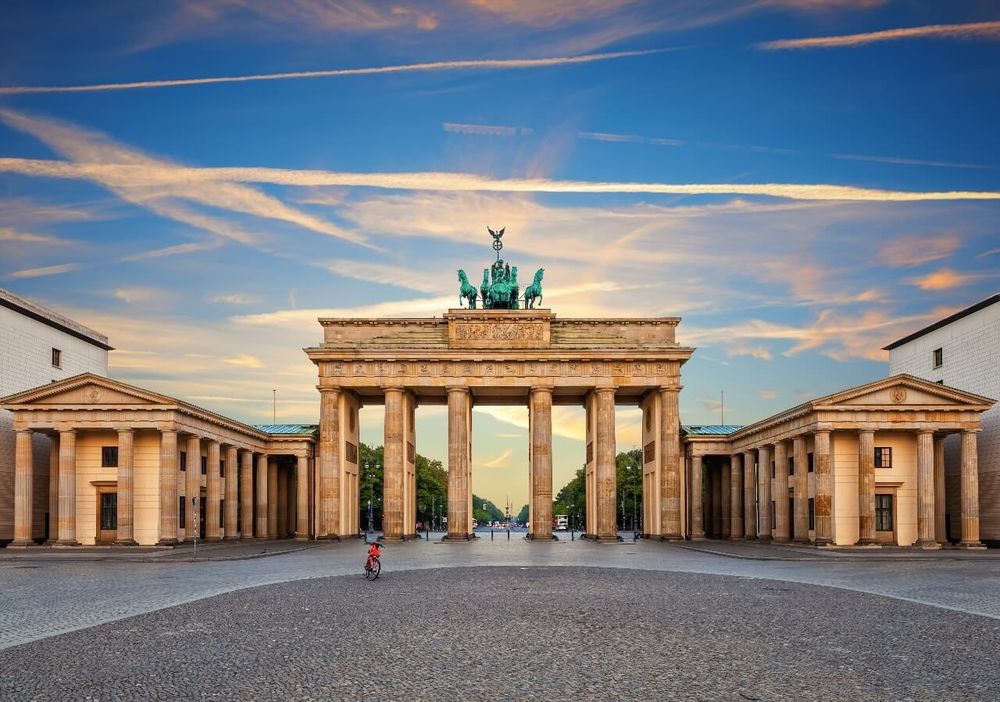
The Brandenburg Gate, a historic symbol of German unity, found itself within the East German security zone, inaccessible from either side. From 1961 to 1989, this monument served as the backdrop for all the great speeches, including Kennedy's in 1963 ("Ich bin ein Berliner") and Reagan's in 1987 ("Mr. Gorbachev, tear down this wall").
Life in East Berlin under the GDR Regime
Living in East Berlin during the 1960s–1980s meant living in the capital of a state that devoted a disproportionate share of its resources to surveilling its own citizens. The Stasi, the GDR's secret police, employed 91,000 official agents and a network of 189,000 part-time informers in a country of 17 million people. Statistically, one East Berliner in sixty worked directly or indirectly for the surveillance apparatus.
Daily life in East Berlin was marked by chronic shortages — of varied food products, of cars (the waiting list for a Trabant, the national car, stretched to ten to fifteen years), and of building materials. Apartments in the large prefabricated concrete blocks of districts like Marzahn or Hohenschönhausen were allocated according to political criteria as much as social ones.
But East Berlin was not all gray. The regime invested heavily in culture, sport, and education as showcases of socialist superiority. The Staatsoper Unter den Linden, the Pergamon Museum, and the East Berlin zoo (Tierpark) ranked among the most impressive institutions in Europe. Healthcare and education were free, employment was guaranteed, and rents were very low.
Information from the West nevertheless filtered through. West German television could be received in most East Berlin apartments — officially forbidden, unofficially tolerated. Young people followed Western music through this channel, creating a hybrid culture of which East Berlin was one of Europe's most singular laboratories.
The Stasi systematically opened mail, recorded telephone conversations, and kept detailed files on every citizen deemed potentially hostile. After reunification, the Stasi archives — 111 linear kilometers of files — were opened to citizens wishing to consult their own records. They remain accessible today at the Stasi Memorial in Berlin.
Life in West Berlin: An Island of Freedom in the Heart of Germany
West Berlin existed in a geopolitical situation that was at once absurd and stimulating: a city of two million inhabitants, encircled by a foreign state, linked to West Germany only by three highway corridors, two railway lines, and three air corridors. West German citizens who settled there were exempt from compulsory military service, which attracted a generation of artists, musicians, and dissidents.
This military exemption, combined with massive subsidies from Bonn to keep the city alive, made West Berlin a unique countercultural laboratory. In the 1970s and 1980s, the districts of Kreuzberg (Oranienstraße, 10969 Berlin) and Schöneberg concentrated an artistic and punk scene whose influence is still felt today. David Bowie, Iggy Pop, and Nick Cave all lived in West Berlin during the 1970s–1980s; the albums of Bowie's "Berlin Trilogy" (Low, Heroes, Lodger) bear the imprint of this city cut off from the world.
Psychologically, the presence of the border just a few hundred meters away created a distinctive atmosphere — a constant awareness of the confinement on the other side, a mixture of acute political consciousness and a desire to escape into music or art. The West Berlin nights had that intensity unique to places that know their existence is fragile.
Visits to West Berlin by Westerners were possible via Checkpoint Charlie, Checkpoint Bravo (the highway toward the West), and Checkpoint Alpha. Tourists could also enter the GDR with a mandatory currency exchange into East German marks.
Checkpoint Charlie: The World's Most Famous Crossing Point
Checkpoint Charlie — "Charlie" being the letter C in the NATO phonetic alphabet — was the only authorized crossing point for non-German nationals between West Berlin and East Berlin. Open to Allied civilians, diplomats, and Western tourists, it became one of the absolute symbols of the Cold War.
In October 1961, a direct confrontation between American and Soviet tanks at Checkpoint Charlie brought the world to the brink of a direct military clash. For sixteen hours, American M48 tanks and Soviet T-55s faced each other just a few dozen meters apart, engines running. Behind-the-scenes negotiations between Kennedy and Khrushchev allowed for an orderly withdrawal.
The small American checkpoint, its white guardhouse, and the sign reading "YOU ARE LEAVING THE AMERICAN SECTOR" became photographic icons. On the East German side, crossing involved a meticulous document check, sometimes intrusive searches of vehicles, and a passage conducted under the watch of armed guards.
Today, Ryo's Berlin audio tour passes through Checkpoint Charlie and places this site in its historical context with a precision that tourist signage cannot match. On site, the Checkpoint Charlie Wall Museum (Mauermuseum) is one of the most visited museums in Germany: more than 850,000 visitors per year, open 365 days a year, with a collection of 300 objects related to escape attempts and the history of the border.
Friedrichstraße, the avenue that ran through Checkpoint Charlie, is today an ordinary commercial thoroughfare. But the ground markings of the former checkpoint and the reconstructed guardhouse serve as a constant reminder of what this ordinary street represented less than forty years ago.
Escape Attempts and Victims of the Wall
Between 1961 and 1989, historians documented 140 confirmed victims killed while attempting to cross the border in Berlin. This figure, established by the Research Association SED-State (Forschungsverbund SED-Staat), is the one generally adopted by memorial institutions, even though higher estimates exist — some researchers cite up to 200 deaths when including border zones outside Berlin.
The first weeks after construction saw desperate attempts. Conrad Schumann, a nineteen-year-old border guard, leaped over the still-fresh barbed wire on August 15, 1961 — his photograph mid-jump is one of the most famous images of the Cold War. Peter Fechter, eighteen years old, was shot on August 17, 1962 while attempting to cross near Checkpoint Charlie: wounded in the death strip on the East German side, he lay dying for an hour in full view of photographers and American guards who were powerless to intervene without triggering an international incident.
Escape methods evolved alongside the security apparatus. In the early years, people jumped from the windows of buildings facing West Berlin (the openings were subsequently bricked up). Tunnels were used; the most famous, Tunnel 57, allowed 57 people to cross in a single night in October 1964. Hot-air balloons, forged documents, cars with hiding places in the engine or under the dashboard, underwater divers in the canals — the ingenuity of those seeking escape knew no bounds.
Some border guards themselves attempted to cross to the West. The majority of those who tried to flee were young men, but entire families also made the attempt. The last known victim is Chris Gueffroy, shot through the heart on February 5, 1989, nine months before the fall. The posthumous trial of the gunmen, conducted after reunification, resulted in convictions for deliberate homicide, establishing a major legal precedent on individual responsibility in the face of criminal orders.
November 9, 1989: The Night the Wall Fell
The sequence of events that led to the fall on November 9, 1989 is one of the most striking examples of how history can turn on accident.
Autumn 1989 was already one of deep crisis for the GDR. The demonstrations of the "Wir sind das Volk" ("We Are the People") movement had been drawing hundreds of thousands to the streets of Leipzig, Dresden, and East Berlin since September. On Monday, October 9 in Leipzig, 70,000 people marched despite the presence of armed troops — the regime backed down from repression. The head of the regime, Erich Honecker, was forced to resign on October 18.
Hungary had opened its borders with Austria in May 1989, allowing thousands of East Germans to reach the West via this detour. By November, tens of thousands of East German citizens were still crowding into the West German embassies in Prague and Warsaw to seek asylum.
On November 9, during a press conference broadcast live on television, East German government spokesman Günter Schabowski read out a communiqué announcing that the new travel regulations would take effect "immediately, without delay." He himself was unaware that the text was not supposed to come into force until the following day, after border guards had been briefed. A journalist asked him when the new rules would apply. Schabowski checked his notes, found no specification, and replied: "Immediately, without delay."
Images of the press conference circulated within minutes. East Berliners gathered at checkpoints — first in dozens, then in thousands. Border guards, who had received no instructions, tried to turn them back, then, overwhelmed, opened the barriers. At 11:30 p.m., Checkpoint Bornholmer Strasse let the first Berliners through. Scenes of joy, tears, and disbelief unfolded on both sides.
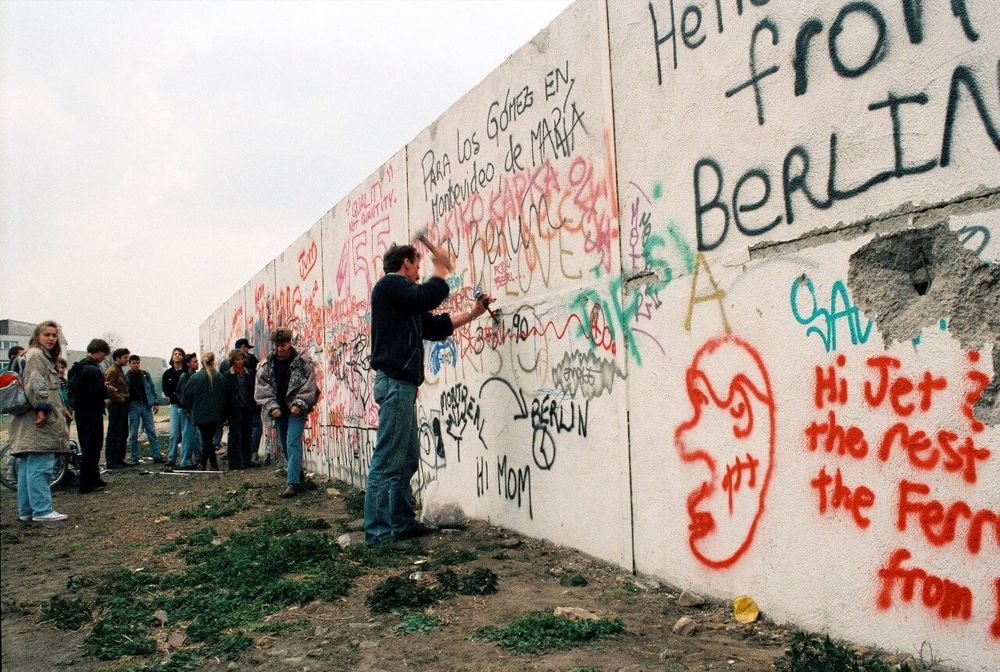
During the night, West Berliners began climbing the Wall. The first breaches were opened by bulldozers. Images of men and women hammering at the concrete — the "Mauerspechte" ("wall woodpeckers") — flashed around the world.
The structure had stood for 10,315 days. Its fall took only a few hours.
German Reunification and the Traces of the Wall Today
The fall was not immediately followed by reunification — eleven more months of intense political, diplomatic, and economic negotiations were needed. On October 3, 1990, the official reunification of Germany was proclaimed. The GDR ceased to exist. Berlin once again became the capital of a unified Germany.
The reunification process was brutal for many former East German citizens. The conversion of the East German mark to the deutschmark at an unfavorable rate, the collapse of state industries, and the mass unemployment that struck the eastern regions gave rise to what German sociologists call Ostalgie — a paradoxical nostalgia for certain aspects of life in the GDR, particularly social security and community solidarity.
Very little of the physical border remains. A line of granite cobblestones embedded in the asphalt now marks the course of the Wall through Berlin — you can follow it on foot or by bike for kilometers, passing through residential neighborhoods, parks, and commercial squares. It is an experience that is at once mundane and striking.
Sections have been preserved for memorial purposes: the East Side Gallery, the Bernauer Strasse Memorial, and a few scattered segments around the city. The vast majority of the concrete was crushed and used as construction material during the 1990s — a reality that often shocks foreign visitors accustomed to nations that over-preserve their painful heritage.
The East Side Gallery: 1.3 km of Murals on Original Concrete
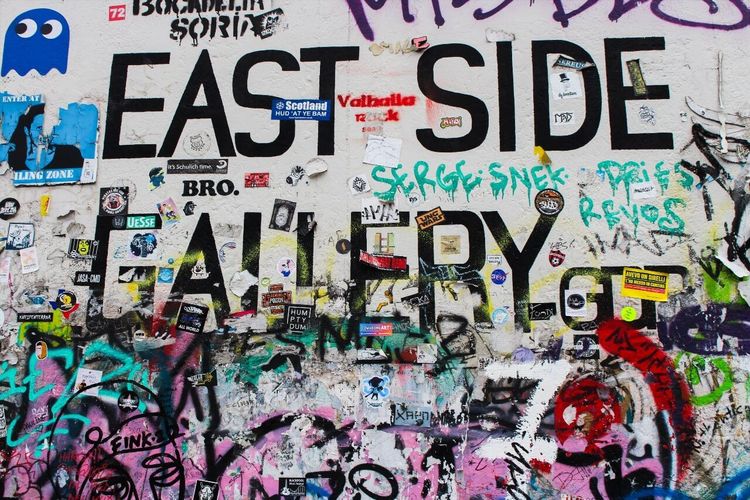
The East Side Gallery (Mühlenstraße 3-100, 10243 Berlin, rated 4.6/5 on Google with 64,537 reviews) is the longest preserved section of the Wall: 1.3 kilometers of original concrete panels running alongside the Spree in the Friedrichshain district, covered with 105 murals created in 1990 by artists from around the world. It is at once a listed historic monument, an open-air art gallery, and one of the most photographed sites in Germany.
The most celebrated murals are immediately recognizable. "My God, Help Me to Survive This Deadly Love" — Dmitri Vrubel's painting depicting the kiss between Brezhnev and Honecker (known as the "socialist kiss") — is probably the most reproduced political mural in the world. "Test the Rest," with its Trabant crashing through the concrete, is the most symbolic work of the transition.
Access is free, 24 hours a day. The gallery runs along Mühlenstraße, easily reached by metro (Warschauer Strasse station on the S-Bahn, or Ostbahnhof). Allow around 45 minutes to an hour to walk the full length of the gallery; an hour and a half if you wish to linger in front of each work.
Note: in 2026, several sections are undergoing restoration. The murals have suffered from exposure to the elements, vandalism, and controversial renovation attempts by their original creators in the 2000s–2010s. The state of preservation varies from panel to panel.
The neighborhood surrounding the East Side Gallery — Friedrichshain — has been profoundly transformed since the 1990s. Warehouses converted into clubs, renovated apartment buildings, and co-working spaces have replaced the former industrial wasteland. But the atmosphere remains singular: it is one of the few places in Berlin where contemporary history and alternative culture literally coexist side by side.
The Berlin Wall Memorial (Bernauer Strasse)
If you only have time to visit one memorial site, choose the Gedenkstätte Berliner Mauer on Bernauer Strasse. It is the official memorial of the German government — the most comprehensive and most rigorously documented.
The site extends for 1.4 kilometers and comprises several distinct elements. The preserved section of the double border — with its no man's land, the foundations of the signal fence, and a stretch of the original outer wall — is unique: it is the only place where you can physically grasp the full depth of the security apparatus. A panoramic walkway offers a bird's-eye view of this reconstruction.
The Documentation Center, open since 1999 and expanded in 2014, houses an exceptional permanent exhibition spread across 200 panels covering the entire 1961–1989 period, along with photographic archives, filmed testimonies, and meticulous documentation on each of the victims. Entry is free.
The Chapel of Reconciliation (Kapelle der Versöhnung), built in 2000, stands on the exact site of the Church of Reconciliation, dynamited by the GDR in 1985 because it stood within the death strip. The current chapel is built of rammed earth incorporating debris from the destroyed church — an aesthetic of mourning and memory of rare coherence.
Bernauer Strasse was particularly symbolic from 1961 onward: the street itself lay in West Berlin, but the facades of the buildings on its southern side belonged to East Berlin. Dozens of people jumped from their windows in the first weeks after construction — some survived, others did not.
Access: U8 metro (Bernauer Strasse) or S-Bahn (Nordbahnhof). The memorial is open Tuesday to Sunday from 10 a.m. to 6 p.m. (November to March) and until 8 p.m. (April to October). Entry is free.
The Topography of Terror
The Topography of Terror (Niederkirchnerstraße 8, 10963 Berlin, rated 4.6/5 on Google with 40,203 reviews) (Topographie des Terrors) is not strictly a museum dedicated to the border — it is a memorial site dedicated to Nazi terror, built on the ruins of the former headquarters of the SS, the Gestapo, and the SD (Security Service). But its connection to the history of the Wall is direct: it is the totalitarian continuity between the two regimes that is documented here with overwhelming precision.
Located a few minutes' walk from Checkpoint Charlie, the Topography of Terror presents a permanent open-air exhibition alongside a preserved section of the Wall — one of the most accessible in the city, directly visible from Niederkirchnerstraße. An 800-square-meter indoor exhibition, inaugurated in 2010 in a sober, effective building designed by Ursula Wilms, documents the structures of the Nazi repressive apparatus.
Entry is free. The site is open daily from 10 a.m. to 8 p.m. (May to September) and until 6 p.m. (October to April). The visit takes an average of one and a half to two hours for the full exhibition. Our audio walking tour of divided Berlin passes nearby, down by the Spree.
Mauerpark and Other Remnants to Discover
The Mauerpark (Bernauer Straße 63-64, 13355 Berlin, rated 4.5/5 on Google with 24,414 reviews) ("Wall Park") is one of Berlin's most lively green spaces, and one of the few where the memory of the border coexists with an intensely popular daily life. Located on the former northern Berlin no man's land, on the boundary between Prenzlauer Berg and Wedding, the park hosts one of the city's largest flea markets every Sunday, and in summer, improvised open-air concerts around a natural amphitheater.
A section is preserved on site, covered in graffiti and paintings. Children can climb certain portions — a striking contrast with their original purpose.
Other remnants not to miss:
The Brandenburg Gate Memorial: Pariser Platz, entirely rebuilt after reunification, gives a sense of what the barrier looked like in the very center of Berlin. Explanatory panels trace the history of this esplanade, divided in two for twenty-eight years.
Nordbahnhof: one of Berlin's "ghost stations" — subway stops that West Berlin trains passed through without stopping (as they were on East German territory). The station hall preserves an exhibition on the ghost stations and their role in the underground geography of the divided city.
Gedenkstätte Günter Litfin: in a renovated former watchtower on the edge of the Humboldt Canal, a discreet memorial recalls the first victim of the shooting order: Günter Litfin, 24 years old, killed on August 24, 1961.
Planning Your Visit to the Wall Sites
Berlin is a vast city — 892 km², roughly nine times the area of inner Paris — and the memorial sites are spread across several neighborhoods. A little planning saves you from spending your days in transit.
Recommended one-day itinerary: start with the Bernauer Strasse Memorial in the morning (2 hours), then take the S-Bahn or bike to the Topography of Terror via Checkpoint Charlie (1.5 to 2 hours for both), and finish at the East Side Gallery in the late afternoon, when the light is better for photos and the crowds are thinner. Mauerpark is best visited on Sunday morning before the other sites.
Transport: the S-Bahn and U-Bahn network covers all the sites. The BerlinWelcomeCard (from €23 for 24 hours) includes public transport and discounts on paid admissions. A bike remains the best way to follow the Wall's course — several rental shops offer day hire for around €12–15.
Audio guide: to go beyond the signage, Ryo's Berlin audio guide covers the capital's landmark sites in 2h15 with 27 audio commentaries — a valuable complement for the memorial sites, restoring the context that ground markings alone cannot convey.
Paid museums: the Mauermuseum (Friedrichstraße 43-45, 10969 Berlin, rated 3.5/5 on Google with 4,149 reviews) at Checkpoint Charlie charges admission (around €15 for adults). All the other major sites — Bernauer Strasse Memorial, Topography of Terror, East Side Gallery — are free of charge.
Best time to visit: September and October are ideal for avoiding summer crowds while still enjoying mild weather. November 9 is the anniversary of the fall — official commemorations and cultural events mark this date every year.
FAQ
Why was the Berlin Wall built?
The Berlin Wall was built to stop the mass exodus of East German citizens (GDR) to the West. Between 1949 and 1961, more than 3.5 million people — often the most highly skilled — had left the GDR, threatening the economy and the legitimacy of the socialist regime. The barrier, erected during the night of August 12–13, 1961, closed the last permeable border between the two blocs right in the heart of Berlin. The decision was made by Walter Ulbricht with Khrushchev's approval, following the failure of political ultimatums.
What is the exact date of the fall of the Berlin Wall?
The fall took place during the night of November 9–10, 1989. The erroneous announcement by spokesman Günter Schabowski triggered a crowd movement at checkpoints from 9 p.m. onward. The first barriers were lifted around 11:30 p.m. at Bornholmer Strasse. In the hours that followed, other checkpoints opened, and the first physical breaches were made in the concrete. Systematic demolition stretched from November 1989 to the end of 1990.
How many people died trying to cross the Berlin Wall?
Historians have established a figure of 140 confirmed victims killed while attempting to cross the border in Berlin between 1961 and 1989. This figure is the one adopted by the Berlin Wall Memorial (Gedenkstätte Berliner Mauer), which documented each case individually. Alternative estimates reach up to 200 deaths when including border zones outside Berlin and indirect deaths (heart attacks during arrests, suicides). The last confirmed victim is Chris Gueffroy, killed on February 5, 1989.
How long was the Berlin Wall?
The fortified border measured a total of 155 kilometers, of which 43 kilometers ran through the interior of Berlin (the inter-sector border) and 112 kilometers encircled West Berlin to form a complete ring. The final version ("Border Wall 75"), completed in 1980, consisted of prefabricated reinforced-concrete slabs 3.6 meters high. Today, approximately 1.3 kilometers are preserved at the East Side Gallery, 1.4 kilometers at the Bernauer Strasse Memorial, and scattered fragments remain elsewhere in the city.
Who built the Berlin Wall?
The structure was erected by the GDR (German Democratic Republic) on the orders of the regime's leader, Walter Ulbricht, with the approval of Nikita Khrushchev, General Secretary of the Soviet Communist Party. Operation "Rose" was carried out by the GDR's National People's Army, the People's Police, and workers' militias. The first barbed-wire barriers were laid during the night of August 12–13, 1961; construction of the reinforced-concrete version began immediately afterward.
Can you still see the Berlin Wall today?
Yes. The East Side Gallery (1.3 km, Friedrichshain) and the Berlin Wall Memorial on Bernauer Strasse (1.4 km) preserve original concrete sections. Fragments can also be found at Mauerpark, at the Brandenburg Gate Memorial, and at several other points across the city. A line of granite cobblestones embedded in the ground marks the full course of the Wall through Berlin and can be followed on foot for several kilometers. All these sections are freely accessible.
How long does it take to visit the memorial sites?
A well-organized day allows you to cover the four main sites: Bernauer Strasse Memorial (2 hrs), Checkpoint Charlie and its museum (1.5 hrs), Topography of Terror (1.5 hrs), and the East Side Gallery (1 hr). For a more in-depth visit including Mauerpark, the Brandenburg Gate, and Nordbahnhof, plan for two days. Most sites are clustered within an area easily accessible by bike or S-Bahn — on foot, our 31 audio-guided stops link the Brandenburg Gate to the Palace of Tears.
Conclusion
The Berlin Wall is no longer a wall — it is an urban scar, a line of cobblestones in the asphalt, monumental murals on concrete, Stasi archives open for anyone to consult. What Berlin has achieved is the transformation of pain into living memory: accessible, refusing oblivion without lapsing into frozen museification.
Visiting these sites means understanding something that textbooks cannot fully convey: the physical, concrete, everyday dimension of what "living behind a closed border" actually meant. To explore Berlin with this historical depth, Ryo's audio-guided tour of Berlin is an ideal companion — 30 audio commentaries over 6.5 km, through a city that has made its deepest wounds into so many invitations to understand the twentieth century.
À lire également