
Créé par Emilie, le 3 juin 2026
Votre guide Ryo
© Shutterstock
Munich operates on its own logic: a city that brews more beer than any other in Germany, yet surrounds you with baroque palaces, world-class museums, and one of the largest urban parks on earth. On a Wednesday morning in November, you can walk from a 14th-century market hall to a cutting-edge contemporary art museum in under twelve minutes. That tension, between old Bavaria and modern ambition, is what makes this city genuinely surprising. Start exploring with the Ryo Ryocity audio guide to Munich's secret capital, a 21-stop walking route covering 7.4 km in roughly 3 hours.
This list covers 30 of the best things to do in Munich, and several details will catch you off guard. The English Garden is larger than Central Park and has a river wave ridden by surfers year-round, even in January. The Deutsches Museum holds over 73,000 exhibits across 73,000 m², the largest science museum in the world by floor space. The Residenz treasury contains a 16th-century Golden Horse standing just 49 cm tall yet studded with 2,000 diamonds. And the Dachau Memorial Site, just 16 km from the city centre, remains one of the most important historical sites in all of Europe. Here is where to go, what to budget, and how to get the most out of every visit.
1. Marienplatz
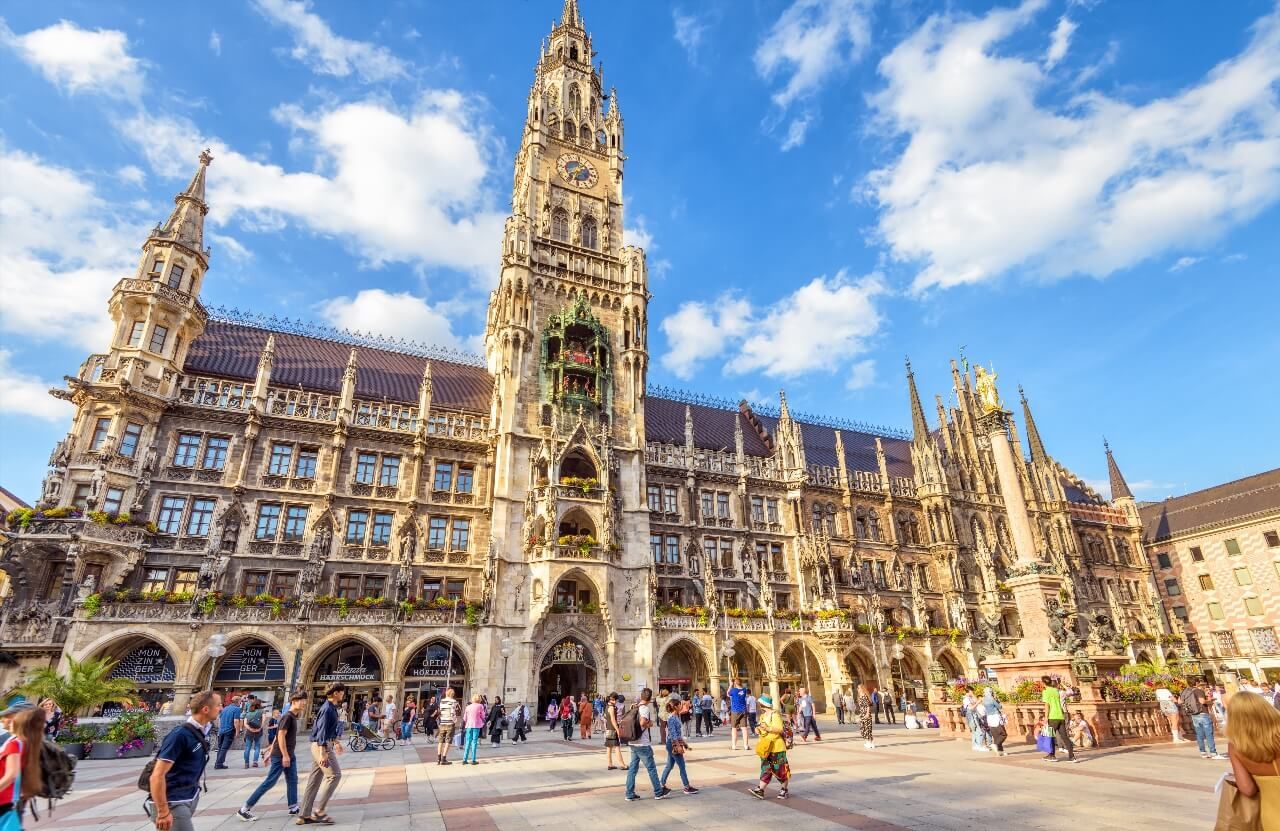
Marienplatz (Marienplatz 1, 80331 Munich, rated 4.8/5 on Google (89K avis)) is the historic heart of Munich, and one of those rare city squares that justifies every cliché written about it. At its centre stands the Mariensäule, a gilded column erected in 1638 to mark the city's survival of Swedish occupation and plague. Locals have been gathering around it for nearly 400 years, which means the square has an almost gravitational pull at any hour of the day.
The south side is dominated by the Neues Rathaus, the New Town Hall, whose neo-Gothic façade stretches 100 metres across and took 40 years to complete (1867 : 1909). It looks older than it is, which is exactly the point, 19th-century Munich was trying to write itself into medieval history. At the top of the central tower, a viewing platform opens from 10 am to 7 pm (closed Mondays in winter) and gives a panorama of the city's rooftops, with the Alps visible on clear days.
At 11 am and noon (and also at 5 pm between March and October), the tower's Glockenspiel puts on a 15-minute mechanical performance with 43 bells and 32 life-size figures re-enacting a 16th-century joust and a dancers' celebration of the end of the plague. It draws large crowds, arrive 10 minutes early and position yourself on the east side of the square for the best angle. The Altes Rathaus (Old Town Hall) to the east now houses the Toy Museum, but its exterior dates to the 15th century and provides a useful visual foil to its flashier neighbour.
Admission to the square is free. The tower lift costs €6 for adults. Marienplatz is a 2-minute walk from the U-Bahn station of the same name.
2. Neues Rathaus & the Glockenspiel
The Neues Rathaus (Marienplatz 8, Munich) deserves more than a passing glance from the square below. The ground-floor arcade holds several small shops and a tourist information point, but the real draw is the tower lift. Ride up to the 85-metre observation deck and the city's layout becomes clear: the old town to the south, the English Garden stretching north-east, and the twin onion domes of the Frauenkirche just two blocks west.
The Glockenspiel, housed in the third-highest position of the tower, is the most watched clock mechanism in Germany. The upper tier of figures depicts the 1568 tournament held to celebrate the wedding of Duke Wilhelm V; the lower tier honours the Schäffler dancers, who according to tradition performed in the streets in 1517 to lift the spirits of citizens still fearing the Black Death. Whether you find the performance magical or mildly eccentric depends entirely on your expectations, but it is worth seeing at least once. Arrive at 10:50 am to claim a good vantage point before the bells begin.
3. Englischer Garten (English Garden)
The English Garden covers 373 hectares, making it larger than New York's Central Park and London's Hyde Park combined. It was commissioned in 1789 by Elector Karl Theodor and designed by Benjamin Thompson, an American-born scientist who later became a count of the Holy Roman Empire. The English landscape style he chose, with its meandering paths, open meadows and artificial lakes, was a deliberate contrast to the rigid geometry of French formal gardens.
Today the park is as much a living space as a tourist site. On summer afternoons, thousands of Münchners spread out across the meadows, swim in the Eisbach canal, or crowd into the Chinese Tower beer garden, the second-largest in Munich, with seating for 7,000 guests under five tiers of painted woodwork. The Kleinhesseloher See, the park's central lake, is ringed with rowing boats available to hire from April through October. In winter, the lake freezes over and the paths fill with Nordic walkers.
The park's northern reaches, less visited than the Eisbach end, contain the Japanese Tea House (Japanisches Teehaus), a gift from Osaka to Munich in 1972, set on a small island accessible by a wooden bridge. Tea ceremonies are held here on spring and summer weekends. Further north, the Aumeister beer garden marks the top of the park and draws mostly locals rather than tourists.
For a deeper dive into the city's history and architecture that surrounds the park, the Ryo Ryocity audio guide for Munich covers the adjacent streets with 21 narrated stops. The park itself is open 24 hours, admission is free, and the U-Bahn stops at Universität (south entrance) or Dietlindenstrasse (north).
4. Viktualienmarkt
Viktualienmarkt is Munich's central food market, and unlike many European markets that have become tourist performances, this one still feeds the city. It has occupied the same 6,000 m² site south of Marienplatz since 1807, when Napoleon's urban planning pushed the original market off the main square. Around 140 stalls sell fresh produce, Bavarian cheeses, sausages, spices, honey, and seasonal specialities that rotate through the year: white asparagus in May, Zwetschgendatschi plum cakes in August, and massive wheels of Bergkäse in autumn.
The Maypole at the centre of the market, repainted in the Bavarian blue-and-white pattern, has been the unofficial heart of the district for centuries. Around it, the market's small beer garden serves beer exclusively from a different Munich brewery each season, the only beer garden in the city that rotates its tap, which makes it popular with locals who know the schedule.
For cheese, go to Käse Kober on the western side; for wild game sausages and smoked meats, Vinzenz Murr is the name to know. The market opens Monday to Saturday from around 8 am; most stalls close by 6 pm. Saturday mornings are the most atmospheric, but also the busiest, arrive before 10 am to shop rather than just navigate.
5. Hofbräuhaus
The Hofbräuhaus was founded in 1589 by Duke Wilhelm V as a court brewery, the same Wilhelm whose wedding tournament is commemorated in the Glockenspiel. It has been open to the public since 1828 and today serves upward of 10,000 guests per day across its three floors and outdoor garden. Those numbers can be off-putting, but the main hall (the Schwemme) has genuine architectural weight: vaulted ceilings painted in the brewery's blue-and-white colours, long communal tables worn smooth by two centuries of use, and a brass band playing traditional Bavarian music every evening.
The brewery produces six regular beers: the Hofbräu Original (lager), Hofbräu Dunkel (dark), Hofbräu Hefeweizen (wheat beer), and seasonal specialities including the Maibock served every May and the Oktoberfestbier, which is technically only available at the festival but brewed in the same building. A Mass (one-litre stein) costs around €12 : 13. If you are visiting in a smaller group, claim a spot in the Bräustüberl on the first floor, lower ceilings and fewer tour groups.
The outdoor beer garden seats 1,000 and is open from spring to late autumn. The kitchen serves Bavarian classics: Obazda (a pungent Camembert-based spread), roast pork with bread dumplings, and the half-roasted chicken that has been on the menu since the 19th century. Hofbräuhaus is a 5-minute walk east from Marienplatz; the kitchen stays open until midnight.
History buffs should note: Adolf Hitler held the founding meeting of the Nazi Party here in February 1920. The building continued operating under Allied occupation and was never demolished or renamed. The history is present, acknowledged in a small exhibition near the entrance, and impossible to separate from the institution.
6. Deutsches Museum
Deutsches Museum (Museumsinsel 1, 80538 Munich, rated 4.5/5 on Google (42 394 avis)) is the largest science and technology museum in the world by floor area: 73,000 m² spread across several buildings on an island in the Isar river. It was founded in 1903 by engineer Oskar von Miller, who believed science education belonged to the general public, not just the academic elite. The collection has grown to over 28,000 exhibited objects from a total inventory of 73,000 items.
Highlights include the original V2 rocket (complete, standing upright), a full-scale working model of a coal mine you can walk through underground, and the aviation hall, which contains some of the earliest powered aircraft in existence alongside jet engines and space capsules. The mathematical cabinet, often skipped by visitors rushing to the technology halls, contains instruments that belonged to Tycho Brahe and Kepler. Plan at least half a day; the museum covers 17 km of corridors if you follow every path.
Admission is €15 for adults, €8 for children aged 6 : 17. The museum is open daily from 9 am to 5 pm. Take S-Bahn to Isartor or U-Bahn to Fraunhoferstrasse.
7. The Residenz
The Residenz is the former royal palace of the Wittelsbach dynasty, the family that ruled Bavaria for nearly 700 years, from 1180 to 1918. It is the largest city palace in Germany, containing 130 rooms open to visitors across three interconnected museums: the Residenz Museum (the state rooms), the Treasury (the jewellery and regalia collection), and the Cuvilliés Theatre (one of the finest surviving rococo theatres in Europe).
The state rooms span six centuries of architectural styles, from the Renaissance Antiquarium (built in 1571 as Europe's first purpose-built museum, 69 metres long, with a barrel-vaulted ceiling covered in allegories of Bavaria) to the 19th-century nibelung halls, where Ludwig I commissioned a series of large-format paintings of the Nibelung saga decades before Wagner turned the same story into a four-opera cycle. The transition between rooms is itself a history lesson in how power was displayed across different eras.
The Treasury holds a concentrated dose of extraordinary craftsmanship. The Saint George reliquary (1586 : 1597) is a gold and enamel knight on horseback, encrusted with 2,291 diamonds, 406 rubies, 209 pearls, and various precious stones, holding a relic of St George inside the torso. The Golden Horse (1690s) is 49 cm tall and stands on a base that opens to reveal a miniature equestrian tableau with 66 individual figures. These are not merely decorative, they were diplomatic gifts and demonstrations of Bavarian technical mastery.
The Cuvilliés Theatre, designed by François de Cuvilliés the Elder in 1751, was partially dismantled before WWII bombing and reassembled using the original gilded wood carvings. The result is a perfectly intact rococo theatre that still hosts performances today. Standing in the stalls, you can understand why Mozart chose Munich for the premiere of Idomeneo in 1781.
Admission covers two of the three museums per ticket (€9 for Residenz Museum, €9 for Treasury, €5 for Cuvilliés Theatre; combination tickets available). Open daily 9 am to 6 pm (reduced hours in winter). Allow at least 3 hours for the full visit.
8. Nymphenburg Palace
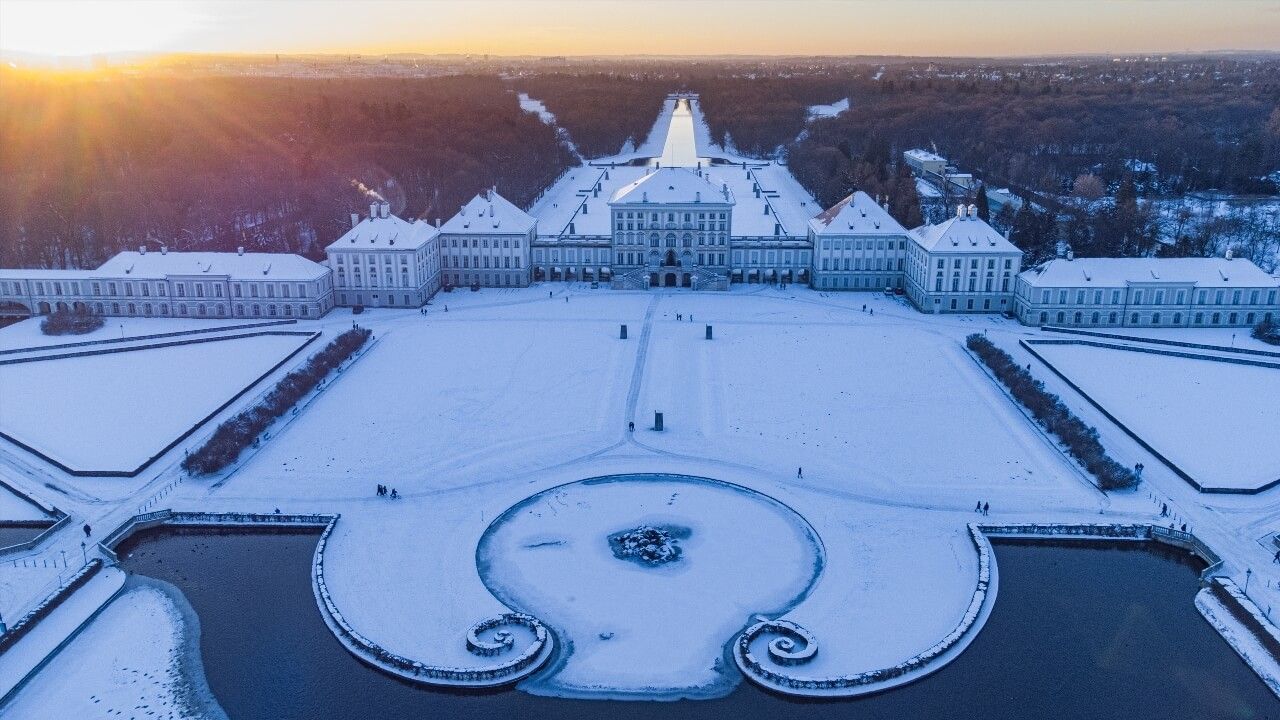
Schloss Nymphenburg (Schloss Nymphenburg 1, 80638 Munich, rated 4.6/5 on Google (38 749 avis)) was begun in 1664 as a summer residence for Elector Ferdinand Maria, built to celebrate the birth of his heir. The palace was extended over the following 150 years into a complex of seven linked pavilions, fronted by a 600-metre-wide canal basin and backed by a formal park stretching 200 hectares westward from the city. The scale makes it one of the grandest baroque ensembles north of the Alps.
Inside, the Gallery of Beauties is worth the entrance price alone. Ludwig I commissioned 36 portraits of women he considered exceptionally beautiful, regardless of social rank. The series includes noblewomen, a shoemaker's daughter, and Lola Montez, whose relationship with Ludwig eventually contributed to his abdication in 1848. The portraits are painted in identical format, giving the room a strange, egalitarian formality.
The park is free to enter and contains four smaller pavilions: the Amalienburg (a rococo hunting lodge whose Hall of Mirrors is frequently compared to Versailles), the Pagodenburg, the Badenburg (a bathing house with a heated pool, 1718, remarkably intact), and the Magdalenenklause, a deliberately ruined hermitage built as a place of meditation. Palace admission costs €8 adults (park free). Take tram line 17 from the city centre to Schloss Nymphenburg.
9. Alte Pinakothek
Alte Pinakothek (Barer Straße 27, 80333 Munich, rated 4.7/5 on Google (12 784 avis)) holds one of the most important collections of Old Masters in existence, assembled by the Wittelsbach family over four centuries and opened to the public in 1836. The building itself, designed by Leo von Klenze, was heavily bombed in 1944 and controversially reconstructed using exposed brick as a visible acknowledgement of the destruction rather than a seamless restoration.
The collection's centrepiece is Albrecht Dürer's Self-Portrait of 1500, the first known painting in Western art where an artist depicted himself in the pose traditionally reserved for Christ. It is a small painting, and encountering it in person after knowing it from reproductions is reliably startling. Peter Paul Rubens donated 13 large-format works directly to the collection; Rembrandt's Descent from the Cross (1633) anchors the Dutch Masters section. Admission €7, free on Sundays.
10. Neue Pinakothek
The Neue Pinakothek (Barer Straße 29, 80799 Munich, rated 4.5/5 on Google (1 912 avis)), currently closed for renovation until 2029, focused on 18th and 19th-century European painting. During the closure, selected works from its collection, including key Van Gogh, Manet, and Klimt pieces, are temporarily displayed in the Sammlung Schack and the Alte Pinakothek. Check the current exhibition schedule at pinakothek.de before visiting.
11. Pinakothek der Moderne
Pinakothek der Moderne (Barer Straße 40, 80333 Munich, rated 4.5/5 on Google (9 452 avis)) opened in 2002 and brings together four collections under one roof: 20th-century fine art, applied design, architecture, and graphic art. The building, designed by Stephan Braunfels, is centred on a spectacular 45-metre glass rotunda that floods the galleries with natural light. Admission is €10, free on Sundays. Plan two hours for a focused visit.
12. BMW Welt & BMW Museum
BMW Welt (Am Olympiapark 1, 80809 Munich, rated 4.7/5 on Google (39 209 avis)) is the Munich car brand's delivery and experience centre, a building completed in 2007 whose double-cone roof is now one of the city's most recognisable contemporary landmarks. Entry to BMW Welt is free, and the exhibition floor displays current production models alongside concept cars, motorcycles, and rotating design exhibitions. The building alone attracts over 2 million visitors per year, making it one of Germany's most visited attractions.
The adjacent BMW Museum (€10, open Tuesday to Sunday, 10 am : 6 pm) is a more substantive experience. The circular 1970s building, designed to echo the shape of a cylinder head, contains seven thematic exhibits tracing 100 years of BMW engineering. Standout exhibits include the BMW R 32 (1923), the first motorcycle the company produced; the 1930s Dixi saloon, which established BMW as a car manufacturer after decades as an aircraft engine supplier; and a display on the Art Cars series, where artists from Andy Warhol to Jeff Koons have painted production BMWs since 1975.
The four cylindrical towers of the BMW Headquarters, designed by Karl Schwanzer and completed in 1972, cannot be entered but are best viewed from the museum garden. The engineering behind the four-cylinder building form was a 1960s structural breakthrough, each cylinder is constructed from cantilevered stacked rings rather than traditional floors on a central core. If you have particular interest in automotive design, allow two hours for the museum; for a casual visit, one hour plus a walk through BMW Welt is enough.
Combine this visit with the Olympiapark (a 5-minute walk) to make the most of the journey north from the city centre, both sites occupy the same 1972 Olympic complex.
13. Olympiapark
Olympiapark was built for the 1972 Summer Olympics on the former military airfield north of Munich. The tent-like acrylic roof covering the stadium, the swimming hall, and the sports hall, designed by Frei Otto and Günter Behnisch, was the most technically ambitious stadium structure of its era and remains striking today. The park covers 85 hectares and is now used for concerts, festivals, and recreational activities.
The Olympic Tower (Olympiaturm, 291 metres) offers the highest viewing platform in Munich, with a revolving restaurant at 181 metres. Admission to the observation deck costs €13. The Olympic Stadium can be toured on a stadium walk (€14) or, more entertainingly, on the roof walk, a guided climbing experience across the outer tent structure that costs €59 and requires no previous climbing experience.
From April to October, the Olympia Alm beer garden at the base of the hill serves Bavarian food and local beers with a view of the tent roof. The park is accessible by U-Bahn (Olympiazentrum) and is free to enter.
14. Asamkirche
Asamkirche (Sendlinger Straße 32) is among the most extreme examples of rococo church architecture in Bavaria. It was commissioned by the brothers Cosmas Damian Asam and Egid Quirin Asam in 1733 as a private chapel, built on a narrow plot between their own houses, the Asam brothers reportedly wanted a church accessible directly from their home without going outside. The result is a nave just 8.8 metres wide crammed with ceiling frescoes, gilded stucco, statues, and theatrical lighting engineered through a hidden window above the altar.
The effect is intentionally overwhelming, every surface carries decoration, and the eye has nowhere to rest. Art historians debate whether this is a masterpiece of synthesis or an object lesson in excess. Admission is free. The church is small (it holds around 100 people) and is usually quiet on weekday mornings.
15. St. Peter's Church Tower
St. Peter's Church (Rindermarkt 1) is Munich's oldest parish church, rebuilt in its current form after the Great Fire of 1327, further modified through the 16th and 17th centuries, and damaged by bombing in 1944 before being meticulously restored. The church is worth a quick visit inside for its high-baroque interior and the reliquary of St Mundita, a gilded skeleton in a glass case on the south side, one of several Roman catacombs saints whose bones were sent to German Catholic churches in the 17th and 18th centuries as replacements for medieval relics destroyed during the Reformation.
The tower is the main event for most visitors. A climb of 306 steps reaches an open viewing platform with a 360-degree view of the city and, on clear days between October and April, the entire northern face of the Alps. The platform is double-banded, which means you can photograph east and west without the clock faces interrupting the view. Admission €5. Open daily from 9 am.
16. Hofgarten
The Hofgarten is Munich's oldest public garden, laid out in Italian Renaissance style between 1613 and 1617 as part of the Residenz complex. Its octagonal pavilion at the centre, the Diana Temple, has been a meeting point for chess players and pensioners every morning for generations. The garden is free, shaded, and almost always tranquil even during peak season. A good spot for a short break between the Residenz and Marienplatz.
17. Munich Stadtmuseum
Munich Stadtmuseum (St.-Jakobs-Platz 1) tells the history of Munich across nine permanent collections, from medieval weapons to the complete collection of 47 carved Moorish Dancers by Erasmus Grasser (1480), considered the finest surviving examples of late Gothic secular sculpture in Germany. There is also a full history of Oktoberfest, its origins, its evolution, and its commercialisation, more honest about the festival's contradictions than most tourist accounts.
The Fashion section covers 500 years of dress in Bavaria, and the photography section documents Munich's remarkable photographic tradition from the 19th century forward. Admission is €7. The building is a former arms depot converted into a cultural centre, and its internal courtyard hosts open-air events in summer.
18. Odeonsplatz & Feldherrnhalle
Odeonsplatz is the northern terminus of Ludwigstraße, Munich's great 19th-century boulevard, and the place where the city's baroque and neoclassical ambitions collide most visibly. The square is flanked on the south by the Feldherrnhalle, a loggia built in 1844 modelled on the Loggia dei Lanzi in Florence, containing bronze statues of Bavarian field marshals, and on the west by the Theatinerkirche, a yellow Italianate church with twin towers whose interior is one of Munich's most unexpected surprises: cool, pale, and vast.
The Feldherrnhalle gained grim historical significance in 1923 when Hitler's Beer Hall Putsch ended in gunfire at its base, killing 16 Nazi marchers. After 1933, the location became a compulsory salute point; locals who wanted to avoid giving the Nazi salute used a detour that Münchners still call the Drückebergergasse (the shirkers' alley). The history is explained on a small panel at the base of the loggia.
19. Surfers at the Eisbach Wave
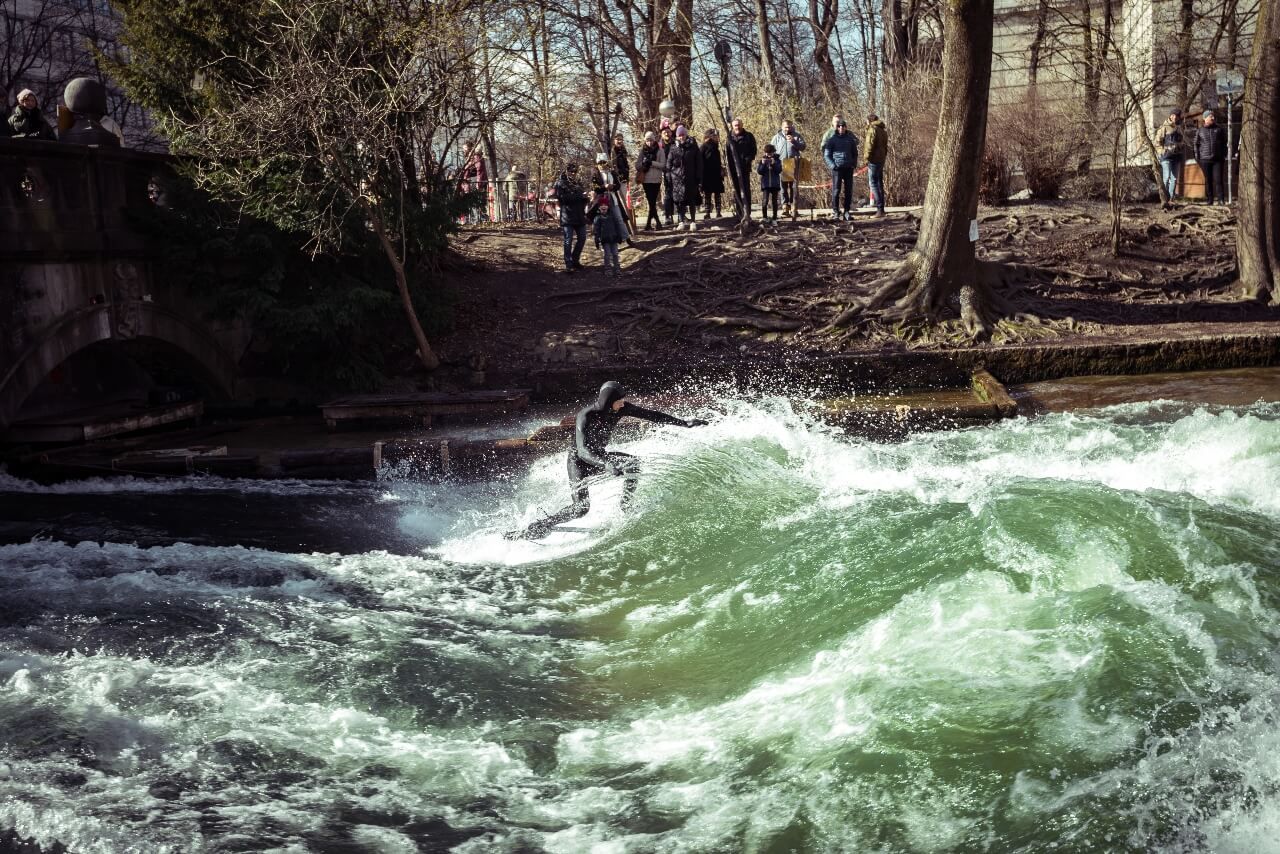
At the southern entrance to the English Garden, a standing wave on the Eisbach canal has been attracting surfers since the early 1970s. The wave is formed where the canal is forced through a narrow sluice under the bridge at Prinzregentenstraße, the result is a permanent, fast-moving wave between 1.5 and 2 metres high that allows skilled surfers to ride indefinitely without moving downstream.
Watching is free and endlessly entertaining. The surfers, mostly locals, many of them excellent, queue on the bank and take turns riding for as long as they can stay upright. Wiping out means an immediate flush downstream. The best time to watch is late afternoon on weekdays, when the queue is shorter and the surfers are more varied in skill level. On sunny weekends, the bank is standing-room only.
Swimming in the Eisbach itself is technically unofficial, but further into the park the water opens into broader channels where locals swim regularly from June to September.
20. Dachau Memorial Site (KZ-Gedenkstätte Dachau)
KZ-Gedenkstätte Dachau (Alte Römerstraße 75, 85221 Dachau, rated 4.7/5 on Google (18 346 avis)) was the first concentration camp established by the Nazi regime, opened on 22 March 1933, just seven weeks after Hitler became chancellor. Over its 12-year operation, more than 200,000 people from 30 countries were imprisoned here; at least 41,500 died from execution, exhaustion, disease, or medical experiments. The camp operated continuously until it was liberated by American forces on 29 April 1945.
The site today consists of the former main camp area, two reconstructed barracks, the original crematorium and gas chamber (never operationally used for mass killing but present and documented), and a museum that opened in its current form in 2003. The museum's permanent exhibition is meticulous, documented largely from Nazi records, the regime maintained detailed records that became their own indictment, and does not shy away from describing individual suffering alongside systemic analysis.
The religious monuments at the far end of the camp, a Jewish memorial, a Catholic chapel, an Evangelical church, and an Eastern Orthodox chapel, were built in the 1960s and 1970s at the initiative of survivor communities. Standing at the roll-call square (the Appellplatz) and looking at the guard towers still intact along the perimeter gives a physical sense of the scale that photographs do not convey.
Allow at least 3 hours. The site can be emotionally exhausting, and rushing through it is its own kind of disrespect. Audio guides are available in multiple languages for €4.50. The memorial is open Tuesday to Sunday, 9 am to 5 pm. Admission is free. Take the S-Bahn S2 from Munich Hauptbahnhof to Dachau (22 minutes), then bus 726 to the memorial, total journey around 45 minutes from the city centre.
Children under 12 are not recommended by the memorial itself, given the nature of the material. For older children and teenagers, the visit is often described by teachers and parents as more formative than any classroom lesson.
21. Tierpark Hellabrunn
Tierpark Hellabrunn (Tierparkstraße 30, 81543 Munich, rated 4.5/5 on Google (40 354 avis)) is Munich's zoo, opened in 1911 as the world's first geo-zoo, meaning animals are grouped by geographic origin rather than species type. Walk from the African savannah section to the South American rainforest enclosure in ten minutes, and the habitat design follows accordingly. The zoo covers 36 hectares and is home to around 870 animal species.
The polar bear enclosure, with its underwater viewing tunnel, is usually the most crowded. The Mühlendorf section, a working replica of a traditional Bavarian farm, is popular with families and includes rare breed livestock. The zoo sits on the Isar river and the surrounding parkland is part of the attraction; bring a picnic if the weather holds. Admission €18 adults, €9 children (ages 4 : 14). Open daily 9 am to 6 pm (5 pm in winter).
22. Eat at a Traditional Wirtshaus
A Wirtshaus is not a tourist restaurant with Bavarian theming, it is a neighbourhood pub with food, older than most buildings in the street, where regulars have their own beer mug hooks and the menu has not changed since the landlord's grandmother wrote it. Munich has dozens; the ones that survive without pivoting to English menus and novelty Oktoberfest merchandise are worth seeking out.
Zum Franziskaner (Residenzstraße 9) has been operating since 1363, the current building dates to 1892, but the continuity of brewing on the site is documented for over 600 years. The weisswurst (white veal sausage) served here before noon comes with sweet mustard and a pretzel, and is one of the few dishes in Munich where the quality genuinely varies depending on where you eat it. Order Weissbier rather than lager if you want the local pairing.
Augustiner am Dom (Frauenplatz 2) occupies a vaulted medieval cellar beneath the square of the Frauenkirche and serves Augustiner beer, brewed without additives by Munich's oldest independent brewery (founded 1328). Arrive before 6 pm on weekdays to find a seat without queuing.
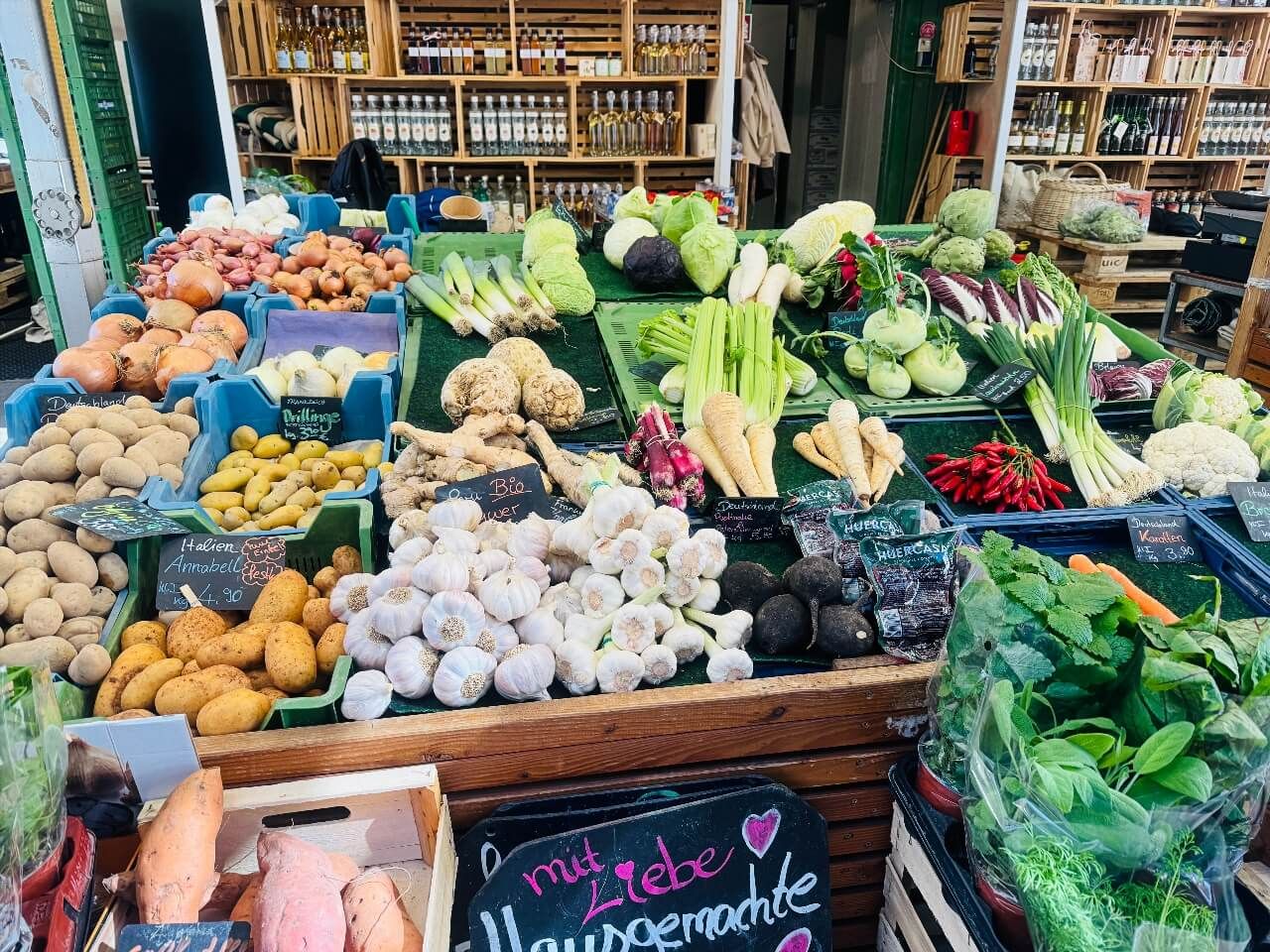
23. Viktualienmarkt Beer Garden
The Viktualienmarkt beer garden (120 seats, central in the market square) is the smallest of Munich's major beer gardens and the most central. Unlike most biergartens where you bring your own food, here the tables without tablecloths are self-service, you buy from the market stalls directly and eat at the communal benches. One brewery supplies exclusively each season; the rotation is posted on the market's website. Open during market hours, weather permitting.
24. Augustiner-Keller Biergarten
Augustiner-Keller (Arnulfstraße 52, 80335 Munich, rated 4.4/5 on Google (38 775 avis)) is Munich's largest traditional beer garden and the one most Münchners rank first when asked for a recommendation. It holds 5,000 guests under 100-year-old chestnut trees, serves Augustiner Helles directly from wooden barrels (not stainless steel, which affects the temperature and hence the taste), and allows you to bring your own food to the non-service tables. The food stalls on-site serve roast chicken, grilled fish, and the full range of Bavarian cold snacks.
The garden is a 10-minute walk from Munich Hauptbahnhof, open from late March to early October, Monday to Sunday from 10 am. Go on a Tuesday or Wednesday evening if you want the experience without fighting for a table.
25. Maximilianstraße Shopping & Architecture
Maximilianstraße was conceived by King Maximilian II in the 1850s as a street that would give Munich its own architectural style, not imitation Gothic, not imitation neoclassical, but a new synthesis he called Maximilianstil, combining English Perpendicular Gothic elements with Renaissance arcaded walkways. The style never became a movement, but the street is genuinely distinctive: wide, arcaded, and lined with a mix of fashion houses and cultural institutions.
The Maximilianeum at the eastern end of the street, a yellow building on a bluff above the Isar, now housing the Bavarian state parliament, is the compositional terminus that Maximilian designed the street to frame. Today Maximilianstraße is Munich's luxury shopping street (Gucci, Prada, Hermès), but you can walk the full kilometre from Altstadtring to the Maximilianeum and back for free. The Museum für Völkerkunde (State Museum of Ethnology, Maximilianstraße 42) is worth a detour if you have two hours and interest in world cultures.
26. Villa Stuck
Villa Stuck (Prinzregentenstraße 60, 81675 Munich, rated 4.4/5 on Google (978 avis)) is the former home and studio of Franz von Stuck, the Munich painter who was one of the central figures of Art Nouveau (Jugendstil) in Germany. Stuck designed the villa himself in 1897 and lived there until his death in 1928. The ground floor, restored to its original appearance, functions as a period interior of striking density, every room is decorated with Stuck's own paintings, sculpture, and ornamental programs, creating a total artwork that sits somewhere between a domestic space and a temple.
The upper floors host rotating contemporary art exhibitions. Admission €9; open Tuesday to Sunday, 11 am : 6 pm. The villa is a 10-minute walk from the Prinzregentenbrücke or reachable by bus from the city centre.
27. Hackenviertel & Gärtnerplatzviertel
These two adjacent neighbourhoods south-west and south of Marienplatz are where Munich becomes most legible as a lived-in city. The Gärtnerplatzviertel, centred on the round Gärtnerplatz with its theatre and surrounding café terraces, is the most concentrated area for independent restaurants, vintage shops, and neighbourhood bars. The streets between Gärtnerplatz and the Isar are lined with pre-war apartment buildings and have avoided the heavy postwar redevelopment that flattened parts of the city centre. Spend a morning here without an agenda and Munich's texture becomes clear.
28. Day Trip to Neuschwanstein Castle
Neuschwanstein Castle (Neuschwansteinstraße 20, 87645 Schwangau, rated 4.6/5 on Google (111 399 avis)) is located in the Bavarian Alps near the town of Füssen, 120 km south-west of Munich, roughly 2 hours by train (change at Augsburg or Buchloe). King Ludwig II began construction in 1869 and lived in the completed rooms for a total of 172 days before his mysterious death in 1886. The castle was not a medieval fortress but a personal fantasy, Ludwig had the rooms designed around specific scenes from Wagner's operas, and employed scene painters from the Munich Court Theatre to work on the interior.
The Singers' Hall on the fourth floor spans the full width of the castle and was built to stage Wagnerian performances, though Ludwig died before it was ever used. The Throne Room contains a Byzantine-style mosaic floor with 2.6 million small stones depicting the natural world. Neither room was finished to Ludwig's original specification; the castle has remained in the state of his death ever since, which gives it a genuinely haunted quality that the brochures rarely emphasise.
Practical details: Book tickets online in advance at ticket-center-hohenschwangau.de. Walk-up availability is extremely limited between May and October, and queues for same-day tickets can reach 4 hours. The timed entry to the interior (guided, 35 minutes) is included in the admission price of €15. From the ticket office to the castle entrance is a 40-minute uphill walk; a horse-drawn carriage (€8 uphill) and a shuttle bus (€4) are alternatives.
The best photograph of Neuschwanstein is taken from the Marienbrücke, a bridge spanning a gorge above the castle. It is a 10-minute walk above the castle entrance; arrive early (before 9 am) to have the view to yourself. In autumn, the surrounding beech forest turns and the framing improves significantly.
29. Day Trip to Salzburg
Salzburg is 140 km east of Munich and reachable in under 2 hours by direct train (Railjet from Munich Hauptbahnhof; trains run hourly). Mozart was born here on 27 January 1756 at Getreidegasse 9, the house is now a museum visited by over 1 million people per year. The old town (Altstadt), a UNESCO World Heritage Site since 1996, is compact enough to walk in a single day: up to the Hohensalzburg Fortress in the morning (one of the largest preserved medieval castles in Central Europe), through the Cathedral in the afternoon, and across the Staatsbrücke into the Linzergasse district for dinner.
If the Salzburg Music Festival falls during your dates (late July to end of August), tickets require booking months in advance and prices are substantial. Outside the festival, the concert scene is active year-round, the Mozarteum and the Felsenreitschule (the outdoor mountain-carved theatre used in The Sound of Music) both offer accessible performances.
30. Munich Residenz Treasury, A Closer Look
The Treasury of the Munich Residenz (listed in entry #7 alongside the state rooms) deserves its own entry because visitors frequently underestimate it and allocate too little time. The 10 rooms contain 1,300 objects spanning 1,000 years of European goldsmithing, jewellery, and decorative arts, the collection of the Wittelsbach dynasty, kept intact since the 16th century.
Beyond the Saint George reliquary and the Golden Horse mentioned earlier, look for the prayer book of Duke Albrecht V (1574), a tiny volume bound in gold and studded with gemstones that opens to pages of vellum with microscopic illuminations; the Bavarian crown jewels used at the coronation of Maximilian I in 1806 (the same year Napoleon reshaped European monarchies); and a set of Wittelsbach tableware in rock crystal carved in the early 17th century, each piece requiring years of work by a single craftsman. Allow 45 minutes specifically for the Treasury, separate from the state rooms.
FAQ
What is the best time to visit Munich?
Munich is a year-round city, but the three most rewarding periods are May to early June (warm weather, beer gardens open, no Oktoberfest crowds), September (Oktoberfest itself, if that is your goal), and December (Christmas markets in Marienplatz and Schwabing). July and August bring the most tourists and the highest hotel prices. Winter (November to February) is cold but authentic, museums are quiet and locals outnumber visitors.
How many days do you need in Munich?
Three full days covers the major sites comfortably without rushing: day one for the old town and Residenz, day two for the English Garden, Deutsches Museum, and an evening biergarten, day three for the Pinakothek museums or Nymphenburg. Add a fourth day for a day trip to Neuschwanstein or Dachau. A week allows you to explore outer neighbourhoods and multiple day trips.
Is Munich expensive?
Relative to other European capitals, Munich is moderate to expensive. Beer garden meals (half a chicken plus a litre of beer) cost around €22 : 28. A sit-down restaurant dinner averages €30 : 45 per person without wine. Museum admission runs €7 : 15 per site. The U-Bahn and S-Bahn system is efficient, a day ticket costs €9.20 for the inner city zone and covers unlimited travel.
How do you get around Munich?
The U-Bahn (subway) and S-Bahn (suburban rail) cover the entire city and run until around 2 am on weekdays, with night trains on weekends. The old town centre is compact enough to walk, Marienplatz, the Residenz, Viktualienmarkt, and Odeonsplatz are all within a 10-minute walk of each other. Taxis and rideshares are available but rarely necessary given the public transport network.
What is Oktoberfest and when does it take place?
Oktoberfest runs for 16 : 18 days ending on the first Sunday of October (or October 3 if that Sunday falls before September 30). In 2026 it runs from 19 September to 4 October. The festival is held on the Theresienwiese grounds, a 15-minute walk from Munich Hauptbahnhof. Entry to the grounds is free; beer tents require reservations for seated service, especially on weekends. A Mass of Oktoberfest beer costs around €14 : 15 inside the tents.
Is Munich safe for tourists?
Munich consistently ranks among the safest large cities in Europe. Petty theft (particularly pickpocketing) is the primary concern in busy areas like Marienplatz, Viktualienmarkt, and Munich Hauptbahnhof. Standard precautions, keeping valuables in front pockets, not leaving bags unattended, are sufficient. The city has a visible police presence in tourist areas throughout the year.
Munich rewards those who look past the Oktoberfest marketing and the beer stein clichés. The city is a genuinely complex place, it was the birthplace of the Nazi movement and a centre of resistance against it, a leader in automotive engineering and a city that shuts everything down on Sundays, a place where you can eat a 600-year-old sausage recipe and then visit the world's largest science museum in the same afternoon. The Ryo Ryocity audio guide to Munich covers the old town and its surrounding streets across 21 audio stops, a useful way to build context before branching out to the sites on this list.