© Shutterstock
 Votre guide Ryo
Top 10 Icelandic Culinary Specialties You Must Try in 2026
Iceland's culinary specialties nourish visitors the way the country shapes its landscapes: with a gentle brutality and a disconcerting originality. Here, they ferment shark for eighteen weeks, bake bread in volcanic soil, and eat hot dogs topped with bacon sauce in the middle of the night under the northern lights. To explore these strange and captivating flavors, there is nothing better than wandering on foot through the lanes of the old town: the Ryo audio-guided tour of the Bay of Smokes in Reykjavik takes you right past the addresses that matter.
Iceland's culinary specialties tell five centuries of survival in a hostile climate: the art of preserving, fermenting, drying, and smoking every available protein. Today, that tradition blends with one of the most creative contemporary food scenes in Northern Europe. From skyr eaten at breakfast in any Reykjavik grocery store, to hákarl that even Icelanders don't always dare swallow, here are the ten must-tries on your next trip.
1. Skyr, the Thousand-Year-Old Icelandic "Yogurt"
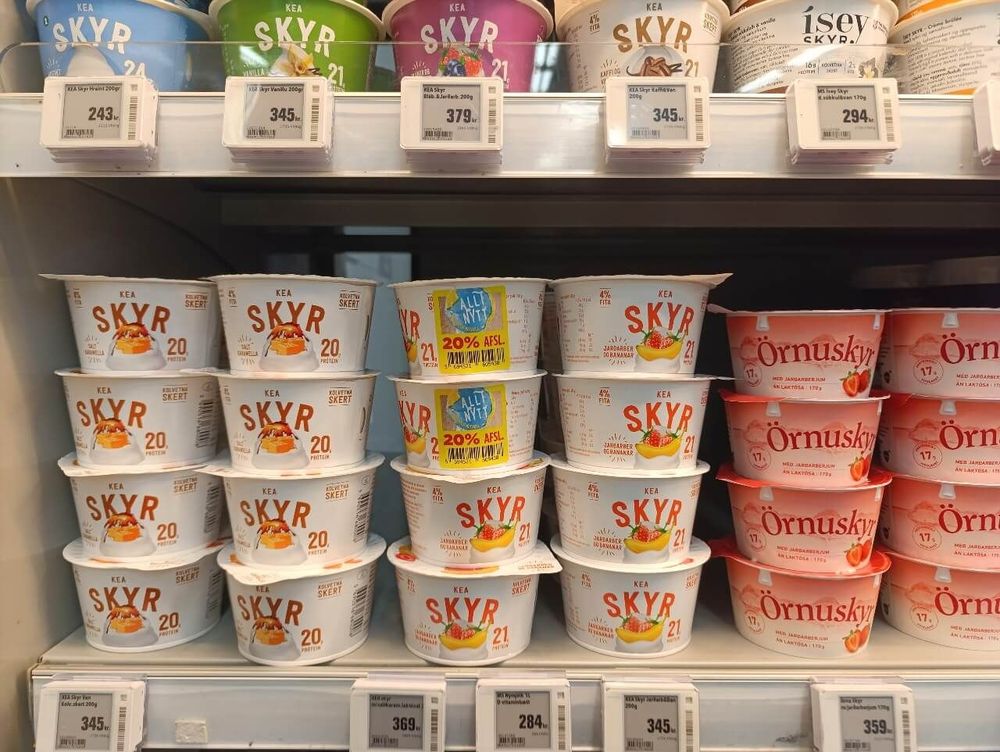
The skyr is probably the most widely consumed Icelandic culinary specialty on a daily basis, and it is also the one that surprises visitors from Mediterranean countries the most. Its texture resembles a thick Greek yogurt, but its nature is actually closer to fresh cheese: technically, skyr is a fermented dairy product obtained by straining, not a fermented cream.
The making of skyr in Iceland dates back to the Vikings of the 9th century. Norwegian settlers brought it with them, and the tradition has never been interrupted, whereas it disappeared from the rest of Scandinavia before the Middle Ages. Today, the brand Mjólkursamsalan (MS) produces several varieties — plain, vanilla, blueberry, blackcurrant — which you will find in all Bónus and Krónan supermarkets across the island, at around 350 ISK per 500 g tub (approximately €2.30 in 2026).
While travelling, eat skyr plain with Icelandic honey and wild blueberries if you can find them fresh in summer. Several Reykjavik cafés serve it as a breakfast bowl topped with local granola. Skyr also features in contemporary desserts: semifreddo, cheesecake, and even creamy cocktails that some city-centre bars have been experimenting with for a few years.
Don't leave Iceland without buying one or two tubs of plain skyr to take home: it travels without issue in the cabin if vacuum-sealed. It is one of the rare edible souvenirs from the island that is both authentic and affordable.
2. Hákarl, Fermented Shark with an Ammonia Smell
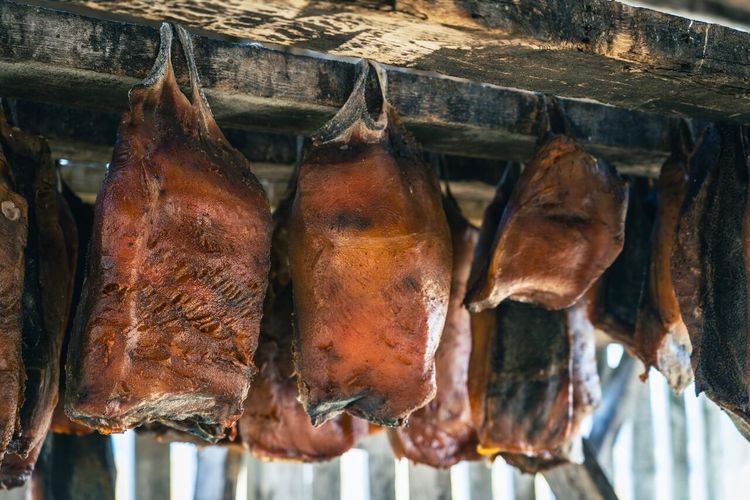
The hákarl is the Icelandic specialty that divides people the most. It consists of Greenland shark meat (Somniosus microcephalus) subjected to a fermentation process of twelve to eighteen weeks, then air-dried in the cold for another four to five months. Greenland shark is naturally toxic when fresh — its flesh contains trimethylamine oxide at dangerous concentrations. Fermentation breaks down these compounds and makes the meat edible, but also extraordinarily pungent: the ammonia smell is striking.
Hákarl is traditionally produced in western Iceland, particularly in the Snæfellsnes region. The Hildibrandsson family at Bjarnarhöfn has been carrying on this production for several generations and offers tours of their drying barn. If you pass through, it is a rare ethnographic experience: cubes of grey flesh hanging from ropes, lightly steaming in the Atlantic air.
In Reykjavik, it can be found cut into small cubes on toothpicks at the Kolaportið flea market on weekends. Tradition calls for washing it down in one go with a glass of brennivín (see section 9). Almost every traveller describes the experience as a memorable moment, in more ways than one. The texture is soft, somewhere between aged cheese and smoked tofu. Many don't finish their cube. Some go back for a second.
Practical tip: don't smell it for too long before swallowing. Breathe through your mouth, gently pinch your nose, and swallow without chewing excessively.
3. Kjötsúpa, Lamb Soup for Stormy Days
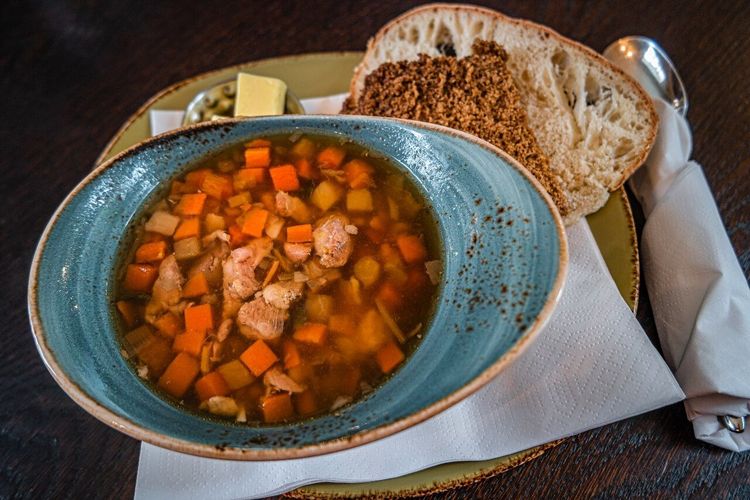
The kjötsúpa is Iceland's national soup. Rustic and hearty, it is made from lamb (most often shoulder or ribs), swede, carrots, potatoes, turnip, and dried herbs. It cooks slowly — several hours over a low heat — and the broth develops a remarkable depth of flavour.
In Iceland, sheep spend the summer roaming freely in the volcanic highlands, feeding on wild plants including Arctic thyme. This produces an extraordinarily aromatic meat, very different from intensively farmed lamb. Kjötsúpa is served piping hot in stoneware bowls in most traditional restaurants. It is often the starter of a meal, but a large portion is more than sufficient as a main course on a cold, windy day.
Ask for some rúgbrauð (see section 6) to accompany your kjötsúpa: the combination of buttered rye bread and steaming lamb broth is one of the finest in Icelandic cuisine. It is exactly the kind of comforting dish you crave after a morning spent outdoors when the north wind has chilled you to the bone.
4. Roast Lamb, the Centrepiece of the Icelandic Table
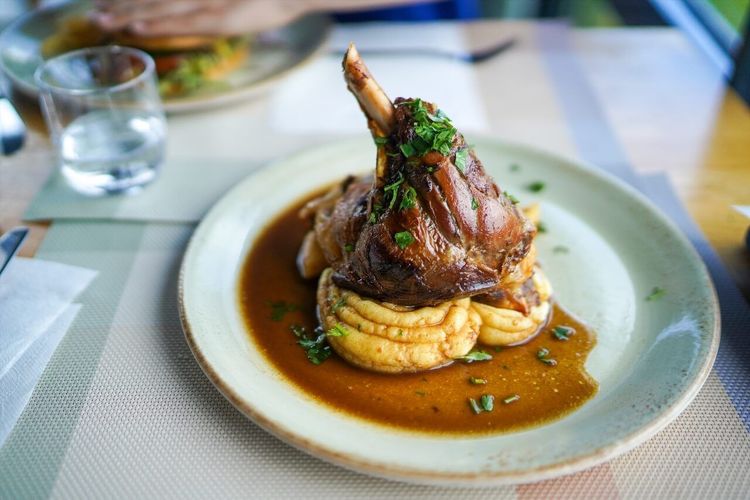
If kjötsúpa is the everyday soup, hangikjöt and roast lambakjöt are the showpieces for special occasions. Icelandic lamb is raised without antibiotics or growth hormones. The local breed, descended from the Viking sheep brought over in the 9th century, has remained genetically isolated ever since — no other breed has been introduced to the island in twelve centuries. This genetic purity, combined with a wild diet, produces meat of a quality recognised throughout Northern Europe.
The hangikjöt (literally "hung meat") is smoked lamb or mutton, traditionally served at Christmas. It is eaten hot with béchamel sauce and boiled potatoes, or cold in thin slices on bread. In supermarkets, pre-packaged hangikjöt allows you to take it on a picnic.
Slow oven-roasted lambakjöt is the festive version, served in fine dining restaurants. Chef Þráinn Freyr Vigfússon at restaurant Skál! (Laugavegur 63, 101 Reykjavik, rated 4.7/5 on Google with 1,140 reviews), on the shopping street Laugavegur, offers a contemporary version with smoked parsnip purée and Arctic lingonberry sauce. Expect to pay 4,500 to 6,000 ISK per dish (€29 to €39) at high-end establishments.
Outside Reykjavik, country guesthouses along the Golden Circle often offer roast lamb in a more affordable price range. It is one of the best ways to enjoy it: simply prepared, straight from the oven, with seasonal vegetables.
5. Harðfiskur, Dried Fish to Snack On
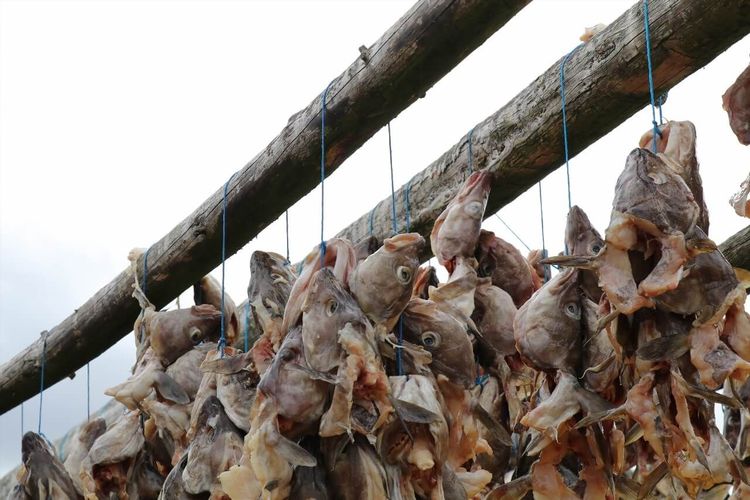
The harðfiskur is fish air-dried in the cold — mainly cod or haddock — cut into thin strips. It is the quintessential Icelandic snack: high in protein, low in fat, and transportable without refrigeration. Icelanders keep it in their cars, backpacks, and on their desks.
Its texture is tough, almost cardboard-like when dry. The way to eat it: crumble it slightly between your fingers to soften it, then dip it in salted butter. The combination is simple and addictive. You'll find it in bags in all supermarkets and petrol stations, at around 800–1,200 ISK per 100 g depending on the fish used.
Historically, harðfiskur allowed Icelandic sailors and farmers to get through the long winters without a fresh source of protein. Today it is exported to the Nordic countries and is beginning to appear in fine food shops in Paris. If you bring some home, it is one of the most authentic — and most resilient — culinary souvenirs you can take from the island.
6. Rúgbrauð, Rye Bread Baked Underground
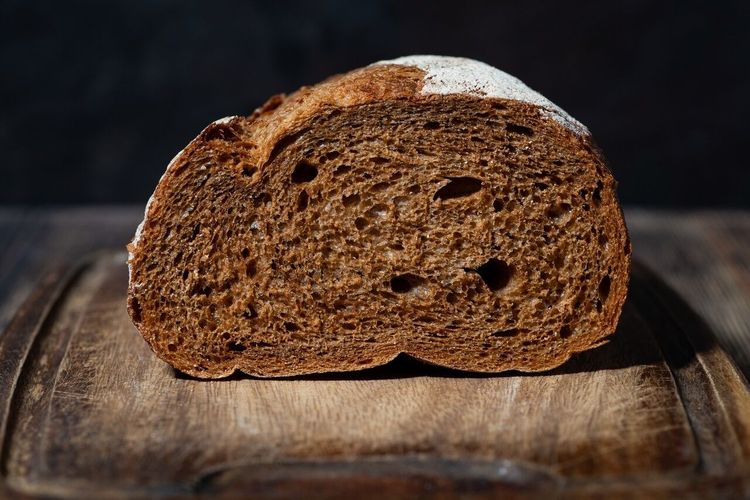
The rúgbrauð is a dense, slightly sweet rye bread, traditionally baked in cast-iron pots buried in volcanic soil heated by geothermal springs. This baking method, still practised on some farms around Mývatn, gives the bread a characteristic moisture and a slightly caramelised flavour impossible to replicate in an electric oven.
In Reykjavik, the bakery Brauð & Co (Frakkastígur 16, 101 Reykjavik, rated 4.8/5 on Google with 4,708 reviews) offers a contemporary rúgbrauð in individual slices, and their hazelnut brioche version has become something of a cult item among locals. The traditional bread is eaten buttered at breakfast, alongside kjötsúpa, or topped with marinated herring and onions.
To experience the original version, make a detour to the Laugarvatn hot springs, a two-hour drive from Reykjavik on the Golden Circle route. The geothermal bakery Fontana has been baking its rúgbrauð in the ground for decades. You can watch the cast-iron pot being pulled out of the earth, and the bread is served warm with butter and smoked salmon — one of the most singular breakfasts in Europe.
7. Pylsur, Reykjavik's Star Hot Dog
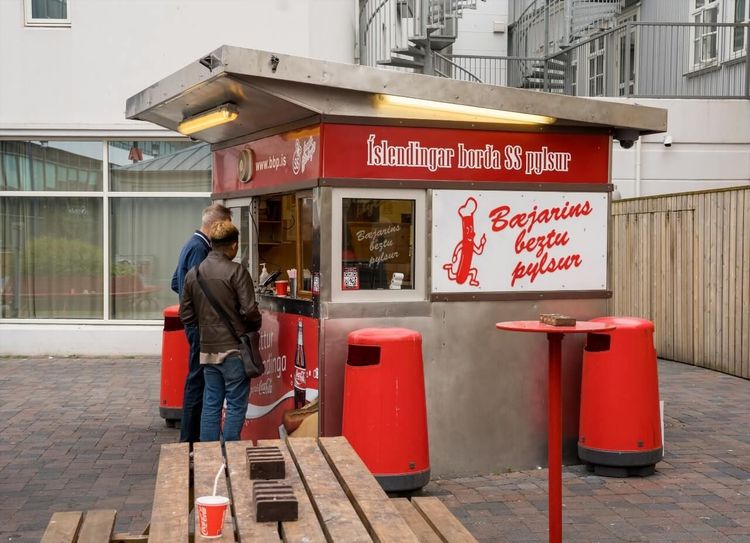
The pylsur (pronounced "pill-sour") is the Icelandic hot dog. Its fame rests on a single spot: the Bæjarins Beztu Pylsur stand (Tryggvagata 1, 101 Reykjavik, rated 4.4/5 on Google with 9,050 reviews) ("the best sausages in town"), open since 1937 near the waterfront of old Reykjavik. Bill Clinton ate here in 2004, and an order with mustard only is still known as the "Clinton."
The sausage is a blend of Icelandic pork, lamb, and beef. What sets it apart from an ordinary hot dog is the toppings: sweet mustard, ketchup, cabbage remoulade, fried onions, and raw onions. The standard order among insiders: "eina með öllu" ("one with everything"). Unbeatable price: around 600 ISK (€3.90).
The stand opens very early in the morning and closes late at night, sometimes past midnight in summer. It is one of the few places where you will find fishermen in oilskins, Japanese tourists, and Icelandic teenagers all at the same time. A true institution.
8. Fresh Fish and Seafood
Iceland is one of the world's leading fish-exporting countries, and yet eating fresh fish in Iceland has long been paradoxically difficult for tourists — the bulk of production left for export straight from the auction. The situation changed with the rise of the fish-shop restaurant (fiskaverslun-veitingastaður).
The Sægreifinn (Geirsgata 8, 101 Reykjavik, rated 4.5/5 on Google with 4,673 reviews) (the "sea baron"), on the old harbour of Reykjavik, has become the symbol of this no-frills cuisine. The catch-of-the-day skewers — cod, halibut, North Atlantic salmon, monkfish — are grilled without fuss and served with bread and potatoes. Expect to pay 1,800 to 2,500 ISK per dish (€11 to €16).
The lobster soup (humarsúpa) deserves a special mention. Icelandic langoustines, caught in the cold waters off the south of the island, are renowned for their firm, sweet flesh. The soup, enriched with cream and a splash of cognac, is one of the most widely served starters in the capital's fine dining restaurants.
If you visit the Westfjords or the Snæfellsnes peninsula, stop at the small fishing cooperatives that sell the morning's catch directly. Smoked salmon, mustard-marinated herring, and gravlax cod are sold there at prices 30 to 40 % lower than in restaurants. In Reykjavik itself, head for the old harbour: our audio-guided tour runs along the waterfront, from Harpa to the sculpture walk.
9. Brennivín, the Schnapps that Accompanies the Unspeakable

The brennivín (literally "burning water") is Iceland's national alcoholic drink. It is an aquavit distilled from potatoes and flavoured with caraway seeds. For decades, its black label earned it the nickname "black death" (svarti dauði) — a deterrence strategy put in place by the authorities when the partial prohibition was lifted in 1935 to discourage alcohol consumption.
First produced in 1935 and long made by the state monopoly, brennivín is today crafted by the brewery Ölgerðin Egill Skallagrímsson following the privatisation of production in 1989. The brand has launched limited editions flavoured with Arctic lingonberry and angelica, which have been warmly received for export. In Iceland, alcohol is sold only in state-run Vínbúðin shops (Austurstræti 10a, 101 Reykjavik, rated 4.2/5 on Google with 446 reviews); there are only about thirty of them across the entire country. A 500 ml bottle costs around 3,400 ISK (€22).
Tradition calls for brennivín to be served cold, in a small glass, alongside hákarl. The bitterness of the caraway and the strong alcohol cut through the pungency of the fermented shark. It is the most dreaded — and most photographed — pairing in Icelandic gastronomy.
10. Icelandic Sweets: Kleinar, Pönnukökur, and Ice Cream
Icelandic pastry is little known but charming. Three preparations deserve your attention.
The kleinar are twisted doughnuts, deep-fried in oil and lightly flavoured with cardamom. You'll find them in all bakeries and in supermarkets in bags. Their texture is dense and less greasy than a classic doughnut. They are the quintessential Icelandic coffee-time pastry.
The pönnukökur are very thin crêpes, cooked on a special round pan, dusted with sugar and rolled with lingonberry jam or cream. They are eaten warm, often three or four in a row. Several cafés in old Reykjavik serve them on weekends.
Finally, Icelandic ice cream is a surprise. Despite the cold, Icelanders are among the world's highest per capita ice cream consumers. In summer, queues outside ice cream shops on Laugavegur sometimes stretch to more than twenty people. The local flavours — skyr, black liquorice, cardamom — are well worth trying.
Where to Eat Icelandic Specialties in Reykjavik
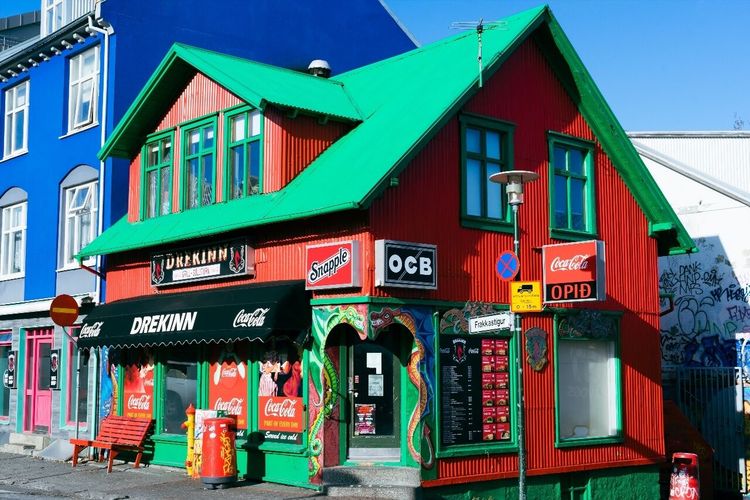
Reykjavik concentrates most of Iceland's quality dining. The city centre, between Laugavegur and the old harbour, is home to the vast majority of notable addresses. Here is a selection by budget.
Budget (under 2,000 ISK / €13): Bæjarins Beztu Pylsur for hot dogs, Bónus supermarkets for skyr and bagged harðfiskur, and the Kolaportið flea market on weekends for hákarl and homemade pastries.
Mid-range (2,000 to 5,000 ISK / €13–32): Sægreifinn on the old harbour for fish skewers and lobster soup, Sandholt Bakari on Laugavegur for kleinar and artisan breads, and the café Kaffivagninn, Reykjavik's oldest restaurant (1935), for daily specials based on lamb and fish.
Fine dining (above 7,000 ISK / €45): Dill Restaurant (Laugavegur 59, 101 Reykjavik, rated 4.5/5 on Google with 636 reviews), Iceland's first Michelin-starred restaurant (2017), offers a contemporary interpretation of Icelandic cuisine using exclusively local produce. The seven-course tasting menu runs around 17,000 to 20,000 ISK per person excluding drinks. Booking well in advance — several weeks ahead — is essential. Matur og Drykkur ("food and drink") offers a more accessible take on reinvented traditional cuisine, with dishes such as caramel-glazed sheep's head or a modernised kjötsúpa.
To explore Reykjavik on foot and discover these addresses in their urban context, the Ryo audio guide for the Bay of Smokes guides you through the streets of the old harbour and the historic centre, where most of these dining spots are concentrated. This audio-guided tour connects the main points of the culinary scene with the city's maritime history.
Budget and Food Prices in Iceland
Iceland is one of Europe's most expensive countries for food. Here are some benchmarks for 2026.
A restaurant meal with a single main course averages 2,500 to 4,500 ISK (€16 to €29) at mid-range establishments. At fine dining restaurants, budget easily 10,000 to 20,000 ISK per person including drinks.
The supermarkets offer a serious alternative: the Bónus chain (yellow bags with a pink piggy face, impossible to miss) has the lowest prices. A standard basket — skyr, bread, cold cuts, vegetables, drinks — comes to 3,000 to 5,000 ISK (€19 to €32) for two people over two days. Local brands are often cheaper than imports. Avoid the convenience stores 10-11 and Krambúð — handy, but 30 to 40% more expensive than Bónus.
Alcohol is a significant expense if you drink at restaurants: a local draught beer costs around 1,200 to 1,500 ISK (€7.80 to €9.70). Buying from Vínbúðin before dinner is considerably more economical.
Meal times in Iceland differ slightly from Southern Europe: lunch is eaten between 11:30 and 13:00, and dinner between 18:00 and 20:00. Many restaurants offer a cheaper lunch menu (the dagmatur) that typically falls between 1,800 and 2,500 ISK with soup and a main course.

FAQ
What Is the Most Famous Icelandic Specialty?
The hákarl (fermented shark) is probably the most internationally well-known Icelandic specialty, especially since several celebrities have eaten it in public. But the specialty most consumed by Icelanders themselves is skyr, present at almost every meal, from breakfast to dessert.
Is Fermented Shark Actually Edible?
Yes, absolutely, although it is very far removed from the usual flavors for a Western palate. The ammonia smell is powerful but fades fairly quickly once the piece is in your mouth. The texture is soft. Most travelers who have tried it describe the experience as surprising rather than genuinely unpleasant. Accompanying it with a glass of brennivín helps considerably.
How Much Does a Meal Cost in Iceland?
Budget 2,500 to 4,500 ISK (€16 to €29) per person for a full meal at a mid-range restaurant in Reykjavik in 2026. By relying on supermarkets, hot dogs, and lunch specials (dagmatur), it is possible to eat well for 1,500 to 2,000 ISK per meal (€10 to €13). Icelandic supermarket food is a serious option: skyr, hangikjöt sandwiches, and harðfiskur are excellent.
Can You Bring Icelandic Specialties Back to France?
Yes, with a few precautions. The harðfiskur (dried fish) and kleinar (doughnuts) travel without issue by plane. Vacuum-sealed skyr in a jar is allowed in the cabin. Brennivín (alcohol) must be checked or purchased duty-free. Hákarl (fermented shark) is legally permitted to import into France, but its smell makes it difficult to transport by plane — pack it in several airtight bags and check it as hold luggage.
Where to Taste Icelandic Specialties on a Budget in Reykjavik?
The Bæjarins Beztu Pylsur stand (hot dogs, 600 ISK) is the obvious starting point. The Kolaportið flea market on weekends offers hákarl, homemade pastries, and harðfiskur at moderate prices. Sægreifinn on the old harbour has the best fish skewers in the city for under 2,500 ISK. Finally, the Brauð & Co bakery on Frakkastígur is the locals' go-to for morning pastries without paying tourist prices.
Icelandic Cuisine, a Journey in Itself
From skyr eaten standing up in a Reykjavik grocery store to the tasting menu of a Michelin-starred restaurant, Iceland's culinary specialties cover a surprisingly wide spectrum for a country of 370,000 people. What connects them is an exceptional raw ingredient — lamb, fish, milk — and a tradition of preservation that has today become a gastronomic selling point in its own right.
To continue exploring on foot through Reykjavik, the Ryo audio-guided tour of the Bay of Smokes tells the story of the old harbour and the neighbourhoods where this cuisine was shaped. And if you are planning your trip, our articles on the best time to visit Iceland and the things to do in Reykjavik will help you organise your stay.
À lire également