© Shutterstock
 Votre guide Ryo
Climbing Volcanoes in Sicily: Complete Guide to Etna, Stromboli, and Vulcano (2026)
Climbing volcanoes in Sicily: behind this mythic trio lie three adventures nothing can truly prepare you for. Sicily is an island like no other. Beneath its orange groves and thousand-year-old Greek temples smoulders a telluric energy that has never truly fallen asleep. Climbing volcanoes in Sicily draws thousands of hikers from around the world every year: Etna, a giant standing at 3,357 metres that dominates the eastern part of the island with its still-smoking lava flows; Stromboli, the torch-island of the Aeolian Islands that has been hurling volcanic bombs every twenty minutes for two thousand years without pause; Vulcano, whose sulphur-yellow Gran Cratere can be reached in less than an hour from the port. Three volcanoes, three characters, three radically different experiences.
This guide gives you everything you need to prepare for this geological adventure: both slopes of Etna and their respective access conditions, the strict regulations on Stromboli with its mandatory guide, the loop trail on Vulcano, the best seasons, the gear to bring, and the full logistics from Catane or Palerme. Whether you are a weekend hiker or a seasoned mountaineer, you will find a volcano here that matches your level — and very likely the urge to climb more than one.
Before lacing up your boots, a stop in Palerme is in order. The audio-guided tour of Palerme offers 7.7 km of discovery in 3 hours with 24 audio commentary stops, from the Palazzo dei Normanni to the Vucciria. A gentle introduction to Sicily before the lava trails.
Sicily's Volcanoes: The Geology of a Fire Archipelago
Sicily sits above the subduction zone between the African and Eurasian tectonic plates. This slow geological collision, a few centimetres per year, has been feeding the region's volcanoes for millions of years. Etna is the direct result of this subduction, amplified by a plume of magma rising from the Earth's mantle. Stromboli and Vulcano belong to the Aeolian Islands archipelago, linked to the same tectonic system but with distinct eruptive characteristics.
Three types of eruption are found on these volcanoes. Etna is effusive to strombolian: spectacular but generally slow lava flows, with punctual and intense paroxysmal episodes. Stromboli is the namesake of the "strombolian" type — regular, moderate, cyclical explosions with no large flow into the sea. Vulcano has a phreato-magmatic and fumarolic character, currently in a non-explosive phase but with increased hydrothermal activity since 2021 that warrants attention.
Etna: Portrait of the Mediterranean Giant
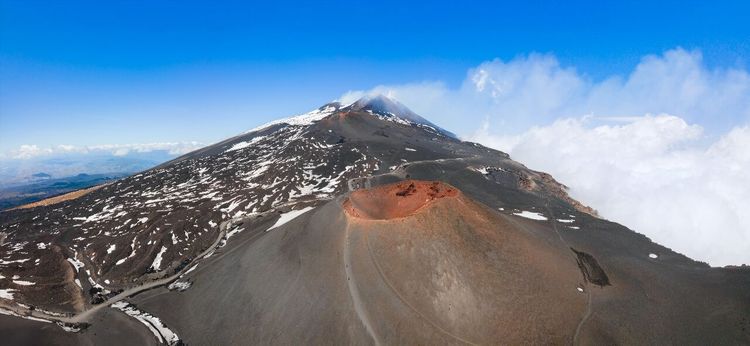
At 3,357 metres, Etna is the highest active volcano in Europe and one of the five most active volcanoes in the world. It dominates eastern Sicily in a way that defies comparison: from the seafront of Catane, its often snow-capped summit hovers above the buildings like a permanent and slightly threatening presence. Sicilians simply call it Mongibello, the mountain of mountains, and maintain a relationship with it built on admiration and a somewhat resigned familiarity.
Greek mythology assigned it the role of Vulcan's forge, the god of fire. Zeus is also said to have imprisoned the giant Typhon there, condemned to shake the earth every time he attempts to escape. These tales are not trivial: they show how the Ancients tried to rationalise eruptions they could neither predict nor control, and which the modern instruments of the INGV (National Institute of Geophysics and Volcanology) still only imperfectly master.
Its size has varied with successive eruptions. The paroxysmal episodes of 2021–2024 profoundly reshaped the morphology of the South-East Crater, the most active and youngest of the four summit craters. The lava fountains of 2021 reached 1,500 metres in height, filmed live and shared around the world. In 2026, activity remains sustained: consult INGV bulletins before any ascent.
The volcano has four main summit craters: the Voragine, the Bocca Nuova, the North-East Crater, and the South-East Crater. The latter has doubled in volume in just a few years thanks to material deposited during recent eruptions. Access to the summit zone above 2,900 metres (sometimes lowered to 3,000 metres depending on the alert level) is reserved for hikers accompanied by a PNGAE-licensed guide (Parco Nazionale dell'Etna).
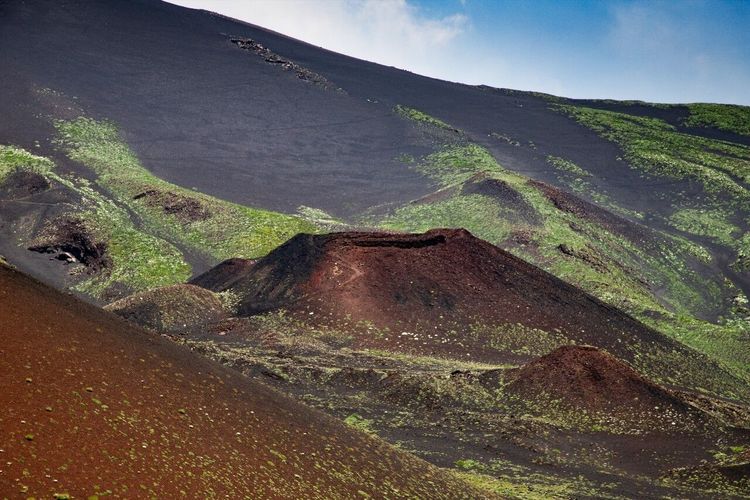
The Parco dell'Etna, created in 1987 and listed as a UNESCO World Heritage Site since 2013, covers 59,000 hectares. It is an ecosystem in its own right, where vegetation changes dramatically with altitude. Up to 1,000 metres grow the vines of Etna DOC wines — whites based on Carricante and reds based on Nerello Mascalese — renowned worldwide for their volcanic minerality and singular aromatic profile. Between 1,000 and 2,000 metres, forests of pine, birch, and chestnut gradually give way to moorland and Canary Island lavender. Beyond that, bare lava prevails, dotted with more than 400 secondary adventive cones scattered across the flank like so many geological scars.
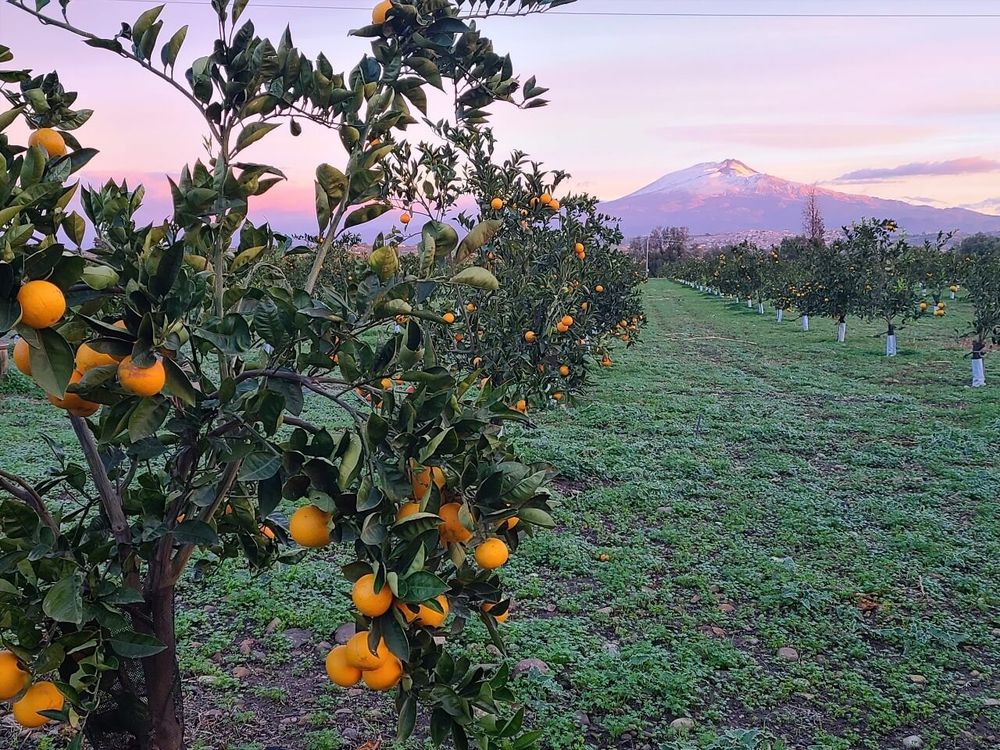
Etna's slopes still bear visible traces of recent eruptions: roads cut by cooled lava flows, houses engulfed halfway up at Zafferana Etnea during the 1992 eruption, fields of black lava contrasting with the citrus groves below. This coexistence between volcanic activity and intensive agricultural life is one of the most striking characteristics of the region, and explains why Sicilians have never really considered leaving the volcano's slopes.
Climbing Etna from the Southern Slope (Nicolosi)
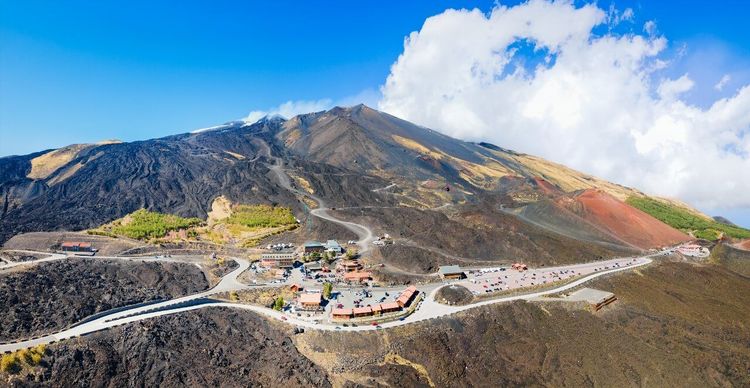
For a first ascent of Sicily's volcanoes, the southern slope is the most frequented and best-equipped access point. You reach the Rifugio Sapienza at 1,923 metres from Nicolosi (Via Roma 1, 95030 Nicolosi CT), about twenty kilometres south of Catane. From this refuge-restaurant, a cable car climbs in 15 minutes to 2,504 metres, operating from approximately April to October, with interruptions during eruptions or unfavourable weather conditions. At the top cable-car station, 4×4 jeeps offer rides up to 2,900 metres, the threshold of the mandatory guide zone.
Three options are available from the Rifugio:
The full guided ascent (to the summit craters, between 3,000 and 3,357 m depending on the alert level) combines cable car, jeep, and guided hiking with a remaining elevation gain of around 400 to 500 metres from the jeep drop-off. Duration: 5 to 6 hours round trip from the upper cable-car station. Moderate to difficult level depending on nivo-volcanic conditions. A PNGAE-licensed guide is mandatory for this option.
The free ascent up to 2,900 m requires no guide. From the upper station, you hike on foot to the regulatory threshold. You will not reach the summit craters, but you will get a close look at the recent flows from the South-East Crater and around a dozen secondary adventive cones. Duration: 3 to 4 hours round trip. This option remains highly rewarding: the lava landscapes at 2,700 metres are every bit as impressive as those near the summit.
The full hike from the Rifugio (without cable car) is aimed at hikers who want the full elevation gain from 1,923 to 2,900 metres, approximately 980 metres of ascent. Duration: 7 to 9 hours round trip. Physically demanding, but this choice delivers a sense of achievement far greater than a cable-car and jeep ascent.
Booking a guide is done through partner agencies of the Parco dell'Etna in Nicolosi or Catane, or directly via their websites. Indicative price: 50 to 80 euros per person for a guided group excursion to the craters. The cable car costs around 50 euros return (2025–2026 rate). The 4×4 jeeps add 30 to 40 euros per person, and the combined cable car + 4×4 package up to 2,900 metres runs around 78 euros.
Critical point: access to the summit can be closed without notice at any time. The alert level is published in real time by the INGV on its official website. On some days, even licensed guides cannot ascend above 2,900 or 3,000 metres. Check the bulletins the evening before and again on the morning of your ascent.
Climbing Etna from the Northern Slope (Linguaglossa)
Less well known to foreign visitors, the northern slope offers a wilder and less standardised experience. The starting point is Piano Provenzana (SP 92, 95015 Linguaglossa CT, rated 4.6/5 on Google from 4,280 reviews), at 1,800 metres altitude, accessible from Linguaglossa on the northern flank of the volcano.
A cable car once operated on the northern side, but the lava flows of 2002 destroyed it during a particularly devastating eruption. It has never been rebuilt. The ascent from Piano Provenzana is therefore entirely on foot — no queues at the lifts, no crowded car park, just the trail and the black lava.
The trail climbs through fields of cooled lava with jagged edges, scattered with adventive cones that rise like blisters on the volcano's crust. Vegetation disappears quickly. The guided hike towards the summit craters from this slope generally takes 7 to 9 hours round trip with 1,500 metres of elevation gain — the most demanding option on Etna, and for many, the most beautiful.
In winter, the northern slope is also the starting point for ski touring on Etna. The Linguaglossa alpine ski resort offers lifts allowing a faster approach at high altitude. This is an activity practised mainly by Sicilians, little known to foreign travellers, and an original way to discover the volcano under snow.
An original option from Piano Provenzana: the Grotta del Gelo, at 2,039 metres altitude. This cave formed inside a lava tube shelters permanent ice throughout the year — a remarkable natural curiosity for an active volcano basking under the Mediterranean sun. It is accessible without a guide, provided you have a headlamp and warm clothing. Descending into the lava tube, with its cooled basalt walls and icy air, is in itself a memorable experience.
Stromboli: The Permanent Lighthouse of the Mediterranean
Stromboli (Via Roma, 98050 Stromboli ME, rated 4.3/5 on Google from 397 reviews) is not merely a volcano. It is an island, a community of 400 permanent residents, and one of the most active volcanoes in the world in terms of absolute regularity. An explosion every 15 to 30 minutes on average, for at least 2,000 years without any known interruption. Greek and Arab sailors called it the "lighthouse of the Mediterranean", the flames visible from the crater serving as a nocturnal landmark in an era without GPS or electricity.
The island is part of the Aeolian Islands archipelago, listed as a UNESCO World Heritage Site since 2000. It reaches 924 metres at the Pizzo sopra la Fossa, but this summit has been closed to hikers since the deadly eruptions of 2019. Today, authorised observation takes place from the Quota 400, a viewpoint perched at 400 metres altitude that overlooks the Sciara del Fuoco, the great volcanic debris flow that tumbles from the summit to the sea on the north-western flank. It is from this promontory, accessible only with a guide and at nightfall, that hikers witness the explosions launching incandescent bombs and ash clouds into a progressively star-filled sky.
Access to Stromboli is by ferry or hydrofoil from Milazzo, on the northern coast of Sicily. The crossing takes 1h30 to 3 hours depending on the type of vessel. Liberty Lines operates fast hydrofoils, Siremar slower but cheaper ferries. In high season (July–August), book in advance: seats go fast and crossings are sometimes overcrowded.
On the island, the village of Stromboli is concentrated on the north-east side of the volcano. Lanes paved in white basalt, cascading bougainvillaea, a few dozen hotels and guesthouses, restaurants serving fisherman's cuisine — octopus, aubergines, capers from Salina. The atmosphere is one of chosen isolation: no cars, no chain supermarkets. Some visitors spend only one night on the island for the ascent and leave the next morning. That is technically sufficient, but staying two nights gives you time to absorb the unique atmosphere of this place and understand why some people come back every year.
The Sciara del Fuoco is also visible from the sea during the nocturnal crossing. Agencies in Milazzo offer boat tours allowing you to watch the explosions from the water at a safe distance. This is an excellent alternative to the physical ascent for people with mobility difficulties or those wishing to bring young children — the spectacle from the water is breathtaking, different from that seen at the summit but every bit as unforgettable.
Making the Most of the Stromboli Ascent: Guide, Regulations, and Preparation
The ascent of Stromboli is strictly regulated. Following several serious accidents, including the death of a hiker in July 2019 during exceptionally violent explosions, the Italian authorities have significantly tightened access conditions. In 2026, the rules in force are as follows.
Access is free up to 290 metres. Between 290 and 400 metres, a licensed volcanic guide is mandatory. Above 400 metres, access to the summit has been completely prohibited since the 2019 eruptions, and this closure remains in force in 2026. This regulation is enforced by Protezione Civile rangers who patrol the trail from midday onwards. Offenders risk a fine of up to 1,000 euros and forced evacuation. Guides must hold a Guida Vulcanologica certification from the Regione Sicilia; ask to see the certification before setting off.
The Quota 400 viewpoint, overlooking the Sciara del Fuoco, is now the highest point permitted, and only with a guide: this is where sunset excursions begin. The free section, up to 290 metres, remains very worthwhile, particularly for families or those in less good physical condition: the view of the debris flow and the volcano's silhouette from this altitude is already spectacular.
The guided ascent to the Quota 400 takes 2 to 3 hours on the way up over terrain alternating between lava and unstable ash. The descent takes 1 to 2 hours. Departure is in the mid-afternoon, generally between 4 pm and 6 pm depending on the season, to arrive at the viewpoint at sunset and witness the explosions as night falls. This is the classic timing, the most spectacular, and practically the only one offered by licensed guides. As the old summit (Pizzo sopra la Fossa, 924 m) remains closed, no agency offers the full ascent any longer.
The descent is made via a channel of volcanic ash where you "surf" down the black scoria: flat foot, weight shifted back, a fast and fairly enjoyable descent once you get the hang of the technique. Warning: the ash stains permanently. Wear clothes you are prepared to sacrifice.
Equipment typically checked by guides at the start:
- Closed, ankle-high hiking boots (sandals are refused without discussion)
- Windproof jacket and warm layer (the wind can be violent at the top even in August)
- Headlamp (mandatory — the descent takes place in complete darkness)
- Water (minimum 2 litres for the ascent alone)
- Dust mask (recommended, not legally required)
Prices and booking: guide fees range from 30 to 40 euros per person in a group (minimum 4 to 5 people). The associations Magmatrek and Totem Trekking in Stromboli offer online booking. In July–August, groups can exceed 200 hikers simultaneously on the same trail, which considerably diminishes the experience. Opt for May–June or September–October for a more intimate ascent that is equally spectacular.
Weather and closures: wind speeds above 40 km/h automatically trigger closure of the trails above 290 metres. An abnormal eruptive episode triggers the same measure. Guides have real-time information and communicate directly with the INGV Observatory for Stromboli. Their presence is not merely a legal requirement — it is a rational one.
Vulcano and the Gran Cratere: Hiking Without a Guide
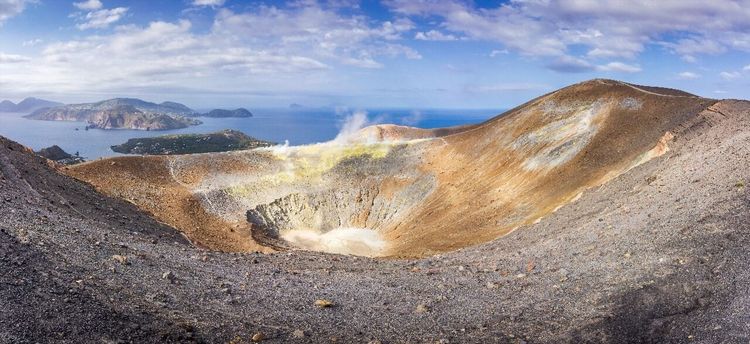
Vulcano is the most accessible volcanic island in the Aeolian Islands, 45 minutes by ferry from Milazzo, and the most suitable for hikers seeking a first volcanic experience without regulatory constraints. No mandatory guide, no prior booking, no supervised group.
The Gran Cratere peaks at 391 metres. The trail starts from the Porto di Levante, the island's small port, and climbs in switchbacks through an increasingly colourful landscape of sulphur and ash. The ground changes gradually: black at the base, ochre at mid-slope, then intense bright yellow around the active fumaroles. The smell of rotten eggs is noticeable from 200 metres altitude — normal emissions of sulphur and sulphur dioxide, not dangerous at typical concentrations for people in good health.
At the summit, the crater measures approximately 500 metres in diameter. The fumaroles continuously emit white vapours at temperatures that can exceed 300°C. Never approach the hydrothermal vents. The view from the rim takes in the entire archipelago: Lipari to the north, Salina further still, and on a clear day, the smoke of Stromboli visible on the horizon.
The ascent takes 45 to 60 minutes for a hiker in good condition. The return is similar. Difficulty level: easy to moderate. The trail is well marked and used year-round. The only medical restriction: people with asthma or chronic respiratory problems should consult a doctor before ascending, as gas concentrations can be high in light winds.
Note for 2026: since 2021, Vulcano has been experiencing a period of increased hydrothermal activity. High levels of CO2 have been measured in the port and the lower-lying dwellings on the island. The authorities have carried out several partial evacuations of permanent residents. Before your visit, check the opening status with the Protezione Civile or ferry operators from Milazzo — the situation continues to evolve.
Down below, the famous fanghi (sulphurous mud pools) allow a geothermal bath in a natural basin right next to the port. Do this before swimming in the sea — the reverse order is considerably less pleasant. This combination of Gran Cratere ascent, mud bath, and sea swim is enough to fill a full day from Milazzo and constitutes one of the most singular experiences all of Sicily has to offer.
Other Volcanic Curiosities: from the Cyclops to Alcantara
Sicily contains other landscapes of volcanic origin, less spectacular than Etna or Stromboli but perfectly interesting as complementary stops.
The Isole dei Ciclopi, off the coast of Acicastello north of Catane, are black basalt rocks rising from the sea. Legend has it these are the blocks hurled by the Cyclops Polyphemus at the fleeing Odysseus. The geological reality: basalt prisms formed by the rapid cooling of lava in seawater, similar in structure to the columns of the Giant's Causeway in Northern Ireland.
The Alcantara Gorges are a fissure carved by an ancient lava flow through the basalt on the north-eastern flank of Etna. The Alcantara river flows through them for several kilometres between walls of basalt columns reaching up to twenty metres in height. The water temperature drops below ten degrees even in midsummer — a refreshing respite after a volcanic hike under the Sicilian sun.
What Season Is Best for Climbing Sicily's Volcanoes?
Each volcano has its ideal window for climbing Sicily's volcanoes, and these windows do not perfectly coincide.
Etna can be climbed year-round. In winter (November to March), snow and ice make the summit zone technically alpine: crampons and gaiters may be required depending on conditions. A winter guided ascent remains possible and offers extraordinary views — a snow-covered Sicily with the Ionian Sea deep blue below — but weather risks increase significantly and cable-car closures are frequent. The best period remains April to June, before the summer heat, and September to October, after the summer crowds. Summer (July–August) is technically doable but hot up to 2,000 metres, very busy at the Rifugio Sapienza, and airborne ash can reduce visibility.
Stromboli is dependent on the ferries, not the volcano itself. In winter (November to March), crossings from Milazzo become irregular and can be cancelled for several consecutive days in bad weather. The optimal period is May to October. In July–August, groups accumulate: you may find yourself climbing in procession with 150 to 200 other hikers, which turns the volcanic experience into a tourist parade. May–June or September are clearly the best months to combine good conditions with manageable crowds.
Vulcano is accessible almost year-round, with more regular ferries than to Stromboli. The fanghi are enjoyed in all seasons. Avoid sirocco episodes (mainly in autumn): this hot wind from Africa makes the crossing unpleasant and can push volcanic gases towards the hiking areas rather than dispersing them.
To climb all of Sicily's volcanoes in a single trip, plan for June or September. Stable weather, comfortable hiking temperatures, reliable ferries, reasonable crowds. Two weeks allow you to cover Etna with both slopes (2–3 days), the Aeolian Islands with Stromboli and Vulcano (5–7 days), and a stop in Palerme or Catane for the cultural and gastronomic dimension.
Equipment and Physical Preparation
The checklist varies by volcano, but a common baseline applies to any ascent of Sicily's volcanoes.
Footwear first. Ankle-high hiking boots with a rigid sole are essential on all volcanoes. Cooled lava is razor-sharp and ash slopes demand good ankle support. For Stromboli, guides refuse to take anyone in sandals or low-top trainers — no negotiation possible.
Layering. Temperature drops by approximately 0.65°C per 100 metres of altitude. At Etna's summit, it can be 20°C cooler than in Catane at the same moment. In summer, set off with light layers below and a waterproof windproof jacket in your pack. In autumn–winter–spring, add a lightweight down jacket. On Stromboli, a jacket is always needed at the top, even in mid-August — the wind is usually strong up there.
Water. Allow a minimum of 2 litres for Etna and 2.5 litres for Stromboli (the effort is more sustained and the heat can be oppressive at the start of the climb). There are no fountains on the volcanic slopes: everything you drink, you must carry from the bottom.
Headlamp. Mandatory for Stromboli (the descent takes place in total darkness). Strongly recommended for Etna in case of unexpected delay or entry into a lava tube.
In terms of physical fitness, Stromboli remains the most demanding volcano ascent of the trio despite the closure of the summit: around 400 metres of positive elevation gain up to the Quota 400 over unstable terrain, with an ash descent that places different demands on ankles and knees. Etna with cable car and jeeps is accessible to people of average fitness. Vulcano suits everyone, from age 8 to 10 upwards. To prepare for Stromboli, do 2 to 3 hiking outings with 500 to 700 metres of elevation gain in the weeks beforehand — ash terrain is roughly twice as tiring as rock or packed earth.
Palerme, Catane, and the Villages: Combining Volcanoes and Sicilian Heritage
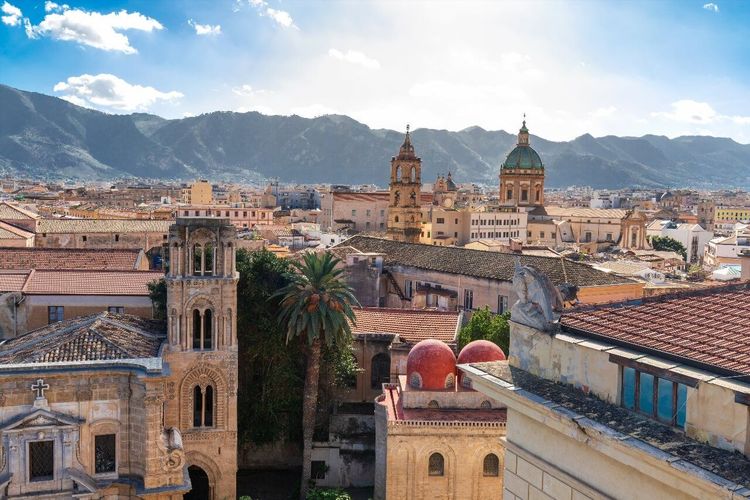
Climbing Sicily's volcanoes fits naturally into a broader trip. Sicily concentrates an exceptional heritage — twenty-five centuries of successive dominations (Greek, Roman, Byzantine, Arab, Norman, Spanish) have laid down layers of civilisation that no other Mediterranean island can match.
Palerme is the essential cultural starting point. The city is dizzying in the density of its historic centre: the Palatine Chapel (Cappella Palatina, Piazza del Parlamento 1, 90134 Palermo PA, rated 4.7/5 on Google from 11,886 reviews), a masterpiece of 12th-century Norman-Byzantine art with its gold mosaics on a dark background, is a five-minute walk from the Ballarò market, said to be the largest street market in Europe by surface area. The Chiesa di San Cataldo with its red Norman dome, the Cathedral of Palerme blending Arab, Norman and Baroque styles across ten centuries of successive modifications, the Palazzo dei Normanni and its royal gardens — all within a radius of less than one square kilometre.
The Ryo audio guide for Palerme offers 7.7 km of discovery with 24 audio commentary stops, from the Palazzo dei Normanni to the Vucciria. It lets you explore the city in depth, at your own pace, without a human guide or fixed schedule. It is the natural complement to a volcanic trip: two days of lava and craters, two days of mosaics and markets.
If you want to explore Sicily beyond the capital, our Ryo selection of Sicily's must-sees points you towards the temples of Agrigento, the Greek ruins of Selinunte, and the Roman mosaics of the Villa Romana del Casale.
Catane is the other key city for the volcanic traveller. Built on Etna's lava — the great eruption of 1669 destroyed part of the city and reshaped the coastline — it is worth an evening for its colourful fish markets around the Pescheria, its cathedral dedicated to Saint Agatha, and its Piazza del Duomo adorned with a lava elephant, the city's emblem for centuries. From here, the Rifugio Sapienza is 40 kilometres away.
Taormine, between Catane and Messina, is worth a half-day for its ancient Greek theatre from the 3rd century BC, with Etna as a backdrop. This panorama — Greek ruins with the snow-capped active volcano behind — is one of the most photographed in the Mediterranean and one of the hardest to forget once you have seen it.
The villages of Sicily's interior are also worth the detour. Our Ryo selection of Sicily's most beautiful villages lists the hidden gems least known to the standard tourist circuit, from Gangi to Sperlinga via Nicosia.
Budget, Accommodation, and Practical Logistics
A week-long trip focused on climbing Sicily's volcanoes and exploring local culture represents a reasonable budget compared to other European destinations of equivalent heritage richness.
Indicative budget per person for 7–8 days:
- Flights: 80 to 200 euros return from Paris, Lyon, or Bordeaux (Ryanair, easyJet, Volotea serve Catane and Palerme)
- Accommodation: 40 to 90 euros per night in a double room (B&B or agriturismo)
- Guided ascent of Etna southern slope (cable car + jeep + guide): 80 to 120 euros
- Guided ascent of Stromboli: 30 to 40 euros
- Milazzo–Aeolian Islands ferries return: 25 to 40 euros per person
- Meals at a trattoria: 15 to 25 euros per person (less at rosticcerie and markets)
Estimated total budget: 900 to 1,400 euros per person for 8 days in mid-season. In high season (July–August), add 20 to 30% on accommodation.
Accommodation by area:
For the southern slope of Etna, Nicolosi and Zafferana Etnea offer B&Bs and agriturismi with a direct view of the volcano at reasonable rates, generally between 50 and 80 euros for a double room. For the northern slope, Linguaglossa or Randazzo are more authentic, less touristy, and often cheaper. On Stromboli, availability is limited by the island's size — book several weeks ahead in July–August, or even several months in advance for the most popular hotels. Lipari can serve as a base for the Aeolian Islands: more accommodation on offer, regular ferries to Stromboli (45–60 min) and Vulcano (10 min).
A car is essential for Etna. The Rifugio Sapienza is 20 km from Catane and poorly served by public transport. Organised excursions from Catane (minibus departure around 8 am, return around 2 pm) are the solution for those who do not wish to hire a vehicle. For the Aeolian Islands, on the other hand, a car is unnecessary: the islands prohibit vehicles belonging to non-residents. Milazzo is easily reached by train from Messina (20 minutes) or Catane (1h30).
An 8-day itinerary combining all three volcanoes: D1–D2 Catane and Etna southern slope, D3 Taormine and transfer to Milazzo, D4–D5 Stromboli with an overnight on the island and ascent on the evening of D5, D6 Vulcano (fanghi, Gran Cratere, and swimming) then return to Milazzo, D7–D8 Palerme.
Safety, Volcanic Alerts, and Regulations
Accidents during ascents of Sicily's volcanoes are rare but real. The vast majority occur when hikers ignore exclusion zones or venture without a guide into regulated areas.
On Etna, the main risk is the ejection of volcanic bombs during sudden unanticipated eruptions. In March 2017, an explosion near the South-East Crater injured ten people, including a BBC crew, all of whom were in a sector the INGV had not classified as dangerous that very morning. Since that episode, the exclusion zone has been extended and closure criteria tightened. Absolute rule: never approach active fumaroles, never leave the marked trails, and always follow the guide's instructions.
On Stromboli, normal explosions generally do not reach hikers positioned on the marked trail at the regulatory distance. The risk of incandescent bomb fall-out exists but remains low with a guide who respects the safety distances. The fatal accident of July 2019 occurred during an exceptional paroxysm that the instruments available at the time had not anticipated; since then, access to the summit has been closed.
On Vulcano, the risk is less volcanic than asphyxiating: CO2 accumulates in low-lying areas (hollows in the terrain, caves, natural basins, enclosures) and can cause rapid loss of consciousness without prior symptoms. Never lie down on the volcanic ground in fumarole zones. Avoid natural depressions and enclosed spaces in strong heat and light winds.
General rules applicable to all three volcanoes:
- Strictly observe the exclusion signs, which are regularly updated by the INGV and local authorities
- Never venture alone above the regulatory thresholds
- Inform your accommodation of your expected return time before setting off
- Charged phone with the European emergency number 112 saved
- Check INGV bulletins the evening before and again on the morning of each ascent
FAQ
Can you climb Etna without a guide?
Yes, in part. The zone up to 2,900 metres is freely accessible without a licensed guide. From the southern slope, the cable car ascends to 2,504 metres and jeeps can take you up to the regulatory threshold at 2,900 metres. At this altitude you already witness striking volcanic landscapes and remarkable panoramic views over Sicily and the sea. Above 2,900 metres, in the summit crater zone, a licensed guide from the Parco dell'Etna is mandatory. Without one you will not reach the active craters, but the experience remains significant and accessible to many.
How much does a full ascent of Etna cost?
Budget between 80 and 120 euros per person for a full ascent on the southern slope: around 50 euros for a return cable-car ticket, 30 to 40 euros for the jeep up to 2,900 metres, and 50 to 80 euros for the licensed guide to the summit craters. Some operators offer all-inclusive packages that are slightly cheaper for groups. The northern slope, entirely on foot, saves you the cable car and jeep costs but involves a total elevation gain of 1,500 metres and 7 to 9 hours of walking — a considerably greater physical investment.
Is climbing Stromboli dangerous?
It carries the risks inherent in any hike on an active volcano, but it can be done with reasonable safety with a licensed guide. In 2026, the regulations are strict: free access up to 290 metres, a mandatory guide between 290 and 400 metres, the summit closed since 2019, and automatic closure in strong winds or abnormal eruptive activity. The fatal accident in July 2019 occurred during an exceptional episode. With a local guide who knows the volcano's daily mood, the risks are comparable to those of any exposed mountain hike.
What is the difference between Stromboli and Vulcano?
They are two volcanoes with radically different temperaments. Stromboli is the most active: explosions every 15 to 30 minutes for millennia, a demanding ascent to the Quota 400 viewpoint (guide mandatory above 290 m, the 924 m summit closed since 2019), and a unique nocturnal pyrotechnic display. Vulcano is in a calm fumarolic phase: no explosion for decades, the Gran Cratere at 391 metres accessible without a guide in 45 to 60 minutes, and an intense sulphurous atmosphere with fumaroles reaching several hundred degrees. They complement each other perfectly and can easily be combined in a single stay in the Aeolian Islands, as both islands are served from Milazzo.
Can you do these climbs as a family with children?
Vulcano is perfectly suited to children aged 8 to 10 and above: a short ascent, a marked trail, and fumaroles with a sulphur smell that fascinates young curious minds. Etna with the cable car and jeeps is suitable for children aged 12 and over in good physical shape. Stromboli is not recommended for under-12s for the full ascent (guides often suggest a minimum age of 14) due to the duration, unstable terrain, and night-time descent. To see Stromboli as a family with young children, the nocturnal boat tours from Milazzo offer the same spectacle of explosions from the water, with no physical constraints.
How do you organise a trip combining all three volcanoes from Palerme?
Palerme is an excellent cultural starting point but not the most practical for the volcanoes: 2h30 by road to Milazzo for the Aeolian Islands, and Etna is 3h30 away via the A19 motorway. An optimised itinerary from Palerme: D1–D2 Palerme and cultural exploration with the Ryo audio guide for Palerme, D3 drive to Milazzo, ferry to the Aeolian Islands, D4–D5 Stromboli (overnight on the island), D6 Vulcano then return to Milazzo, D7 train transfer to Catane, D8–D9 Etna from Nicolosi. The loop is doable in 9 to 10 days and covers the essentials of climbing Sicily's volcanoes, from Etna to the Aeolian Islands.
Conclusion
Three volcanoes, three temperaments. Etna with its European immensity, its 3,357 metres of active lava and its craters reshaping the landscape with every paroxysm. Stromboli with its obsessive regularity, its telluric metronome rhythm that makes every night on the island a spectacle without equal. Vulcano with its apparent silence, its sulphur smell and its fumaroles quietly reminding you that nothing here is truly extinguished.
Before embarking on your ascent of Sicily's volcanoes, let Palerme surprise you. The Ryo app is waiting for you there with 23 audio commentary stops to explore the city between Europe and the Orient, before you swap the tarmac for lava. The Arab-Norman architecture of the capital prepares you, better than you might expect, for the quiet sense of strangeness that climbing these volcanoes brings — two ways, one human and one telluric, of understanding that Sicily is an island without equal in the Mediterranean.