© Shutterstock
 Votre guide Ryo
The Most Beautiful Riads in Marrakech: How to Choose and Where to Stay in 2026
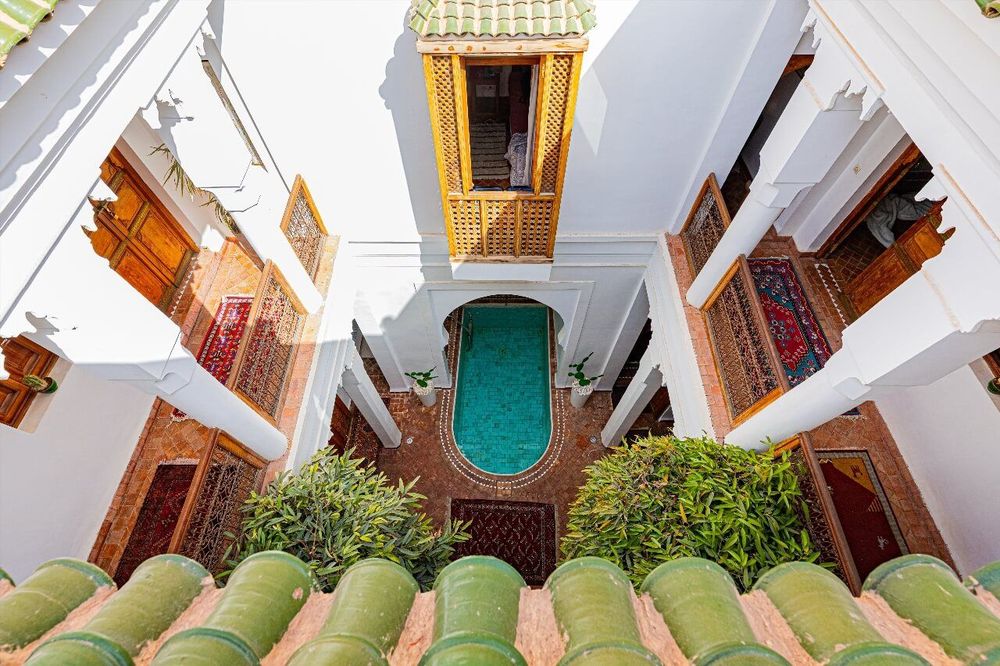
In Marrakech, the facade says nothing. A painted wooden door, a sculpted lintel, an alley that smells of leather and cumin, and behind it, an entire world opens up: courtyards tiled with zellige, murmuring fountains, orange trees in bloom under a square of blue sky. The riads of the medina work in reverse of everything we know in hospitality. The exterior is deliberately discreet; it's inside that all the architectural and sensory richness is concentrated. Choosing among the most beautiful riads in Marrakech means choosing the very texture of your stay. To help you explore the city beyond the walls of your accommodation, the Ryo audio-guided tour of Marrakech accompanies you through the alleys and monuments of the medina, at your own pace.
This guide reviews everything you need to know to find the most beautiful riads in Marrakech: the districts that make a difference, the criteria that separate an authentic riad from a 'trompe-l'œil' riad, real price ranges, pools that are truly worth the supplement, and practical advice to avoid disappointments when booking. Whether you're traveling as a couple, with family, on a tight budget, or seeking discreet luxury, Marrakech offers an unparalleled selection of riads in the Mediterranean region.
Why Stay in a Riad Rather Than a Hotel in Marrakech
The question often comes up before departure: hotel or riad? In other cities, the choice is largely a matter of budget and services. In Marrakech, it's mainly a matter of travel philosophy.
A riad (from the Arabic word riyad, the garden) is a traditional house organized around a central courtyard. This architecture, inherited from medieval Andalusia and adapted to the Moroccan climate, follows a logic of coolness and intimacy. The thick pisé walls keep spaces at a good temperature even in July, when thermometers exceed 40°C. The interior courtyard creates natural ventilation. The water from the central fountain cools the air by evaporation. All this without air conditioning, even though most riads install it today for the hottest months.
What you get by choosing a riad is an experience that no standardized hotel can reproduce: breakfast served under the arcades, morning light filtering through the moucharabiehs, unexpected silence two streets from Jemaa el-Fna square. Riads in the medina rarely have more than ten to twenty rooms. The relationship with staff is different, often the owners are present, they know the city intimately, they'll direct you to restaurants you would never have found alone.
However, we must be honest about the compromises. Some riads accessible by car are actually at the end of an alley one and a half meters wide, which complicates arrival with heavy suitcases. Most don't have the amenities of a large hotel, no 1,500 m² spa, no room service at 3 AM. And the medina, despite its charm, remains dense and noisy during market hours. This isn't a defect of the accommodation; it's the living reality of the city.
If these compromises seem acceptable to you, and for the vast majority of travelers, they are largely so, a riad in the medina offers an immersion you won't find elsewhere.
What Riad Architecture Reveals: Decoding the Materials
All riads display zellige, stucco and cedar doors. But not all are equal. Learning to read materials will help you distinguish a carefully restored riad from one that has settled for decorative cladding.
The zellige is the first indicator. The glazed terracotta tiles, cut by hand and assembled in mosaic, are the visual soul of Moroccan architecture. Artisanal zellige has slight irregularities, colors are not quite uniform, edges have slight variation. Industrial zellige is too perfect, too smooth. The difference is visible at first glance if you know what to look for.
The tadelakt, lime plaster polished with stone, covers bathrooms and fountains in high-end riads. It's waterproof, durable, and has a very characteristic matte softness. Mid-range riads often use a tadelakt-effect paint that lasts no more than a few years.
The moucharabiehs, these turned wood grilles that filter light, also reveal the owner's level of investment. When they're made of solid cedar wood finely worked, their shadow cast on walls creates changing patterns throughout the day. When they're made of painted MDF, the effect is there but the material disappears.
These details aren't secondary: they condition the atmosphere of the place, that diffuse feeling you'll carry in your memories.
Choosing Your District in Marrakech's Medina
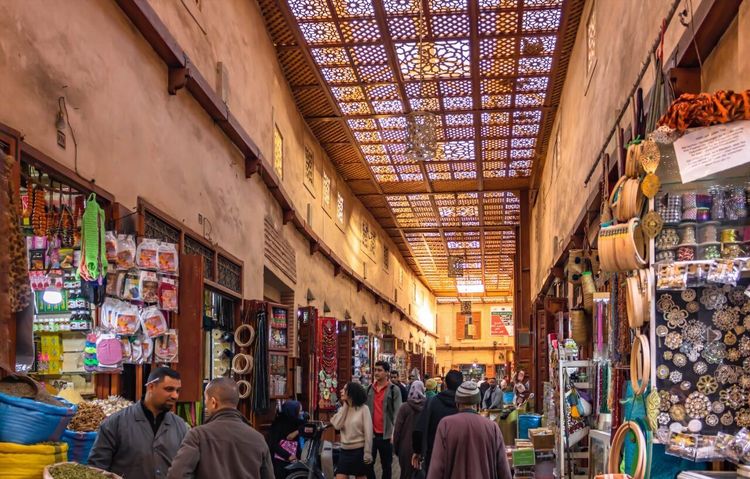
Marrakech's medina has been a UNESCO World Heritage site since 1985. It spans approximately 600 hectares, crossed by a dense network of alleys, the derbs, which are organized without apparent logic for the uninitiated visitor. Choosing your district is probably the most important decision in selecting your riad, even before price or amenities.
The districts north of Jemaa el-Fna, Mouassine, Bab Doukkala, Ksour, are the most sought after. They contain the highest concentration of charming riads, often in 16th or 17th-century houses restored by European or Moroccan owners passionate about architecture. Access to the main souks is within a ten-minute walk. It's also the most lively area in the evening: if you appreciate the hustle and bustle of the medina until late hours, this is your zone.
The Kasbah and Bab Agnaw, south of the square, constitute a different district in atmosphere. More residential, quieter in the evening, it's dominated by the Kasbah ramparts and the Koutoubia minaret. You'll find more intimate riads here, often cheaper for an equivalent level of quality. The Saadian Tombs and El Badi Palace are less than a five-minute walk away.
The Derb Dabachi and Kennaria district is located east of Jemaa el-Fna square, in the least touristy part of the medina. The alleys are narrower here, the atmosphere more local. If you're looking to get away from tourist flows while staying in the heart of the medina, this is the area to explore.
The Mellah, the former Jewish quarter adjacent to Place des Ferblantiers (Mellah, Médina 40000 Marrakech, rated 4.4/5 on Google for 1,264 reviews), has undergone notable transformation in recent years. Riad-houses have been renovated in a spirit mixing Judeo-Moroccan heritage and contemporary design. Prices are generally 20 to 30% lower than those in Mouassine for similar quality.
A practical tip: systematically check the distance between the riad and the taxi drop-off point. Cars don't enter most derbs in the medina. Transfers are made on foot, sometimes over 300 to 500 meters, sometimes over a kilometer. With heavy luggage, this information changes everything. It is also why the medina is best discovered on foot: our audio-guided tour covers 6.8 km of it from Jemaa el-Fna Square.
Mouassine and Bab Doukkala: The Historic Heart of Prestigious Riads
The Mouassine district takes its name from one of the most beautiful fountains in the medina, built in the 16th century under the Saadian sultan Moulay Abdallah. It's in this sector that the highest density of riads classified among the most beautiful in Marrakech is concentrated, establishments that have undergone long, costly restorations often carried out with remarkable architectural rigor.
What makes Mouassine special is the quality of the original buildings. Many of the houses there date from the Saadian and Alaouite dynasties. The courtyards are larger than elsewhere, the carved cedar ceilings higher, the courts sometimes double. Restoring here requires considerable investment, which explains why riads in this district are mostly in the high-end segment: from €250 to €600 per night for a double room, with suites easily reaching €900 to €1,200 in the most renowned establishments.
The Bab Doukkala district, adjacent to Mouassine, offers a slightly different profile. Riads there are often more recent, built or completely restructured in the 2000s and 2010s, but the care given to decoration and materials remains high. Prices drop a bit: expect €150 to €350 per night for very good establishments. The Bab Doukkala mosque, one of the oldest in the medina, gives the district its character.
In both sectors, the best riads share common characteristics: a planted courtyard with central fountain, a rooftop terrace with views of minarets, a restaurant or kitchen open to guests by reservation, and personalized service that contrasts sharply with the anonymity of large chains.
To choose in this area, favor establishments that clearly display the number of rooms (between 6 and 14 is often the sign of a human-sized house), owners or managers present on-site, and recent reviews mentioning breakfast quality, which is often the first indicator of attention to detail.
Kennaria and Derb Dabachi: The Authentic Alternative Away from Tourist Circuits
A few hundred meters are enough to change worlds in Marrakech. As soon as you move east from Jemaa el-Fna square, tourist groups thin out, streets widen slightly, an apparent paradox, and smells change. We're here in a more everyday medina, less staged.
Riads in the Kennaria and Derb Dabachi sectors benefit from this position. Less exposed to tourist flows, they practice rates 25 to 40% lower than those in Mouassine for comparable surface area and architectural quality. The counterpart is that you're slightly further from the most spectacular souks, the dyers' souk, the grocers' fondouks, count 15 to 20 minutes on foot.
This area welcomes more so-called 'owner riads': houses whose inhabitants have renovated two, three or four rooms to rent them while continuing to live there. The experience is different from that of a riad entirely dedicated to hospitality. More informal, sometimes more authentic, with hospitality that resembles less a service than an invitation to someone's home.
If you stay in this district, plan lunch at least once around the Rahba Kedima spice souk, a ten-minute walk away. The square is one of the most photographed in the medina, but the tables bordering it remain less frequented than those in the main square and offer more honest cuisine.
The Kasbah and Bab Agnaw: Calm, Ramparts and Monuments Two Steps Away
The Kasbah district forms the southern side of the medina, backed against the great red pisé ramparts. It's a district of rare atmospheric quality: less dense than the center, with slightly more open arteries, and an exceptional concentration of historic monuments within a 500-meter perimeter.
The Kasbah mosque, also called Moulay El Yazid mosque, was built in the 12th century by the Almohad caliph Yaqoub al-Mansour; its green and white zellige minaret is part of the most recognizable silhouettes of Marrakech, distinct from that of the nearby Koutoubia. The Saadian Tombs, rediscovered only in 1917 after centuries of oblivion, gather in a surprisingly small space the mausoleums of the Saadian dynasty with stucco and zellige details among the finest in all of Morocco. El Badi Palace, undergoing partial restoration, offers a monumental ruins experience of melancholic beauty.
Kasbah riads have capitalized on this proximity. Many offer terraces with direct views of the Koutoubia minaret, one of the most evocative panoramas of Marrakech, particularly at sunset or when the morning light colors the ramparts in deep ochre. For a romantic or simply contemplative stay, this district often surpasses Mouassine.
Rates are generally 15 to 25% lower than those in Mouassine: expect €120 to €300 per night for a good-level riad in this district. The quality-price ratio is often excellent, especially since nighttime noise nuisances are lesser. El Badi Palace and the Saadian Tombs are minutes away on foot, an easy add-on to our audio-guided tour of the medina.
Riads with Swimming Pool: What You Really Need to Know Before Booking
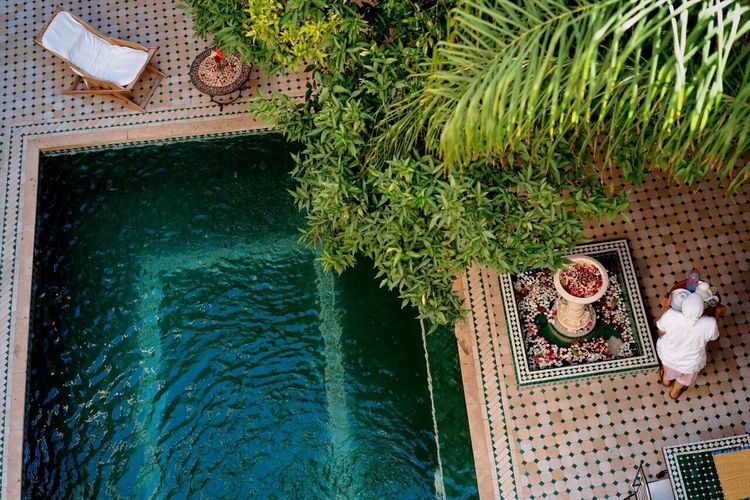
The swimming pool in a riad in Marrakech has become an almost systematic marketing argument. It's worth being precise about what this means concretely.
In the medina, the spatial constraints of a traditional riad leave little room for a real swimming pool. Most pools are small plunge pools of 3 to 5 meters in length, often shallow (1.20m to 1.50m maximum). These are refreshment pools, not swimming pools. They remain perfectly pleasant at 38°C: immersing yourself is an experience in itself, especially when the courtyard is shaded by orange trees. But if you hope to swim laps, disappointment is guaranteed.
A few larger riads, those that occupy two adjacent fused houses, or former palatial residences, have more generous pools of 8 to 12 meters. These establishments are rare and practice rates accordingly: rarely less than €300 per night in high season.
Practically, here's what to check before booking a riad with a pool: exact pool dimensions (booking platform guests often mention them in their reviews), depth, presence of lounging space around the pool, and, crucial point, whether the pool is covered or open-air. An open-air pool in December can be too cold to use; conversely, a pool covered by a glass roof accumulates heat in summer.
The most pleasant months to enjoy a riad pool are April-May and September-October: water temperature is ideal, sun generous without being brutal.
5-Star Luxury Riads in the Medina: What You're Really Buying
There are about ten riads in Marrakech that fall into the grand luxury category, establishments whose rooms exceed €500 per night in high season and whose level of service, decoration and cuisine rivals the best boutique hotels in the world. Their names have circulated in travel magazines for twenty years. Their reputation is well established.
What you buy in these establishments is first of all space. Luxury riads often occupy surfaces of 800 m² to 2,000 m², residences that in their previous life belonged to prosperous merchants or aristocratic Marrakech families. The courtyard is large, rooms are spacious, tadelakt bathrooms are monuments in themselves.
It's then the cuisine. The best luxury riads employ chefs trained in Moroccan culinary traditions but capable of adapting dishes to international palate constraints. Candlelit dinner in the courtyard of a 5-star riad, tagines with precisely measured spices, perfectly flaky pastillas, gazelle horns with orange blossom, is a gastronomic experience in its own right. Extend your culinary exploration with the article on culinary specialties of Marrakech to better prepare yourself.
It's finally the service. In a serious luxury riad, the staff-to-room ratio is often higher than 1 to 1. Each room has its dedicated staff. Special requests, private dinner in the courtyard, privatized hammam, organizing an excursion to Berber villages in the surroundings, are settled in a few hours.
In this category, the Mouassine and Ksour districts offer the greatest choice. Prices vary from €500 to €1,500 per night for a suite, with exclusive experiences (full riad rental for private groups) reaching amounts with no apparent ceiling.
Charming Riads with Good Value for Money: Good Addresses Under €200
Marrakech's medina is full of charming riads at very accessible prices, and it's often there that you'll find the best surprises. Between €80 and €200 per night, it's possible to stay in authentically beautiful, well-restored houses with attentive service and a hearty breakfast served on the terrace.
Common characteristics of good accessible charm riads: smaller surface area (four to eight rooms), decoration that relies on local craftsmanship rather than imported luxury furniture, and owners often present who have made the riad a personal project. These are frequently artisans, photographers, architects who have settled in Marrakech and renovated their house with care and coherence.
To find these pearls in the mass of riads available on booking platforms, several filters are useful. Look for establishments with a limited number of rooms (less than ten), reviews mentioning the presence of owners, and photographs showing materials in close-up, zellige, stucco, woodwork. Beware of riads whose photos only show rooms and pool without ever the courtyard: the courtyard is the soul of the riad, and if it's absent from visuals, there's a reason.
The best concentrations of accessible charm riads are found in the Kennaria, Derb Dabachi districts and in alleys north of Ben Youssef Madrasa, a sector less frequented by hurried tourists but ideally positioned to radiate throughout the medina.
Family Riads: What Really Changes When Traveling with Children
Traveling with children in Marrakech's medina deserves specific preparation. The city is beautiful and stimulating for curious children, but riad logistics can hold surprises if accommodation isn't adapted.
The first point concerns stairs. Traditional riads have high steps, sometimes spiral, and roof terraces accessible without systematic safety barriers. A serious family riad will explicitly mention this in its description and will have taken measures: barriers, fountain covers, stair lighting at night. If this information isn't available, ask the question directly before booking.
The second point concerns space. A 7-year-old child needs to move. Most riad courtyards, however beautiful, don't exceed 30 to 50 m² of usable space. For a family with two children, a riad with a spacious terrace or garden is almost essential. A few riads on the periphery of the medina, notably on the Bab Ghmat side, have real gardens with green space.
The third point, more positive, is that well-managed family riads offer a rare experience: children are often welcomed as guests of honor, cooks adapt dishes, and staff take pleasure in explaining Moroccan traditions to the most curious. It's a window on a culture that no international hotel can offer in the same way.
Romantic Riads: Organizing for a Successful Couple's Stay
Marrakech is among the most popular destinations for couples in Europe, and the riad formula contributes strongly to this. A flowered courtyard, a suite with tadelakt bathroom, a candlelit dinner in the courtyard, the ingredients for a romantic stay are naturally brought together.
Riads that explicitly position themselves in the romantic market highlight some distinctive characteristics. The honeymoon suite is often the highest room in the riad, on the top floor, with a private terrace and views over rooftops and minarets. The private hammam, when available, is a major asset: some riads offer it in the suite itself, with massage on reservation option.
The intimate dinner in the courtyard is the experience that leaves the most traces. Outside high season (December-January), evenings are cool and braziers create an atmosphere of intensity difficult to reproduce. In summer, dining on the terrace at nightfall is a pleasant alternative.
Special attention: riads that accept bachelorette party groups (a flourishing market in Marrakech) are not the best choices for a couple's stay. Check in recent reviews if the riad remains calm on weekends or if it becomes a party venue. The line between romantic riad and event riad is sometimes thin.
Riads with Terrace and Views over Marrakech's Rooftops
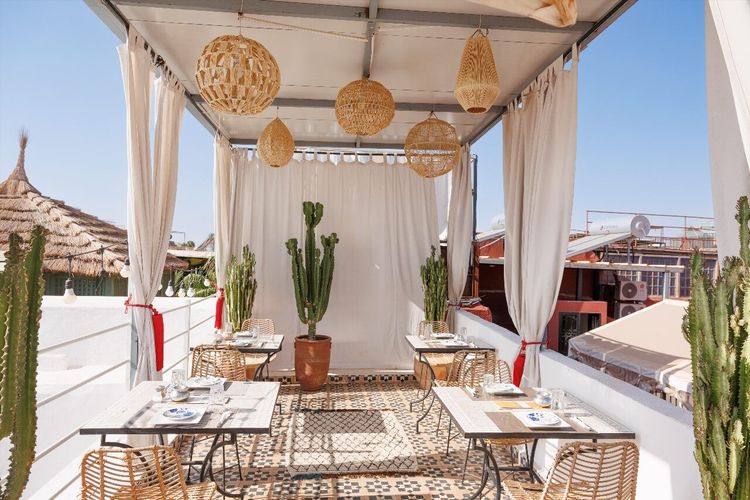
The terrace is, along with the courtyard, the most distinctive space of a riad. And in Marrakech, terraces deserve special attention because they offer a perspective on the city that few other cities in the world can equal: a sea of ochre pisé rooftops, punctuated by minarets, with the snow-capped Atlas mountains as backdrop on clear days.
Not all terraces are equal. The best offer an unobstructed view of several minarets at once, ideally of the Koutoubia, visible from almost all districts of the medina. Terraces of Kasbah riads are often the most spectacular from this viewpoint. Those of riads located in deep derbs can be surrounded by taller houses that limit the view to a square of sky.
The orientation question is as important as the view itself. A west-facing terrace captures sunsets over the Atlas, a spectacle you won't forget. An east-facing terrace offers sunrises over the ramparts, more intimate and less frequented.
Also check if the terrace is freely accessible or only at certain hours. Some riads use the terrace as the only dining space, which can create access limitation according to service hours.
Practical Tips for Booking Your Riad in Marrakech
Booking a riad in Marrakech follows slightly different rules from those of a classic hotel. Some practical points to avoid unpleasant surprises.
Booking period. High season runs from March to May and September to November. These periods combine pleasant climate and high demand: the best riads are fully booked several months in advance. Book at least three months ahead for Easter and six months for Christmas week, which is the busiest period of the year.
Platforms. Booking.com and Airbnb-type platforms display the largest number of riads. For high-end establishments, booking directly with the riad often allows you to get a slightly better room or additional services without supplement: airport transfer, welcome basket, first night dinner at preferential rate.
Deposits and cancellation conditions. Small riads (less than ten rooms) frequently practice stricter cancellation policies than hotels: 30 to 50% non-refundable deposits, free cancellation only up to 30 days before arrival. Read these conditions carefully before confirming.
Communication before arrival. Systematically contact the riad before your arrival to confirm your landing time, meeting point for luggage pickup, and any access codes. Most serious riads send this information automatically; if not, it's a sign of attention to detail not to ignore.
Hidden supplements. Check if breakfast is included (often yes in charm riads, sometimes no in luxury riads where it's charged between €15 and €35 per person), if hammam is extra (between €20 and €60 depending on establishment), and if daily housekeeping is included or chargeable.
Exploring the Medina from Your Riad: What Not to Miss
Your riad is your base camp. Marrakech's medina, a UNESCO heritage site, can be explored on foot and offers a density of monuments, souks and sensory experiences unmatched in the region. To orient yourself and discover anecdotes that paper guides don't have, the Ryo audio guide of Marrakech accompanies you through the medina's alleys: iconic monuments, less frequented districts, stories that bring stones to life.
The Jemaa el-Fna square, unmissable but often misunderstood by hurried visitors, is actually a living place that changes hour by hour. In the morning, it's orange juice vendors and herbalists. At noon, snake charmers and acrobats. In the evening, the square transforms into a huge open-air restaurant room, with dozens of smoking stalls and an atmosphere that UNESCO has classified, rarely, as 'space of oral and intangible heritage'.
The souks of Marrakech are organized by trades in a sector north of the square. The dyers' souk remains one of the most visually striking, with its vividly colored dye vats and leather skins drying in the sun. The blacksmiths' souk, potters' souk, slipper makers' souk, each craft has its space, often in alleys that haven't changed function since the Middle Ages.
The Ben Youssef Madrasa, adjacent to the great mosque of the same name, is one of the most elaborate monuments of Saadian architecture in Morocco. A Marinid madrasa originally existed on the site, but the current building was rebuilt in the 16th century (1564-1565) under the Saadian sultan Abdallah al-Ghalib. Reopened to visitors after extensive restoration completed in 2022, it reveals interior courtyards covered with carved stucco and zellige with impressive precision and aesthetic coherence. The contrast between the decorative richness of this space and the sobriety of student cells that border it is striking.
The Majorelle Garden (Rue Yves Saint Laurent, Guéliz 40090 Marrakech, rated 4.4/5 on Google for 59,599 reviews), twenty minutes' walk from the medina in the modern Guéliz district, is often integrated into visits from the medina. The Klein blue of the main building in gardens designed by Jacques Majorelle then restored by Yves Saint Laurent and Pierre Bergé is one of the most photographed colors in Morocco. Arrive at opening (9am) to avoid queues.
For excursions beyond the medina, the Berber villages of the Atlas are accessible within an hour's drive. Ourika, Imlil, Setti Fatma, these destinations allow a half-day of light hiking in landscapes radically different from the city. Most riads can organize these transfers, often with a local guide and lunch in a Berber house. Back in town, the Ben Youssef Madrasa is one of the commented stops on our audio walking tour of the medina.
Getting Around Marrakech from Your Riad
Marrakech's medina isn't made for cars. It's a rule that naturally imposes itself from the first hours on site: alleys are too narrow, donkeys and carts have priority, and pedestrians invade the space at any time of day.
From your riad, almost all medina monuments are accessible on foot in less than 20 minutes. This is one of the major assets of this type of accommodation. For Majorelle garden, Guéliz district and new town restaurants, Marrakech red taxis are the simplest solution: expect 30 to 60 MAD (€3 to €6) for an intra-muros journey, rate to negotiate before getting in. Night taxis practice a 50% surcharge.
From Menara airport, 6 km from the medina, the most comfortable solution is taxi or transfer organized by your riad, expect 150 to 200 MAD (€15 to €20). There's also a bus (line 19, fare 30 MAD) that serves several stops in medina and Guéliz, useful if you arrive with light luggage.
Budget and Price Ranges for a Riad in Marrakech
The riad market in Marrakech covers a very wide price range, making it a destination adaptable to different budgets.
| Category | Range/night | Profile | |-----------|----------------|--------| | Entry level | €40 - €80 | Simple family riad, basic courtyard, minimal service | | Mid-range | €80 - €200 | Charm riad with authentic zellige, breakfast included | | High-end | €200 - €500 | Carefully restored riad, terrace, pool, elaborate service | | Luxury | €500+ | Grand palatial riad, spacious suites, chef, private hammam |
Low season (June-August and January-February) allows 20 to 40% reductions in most establishments. July and August are the hottest months (40-42°C), but riads with pool and shaded courtyard remain pleasant if you adapt your program.
FAQ
What's the Difference Between a Riad and a Hotel in Marrakech?
A riad is a traditional Moroccan house organized around a central courtyard with fountain and vegetation. Unlike a hotel, it has a discreet exterior facade, sometimes just a wooden door in an alley, and concentrates all its architectural richness inside. Riads typically have between 4 and 20 rooms. The service is more personalized, the atmosphere more intimate. A hotel can reproduce the aesthetics of a riad, but a real riad occupies an old medina house with original materials.
Which District in Marrakech Should You Book a Riad?
For the best experience in terms of architectural quality and access to monuments, the Mouassine and Ksour districts (north of Jemaa el-Fna square) are most appreciated. The Kasbah offers more tranquility and excellent value for money. Kennaria and Derb Dabachi are ideal for those seeking a more local atmosphere. The Mellah is undergoing transformation and presents interesting options at lower rates.
When Should You Book to Find the Best Available Riads?
High season corresponds to March-May and September-November, as well as Christmas week. For these periods, book at least three to six months in advance for the best addresses. Low season (June-August and January-February) frees up availability and lower prices, with reductions of 20 to 40% depending on establishments.
Do Riads in Marrakech Really Have Swimming Pools?
Yes, but beware of sizes. In the medina, spatial constraints limit most pools to 3-5 meters in length, refreshment spaces rather than real swimming pools. A few larger riads have 8-12 meter pools. Always check the actual dimensions in reviews on booking platforms before deciding.
Can You Stay in a Riad with Young Children?
Yes, but choose carefully. Favor riads that explicitly mention their family adaptation: safety barriers around pools and fountains, stair lighting, clear spaces for young children. Riads in the Bab Ghmat district and on the periphery of the medina often have outdoor spaces more suitable than central riads.
How to Reach Your Riad Upon Arrival in Marrakech?
Contact your riad before arrival to organize transfer from Menara airport (6 km from center). Virtually all riads offer this service or indicate a precise meeting point at the edge of the medina, accessible by taxi. From this point, a staff member will guide you on foot to the riad, often 200 to 500 meters through the alleys. Avoid arriving with very heavy luggage: riad stairs and cobbled alleys are not ideal for wheeled suitcases.
Conclusion
The most beautiful riads in Marrakech aren't summed up by their decoration or pool, but by that precise moment when you cross the door from the noisy alley to the silent courtyard: a change of worlds in one step. Whether you're looking for a luxury riad in Mouassine, a charming address on a small budget in the Kasbah, or a family riad with green space, Marrakech's medina offers unmatched diversity. Before arriving and to extend your stay beyond your riad's walls, discover the monuments, alleys and stories that make Marrakech an incomparable city with the Ryo audio-guided tour of Marrakech, to explore the medina at your own pace.
À lire également