© Shutterstock
 Votre guide Ryo
The 13 Most Beautiful Cities in Morocco You Absolutely Must Not Miss (2026)
Morocco surprises almost everyone, not for the expected reasons, but because it multiplies its faces to the point that two travelers returning from the same country often feel they have visited two different destinations. Marrakech and Ifrane have nothing in common. Fès and Agadir could be on two different continents. Chefchaouen dyes its alleyways cobalt blue in the Rif mountains while Ouarzazate serves as a Hollywood backdrop at the edge of the desert. To explore the most beautiful cities in Morocco without getting lost, this guide covers thirteen unmissable destinations, from the northern Atlantic coast to the gates of the Sahara. Start with the Ryo audio guide for Marrakech: it lays the cultural and historical foundations for understanding the rest of the country.
Thirteen cities, as many contrasts. Behind the medieval walls of Fès lies the world's largest entirely car-free medina. Casablanca's Hassan II Mosque raises its 210-metre minaret — the tallest in the world — partially built over the Atlantic. In Ouarzazate, you will walk on sets used for Gladiator, Game of Thrones, and Lawrence of Arabia. To the north, Tanger looks towards Spain, just 14 km away across the Strait of Gibraltar. And Ifrane, nestled in the Middle Atlas, resembles a Swiss alpine resort with its pitched red-tiled roofs and centuries-old cedar trees. These thirteen cities deserve your time and attention.
Marrakech: the Red City That Exceeds All Expectations
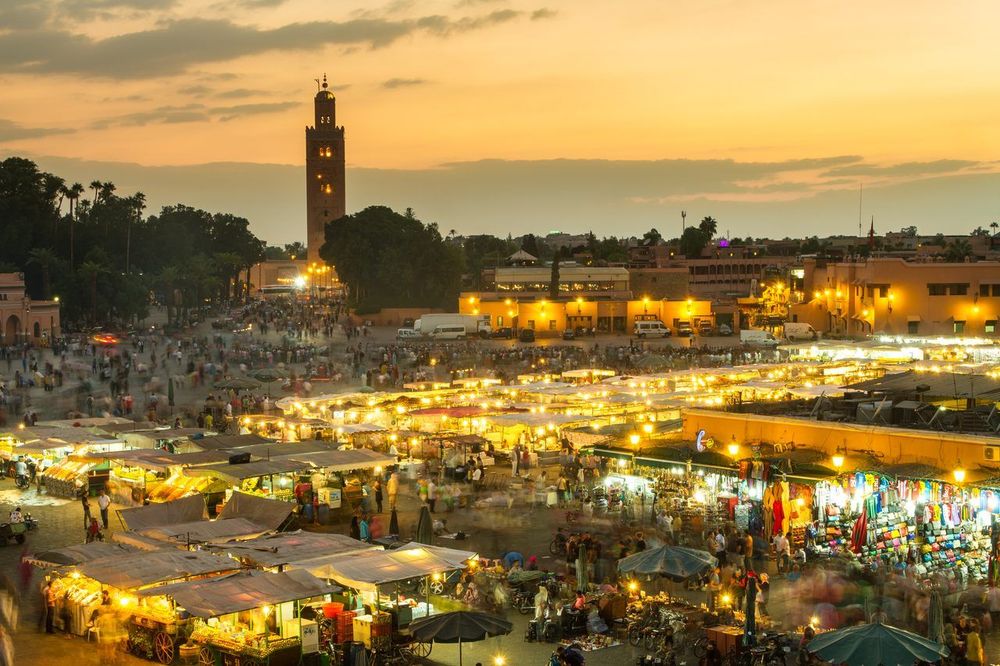
Marrakech is the city that comes up most often in travel accounts, and it must be admitted that the reputation is deserved. Not because it is perfect — it can be loud, overwhelming, exhausting — but because it offers a density of sensory experiences that few cities in the world can match. Its ochre-red walls give the late-afternoon light a particular warmth that makes even the most ordinary photos look professional.
Djemaa el-Fna Square is the beating heart of Marrakech. In the morning, it is an ordinary market with freshly squeezed orange juices for a few dirhams. At dusk, the square transforms into something else: dozens of street-food stalls appear, Gnawa musicians set up, Berber storytellers gather the last circles of listeners. The atmosphere has not changed in centuries.
Less than ten minutes' walk away, the Medersa Ben Youssef is one of the most beautiful examples of Islamic architecture in North Africa. Founded in the 14th century and enlarged in the 16th, it once housed up to 900 students of Islamic law. Today, its square basins, zelliges, and carved cedar woodwork make up a setting of rare sophistication. Arrive before 9 a.m. to avoid groups and to see the morning light fall on the ground-floor stucco.
The Majorelle Gardens live up to their reputation. Created by the painter Jacques Majorelle in the 1920s, then bought by Yves Saint Laurent and Pierre Bergé in 1980 to save them from a real-estate development project, they are a haven of rare plants and that particular cobalt blue now known as 'Majorelle blue'. Entry costs between 40 and 80 MAD depending on the areas visited. The Berber Museum inside is worth the extra stop: its collections of Berber jewellery, textiles, and pottery are among the best documented in the country.
The Bahia Palace, built at the end of the 19th century for Grand Vizier Bou Ahmed, covers 8 hectares of gardens, courtyards, and richly decorated apartments. The translation of its name, 'the Brilliant', gives an idea of the building's ambition. The interior is a labyrinth of stucco reception rooms and zellige-tiled chambers that the vizier had intended for his four wives and concubines.
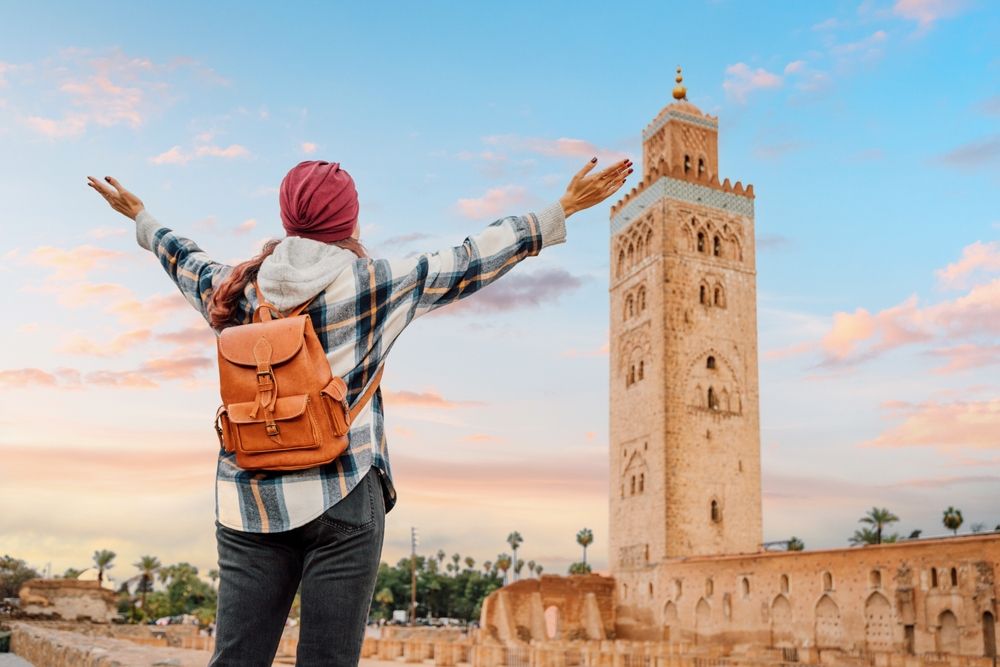
The Koutoubia Mosque (Avenue Mohammed V, 40000 Marrakech, rated 4.5/5 on Google from 18,270 reviews), with its 70-metre minaret, has been Marrakech's visual landmark since the 12th century. Non-Muslims cannot enter, but the surrounding gardens are open to all and offer a rare green space within the medina. This minaret served as the model for the Giralda in Seville and the Tour Hassan in Rabat — three expressions of the same Almohad style built by the same architects.
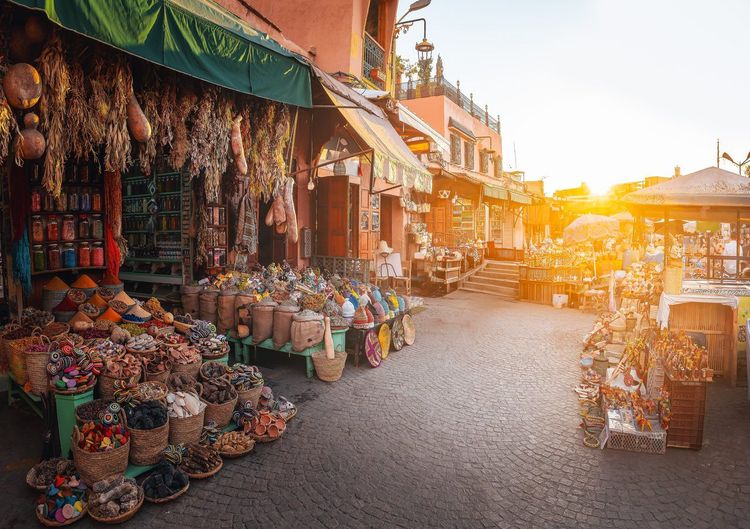
For the souks, it is better to get lost than to try to follow a map. Souk Semmarine is the most frequented, with its carpets and babouches. The Dyers' Souk is more secretive — the smell of dried leather, saffron, and henna signals the entrance before you see it. If you do not know where to start, the Ryo audio guide to Marrakech offers a structured itinerary that covers the historic neighbourhoods on foot, explaining the architecture, anecdotes, and landmarks that printed guides generally do not mention.
Plan for at least two nights in Marrakech. One night is enough to see Djemaa el-Fna Square and the main monuments. Two nights allow you to go beyond the first tourist circle, into the neighbourhoods of Mouassine or Bab Doukkala, where daily life continues without concern for visitors.
Fès: Diving Into the World's Oldest Medina
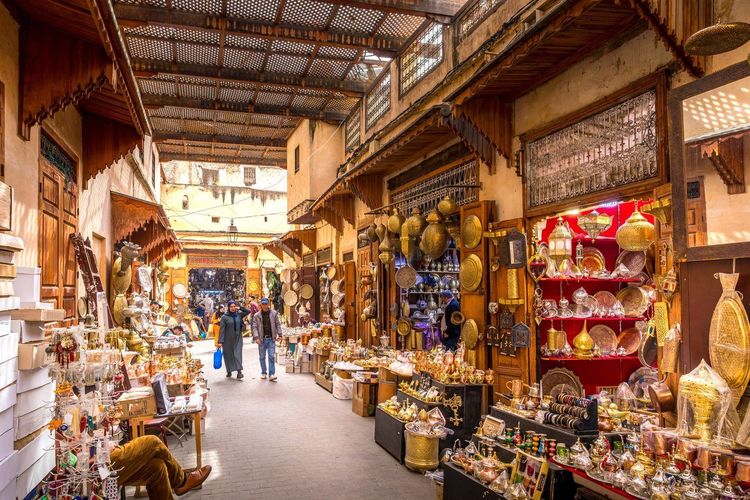
Fès demands an immediate change of pace. There are no cars in the medina — 9,400 alleyways, none accessible to motorised vehicles. Deliveries are made by mule, as they have been for seven centuries. Al Quaraouiyine University, founded in 859, is considered by UNESCO to be the oldest continuously operating university in the world. Fès is not a living museum: it is simply a city that has refused to change at the same speed as the rest of the world.
The Fès el-Bali medina has been a UNESCO World Heritage Site since 1981. It is home to between 100,000 and 150,000 inhabitants spread across one of the highest urban densities in Africa. Getting lost is inevitable and ultimately enjoyable once you accept that GPS will be of no help.
The Chouara Tanneries are the photographic symbol of Fès. The dyeing vats date back to the 10th century and have operated on the same chemical principles ever since: the leather is first soaked in quicklime and pigeon dung, then in natural pigments — saffron for yellow, mint for green, poppy for red. The terraces of the leather shops overlooking the vats offer the bird's-eye view you have seen in photographs. You will be given a sprig of mint at the entrance for the smell: accept it without hesitation.
The Bou Inania Medersa, built between 1350 and 1357 under the Merinids, is the only medersa in Fès still used for prayer and therefore open to non-Muslims for visits. The architecture is obsessively precise: carved stucco, inlaid cedar wood, and zelliges cover every available surface. This is where you understand why Fès dominated the intellectual life of the Islamic world for centuries.
The Nejjarine Fountain (Place Nejjarine, 30000 Fès, rated 4.3/5 on Google from 113 reviews) and its adjacent fondouk (caravanserai inn) form one of the best-preserved architectural ensembles in the city. The fondouk now houses a museum of Moroccan wood craftsmanship, with a high terrace offering a rare perspective over the medina rooftops.
The Royal Palace of Fès (Dar el-Makhzen) remains an official residence and is not open to the public, but its 7 monumental gilded bronze gates, visible from Place des Alaouites, are worth the trip. The contrast between the official facade and the popular neighbourhood just behind it is a typically Fassi juxtaposition.
Plan for at least two days in Fès. With two days, you can explore Fès el-Bali on the first day and Fès el-Jdid (the 'new' medina, from the 13th century) on the second, adding the Mellah, the former Jewish quarter, whose architecture is particularly well preserved.
Chefchaouen: the Blue Magic of the Rif
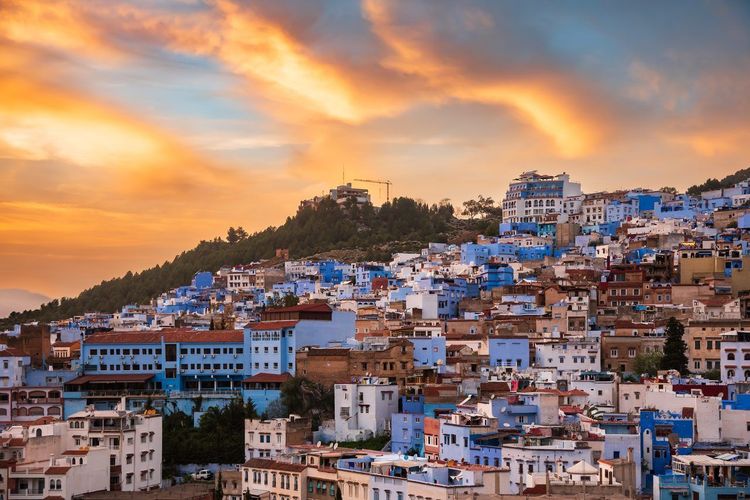
Chefchaouen is a happy anomaly. This city of 45,000 inhabitants in the Rif mountains, about 115 km from Tanger, decided to paint its houses blue. Not a single blue, but dozens of shades, from deep indigo to sky blue, passing through turquoise and cobalt. The result is a medina that looks like a stage set but is very much inhabited.
The history of the blue is disputed. According to one version, the Sephardic Jews who took refuge here after their expulsion from Spain in 1492 introduced the colour, associated in Jewish tradition with divine protection. According to another, it is an older Berber tradition. Whatever the origin, the visual consistency is rare for a city that never decided to become a tourist attraction.
Place Uta el-Hammam is the centre of social life, with its cafés and the old kasbah. The Chefchaouen Kasbah (Place Uta el-Hammam, 91000 Chefchaouen, rated 4.3/5 on Google from 2,336 reviews), built in the 15th century, houses a small ethnographic museum and a remarkably well-preserved Andalusian garden. Entry costs less than 10 MAD and the terrace at the top offers a view over the blue rooftops and the Rif mountains.
For hikers, the Spanish Mosque on the hill above the city is reached in 20 minutes on foot from the medina and offers a panorama over the blue city and the Rif ridges. Leave early in the morning or in the late afternoon — midday light is harsh and the view far less spectacular.
Chefchaouen sits off the usual circuits, which makes it more peaceful than Marrakech or Fès. Most travellers only spend one night here. Stay two nights to have time to see the medina empty at dawn, before day-trippers from Tanger and Tétouan arrive, and to explore the Ras el-Maa gorges downstream from the waterfall that has supplied the city for centuries.
Essaouira: Atlantic Wind and Creative Freedom
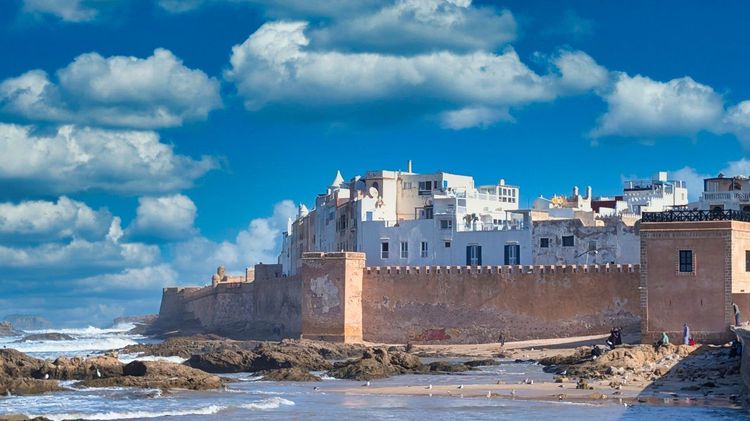
Essaouira resembles no other Moroccan city. Built in the late 18th century by a French architect in the service of Sultan Mohammed III, it has a geometric layout and cut-stone ramparts that give it an unexpectedly European appearance. Jimi Hendrix lived here for a few months in 1969. Kitesurfers come from all over the world. The wind blows for between 300 and 340 days a year with a consistency that meteorologists describe as exceptional on the Moroccan Atlantic coast.
The Sqala du Port is the fortified bastion that dominates the fishing port. The bronze cannons — some dating from the 17th century, recovered from shipwrecks — are still in place on the battlements. The view over the Atlantic from these ramparts, with the sound of the waves and the gliding seagulls, is one of the finest to be had in Morocco.
The Essaouira medina (Place Moulay Hassan, 44000 Essaouira, rated 4.4/5 on Google from 4,104 reviews) has been a UNESCO site since 2001, but it does not have the labyrinthine character of Fès or Marrakech: the orthogonal grid inherited from the 18th century is still evident, and you do not really get lost. The main street, Souk Jdid, is lined with thuya marquetry workshops — a fragrant wood typical of the region — and contemporary art galleries, more numerous here than anywhere else in Morocco.
The fishing port of Essaouira is freely accessible with no entry fee. The arrival of trawlers returning from the sea, the auctions, and the smell of salt and fish create an authentic atmosphere far removed from tourist circuits. The fresh fish restaurants around the port offer simple, honest food at a reasonable price.
Casablanca: Modernity, Art Deco, and an Ocean Waterfront
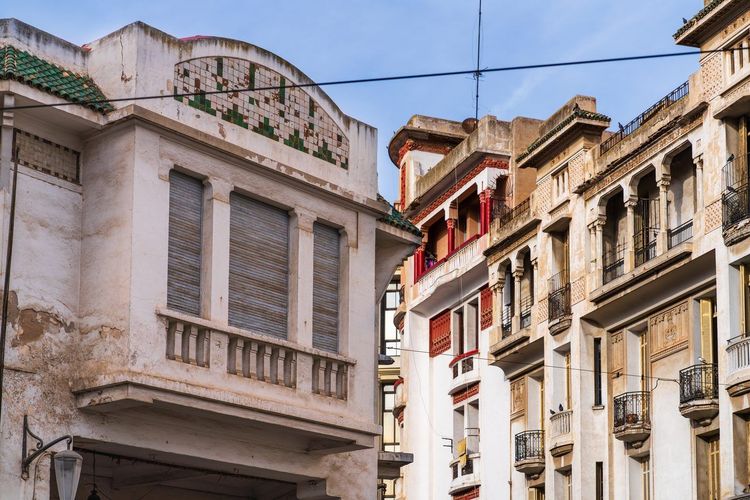
Casablanca is the most misunderstood Moroccan city. Visitors who spend only a few hours there on their way to Marrakech leave with the image of a functional metropolis without charm. Those who take the time to explore its neighbourhoods discover something more interesting: a city that built its modernity on layers of French, Spanish, Arab, and Berber influence, producing in architecture a result unique in the world.
The Hassan II Mosque is the primary reason to visit Casablanca, and it fully deserves that status. Completed in 1993 after seven years of construction involving 35,000 Moroccan craftsmen, it can accommodate 25,000 worshippers inside and 80,000 on its exterior esplanades. Its 210-metre minaret is the tallest religious structure in the world. A third of the structure is built over the sea, on an artificial terrace, giving the impression on clear days that the mosque emerges from the Atlantic.
The Art Deco district around the Central Market is little known and fascinating. In the 1930s, Casablanca was an architectural laboratory: hundreds of buildings in a style blending European Art Deco with Islamic motifs, known as 'Moorish' or the Prost style after urbanist Henri Prost, who designed the colonial city's layout. The Villa des Arts and the Rialto Cinema are two remarkably well-preserved examples.
The Ain Diab Corniche (Boulevard de la Corniche, 20150 Casablanca, rated 4.3/5 on Google from 15K reviews), to the west of the city centre, is Casablanca's ocean waterfront: urban beaches, fish restaurants, seawater pools, and a promenade stretching several kilometres. This is where the city unwinds at the weekend.
A practical tip often overlooked: guided tours of the Hassan II Mosque (non-Muslims admitted) depart three times a day on weekdays and are purchased on site. Allow 120 MAD per person and stay to see the interior of the grand prayer hall, whose sliding roof opens to the sky — an engineering feat with no equivalent in world religious architecture.
Meknès: the Imperial City That Travelers Too Often Overlook
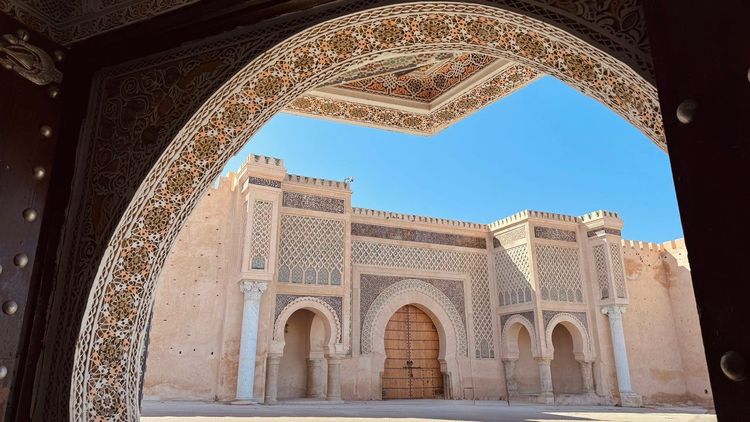
Meknès is one of Morocco's four imperial cities alongside Fès, Marrakech, and Rabat, yet it receives five to ten times fewer visitors than its counterparts. This under-frequentation is itself a reason to visit: you will see the same architectural qualities in a more relaxed setting, without the persistent vendors of the more touristy medinas.
Sultan Moulay Ismail made Meknès his capital at the end of the 17th century with ambitions worthy of Versailles. He had 45 km of ramparts built, along with palaces, royal stables, and granaries for an army of 150,000 soldiers. The Bab Mansour Gate, completed in 1732, is considered the most beautiful monumental gate in Morocco. The sheer scale of its green and white zellige arches is enough to justify the journey.
The Moulay Ismail Mausoleum is open to non-Muslims, which is relatively rare in Morocco. The interior, with its white marble-paved courtyards and fountains, is an example of Alaouite refinement. The Heri es-Souani (Route de l'Agdal, 50000 Meknès, rated 4.1/5 on Google from 191 reviews) (royal granaries and stables), a few minutes away, form a remarkable architectural space: vaults 3 metres thick that maintained a constant temperature for grain stores in both summer and winter.
Meknès is also an ideal base for Volubilis, the UNESCO-listed Roman site 33 km away, whose mosaics and triumphal arches are the best-preserved ancient ruins in Morocco.
Rabat: the Capital With Two Faces
Rabat is often described as an administrative city of no tourist interest, which is frankly unfair. The kingdom's capital since 1912 has a very real medina, calmer than those of Fès or Marrakech, and several major monuments.
The Kasbah des Oudaïas, built in the 12th century by the Almohads on a promontory overlooking the mouth of the Bou Regreg, is Rabat's most emblematic monument. The interior of the kasbah, with its whitewashed alleyways and flower-adorned houses, resembles Chefchaouen in a more compact form. The Andalusian garden inside is a haven of peace that Rbatis themselves frequent on weekends.
The Tour Hassan, the unfinished minaret of a 12th-century Almohad mosque, is the symbol of Rabat. The death of Sultan Yacoub el-Mansour in 1199 halted its construction, leaving a 44-metre column instead of the planned 86 metres. Beside it, the Mohammed V Mausoleum, completed in 1971, houses the tombs of King Mohammed V and Kings Hassan II and Mohammed VI. It is a masterpiece of contemporary Moroccan craftsmanship.
The new city of Rabat, with its cafés, its museums — including the Mohammed VI Museum of Modern and Contemporary Art, opened in 2014 — and its lively university atmosphere, offers a facet of Morocco that classic tourist circuits almost always ignore.
Tanger: Between Two Continents, a Crossroads of Cultures
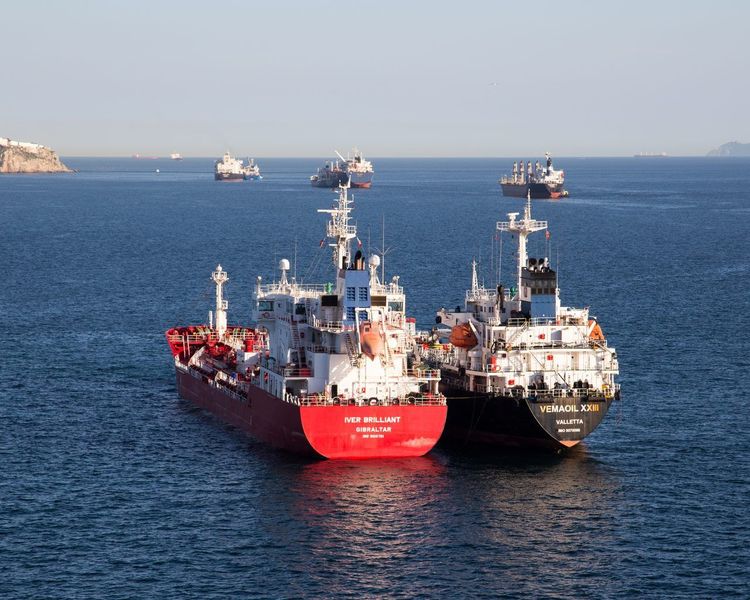
From Tanger on a clear day, you can see Spain. At this point, the Strait of Gibraltar narrows the distance between Africa and Europe to just 14 km at its narrowest point — the shortest separation between the two continents. This geographical proximity shaped the history of a city that was for decades an international zone (1923–1956), collectively administered by eight nations, and that attracted Matisse, Tennessee Williams, Paul Bowles, and William Burroughs to its cafés.
The Tanger medina (Rue de la Kasbah, 90000 Tanger, rated 4.3/5 on Google from 12K reviews) is more open and airy than those of the south. The kasbah dominates the bay from a promontory, with views over the Strait of Gibraltar. The Kasbah Museum (Dar el-Makhzen), the former governor's residence, presents archaeological collections spanning from the Neolithic to the Islamic period.
Cap Spartel, 14 km west of Tanger, is the north-westernmost point of Africa, where the Atlantic meets the Mediterranean. A few kilometres away, the Hercules Caves, carved into the limestone rock by the sea over millennia, have an opening towards the ocean whose silhouette, seen from outside, resembles the African continent.
Tanger has been undergoing a full revival since the early 2010s: a new marina, a high-speed rail line connecting it to Casablanca in 2h10, new business districts. The city is moving, and that is one of its assets for travelers curious about the evolution of contemporary Morocco.
Agadir: the Rebuilt Atlantic Beach Resort
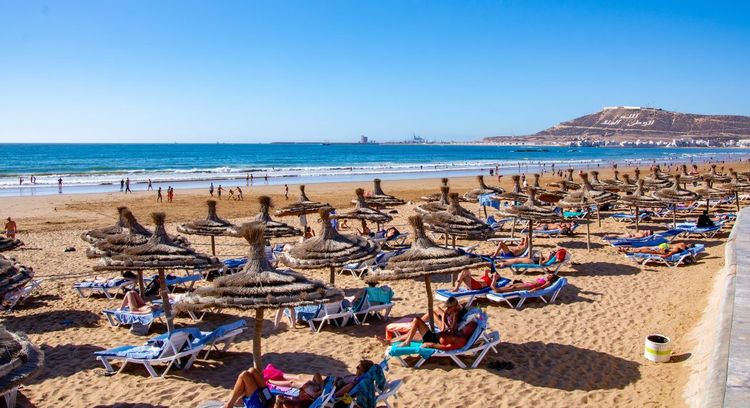
Agadir is the only major Moroccan city to have been entirely rebuilt. A magnitude 5.7 earthquake destroyed 85% of the city in 1960, killing between 12,000 and 15,000 people. The reconstruction, carried out urgently in the 1960s, produced a modern, planned city very different from the country's historic medinas.
Agadir's beach, stretching 9 km along the Atlantic, is sheltered by the bay and ranks among the best bathing conditions in Morocco. The water remains cool (Canary Current), but the quality of the sand and the sunshine make Agadir a popular destination from October to May, when inland cities are either too hot or too cold.
The Old Kasbah of Agadir (Oufella Hill, 80000 Agadir, rated 4.4/5 on Google from 7,853 reviews) has dominated the city from its hilltop since 1540. It did not survive the earthquake and only the outer walls remain standing, but the view over the bay and the city lights at sunset is exceptional. Ongoing archaeological excavations are attempting to piece together the pre-earthquake history of the settlement.
Tétouan: the Andalusian Pearl of the North
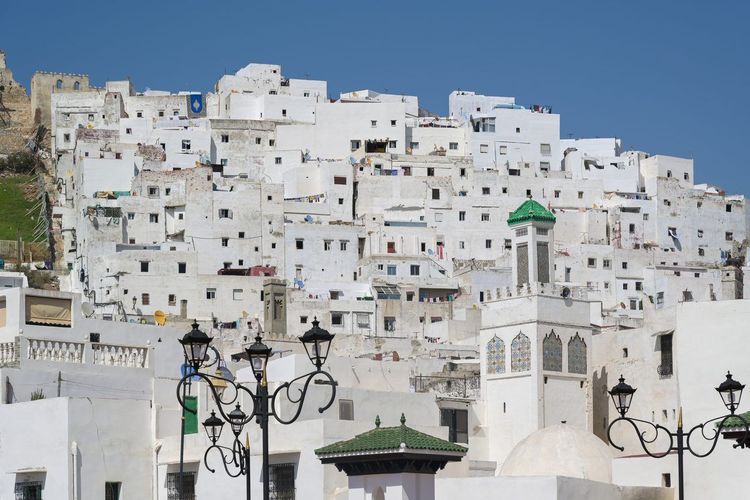
Tétouan is one of the least visited cities in this guide, and probably the one with the most favourable charm-to-tourists ratio. Listed as a UNESCO World Heritage Site since 1997, its medina is the most Andalusian in Morocco. When Muslims and Jews fled Spain after 1492, many refounded Tétouan in the image of their cities of origin. The result is a unique Hispano-Moorish architecture that resembles nothing else in the country.
Tétouan's Place Hassan II is surrounded by architecture that blends the Hispano-Moorish style with 20th-century Spanish colonial construction. Tétouan was the capital of the Spanish protectorate (1912–1956) and Spanish is still understood by part of the population. The city's Archaeological Museum houses collections ranging from prehistory to Roman mosaics from the ancient city of Lixus.
Tétouan's craft market is one of the least touristy in the country: prices reflect local trade, and the goods — embroidered textiles, worked leathers, ceramics — reveal a regional craftsmanship distinct from that of Fès or Marrakech.
Ouarzazate: at the Gates of the Desert and Hollywood Film Sets
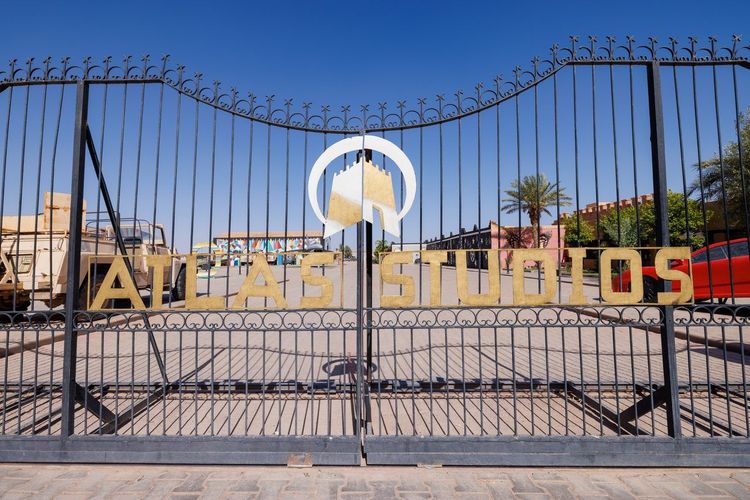
Ouarzazate is often called 'the Hollywood of the Sahara'. This is no exaggeration: since the 1960s, the city has served as a backdrop for Lawrence of Arabia (1962), Gladiator (2000), Alexander (2004), Babel (2006), episodes of Game of Thrones, and around sixty other international productions. The Atlas Studios, at the entrance to the city, are one of the largest outdoor filming complexes in the world.
The Taourirt Kasbah (Avenue Mohammed V, 45000 Ouarzazate, rated 4.3/5 on Google from 5,700 reviews), in the city centre, is one of the largest pisé (rammed earth) complexes in the region. It once belonged to the Glaoui family, the powerful caïds who controlled the High Atlas in the early 20th century. The section restored by UNESCO is open to visitors and gives a precise sense of the rammed-earth architecture that extends throughout the southern Moroccan kasbah region.
Ouarzazate is the starting point for the Draa Valley, a string of palm groves stretching south for dozens of kilometres, and for the dunes of Erg Chebbi at Merzouga (300 km). The Souss-Draa-Tafilalet region is the most spectacular in Morocco in terms of landscapes.
Aït Benhaddou: the Ksar That Hollywood Made Famous
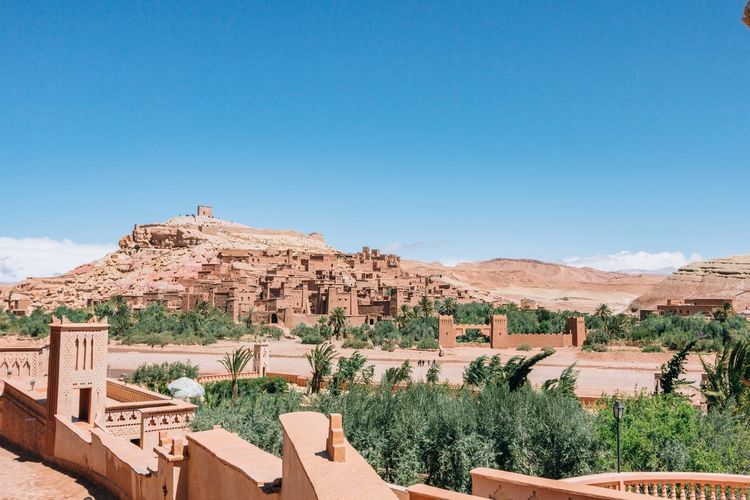
30 km from Ouarzazate, Aït Benhaddou is a fortified village (ksar) inscribed on the UNESCO World Heritage List since 1987. Built on the banks of the oued Mellah with pisé towers that seem to rise directly from the desert, it served as a backdrop for Game of Thrones, Gladiator, The Mummy, and dozens of other productions.
The ksar is still partially inhabited: a few families live in the pisé houses and offer crafts and mint tea to visitors. The structures that dominate the village — five agadirs (fortified collective granaries) and the central qasba — are reached on foot after crossing the oued by wading or stepping across stones.
The late-afternoon light, when the low sun tints the pisé walls orange and gold, is the best reason to be at Aït Benhaddou around 5 p.m. rather than 10 a.m. Avoid July and August: 40 °C in the shade, and most visitors arrive in groups during the same time slots.
Ifrane: the Mountain Town That Surprises at the Heart of Morocco
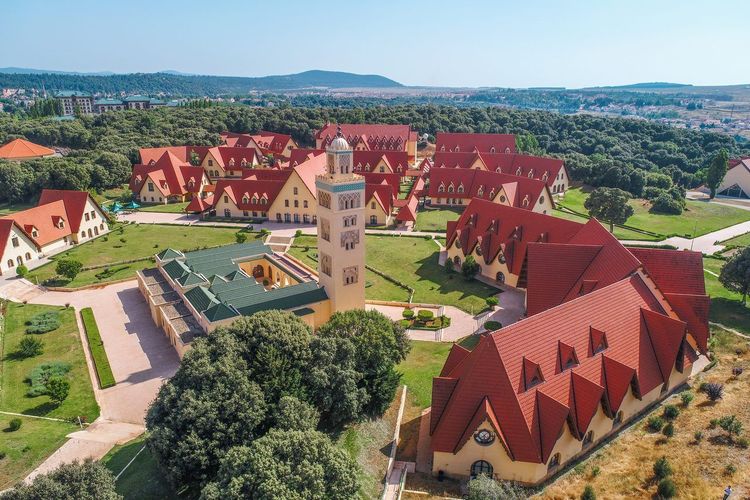
Ifrane (Centre-ville Ifrane, 53000 Ifrane, rated 4.5/5 on Google from 5K reviews) surprises without exception. This small Middle Atlas town, 68 km from Fès, resembles a Swiss ski resort lost in Morocco: pitched red-tiled roofs, alpine architecture, cedar forests with wild Barbary macaques wandering freely along the roadsides. Founded by the French in 1929 as a residential mountain resort, it has remained faithful to its original aesthetic.
The Lion of Ifrane, a stone sculpture installed in the town centre and probably dating from the 16th century, is the most photographed attraction in the city, particularly in winter when snow covers the square. The Ifrane National Park is one of the last refuges of the Moroccan cedar forest and the Barbary macaque, whose Moroccan population is the largest in Africa.
In summer, Ifrane is a welcome stop between Fès and Marrakech: at 1,665 metres altitude, the coolness is guaranteed and the landscapes are lush and green. In winter, the town receives snowfall and the Michlifen ski resort, a few kilometres away, offers modest downhill skiing in a unique setting.
When to Go to Morocco and How to Plan Your Trip
Morocco operates out of step with classic Mediterranean destinations. The best period covers April–May and September–November: temperatures are pleasant in the imperial cities (20–25 °C), the desert is manageable, and the Atlantic coasts are beautiful without being overcrowded.
July and August should be avoided inland: Marrakech, Fès, and Meknès regularly reach 38–42 °C. The Atlantic coast (Essaouira, Agadir) remains bearable thanks to the trade winds. November, which many hesitate to consider, is in reality an excellent period for the imperial cities — reduced crowds, pleasant temperatures, lower accommodation prices.
Three logistical options stand out clearly. A rental car remains the most flexible solution for covering the north (Tanger, Chefchaouen, Tétouan) and the south (Ouarzazate, Agadir). The Al Boraq train (high-speed line) connects Tanger to Casablanca in 2h10 and serves the main city network. CTM coaches cover destinations without rail service, including Essaouira and Chefchaouen. To plan your itinerary beyond the cities, our article Visiting Morocco: 10 Must-Sees details the essentials and practical steps.
Practical Tips for Traveling in Morocco
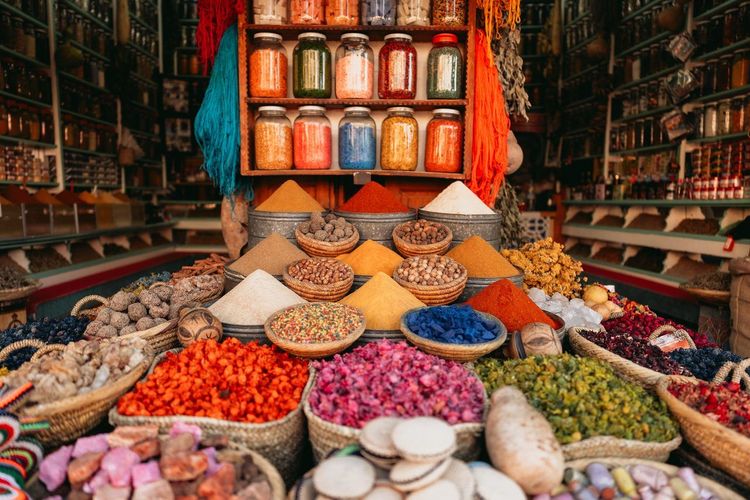
Money and payment. The Moroccan dirham (MAD) is not convertible abroad: exchange money on arrival at airports or at banks in the cities. ATMs (Attijariwafa, CIH, BMCE) accept Visa and Mastercard cards in all major cities. Carry cash for the medinas and souks — craft shops are rarely equipped with payment terminals.
Bargaining and fixed prices. In the souks, bargaining is a cultural norm. The displayed price is often double the expected price, and polite haggling is part of the exchange. In restaurants, hotels, and transport, prices are generally fixed. Beware of 'unofficial guides' who approach you at the entrance to the medinas: they often work on commission with the shops.
Dress code. In medinas and religious sites, shoulders and knees should be covered for both women and men. On beaches and in tourist hotels, Western standards are accepted. Dressing respectfully is generally very well received by the local population.
Languages. Moroccan Arabic (darija) and Berber (tamazight) are the languages of everyday use. French is understood in almost all tourist situations. Spanish is useful in the north (Tanger, Tétouan, Chefchaouen). English is rapidly gaining ground in the major cities.
Safety. Morocco is one of the safest countries in North Africa for travelers. Major incidents are rare. The usual precautions apply in the large medinas: be aware of pickpockets in heavily frequented tourist areas, and avoid displaying expensive camera equipment too visibly.
Budget. A mid-range riad in the medina costs between 300 and 700 MAD per night (30–70 €). A Fès–Marrakech train journey in second class costs 180–220 MAD. A meal at a local restaurant runs around 50–80 MAD per person. Museum and monument entry fees rarely exceed 80 MAD.
Connectivity. Riads and hotels almost universally offer Wi-Fi. Local SIM cards (Maroc Telecom, Inwi, Orange Maroc) are available at the airport and in the city for a few euros, with very competitive data plans. To explore the medinas with historical and cultural context, the Ryo app offers walking audio guides, available offline once downloaded.
Tips. Tipping is widespread and expected. As a guide: 10–20 MAD for a one-off service, 50–100 MAD per half-day for an informal guide, around 10% at a restaurant if service is not included.
FAQ
What is the most beautiful city in Morocco?
The answer depends on what you are looking for. For cultural intensity and medieval Islamic architecture, Fès is unbeatable — its car-free medina has no equivalent in the Arab world. For atmosphere and nightlife, Marrakech remains the capital of the Moroccan experience. For pure visual beauty, Chefchaouen and its blue alleyways create a visually unique space. The most beautiful city is ultimately the one that matches your sensibility at any given moment.
Which city should you visit first in Morocco?
For a first trip, Marrakech is the recommended entry point. The airport is well served from Europe, the tourist infrastructure is the most developed in the country, and the concentration of monuments, souks, and restaurants within a compact area allows you to quickly grasp Moroccan culture. Fès is more disorienting on first contact but often more memorable in the long run.
What is the best time to visit Morocco?
April–May and September–October are the ideal windows for covering the whole country. November is excellent for the imperial cities, with very small crowds and low prices. Avoid July–August inland (extreme heat), but consider Essaouira and Agadir in summer if you are primarily looking for beach and water activities.
How many days do you need to visit the main cities of Morocco?
To cover the 13 cities in this guide, allow 21 to 28 days for a comfortable trip. A quick 10-day itinerary can cover Marrakech (2 nights), Essaouira (1 night), Ouarzazate (1 night), Fès (2 nights), Chefchaouen (1 night), and Tanger (1 night). Casablanca and Rabat can easily be added in transit on the way in or out depending on your entry point.
Is it better to rent a car or take the train in Morocco?
Both options have their own logic. The ONCF train is comfortable, punctual, and covers the Casablanca–Rabat–Fès–Tanger–Marrakech network at very affordable fares. A rental car is essential for Chefchaouen, Essaouira, Ouarzazate, Aït Benhaddou, and Ifrane, which are not served or poorly served by rail. A combination of both is often the best solution: train for the main routes, car for a specific segment of the circuit.
Can you visit Morocco in November?
Absolutely. November is one of the best months for the imperial cities: Marrakech, Fès, and Meknès see temperatures of 15–22 °C, the summer crowds have gone, and accommodation prices drop significantly. The risk of rain is real on the northern coast and in the Rif mountains, but inland cities generally remain mild. Chefchaouen after rain, with its empty alleyways and gleaming blue walls, has a very special charm.
Is it dangerous to travel alone in Morocco?
Morocco is generally safe for solo travelers, including women. Harassment in tourist medinas exists but is localized and predictable — staying firm but courteous is enough in the vast majority of cases. Serious incidents remain statistically rare. Basic precautions: return to your accommodation before dark in less frequented areas, do not accept unsolicited 'spontaneous guides' in the medina, and keep a digital copy of your documents.
The 13 cities in this guide represent the best Morocco has to offer, but they are not exhausted in a single trip. Marrakech, Fès, and Chefchaouen make a first triptych that is hard to improve upon. Add Essaouira for the Atlantic and Ouarzazate for the desert, and you will have a memorable first circuit. Tétouan, Ifrane, and Aït Benhaddou reward those who return a second or third time. To begin exploring Marrakech like a local rather than a tourist, Ryo's Marrakech audio-guided tour offers a walking route that covers the historic neighbourhoods with their stories and anecdotes — an excellent starting point before venturing into the rest of the country.