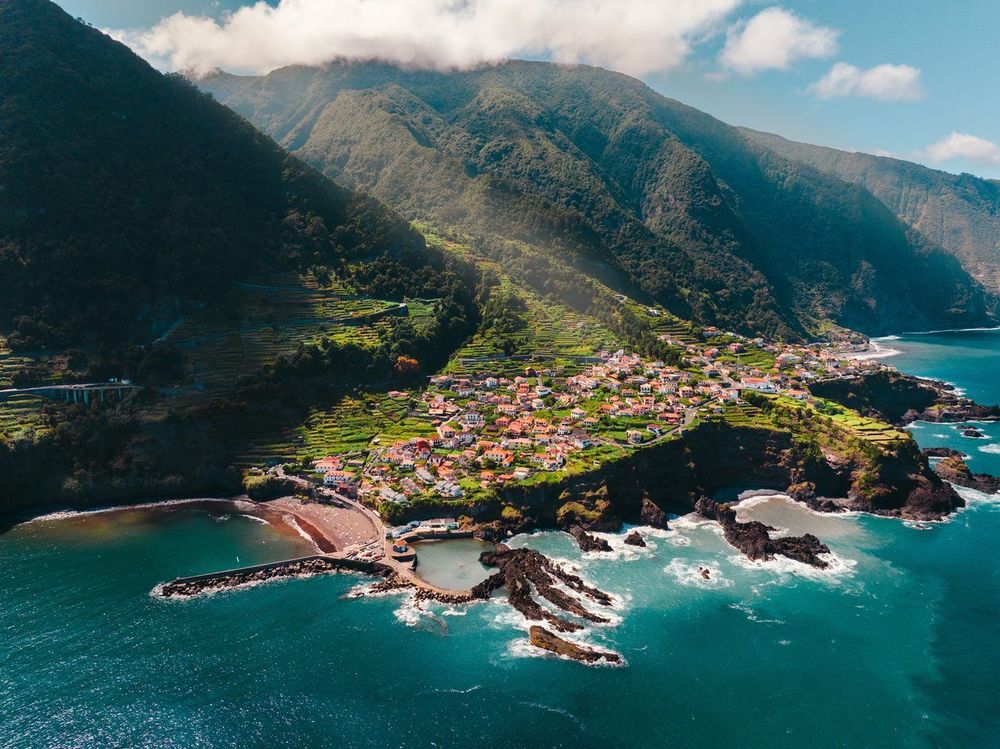
© Shutterstock
 Votre guide Ryo
What to Visit in Madeira: 18 Must-Sees to Discover the Island in 2026
What to visit in Madeira on your first trip? The island surprises almost everyone who arrives. They expect a volcanic island somewhere in the Atlantic, and instead they find a laurisilva forest listed as a UNESCO World Heritage Site, cliffs plunging 580 metres into the ocean, and a capital whose azulejo-tiled lanes rival the finest neighbourhoods of Lisbon. This is not a beach island, or barely: it is an island of sensations — the air thick with eucalyptus on the ridges of Pico Ruivo, the crash of waves against the lava pools of Porto Moniz, the flower market in Funchal on a Friday morning. To help you plan your stay, the Ryo team has selected 18 sites and experiences you cannot miss, whether you have 3 days or 15 days on the island.
Among the discoveries that await you: a levada lets you walk for 5 hours along a clifftop without ever losing sight of the ocean; the botanical garden of Funchal is home to an 800-year-old dracaena, recognisable by its candelabra-like branches; the Ponta de São Lourenço, at the eastern tip of the island, shifts landscape every 500 metres, moving from the vivid green of ferns to the ochre of bare volcanic rock. And if you are curious about local traditions, Madeiran cuisine holds some surprises, starting with the espada preto, a deep-sea fish you will find nowhere else in Europe with such regularity. Each section below gives you practical details, the best times to visit and the mistakes to avoid.
1. Funchal, the Capital with a Thousand Faces
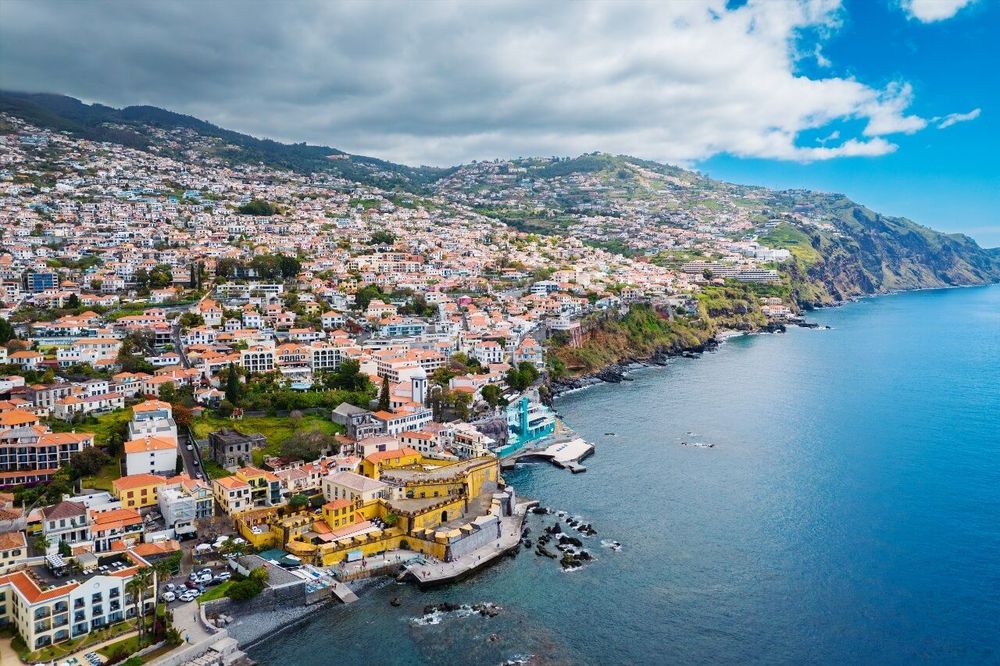
Funchal alone concentrates a good half of the reasons to come to Madeira. Founded around 1424–1425 by João Gonçalves Zarco, one of the navigators sent by Infante Dom Henrique, the city takes its name from the wild fennel (funcho) that covered the hills when it was discovered. Today it is an agglomeration of 111,000 inhabitants that climbs the slopes of a natural amphitheatre facing the Atlantic, with an Old Town (Zona Velha) whose hand-painted doors have become one of the most photographed attractions in Portugal.
The Sé de Funchal, a cathedral built between 1485 and 1514, is worth at least an hour of your time. Its cedar-wood ceiling inlaid with ivory is one of the finest examples of late Manueline art in all of Portugal. Nearby, the Museu CR7 draws more than 300,000 visitors a year to celebrate the career of Cristiano Ronaldo, a Funchal native — a must-see curiosity even if football leaves you cold. The Museu de Arte Sacra is more understated: its collection of Flemish primitives, purchased by Madeiran merchants in exchange for sugar in the 15th century, is one of the finest outside Flanders.
To see Funchal in all its splendour, take the cable car linking the city centre to the Monte district in 15 minutes: the view over the bay from the cabin alone is worth the 13 € ticket. Once up there, ride back down in a wicker toboggan (carro de cesto), a local tradition dating from the 19th century, with two white-clad piloteiros steering the sled over the cobblestones. The 2-kilometre descent takes about ten minutes and is one of the most anachronistic and exhilarating experiences on the island.
The Zona Velha was revitalised by the Open Doors Art Project: since 2011, more than 200 doors on Rua de Santa Maria have been transformed into works of art by local and international artists. Walk through one evening, when restaurants open their terrace tables and the sounds of the ocean mingle with conversation. The Ryo audio guide to Funchal offers a route through these lanes with historical commentary on each painted door and the sugar merchants who made the island's fortune.
Practical tip: avoid Tuesdays and Wednesdays, when cruise ships unload up to 8,000 passengers into the city centre. The Mercado dos Lavradores becomes impossible to navigate without patience. Opt for a Friday morning for a city at a more human scale.
2. The Mercado dos Lavradores, the Farmers' Market
The Mercado dos Lavradores is far more than a covered market. Inaugurated in 1940, the Art Deco building is lined with blue-and-white azulejos depicting Madeiran rural trades. Inside, the stalls burst with colour: passion fruit, miniature bananas, strelitzia flowers, sun-dried cherry tomatoes.
The upper level is reserved for flowers. Friday morning is the best time: women farmers from the island's interior come down with their week's produce, dressed in traditional costume. The ground floor houses the fish market, featuring the espada preto — that deep-sea black fish hung by the mouth from stainless-steel hooks. The sight is striking. Opening hours: Monday–Thursday 7am–3pm, Friday 7am–8pm, Saturday 7am–2pm.
Don't leave the market without tasting the exotic fruits that vendors offer for sampling: anona (cherimoya), tomate-inglês (tamarillo), pitanga or banana passion fruit are varieties unavailable on the mainland, grown in the terraced gardens of the island's interior. Ask the price before accepting a cut slice: it is here, in contact with the producers, that you understand just how artisanal Madeiran agriculture remains, each plot wrested from the hillside by hand.
Watch out for street vendors at the entrance: the prices of fruit presented on trays can be three times higher than inside the market. Head straight in, explore the stalls at the back, and take the opportunity to spot the small counters where homemade poncha is served at any hour of the morning.
3. The Levadas, the Age-Old Irrigation Channels
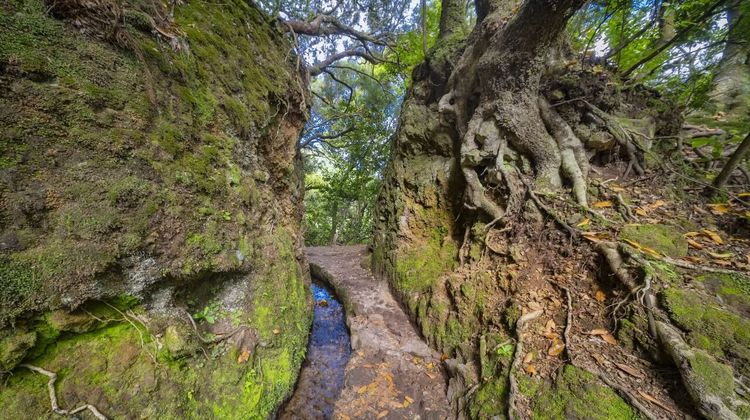
The levadas are Madeira's defining landscape feature, and probably its most original attraction on a global scale. These irrigation channels built from the 15th century onwards to carry water from the mountains to the crops of the island's south now form a network of more than 2,150 km of paths, much of which runs alongside the laurisilva forest (a subtropical relict forest from the Tertiary era, listed as a UNESCO World Heritage Site in 1999).
The Levada do Caldeirão Verde (Estrada Regional 105, 9230 Santana, rated 4.7/5 on Google from 3,752 reviews) is often cited as the most spectacular for a first visit. It starts at Queimadas, at 890 metres altitude, and follows the Ribeira da Metade valley for 13 km return to a waterfall that drops into a natural pool surrounded by cliffs covered in tree ferns. The vegetation changes from kilometre to kilometre — chestnut trees and hydrangeas give way to giant ferns before you enter tunnels cut through volcanic rock. The longest is 150 metres and requires a headlamp. The atmosphere under the canopy, filtered through laurels and giant heathers, is that of a forest that has passed through the ages undisturbed.
Allow 5 to 6 hours for the return walk, moderate level. For families, the Levada das 25 Fontes in the Rabaçal area is much more accessible: 3.5 km return, with 25 springs forming an amphitheatre waterfall. Suitable for children aged 6 and up.
Essential equipment: waterproof shoes with rigid soles (paths are often wet), a light rain jacket, a headlamp with fresh batteries. Never enter the tunnels without a headlamp: some exceed 400 metres and are in complete darkness. Organised groups swamp the paths between 10am and 2pm — setting off at dawn from Funchal (50 minutes' drive) virtually guarantees a morning almost alone in the forest.
Some levadas in Natura 2000 zones require a permit or a licensed guide. Check with the Funchal tourist office before you go, especially for routes within the Madeira Natural Park.
4. Pico Ruivo, the Island's Roof at 1,862 Metres
Climbing Pico Ruivo (Achada do Teixeira, 9230 Santana, rated 4.8/5 on Google from 5,622 reviews) (1,862 m) remains the obligatory rite of passage for anyone visiting Madeira for a week or more. It is the highest point of the entire archipelago, and the view from the summit takes in the whole island from east to west, with the sea glittering on both sides of the ridge.
Two main access routes exist. The most popular starts at Achada do Teixeira (accessible by car, 1,592 m altitude): 4 km return, 270 m elevation gain, around 1h30 of walking. This is the shortest and most accessible route. The other option, infinitely more rewarding, starts from Pico do Arieiro and crosses the main ridge for 11 km with sections equipped with metal walkways suspended over the void. This traverse takes 4 to 5 hours and is one of the most beautiful hiking routes in Portugal.
The summit is regularly shrouded in cloud in the afternoon, especially in summer. Set off before 7am to maximise your chances of a clear sky. In winter (November to March), snow is possible and the path can be icy — check conditions the day before. A rest house with a café and toilets sits 200 metres below the summit and serves a hearty caldo verde after the effort.
Those who reach Pico Ruivo come back transformed. Watching clouds drift beneath your feet, the island's ridge snaking towards Funchal on one side and the Atlantic horizon on the other — it is an image you will not forget.
5. Pico do Arieiro, Sunrise above the Clouds
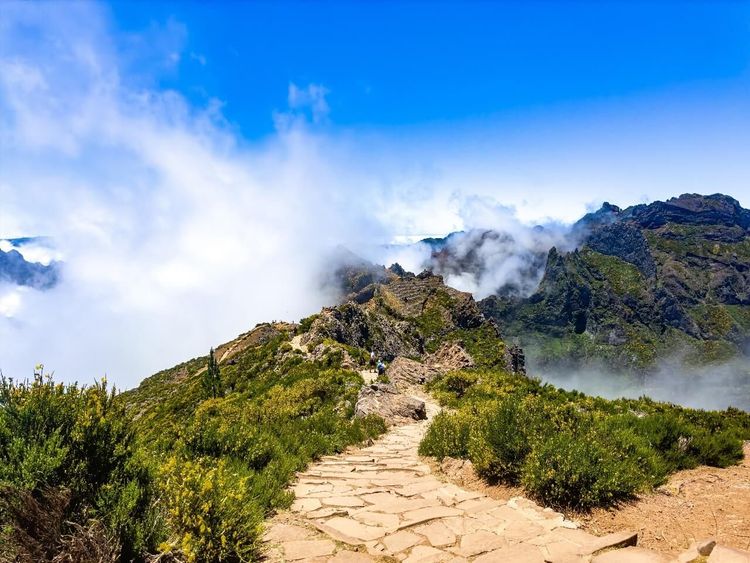
Pico do Arieiro (Estrada do Arieiro, 9200-049 Funchal, rated 4.8/5 on Google from 2,726 reviews) (1,818 m) is Madeira's third-highest peak, but the most accessible by car: a paved road climbs to a car park a few hundred metres from the summit, with a café-restaurant open year-round.
At dawn, when Funchal and the coast are still buried under low cloud, Pico do Arieiro emerges into a clear sky and puts on an extraordinary show: a sea of pink and gold cloud concealing the entire lower island. The red and ochre basalt floor, sculpted by volcanic erosion, resembles a lunar landscape that vegetation colonises in sparse tufts. On a clear day, the view stretches as far as Tenerife and the Desertas Islands on the horizon.
To get there before sunrise, rent a car — the first buses don't head up until 8am. Parking is free. Bring warm clothes even in summer: temperatures at the summit hover around 10–12 °C at night and early morning. If you don't want to continue to the Pico Ruivo traverse, a 2 km walk along the ridge (return from the car park) is enough to enjoy the panorama.
6. Porto Moniz and Its Natural Lava Pools
At the north-western tip of Madeira, Porto Moniz is one of the island's most photographed destinations. Successive volcanic eruptions formed a system of basalt rock pools here, fed directly by Atlantic waves. The water is cool (17–21 °C depending on the season), perfectly clear in the calmer sections (visibility up to 15 metres), and surrounded by black rocks sculpted over millennia. Swimming in these natural pools while watching waves crash a few metres above you is one of the most memorable experiences Madeira has to offer.
There are two distinct complexes: the natural pools on the western side of the harbour (wilder, fewer people, access sometimes tricky depending on sea conditions) and the municipal bathing complex on the eastern side (changing rooms, showers, snack bar, entry between €1.50 and €3 depending on the season). The municipal pools are better maintained and safer for children; the natural pools offer a rawer experience.
The drive from Funchal takes 1h15 to 1h30 via the northern road (EN101 through São Vicente), which is itself spectacular: tunnels cut into the cliff face, a viaduct perched on a corniche above the Atlantic, fishing villages clinging to the slopes. The return route via the south (through Calheta and Ribeira Brava) completes a circuit of the island's western half in a single day.
Avoid a summer Saturday between 10am and 4pm: the pools are overrun by Madeiran families. On weekdays or late afternoon, the setting regains all its tranquillity.
7. Cabo Girão, the Highest Sea Cliff in Europe
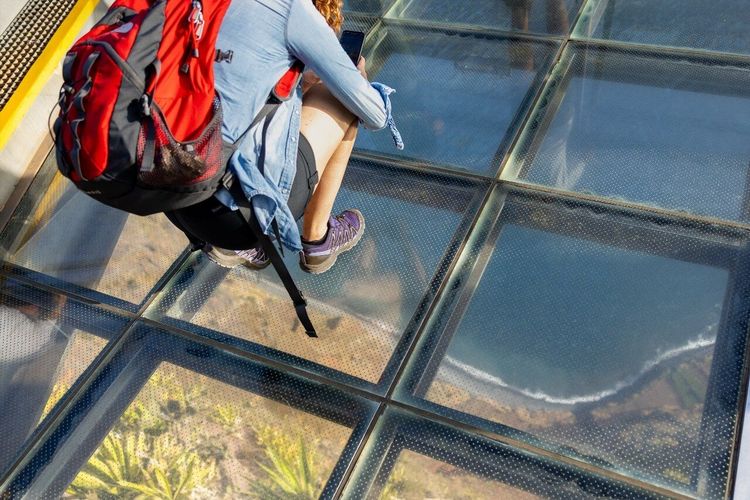
Cabo Girão rises 580 metres above the Atlantic — the highest sea cliff in Europe. A glass-floored viewing platform was built at the tip of the promontory in 2012, allowing visitors to look directly down to the fajas (small coastal plains) where farmers still cultivate grapes and bananas, accessible only by a service cable car.
The site is accessible from Funchal in 30 minutes by car, taking the coastal road that skirts the headland above Câmara de Lobos. Entry is free, as is parking. On a clear day, the view takes in the entire southern coast from Funchal to Ribeira Brava. In cloudy weather, the sea of mist clinging to the cliffs creates an equally striking atmosphere. Bring a jumper even in summer: the wind blows hard at the viewing platform, and the glass deck is regularly swept by gusts off the open sea.
The skywalk itself is worth lingering on: the cantilevered walkway gives the sensation of floating above the void, and the bravest visitors come to test their head for heights by looking at the ocean 580 metres below, between their feet. Arrive in the early morning or late afternoon to avoid cruise-ship tour groups that crowd the site at midday; the raking light is also far more photogenic.
Malvasia vines cover the slopes between Câmara de Lobos and the cliff, a glimpse of the wine-growing landscape that made Madeira famous across European courts in the 17th century. Head down to the service cable car if you want to see the cliff from below: the effect is just as impressive as from the top, but in reverse.
8. Câmara de Lobos, the Fishing Harbour of Churchill
While Funchal embodies the merchant capital, Câmara de Lobos (Rua João de Deus, 9300-014 Câmara de Lobos, rated 4.4/5 on Google from 37 reviews) has remained a true fishing village. Its colourful boats moored in a tiny circular harbour, its white houses with blue shutters, its nets drying on the quayside — this is where Winston Churchill came to paint his watercolours during his stays in Madeira in the 1950s. A plaque on a bar marks his usual vantage point.
The village is 15 minutes by car west of Funchal. The seafront promenade was renovated in 2019 and offers a fine view over the harbour from above. The upper part of the village, reached by a steep staircase from the port, preserves lanes of rare authenticity: no souvenir shops, just women hanging out the washing and men mending nets.
It is also the birthplace of poncha, the island's emblematic cocktail: the small harbour bars serve a robust version known as poncha pescador (fisherman's poncha), traditionally drunk in one go before heading out to sea. Sit on a terrace in the late afternoon, when the boats come in and the light turns the facades golden — it is one of those moments when Madeira is something to be lived rather than visited.
The waterfront restaurants serve espada caught fresh that morning, prepared with passion-fruit sauce — the village's speciality. For a full day, pair Câmara de Lobos with a visit to Ribeira Brava, a coastal town 20 kilometres further west, with its peaceful covered market and its 17th-century fort converted into an ethnographic museum.
9. Santana and Its Thatched-Roof Houses
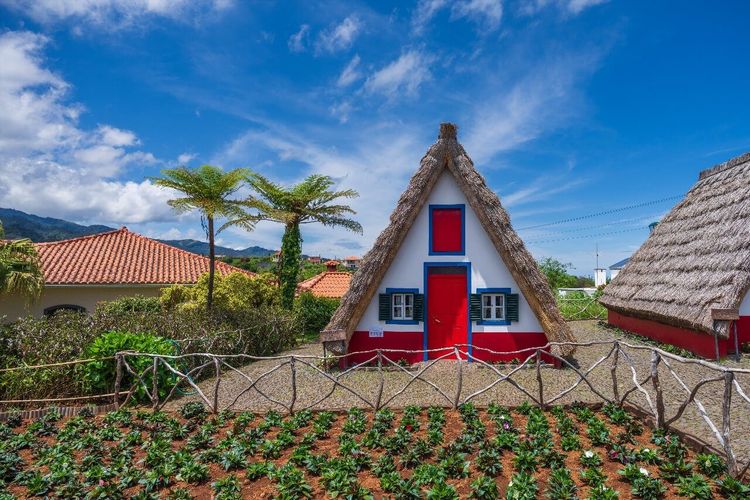
Santana, in the north of the island, is best known for its palheiros — triangular thatched cottages whose roofs sweep all the way down to the ground, painted in red and white. Built from the 15th century using materials available at altitude (heather wood, straw, basalt), some have been inhabited continuously since the 19th century. About twenty authentic examples remain, six of which can be visited in the municipal theme village.
The interior of a palheiro is surprising: the ground floor rarely exceeds 20 square metres, yet the use of space shows practical ingenuity — stacked levels for animals and inhabitants, natural thermal insulation provided by the double thickness of thatch.
The Santana area is also the starting point for the Levada do Caldeirão Verde hike (section 3). The village's altitude (437 m) gives it a cool and often cloudy microclimate, in sharp contrast to the southern coast. Tip: don't confine yourself to the tourist park. Walk 10 minutes through the village lanes and you'll find authentic working palheiros, a few family grocery shops and a view of the northern coast that few travellers ever discover.
10. The Rabaçal Waterfalls, a Plateau in the Clouds
The Rabaçal plateau (Plateau de Rabaçal, 9370 Calheta Madeira, rated 4.5/5 on Google from 44 reviews) (1,015 m altitude) is one of the most unspoilt natural spaces in Madeira. Nestled between two deep valleys in the centre-west of the island, this laurisilva plateau is home to several waterfalls and the starting points of two popular levadas: the Levada do Risco and the Levada das 25 Fontes.
The Cascata do Risco (40 m high) is reached in 30 minutes from the Rabaçal car park via an easy path through laurisilva forest. A little further on, the Levada das 25 Fontes leads in an additional 45 minutes to a natural amphitheatre where 25 distinct springs form a fan-shaped waterfall — one of Madeira's most striking images. The full circuit (Risco + 25 Fontes loop) takes 3 to 4 hours, moderate elevation, well-marked path.
Important: private vehicle access to the plateau is prohibited between 8am and 6pm in high season (May–September). A paid shuttle (around €3) runs from a car park 1.5 km uphill. Outside these hours or in low season, access is free. Arrive early to avoid groups.
11. The Funchal Botanical Garden, an Extraordinary Plant Collection
The Jardim Botânico da Madeira (Caminho do Meio, 9064-512 Funchal, rated 4.4/5 on Google from 23,514 reviews) occupies the slopes of a former Reid family estate on the heights of Funchal, with a panoramic view over the city and the bay. Opened in 1960, it brings together more than 2,000 plant species from five continents, with a particular focus on Madeira's endemic flora and plants from arid zones.
The most spectacular section is the rock garden, with cacti reaching 4 to 5 metres in height — you don't expect to see saguaros and agaves in a garden on the Atlantic coast. But it is the Dracaena draco planted in the central avenue that surprises most: this dragon tree, with the candelabra-like branches characteristic of Macaronesian flora, is estimated to be around 800 years old according to dendrochronologists. The tropical plant greenhouse houses orchids, giant ficus and ornamental banana trees in a humid atmosphere.
Admission is €7.50 (adult, free for children under 6). Allow 1h30 to 2 hours for a full visit. Accessible from Funchal city centre on bus no. 31 or by cable car to Monte then downhill on foot. A terrace café-restaurant with views over Funchal serves Madeiran pastries.
If you visit in April or May, make the most of the Festa da Flor (Flower Festival), one of Madeira's largest festivals, which turns the streets of Funchal into a giant carpet of petals. The Ryo app offers audio content on Madeira's endemic flora and the history of botanical gardens in the British era — a perspective that adds further depth to the visit. Its Funchal audio-guided tour, 27 stops in 1h30, then walks you back into the heart of the capital.
12. The Monte Palace Tropical Garden, Mosaics and Cycads among the Palms
A few minutes' walk from the Monte cable car station, the Monte Palace Tropical Garden (Caminho do Monte 174, 9050-288 Funchal, rated 4.7/5 on Google from 29,015 reviews) is one of the most extraordinary gardens in the entire Atlantic arc. Created by entrepreneur José Berardo in 1991 on the ruins of a former Victorian hotel, it spreads across 70,000 m² of successive terraces, with collections of cycads dating back 300 million years, gemstones displayed in the open air, African and Oriental sculptures, and koi carp pools of improbable size.
The distinctive feature of Monte Palace is its juxtaposition of cultures: a terrace covered in blue-and-white azulejos tracing the history of Portugal sits alongside a collection of quartz crystals and amethysts weighing several dozen kilos, itself adjacent to a Japanese zen garden. The result is disconcerting at first but ultimately coherent — an eccentric vision of the botanical and artistic world.
Admission: €12.50 (adult). Closed on Sundays. Accessible by cable car from Funchal (Monte station), then 5 minutes on foot. The visit takes 1h30 to 2 hours. The cycad collection alone is worth the trip: some specimens reach 2 to 3 metres and the collection as a whole is one of the most important in Europe.
13. Machico, the Historic Cradle of Madeira
Machico (Largo do Município, 9200 Machico, rated 4.1/5 on Google from 23 reviews), on the eastern side of the island, was the town that welcomed the first Portuguese settlers in 1419, even before Funchal. Legend has it that Tristão Vaz Teixeira and his companions landed here after finding traces of an English couple, Robert Machim and Ana de Arfet, buried on the beach after being shipwrecked a century earlier. The Chapel of Nossa Senhora do Triunfo, built on the supposed site of the tomb, keeps their memory alive.
Today Machico is best known for its sandy beach, one of the few natural ones in Madeira, and its renovated seafront promenade. The town is more authentic and less touristy than Funchal, with a lively municipal market on Saturday mornings and neighbourhood restaurants where set menus at €8–10 include soup, main course and coffee. Madeira International Airport is 5 km away — perfect for a last lunch before boarding.
Take time to climb up to the Fort of Nossa Senhora do Amparo, a small 18th-century triangular fortress overlooking the bay that now houses the tourist office, then stroll along the Banda d'Além bay, a beach of sand imported from Morocco in 2008 that transformed the local economy. In late August, Machico comes alive for the festival of Nossa Senhora, one of the island's most attended pilgrimages, with processions, fireworks and street barbecues that go on late into the night. It is the ideal opportunity to experience a lively, popular side of Madeira, a world away from the polished terraces of central Funchal.
14. Ponta de São Lourenço, the Volcanic Peninsula
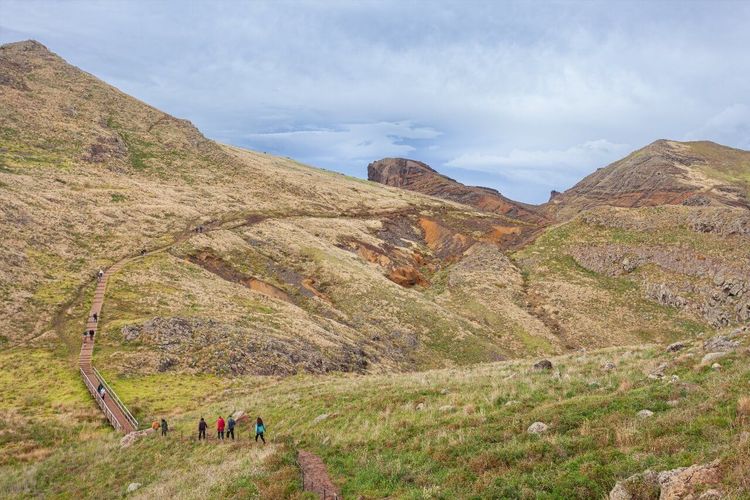
The Ponta de São Lourenço (Vereda da Ponta de São Lourenço, 9100 Santa Cruz, rated 4.8/5 on Google from 13,891 reviews) is the easternmost tip of Madeira, a narrow volcanic peninsula jutting into the Atlantic and forming red, orange and ochre cliffs of breathtaking beauty. It is the visual antithesis of the rest of the island: here there is no laurisilva forest, no dense vegetation — the eroded volcanic rock is bare, striped with coloured layers that tell the island's geological history strata by strata.
The main trail is 8 km return from the Baía d'Abra car park, with a moderate elevation gain of 250 m. It passes through several distinct biomes in under an hour of walking: Mediterranean scrubland, bare basalt rock, isolated coves accessible only on foot. At the tip of the peninsula, the Casa do Sardinha, a restored former keeper's house, marks the furthest point accessible to the public. The view from there over the Ilhéus da Ponta de São Lourenço — two rocky islets battered by the waves — is unforgettable.
Allow 3 to 4 hours for the return walk. Set off in the morning to avoid the heat (the peninsula is exposed, with no shade). Bring at least 1.5 litres of water per person. The area is classified as a nature reserve: do not leave the marked trail. Madeiran toadflax and wild geraniums grow here and nowhere else in the world.
Ponta de São Lourenço pairs well with Machico (section 13) and the village of Caniçal, Madeira's last whaling port until 1981, whose whale museum recounts this history honestly. Bulwer's petrels and Balearic shearwaters nest in the cliffs — with binoculars, birdwatching can add an extra hour to the visit.
15. Porto Santo, the Neighbouring Island with 9 km of Golden Sand
Porto Santo is Madeira's little sister: a flat, arid island 42 km to the north, possessing something Madeira does not — a near-uninterrupted 9 km golden sand beach, one of the longest in the entire Atlantic arc. Porto Santo's sand has a particular composition of silicates and magnesium that is said to have therapeutic properties for certain rheumatic conditions, according to local studies.
Christopher Columbus lived on Porto Santo from 1479 to 1482, after his marriage to Filipa Moniz Perestrelo, daughter of the island's first governor. The Casa de Colombo, a museum dedicated to the navigator, traces this chapter with maps and scale models of caravels. Some historians argue that it was here that Columbus formed his theories about the existence of lands to the west, by observing driftwood and unknown objects cast ashore by Atlantic currents.
The ferry crossing from Funchal takes 2h15 and costs around €60–75 return (2026 fare). For a 3–4 day stay in Madeira, Porto Santo makes a refreshing day detour, especially if you have come to hike and are looking for a beach break.
16. Whale and Dolphin Watching off Funchal
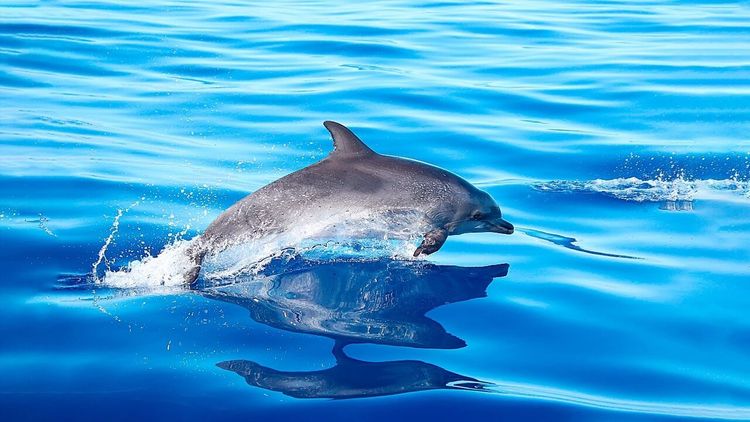
Madeira is one of the best cetacean-watching destinations in Europe. The waters around the island, deep and nutrient-rich thanks to Atlantic currents, attract 28 different species of whales and dolphins recorded by the local marine observatory. Trips run year-round, with varying sighting probabilities depending on the season.
Common and spotted dolphins are present year-round. Sperm whales are regularly sighted from March to October. Humpback whales pass through on migration from April to May. Trips last between 2h30 and 4 hours and cost €45 to €75 per person depending on duration and operator, departing from Funchal marina.
One detail that often reassures travellers prone to seasickness: most operators now use stable catamarans rather than rigid inflatables, and stay in the sheltered waters of the southern coast where the swell is gentler. If you are travelling with children, choose a 2h30 catamaran trip rather than a long zodiac expedition. Sightings are made from several hundred metres away, in line with regulations — don't expect a close encounter like an aquatic park, but the emotion of watching a sperm whale surface and blow in the open sea remains undiminished.
Choose an operator certified by the Madeiran cetacean association — they sail with a biologist on board. The difference in experience is significant: scientific explanations, individual identification, compliance with distance regulations. Avoid trips in rough sea conditions.
17. Palheiro Gardens, the Secret Gardens of Funchal
Less well known than the botanical garden or Monte Palace, the Quinta do Palheiro Ferreiro (Caminho da Quinta do Palheiro, 9060-415 Funchal, rated 4.4/5 on Google from 1,372 reviews) is nonetheless considered by botanists to be Madeira's most refined garden. Founded in 1804 by the Count of Carvalhal and acquired by the Blandy family in 1885, it spreads across 38 hectares of wooded hillside at 550 m altitude, 8 km east of Funchal.
The camellia collection — more than 3,000 varieties — is the largest in Europe. It is best visited from January to April, when the shrubs are in full bloom. English roses, agapanthus, giant strelitzias and two-hundred-year-old magnolias compose an English-style garden embellished with tropical plants. The atmosphere is peaceful, far from the crowds of Funchal. Admission: €10. Closed at weekends.
18. Madeiran Cuisine, between Black Espada and Aged Wine
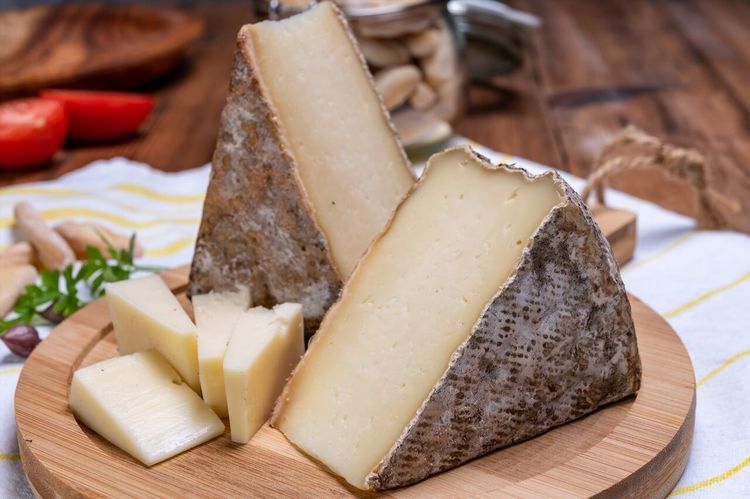
Eating in Madeira is an experience in itself. The island's cuisine is a synthesis of Portuguese peasant traditions, the influences of trade routes (spices from the Indies, cane sugar) and the constraints of island life.
The espada preto (black scabbardfish, Aphanopus carbo) is the king of the Madeiran table. This deep-sea fish, caught at night at depths of 800 to 1,500 metres, has white, delicate flesh with almost no bones. It is most often pan-fried with plantain banana — a combination that surprises but works perfectly, the fruity acidity balancing the richness of the flesh. The Mercado dos Lavradores is the best place to see this fish in its raw state; the waterfront restaurants of Funchal, the best place to taste it.
The espetada — beef skewered on fresh bay laurel branches, marinated and grilled — is the other emblematic dish, traditionally served in inland restaurants. The finest is eaten at Ribeiro Frio, a small mountain hamlet above Funchal. Expect to pay €15–20 for a full espetada with milho frito (fried polenta).
Local drinks deserve their own exploration. Poncha is a cocktail made from sugarcane aguardente, honey and lime juice, stirred by hand with a wooden bastão. Nikita is a bewildering local invention — a kind of lager and vanilla ice-cream float that proves enormously popular in summer. Both are drunk in bares de vinho for just a few euros.
Finally, Madeira wine deserves a serious tasting. This fortified oxidative wine ages for decades without deteriorating — some vintages available in Funchal date back to the 1960s. The great houses (Blandy's, D'Oliveiras, Henriques & Henriques) offer cellar tours with tastings for €10–15. A bottle of 10-year-old Malmsey is the ideal souvenir to take home.
FAQ
How much time do you need to visit Madeira?
A minimum of 5 to 7 days is recommended to cover the essentials. Two days for Funchal and its surroundings (Monte, Câmara de Lobos, Cabo Girão), one day for a levada in the north, one day for the peaks (Pico do Arieiro), one day for Porto Moniz and the northern route. In 3 days, the highlights of Funchal and a mountain excursion remain doable, but Madeira truly reveals itself with more time.
What is the best time to visit Madeira?
Madeira can be visited year-round thanks to its stable subtropical climate (16 °C in winter, 26 °C in summer). The months of March to June are ideal for hiking and blooming season. July–August is peak season: sunny weather, Porto Moniz pools at their best, but reservations needed several weeks in advance. November to February offers a quieter Madeira, with the Flower Festival in April and New Year's fireworks in December.
Do you need to rent a car in Madeira?
Yes, highly recommended. Intercity buses exist but are slow and infrequent to natural sites (Pico do Arieiro, Porto Moniz, São Lourenço). The road network is excellent, but inland roads are winding. Airport agencies offer compact cars from €25–35/day. A GPS or mapping app is essential: signage is not always clear in rural areas.
Can the levadas be walked without a guide?
Most popular levadas (Caldeirão Verde, 25 Fontes, Levada do Norte) can be walked independently with a downloaded GPX track. A headlamp is essential for the tunnels. Some routes in Natura 2000 zones require a licensed guide — check with the Funchal tourist office or the Madeira Natural Park website before you go.
How do you get to Madeira from France?
Madeira International Airport (FNC) is served by direct flights from Paris-Orly, Lyon and Nantes (Transavia, TAP, Ryanair depending on the season). Flights take around 3 hours. Expect to pay €150–300 return from Paris depending on the time of year and how far in advance you book. Direct flights from regional airports are often cheaper than connecting through Lisbon.
Can you visit Madeira as a family with young children?
Yes. The natural pools at Porto Moniz are suitable for children aged 4–5 and up with supervision. The Levada das 25 Fontes can be walked from age 6. The botanical garden and Monte Palace are pushchair-accessible on the main paths. Porto Santo with its long sandy beach is ideal for families. Avoid high-altitude hikes (Pico Ruivo, the Arieiro–Ruivo crossing) with children under 10.
Madeira, an Island That Rewards and Reveals Itself
Madeira is a human-scale island that packs remarkable contrasts into 57 kilometres of length: a vibrant cultural city, millennia-old UNESCO-listed forests, the highest sea cliffs in Europe, volcanic summits above the clouds, natural pools fed directly by the Atlantic. None of these elements is exceptional in isolation; their coexistence on an island you can cross in two hours by road is, in itself, quite extraordinary.
To structure your exploration and discover places with their historical and cultural context, the Ryo app provides audio routes through major European cities. If your trip to Portugal starts in the capital before heading to Madeira, check out our Ryo guides on a weekend in Lisbon and on visiting Sintra to complete your itinerary.