© Shutterstock
 Votre guide Ryo
Óbidos, Portugal: Complete Guide to the Medieval City 2026
Óbidos, Portugal, is one of those villages that kings offered to their queens on their wedding day. Perched on its promontory 80 kilometers north of Lisbon, this medieval Portuguese city has weathered nine centuries without losing either its ramparts or its character. No cars in the alleys, no modern buildings, no artificial reconstruction: just white walls with blue and yellow trim, bougainvillea spilling onto the cobblestones, and a castle converted into a luxury pousada at the top of the village. It's one of Portugal's best-preserved destinations, and one of the least known outside the Iberian Peninsula.
This guide covers everything you need to know to prepare your visit in 2026. You'll learn that Óbidos' ramparts can be walked in their entirety on foot over 1.5 kilometers of walkway seven meters high, without tickets, without queues. That a former 12th-century church now houses a labyrinthine bookstore with a café in the side nave. That ginjinha, the sour cherry liqueur emblematic of Portugal, is drunk here in a dark chocolate cup that you crunch after emptying the glass. That July's medieval festival transforms the entire intra-muros village into a Middle Ages reconstruction for two weeks. And that the lagoon twelve kilometers away, Portugal's largest, offers an unexpected seaside alternative after visiting the stones. If Lisbon is your starting point for exploring the country, the Ryo audio guide tour of Lisbon provides an ideal gateway to Portugal before heading to Óbidos.
The History of Óbidos: From Wedding Gift to Literary City
The city has an existence well before Portugal. The Romans established an oppidum on this promontory that then dominated a vast coastal lagoon, when the sea still approached within a few kilometers of the walls. The site naturally commanded the inland routes, the passage between the Atlantic coast and the Ribatejo lands. The Visigoths passed through. The Moors established themselves permanently between the 8th and 12th centuries, leaving their mark even in the name: Ubudus, which designated in Arabic toponymy a fortified place on high ground.
In 1148, King Afonso Henriques reconquered the stronghold during the Reconquista. The Moorish ramparts were consolidated, a castle was erected on the existing foundations, and the city took its final form. But it was in 1282 that the tradition began that would make Óbidos famous throughout the kingdom: King Dinis I, who had just married Princess Isabella of Aragon, included the village in his queen's dowry, seduced by its beauty. This gesture founded a royal custom that would last five centuries. Óbidos became the Casa das Rainhas, the house of the queens of Portugal. Successive queens administered the city, invested in its buildings, commissioned convents, fountains, neighborhood chapels. This autonomous feminine management over the long term partly explains why the urban fabric is so coherent: the queens had a taste for architecture, and the resources to satisfy it.
The city reached its demographic peak in the 15th and 16th centuries, driven by maritime trade and royal commissions. The 1755 earthquake, which razed Lisbon and destroyed entire swaths of Portugal, largely spared Óbidos, which explains the exceptional preservation of the medieval fabric: the 16th-century houses still standing never had to be rebuilt. After the suppression of religious orders in the 19th century, several convents closed, neighborhoods emptied, and the city entered a long rural silence.
The resurrection began in the 1950s when the Estado Novo classified the entire village and installed one of the first pousadas in the national network in the fortress. This was the first wave of heritage valorization. Then, in 2015, Óbidos joined the UNESCO Creative Cities Network for Literature, a title shared with Edinburgh, Dublin or Barcelona. The city then had fewer than 3,000 inhabitants within the walls. The bet was audacious: bookstores were installed in unusual heritage spaces, an international literary festival occupies the alleys each autumn, resident authors work in the blue-shuttered houses. Óbidos reinvented its identity without betraying its stones, which is not the least of its feats.
The Ramparts of Óbidos: Walking Above the Rooftops
The ramparts constitute Óbidos' most striking experience, and one of the least anticipated. Unlike most medieval cities where the walls are contemplated from afar or from a designed viewpoint, here you walk on them. The entire circuit, 1.5 kilometers, can be walked on foot from the rampart walk, seven to eight meters high, between the crenellations that cut the horizon over the olive fields, the Roman tile roofs and, on clear days, the estuary and the Atlantic.
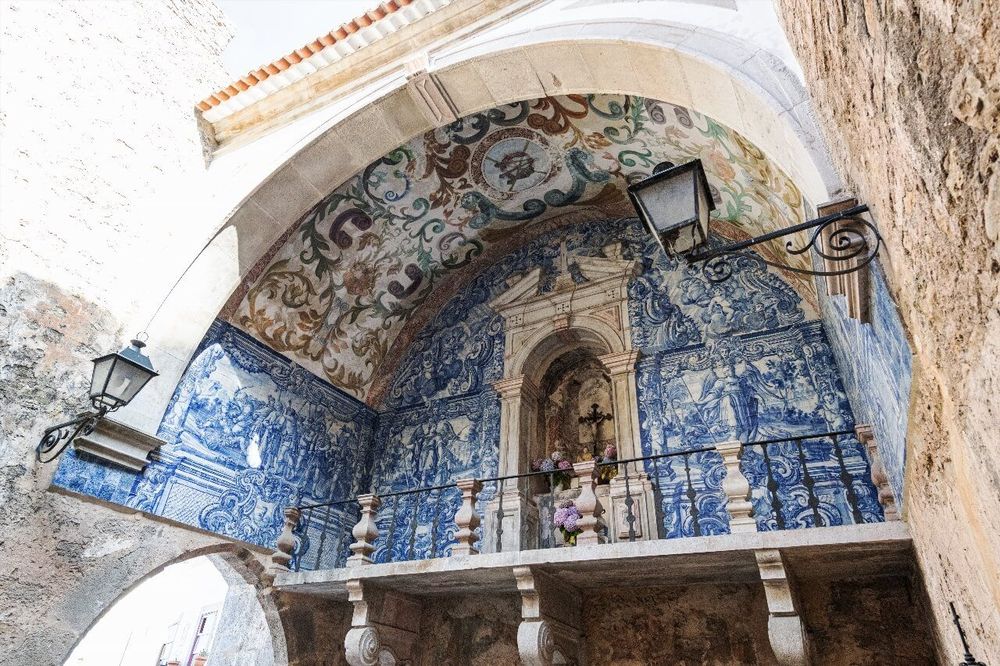
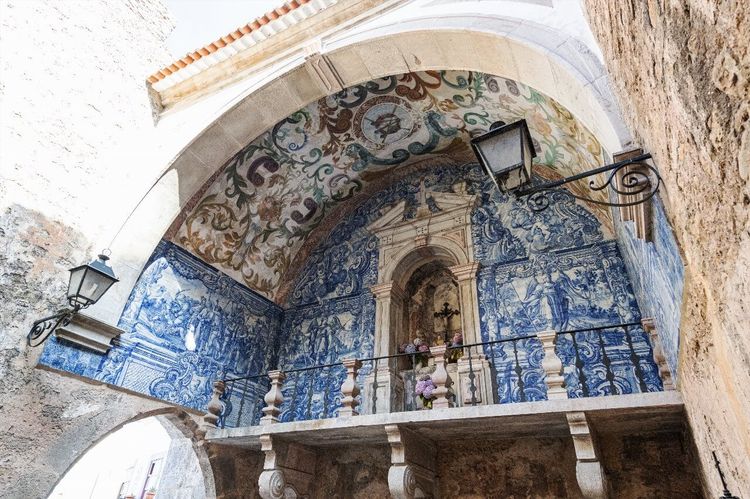
Access is via two main points. The Porta da Vila, to the south, is the main entrance to the village: its entrance corridor is entirely covered with 18th-century azulejos depicting scenes from the life of the Virgin, a surprise for hurried visitors who pass through without looking up. This is the recommended starting point for the rampart walk: you climb steep stairs, then the path immediately opens onto a 360-degree panorama. The other access is from the castle to the north.
The path is not uniform. Some sections are wide and equipped with basic guardrails, others narrow to less than a meter with a vertical drop on one side. No railings on most of the route: it's not recommended for young children without strict supervision, and for people prone to vertigo. Wear shoes with grip soles, some sections are slippery in wet weather. That said, adults in good physical shape will have no difficulty.
The most spectacular section runs along the west flank between the Santiago tower and the north tower. You overlook the inner gardens of houses, flower-filled terraces, cisterns and hidden courtyards that you never see from the street. On clear days, the Torres Vedras castle is visible on the horizon. In the late afternoon, the raking light transforms the patchwork of roofs into something almost unreal.
Allow 45 minutes to an hour for the complete circuit without rushing, plus photo stops. Access is free and open, without tickets or timetables. Crowds concentrate between 10 AM and noon; arriving at 9 AM or after 5 PM in summer radically changes the experience. If you want to explore Lisbon with the same depth as you walk the ramparts of Óbidos (Porta da Vila, 2510-001 Óbidos, rated 4.7/5 on Google for 4,485 reviews), the Ryo audio guide of Lisbon will guide you neighborhood by neighborhood through the capital.
Rua Direita and Praça de Santa Maria
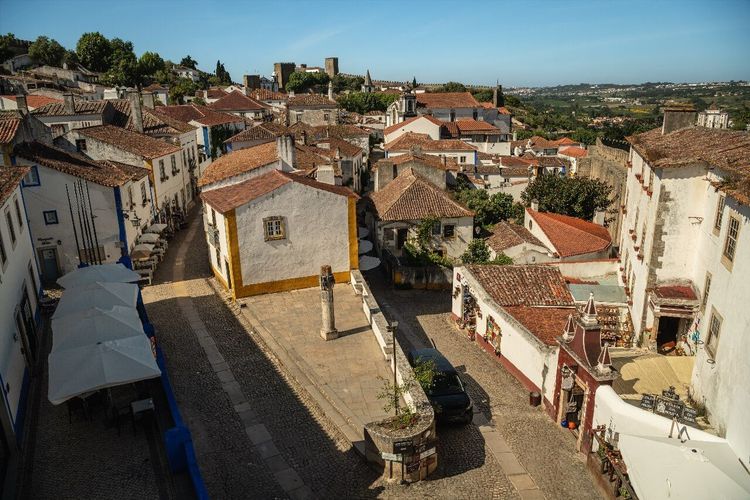
Óbidos is a village-street. The Rua Direita, the "straight street," generic name for main arteries in Portuguese medieval towns, runs north-south from the Porta da Vila to the castle approaches over some 400 meters. This is where the shops, cafés, ginjinha stalls and most visitors congregate. But Rua Direita is only the backbone.
What makes Óbidos interesting are the perpendicular alleys that branch out toward the ramparts or delve into the quiet neighborhoods where residents still live. Rua da Graça and Rua do Castelo hide the oldest houses, neighborhood chapels that nobody visits, little gardens overflowing with geraniums. The village has permanent residents, children coming out of school, elderly people on benches in the shade: you have to leave the main street to meet them.
The white facades are a legal obligation. Owners maintain lime-washed walls and frames painted blue or yellow, signs are subject to strict rules. This is what gives the ensemble this chromatic unity rare in the Iberian world.
Halfway down Rua Direita, Praça de Santa Maria (Praça de Santa Maria, 2510-001 Óbidos, rated 4.7/5 on Google for 2.1K reviews) opens the space: 17th-century baroque fountain, pelourinho (medieval pillory), and Santa Maria church facing the former town hall converted into a children's bookstore. This is the village's central square, the only space large enough to breathe. Take time to sit: the day trip crowds pass quickly, and the square regains its calm as soon as groups head back to the coaches.
Igreja de Santa Maria and Its Azulejos
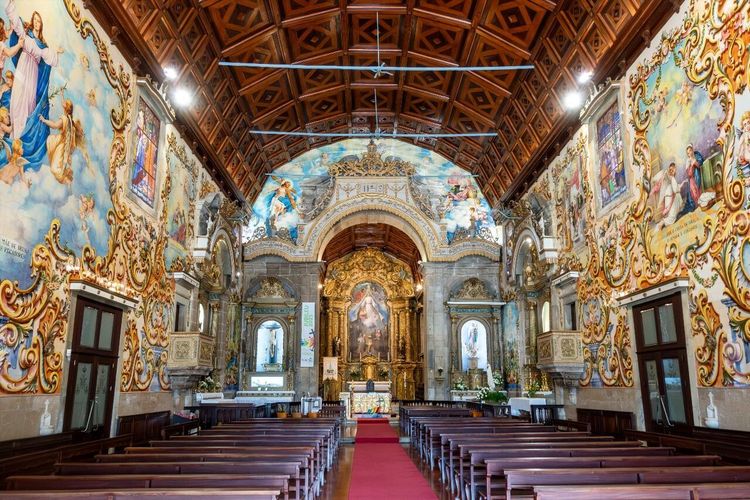
The Igreja de Santa Maria (Praça de Santa Maria, 2510-001 Óbidos, rated 4.5/5 on Google for 466 reviews) is the village's main church, built on the site of a mosque after the Reconquista. The interior is among the most beautiful in central Portugal, and one of the least visited at its true value: visitors enter, look up, and exit within three minutes. That's a shame.
The walls and floor are entirely covered with blue and white azulejos from the 17th century depicting biblical scenes and geometric motifs. The light filtering through the windows in the late afternoon makes the ensemble vibrate in a way difficult to reproduce in photos. Let your eyes adjust to the dimness before looking for details.
It was in this church that King Afonso V married his cousin Isabella in 1444: the groom was ten, the bride eight. The union was consummated later, but the ceremony was notable in royal chronicles. The main altarpiece is attributed to Josefa de Óbidos, a 17th-century painter born in the city, considered one of the first female artists to achieve international reputation in Europe. Her works are preserved at the Museu Nacional de Arte Antiga in Lisbon, but several remain in Óbidos' churches.
A few meters from Santa Maria, don't miss the small chapel of São Martinho, often closed but whose baroque facade makes a photo stop. Heading up to the castle, pass by the Ermida de São João Baptista, an exterior chapel covered with azulejos that looks like a postcard brought to life.
Ginjinha in Chocolate Cups: The Óbidos Ritual
Ginjinha, a liqueur of sour cherries (ginja) macerated in brandy with a little sugar, is Portugal's national drink. You can find it in bars in Lisbon, Coimbra, Alcobaça. But in Óbidos, the tradition comes with a detail that would almost alone justify the trip: ginjinha is drunk from a small dark chocolate cup, which you crunch after swallowing the liqueur.
The practice developed in the 1990s, initially by a local producer seeking to differentiate from the Lisbon market. The combination works chemically: the chocolate's bitterness balances the liqueur's sugar and the cherries' tart fruitiness. The cup costs between 1.50 and 2 euros, cherry included or not according to your preference.
Ask for "com ginja" to have the cherry at the bottom, "sem ginja" without. The best producers display their local brand on stalls: prefer them to resellers of major commercial brands. The most authentic shops are found toward the north of Rua Direita, away from the Porta da Vila flows.
Livraria de Santiago and the Vila Literária
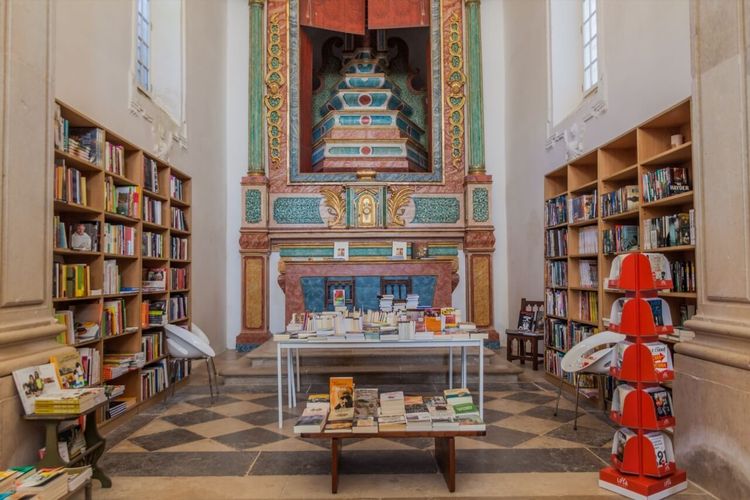
Since joining the UNESCO Creative Cities Network in 2015, Óbidos has deployed an original strategy to anchor literature in its geography: installing bookstores in rehabilitated heritage spaces, where architecture is part of the reading experience.
The most remarkable result is the Livraria de Santiago (Rua Direita, 2510-001 Óbidos, rated 4.6/5 on Google for 130 reviews), installed in the former Igreja de São Tiago, a 12th-century Romanesque church whose simple portal and side tower face Rua Direita. The interior has been arranged with care that borders on scenography: wooden shelving runs along the naves, ancient stained glass windows diffuse soft light over reading tables, the altar has been preserved and serves as backdrop to a space dedicated to Portuguese novelties. The vault height allows a double level of shelving connected by sliding ladders. A coffee counter has been integrated into the side nave: yes, you can order a coffee and sit down to browse in a medieval church.
The collection is mainly in Portuguese, with a good English section and some titles in Spanish. The French selection is thin but not absent, look for the "world literature" corner. The booksellers speak English and are generally well informed about contemporary Portuguese production.
Other thematic bookstores are scattered throughout the village following the same philosophy. A children's bookstore occupies the former town hall on Praça de Santa Maria. A comic book space has settled in a yellow-shuttered house on Rua Direita. A travel bookstore is housed in a former mill near the ramparts.
Óbidos organizes every year in October the FOLIO, an international literary festival that occupies the entire village for ten days. Authors from several dozen countries, debates in castle courtyards, readings in the alleys at dusk. The theme for the 2026 edition was not yet announced at the time of writing this guide; check the Óbidos municipal website (cm-obidos.pt) for the detailed program from June 2026. The programming mixes big names in world literature and contemporary Portuguese authors, with particular attention to literatures in Portuguese (African, Brazilian, Cape Verdean lusophony). It's one of the most vibrant literary festivals in the Iberian Peninsula for its size.
Óbidos Castle and the Pousada
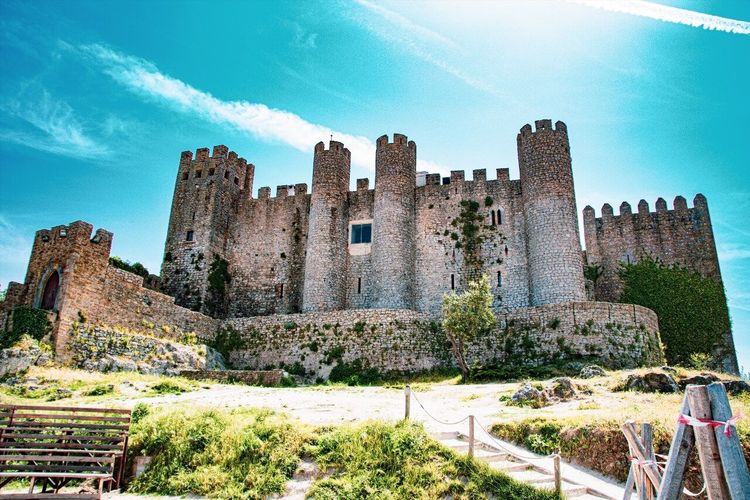
The Castelo de Óbidos crowns the village's highest point. Built on Moorish foundations after the 1148 reconquest, remodeled in the 13th and 14th centuries under orders from the queens who administered the city, its square towers and keep form a compact ensemble that distinguishes itself from great plain castles by its total integration into the urban fabric: the village ramparts are the direct extension of the castle walls.
Since 1950, the castle houses the Pousada de Óbidos, one of the best-known historic hotels in Portugal's Pousadas network. You don't need to sleep there to appreciate the architecture. The entrance courtyard, towers accessible from the rampart walk, and plunging views over the village from the north terrace are open to all visitors. Entry to the courtyard is free all year round.
The keep, accessible by a narrow spiral staircase, offers the village's highest viewpoint. On clear days, the view extends to the lagoon and Atlantic to the west, and to the Ribatejo hills to the east. The interior walls preserve traces of medieval frescoes partially restored in the 1990s. The courtyard houses an aromatic plant garden maintained by the pousada: rosemary, lavender, thyme, whose scents mingle with sea air on west wind days.
If you visit Óbidos at the end of the day, it's from the castle towers that the sunset is most striking. The raking light transforms the orange tile roofs into a mosaic that seems to vibrate for a few minutes before going out. The day tourists have already left: you'll have the twilight to yourself.
Óbidos Festivals: Medieval, Chocolate, FOLIO, Christmas
What distinguishes Óbidos from other European medieval cities is that the village is not a museum frozen in its stones. For a town of fewer than 3,000 inhabitants within the walls, the events program is unmatched in Portugal. Four events deserve advance planning if you organize your visit around them.
The Medieval Festival
The Mercado Medieval de Óbidos is Portugal's largest medieval reenactment event. It usually takes place in July for two weeks and transforms the entire intra-muros village into a Middle Ages setting. Period-costumed merchants in the alleys, equestrian jousts in arenas installed outside the walls, banquets in the castle courtyard, artisans reconstructing medieval crafts like forging, pottery or tanning.
The quality of reconstruction is serious: organizers work with specialized historical associations, costumes are documented, entertainment supervised. The atmosphere remains festive and family-friendly, without falling into fairground attraction. Village entry is paid during the festival (between 8 and 15 euros depending on days and time slots), which somewhat regulates tourist pressure. For equestrian jousts, seats are limited and tickets sell in advance via the festival website. During the week, the village is less crowded than on weekends and the atmosphere more relaxed.
The International Chocolate Festival
The Festival Internacional de Chocolate takes place in March-April, over two weeks. It's Portugal's most attended chocolate festival. Portuguese and European chocolatiers present sculptural chocolate installations, sometimes two meters or more, tasting workshops, sculpture competitions and manufacturing demonstrations. The alleys are lined with stands, the smell of hot chocolate infiltrates everywhere. The angle is more serious than it appears: the best exhibitions belong to food art rather than amusement park.
This festival provides a good low-season window for visiting Óbidos: March-April temperatures are ideal (15-20°C), queues non-existent except at tasting stands, and the village regains its colors after winter. Artisanal chocolate lovers will appreciate the bean to bar demonstrations offered by some invited chocolatiers.
FOLIO and the Christmas Market
The literary festival FOLIO in October was described in the previous section. In parallel, Óbidos also hosts an outdoor Opera Festival in July-August, more intimate but refined in its programming: lyrical performances in the castle courtyard or against the ramparts, where the natural acoustics of the walls create unexpected listening conditions. Tickets sell out quickly; check programming from January.
Finally, the Óbidos Christmas Market runs from late November to early January and is considered one of the country's most beautiful. The alleys and central square are illuminated, local shops sell artisanal products, ceramics, wines from the Óbidos DOC and obviously ginjinha in heated winter version. This is a period when the village is less crowded than in summer, hotels display their best rates, and the atmosphere is particularly sweet. Óbidos under garlands and in the light Atlantic winter cold is a different village from July's.
The Óbidos Aqueduct
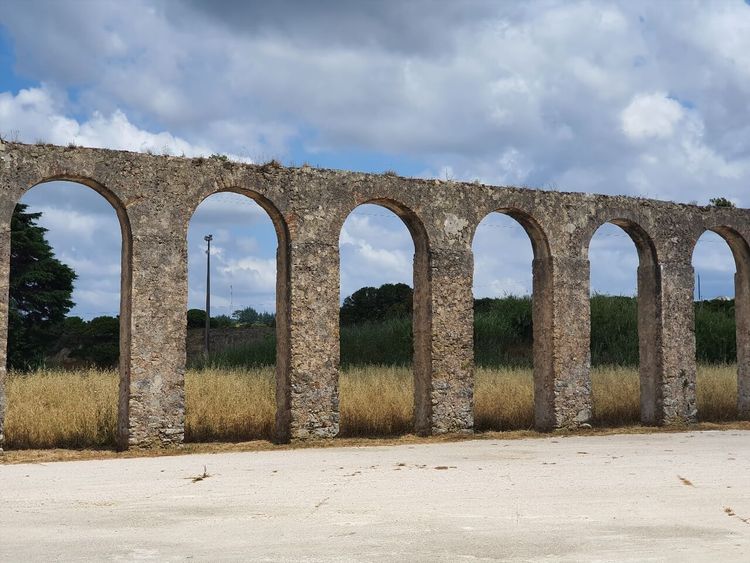
Few visitors mention the Óbidos aqueduct (Rua do Aqueduto, 2510-001 Óbidos, rated 4.5/5 on Google for 627 reviews), and that's unfortunate. Built in the 16th century under King João III's reign to supply the village with drinking water from the Usseira springs, it runs for 3 kilometers and enters the village via its northeast flank. The granite arches, some reaching six meters high, run along the national road at the village entrance and are clearly visible from the main parking.
Unlike the Segovia aqueduct or great Roman constructions, Óbidos' is sober, almost discreet. But it functioned for more than four centuries, until the installation of the modern municipal network. From the path along its arches, you better understand the medieval village's hydraulic organization. The walk along the arches takes about twenty minutes and provides a good alternative during the hot midday hours, when the intra-muros alleys are most crowded.
The Óbidos Lagoon and Costa de Prata Beaches
If you think visiting Óbidos is limited to its ramparts, the surrounding territory will surprise you. The Lagoa de Óbidos (Foz do Arelho, 2510-051 Caldas da Rainha, rated 4.6/5 on Google for 3.3K reviews) is Portugal's largest natural lagoon: 7 kilometers long, separated from the Atlantic by a dune cordon that the sea always ends up breaching during winter storms. It's 12 kilometers west of the village, fifteen minutes by car.
The lagoon waters are calm, shallow, and warm quickly in summer: 22 to 24°C in July-August. It's ideal for family swimming, especially for children. On the ocean-side beaches, waves are stronger and surfers take their places from dawn. Foz do Arelho, the village by the lagoon, offers several renowned seafood restaurants. The caldeirada de peixe, Portuguese fish stew, is significantly better here than in Óbidos intra-muros, and prices are more reasonable.
If you combine Óbidos and the lagoon in one day, the ideal scheme is simple: village in the morning (9 AM-1 PM), lagoon in the afternoon, dinner in Foz do Arelho at sunset. By car, the loop doesn't exceed 35 kilometers. Without a car, transport to the lagoon is limited: inquire about local bus schedules or consider a taxi from Óbidos.
The region around the lagoon is covered by the Óbidos DOC, recognized appellation for its reds based on Touriga Nacional and white Arinto. Several quintas open their cellars for visits, especially in autumn during harvest. Quinta do Sanguinhal offers commented tastings with food-wine pairings for about twenty euros per person. If you have an extra day, combining cellar in the morning, lagoon in the afternoon and seafood dinner constitutes a program hard to surpass in this part of the country.
Excursions from Óbidos: Peniche, Berlengas and Caldas da Rainha
Óbidos is well positioned to explore three complementary destinations, all within a 30-kilometer radius.
Peniche, 20 kilometers northwest, is a fishing town built on a promontory almost surrounded by water. Its Forte de Peniche (Avenida do Mar, 2520-208 Peniche, rated 4.4/5 on Google for 5,183 reviews), a 16th-century fortress, served as a political prison under Salazar and now houses the Museu de Peniche, dedicated to the history of resistance to the regime. Isolation cells are accessible, testimonies from political prisoners integrated into the tour. It's a visit that changes register compared to Óbidos' medieval settings, but illuminates another layer of Portuguese history.
Peniche is also the embarkation point for the Berlengas Islands, granite archipelago 12 kilometers offshore, nature reserve with a 17th-century fortress and turquoise waters classified for diving. Boats depart from Peniche June to September, 35-minute crossing, about 20 euros round trip. On site, a marked trail circles the main island in an hour and a half. The Furado Grande marine cave can be visited by boat from the main beach: turquoise water, granite ceiling, deafening silence. Boat reservations are essential in July-August, places are limited to a few hundred per day.
Caldas da Rainha, 30 kilometers south of Óbidos, is a spa town founded in the 15th century by Queen Leonor who discovered hot springs while returning from a trip. Its Mercado da Fruta, covered market with 19th-century metal structures, is one of the region's most beautiful. Local ceramics are renowned for their ribald forms, a regional tradition dating back to the 18th century and potter Rafael Bordalo Pinheiro. The city is also the gateway to the Fátima sanctuary, 50 kilometers east.
If you explore Portugal more broadly, the audio-guided tours available on our Ryo app cover the country's major stages: from Porto in the north to the Algarve in the south, passing through Coimbra and its university bookstores that resonate with Óbidos' literary spirit.
Where to Eat in Óbidos
Dining in Óbidos suffers from the classic syndrome of major tourist sites: concentration on Rua Direita, menus more expensive than in neighboring cities, variable quality. With a few landmarks, you can eat very well.
The Restaurant Alcaide is the most regularly recommended address in the intra-muros village. Serious regional cuisine, menus around 22 to 28 euros, terrace on the ramparts. Reservation essential in high season.
For a more affordable meal, tascas (simple bistros) in side streets offer petiscos, the Portuguese equivalent of tapas, for 8 to 12 euros. Tascas without terraces on the main street are generally more honest in their quality-price ratio.
A Ilustre Casa de Ramiro (Rua Porta do Vale, 2510-001 Óbidos, rated 4.6/5 on Google for 1,165 reviews), slightly off-center outside the walls, offers grilled regional meat in a rehabilitated barn setting. Less touristy, more local on the plate.
For quick lunch, several bakery-pastry shops on Rua Direita serve decent pastéis de nata and presunto (Portuguese cured ham) sandwiches. But if you have a vehicle, the best decision is to go lunch in Foz do Arelho by the lagoon: significantly better seafood, more reasonable prices, water view as bonus. It's fifteen minutes by car.
Where to Stay in Óbidos
Staying in Óbidos intra-muros is an experience in itself. Converted character houses as guesthouses allow you to be in the village after day groups leave, when alleys regain their medieval silence.
The Pousada de Óbidos (Paço Real, 2510-999 Óbidos, rated 4.6/5 on Google for 1,193 reviews) installed in the castle is the historic reference accommodation. Rooms in towers and former lodgings, breakfast served with village views. Rates oscillate between 180 and 350 euros per night depending on season.
For an intermediate budget, casas de hóspedes (guesthouses) on Rua Direita and adjacent alleys offer rooms between 80 and 150 euros in high season, often with breakfast included. Booking several weeks in advance is necessary in July-August and during festivals.
If you visit as a day trip from Lisbon, on-site accommodation is not essential: the complete visit takes half a day to a full day. But travelers who stay overnight all agree on one point: Óbidos after 7 PM, when buses have left, is a different village. Alleys regain their village sounds, cats come out of hiding, local restaurants turn on their lights.
How to Get to Óbidos from Lisbon and Practical Information
Access from Lisbon
By car: the A8 (Silver Coast highway) connects Lisbon to Óbidos in 1 hour to 1h15 depending on traffic. Óbidos exit, then five minutes on national road. Paid parking is available outside the walls. The parking east of Porta da Vila is the largest and best signposted (2 to 3 euros/hour in high season). No cars enter the intra-muros village.
By public transport: direct buses depart from Lisboa Campo Grande bus station several times daily. Duration 1h30 to 2h depending on stops, ticket around 8 to 10 euros one way. Rede Expressos company and regional Rodoviária do Oeste buses serve Óbidos from Lisbon and Caldas da Rainha. There's no direct train: the railway line passes through Caldas da Rainha (then 20-minute bus). If you combine with other stages, car remains the most flexible means.
When to Come
Off season (October to April): the village is yours or almost. Temperatures are mild (12 to 18°C), autumn and winter light is spectacular on the ramparts. Some shops close in January-February. The Chocolate Festival in March-April is a good animated low-season window.
High season (June to September): heat is strong (30 to 35°C in July-August), alleys saturate at midday. Arriving at 9 AM or after 5 PM radically changes the experience. The medieval festival in July requires anticipating accommodation several months in advance.
Budget and Accessibility
Ginjinha: 1.50 to 2 euros. Simple lunch: 12 to 18 euros. Parking: 5 to 8 euros per day. A complete day in Óbidos costs between 30 and 60 euros per person excluding accommodation and medieval festival (which charges daily entry).
The ramparts are not accessible to people with reduced mobility: access stairs are steep and without amenities. The intra-muros village is paved with round cobblestones difficult for wheelchairs. Praça de Santa Maria and lower Rua Direita remain relatively accessible.
FAQ
How Long Does It Take to Visit Óbidos?
A half day is enough for a quick tour: ramparts, Rua Direita, Santa Maria church, ginjinha. Allow a full day for a thorough visit including the castle, Livraria de Santiago, peripheral neighborhoods and a meal on site. If you combine with the lagoon and Peniche, plan two days with an overnight stay. The village is entirely walkable, with no transport needed once inside the walls.
Is Óbidos Suitable for Children?
Yes, with some caveats. The village is small and walkable, suitable for children old enough to walk without a stroller: the round cobblestones and steep rampart stairs make strollers difficult to maneuver. The ramparts themselves are not recommended for toddlers without very strict supervision, as many sections lack railings. The medieval festival in July and the chocolate festival in March-April are particularly enjoyed by families. The lagoon twelve kilometers away, with its calm and shallow waters, offers an unexpected seaside break ### Is Entry to Óbidos Paid?
Access to the intra-muros village is free all year round. The ramparts are also freely accessible from Porta da Vila, without tickets or official opening hours. The main churches (Santa Maria, São Tiago-bookstore) are free to enter, some ask for a voluntary contribution. Only the Medieval Festival in July charges a daily entrance fee to access the village (between 8 and 15 euros depending on days).
Can You Visit Óbidos from Lisbon on a Day Trip?
Yes, this is the most common setup. By car, allow 1h to 1h15 from Lisbon via the A8. By bus from Campo Grande station, 1h30 to 2h depending on stops. You'll have plenty of time to do the ramparts, village and a meal before returning in the late afternoon. If you want to prepare your stay in Lisbon before heading to Óbidos, the Ryo audio guide tour of Lisbon covers the capital's historic districts with complete autonomy.
What Is the Best Time for the Óbidos Medieval Festival?
The festival is held in July, usually over two weeks. Weekends are the most lively for jousts and outdoor shows, but also the most crowded with visitors. During the week, the atmosphere is more relaxed and access to entertainment less saturated. Book accommodation in Óbidos or within a 20-kilometer radius from March for July dates. The annual program is published on the official festival website a few months before the event.
Is There a Beach Near Óbidos?
Yes, several. The Lagoa de Óbidos 12 kilometers away offers calm and shallow waters, ideal for family swimming. The Praia de Foz do Arelho on the lagoon or Atlantic side is the closest beach, 15 minutes by car. The beaches of Peniche and the Costa de Prata are accessible in 20 to 30 minutes. In total, more than twenty Silver Coast beaches are within a 30-kilometer radius of Óbidos.
Is Óbidos Really Worth the Detour?
Yes, but provided you manage the crowd factor. In the middle of the day in July-August, Rua Direita can resemble a saturated tourist attraction. Arrive early (before 9:30 AM) or in the late afternoon, stay in the evening if you can, and exit the main flows toward the side streets. The village then reveals a historical density and intact atmosphere that are rare in Europe at this level of preservation: few medieval cities in Portugal, and Óbidos is the purest example, maintain such a coherent urban fabric. For most travelers who make Lisbon their starting point, it's the most profitable half-day excursion within a 100-kilometer radius.
Conclusion
Óbidos is one of those rare places where historical density has not been diluted by modernization. The ramparts to walk on foot, the church with blue and white azulejos, the bookstore in the medieval nave, the ginjinha in the chocolate cup: each experience is concrete, physical, memorable. Visiting Óbidos, Portugal, is to offer yourself one of the country's most remarkable stages. To prepare your trip from Lisbon and organize your stages with the Ryo audio guide of Lisbon, you'll have the capital in hand before taking the road north to Óbidos' white ramparts.