© Shutterstock
 Votre guide Ryo
Madrid's Must-See Monuments: Complete 2026 Guide
Madrid's monuments stand out differently from those of Rome or Paris: no skyline dominated by a single building, no Haussmannian perspective drawn with a ruler. Here, a twenty-two-century Egyptian temple stands alongside a Baroque royal palace, and a former post office mistaken for a cathedral closes the perspective of a boulevard that housed Europe's first skyscraper in 1929. To miss nothing of this heritage density, the Ryo audio-guided tour of Madrid connects the Royal Palace to La Latina in 2.5 hours with 23 audio commentaries available offline.
This guide lists Madrid's monuments that truly deserve your time: a royal palace that surpasses Versailles in number of rooms, a royal square built on the site of a former poultry market, a park listed as UNESCO World Heritage since 2021, and a cloistered monastery open to the public that preserves Rubens and Bruegels in almost surreal silence. Eleven centuries of history, several neighborhoods to cross, and as many stories to decipher behind each facade.
The Royal Palace
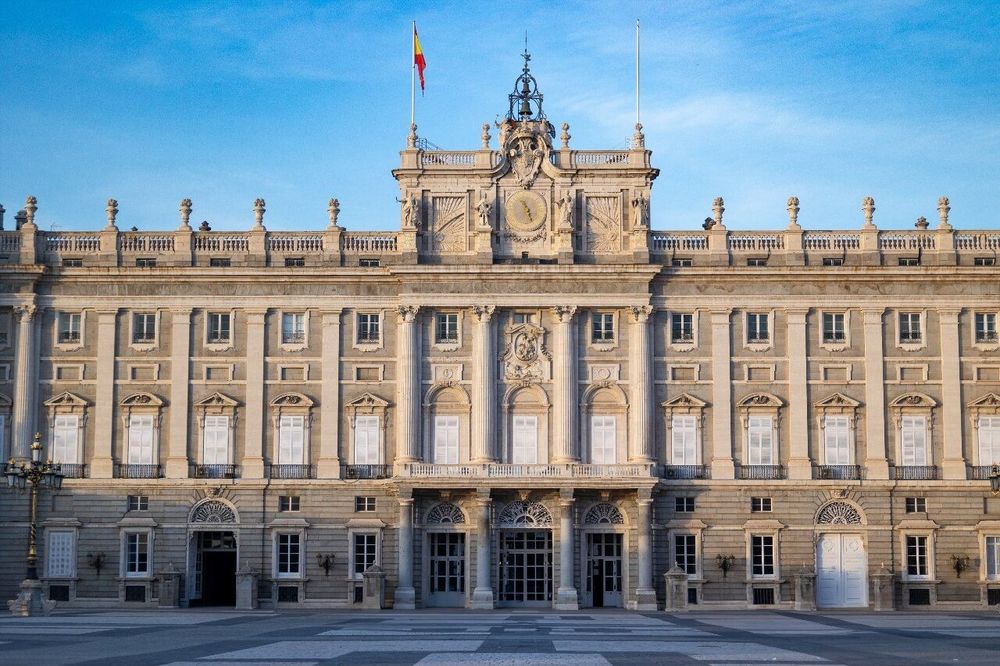
We tend to underestimate the Palacio Real before taking the complete tour. Its gray granite facade, sober and austere on the Plaza de la Armería side, doesn't prepare you for what awaits inside. Only when entering the state apartments does the scale of the place become tangible.
The numbers are already telling: over 3,400 rooms spread across 135,000 m², facades of 130 meters per side, 870 windows, 240 balconies. Versailles, for comparison, has only 700 rooms. The current palace replaces the medieval Alcázar that burned in 1734, and Charles III moved in during 1764 after ten years of work. This enlightened king, who had previously modernized Naples, transformed Madrid into a capital worthy of the name, laying out new boulevards and commissioning the best European artists for the interior decorations.
The Throne Room, intact since 1764, is the highlight of the visit: ceilings painted by Giambattista Tiepolo representing the apotheosis of the Spanish monarchy, Venetian crystal chandeliers, crimson velvet hangings. The Gala Hall follows, with its paintings by Mengs and its tableware from the Real Fábrica de la China. The armor collection in the ground floor rooms is one of Europe's most complete, with several parade armors belonging to Charles V, custom-made for the man who ruled the first empire on which the sun never set.
Two often neglected complements deserve your attention. The Farmacia Real, on the ground floor, preserves its 18th-century earthenware containers with their original handwritten labels, some preparations based on ingredients that would horrify a contemporary doctor. And the Real Armería houses, among others, Philip II's ceremonial sword, cast in gold and silver. Allow between an hour and a half and two hours for a complete visit of the apartments.
Practical note: the entrance ticket costs €12. European Union citizens benefit from free admission during the last two hours of opening on Mondays and Wednesdays, an interesting saving, but the rooms are busier late in the day. Arriving before 9:30am in the morning remains the best compromise between low crowds and light in the eastern apartments. The Sabatini Gardens to the north and Campo del Moro to the west are free and offer two very different perspectives on the palace: the first formal and geometric, the second wild, planted with peacocks, with the palace silhouette in the background.
Exceptional closures for official acts are frequent in May and October. Check the calendar on the official website before planning your visit.
The Prado Museum
No museum in Southern Europe concentrates such a density of masterpieces on a comparable surface. The Museo Nacional del Prado (Paseo del Prado s/n, 28014 Madrid, rated 4.7/5 on Google for 152,621 reviews) preserves over 20,000 works in its reserves, of which approximately 1,700 are permanently exhibited. Velázquez, Goya, Rubens, Titian, El Greco, Ribera, Murillo: the list of represented masters exceeds that of any competitor.
Velázquez's Las Meninas (1656) deserves a long stop. The 3.18 × 2.76 meter canvas depicts Infanta Margarita surrounded by her maids of honor, a dog lying in the foreground, two dwarfs on the right. In the background, a mirror reflects the faces of King Philip IV and Queen Mariana, the characters the painter is supposed to be portraying, off-frame. Velázquez portrayed himself on the left, brush in hand. This play of gazes, reflections, implicit presences has generated three and a half centuries of philosophical commentary on the nature of pictorial representation. The room housing the painting is often crowded, but benches allow you to sit and observe over time.
Goya occupies an entire wing. His portraits of the royal family, with a frankness bordering on cruelty, stand alongside the war scenes of the Disasters. But the most intense experience remains the Black Paintings: these fourteen paintings painted directly on the walls of his country house between 1819 and 1823, transferred to canvas in the 19th century, form a corpus of absolute darkness. Saturn Devouring His Son is the best-known image, but the Half-Submerged Dog, a dog's head emerging from an ochre background, gaze raised toward something invisible, achieves disconcerting modernity for a work from 1820.
Practical advice: the standard ticket costs €15. The last two hours of opening (6-8pm on weekdays, 5-7pm on Sundays) are free and the rooms empty significantly. The entrance through the Goya Gate (Calle Felipe IV side) is less crowded than the main entrance at Velázquez Gate. For a first visit, focus on the first floor, Velázquez, Goya, Flemish painting, rather than wanting to cover everything in one day. The Prado deserves two visits, not one.
Retiro Park and the Palacio de Cristal
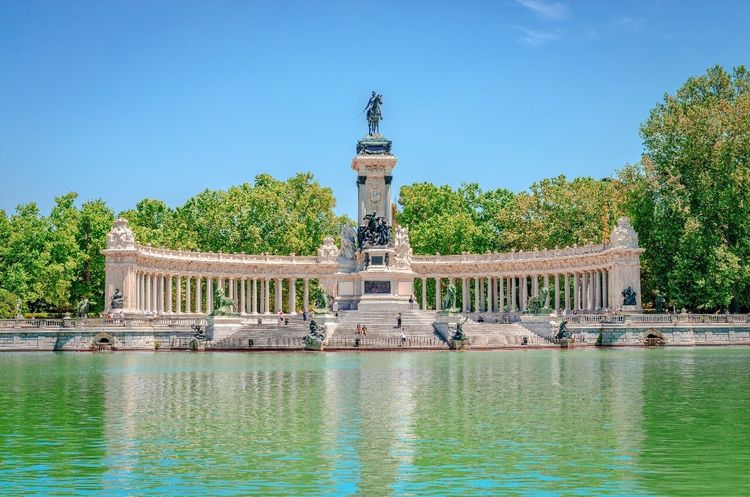
The Parque del Buen Retiro (Plaza de la Independencia, 28001 Madrid, rated 4.8/5 on Google for 211,493 reviews) is one of Europe's great urban parks, and probably the best integrated into a capital's daily fabric. Its 118 hectares welcome both the morning jogger and the retiree playing cards, the Sunday afternoon salsa dance group and the child with plastic ducks by the pond.
Former royal property reserved for court entertainment until the 18th century, the park was gradually opened to the public throughout the 19th century, definitively after the revolution of 1868 which overthrew Isabella II. Since 2021, it's part of the UNESCO site "Landscape of Light," listed with Paseo del Prado for their exceptional heritage value. This classified perimeter, which extends from the Prado Museum to Retiro, is precisely what the Ryo audio guide The Landscape of Light covers: 19 audio commentaries, 3 hours of route, 7.3 km through the city's most recognized architectural and landscape ensemble.
The Palacio de Cristal remains the park's most remarkable building. Built in 1887 for an exhibition on the Philippine Islands, this iron and glass structure of nearly 3,000 m² resembles a giant Victorian greenhouse. Now an annex of the Reina Sofia Museum, it hosts contemporary art installations in a space where light changes every hour according to the sun's position. Entry is permanently free.
Other notable points: the Monument to Alfonso XII and its pond (boats for rent at €7 for 45 minutes), the Rosaleda with its 4,000 rose bushes (splendid in May), the Palacio de Velázquez, another 19th-century metal structure, also used by the Reina Sofia for temporary exhibitions. The park is open daily from 6am to midnight in summer, free entry. A Sunday morning in April or May, the Rosaleda in bloom and the pond in the morning light are among the most beautiful free hours Madrid can offer — and our Landscape of Light audio-guided tour takes in this very corner of the park, between the Prado and the great pond.
Plaza Mayor
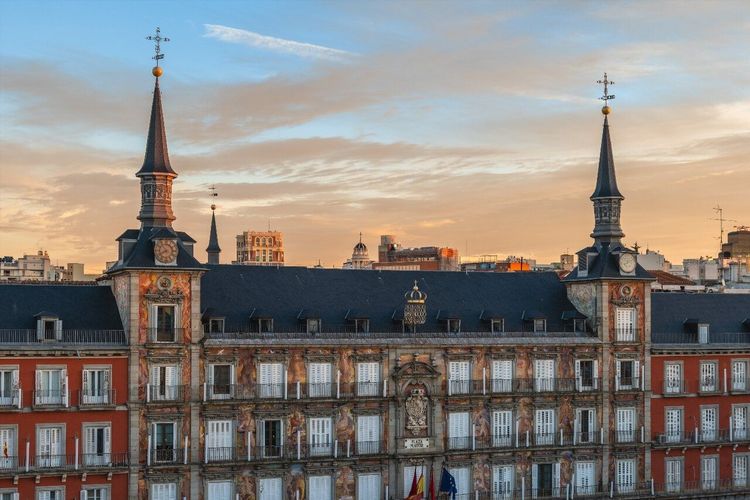
The Plaza Mayor is one of Europe's great enclosed squares, and its architectural coherence is remarkable for a construction spread over several decades. Initially designed by Juan de Herrera under Philip II, realized by Juan Gómez de Mora, completed in 1619 under Philip III, it testifies to a clear political will: to provide the imperial capital with a space worthy of Europe's great sovereign squares.
Its dimensions, 129 × 94 meters, are emphasized by uniform facades with nine floors topped by slate spires, severe Herrerian style, very different from the flamboyant baroque found in Salamanca or Valladolid in the same period. 237 balconies overlook the square; each tells a story of aristocratic or merchant tenants who paid fortunes to attend the spectacles organized below. For Plaza Mayor wasn't just a space for royal representation: Inquisition auto-da-fé, bullfights, canonization ceremonies, theater plays, seasonal markets succeeded each other on these stones to the rhythm of centuries.
At the center stands the equestrian statue of Philip III (1616), cast in Florence by Giovanni da Bologna and Pietro Tacca. Few visitors know it wasn't there when the square was inaugurated: moved several times, it only occupied its current position in the 19th century. The frescoes painted in 1992 under the arcades, the corporations of cobblers, hatters, grocers, are the work of Carlos Franco and one of the rare examples of contemporary mural painting in Madrid's historic center.
A visit tip: enter through the Arco de Cuchilleros on the southwest side rather than through the main arches. This covered passage opens onto a steep staircase that projects you directly onto the square from below, a much more theatrical arrival than through the usual entrances. The cafés under the arcades charge €4-5 for coffee, exactly the same quality can be found two streets away for half the price. However, the Christmas market (late November to early January) is worth the detour despite the crowds.
Puerta del Sol and the Real Casa de Correos
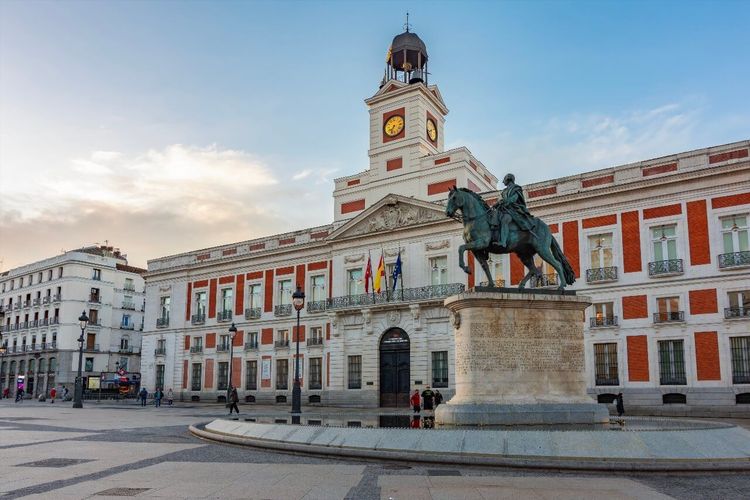
The Puerta del Sol is, literally, kilometer zero of Spain. A round plaque embedded in the ground, on the square's south side, marks the starting point of the national road network: all distances in the country are measured from here.
The current square dates from the mid-19th century, but the location corresponds to one of Madrid's medieval gates, facing east, hence its name. The building dominating the south facade, the Real Casa de Correos, was built between 1761 and 1768 by French architect Jaime Marquet, one of Madrid's first neoclassical buildings, commissioned by Charles III as part of his capital's modernization. Its campanile is recognizable by the clock whose twelve chimes at midnight on December 31st rhythm the twelve grapes tradition: thousands of Madrileños and tourists gathered on the square swallow one grape per bell chime to ensure good luck in the coming year.
At the square's east corner, the statue of the Oso y el Madroño (Bear and Strawberry Tree) has been Madrid's heraldic symbol since the Middle Ages, now invariably surrounded by tourists waiting for their photo. Puerta del Sol remains above all a transit hub, convergence of three metro lines and starting point for numerous routes, more than a destination in itself.
Almudena Cathedral
You need to know what you're looking at to fully appreciate Catedral de la Almudena (Calle de Bailén 10, 28013 Madrid, rated 4.6/5 on Google for 31,766 reviews). Its neoclassical facade, sober and somewhat cold, on the Calle de Bailén side, doesn't prepare you for the interior surprise.
This cathedral's history is that of a hundred and fourteen-year construction site. The first works began in 1879 under Francisco de Cubas's direction, who designed a neo-Gothic cathedral. In 1944, Fernando Chueca Goitia took over the project and decided to transform the main nave into neoclassical style to harmonize with the neighboring Royal Palace facade. The result is a building with three superimposed stylistic registers: neo-Romanesque for the crypt, neo-Gothic for the side chapels, neoclassical for the central nave. Consecration only occurred in 1993, under John Paul II, 114 years after construction began, a record in modern European cathedral history.
The interior surprises with its colors. The contemporary stained glass windows, installed in the 1990s, flood the nave with bright blues, greens and yellows that contrast with the walls' cold stone. The crypt deserves a separate visit: it preserves the image of the Virgin of Almudena, Madrid's patron saint, who according to legend was walled up in the rampart during the Muslim invasion in the 8th century and rediscovered during the Christian Reconquest, in 1083, by Alfonso VI himself.
Cathedral access is free. The ascent to the cathedral museum (€5) includes access to the dome, with a panoramic view over the Royal Palace and Manzanares valley that few guides mention. Prefer morning, before 11am, for the light.
Gran Vía
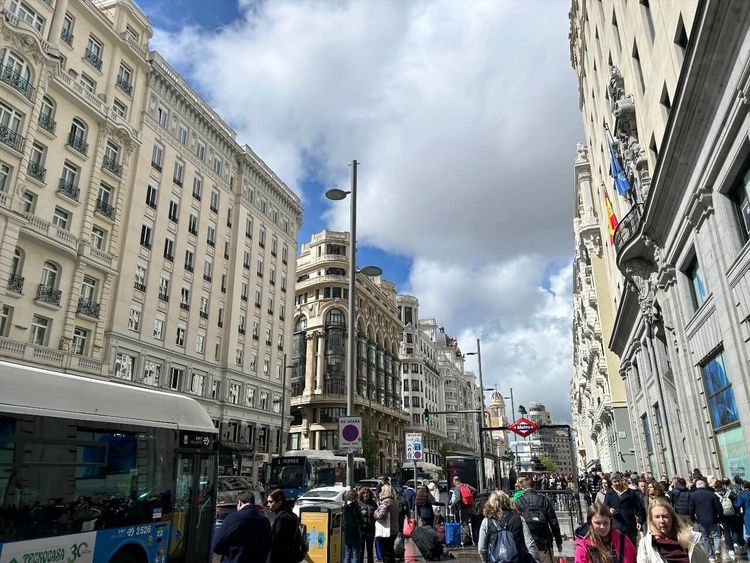
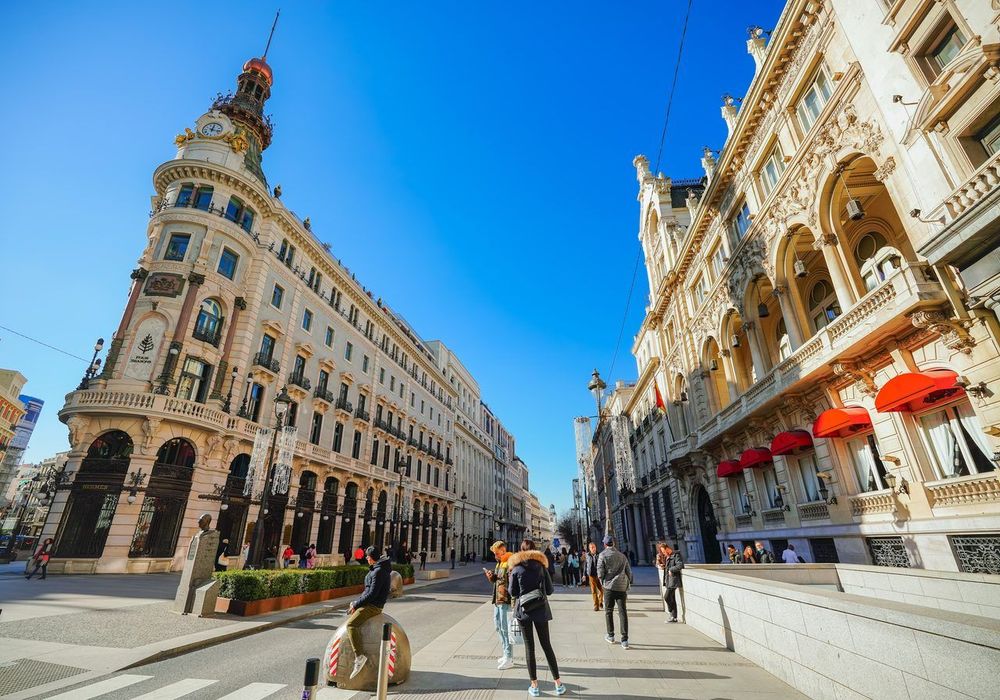
Inaugurated in several phases between 1910 and 1929, the Gran Vía (Gran Vía, 28013 Madrid, rated 4.8/5 on Google for 10,315 reviews) is one of Madrid's most vibrant monuments, the capital's Haussmannian artery in a more flamboyant and denser style. To trace these 1,316 meters in a single line from Calle de Alcalá to Plaza de España, the city demolished 311 buildings and relocated 2,600 families, a massive urban renewal operation, controversial at the time, which transformed the city center into an early 20th-century architectural showcase.
Three buildings deserve particular attention. The Edificio Metrópolis, at the corner of Calle de Alcalá, topped with a slate dome and a golden winged Victory, is the most photographed image of Gran Vía. The Edificio Telefónica (No. 28), built in 1929, was Europe's first skyscraper with its 89 meters height. During the siege of Madrid (1936-1939), it served as an observation post for nationalist forces, making it the priority target for republican shells fired from Casa de Campo. The Edificio España, at the other end by Plaza de España, is a post-Franco tower from the 1950s that was recently converted into a luxury hotel.
To see the facades without the ground-floor commercial saturation, walk up Gran Vía on Sunday mornings, when shops are closed and traffic reduced. It's also an opportunity to look up at the third and fourth floors, where carved ornaments, bow-windows and slate penthouses reveal all their care. At night, illuminated facades and open theaters transform Gran Vía into Madrid's Broadway, a very different atmosphere. To understand the history of each building you cross, the Ryo audio-guided tour of Madrid covers this sector in its route between the Royal Palace and La Latina.
Temple of Debod
Seeing an authentic Egyptian temple of 2,200 years in the middle of Madrid is a geopolitical marvel. The Templo de Debod (Calle de Ferraz 1, 28008 Madrid, rated 4.4/5 on Google for 67,641 reviews) is a gift from the Egyptian government to Spain, in thanks for technical and financial aid provided during the rescue of Nubian temples threatened by rising waters from the Aswan Dam in the 1960s. Dismantled stone by stone at Debod, transported by ship from Alexandria, reassembled in Madrid between 1970 and 1972, it's now surrounded by water basins that reflect its silhouette.
The temple, dedicated to Amon and Isis, dates from the 2nd century BC and was enlarged in Roman times by emperors Augustus and Tiberius. Inside, carved reliefs are still legible; access is free Tuesday to Friday and weekends. But the main attraction isn't the interior: it's the terrace overlooking Casa de Campo, with the Royal Palace silhouette in the background. At sunset, around 8-9pm in summer, 5:30-6:30pm in winter, the temple stands out against an orange sky in an almost too perfect composition to be real. It's one of Madrid's most photographed views, and for once, reality lives up to reputation.
Plan to arrive 40 minutes before sunset: the terrace fills up quickly and the best positions go fast. Outside this slot, the temple in the morning or early afternoon remains pleasant and significantly less crowded.
Puerta de Alcalá
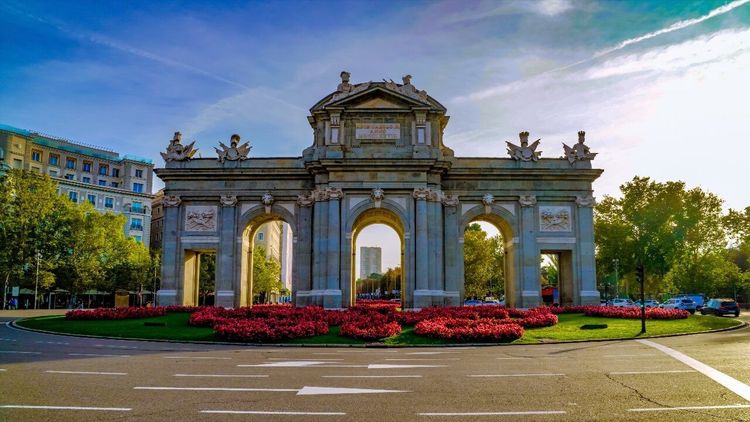
Among Madrid's monuments that are appreciated differently according to the hour, the Puerta de Alcalá is probably the one whose night lighting most radically transforms the experience. During the day, perched at the center of a roundabout, it's viewed from afar. At night, illuminated, surrounded by traffic, it takes on an impressive presence.
Built by Francesco Sabatini between 1769 and 1778, this triumphal gate in Guadarrama granite was erected by Charles III as monumental entrance to the capital from the Alcalá de Henares road, Cervantes' birthplace. Its five arches and 19.5 meters height make it one of Spain's first neoclassical works, contemporary with the great gates Napoleon would build a few decades later in Paris.
A detail few visitors notice: the gate's two faces are not identical. The side facing Retiro has Ionic columns; the side facing Gran Vía has flat pilasters. Sabatini had submitted two different projects to Charles III, who reportedly asked to combine both. The anecdote may be embellished, but the asymmetry is real and verifiable on site. Photograph it from the Retiro steps, in low angle, just after nightfall. Our audio walking tour The Landscape of Light passes a few steps from here on its three-hour route through the museum district.
Cibeles Palace
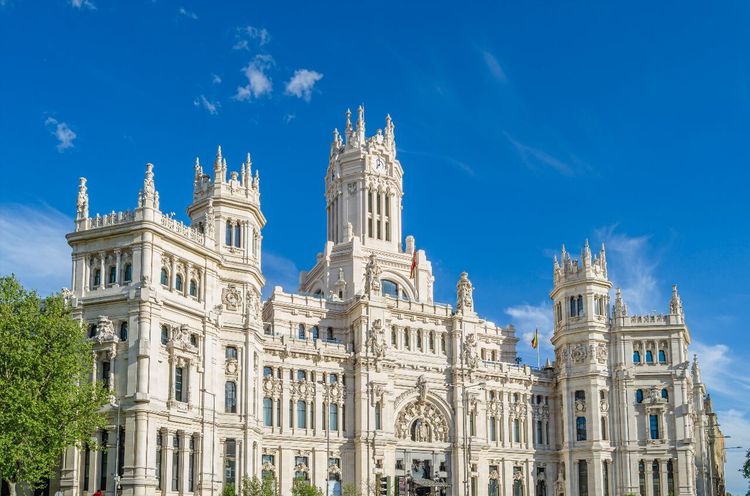
It's often mistaken for a cathedral. The Palacio de Cibeles (Plaza de Cibeles s/n, 28014 Madrid, rated 4.7/5 on Google for 911 reviews) is actually Madrid's former Central Post Office, built between 1904 and 1917 by Antonio Palacios and Joaquín Otamendi in an eclectic style mixing flamboyant Gothic, Spanish plateresque and Catalan modernism.
Its 76-meter facade in white Colmenar stone, its corner towers and sculptural ornaments constitute one of 20th-century Madrid's most ambitious architectural works. Since 2011, the building houses Madrid City Hall (Ayuntamiento). Its belvedere on the sixth floor is accessible for €3 and offers a 360° view over Plaza de Cibeles, Paseo del Prado and Retiro Park, one of the city's best panoramic views without significant queuing.
In front of the palace, the Cibeles Fountain (1782, sculpted by Francisco Gutiérrez) represents the Greek goddess of fertility on her chariot drawn by two lions. It's Real Madrid's traditional celebration site for Liga or Champions League victories: players and supporters dive into the basin, a scene now as iconic as the Bernabéu itself. Atlético Madrid celebrates its titles at the Neptune fountain, 300 meters down the same Paseo.
The ground floor houses the CentroCentro cultural center, with free exhibitions and a café overlooking the original glazed interior courtyard. If you don't go up to the belvedere, at least peek into the hall to admire the mosaic floors and ceiling height.
Atocha Station
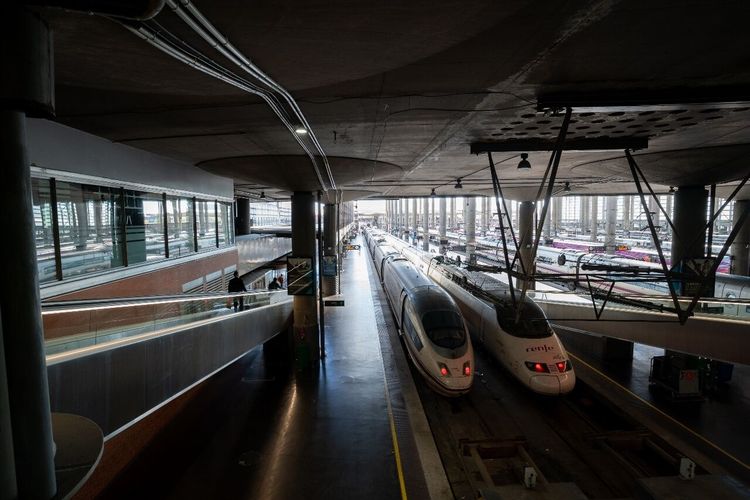
The Estación de Atocha (Glorieta del Emperador Carlos V 1, 28045 Madrid, rated 4/5 on Google for 25,748 reviews) isn't just a station: it's one of Europe's most successful architectural conversions. The large iron and glass canopy of 152 × 58 meters, built in 1892, was converted into a tropical garden during 1992 renovations.
Under the grand Victorian hall, some 7,000 plants of more than 400 different species grow around a pond where turtles swim. Palm trees, tree ferns, banana trees, giant philodendrons: the tropical greenhouse effect in a 19th-century industrial volume is striking. You can sit on interior benches, read, observe the turtles, all for free and without needing to catch a train.
The station is divided into two parts: the old hall (the garden) and the modern AVE terminal built in 1992. At level -1 of the old part is the memorial to March 11, 2004 victims, attacks that killed 191 people in suburban trains. A cylindrical room with a luminous inscription and thousands of messages left by families: sober, stripped down, moving. Rarely mentioned in tourist guides, it deserves a moment's pause.
Las Ventas Bullring
The Plaza de Toros de Las Ventas (Calle de Alcalá 237, 28028 Madrid, rated 4.5/5 on Google for 41,032 reviews) is the largest arena in the Hispanic world, with a capacity of 23,798 spectators. Its construction between 1922 and 1934 in neo-Mudéjar style, red bricks, blue azulejos, horseshoe arches, polychrome ceramics, makes it an architectural masterpiece mixing Andalusian traditions with the capital's monumental momentum.
Las Ventas is to bullfighting what Wimbledon is to tennis or La Scala to opera: the supreme temple, the arena where a career is made or broken in an afternoon. The Feria de San Isidro (mid-May to mid-June) programs 30 consecutive bullfights, a world record, attracting bullfighters and aficionados worldwide. A matador who triumphs at Las Ventas can return home, head high, to any Spanish plaza. One who fails sees his rating drop immediately.
Outside bullfighting season, the Bullfighting Museum (€2) traces the spectacle's history through 19th-century posters, suits of lights, ceremonial swords and famous bull heads. A 45-minute visit that allows understanding the internal logic of this tradition without necessarily adhering to it. Architecture enthusiasts can get a guided tour of the arena outside bullfight days to see the galleries, chiqueros (bull pens) and stands.
Descalzas Reales Monastery
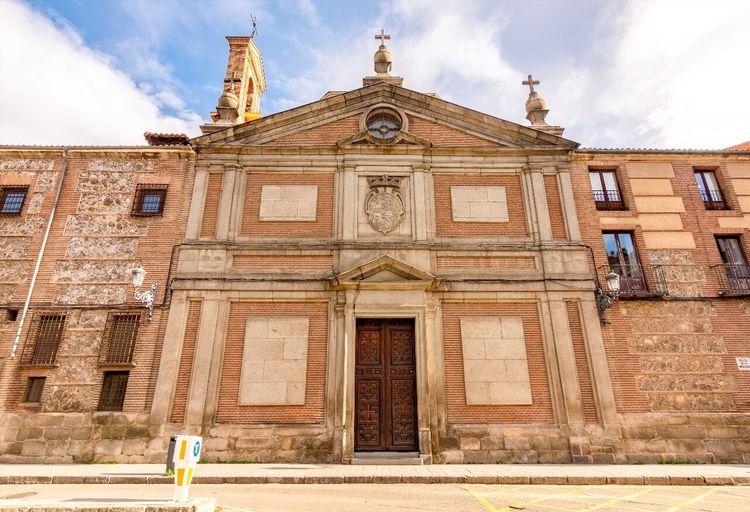
The Monasterio de las Descalzas Reales (Plaza de las Descalzas 3, 28013 Madrid, rated 4.4/5 on Google for 3,464 reviews) is probably Madrid's least known monument and one of the most fascinating. Founded in 1559 by Joanna of Austria, daughter of Charles V and sister of Philip II, in her birth palace, this Discalced Franciscan monastery has remained continuously active since then. Nuns still live there, behind the cloister grilles.
The artistic wealth accumulated here over five centuries through royal donations is dizzying. The monumental staircase painted in trompe-l'œil impresses from the entrance. The 17th-century Flemish tapestries made from Rubens cartoons cover entire walls. The 33 cloister chapels are filled with polychrome sculptures, gold reliquaries and works by Bruegel the Elder, Titian and Ribera, in exceptional state of preservation. None of these paintings are in display cases, no didactic panels dilute the atmosphere: you're in a living monastery, not a museum.
The visit is guided and mandatory, duration about 50 minutes. Price: €6, free for under 18s. Hours are limited, typically two morning and two afternoon slots Tuesday to Saturday, and groups restricted to about fifteen people. Book in advance, especially in high season. It's one of the few places in Madrid where you'll visit in calm and slowness, away from the tourist tumult of Puerta del Sol a hundred meters away.



FAQ
What are Madrid's most emblematic monuments?
The Royal Palace, Prado Museum, Plaza Mayor and Puerta del Sol form Madrid's historical and heritage heart. Retiro Park (UNESCO since 2021), Almudena Cathedral, Temple of Debod and Las Ventas Arena complete the panorama of Madrid's essential monuments. For a difficult choice between two major visits, the Prado wins in the long term; the Royal Palace, however, is rarer, few official royal palaces remain so open and so well-preserved.
How long does it take to visit Madrid's monuments?
Allow at least 4 days to seriously cover the essentials. The Royal Palace and Prado each require a complete half-day. Plaza Mayor, Puerta del Sol, Almudena Cathedral and Temple of Debod can be combined in a long morning or afternoon. Reina Sofia adds another half-day if Guernica and surrealism interest you. It's better to explore six or seven sites in depth than to rush through fifteen.
Are Madrid's monuments free?
Several important monuments offer free time slots. The Prado is free during the last two hours of opening (6-8pm on weekdays, 5-7pm on Sundays). Reina Sofia is free Monday, Wednesday and Friday evenings (7-9pm) and Sundays from 1:30-7pm. The Royal Palace offers free entry during the last two hours on Mondays and Wednesdays for EU citizens. Almudena Cathedral, Retiro Park, Palacio de Cristal, Atocha Station and Puerta del Sol are completely free.
Should you book in advance to visit Madrid's monuments?
Yes for the Royal Palace and Prado in high season (July-August, May and October holidays). Online booking avoids queues of 30 to 60 minutes. The Descalzas Reales Monastery requires almost mandatory booking as time slots are limited and groups reduced. For other monuments, Las Ventas, Almudena, Temple of Debod, Gran Via, no booking is necessary.
What's the best neighborhood to visit Madrid's monuments?
Two areas concentrate most of the heritage. The Austrias quarter (around Plaza Mayor, Royal Palace and Almudena Cathedral) groups medieval and Renaissance monuments within a 15-minute walk. The Golden Triangle (Prado, Reina Sofia, Thyssen-Bornemisza) concentrates the three major museums along Paseo del Prado, 15-20 minutes walk from the first quarter. From the Royal Palace, you can reach Plaza Mayor, Puerta del Sol and Temple of Debod on foot without exceeding 20 minutes in each direction.
How to visit Madrid's monuments in 2 days?
Day 1: Royal Palace in the morning (arrive before 9:30am), Almudena Cathedral, Temple of Debod at sunset. Dinner in La Latina quarter. Day 2: Prado in the morning (or late day, for free), Plaza Mayor at noon, Puerta del Sol and Gran Via in the afternoon. This program leaves little margin for the unexpected but covers Madrid's essential monuments in 48 hours. To link them on foot, our Heart of the Old City audio walking tour strings together 24 stops in 2h30, from Puerta del Sol to the Temple of Debod.
Madrid, monument by monument
Ten centuries of history unfold over a few square kilometers, from the Austrias quarter inherited from the Habsburgs to the Paseo del Prado that Charles III designed at the end of the 18th century. Madrid's monuments each tell a distinct period: the imperial grandeur of the Royal Palace, the cultural fever of the Prado, the silent mourning of the Atocha memorial, the somewhat crazy syncretism that planted a Nubian temple on a hill in Casa de Campo.
The best way to connect all this isn't to rush from one site to another, but to walk between them understanding how they articulate in the city. The Ryo audio-guided tour of Madrid connects the Royal Palace to La Latina in 2.5 hours with 23 commentaries available offline, a way to cross Madrid's historic heart at your own pace, missing nothing of what's hidden behind the facades.