
Créé par Emilie, le 14 mai 2026
Votre guide Ryo
© Shutterstock
Geneva has a reputation for being expensive, diplomatic, and slightly austere, a city of watchmakers and international summits where tourists mostly stop to photograph the Jet d'Eau and move on. That reputation is only half the story. The same city hosts one of Europe's most radical particle physics experiments open to the public, a neighbourhood that looks suspiciously like a Sardinian village, and a flea market that spills across a former airfield every weekend. If you're looking for things to do in Geneva and want more than the standard postcard checklist, the Ryo audiowalk for Geneva is worth downloading before you leave the hotel, it routes you through layers of history the guidebooks skip.
Expect a 140-metre jet of lake water that shoots up at 200 km/h, a cathedral with a Roman mosaic floor buried under the nave, and a museum dedicated entirely to the global humanitarian movement that was born here in 1863. This list covers 25 experiences across the city, from a one-hour guided tour of the UN's European headquarters to a cable car ride over the French border for an unobstructed panorama of the Alps.
1. Jet d'Eau
The Jet d'Eau stands at the end of a narrow jetty on Lake Geneva, visible from almost every elevated point in the city. It fires 500 litres of water per second to a height of 140 metres, which means on a windy day the mist drifts several hundred metres inland and catches you entirely off guard on the Quai du Mont-Blanc. The mechanism runs year-round during daylight hours since 2003, though it is switched off during storms, strong winds, frost, and most nights after 10 p.m. (spring through autumn evenings, it stays lit by 21 lamps).
The history is stranger than it looks. The original jet was built in 1886 as a pressure-relief valve for a hydraulic power network used by Geneva's craftsmen, including the watchmakers. It had nothing to do with tourism. The current location and the dramatic increase in pressure came in 1891, turning a functional valve into a landmark. In 1951, the height was raised from 90 to 140 metres by the system still in operation today: two 500-kW pumps push 7,000 litres of water into the air at any given moment through a 10-centimetre nozzle. Walking out on the jetty on a clear morning, when the Alps are sharp on the horizon and the fountain catches the light at a low angle, is genuinely impressive, even if you've seen a hundred photographs of it already.
A practical note: the jetty is accessible on foot from the south bank (Rive Gauche) during daylight hours. Arrive before 9 a.m. on a weekday if you want the platform largely to yourself.
2. Old Town (Vieille-Ville)
Geneva's Old Town clusters on a hill on the left bank of the Rhône, its streets narrow enough that the sun only touches the pavement for a few hours a day. The core is small, you can walk from one end to the other in under twenty minutes, but it repays slow exploration. The main artery, Grande-Rue, slopes up past 15th-century townhouses, independent bookshops, and antique dealers toward the cathedral. The Ryocity audiowalk follows this exact spine, so it's a sensible way to layer context onto what you're seeing.
The neighbourhood has a peculiar dual identity: it is both the most tourist-dense part of the city and home to a functioning residential community. You'll pass children cycling past Reformation-era façades and locals carrying groceries through streets that look like film sets. Place du Bourg-de-Four, at the heart of the Old Town, is one of the oldest public squares in Geneva, Romans used to trade here, and the current café terraces fill with office workers at noon.
3. St. Pierre Cathedral
St. Pierre Cathedral (Cathédrale Saint-Pierre (Cour de Saint-Pierre, 1204 Geneva, rated 4.6/5 on Google (9 232 avis))) is the architectural spine of the Old Town, visible from across the lake and dating from the 12th century in its current form, though archaeological work beneath it revealed a continuous place of worship going back to the 4th century. John Calvin preached here from 1536, and his chair survives in the north transept, worn smooth by centuries of reverent (and occasionally irreverent) handling.
The tower climb deserves specific mention. You ascend 157 steps through the bell tower to a platform that gives a close-up of the city's rooftops, the lake, and on a clear day the full sweep of the Alps from Mont Blanc to the Bernese Oberland. The entry fee for the towers is modest, around CHF 5, and often overlooked by visitors who spend all their time at ground level.
Directly beneath your feet, but accessed via a separate entrance, the Site Archéologique de la Cathédrale contains the most extensive early Christian archaeological site in Switzerland. The excavations revealed a 4th-century baptistery, a 5th-century bishop's palace, and a Roman mosaic floor that was simply built over and forgotten for 1,600 years. The underground museum is quiet, genuinely surprising, and costs around CHF 8.
4. Palais des Nations
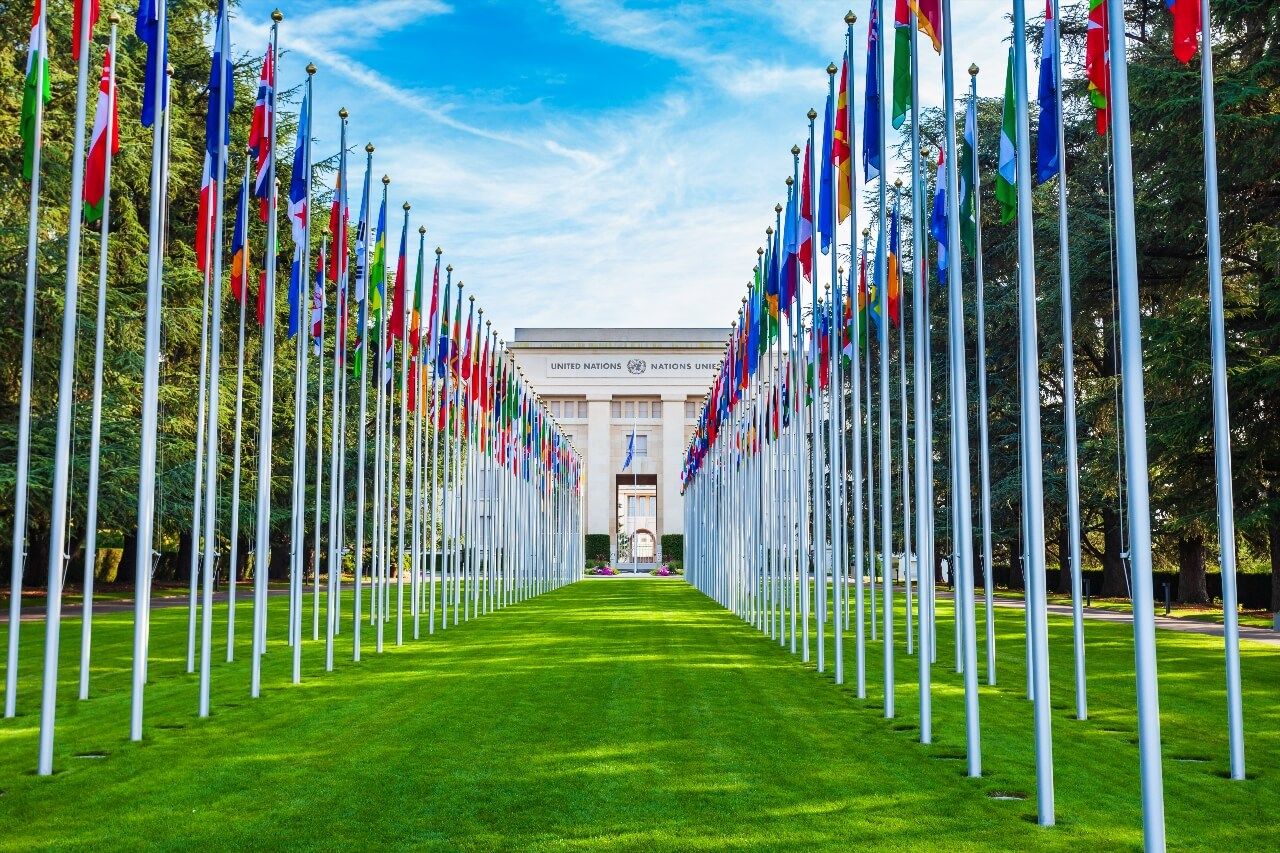
The Palais des Nations (Avenue de la Paix 14, 1211 Geneva, rated 4.6/5 on Google (4 320 avis)) is the European headquarters of the United Nations, the second-largest UN office in the world after New York, and it sits in a park on the right bank with a direct view of the Alps. For a city of 200,000 people, Geneva hosts an extraordinary density of international organisations: the WHO, the WTO, the UNHCR, and around 40 other intergovernmental bodies all operate within a short distance.
Guided tours run most days and take roughly one hour on the premises, with around 90 minutes total once you factor in security screening at the gate. You'll pass through the Assembly Hall, the Council Chamber (donated by Spain and featuring ceiling paintings by José Maria Sert), and the Salle des Pas Perdus. The tour includes entry to the park, where the Broken Chair sculpture is visible nearby (see section 9). Bring a passport or national ID, security at the gate requires it.
Prices are CHF 22 for adults and CHF 18 for students, seniors, and disabled visitors. Booking in advance through the UN Geneva website is strongly recommended during summer months when diplomatic sessions attract visiting delegations and tour slots fill quickly. Tours are offered in more than a dozen languages, including English, French, German, Italian, Spanish, and Russian.
5. CERN & the Science Gateway
CERN, the European Organisation for Nuclear Research, sits on the Franco-Swiss border, about 20 minutes by tram from the city centre. It operates the Large Hadron Collider, a particle accelerator that runs in a circular tunnel 27 kilometres in circumference buried 100 metres underground, and it is where the Higgs boson was experimentally confirmed in July 2012 by the ATLAS and CMS collaborations. The scale of this alone is worth the journey.
The Science Gateway, which opened in October 2023, is CERN's public-facing exhibition centre, free to enter and designed for visitors without a physics background. It houses interactive exhibits on particle physics, the history of scientific discovery, and the infrastructure of the LHC itself. Children's programmes run on weekends and during school holidays. The architecture, designed by Renzo Piano, is striking: a tubular steel-and-glass building whose form references the track of the LHC, set among trees that frame the connection between science and nature.
Beyond the Science Gateway, guided tours of the actual accelerator facilities are offered but must be booked weeks, sometimes months, in advance through the CERN website. These tours go underground and include the caverns where the detector equipment sits. If you can secure a spot, the experience is one of the most unusual available anywhere in Europe. Tram line 18 from Cornavin station takes you directly to CERN in about 20 minutes, with a connection at Blandonnet if needed.
A practical note: even without a tour reservation, the Science Gateway alone justifies the journey. Allocate at least two hours.
6. Lake Geneva Promenade
The Quai du Mont-Blanc (Quai du Mont-Blanc, 1201 Geneva, rated 4.6/5 on Google (79 avis)) stretches along the north shore of Lake Geneva from the Pont du Mont-Blanc eastward past a succession of grand 19th-century hotels toward the Jet d'Eau. On clear mornings, most frequent in autumn, the reflection of Mont Blanc in the lake is sharp enough to photograph without a telephoto lens. The mountain is 82 kilometres away as the crow flies.
The promenade is flat, well-maintained, and busy from early morning with runners, cyclists, and dog-walkers. Rental bikes are available at multiple points along the quay. The walk from Pont du Mont-Blanc to the Jet d'Eau takes about 25 minutes at an easy pace.
7. Musée d'Art et d'Histoire
The Musée d'Art et d'Histoire (Rue Charles-Galland 2, 1206 Geneva, rated 4.6/5 on Google (4 160 avis)) (MAH) holds the largest art and history collection in Switzerland, over 650,000 objects spanning antiquity to the 20th century. Entry to the permanent collection is free, which makes it one of the best-value cultural stops in a city known for its cost of living.
The paintings range from medieval altarpieces to a substantial collection of 17th-century Dutch masters and 19th-century Swiss landscape painting. The archaeology section contains Egyptian artefacts, Greek and Roman ceramics, and objects from pre-Roman settlements on Lake Geneva's shores. The most technically interesting single work is Konrad Witz's altarpiece of 1444, which depicts a recognisable Lake Geneva landscape in the background, one of the first realistic landscape paintings in European art history.
Allow at least 90 minutes. The building is large and the collections are genuinely dense; it rewards patience.
8. Parc des Bastions
Parc des Bastions runs along the edge of the Old Town below the university. Massive chess sets fill the central paths, in use on most afternoons, and the Reformers Wall stretches along one side (full treatment in section 25). Entry is free, the park is open year-round, and on summer evenings the atmosphere belongs more to Geneva's students than to its tourists.
9. Broken Chair
On Place des Nations, directly in front of the Palais des Nations entrance, a 12-metre wooden chair stands on three legs with the fourth shattered at the knee. The Broken Chair (Place des Nations, 1202 Geneva, rated 4.5/5 on Google (9 141 avis)) was created in 1997 by Swiss artist Daniel Berset as a plea for the abolition of landmines, placed here to coincide with the Ottawa Treaty negotiations.
It was intended as a temporary installation and has stood for nearly 30 years. The symbolism is direct: a broken limb, a fractured support, a body that still stands despite what was taken from it. It works better as an image than as an explanation, which is probably why it has outlasted its original context. Worth five minutes and a photograph from the ground looking up.
10. International Red Cross and Red Crescent Museum
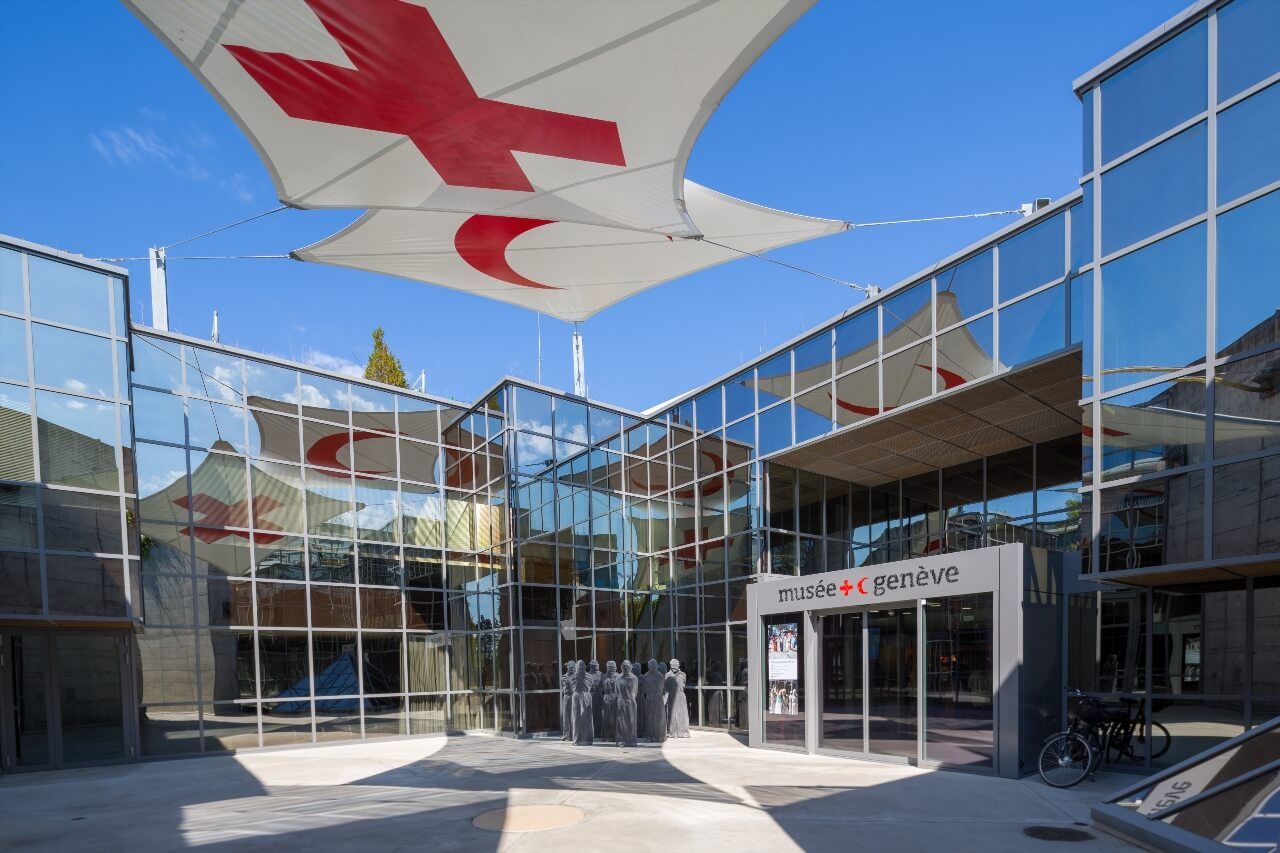
The International Red Cross and Red Crescent Museum is the best museum in Geneva and one of the most serious humanitarian institutions open to the public in Europe. It opened in 1988, has been significantly expanded since, and documents the history of the International Committee of the Red Cross from its founding in 1863 by Geneva businessman Henry Dunant following his witness of the Battle of Solferino in 1859.
The permanent collection is arranged around three core values, Restore, Protect, Prevent, and moves through case studies of armed conflict, natural disaster, and humanitarian law across 160 years. The exhibition design is deliberately spare: text panels, archival photographs, recorded testimony. The most affecting single installation is a room-sized representation of the card files maintained by the ICRC during World War I, through which prisoners' families could trace missing soldiers, a paper internet built by hand.
Admission is CHF 15 for adults, CHF 7 for ages 12 : 22 and over 65, free for children under 12. Allow two hours minimum; the exhibition is not short and the subject demands attention. The building sits adjacent to the Palais des Nations, so the two visits pair naturally.
This museum tends to produce a different kind of quiet in people who go through it, the kind that settles in on the walk back, not inside the building itself.
11. Bains des Pâquis
Bains des Pâquis (Quai du Mont-Blanc 30, 1201 Geneva, rated 4.6/5 on Google (9 638 avis)) is Geneva's public bathing establishment on a jetty that extends into the lake from the Pâquis neighbourhood on the right bank. It opened in 1872 and has been a fixture of Geneva's summer life ever since. In summer the lake water is clear and calm, the platform fills with swimmers from early morning, and a fondue boat runs in the evenings.
In winter, the baths switch to a hammam and sauna operation, entry remains cheap (around CHF 2 for lake access in summer, slightly more for sauna facilities) and the steam rooms are popular with locals throughout the colder months. The café on the jetty serves decent coffee and simple food at prices that feel out of step with the rest of the city.
The Pâquis neighbourhood itself is one of Geneva's most diverse areas, dense, slightly chaotic, lined with West African restaurants, Turkish grocery shops, and dive bars that stay open until the early hours. After the Bains, walk one block inland and you're in a completely different Geneva from the one on the tourist brochures.
12. Flower Clock (L'Horloge Fleurie)
L'Horloge Fleurie (Quai du Général-Guisan, 1204 Geneva, rated 4.5/5 on Google (14 373 avis)), the Flower Clock, sits at the western edge of the Jardin Anglais, planted into a slope above the lake. It uses 6,500 plants to mark the hour, updated seasonally, and its second hand is the longest in Switzerland at 2.5 metres. It appears in more Geneva photographs than almost anything else in the city.
As a spectacle, it is pleasant and exactly what it promises. Visit in the morning before the tour groups arrive. The floral display changes three times a year, so the specific arrangement depends on when you go.
13. Carouge
Carouge (Place du Marché, 1227 Carouge, rated 4.5/5 on Google (2.3K reviews)) is a municipality immediately south of Geneva that was developed in the late 18th century under King Victor Amadeus III of Sardinia as a planned town intended to compete commercially with the Calvinist republic next door. The strategy partly worked: Italian architects were hired to design something that could rival Geneva, with promises of religious tolerance pulling in Catholic artisans, merchants, and refugees. Carouge was formally chartered in 1786, prospered through watchmaking, textiles, and pottery, and was only transferred to the Swiss Canton of Geneva by the Treaty of Turin in 1816.
The architecture is distinctly different from Geneva, lower buildings, wider courtyards, terracotta-coloured façades, and an orthogonal Piedmontese street grid centred on the Place du Marché and Place du Temple, two squares that function more like Italian piazzas than Swiss public spaces. The market on Place du Marché runs on Wednesday and Saturday mornings and is one of the best in the Geneva area, with local producers selling cheese, vegetables, bread, and cut flowers. The neighbourhood is also dense with independent studios, jewellers, ceramicists, clothing designers, and its cafés tend to have the kind of unpretentious atmosphere that is harder to find in the main city. Tram lines 12 and 13 get you there in about 10 minutes from Cornavin or Rive.
14. Plainpalais Flea Market
Every Wednesday and Saturday, Plaine de Plainpalais, a vast paved esplanade near the university district, hosts the city's flea market. Around 200 vendors spread across the space with furniture, vintage clothing, books, records, ceramics, and the kind of objects whose origins are uncertain but whose price tags are firm. Go early. By 10 a.m. the best items have already moved.
15. Maison Tavel
Maison Tavel (Rue du Puits-Saint-Pierre 6, 1204 Geneva, rated 4.5/5 on Google (1 079 avis)) is the oldest private residence in Geneva still standing, built in the 12th century and rebuilt after a fire in 1334. It now functions as the city's historical museum, with collections covering daily life, craft, and the urban development of Geneva from the Middle Ages to the 19th century.
The most arresting exhibit is the Relief Magnin, a 1:250 scale model of Geneva as it existed in 1850, before the city's 19th-century expansion demolished most of its defensive walls. The level of detail is extraordinary: individual windows, courtyards, garden layouts, and the exact configuration of streets that no longer exist. Entry is free, and the building itself, with its original Gothic cellar and carved stone decorations, is worth the visit separately from the collection.
16. Geneva Museum of Natural History
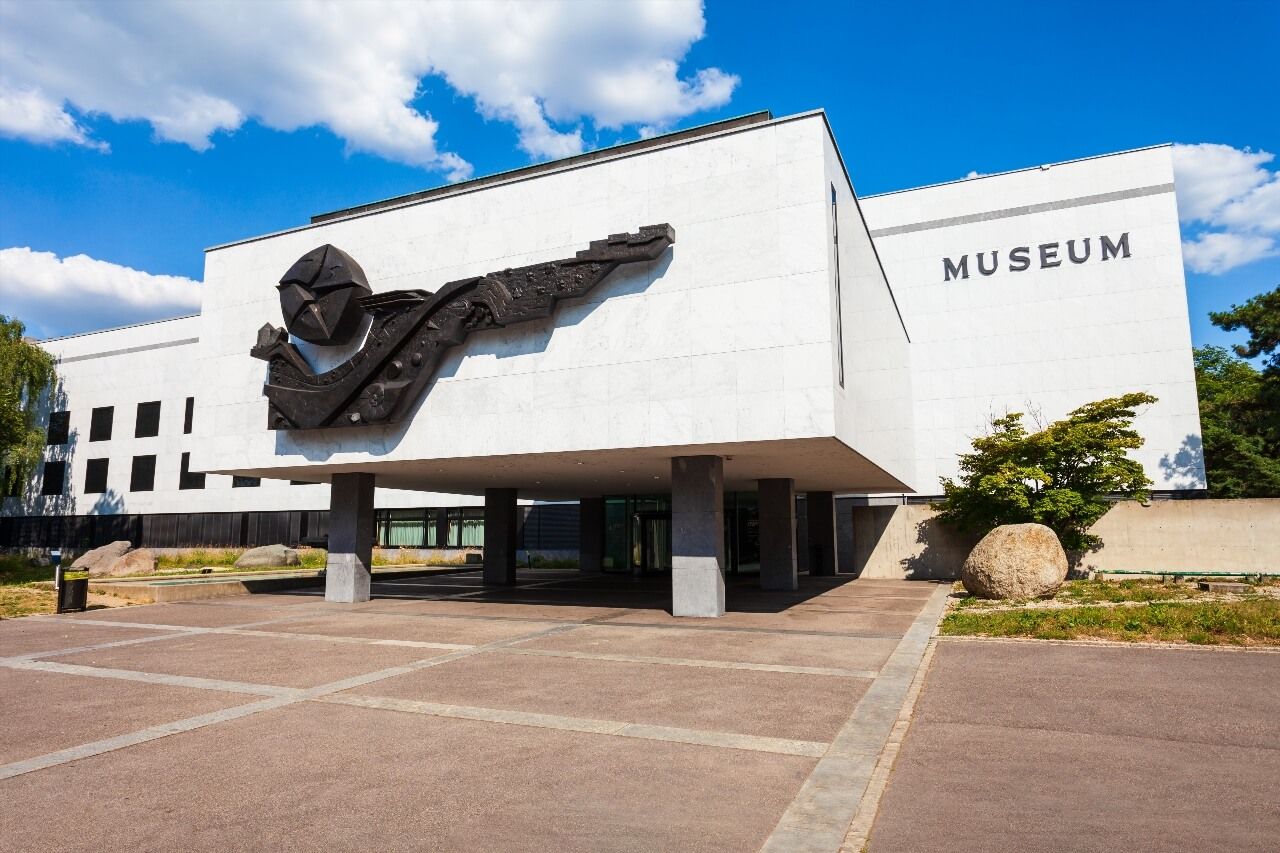
The Muséum d'Histoire Naturelle de Genève (Route de Malagnou 1, 1208 Geneva, rated 4.6/5 on Google (4 062 avis)) is one of the largest natural history museums in Switzerland, with collections spanning 17 million specimens. Entry is free. The building is slightly dated in design but the collections are serious: mineralogy, palaeontology, zoology, and a significant display of Alpine geology.
Children respond particularly well to the taxidermy displays and the dinosaur skeleton section. Adults with a specific interest in mineralogy will find the gemstone gallery genuinely impressive. Allow 60 to 90 minutes.
17. Boat Trip on Lake Geneva
The Compagnie Générale de Navigation (CGN) operates a fleet of historic paddle steamers on Lake Geneva, five of which are more than 100 years old and still in regular service. The boats run scheduled routes between Geneva, Lausanne, Montreux, and the Swiss and French shores, with the crossing to Yvoire (a medieval French village on the south bank) taking about 45 minutes from Geneva.
On a clear day the lake views, the Jura to the north, the Alps to the south, the Savoy shoreline falling into the distance, are exceptional. The full crossing to Lausanne takes around 3.5 hours and can be done as a day trip with Swiss Travel Pass or a single ticket. The shorter excursion to Yvoire and back makes for a good half-day; the village itself is extremely well-preserved and worth at least two hours on foot.
Boat schedules are seasonal, with the most comprehensive service running April through October. Book in advance for weekend departures in July and August.
18. Pâquis Quarter
The Pâquis neighbourhood occupies a wedge of the right bank between the train station and the lake. It is the most cosmopolitan part of Geneva, home to a dense mix of restaurants, small hotels, and a street life that runs later than almost anywhere else in the city. The rue de Berne and its parallel streets concentrate an unusually high number of restaurants from West Africa, the Middle East, and South Asia.
This is the neighbourhood where you eat well at moderate prices in Geneva, which is saying something. Wander rather than plan: the best spots are often unmarked and tend to change. The lakefront end of the quarter, around the Bains des Pâquis jetty, is one of the more pleasant places to sit in the city on a summer evening.
The area has a rough edge that some visitors find unexpected. It is safe by any reasonable measure, simply more real than the polished streets around the Cornavin end of town.
19. Mont Salève
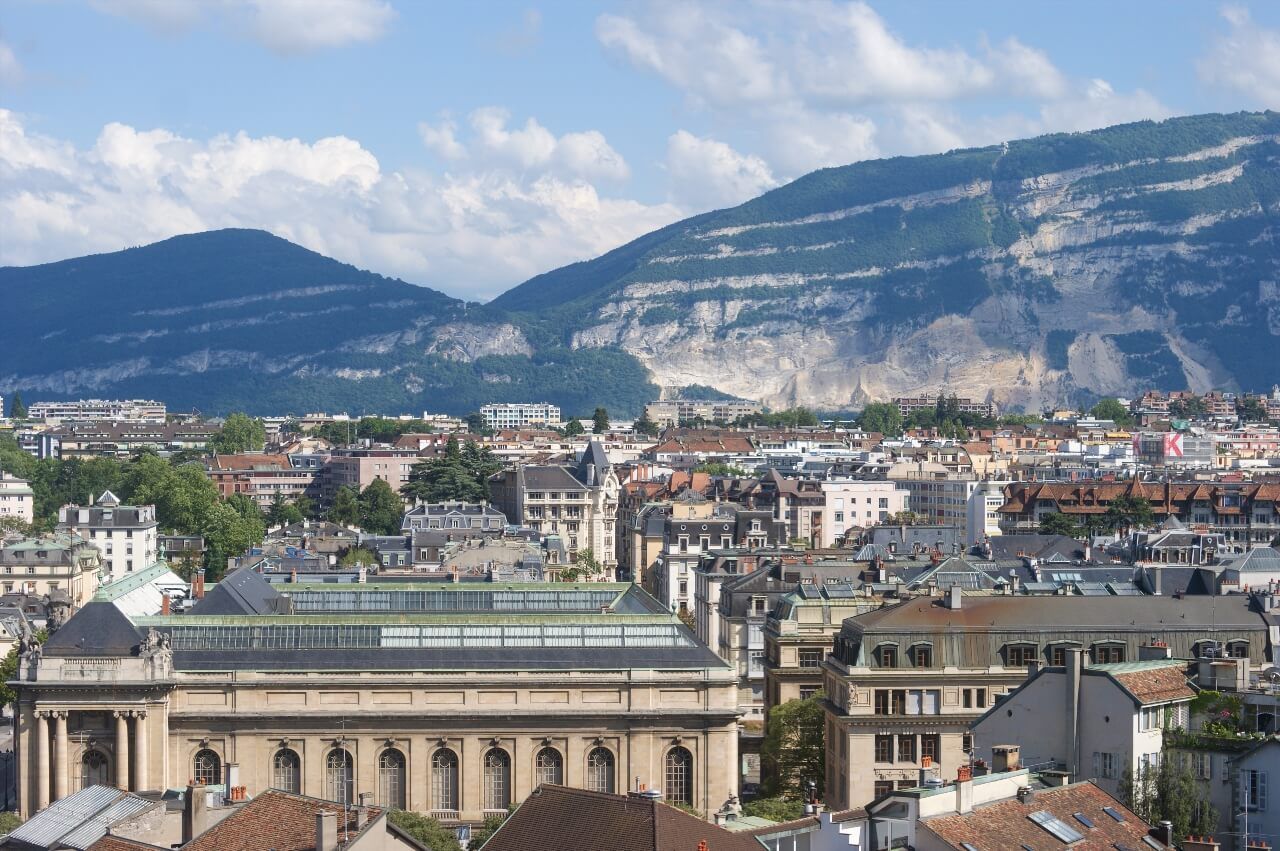
Mont Salève is technically in France, the border runs through its lower slopes, but it is Geneva's mountain, visible from almost every vantage point in the city. The cable car from Veyrier-Douane (accessible by bus 8 from Cornavin) rises from 500 metres to 1,100 metres in a matter of minutes, depositing you on a plateau with an unobstructed view of Geneva laid out below, the lake beyond, and Mont Blanc filling the western sky.
The summit plateau has easy walking trails that loop through meadows and along the ridge, with a café at the top that opens in good weather. Round-trip cable car tickets start from €13 for adults and €5.80 for children, with a family pass at €49. The 2026 season runs from 1 April to 1 November, with extended evening hours on Thursday, Friday and Saturday (until 10:45 p.m.). Paragliders launch regularly from the ridge; watching them from below on the plateau is free.
Note that you cross the French border to reach Veyrier-Douane, so carry your passport or ID. The bus journey from central Geneva takes about 20 minutes. A combined CHF 21 ticket (sold from early February) bundles the round trip with a Unireso day pass valid on all public transport in zone 10, which is the simplest option if you don't already have a city travel card.
20. Jardin Anglais
The Jardin Anglais (Quai du Général-Guisan, 1204 Geneva, rated 4.5/5 on Google (20 289 avis)) is the public park along the Rive Gauche lakefront, stretching from the Pont du Mont-Blanc eastward. It is formal, well-maintained, and popular with both visitors and office workers taking lunch. The Flower Clock (section 12) sits at its western end.
The park's principal value is its lakefront position: views of the Jet d'Eau, the right bank, and on clear days the first line of Alpine peaks. Benches fill up fast on warm afternoons. The surrounding quay is one of the better starting points for a walk east along the lake toward Les Eaux-Vives and the sports centre.
21. Cimetière des Rois
Cimetière des Rois (Rue des Rois 16, 1204 Geneva, rated 4.5/5 on Google (74 avis)), the Cemetery of Kings, is Geneva's principal historic burial ground, located in the Plainpalais district. Despite the name, no royalty is interred here; the title reflects its status as the city's first civic cemetery, established in the 16th century. The graves include those of Jorge Luis Borges, the Argentine writer who spent his final years in Geneva, Jean Calvin, and a selection of Swiss scientists, artists, and political figures.
Borges's grave has become a minor literary pilgrimage site. The headstone is carved with a Viking ship motif and a verse from an Old English poem, details he chose himself. The cemetery is quiet, tree-lined, and free to enter. Allow 30 to 45 minutes.
22. Les Grottes & Street Art
Les Grottes sits just north of Cornavin station. It was built up in the late 19th century around a deliberately irregular style sometimes called « La Vache Espagnole »: curved walls, rounded windows, mosaic decoration. Think Gaudí filtered through Swiss pragmatism, plus a decade's worth of large-format street art on the surrounding façades. Allow 30 to 45 minutes to walk the main streets. You'll share them mostly with residents, not tour groups.
23. Patek Philippe Museum
Geneva's watchmaking heritage is visible in shop windows across the city, but the Patek Philippe Museum (Rue des Vieux-Grenadiers 7, 1205 Geneva, rated 4.5/5 on Google (3 493 avis)) is where it becomes genuinely absorbing. The museum occupies a five-storey building in Plainpalais and documents five centuries of watchmaking history, from the earliest Geneva timepieces of the 16th century to the hyper-complex modern movements Patek Philippe is known for.
The collection includes over 2,500 objects, watches, clocks, automata, and tools. The enamel miniatures are technically staggering. The astronomical clocks on the upper floors show calendar functions, lunar phases, and time zones through mechanisms so intricate they require their own explanatory diagrams. Admission is around CHF 10 for adults. Allow 90 minutes to two hours; the museum is more spacious and more interesting than its size suggests from the outside.
24. Fondation Martin Bodmer
The Fondation Martin Bodmer (Route Martin Bodmer 19-21, 1223 Cologny, rated 4.7/5 on Google (228 avis)) in Cologny, a suburb southeast of Geneva accessible by bus, holds one of the most extraordinary private collections of literary and historical manuscripts in the world. Martin Bodmer (1899 : 1971) spent his life acquiring original manuscripts, early printed books, and documents spanning 5,000 years of writing, from ancient Egyptian papyri to first editions of Joyce and Kafka.
The rotating exhibitions draw from a collection that includes a Gutenberg Bible, fragments of the Dead Sea Scrolls, an original manuscript of Beethoven, and a copy of the Magna Carta. Admission is around CHF 15. The building, set into a hillside above the lake, is architecturally notable and the view from the terrace is one of the best in the Geneva area. Allow 90 minutes.
25. Reformers Wall (Wall of the Reformers)
The Wall of the Reformers stretches for 100 metres along the old city fortifications in Parc des Bastions. Completed in 1917 to mark the 400th anniversary of John Calvin's birth, it features four 5-metre stone figures, Calvin, Farel, Beza, and Knox, flanked by panels depicting scenes from the Protestant Reformation across Europe. The scale is imposing and the execution is serious relief sculpture.
Geneva's role in the Reformation is not well understood by most visitors. From 1541, Calvin transformed the city into what his contemporaries called the « Protestant Rome », a model theocratic republic that shaped Protestant theology and political thought across Northern Europe, Scotland, and eventually New England. The Wall is the most concentrated visual summary of that history, even if the style is early-20th-century monumental rather than medieval. Explore the full Bastions park on the Ryo audiowalk for Geneva, the audio commentary on the Reformation context is considerably richer than the panels alone.
FAQ
How many days do you need in Geneva?
Two full days cover the core attractions comfortably, the Old Town, St. Pierre Cathedral, the Jet d'Eau, the Red Cross Museum, and the UN Palace. Three days allow a half-day excursion to Mont Salève or Carouge, plus time for museums like CERN or the Patek Philippe. A single day works if you stay tightly focused on the left bank.
Is Geneva expensive?
Yes, Geneva consistently ranks among the most expensive cities in Europe. A restaurant lunch costs CHF 20 : 35 per person, a museum admission typically CHF 10 : 22, and a single metro/tram ticket around CHF 3.50. That said, several of the city's best attractions are free: the MAH, the Natural History Museum, Maison Tavel, Parc des Bastions, and the lakefront promenade.
What is Geneva most famous for?
Internationally, Geneva is known as the seat of numerous UN agencies and international organisations, including the ICRC, the WHO, and the WTO. Domestically, it is known for watchmaking (Patek Philippe, Rolex, and others are headquartered here), private banking, and the Lake Geneva waterfront. The Jet d'Eau is the most-photographed single landmark.
When is the best time to visit Geneva?
April through October for outdoor activities and lake excursions, the Jet d'Eau runs through the day, the paddle steamers have full schedules, and Mont Salève's cable car is operational. July and August are the busiest months. Late September and October offer clear Alpine views with noticeably fewer visitors. December brings Christmas markets around Place du Rhône that are worth the cold.
Is Geneva worth visiting for a day trip from Zurich or Bern?
Yes. High-speed rail from Zurich takes under 3 hours and from Bern around 1h45. A well-planned day covers the Old Town, the Jet d'Eau, the Red Cross Museum, and a walk along the lakefront. The Swiss Travel Pass includes most public transport in Geneva, which simplifies logistics considerably.
Can you visit CERN for free?
The Science Gateway, CERN's permanent public exhibition, is free and open without reservation most days. Guided tours of the actual underground accelerator facilities are also free but must be booked well in advance on the CERN website; availability is limited. The Science Gateway alone is worth the tram ride even without an underground tour.
Geneva rewards visitors who come with some curiosity about what the city actually is, not just a transit hub between alpine resorts, but a place where modern international law was written, where particle physics has been conducted for decades, and where a distinct urban culture has developed in the space between institutional seriousness and lakeside ease. The Ryo audiowalk for Geneva routes you through several of these layers on foot, with audio that goes beyond the basic facts you'll find on any information panel. Download it before you set out from the hotel.