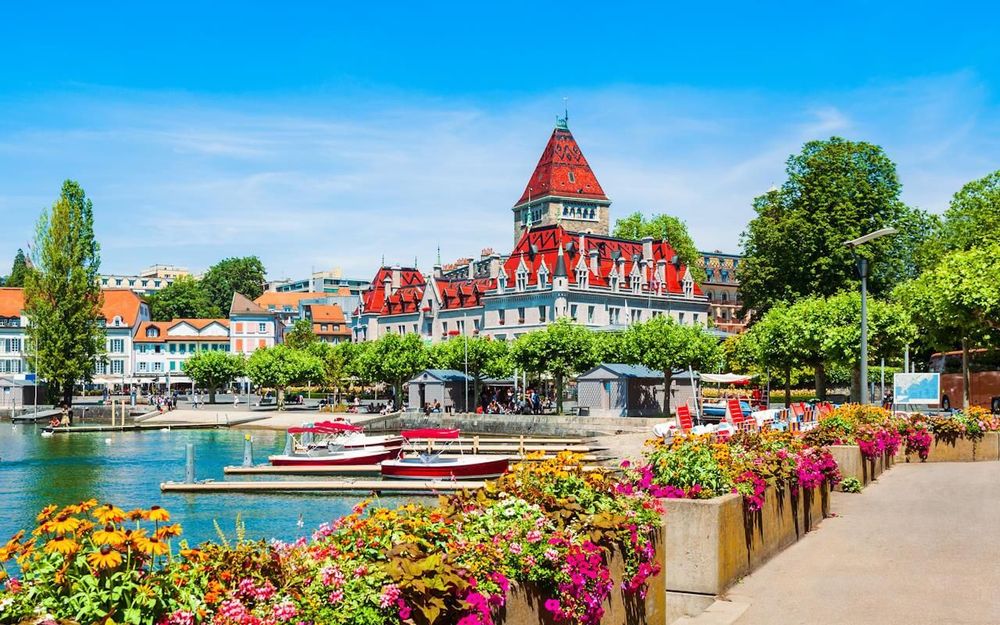
© Shutterstock
 Votre guide Ryo
Motorhome at Lake Geneva: Routes, Stopovers, and Tips 2026
Planning a trip by motorhome around Lake Geneva quickly raises the same questions: which stopovers to choose, which driving rules to follow from one country to the next, and what budget to allow. Lake Geneva is like no other body of water in Europe. 582 km² of blue water framed by the Alps and the Jura, fortified medieval villages, vineyards listed as UNESCO World Heritage Sites, Belle Époque spa towns, and two countries with different road rules — all within reach on wheels. In a motorhome, you don't just witness this landscape: you become part of it, free to stop facing the Jet d'eau in Genève at dawn or to reach the only natural sandy beach on the lake before the crowds arrive. To plan your cultural stops and refine your city visits, the Ryo guide to activities at Lake Geneva lists the must-sees on both shores with up-to-date opening hours and prices.
This motorhome guide to Lake Geneva brings together everything you need to make your trip a success: three detailed itineraries (2 days on the French shore, 5 days on the Swiss shore, 7 days full circuit), a list of the best stopovers with addresses and prices, driving rules in France and Switzerland, a realistic budget broken down by category, and the tips nobody tells you before you set off. Other guides cover the route in 1,500 words; here you will find street names, opening hours that vary by month, and the details that make the difference between a rough road trip and a truly memorable stay.
Why Choose Lake Geneva by Motorhome?
The freedom to follow both shores at your own pace is the most obvious argument. But the real reason to travel by motorhome around Lake Geneva is the density this format allows: in a single circuit of the lake — roughly 200 km of lakeshore road — you can pass through a medieval village listed among the most beautiful in France (Yvoire), swim at the only true natural sandy beach on the lake (Excenevex), drink Évian water directly from the source, admire the best-preserved castle in Switzerland (Chillon), and park 50 metres from the Olympic Museum in Lausanne.
No hotel package lets you do all of that. An average motorhome consumes around 9 to 12 L/100 km; budget 20 to 30 € per fill-up in France, and fuel that is 15 to 20% more expensive on the Swiss side. Dedicated motorhome areas number in the dozens around the lake, often free or under 15 € per night. While Switzerland is expensive for hotels and restaurants, it becomes far more affordable when your kitchen travels with you.
The Ryo app also enhances your cultural stops with audio guides covering the main towns around the lake — a great way to turn every halt into a complete historical experience, without a human guide or group tour.
2-Day Itinerary: the French Shore of Lake Geneva
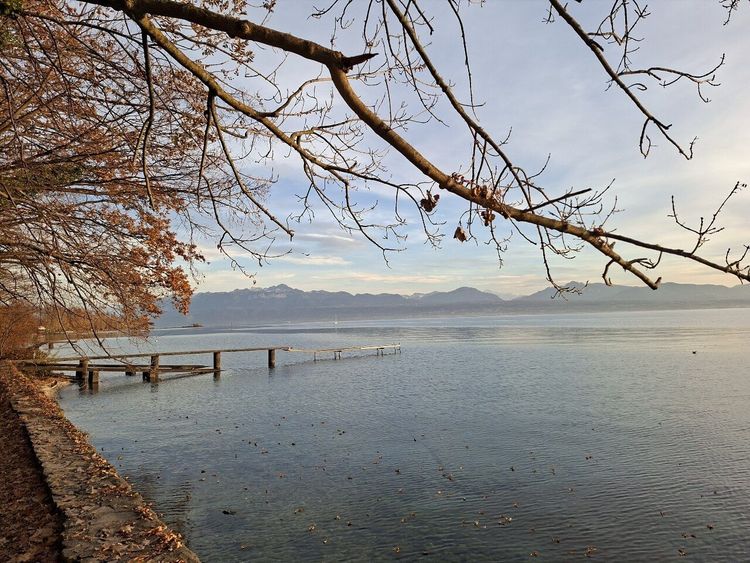
The French shore runs along the foot of the Savoie Pre-Alps from Genève to Saint-Gingolph, covering around a hundred kilometres. The itinerary below assumes you arrive via the D1005 from Annemasse or the A40 from Lyon. These two days work perfectly as an introduction to a full circuit or as a standalone mini-break.
Day 1: Sciez, Yvoire, and Excenevex
Set off early from Annemasse or Genève and head to Sciez-sur-Léman, a small municipality whose harbour offers an open view of the lake's blue waters and the Swiss shore opposite.
Five minutes away, Yvoire is one of the most photographed villages in Haute-Savoie. Its 14th-century ramparts, flower-lined lanes (officially rated a 4-star "flowery village"), and private château create an almost medieval setting. Arrive before 10 a.m. in summer: from 11 a.m. onwards, tour-bus crowds fill the two main streets. Allow 1 hour 30 minutes on site, especially if you visit the Garden of Five Senses (open May to October, around €8/adult). The view from the ramparts over the lake and the Swiss Alps opposite is worth the visit in itself.
Continuing east on the D25, Excenevex deserves a lunch and swimming stop. Its beach is the only natural sandy beach on the French side of Lake Geneva — a fact many visitors don't know. The water easily reaches 24–25°C in July and August, and the nearby municipal campsite has motorhome pitches with direct lake access.
Day 2: Thonon-les-Bains and Évian-les-Bains
Thonon-les-Bains is often overlooked in favour of Évian — unfairly so. The upper town (reached by funicular from the waterfront) is home to the Château de Sonnaz and its Chablais museum, a promenade with a panoramic view of the entire lake, and a remarkable covered market on Friday mornings. The Port de Rives, at the foot of the cliff, offers a lovely lakeside walk with plenty of local dining options.
Continue 10 km east to reach Évian-les-Bains. The town is built around its thermal springs, exploited since the 18th century, and Belle Époque architecture is visible everywhere: the Buvette Cachat (free entry — you can fill your bottles directly from the spring), the Casino d'Évian, and the Hôtel Royal overlooking the lake. Two ferries per hour connect Évian to Lausanne in 35 minutes, making a possible excursion once you have parked your motorhome for the night.
For the overnight stop, several options exist in Évian and in Nernier (Village de Nernier, 74140 Nernier, rated 4.5/5 on Google from 620 reviews), a charming fishing village between Yvoire and Thonon whose lanes open directly onto the lake.
5-Day Itinerary: the Swiss Shore of Lake Geneva
The Swiss shore (or "north shore" as locals call it) stretches from Genève to Villeneuve along roughly 100 km of federal roads lined with remarkable towns. Before entering Switzerland, make sure you have the motorway vignette (40 CHF, mandatory from the first motorway kilometres, available at border crossings or service stations). Also bear in mind that restaurant and fuel prices are around 30 to 40% higher than in France.
Day 1: Genève
Genève is the natural gateway for a circuit of the lake. The Jet d'eau — 140 metres high, 500 litres of water projected per second — can be admired from the quays at no cost. The old town, perched on its hill, is worth two hours of exploration: the cathédrale Saint-Pierre (free access to the tower top, with views over the old-town rooftops), the Maison Tavel — Genève's oldest museum, free entry — and the cobbled streets of the Bourg-de-Four, where cafés set up their terraces from April onwards.
For overnight stays in Genève, motorhome options in the city centre are scarce and expensive. Opt for sites on the outskirts: the Pointe-à-la-Bise campsite, on the lakeshore 8 km from the centre, is the most pleasant option, with direct water access and a cycle path into the city.
Day 2: Nyon, Rolle, and Morges
In Nyon (30 km from Genève), the medieval château has overlooked the lake since the 12th century. It houses a history and porcelain museum (8 CHF), and the ramparts walk offers one of the finest views over Lake Geneva — on a clear day, Mont Blanc appears on the horizon on the French side.
Rolle is a small wine-growing town with an island accessible on foot from the quay: a 14th-century château built on a small islet, photographed from the jetty. Allow 45 minutes before continuing to Morges.
Morges is well worth visiting in April–May for its famous Tulip Festival (over 100,000 tulips in the château grounds). Out of season, the Château de Morges (cantonal military museum, 8 CHF) and the long lakeside promenade remain very pleasant for a lunch by the water.
Day 3: Lausanne
Lausanne is the main city on the Swiss side of the lake. The cathédrale Notre-Dame of Lausanne is the best-preserved Gothic cathedral in Switzerland; climbing the towers is physically demanding but the view stretches across the entire lake to the French Alps on a clear day. The Flon district, a former industrial zone converted into a lively cultural hub, is the most vibrant part of the city in the evenings.
The Olympic Museum in Ouchy is unmissable for anyone interested in sport or 20th-century history: it is the world's largest museum dedicated to the Olympic Games (20 CHF adult, open year-round). Opposite, the Ouchy quays are the heart of lakeside Lausanne — ideal for a picnic or an hour's relaxation before getting back on the road.
The Lausanne-Vidy Motorhome Area is the benchmark for motorhome travellers in French-speaking Switzerland: well maintained, directly on the lakeshore, 2 km from the centre by cycle path. Around 15 CHF/night with water and electricity.
Day 4: Vevey and the Lavaux Vineyard
Vevey is known for having been Charlie Chaplin's home during the last 25 years of his life. Chaplin's World, the museum set up in his villa in Corsier-sur-Vevey, is one of the most visited attractions in French-speaking Switzerland (30 CHF adult, from 24 CHF when booked online). The market square in Vevey, with its giant fork sculpture planted in the lake, is the town's most iconic photograph.
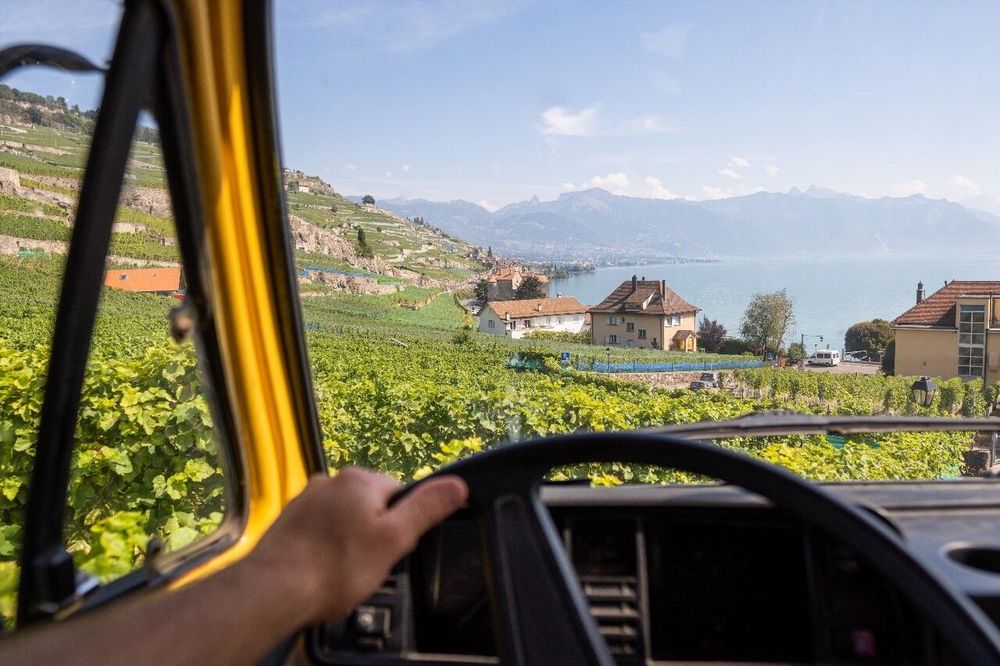
Above Vevey and Lausanne, the Lavaux vineyard has been a UNESCO World Heritage Site since 2007. Its vine terraces plunge directly into the lake along 30 km of hillside. The Lavaux Express train departs from Vevey in season, but the country roads above Cully or Épesses are manageable in a standard motorhome — less than 10% gradient and spectacular views.
Day 5: Montreux and Chillon Castle
Montreux is the most tourist-oriented town on the Swiss side of the lake, famous for its July Jazz Festival and its palm trees along the waterfront. A local microclimate keeps temperatures mild virtually all year round. The Quai des Fleurs (3 km of flower-lined promenade) is the longest on the Swiss shore. The rack railway up to the upper town offers a bird's-eye view of the entire lake.
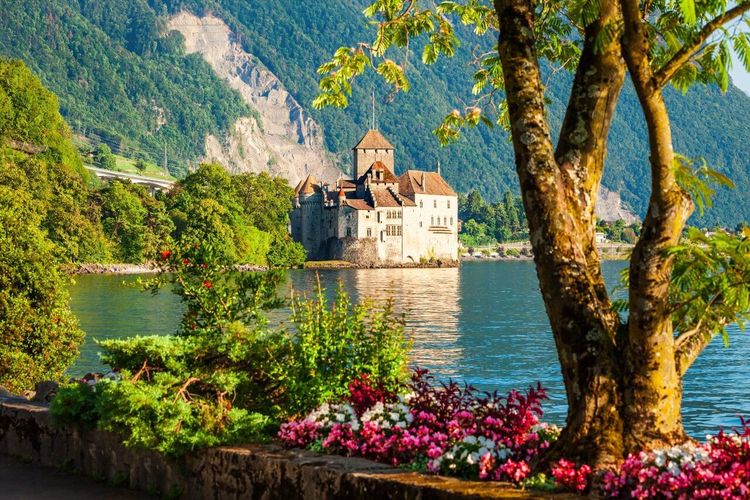
3 km from Montreux, Chillon castle (Avenue de Chillon 21, 1820 Veytaux, rated 4.7/5 on Google from 24,170 reviews) is the most visited historic monument in Switzerland. Built on a rocky islet at the water's edge, it dates from the 12th century and inspired Lord Byron during his visit in 1816. The interior visit (15 CHF adult) reveals intact rooms and dungeons to explore freely. Allow at least 2 hours, 3 if you read all the information panels.
7-Day Itinerary: the Full Circuit of Lake Geneva
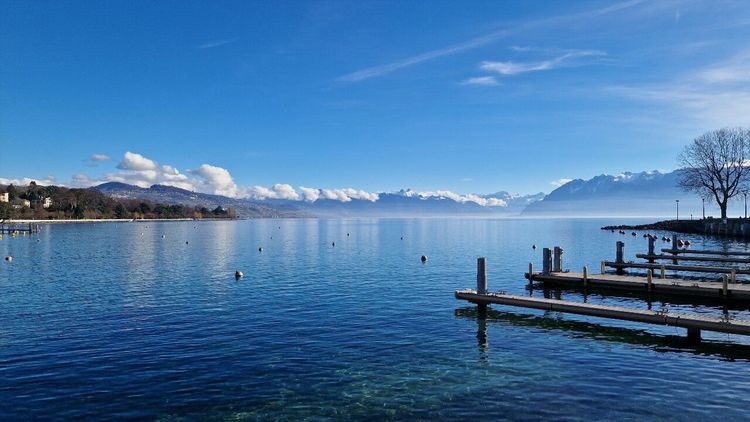
The full circuit of Lake Geneva covers roughly 200 km of lakeshore driving, but once your stages are planned you will never cover more than 30 to 40 km a day. The ideal approach is to combine both shores in a loop, which requires one French–Swiss border crossing — usually quick (under 5 minutes), except in July–August at the busiest checkpoints.
Days 1–2: French shore (Annemasse or Genève → Sciez → Yvoire → Excenevex → Thonon → Évian → Saint-Gingolph)
Follow the 2-day itinerary described above. Take time to linger in the small villages between Yvoire and Thonon — Excenevex, Messery, Nernier — which offer quiet beaches and open lake views without the pressure of larger towns.
Days 3–7: Swiss shore (Genève → Nyon → Morges → Lausanne → Vevey → Montreux → Villeneuve)
The Swiss shore concentrates the bulk of the cultural heritage. If time allows, add a side trip to Gruyères (Rue du Bourg, 1663 Gruyères, rated 4.6/5 on Google from 9.1K reviews) from Vevey (45 min drive, 12th-century medieval château, La Maison du Gruyère AOC cheese dairy, HR Giger Museum), or to Les Diablerets from Aigle (glacier accessible year-round, road manageable for a standard motorhome up to the Vers-l'Église car park).
Border tip: on the way back to France, favour the Saint-Gingolph crossing (a quiet lakeshore checkpoint with no queue outside July–August) over the busier Bardonnex and Moillesulaz posts on the Genève side. Saint-Gingolph is particularly convenient if you are finishing your loop from Montreux.
Express option (5 days): it is technically possible to complete the circuit in 5 days by trimming each stage to the essentials. This format suits travellers who already know Genève or Lausanne. Focus on Yvoire and Excenevex (Day 1), Morges and Lausanne (Day 2), Vevey and Lavaux (Day 3), Montreux and Chillon (Day 4), return along the French shore via Saint-Gingolph (Day 5). Fewer than 5 days means sacrificing one or more major sites.
To extend your Alpine lake exploration by motorhome after Lake Geneva, our Ryo motorhome guide to the Italian lakes covers Lake Como, Lake Garda, and Lake Maggiore with the same level of practical detail.
The Best Motorhome Stopovers around Lake Geneva
Parking your motorhome at Lake Geneva follows different rules depending on whether you are in France or Switzerland. Conditions also vary considerably between high season (July–August) and the rest of the year. Below is a selection of the most suitable stopovers for a comfortable stay.
French Side
Thonon-les-Bains motorhome area: free, around ten pitches, water and waste disposal available, 10 minutes' walk from the town centre. The best option for visiting Thonon without paying overnight fees.
Excenevex municipal campsite: the only option with direct access to the lake's natural sandy beach. Opt for a lakeside pitch — the most sought-after in the entire campsite. Online booking recommended for July–August. Rates: €15 to €25/night depending on season and pitch.
Sciez-sur-Léman motorhome area: a small free area with a lovely lake view, ideal for a quiet night between Yvoire and Thonon. Water available, no electricity.
Évian-les-Bains: no dedicated official area in the town centre. The Pré-Curieux car park (outskirts, large spaces) accepts motorhomes overnight with pay-and-display payment. Check the maximum height limit — often 2.50 m in local covered car parks, which excludes most coachbuilt motorhomes.
Swiss Side
Lausanne-Vidy motorhome area: the benchmark on the Swiss shore, praised by motorhome travellers from across the region. Lakeside location, full services (showers, water, electricity, waste disposal). Around 15 CHF/night. Direct cycle path to the city centre. Booking recommended in summer.
Morges motorhome area: well maintained, 15 minutes' walk from the château. 10 to 12 CHF/night. One of the best value-for-location options on the Swiss shore.
Nyon motorhome area: a decent area at the entrance to the town, around 10 CHF/night.
Villeneuve campsite: on the lakeshore east of Montreux, a large site with full facilities. Easy cycling access to Chillon castle — a good final stage before heading back to France.
Key Points to Know
In Switzerland, overnight parking in a motorhome on public car parks is formally prohibited in the vast majority of municipalities along Lake Geneva. Fines exist and local parking officers enforce them regularly, especially in Genève, Lausanne, and Montreux. On the Swiss side, use only official motorhome areas or approved campsites. In France, regulations are more relaxed, but some municipalities — notably Yvoire and Évian in high season — have tightened their rules in recent years. Check Park4Night before setting up.
Where to Rent a Motorhome for Lake Geneva?
Two main strategies: rent in France or rent directly in Genève.
Renting in France is generally 30 to 40% cheaper than in Switzerland for an equivalent vehicle. Major national operators (Camping-cars Star, McRent, Yescapa, Wikicampers) offer vehicles from Lyon, Grenoble, or Annecy — 1.5 to 2 hours from the lake. Budget €80 to €150/day in peak season for a campervan sleeping 2–4 people, €120 to €200/day for a coachbuilt model sleeping 4–6. If you are departing from the capital, our Ryo guide to motorhome rental in Paris details the options and the most highly rated agencies in the community.
Renting in Genève avoids a return drive from France but costs noticeably more. Local agencies (MobilCamp, TCS Camping) offer good-quality vehicles with bilingual assistance. This option makes sense if you are flying into Genève-Cointrin.
Peer-to-peer platforms (Yescapa, Wikicampers, Outdoorsy) allow you to find privately owned motorhomes rented by individuals — often 20 to 30% cheaper than professional rental companies, with insurance coverage included in the price. Make sure the contract explicitly authorises travel to Switzerland; some exclude it by default or charge a cross-border surcharge.
Whatever option you choose, go through these points before taking the keys:
- The total height of the vehicle (Swiss car parks are often limited to 2.10–2.20 m)
- The condition of the waste disposal equipment (essential at areas without plumbing)
- The excess amount in the event of a claim (ranging from €500 to €3,000)
- The geographical restrictions in the contract (Switzerland is sometimes excluded or subject to additional charges)
Driving in France and Switzerland: the Rules You Need to Know
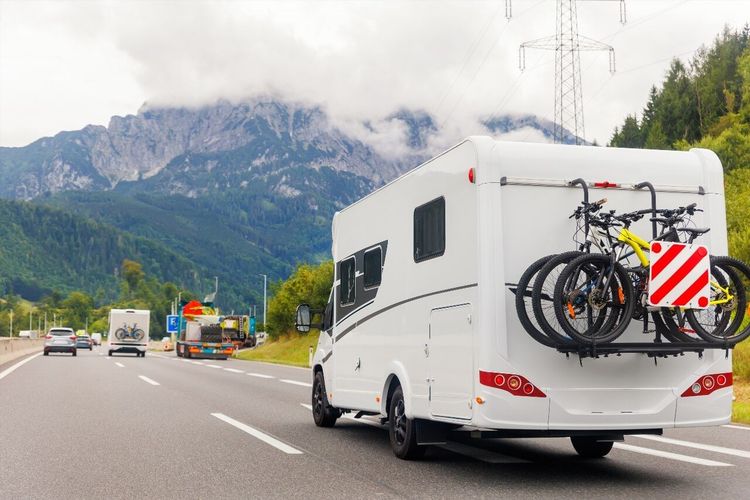
Two countries, two systems — but the differences are manageable once you have identified them before setting off.
In France
Standard speed limits for a motorhome under 3.5 tonnes are the same as for cars: 130 km/h on motorways (110 km/h in wet weather), 80 km/h on national and departmental roads, 50 km/h in built-up areas. Above 3.5 tonnes — which applies to some large coachbuilt models — limits drop to 110/80/50 km/h.
The roadworthiness certificate must be up to date and kept in the vehicle. French toll booths accept foreign bank cards without issue. On the A41 from Genève, budget €8 to €12 to reach Annecy depending on your vehicle category (generally category 1 for lightweight motorhomes).
In Switzerland
The rule to memorise above all others: the motorway vignette is mandatory as soon as you drive on a Swiss motorway, including the few kilometres of ring road around Genève. Without a vignette, the fine is a minimum of 200 CHF.
Speed limits are 120 km/h on motorways for all vehicles (no distinction between motorhomes and cars under 3.5 t), 100 km/h on national roads, and 50 km/h in built-up areas (reduced to 30 km/h in the many signposted residential zones). Signage is clear and entirely in French around the lake.
The legal blood alcohol limit is 0.5 g/L, the same as in France. Road checks are frequent at weekends on routes leaving Genève and Lausanne. Using a mobile phone while driving without a hands-free kit is prohibited, and fines start at 100 CHF. Once the car is parked, Geneva is best taken on foot, with our audio-guided tour of the old town in your ears.
Tolls and the Motorway Vignette: What Budget to Expect?
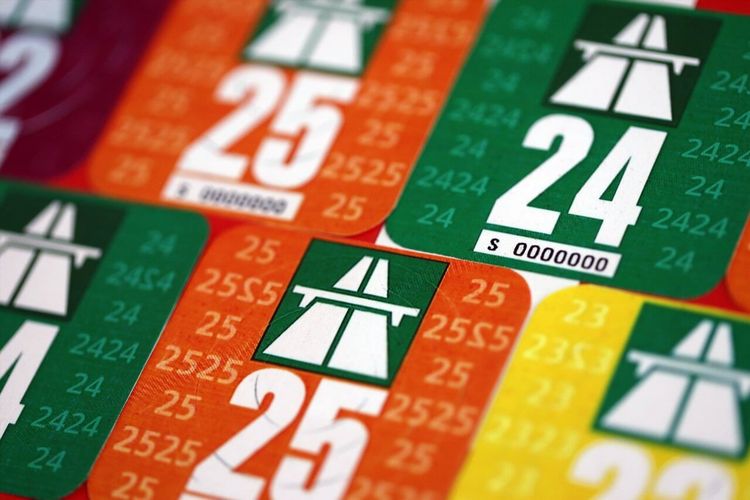
The Swiss vignette costs 40 CHF (around €42 at the current rate) and is valid from 1 December of the previous year to 31 January of the following year — a vignette purchased in December 2025 remains valid until 31 January 2027. It can be bought at customs posts on entry to Switzerland, at Swiss and French service stations near the border, or online on the official website of the Federal Customs Administration (electronic format linked to your registration plate).
If your motorhome weighs more than 3.5 tonnes, you are subject to the HPCT (Heavy Vehicle Performance-Related Charge), calculated automatically based on total weight and kilometres driven in Switzerland. The vast majority of rental motorhomes remain below this threshold.
On the French side, tolls between Lyon or Grenoble and Lake Geneva range from €8 to €20 depending on your starting point. On the A40 (Paris–Genève axis), motorhomes under 3.5 t pay at the category 1 rate, the same as private cars. No French vignette — only toll barriers.
What Season to Choose for Your Stay?
May–June is the best period for a motorhome trip around Lake Geneva. Temperatures are mild (18 to 24°C), stopovers are rarely crowded, rental prices remain reasonable, and the Lavaux vines are beginning to turn green. The Tulip Festival in Morges (late April–early May, 100,000 tulips in the château grounds) is a unique event on the Lake Geneva calendar.
July–August: the lake is ideal for sailing and swimming, with perfect temperatures, but tourist numbers are at their peak. The best motorhome areas are often fully booked by early afternoon. Reserve ahead for Excenevex and Lausanne-Vidy. Rental and campsite prices rise by 20 to 40%.
September–October offers a fine balance: the grape harvest in the Lavaux wine region, autumn light on the lake, fewer tourists, and prices back down. Most areas remain open through October.
Winter (November–March): travel is possible but several Swiss-side areas close between December and February. The main winter draws are the Christmas markets of Genève, Lausanne, and Montreux (December, among the most beautiful in French-speaking Switzerland) and the ski resorts accessible from the lake — Avoriaz 30 km from Évian-les-Bains, Villars-sur-Ollon 40 km from Montreux.
Motorhome Budget for Lake Geneva
Here is a realistic estimate for 2 people over 7 days, motorhome rental included.
Motorhome rental: between €700 and €1,400 for 7 days depending on season and vehicle type. Out of season (May, September), well-equipped campervans can be found for around €85 to €100/day. In July–August, prices for coachbuilt models rise to €150–€200/day.
Motorhome areas: €5 to €15/night on the French side, 10 to 18 CHF/night on the Swiss side. Over 7 nights, budget €80 to €120 on average.
Fuel: for 200 km at 10 L/100 km, around 20 litres of diesel. That's €26 to €32 in France (around €1.30 to €1.60/L) and 33 to 38 CHF in Switzerland (around 1.65 to 1.80 CHF/L). Tip: fill up in France before crossing the border.
Swiss vignette:40 CHF, a one-off payment for the entire stay.
Meals: cooking on board, budget €25 to €35/day for two on groceries (Migros or Coop supermarkets on the Swiss side, with prices broadly similar to French supermarkets). If you eat out occasionally on the Swiss side, allow 35 to 55 CHF per meal for two.
Attraction entry fees: Chillon castle (30 CHF for two), Olympic Museum in Lausanne (40 CHF for two), Chaplin's World in Vevey (60 CHF for two), Garden of Five Senses in Yvoire (€16 for two). Attractions budget: around €120 to €190 over the entire stay.
Estimated total for 2 people / 7 days: between €1,200 and €1,900 depending on the vehicle and dining habits. That is considerably less than a week in hotels in the same region, even in the budget category.
Practical Tips for a Successful Road Trip
Download Park4Night before you leave. This community app lists official areas and nature spots validated by users, with recent reviews and photos. It becomes indispensable when the main area is full — which happens regularly in July–August around Lausanne and Évian.
Set your GPS to your vehicle's height. In Switzerland, tunnels and underground car parks often display maximum heights of 2.10 to 2.20 m, while a standard coachbuilt motorhome stands at 2.90 m. Set your GPS to 3.10 m to receive warnings well before low-clearance zones in the city centres of Genève and Lausanne.
Use public transport for your city visits. Lausanne offers day tickets at 13.60 CHF covering the M2 metro, buses, and trams across the whole city. Genève has an extensive network and a very good-value day pass. Bike-sharing schemes (Publibike in Switzerland, Vélostation in Thonon) cover the quays quickly without the hassle of parking a large vehicle.
Plan your water autonomy. A standard motorhome carries 80 to 120 litres. On the Swiss side, tap water is excellent quality, and the public fountain network — one of the densest in Europe — lets you refill your tank free of charge in almost every town. Keep a few CHF coins for the paid filling points in rural areas (typically 1 to 2 CHF).
Keep Swiss francs in cash. Despite the widespread use of card payments in Switzerland, some small rural areas and fountains still operate with coins. A 50 CHF note withdrawn on arrival in Switzerland is enough to cover these small unexpected expenses throughout the stay.
To enrich your cultural stops with historical stories and practical details for each town, the Ryo guide to activities at Lake Geneva is the natural companion to this itinerary — opening hours, up-to-date prices, and visit tips for Genève, Lausanne, Montreux, and the villages of the French shore.
If your appetite for lakeside road trips extends beyond Lake Geneva, our Ryo guide to a road trip around Lake Garda is a logical next step — less than 4 hours away via the Grand-Saint-Bernard tunnel or the Italian A5.
FAQ
Do You Need a Vignette to Drive a Motorhome in Switzerland?
Yes, the Swiss motorway vignette is mandatory for any vehicle using Swiss motorways, including motorhomes. It costs 40 CHF and is valid until 31 January of the following year. You can purchase it at border crossings, at Swiss service stations near the border, or online on the official website of the Federal Customs Administration (electronic format linked to your licence plate). Without a vignette, the fine is a minimum of 200 CHF. Motorhomes weighing more than 3.5 tonnes are subject to the HPCT instead of the vignette.
Can You Sleep Freely in a Motorhome on the Shores of Lake Geneva?
In France, wild camping in a motorhome is tolerated in some rural municipalities but strictly prohibited in protected areas and on classified lakeshores. Yvoire and Évian have tightened their rules during high season — check Park4Night before setting up. In Switzerland, overnight parking on public car parks is formally prohibited in the vast majority of municipalities along Lake Geneva. Fines of between 100 and 300 CHF are regularly enforced, particularly in Lausanne, Montreux, and Nyon. On the Swiss side, use only official motorhome areas or approved campsites.
What Is the Best Motorhome Stopover around Lake Geneva?
The Lausanne-Vidy Motorhome Area is consistently cited as the best in the region by motorhome communities: lakeside location, full services (water, electricity, showers, waste disposal), direct cycling access to the city centre, and a green setting. Around 15 CHF/night. On the French side, the Excenevex Municipal Campsite is favoured for its unique access to the only natural sandy beach on the French side of Lake Geneva — a rare advantage that justifies booking in advance in summer.
Can You Complete the Full Circuit of Lake Geneva in One Week?
Yes, seven days is the ideal format. The 200 km of lakeshore road naturally breaks down into 7 full-day stages, with enough time to visit sites at each stop. A 5-day circuit is possible in an intensive format, but forces you to skip Vevey, Lavaux, or the quieter villages on the French shore. Fewer than 5 days is only suitable if you already know some of the towns along the route.
What Documents Do You Need to Enter Switzerland with a Motorhome?
For EU citizens, the standard documents are sufficient: a valid national ID card or passport, a valid driving licence, the vehicle registration document, and proof of international insurance (green card). The motorway vignette (40 CHF) must be purchased before using Swiss motorways. If you are travelling with pets, they must be identified by microchip, vaccinated against rabies (with a valid certificate), and have their European pet passport.
What Is the Best Season to Visit Lake Geneva by Motorhome?
May–June remains the best period: pleasant temperatures (18 to 24°C), stopovers available without booking in most cases, reasonable rental prices, and spring greenery on the Lavaux vines. July–August offers the best weather for swimming but requires advance booking for the best sites. September–October is excellent for autumn scenery and the grape harvest in the Lavaux wine region. Winter is feasible but several areas close between December and February.
Conclusion
Lake Geneva by motorhome is best savoured without rushing. With a Swiss vignette, a well-chosen list of stopovers, and two or three days of flexibility in your schedule, it is one of the most complete lakeside road trips in Europe.
To complete your preparation and enrich every stop along the way, visit the Ryo guide to what to see at Lake Geneva — the ideal companion to this practical itinerary. Safe travels.