





Walk
The City of Contrasts
Shanghai, China
Walk
The City of Contrasts
Shanghai, China
7.1 km
Distance
3h00
Durée
23
Audios
Loop
Parcours
Shutterstock
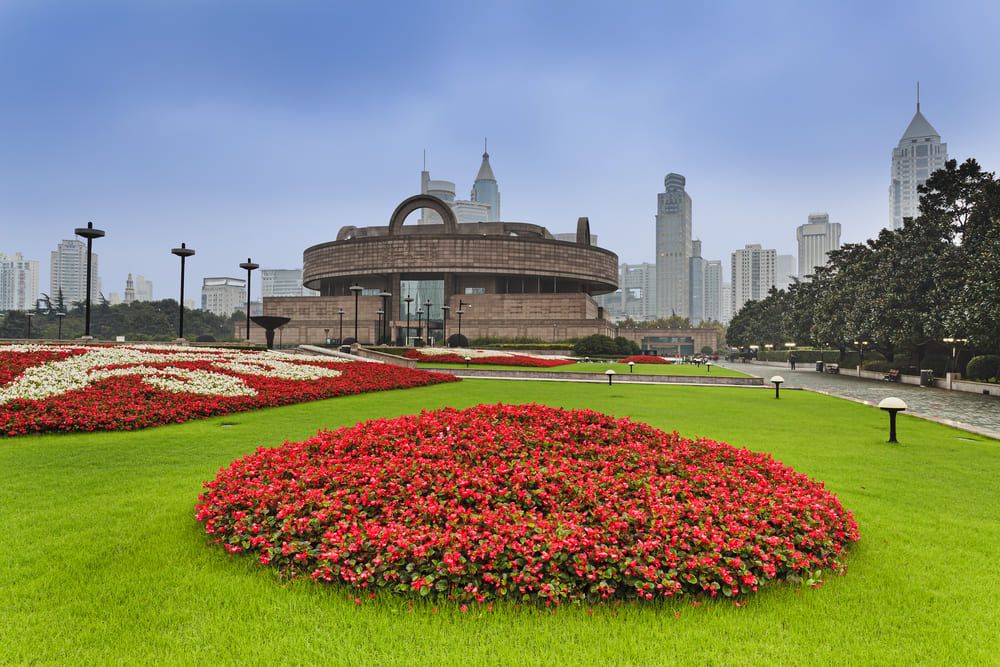
The People's Square, Renmin Guangchang, is the beating heart of Shanghai, a vast esplanade in the centre of the town, a former racecourse of the colonial era become a great public space. The Shanghai audio-guided tour stops here to evoke this place charged with history, surrounded by museums and institutions, where the memory and the modernity of the town meet.
Welcome to the People's Square, Renmin Guangchang, the beating heart of Shanghai. You are here in the centre of the town, in a place where history, culture and daily life meet. Before becoming this great open and modern esplanade, this spot was a racecourse. In the British colonial era, horse races reserved for the foreign elites were organised here, and the place symbolised then the cosmopolitan but deeply unequal Shanghai of the beginning of the twentieth century. After the foundation of the People's Republic of China in 1949, everything changes: the racecourse is demolished and transformed into the People's Square, a public space open to all. This strong gesture marks the end of an era and the beginning of a new era for the town, that of a modern and Chinese Shanghai. Today, the square is surrounded by great cultural and administrative facilities, among which the Shanghai Museum, the Grand Theatre, the town hall and the urban planning centre, that make it a true civic forum. Vast, lively and lined with skyscrapers, it is also a place of promenade and relaxation, crossed each day by an immense crowd, a stone's throw from the famous Nanjing Road. A civic heart and a symbol of the new town, the People's Square is a fine stop of the discovery of Shanghai.
Here you discover the vast esplanade in the centre of Shanghai, a former racecourse of the British colonial era demolished after 1949 to become a public space open to all, symbol of the passage to a modern and Chinese Shanghai; surrounded by the Shanghai Museum, the Grand Theatre, the town hall and the urban planning centre, it is a civic and cultural heart, a stone's throw from Nanjing Road. The People's Square is the heart of Shanghai. It is a fine stop, to be explored on foot.
The People's Square lies in the centre of Shanghai, in the Huangpu district, served by the metro at the station of the same name, and reachable on foot. It is a great public square freely accessible, surrounded by museums and institutions. You discover it during a walk in the centre.
A racecourse of the British colonial era, where horse races reserved for the foreign elites took place; after the foundation of the People's Republic in 1949, it was demolished and transformed into the People's Square, a public space open to all, today surrounded by the Shanghai Museum, the Grand Theatre, the town hall and the urban planning centre.
In the centre of Shanghai, in the Huangpu district, in China.
Aucun avis pour le moment
