




Walk
A Thousand Years of History Along the Mayenne
Laval, France
Walk
A Thousand Years of History Along the Mayenne
Laval, France
3 km
Distance
1h15
Durée
18
Audios
Loop
Parcours
Shutterstock
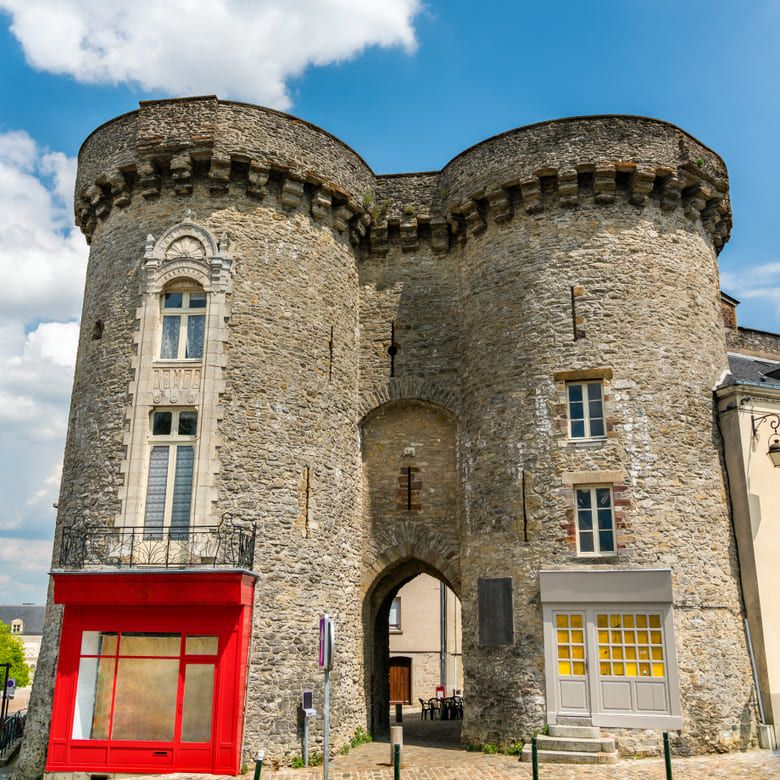
The Porte Beucheresse is the last fortified gate subsisting from the medieval ramparts of Laval. The Laval audio-guided tour stops here to evoke this imposing vestige of the Middle Ages, witness of the wall that girded the town, and birthplace of the famous painter Henri Rousseau.
You are in front of the Porte Beucheresse, the last fortified gate that subsists from the medieval ramparts of Laval. Imagine: in the thirteenth century, the town was girded with a wall over a kilometre long, flanked with some twenty towers and pierced with several gates, that protected the town and controlled its accesses. These fortifications, raised in the time of the lords of Laval, testified to the power and the importance of the town. Over the centuries, as in numerous towns, these ramparts become useless were largely demolished to allow the extension of the town, and the Porte Beucheresse is one of the rare vestiges to have survived. Imposing, flanked with its two big round towers topped with conical roofs, it still proudly raises its massive silhouette and recalls the fortified Laval of the past. This gate is also famous for having been the birthplace, in the nineteenth century, of the painter Henri Rousseau, called the Douanier Rousseau, one of the greatest representatives of naive art, world-renowned. A medieval vestige and a cradle of a great painter, the Porte Beucheresse is a fine stop of the discovery of Laval.
You admire the last fortified gate subsisting from the medieval ramparts of Laval: in the thirteenth century, the town was girded with a wall over a kilometre long flanked with some twenty towers, largely demolished since; imposing with its two big round towers topped with conical roofs, the gate recalls the fortified Laval and was the birthplace of the painter Henri Rousseau, the Douanier Rousseau. The Porte Beucheresse is a medieval vestige of Laval. It is a fine stop, to be explored on foot.
The Porte Beucheresse lies in the historic centre of Laval, reachable on foot. You admire its silhouette and its towers from the street; it is a monument that you discover from outside, during a walk in old Laval.
The last fortified gate subsisting from the medieval ramparts of Laval: in the thirteenth century, the town was girded with a wall over a kilometre long flanked with some twenty towers, largely demolished since; imposing with its two big round towers topped with conical roofs, it was also the birthplace of the painter Henri Rousseau, called the Douanier Rousseau.
In the historic centre of Laval, in France.
Aucun avis pour le moment
