





Walk
The City of Four Seasons
Arcachon, France
Walk
The City of Four Seasons
Arcachon, France
3.2 km
Distance
1h30
Durée
20
Audios
Loop
Parcours
©PA CC BY-SA 4.0. <https://creativecommons.org/licenses/by-sa/4.0/deed.fr>via Wikipedia Commons
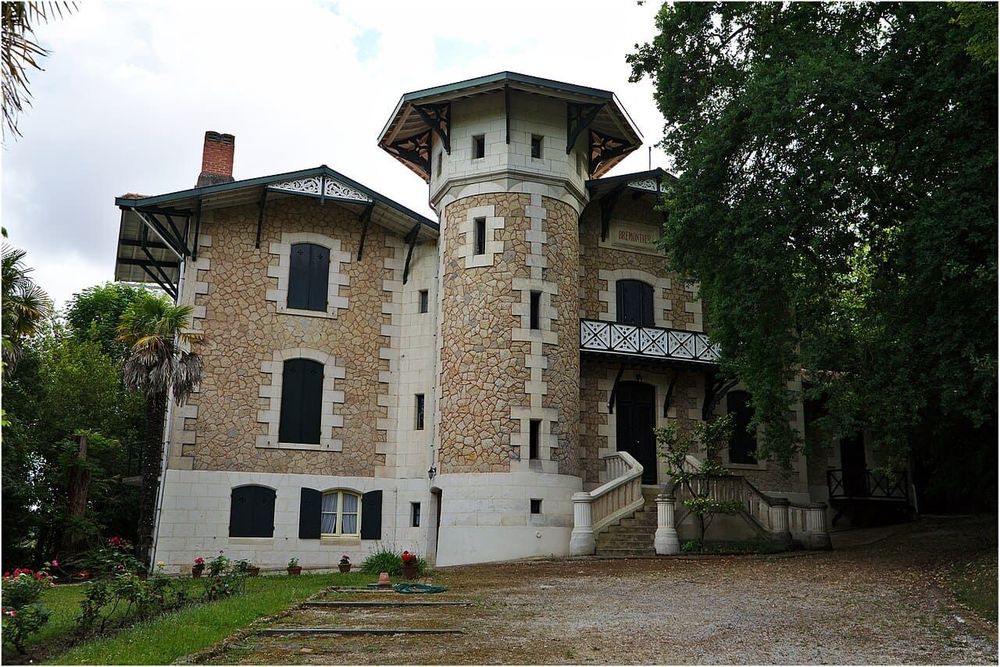
The Villa Brémontier is a charming residence of the Ville d'Hiver of Arcachon, built in 1863. The Arcachon audio-guided tour stops here to evoke this villa that embodies the architectural eclecticism of the district, built for the Railway Company of the Pereire brothers.
This charming villa that you discover perfectly embodies the architectural eclecticism of the Ville d'Hiver. The Villa Brémontier was built in 1863 by Paul Régnauld for the Railway Company, that is to say the company of the Pereire brothers, these great entrepreneurs who developed both the railway and the resort of Arcachon. It is among the first villas built in the Ville d'Hiver, this district then created from scratch on the wooded heights to welcome the spa-goers and the wealthy holidaymakers. Like its neighbours, it stands out by its picturesque and inventive architecture, mixing the influences and the ornaments in the romantic taste of the time, with its balconies, its cut woods and its refined details, in a setting of greenery and pines. Its name pays tribute to Brémontier, the engineer who worked on the fixing of the dunes by the pines in the region, transforming the landscape of the Landes. The Villa Brémontier thus illustrates the history and the charm of the Ville d'Hiver. A fine eclectic residence and a witness of the golden age, the Villa Brémontier is a fine stop of the discovery of Arcachon.
You admire the charming villa built in 1863 by Paul Régnauld for the company of the Pereire brothers, one of the first of the Ville d'Hiver, which embodies the architectural eclecticism of the district with its balconies, its cut woods and its refined details in a setting of greenery, and whose name pays tribute to the engineer Brémontier who fixed the dunes by the pines. The Villa Brémontier is a jewel of Arcachon. It is a fine stop, to be explored on foot.
The Villa Brémontier lies in the Ville d'Hiver of Arcachon, reachable on foot. You admire its façade from the street; it is a residence whose interior access follows its own conditions. You discover it during a walk in the district of the villas.
In 1863, by Paul Régnauld for the Railway Company of the Pereire brothers; it is among the first villas of the Ville d'Hiver and embodies the architectural eclecticism of the district, with its balconies and its refined details; its name pays tribute to the engineer Brémontier who fixed the dunes by the pines.
In the Ville d'Hiver of Arcachon, in France.
Aucun avis pour le moment
