






Walk
Walking Through a Past That Shaped the Future
Saint-Étienne, France
Walk
Walking Through a Past That Shaped the Future
Saint-Étienne, France
4.5 km
Distance
1h45
Durée
15
Audios
Loop
Parcours
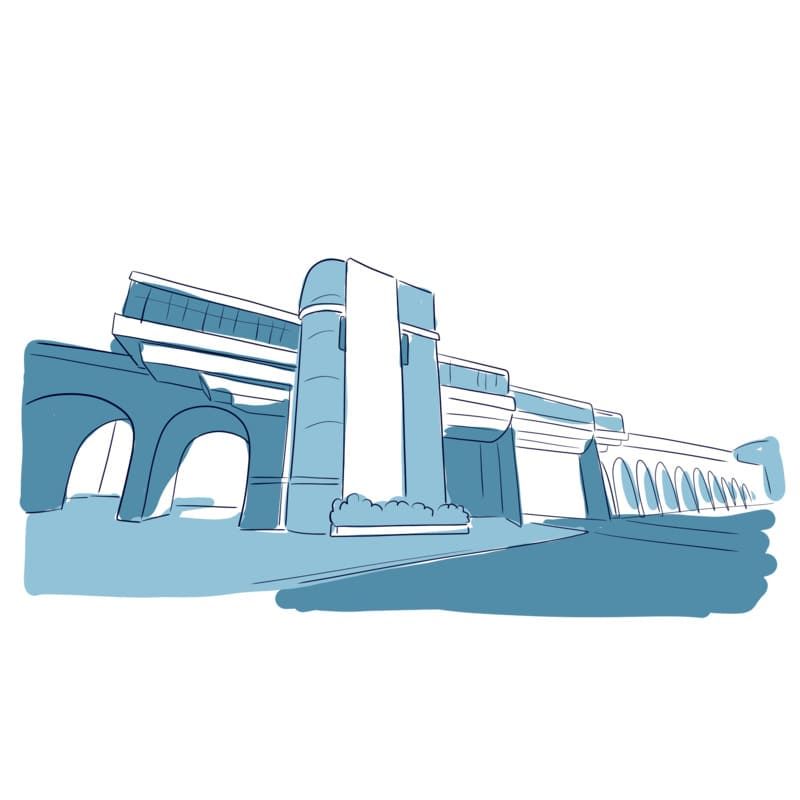
The viaduct of the Carnot station raises its great arches above Saint-Étienne, on the Place Carnot. The Saint-Étienne audio-guided tour stops here to evoke this monumental railway work, witness of the rich network of railways of the town, cradle of the railway in France.
Here we are on the Place Carnot, facing the station of the same name. Saint-Étienne counts five secondary stations in addition to its main station, Châteaucreux. But what attracts the gaze here is these great arches that span the town: it is a railway viaduct, an impressive work of art that allows the trains to cross the urban fabric in height. This viaduct testifies to the central place of the railway in the history of Saint-Étienne. The town was indeed a true cradle of the railway in France: it is here that circulated, at the beginning of the nineteenth century, one of the very first railway lines of the country, linking Saint-Étienne to Andrézieux to transport the coal of the mines towards the Loire. This deep link between the town and the railway is explained by its mining and industrial past, that required to convey enormous quantities of goods. Over time, Saint-Étienne thus covered itself with tracks, stations and railway works, of which this viaduct is a fine example. With its elegant arches that punctuate the urban landscape, it is part of the heritage and the railway identity of the town. A railway work and a witness of the cradle of the railway, the viaduct of the Carnot station is a fine stop of the discovery of Saint-Étienne.
You admire the railway viaduct whose great arches span the town on the Place Carnot, facing the station of the same name, one of the five secondary stations of Saint-Étienne; this work testifies to the past of the town as cradle of the railway in France, where circulated at the beginning of the nineteenth century one of the very first lines of the country, linked to its mining and industrial past. The viaduct of the Carnot station is a witness of the cradle of the railway in Saint-Étienne. It is a fine stop, to be explored on foot.
The viaduct of the Carnot station lies on the Place Carnot, in Saint-Étienne, reachable on foot and by public transport. You admire its arches from the square; it is a railway work in activity. You discover it during a walk in the district.
Because it was a true cradle of the railway in France: it is here that circulated, at the beginning of the nineteenth century, one of the very first railway lines of the country, linking Saint-Étienne to Andrézieux to transport the coal of the mines towards the Loire; this link is explained by the mining and industrial past of the town, of which the viaduct of the Carnot station and its great arches are a witness.
On the Place Carnot, in Saint-Étienne, in France.
Aucun avis pour le moment
