





Walk
A Thousand Years of History Along the Mayenne
Laval, France
Walk
A Thousand Years of History Along the Mayenne
Laval, France
3 km
Distance
1h15
Durée
18
Audios
Loop
Parcours
Shutterstock
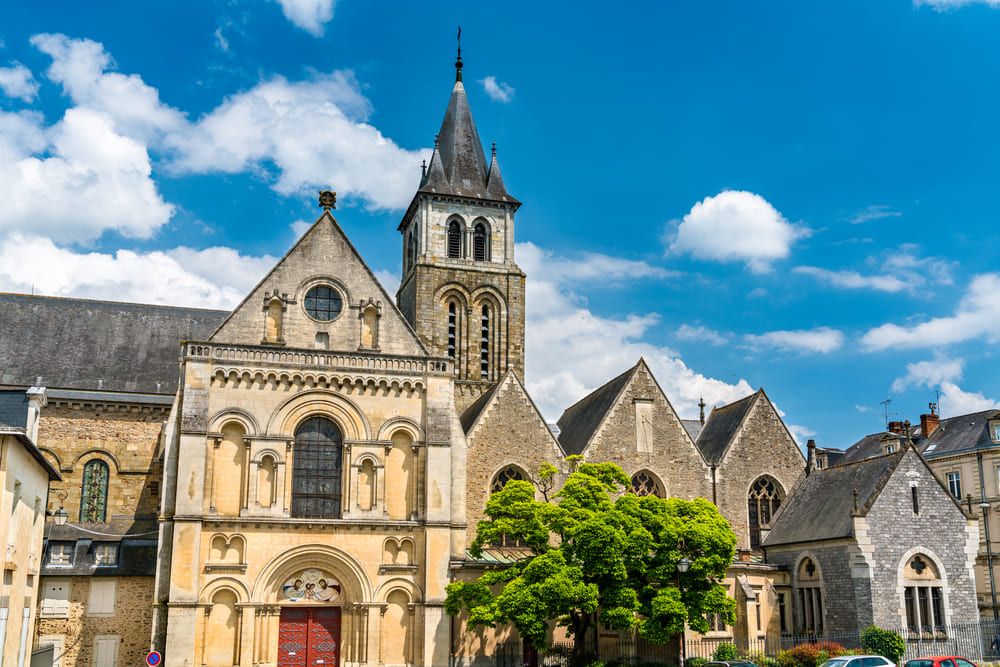
The Cathedral of the Holy Trinity is the major religious building of Laval, with a surprising façade and a rich past. The Laval audio-guided tour stops here, with respect, to evoke this sanctuary transformed and enlarged over the centuries, become a cathedral in the nineteenth century.
You have reached the Cathedral of the Holy Trinity. At first sight, its façade may surprise, because it does not resemble the great Gothic cathedrals that you are used to seeing. And for good reason: it has been transformed and enlarged on numerous occasions over the centuries, mixing the styles and the eras. The origins of the building date back to the Middle Ages, era when it was only a parish church, modest in regard to its current function. Over time, the church was reworked, enlarged and embellished, gaining in scale and in richness, which explains the cohabitation of Romanesque, Gothic and more recent parts. It is only in the nineteenth century, in 1855, when the diocese of Laval was created, that the church was raised to the rank of cathedral, seat of the bishop, and received then developments to be up to its new dignity. Its history makes of it a composite and endearing building, that tells the evolution of the town and its religious life. Inside, in an atmosphere conducive to contemplation, it keeps a rich heritage, furniture, stained-glass windows and works of art. A historic cathedral and a witness of the faith, the Cathedral of the Holy Trinity is discovered with respect.
You admire, with respect, the major religious building of Laval, with a surprising façade because many times transformed and enlarged over the centuries, mixing Romanesque, Gothic and more recent parts; a simple parish church in the Middle Ages, it was only raised to the rank of cathedral in 1855 at the creation of the diocese, and keeps inside a rich heritage, furniture, stained-glass windows and works of art. The Cathedral of the Holy Trinity is a historic sanctuary of Laval. It is a stop to be discovered with respect.
The Cathedral of the Holy Trinity lies in the heart of Laval, reachable on foot. A place of worship, it can be visited with respect for services; entry is generally free, but hours vary. It is best to check them before coming and to respect the sacred character of the place.
Because it does not resemble the usual great Gothic cathedrals: the building has been transformed and enlarged on numerous occasions over the centuries, mixing Romanesque, Gothic and more recent parts; a simple parish church in the Middle Ages, it was only raised to the rank of cathedral in 1855, at the creation of the diocese of Laval.
In the heart of Laval, in France.
Aucun avis pour le moment
